
How to Make an ACT Study Plan in 2026: A Step-by-Step Guide That Actually Works
On this page
- What a Good ACT Study Plan Actually Looks Like (And Why Most Students Skip the Most Important Step)
- Step 1: Understand the Enhanced 2026 ACT Format Before You Plan Anything
- Step 2: Take a Real ACT Diagnostic and Set a Realistic Target Score
- Not sure where to start with your ACT plan?
- How Long Should Your ACT Study Plan Be? Matching Timeline to Score Gap
- Step 3: Calculate Exactly How Many ACT Study Hours You Need
- Step 4: Build Your ACT Weekly Study Schedule Section by Section
- Step 5: Use Spaced Retesting to Confirm ACT Score Gains Before Test Day
- What Is a Good ACT Study Plan for Different Score Bands?
- The Best Way to Study for the ACT: Free Resources vs. Structured Coaching
- Frequently Asked Questions About Making an ACT Study Plan
- Is 2 months enough to study for the ACT?
- How many hours should I study for the ACT?
- What is a good study plan for the ACT test?
- How do I create my own ACT study plan from scratch?
- Is a 1-month ACT study plan realistic?
- How do I study for the ACT for free?
- Is raising an ACT score from 28 to 34 feasible?
- How can parents help without adding pressure?
- Your ACT study plan is ready. The next step is yours.
To make an ACT study plan, follow five steps: learn the enhanced 2026 ACT format, take a full-length diagnostic to find your baseline composite, set a target score and calculate the study hours the gap requires, pick a test date and map weekly sessions by section, then retest at the midpoint to confirm progress. Most students need roughly 40 to 80 hours of focused prep to gain about 3 to 5 composite points, in our coaching. The plan only works if it starts with a real diagnostic, not a guess.
The format and scoring facts below come from ACT.org; the improvement ranges come from our own coaching, and this guide flags which is which every time. The sections move in the order you should actually execute them, starting with why the diagnostic comes before any textbook.

What a Good ACT Study Plan Actually Looks Like (And Why Most Students Skip the Most Important Step)
A good ACT study plan is a dated weekly schedule built backward from your test date and calibrated to the gap between your diagnostic composite and your target composite. Most students skip the diagnostic and jump straight into reviewing content. That's the mistake. Without a baseline you're guessing which section to prioritize, and guessing wastes the hours you have.
Your ACT composite is the number colleges quote. It's the average of your English, Math, and Reading scores, rounded to the nearest whole number on a 1 to 36 scale, per ACT.org. Science and Writing are optional and scored separately; neither one touches your composite. That single fact reshapes how you allocate study time, and it comes back in Step 1.
Here are the five steps, in order:
-
Understand the enhanced 2026 ACT format so your pacing math is correct.
-
Take a full-length diagnostic and set a realistic target score.
-
Calculate the study hours your score gap demands.
-
Build a weekly schedule section by section, weighted toward your weakest area.
-
Use spaced retesting to confirm gains before test day.
For the exact question counts and timings you'll build your plan around, start with our breakdown of the enhanced ACT format: sections, timing, and question counts. In our coaching, students completing roughly 40 to 80 focused hours typically gain about 3 to 5 composite points. It's a pattern we see across score bands, not a promise, and it depends heavily on how those hours are spent.
Step 1: Understand the Enhanced 2026 ACT Format Before You Plan Anything
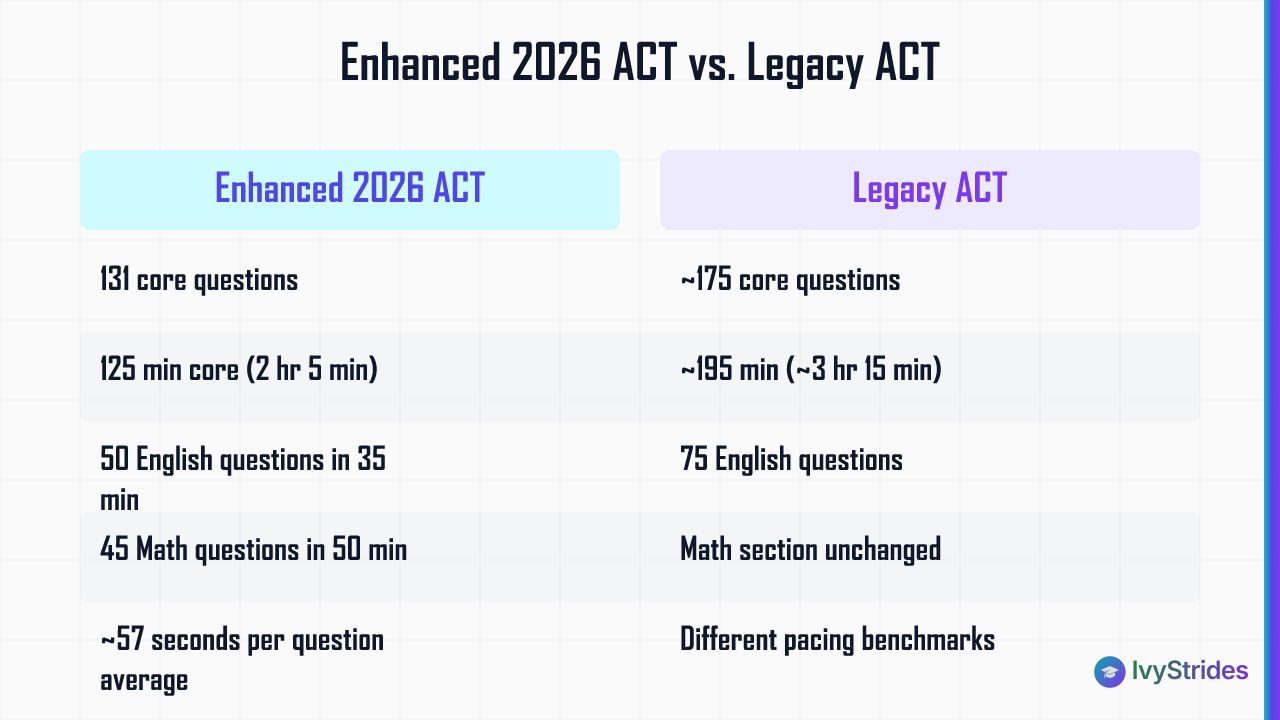
The enhanced 2026 ACT has a shorter core than the test your older siblings took. Before you can schedule prep sessions, you need to know exactly what the enhanced 2026 ACT looks like: 50 English questions in 35 minutes, 45 Math in 50 minutes, and 36 Reading in 40 minutes, for a core total of 131 questions in 125 minutes, per ACT.org. That's the composite. Everything else is optional.
Here is the current structure:
| Section | Questions | Time | Counts toward composite? |
| English | 50 | 35 min | Yes |
| Math | 45 | 50 min | Yes |
| Reading | 36 | 40 min | Yes |
| Core total | 131 | 125 min (2 hr 5 min) | , |
| Science (optional) | 40 | 40 min | No, scored separately + STEM score |
| Writing (optional) | 1 essay | 40 min | No, scored separately |
Across the core, you get about 57 seconds per question on average. That number matters more than it looks. It's your baseline pacing benchmark, and each section runs its own tighter or looser rhythm inside it.
Compare that to the legacy ACT and the shift is real: the enhanced test is roughly 70 minutes shorter and has 44 fewer questions, per ACT.org. If you're using an old prep book that lists 75 English questions or a 2-hour-55-minute runtime, throw out its timing drills. The pacing math is wrong now.
Should you add Science? If you're applying to STEM programs, yes. Science yields a separate score and feeds a STEM score that some engineering and science programs look at, even though it stays out of your composite. Here's a pattern worth knowing: in our coaching, students who sit the optional Science section with zero prep often score roughly 3 to 5 points below their other sections, which can drag a STEM score down without ever touching the composite. Prep it or skip it deliberately. Don't wander in unprepared.
Picking your test date is the first logistical step; check the ACT Test Dates 2026-2027 schedule so you can count backward from your exam and build a realistic calendar. Registration usually closes about five weeks before the test, and a late surcharge of $42 applies after the standard deadline, per ACT.org. For the full rundown of what's new this cycle, see our guide to the enhanced ACT changes for 2026.
Step 2: Take a Real ACT Diagnostic and Set a Realistic Target Score
Your ACT diagnostic is a full-length, timed, official practice test that establishes your baseline composite and shows exactly which sections are dragging it down. This is the step students most want to skip, and skipping it is why so many plans stall. You cannot prioritize a weakness you haven't measured.
Take a free official practice test from ACT.org's free prep page. Sit it under real conditions: timer running, phone off, one 10-minute break, no looking up answers. Then read the section report, not just the composite. A 24 composite built on a 28 English and a 20 Math tells a completely different prep story than a flat 24-24-24.
Now set your target. Anchor it to real data, not a wish. Your target should sit in the 50th-to-75th percentile range of admitted students at your target schools; see ACT score ranges for top colleges for a school-by-school breakdown. Each college publishes this in its Common Data Set, section C9. Land in that middle-50% band and your score stops being a liability in the read.
Your score gap is simply target minus baseline. That gap drives everything else. Here's the rough hours-needed framework we use, framed as typical outcomes in our coaching, not guarantees:
| Score gap | Typical focused hours | Realistic timeline |
| 0 to 2 points | around 20 to 40 hours | 1 month |
| 3 to 4 points | around 40 to 80 hours | 2 months |
| 5+ points | around 80 to 120+ hours | 3 months |
Two honest caveats before you set the number in stone. First, admissions outcomes depend on your full application, not your ACT score alone; a strong essay and transcript carry weight a test score can't replace, and test-optional policies vary by school and year. Second, if you haven't decided between tests yet, that call comes first. If you have not yet decided whether the ACT or the Digital SAT is the better fit for your strengths, that decision should come before you commit to a full ACT study plan.
Beyond admissions, specific composite thresholds unlock automatic merit scholarships at many universities, which makes hitting your target score a financial decision as much as an academic one. Before you lock a target, read our honest take on how much can you improve your ACT realistically so your goal is ambitious and grounded. When you're ready to build volume, our library of the best ACT practice tests in 2026 covers where reliable full-length material comes from.
One more pattern from across our score bands: a 4-point composite gain is typical for students who complete roughly 60 to 80 focused hours, and students starting below a 20 composite often see larger raw gains because foundational content work pays off quickly.
Not sure where to start with your ACT plan?
Book a free 15-minute strategy call. An IvyStrides ACT coach will review your diagnostic score, identify your highest-priority section, and recommend a realistic timeline and prep path for your target schools.
How Long Should Your ACT Study Plan Be? Matching Timeline to Score Gap
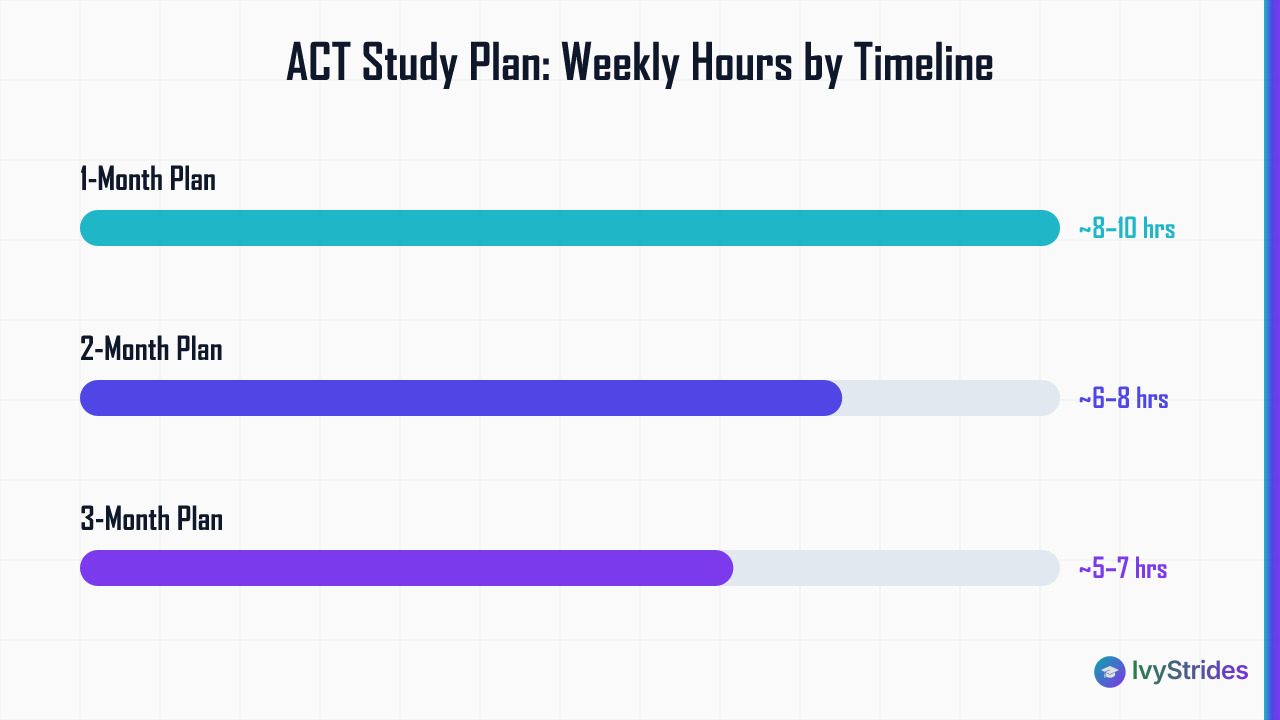
Your ACT study plan length should match your score gap, not the calendar. A 1-2 point gap fits a 1-month plan; a 3-4 point gap fits the 2-month window most students land in; a 5+ point gap or a starting composite below 20 needs 3 months. Picking a timeline shorter than your gap requires is how good students end up disappointed on test day.
Here's how the three common windows break down, framed as typical in our coaching:
| Plan length | Weekly hours | Full-length practice tests | Best for |
| 1 month | around 8 to 10 hrs | 2 to 3 total | 1-2 point gap, retakers who know their weak spots |
| 2 months | around 6 to 8 hrs | 3 to 4 total | 3-4 point gain, the most common effective window |
| 3 months | around 5 to 7 hrs | 4 to 5 total | 5+ point gain, students starting below 20 |
The 2-month plan is the workhorse. It gives you enough runway to fix content gaps and enough repetition to build pacing, without the burnout risk of a compressed sprint. If you have roughly eight weeks before your test date, a week-by-week breakdown of exactly what to cover each session is available in our ACT Prep in 2 Months: week-by-week study plan.
What about two weeks? Be honest with yourself. Two weeks is rarely enough for a meaningful composite gain. You can sharpen pacing and knock out careless-error habits in that window, but you cannot close a content hole in Math trigonometry or ACT English punctuation rules that fast. If your test is two weeks out and your gap is large, the better move is often to register for a later date and build the real plan.
Step 3: Calculate Exactly How Many ACT Study Hours You Need
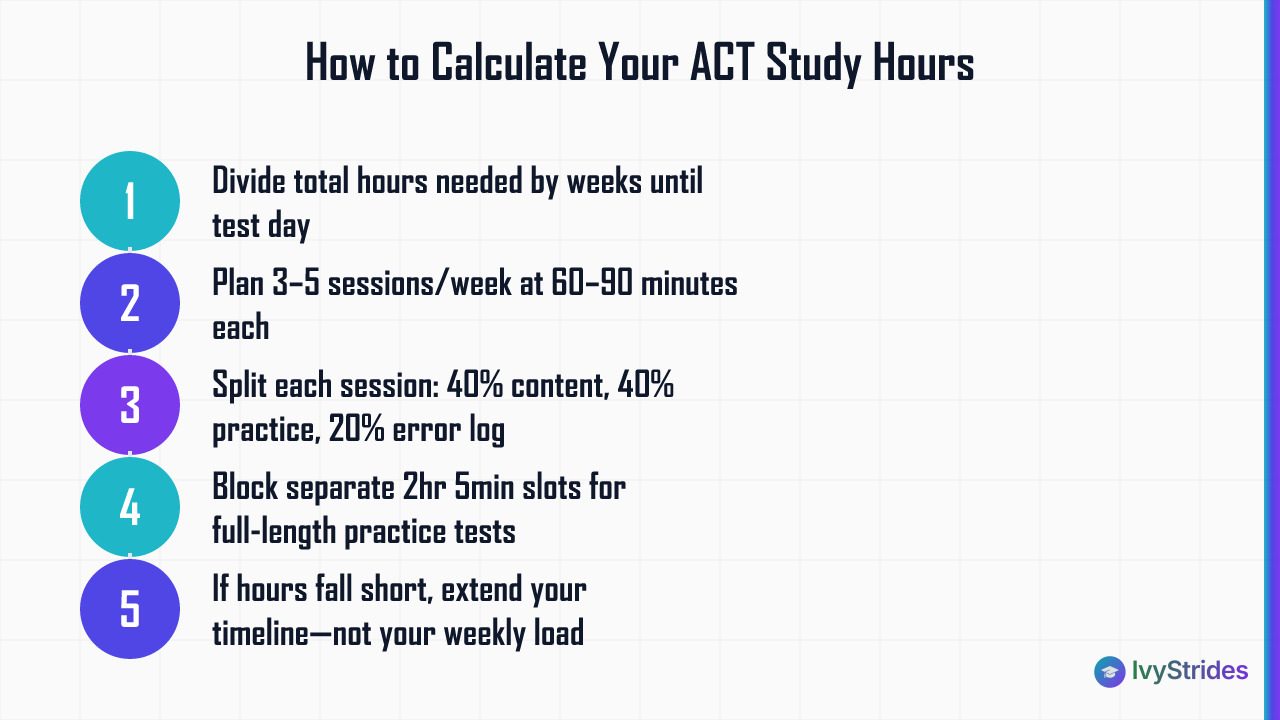
Your weekly ACT study hours equal your total hours needed divided by the weeks until test day. That's the whole formula. If your gap calls for around 60 hours and you have eight weeks, that's roughly 7 to 8 hours a week. Fill in your own numbers from the gap table above and you have your weekly commitment.
Now shape those hours into sessions. Aim for 60 to 90 minutes per session, three to five sessions a week. Longer than 90 minutes and focus erodes; shorter than 60 and you never get into deep timed work. A workable split for each session runs roughly 40% content review, 40% timed practice, 20% error-log review. That last slice is the one students cut first and shouldn't.
Reserve separate, longer blocks for full-length practice tests. Block 2 hours 5 minutes for the core sections, and add 40 minutes if you're sitting the optional Science. Treat those as their own session type, not something you squeeze into a weeknight.
One pattern from our coaching worth stating plainly: students who log fewer than about 4 hours a week rarely see composite gains above a single point. Prep is dose-dependent. If your schedule genuinely can't support the weekly hours your gap requires, the fix is a longer timeline, not the same hours crammed into fewer weeks.
Self-directed students can build real volume from ACT.org's free prep materials, which use actual retired test content. Whether that's enough on its own depends on your gap; we break down exactly when in is free ACT prep enough to raise your composite.
Step 4: Build Your ACT Weekly Study Schedule Section by Section
Your ACT weekly schedule should allocate the most time to the section with your largest point gap, then divide the rest across the other core sections and your error log. This is the operational heart of the plan. The prioritization rule is simple: your diagnostic told you where the points are; put your hours there.
Once your diagnostic flags a weak section, your weekly plan should dedicate the majority of that session to targeted drills in that specific area, whether that is ACT English grammar rules, ACT Math trigonometry, or ACT Science data interpretation. Here's what each core section demands, with its own pacing benchmark drawn from the official timings:
- English (50 questions, 35 minutes, about 42 seconds each): grammar, punctuation, sentence structure, and rhetorical skills. The fastest section by tempo. Rules-based, which means it responds quickly to content review.
- Math (45 questions, 50 minutes, about 67 seconds each): algebra, geometry, and trigonometry. The most content-heavy section, and usually the biggest lever for students below a 26.
- Reading (36 questions, 40 minutes, about 67 seconds each): passage-based comprehension across prose fiction, social science, humanities, and natural science. Pacing and passage strategy matter more than raw reading ability.
- Science, optional (40 questions, 40 minutes, about 60 seconds each): data interpretation, research summaries, and conflicting-viewpoints passages. High-value for STEM applicants through the STEM score.
Say your diagnostic shows Math at 20 and everything else near 26. A sensible week runs three Math sessions, one English, one Reading, with your midpoint retest looming. In our coaching with students in the 20-26 band, the most common reason for a flat score after four weeks is spending equal time on all four sections instead of front-loading the weakest one. Equal time feels fair. It's just inefficient.
The mechanism that makes those sessions count is the error log. After every practice set, record three things for each miss: the question type, why you got it wrong, and the correct approach. Not the correct answer. The approach. Over roughly two weeks a pattern surfaces, and the pattern is your study list. For the tactical depth inside each section, our ACT section-by-section prep: English, Math, Reading, and Science guide goes deeper than any weekly template can.
Consider a common pattern that shows the method working: a student starting near a 24 composite closes a 4-point gap by putting roughly 60% of sessions into ACT Math and using an error log to track a recurring cluster of algebra sign errors. The gain doesn't come from doing more; it comes from doing the right thing repeatedly. For the section-level tactics behind a jump like that, see how to raise your ACT score 4 points.
Step 5: Use Spaced Retesting to Confirm ACT Score Gains Before Test Day
Spaced retesting means taking a second full-length practice test at the midpoint of your plan and a third one to two weeks before the real exam, both under strict timed conditions. This is how you find out whether the plan is actually working while you still have time to change it. A plan you never measure is a plan you're trusting on faith.
Take the midpoint test at the halfway mark. Compare section scores, not just the composite. A flat composite can hide a 3-point Math gain cancelled by a Reading dip, and that's useful information the composite alone erases. In our coaching, students who skip the midpoint practice test are more likely to be surprised by a flat score on test day, when there's no runway left to adjust.
If the score is flat, diagnose the root cause before you panic. Flat scores come from one of three things: a content gap, a pacing problem, or test anxiety. Here's the fastest tell. If you're leaving more than about three questions blank per section, pacing is your primary issue, not knowledge. Fix the clock before you add more content. If you're finishing every section but missing the same question types, it's content, and your error log already knows which ones. Stuck for weeks despite doing the work? Read how to break an ACT score plateau for the deeper diagnostic.
Your final practice test comes one to two weeks out. Treat it as a full dress rehearsal: same wake time, same break structure, same section order. One caveat: a single practice score is a data point, not a guarantee of your real test score. Real conditions add nerves that practice can't fully replicate. If your last two practice tests both cleared your target, proceed with confidence. If they didn't, weigh a later date. Our framework for that call lives in should you retake the ACT. Our ACT practice tests library gives you the retest material to make each checkpoint count.
What Is a Good ACT Study Plan for Different Score Bands?
A good ACT study plan changes shape depending on where you're starting, because the lever that moves a 19 is not the lever that moves a 33. Below-20 students are fighting content gaps; 20-26 students are fighting pacing; 27-32 students are fighting careless errors; 33+ students are fighting for near-perfect execution. Find your band and prep the lever that fits it.
| Score band | Primary lever | Typical hours / timeline (in our coaching) |
| Sub-20 | Foundational content: English grammar, Math algebra | around 80 to 120+ hours, 3+ months |
| 20-26 | Pacing and question-type recognition | around 40 to 80 hours, 2 months |
| 27-32 | Targeted weak-section work, error-log discipline | around 30 to 60 hours |
| 33+ | Near-perfect pacing, zero careless errors, Reading/Science speed | Marginal, execution-driven |
Sub-20: The gains here are the largest and the most satisfying because foundational work pays off fast. Prioritize ACT English mechanics and Math algebra fundamentals before you touch pacing. You can't pace questions you don't yet know how to solve.
20-26: This is the most common band and the most responsive. The content is largely there; the clock is the enemy. Timed drills and question-type recognition are your primary work. A 40-to-80-hour plan over roughly two months is the typical effective window.
27-32: Fine margins now. A 4-point climb into the 31-36 range is achievable for students completing focused, section-specialist work, and it comes almost entirely from error-log discipline: hunting the two or three careless patterns that cost you real points. See how to improve your ACT score for the drill structure.
33+: Gains here require near-perfect execution, usually in Reading and Science speed, with zero careless errors in your two strongest sections. The path is narrow and specific; we map it in how to score 34+ on the ACT.
The Best Way to Study for the ACT: Free Resources vs. Structured Coaching
The best way to study for the ACT combines free official materials for volume with structured feedback that catches what you can't see in your own work. Free ACT prep from ACT.org gives you real, retired test content, which is the gold standard for practice. Where it stops is personalization.
Free resources can't read your error log and tell you that your Math misses are all sign errors, not concept gaps. They can't watch your pacing and flag that you're spending 90 seconds on early English questions you should clear in 25. And they can't coach a specific section weakness the way a section specialist can. Free prep is genuinely enough for one profile: students within about 1 to 2 points of their target who need volume, not new instruction.
Structured coaching earns its place when the gap is wide or the weakness is specific. In our coaching, students who pair free official materials with section-specialist feedback tend to outpace self-study-only students at the same starting band. Students carrying a 4+ point gap, or a Science score sitting below 20 while their composite is higher, are the ones who typically see the clearest return from targeted 1-on-1 work. If you want the honest full comparison, we wrote is free ACT prep enough without spin.
We built IvyStrides on section-specialist coaching: one coach for ACT Math, another for English and Reading, another for Science, rather than one generalist stretched across all four. For the full coaching structure, start with our ACT prep coaching overview. For a self-directed walkthrough of the whole prep arc, how to study for the ACT: a coach's complete prep plan puts it all in one place.
Frequently Asked Questions About Making an ACT Study Plan
Is 2 months enough to study for the ACT?
Yes, two months is enough for most students targeting a 3-4 point composite gain. Plan for roughly 6 to 8 hours a week, take three to four full-length practice tests, and put the majority of your sessions into your two weakest sections. Students starting below a 20 composite typically need closer to three months for the same jump.
How many hours should I study for the ACT?
Most students need roughly 40 to 80 hours of focused prep to gain about 3 to 5 composite points, based on our coaching across score bands. A 1-2 point gap may take only 20 to 40 hours; a 5+ point gap usually runs 80 to 120 hours or more. Divide your total by the weeks you have to find your weekly commitment.
What is a good study plan for the ACT test?
A good plan opens with a full-length diagnostic, sets a target from your colleges' Common Data Sets, allocates weekly hours by section weakness, and includes a midpoint practice test to confirm progress. Sessions should blend content review, timed practice, and error-log analysis. Passive re-reading of notes does almost nothing for a composite.
How do I create my own ACT study plan from scratch?
Take an official practice test from ACT.org for your baseline composite. Subtract it from your target to find your gap. Use the hours framework, roughly 15 to 20 hours per composite point, to set a weekly schedule. Assign each session to a specific section, and retest at the halfway mark.
Is a 1-month ACT study plan realistic?
A 1-month plan is realistic for students with a 1-2 point gap or retakers who already know their weak spots. It needs around 8 to 10 hours a week and at least two full-length practice tests. Students carrying a 4+ point gap or real content holes in Math or English will need more runway to see a meaningful gain.
How do I study for the ACT for free?
ACT.org provides free official practice tests and prep materials using real test content. Use them for full-length timed practice, and add free question banks for your weakest section. Free prep works best once you already have a diagnostic-driven plan; without that structure, free resources alone rarely produce consistent gains.
Is raising an ACT score from 28 to 34 feasible?
A 6-point climb from 28 to 34 is possible but demanding, typically requiring around 80 to 120+ hours of section-specific prep over three months in our coaching with students at this band. The work is mostly error-log discipline and pacing precision. Students who reach 34 usually have near-zero careless errors in their two strongest sections.
How can parents help without adding pressure?
Parents move the needle most by handling logistics, protecting study time, and funding the right resources, not by quizzing content. For a concrete list of what helps and what backfires, see how can parents support ACT prep.
You now have every piece: the current format, a diagnostic-first baseline, an hours framework tied to your gap, a section-weighted weekly schedule, and retesting checkpoints to prove it's working. Build the calendar this week, while your test date is still far enough away to matter.
Your ACT study plan is ready. The next step is yours.
If you want a plan built around your actual diagnostic score, your target schools, and your schedule, talk to an IvyStrides ACT specialist. The first call is free, and you will leave with a concrete next step.

Award-winning author (South Asian Book Award) and graduate of BITS Pilani and UCLA Luskin School of Public Affairs. Brings a published writer's eye to Common App essays and grammatical precision to SAT and ACT R&W instruction.