
How to Raise your ACT Score 4 Points in 2026: A Step-by-Step Guide That Actually Works
On this page
- What a 4-Point ACT Gain Looks Like at Your Score Band
- Step 1: Take a Real Diagnostic Test Before You Study Anything
- Step 2: Find Your Two Highest-Yield Sections (Not All Four)
- Why Your Score Is Not Moving Yet (And What to Fix First)
- Step 3: Build an 8-Week Study Plan Around Your Two Target Sections
- Section-by-Section Tactics: The Fastest Grammar Tips, Math Moves, and Science Shortcuts for ACT 2026
- ACT English
- ACT Math
- ACT Reading
- ACT Science
- What a 4-Point ACT Gain Actually Means for Your College List
- When to Retake the ACT and When to Stop
- FAQ
- Is a 26 a bad ACT score?
- Is 32 out of 36 a good ACT score?
- Can you realistically raise your ACT score in one month?
- How many hours does it take to raise your ACT score by 4 points?
- Should I retake the ACT if I got a 27?
- What is the lowest ACT score considered "good"?
Raising your ACT score by 4 points typically takes roughly 8 to 12 weeks of focused prep and roughly 40 to 80 hours of study, depending on your starting score. The most reliable path: take a full-length official practice test to set your baseline, identify the one or two sections where you're losing the most points, and work those sections with targeted drills and timed retesting. Most students see the fastest gains in ACT English and ACT Science, because both reward learnable rules and data-reading speed more than raw content knowledge.
The score, format, and percentile figures below come from the official ACT program materials. The hour and timeline ranges are patterns we see across IvyStrides students, hedged as such. The next section starts where every real plan starts: understanding what a 4-point move actually means at your specific score band.

What a 4-Point ACT Gain Looks Like at Your Score Band
The ACT composite is scored on a 1-36 scale, averaged from four section scores (English, Math, Reading, Science), each also scored 1-36. The national average composite sits near 20. That single fact reframes the conversation: a 4-point gain from 22 to 26 is not the same task as a 4-point gain from 28 to 32.
Here's a rough score-band map most families find useful:
- 18-20: near the national average; competitive at open-admission and many regional colleges.
- 20-23: competitive at mid-tier public and private universities.
- 24-28: strong for selective colleges; a 26 sits at around the 82nd percentile.
- 29-33: competitive at highly selective schools. A 32 lands around the 96th-97th percentile.
- 34-36: competitive at elite schools where medians run 34-36.
So is a 26 "bad"? It's above the national average, but below the median at most selective colleges. Is a 32 "good"? At most selective universities, yes. At ultra-selective schools with median composites of 34-36 per act.org, a 32 sits below the middle 50 percent, which is why many students in that band still choose to retake.
Consider what a 4-point move actually buys you. A student going from 26 to 30 shifts from around the 82nd percentile to roughly the 93rd, per act.org percentile data. That's not a cosmetic bump. It's a different admissions conversation.
Most major universities also superscore the ACT, taking your highest section scores across multiple sittings and rebuilding the composite. This matters for retake strategy, which we'll come back to. If you're still weighing whether the ACT or SAT is the better fit for your strengths, see our full comparison of ACT vs SAT difficulty before committing to either prep plan.
Step 1: Take a Real Diagnostic Test Before You Study Anything

Photo by Andy Barbour on Pexels
This is the non-negotiable first step. Before you buy a prep book, watch a video, or drill a single practice problem, sit for a full-length, timed, official practice test. Everything else is guesswork without that baseline score.
Here's why. Your composite is the average of four section scores. Score 24 English, 26 Math, 22 Reading, 24 Science, and your composite is 24. Your fastest path to 28 is not "study more." It's Reading, then Science, in that order. Without the section breakdown, you'd probably study whatever feels hardest, which is rarely where the points actually live.
Use our act practice test online library for full-length timed sittings, and confirm the current format at act.org before you start. The ACT format has changed for 2025-2026 test dates; before you build your study plan, confirm which version you'll be sitting by reading our full breakdown of what the Enhanced ACT is and how it differs from the previous format. The optional Science section and updated timing are the two changes most likely to affect how you prep, so verify both against act.org before choosing materials.
In IvyStrides 1-on-1 ACT coaching, the diagnostic is always a full-length timed test, not a topic quiz. Topic quizzes tell you what content is unfamiliar. Full tests tell you what content is unfamiliar and what pacing does to you under a 35-minute clock. Those are different problems with different fixes.
Step 2: Find Your Two Highest-Yield Sections (Not All Four)
A 4-point composite gain requires roughly 4 points across the average of four sections. In practice, that usually means gaining about 8 points in two sections and holding steady in the other two. Trying to gain a point everywhere is the slowest possible route.
Look at your diagnostic and rank your four section scores. The bottom two are your targets. For most students, the "easiest to move" ranking looks like this.
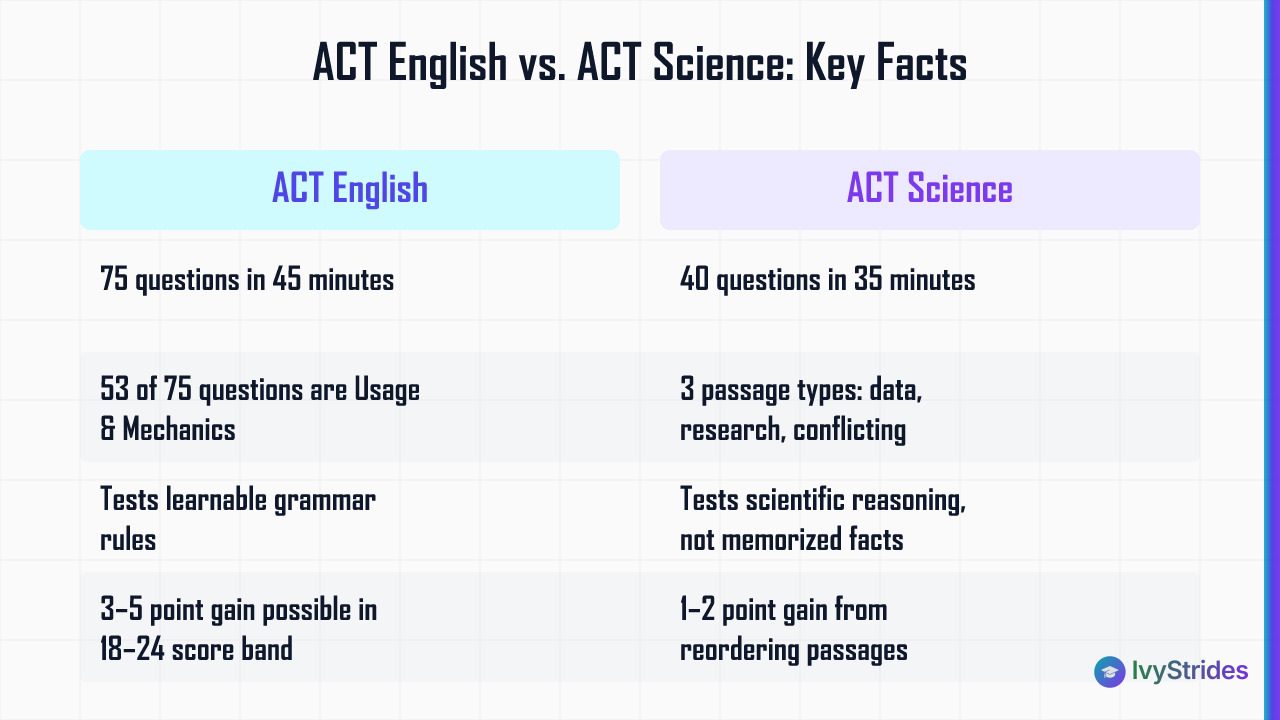
ACT English is almost always the highest-yield section for students below a 28 English. It's 75 questions in 45 minutes, and roughly 53 of those questions are Usage and Mechanics: punctuation, grammar, sentence structure, per act.org. These are learnable rules. Comma splices, subject-verb agreement, pronoun-antecedent agreement, and apostrophe usage alone can recover roughly 3 to 5 points for students in the 18-24 English band, in our coaching. That's not a trick. It's just where the questions are.
ACT Science is 40 questions in 35 minutes across three passage types: data representation, research summaries, and conflicting viewpoints. It tests scientific reasoning, not memorized biology or chemistry facts. Most of the score comes from reading tables and charts quickly. The conflicting viewpoints passage is the slowest and most content-heavy; students short on time often gain roughly 1 to 2 points simply by attempting it last, in our coaching.
ACT Reading is a pacing problem for most students. 40 questions in 35 minutes across four passages leaves you roughly 8 to 9 minutes per passage. The content isn't harder than what you read in AP English; the clock is what kills scores.
ACT Math is 60 questions in 60 minutes covering pre-algebra through trigonometry. Calculator permitted throughout, no reference sheet. Pre-algebra and elementary algebra appear most often, which means a student who nails those two categories can recover meaningful points without touching trigonometry at all.
Build an error log as you review. For each wrong answer, tag it as content gap, pacing, or careless mistake. This is the single most useful diagnostic exercise you'll do; download our sat mistake tracker template and adapt it for ACT sections. Without categorization, you'll re-review the same errors and re-make them.
Why Your Score Is Not Moving Yet (And What to Fix First)
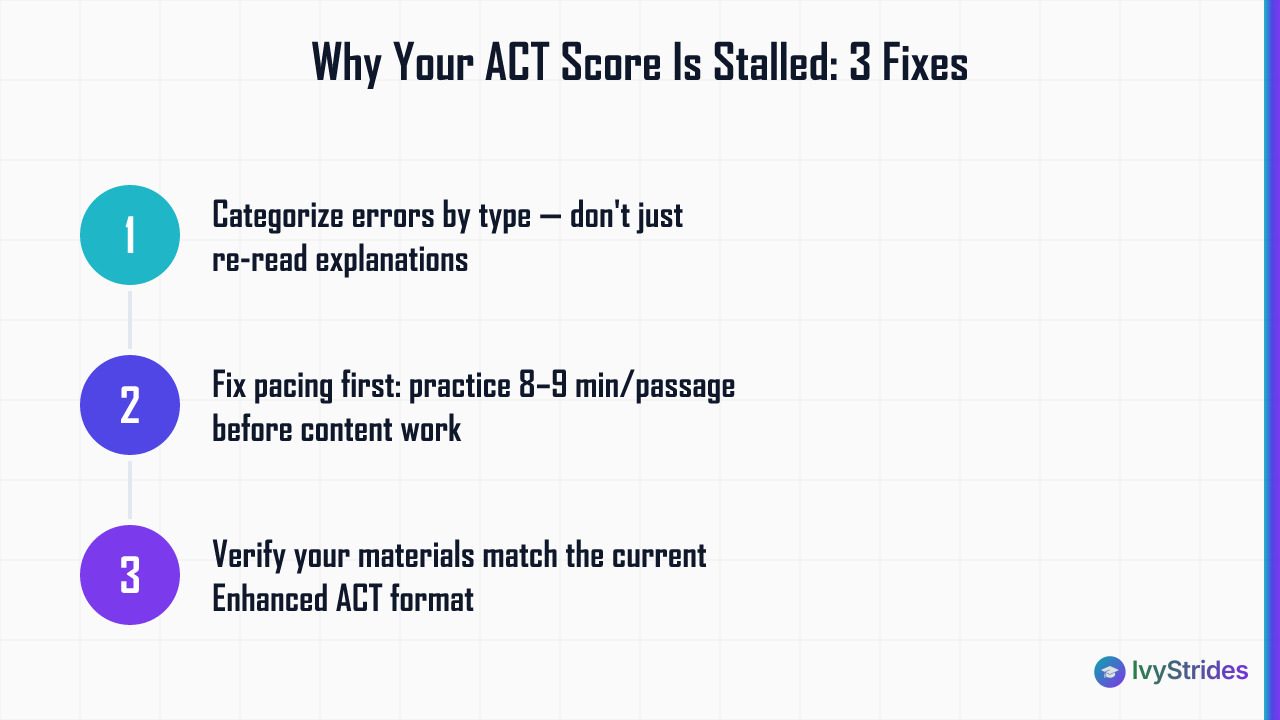
Stalled after a few weeks of studying? One of three things is almost certainly happening.
One: you're re-reading, not error-analyzing. In our coaching with students in the 22-26 range, the most common reason for a stalled score is reviewing wrong answers without categorizing the error type. Reading the answer explanation and nodding along is not studying. Writing down why you missed it (didn't know the rule, ran out of time, misread the question), then drilling that specific category, is studying.
Two: your pacing is the actual problem, not your content. Students who run out of time on ACT Reading often gain roughly 2 to 3 points just by practicing the 8-to-9-minute per passage rule on timed drills, before touching any content weakness, in our coaching. If you're omitting six or more questions per section, no amount of content study will fix your score. Fix pacing first.
Three: your materials may be outdated. Prep books written for the pre-2025 ACT may include question types or timing that no longer match the Enhanced ACT. Verify against the current format at act.org before trusting any third-party book.
If you've already been studying for more than one full test cycle without movement, this is a plateau, not a warmup problem. Our guide on how to break an ACT score plateau covers the deeper reasons scores stall and what to do differently. For the broader framework on section-by-section movement, our overview of how to improve your ACT score is a good companion.
Honestly, this is the point in the process where most students realize they need a second set of eyes on their plan. That's what the strategy call is for.
Step 3: Build an 8-Week Study Plan Around Your Two Target Sections
Here's the framework we use in 1-on-1 ACT prep. It assumes you have roughly 8 to 12 weeks before your next test date.
Hour budget by starting score band. In our coaching, students starting in the 22-26 range typically need roughly 40 to 60 hours of focused prep over about 8 to 10 weeks to gain 4 composite points. Students starting in the 27-30 range typically need roughly 60 to 80 hours over about 10 to 12 weeks, because at higher bands you're chasing fewer, harder errors. The math isn't linear.
Do the arithmetic yourself. Roughly 60 hours across 8 weeks is about 7.5 hours per week: three 90-minute sessions plus one full-length test every two weeks. That's a real commitment, not an "I'll do some questions when I feel like it" pace.
Weekly structure. Three sessions per week, 60 to 90 minutes each:
- Session 1: content drills on your weakest section's weakest sub-skill (comma rules for English, data representation for Science, and so on).
- Session 2: timed section practice at real ACT pacing (45 minutes for English, 60 for Math, 35 for Reading, 35 for Science).
- Session 3: error log review from the past two sessions. Recategorize errors. Redo missed problems from scratch, not from memory.
Full-length practice tests at week 4 and week 8. These are your spaced retesting checkpoints. One full test every four weeks lets you measure real composite movement under actual test conditions and adjust the plan for the second half of the cycle. Register for your official test date at act.org; registration deadlines typically close roughly five weeks before each administration, so check the current dates there.
The self-directed version of this plan works for disciplined students. The coached version works for students who need someone else holding the calendar and the error log. Our ACT prep overview walks through the fuller structure of a coached plan.
Section-by-Section Tactics: The Fastest Grammar Tips, Math Moves, and Science Shortcuts for ACT 2026
Most guides go generic here. Let's not.
ACT English
Master these four rule categories first, in this order:
-
Comma rules. Comma splices (two independent clauses joined by only a comma) show up on nearly every ACT English section. So do serial commas, appositive commas, and comma-before-conjunction rules. If you can answer "should there be a comma here?" correctly, you've recovered a large share of your English deficit.
-
Subject-verb agreement. The ACT hides the subject behind prepositional phrases. "The box of apples (is/are) on the table." Cross out the prepositional phrase; the verb agrees with "box."
-
Pronoun-antecedent agreement. Singular pronoun for singular noun. The ACT loves collective nouns (team, group, company) that take singular pronouns.
-
Apostrophes. Its vs. it's. Possessive vs. plural. Trivial once learned, still tested on every form.
The rhetorical skills questions (roughly 22 of 75) test transitions, sentence order, and passage-level logic. You learn these through repeated exposure, not a memorized rule.
ACT Math
Rank your errors by topic. Pre-algebra (fractions, percents, ratios) and elementary algebra (linear equations, exponents) are the two most frequent question categories. A student who owns those two can often score above 28 without touching trigonometry.
The pacing logic: 60 questions in 60 minutes averages one minute each, but questions 1-30 should take you roughly 30 to 40 seconds, and questions 45-60 can take about 90 seconds. Spend equal time on every question and you're bleeding easy points at the front to stare at hard geometry at the back.
Use the calculator, but don't over-rely on it. Setting up the equation correctly is where the points are won.
ACT Reading
The 8-to-9-minute per passage rule is the whole game. On timed drills, set a timer for 8:30 and force yourself to move on. Students who practice this pacing on five timed drills typically reduce their omit count by roughly 4 to 6 questions per test, in our coaching.
Passage order matters. The four passages appear in a fixed order: literary narrative, social science, humanities, natural science. If literary narrative is your weakest, do it last. Nothing says you have to answer them in order.
ACT Science
Three passage types, in order of speed:
- Data representation (fastest): read the chart, answer the question. Skip the intro paragraph unless you need it.
- Research summaries (medium): skim the experimental setup, then jump to the question and locate the specific data.
- Conflicting viewpoints (slowest): two or more scientists disagree. Read enough to identify each claim, then answer.
Short on time on test day? Attempt conflicting viewpoints last. Students who do this typically gain roughly 1 to 2 Science points without any additional content study, in our coaching. Timing and question counts are confirmed at act.org.
For the broader test-choice conversation, our comparison of the act vs sat formats explains why some students see faster gains on one test than the other.
What a 4-Point ACT Gain Actually Means for Your College List
Percentiles matter, but percentiles don't get you admitted. Here's the honest framing.
A move from 26 to 30 shifts you from roughly the 82nd to the 93rd percentile nationally, per act.org percentile data. That materially changes your competitiveness at selective colleges. A move from 30 to 34 shifts you into roughly the top 1 to 2 percent, which opens conversations at highly selective schools where 30 would have put you below the median.
But a 32 is still below the middle 50 percent at MIT, Harvard, and Caltech, where medians run 34-36. So "good score" is entirely relative to the target list. Pull the Common Data Set for each of your target schools before you decide whether your current score is competitive.
Test-optional is not the same as test-blind. Test-optional policies vary by school and year. At many test-optional schools, a submitted score still meaningfully helps when it's at or above the school's median. Check each school's current policy before deciding not to submit.
A stronger ACT score strengthens your application, but it works alongside your essays, not instead of them. If you're also working on your Common App personal statement, our common app essay tutor team can help you develop both in parallel. Students preparing for AP exams alongside ACT prep benefit from treating both as one connected academic strategy rather than two separate workloads. And if you're a sophomore or junior thinking about the PSAT/NMSQT and the National Merit pathway, the same diagnostic-first approach applies; see our guide on how does National Merit work for the full picture.
For the broader question of how much test scores influence admissions decisions in the current policy landscape, our analysis of does the SAT matter for college admission applies equally to the ACT.
When to Retake the ACT and When to Stop
ACT, Inc. allows up to 12 attempts, and most colleges superscore across sittings. So the retake decision isn't about whether you can. It's about whether the marginal point is worth the time it costs.
Rough guidance:
Score 22-26: a retake almost always makes sense if you have 8 or more weeks and a fresh diagnostic showing fixable gaps. This is the band with the fastest gains and the biggest admissions impact per point.
Score 27-29: retake if your target schools have medians of 30 or above and your diagnostic shows clear pacing or content fixes. If your diagnostic looks clean and your errors are scattered and random, you may be at your natural ceiling for the current prep cycle.
Score 30-33: retake if a specific target school's median is 33 or higher. Otherwise, the marginal point may be worth less than time spent on essays or AP prep.
Score 34+: usually not worth a retake. The admissions benefit of moving from 34 to 35 is small at almost every school. Invest the time elsewhere.
In our coaching, students who retake without a new diagnostic and a revised study plan rarely improve by more than 1 point. "Just take it again" is not a strategy. If you're planning a retake, treat it as a new prep cycle: fresh diagnostic, fresh section-targeting, fresh weekly plan.
For a coached retake cycle with a section-specialist tutor for each area, our 1-on-1 ACT prep program is built around this exact structure. You can also meet the tutors who work with students at each score band. To learn more about our approach, read about IvyStrides.
FAQ
Is a 26 a bad ACT score?
A 26 is above the national average of roughly 20 and sits around the 82nd percentile nationally, per act.org. It's competitive at many mid-tier and some selective colleges, but below the median at highly selective schools. Whether it's "bad" depends entirely on your target list. For a student aiming at a strong state flagship, a 26 is a solid application asset. For a student aiming at schools with median composites of 32 or higher, it's a score worth improving.
Is 32 out of 36 a good ACT score?
A 32 is an excellent score, placing you around the 96th-97th percentile nationally per act.org percentile data. It's competitive at most selective universities. At ultra-selective schools where median composites run 34-36, a 32 sits below the middle 50 percent, so the retake decision depends on the specific college list and how much prep time is realistically available.
Can you realistically raise your ACT score in one month?
A 2-to-3-point gain in one month is realistic for students who start from a real diagnostic, focus exclusively on their one or two weakest sections, and complete at least two full-length timed practice tests during the month. A 4-point gain in one month is possible but demands very focused daily study of roughly 60 to 90 minutes. Most students achieve a 4-point gain more reliably over about 8 to 10 weeks.
How many hours does it take to raise your ACT score by 4 points?
In our coaching with students at the 22-26 starting range, a 4-point gain typically requires roughly 40 to 60 hours of targeted prep. Students starting at 27-30 typically need roughly 60 to 80 hours, because each additional point at higher bands requires eliminating harder, less frequent error types. Hours of passive re-reading don't count; only active error analysis and timed practice move the score.
Should I retake the ACT if I got a 27?
A 27 is a solid score but below the median at most selective colleges. If your target schools have median ACT scores of 30 or higher, a retake is worth considering, provided you have at least 8 weeks before the next test date and a diagnostic showing fixable gaps. If your target schools are test-optional and your application is strong in other areas, that time may be better spent on essays or AP prep.
What is the lowest ACT score considered "good"?
There's no single answer, because "good" is relative to the target college. Broadly: 18-20 is competitive at open-admission and many regional colleges; 20-23 is competitive at mid-tier schools; 24-28 is strong for selective colleges; 29-33 is competitive at highly selective schools; 34-36 is the range at elite schools. The national average is roughly 20, per act.org.
A 4-point ACT gain is not luck. It's a diagnostic, two targeted sections, a plan of roughly 8 to 12 weeks, and disciplined error analysis. The students who execute those steps see the gains. The ones who skip the diagnostic and study everything equally usually don't.

Award-winning author (South Asian Book Award) and graduate of BITS Pilani and UCLA Luskin School of Public Affairs. Brings a published writer's eye to Common App essays and grammatical precision to SAT and ACT R&W instruction.