
The ACT Score Ranges for Top Colleges in 2026: What to Look For and How to Choose Wisely

On this page
- What the Middle-50% ACT Range Actually Means (and Why It Matters More Than an Average)
- ACT Score Ranges by College Tier: The Numbers You Actually Need
- ACT Score Percentiles: Where Does Your Composite Actually Rank?
- Is a 34 ACT Competitive at Ivy League Schools? What the Data Shows
- What Is a Good ACT Score for Top Universities? A Tier-by-Tier Answer
- Test-Optional in 2026: When Submitting Your ACT Score Still Matters
- ACT vs. SAT: Which Score Should You Submit to Top Colleges?
- How to Set Your Target ACT Score and Build a Realistic Prep Plan
- FAQ
- Is a 28 ACT score competitive at selective colleges?
- How rare is a 31 on the ACT, and is it good enough for top schools?
- Should I retake the ACT if my score is below the 25th percentile at my target school?
- Do top colleges look at individual ACT section scores, or only the composite?
- Is a 29 ACT or a 1350 SAT a stronger score to submit?
For most top colleges, the ACT composite middle-50% range for admitted students falls between 33 and 36. Ivy League and peer elite schools such as Harvard, Princeton, Yale, MIT, and Columbia typically report a 34-36 band. Highly selective top-25 universities including Duke, Northwestern, Vanderbilt, and Rice cluster in the 34-36 range as well, while Notre Dame and Cornell sit closer to 33-36. Selective national universities outside the top 25 generally look for composites in the roughly 28-33 range. These figures come from Common Data Set reports and reflect the 25th-to-75th percentile of recently admitted classes.
Those numbers are self-reported by each college through its annual Common Data Set, the most reliable public source for admitted-class score data. The harder question is what a range like 34-36 actually means for your application, and how many points you'd need to gain to move into contention. The rest of this article walks through that tier by tier, with national percentile context and a plan for closing the gap.
What the Middle-50% ACT Range Actually Means (and Why It Matters More Than an Average)
Colleges rarely publish a single average ACT score. They publish a band. When Yale reports a middle-50% range of 34-36, it's saying this: 25% of admitted students scored below 34, 50% scored between 34 and 36, and 25% scored at the very top. The 34 is roughly the 25th percentile cutoff; the 36 is the 75th. Everything in between is where the bulk of the admitted class lands.
Why does the band matter more than an average? Because an average hides the spread. A school could report an average of 34 whether its admitted students clustered tightly around it or spread from 30 to 36. The middle-50% range tells you the actual competitive territory.
Here's the part most students misread. Scoring below roughly the 25th percentile does not mean automatic rejection; it means the bar rises on every other part of your application. Selective colleges practice holistic admissions, so a composite under that mark puts more weight on GPA, course rigor, essays, and extracurriculars. It's a heavier lift, not a closed door. Scoring above the 75th percentile doesn't guarantee admission either: at the most selective schools, many applicants above that line still get denied.
One caveat before the numbers. Common Data Set figures are self-reported annually, and the ranges below reflect the 2023-2024 admitted class. Verify each school's current CDS before applying, since bands shift year to year. If you're still weighing which test to prep for, our breakdown of ACT vs SAT difficulty covers how to pick the format that plays to your strengths.
ACT Score Ranges by College Tier: The Numbers You Actually Need

All ranges below are middle-50% ACT composites from each school's Common Data Set for the 2023-2024 admitted class. Treat them as competitive territory, not cutoffs.
Ivy League and peer elites (34-36 band):
| School | Middle-50% ACT |
| Harvard | 34-36 |
| Princeton | 34-36 |
| Yale | 34-36 |
| MIT | 35-36 |
| Columbia | 34-36 |
| Penn | 34-36 |
| Dartmouth | 34-36 |
| Brown | 34-36 |
| Cornell | 33-36 |
Highly selective top-25 national universities (33-36 band):
| School | Middle-50% ACT |
| Duke | 34-36 |
| Northwestern | 34-36 |
| Vanderbilt | 34-36 |
| Rice | 34-36 |
| Johns Hopkins | 34-36 |
| WashU | 34-36 |
| Notre Dame | 33-35 |
Look closely at the top tier. At most Ivies roughly the 75th percentile is a 36, which means a 35, an objectively excellent score, still places a student in the lower half of the admitted distribution there. That single fact reshapes how students at the 34-35 level should think about a retake.
Below the top 25, the picture opens up. Selective national universities, roughly the top-50 tier, generally report bands in the 28-33 range. Broadly accessible four-year colleges typically look for 20-27.
One note on context. A strong ACT carries more weight next to a rigorous AP course load, because selective colleges read both signals together. A 34 with three AP exams scored 5 reads differently from a 34 with no advanced coursework. For AP credit specifics, the AP Program documentation is the source of record; policies vary by college.
If a specific school is on your list, read its full profile, such as Should You Apply to Johns Hopkins University? Stats and Fit or Should You Apply to Brown University? Deadlines and Odds 2026.
ACT Score Percentiles: Where Does Your Composite Actually Rank?
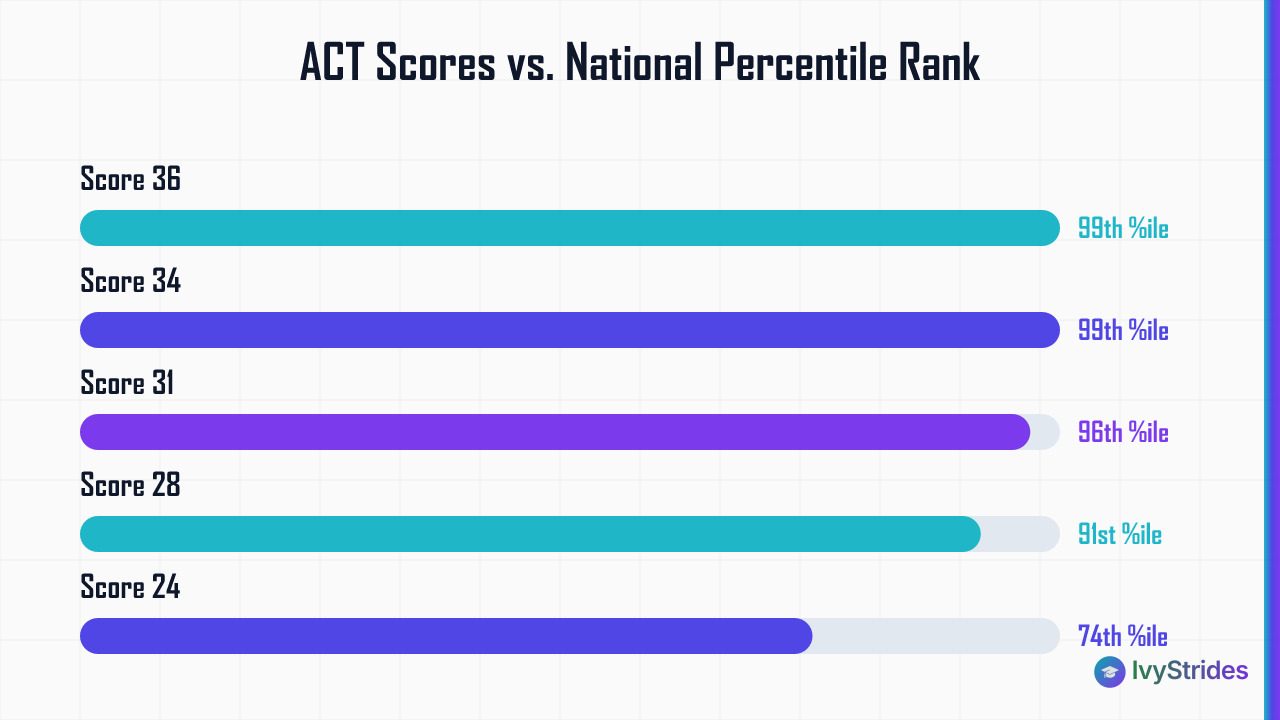
College middle-50% bands tell you where you stand against admitted students at elite schools. National percentiles tell you something different: where you stand against every student who took the ACT. A score that looks modest against Harvard's admitted class can still be extraordinary nationally.
The national average composite is around 19.4, per ACT, Inc. national norms data. Key benchmarks from that same source:
- A 36: 99th percentile or higher, top of the scale.
- A 34: roughly the 99th percentile, the top 1% of all test-takers.
- A 31: approximately the 96th percentile, meaning roughly 96 out of 100 test-takers scored lower.
- A 30: around the 94th-95th percentile.
- A 29: approximately the 93rd percentile.
- A 28: roughly the 91st percentile.
- A 24: near the 74th percentile.
- A 20: close to the 49th percentile, right around the national midpoint.
A 29 puts you ahead of roughly 93% of the country. The reason it can feel inadequate is context collapse: if your entire frame of reference is the 34-36 band at eight Ivy League schools, a 29 looks like a shortfall. Against the national field, it's excellent. Holding both truths at once is the key to setting a realistic target.
Percentile ranks shift slightly year to year, so verify against current ACT national norms before making a submission decision on the margin.
If you're also tracking the PSAT/NMSQT for National Merit, our guide to PSAT score range and percentiles shows how those cutoffs map to competitive standing.
Is a 34 ACT Competitive at Ivy League Schools? What the Data Shows
Yes, a 34 is competitive at Ivy League schools. But competitive and comfortable are different things.
At Harvard, Yale, and Princeton, the middle-50% band is 34-36. A 34 sits right at roughly the 25th percentile of the admitted class, meaning about a quarter of admitted students scored below it and three-quarters scored 35 or 36. You're inside the range, but at its floor: it clears the academic bar without distinguishing you on scores alone. At MIT, where the middle-50% is 35-36, a 34 falls below that mark. These figures come from each school's Common Data Set.
So does the difference between a 35 and a 36 matter? Nationally, no: both sit at roughly the 99th percentile per ACT national norms. Within an Ivy League admitted-class profile, the difference is marginal and almost never deciding. Harvard states plainly that it does not admit by the numbers; scores are one input in a holistic review weighing essays, recommendations, activities, and context. A 34 with a compelling application beats a 36 with a flat one. Recruited athletes and other institutionally prioritized applicants also shift the distribution, so published numbers describe the admitted class, not the bar for any one applicant.
Here's the honest coaching takeaway. If you have a 34 and you're targeting the most selective schools, the question isn't whether to submit; a 34 is worth submitting. It's whether your time is better spent nudging toward a 35, or invested in what actually differentiates you: the essays, the projects, the depth of your extracurricular record. If you're weighing a specific school, our profiles on Should You Apply to Dartmouth College? SAT Scores and Trends and Should You Apply to Duke University? Key Factors Explained break down how scores fit the full picture.
What Is a Good ACT Score for Top Universities? A Tier-by-Tier Answer
There's no universal "good" ACT score. A good score sits inside or above the middle-50% band at the schools on your list. A 30 is spectacular for one student's list and below target for another's, so the real answer is tier by tier.
ACT, Inc. offers a broad framing: 18-20 opens doors at many colleges, 20-23 is competitive at mid-tier institutions, 24-28 works for selective schools, and 30-36 is top-tier territory, per ACT's guidance on understanding your scores. Layered onto the tiers above:
- 30-36: Your target band for highly selective and elite national universities. A 30 alone won't clear the top Ivies, but it's a strong foundation across most of the top-50 tier.
- 24-29: The competitive range for selective and moderately selective four-year colleges. A 28, at roughly the 91st percentile, is a genuinely strong score at schools with a 26-30 band.
- 20-23: Solidly competitive at a wide range of mid-tier and broadly accessible colleges. A 23 or higher places you in roughly the top quarter of all test-takers nationally, per ACT national norms.
- 18-19: Meets the bar at many open-admission and regional colleges.
One comparison makes this concrete. A 28 ACT is a very good score. At a school like the University of Michigan, whose middle-50% runs roughly 32-35, a 28 falls below that band, so it's competitive only if the rest of your application is exceptionally strong. At a school with a 26-30 band, the same 28 sits in the meat of the admitted range. Same score, two different verdicts. Never label a score good or bad in the abstract; anchor it to a specific school's admitted profile.
For schools where a low-to-mid 30s score is the target, our profiles on Should You Apply to Vanderbilt University? and Should You Apply to Rice University? Costs, Fit and Admissions show how the numbers interact with fit and cost.
Test-Optional in 2026: When Submitting Your ACT Score Still Matters
Before deciding whether to submit at all, know which schools have moved back to test-required status for 2026-2027, because that changes the calculus.
Several of the most selective schools have reversed course from their pandemic-era stance. For the 2026-2027 cycle, Harvard, Yale, Dartmouth, Brown, Cornell, MIT, Caltech, Stanford, and UPenn have returned to test-required status. If any are on your list, you must submit a score: a strong ACT isn't optional insurance anymore, it's a requirement. The FairTest tracker maintains the current list of policies as they change.
At the many schools that remain test-optional, the decision is strategic rather than mandatory. The clean rule: submit a score above roughly the 50th percentile of the admitted class, and lean toward submitting anything near or above the 75th. A score below the 25th percentile generally hurts more than a blank, so withholding can be the smarter play.
One firm caveat. Test-optional policies vary by school and by year. Verify each school's current policy directly with its admissions office; do not rely on last cycle's rules. For a deeper decision tree, see should you submit ACT scores if test-optional.
ACT vs. SAT: Which Score Should You Submit to Top Colleges?
If you're still deciding between the ACT and the Digital SAT, both are accepted everywhere and treated equivalently; the right choice depends on which format plays to your strengths. If you've taken both, the tool you need is the concordance table. Per the official ACT-SAT concordance, the key equivalences run approximately:
- ACT 28 ≈ SAT 1310
- ACT 29 ≈ SAT 1330
- ACT 31 ≈ SAT 1390
- ACT 34 ≈ SAT 1520
These are approximate: the concordance is a statistical bridge between two scoring scales, not an exact conversion.
The practical rule: convert both scores to a common scale, then check each against the admitted class profile at each school. If your ACT converts to a figure above roughly the 50th percentile there, it's worth submitting. Sometimes your ACT lands higher relative to a school's band; sometimes your SAT will. Submit the stronger one, school by school. For context, the SAT moved to a fully digital adaptive format in March 2024, so the two now differ in delivery even though colleges weigh them equally.
For a straight answer on the harder-test debate, read is the SAT harder than the ACT.
How to Set Your Target ACT Score and Build a Realistic Prep Plan
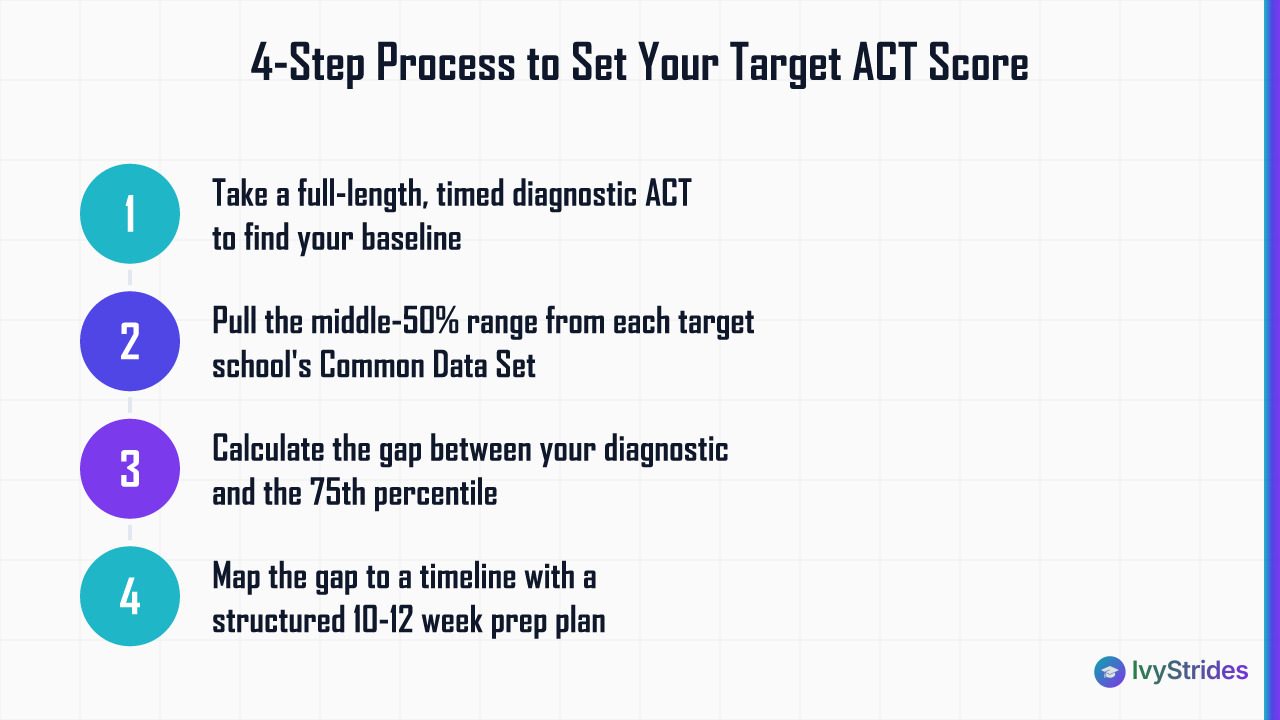
Once you know your target range, the next question is how many points you need and how long that realistically takes. Here's the four-step process we use with students.
Step 1: Take a full-length, timed diagnostic ACT. Without a baseline, there's no way to know which of the four sections, English (75 questions, 45 minutes), Math (60 questions, 60 minutes), Reading (40 questions, 35 minutes), or Science (40 questions, 35 minutes), is holding your composite down. In our coaching, students consistently underestimate how much a single weak section, most often Math or Science, suppresses their overall score. Students who start with a timed diagnostic close their gap faster than those beginning with general content review, because it tells us precisely which question types to prioritize.
Step 2: Pull the middle-50% range at each target school from its current Common Data Set. You have this for the schools above; do the same for the rest of your list.
Step 3: Calculate the gap. Subtract your diagnostic composite from the 75th percentile at your top choice. If you scored a 29 and your target reports a 33-36 band, the gap is meaningful. Aiming for at least the admitted-class median, roughly a 4-point climb, is a reasonable planning target.
Step 4: Map the gap to a timeline. A 4-point composite gain is achievable but requires consistent weekly work, not last-minute cramming. In our coaching with students starting in the 26-29 range, a structured 10-12 week plan with section-specialist coaching typically produces a 4+ point gain for those who complete the full program. The framework rests on four pillars: a diagnostic baseline, targeted weakness work by section, spaced retesting, and section specialists rather than one generalist tutor. Matching the coach to your weakest section is where the point gains concentrate.
Two complements to keep in view. At schools where your composite falls below roughly the 50th percentile of admitted students, essays and extracurriculars carry proportionally more weight. And a rigorous AP load reinforces the academic signal your ACT sends. Neither replaces a strong score; both amplify one.
Ready to establish your baseline? Start with our act practice test online library. For a personalized plan, our 1-on-1 ACT prep pairs you with section specialists.
One honest caveat: admissions outcomes depend on the full application, not test scores alone. A strong ACT is one component of a competitive file, never a guarantee.
FAQ
Is a 28 ACT score competitive at selective colleges?
A 28 ACT sits at approximately the 91st percentile nationally, per ACT national norms. At highly selective schools with a 33-36 band, a 28 falls well below the admitted range, so other components would need to be exceptionally strong. At moderately selective schools with a 26-30 band, a 28 is genuinely competitive. Benchmark against the specific school's Common Data Set, not a universal label.
How rare is a 31 on the ACT, and is it good enough for top schools?
A 31 places a student at approximately the 96th percentile nationally. At Ivy League schools where the band is 34-36, a 31 falls below the admitted range and isn't competitive there without exceptional other factors. At top-50 universities with bands in the 29-33 range, a 31 is competitive and sits near or above the median.
Should I retake the ACT if my score is below the 25th percentile at my target school?
Generally yes, if you have time before your deadline and a structured plan. Scoring below that mark doesn't disqualify you, but it shifts weight onto every other part of your application. In our coaching, a focused 8-12 week plan targeting the sections holding down the composite can produce a meaningful gain for students who complete it. Start from a diagnostic baseline so prep time goes to the right sections.
Do top colleges look at individual ACT section scores, or only the composite?
Most colleges primarily evaluate the composite, but section scores are visible to readers and can matter in context. An engineering applicant with a 36 composite but a 28 in Math will draw scrutiny. A very high Math score can reinforce a STEM application even if the composite sits slightly below the median. At schools that superscore, the composite is built from your best sections across sittings.
Is a 29 ACT or a 1350 SAT a stronger score to submit?
Per the official ACT-SAT concordance, an ACT 29 converts to approximately an SAT 1330-1340, so a 1350 is marginally stronger on that basis. In practice both sit in the same competitive range and are treated equivalently. Submit whichever sits higher relative to the middle-50% band at each specific school.

Award-winning author (South Asian Book Award) and graduate of BITS Pilani and UCLA Luskin School of Public Affairs. Brings a published writer's eye to Common App essays and grammatical precision to SAT and ACT R&W instruction.