
Enhanced ACT Changes for 2026: Shorter Test, Optional Science, and What It Means
On this page
- What Is the Enhanced ACT? A Quick Answer for Students and Parents
- Enhanced ACT vs. Classic ACT: The Full Format Comparison
- Should You Take the Optional Science Section?
- How the Enhanced ACT Composite Score Works
- Is the Enhanced ACT Easier or Harder Than the Classic Format?
- When Does the Enhanced ACT Roll Out and Who Is Affected?
- How to Prep for the Enhanced ACT Format
- Is Free ACT Prep Enough for the Enhanced Format?
- FAQ
- Is there a break in the enhanced ACT?
- What is the difference between the classic ACT and the enhanced ACT?
- Will my old ACT score still be valid if I retake with the enhanced format?
- How many questions are on the enhanced ACT?
- Can I superscore a classic ACT with an enhanced ACT score?
- How long will the enhanced ACT take on test day?
The enhanced ACT, rolling out to state and district administrations in spring 2026, cuts the core test from 215 questions to 131 (50 English, 45 Math, 36 Reading), makes Science optional at 40 questions, and drops core testing time to roughly 125 minutes. The Composite reflects only English, Math, and Reading when Science is skipped. Students get about 18% more time per question on the core sections. Content difficulty is not reduced.
Those numbers come from ACT, Inc.'s official announcements at act.org. The harder questions are the ones this article answers next: whether skipping Science will cost you at your target schools, how the new Composite compares to legacy scores, and how to actually prep for a format most tutors haven't seen a live administration of yet.
What Is the Enhanced ACT? A Quick Answer for Students and Parents
The enhanced ACT is the redesigned version of the test that ACT, Inc. is rolling out beginning in spring 2026, first through state and district administrations. It has three required core sections (English, Math, Reading) totaling 131 questions, plus an optional Science section of 40 questions. Take Science and you sit for 171 questions across roughly 165 minutes of testing time. Skip it and you're done in about 125 minutes.
Here's the structural shift in one line. English drops from 75 to 50 questions, Math from 60 to 45, Reading from 40 to 36, and Science moves from mandatory to optional at 40. The 1-36 Composite scale stays. What changes is how it's calculated when Science is skipped (average of the three core sections) and how much time you get per item.
That last piece is the one students underestimate. Roughly 18% more time per question sounds modest on paper. In practice, on ACT Reading, where pacing has historically eaten scores in the 26-30 band, that extra time is the difference between a rushed last passage and a confident one. Content standards, per ACT, Inc., were not simplified. The test is shorter. It is not easier.
Enhanced ACT vs. Classic ACT: The Full Format Comparison
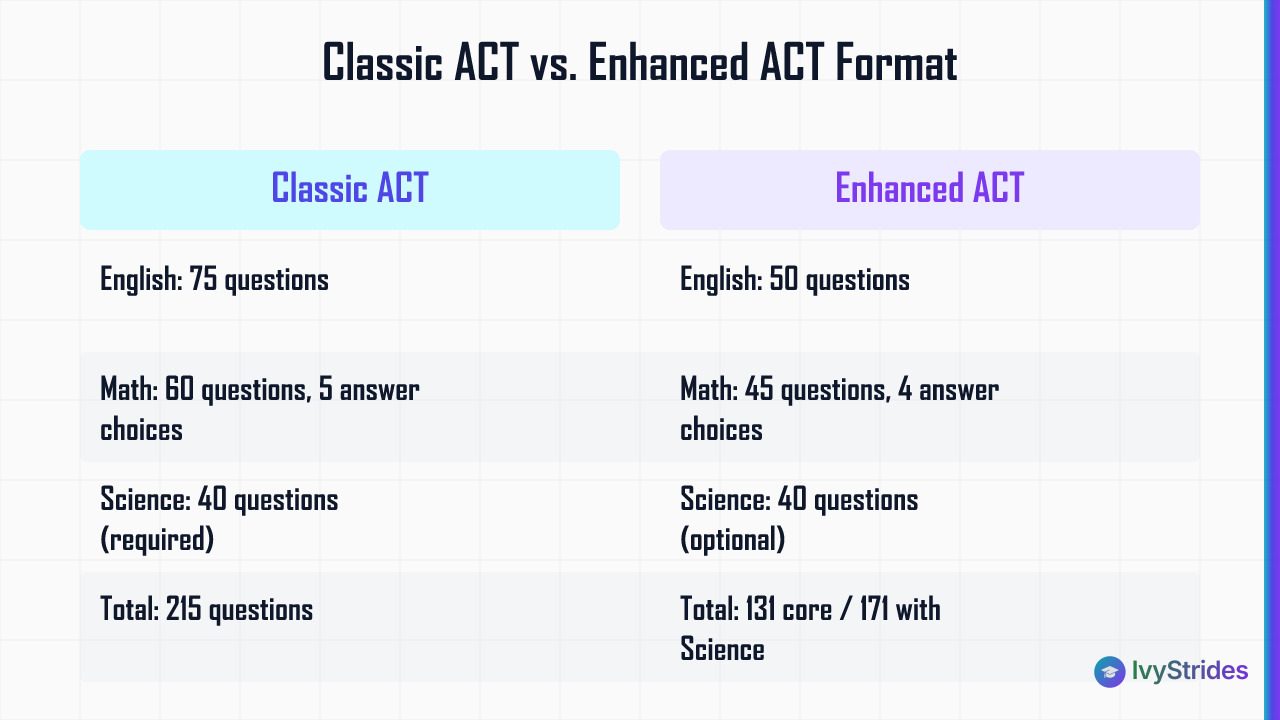
Here is the section-by-section comparison, drawn from ACT, Inc.'s published format specifications at act.org:
| Section | Classic ACT | Enhanced ACT |
| English | 75 questions | 50 questions |
| Math | 60 questions, 5 answer choices | 45 questions, 4 answer choices |
| Reading | 40 questions | 36 questions |
| Science | 40 questions (required) | 40 questions (optional) |
| Total | 215 questions | 131 core / 171 with Science |
| Core testing time | ~175 minutes | ~125 minutes |
| Total seated time (no Science) | Longer | ~2 hours 15 minutes (excluding check-in and breaks) |
A few things deserve a closer look. Math dropped from five answer choices per question to four. That sounds trivial. It isn't. Elimination strategy, back-solving, and the plug-in-answer-choices technique that most students rely on for algebra and geometry questions all shift when there's one fewer trap answer to rule out. Students who scored in the roughly 28-32 range on classic ACT Math by working systematically through choices need to recalibrate.
Break structure remains between sections, though the exact schedule varies by administration (state, district, or national). Confirm with your test site before test day.
If you're still deciding between the ACT and the SAT, the enhanced format changes the comparison in meaningful ways, particularly on timing and section flexibility. Our full breakdown of ACT vs. SAT differences covers how to choose.
Should You Take the Optional Science Section?
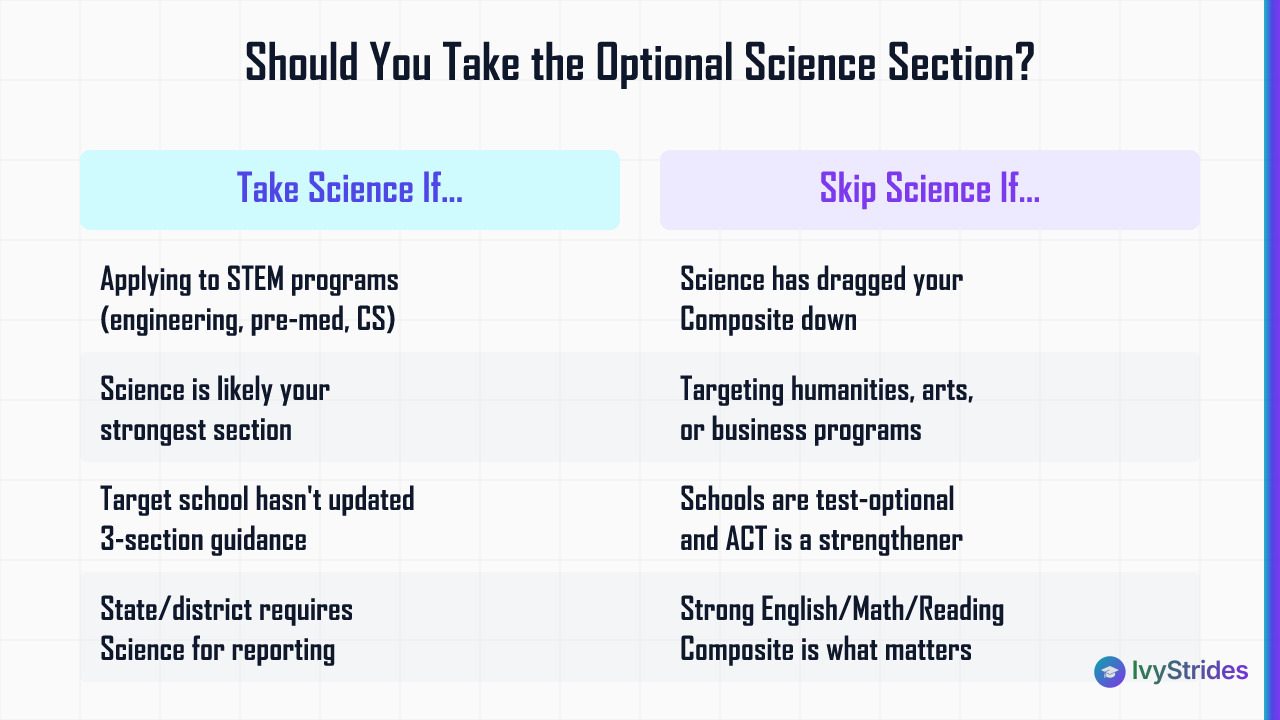
This is the decision students are stuck on, and honestly, so are a lot of admissions offices. Here's how to think about it.
Take Science if any of the following apply:
- You're applying to STEM-focused programs (engineering, pre-med tracks, computer science at competitive universities, direct-admit science majors).
- Your Science score is likely to be your strongest section, and you want it visible.
- Your state or district administration requires Science for reporting purposes (some do; verify with your school).
- You want the four-section Composite because a target school hasn't updated its guidance on the three-section version.
Skip Science if:
- Science has historically dragged your Composite down and you're applying to programs where a strong English/Math/Reading Composite is what matters.
- Your target schools are test-optional and you're using the ACT as a strengthener rather than a requirement.
- You're targeting humanities, arts, or business programs where a Science subscore adds little.
The Composite math backs this up. When Science is skipped, ACT, Inc. calculates the Composite as the average of English, Math, and Reading only. Your Science score, if taken, is reported separately and does not enter the Composite. So the calculus is genuinely this: does a separately-reported Science score help or hurt the story your application tells?
In our coaching with students targeting STEM programs, we typically recommend taking Science to avoid ambiguity with admissions offices still updating their guidance on the enhanced format. A missing Science score at a school that hasn't published a three-section policy is a small but real risk.
One caveat worth naming: test-optional policies vary by school and year, per the FairTest tracker. Even as those policies remain common, a strong enhanced ACT Composite can still strengthen an application at schools that continue to value standardized scores. Test-optional isn't test-blind. Read how much the ACT matters for college admission before you decide to skip Science on a school where a score would help.
How the Enhanced ACT Composite Score Works
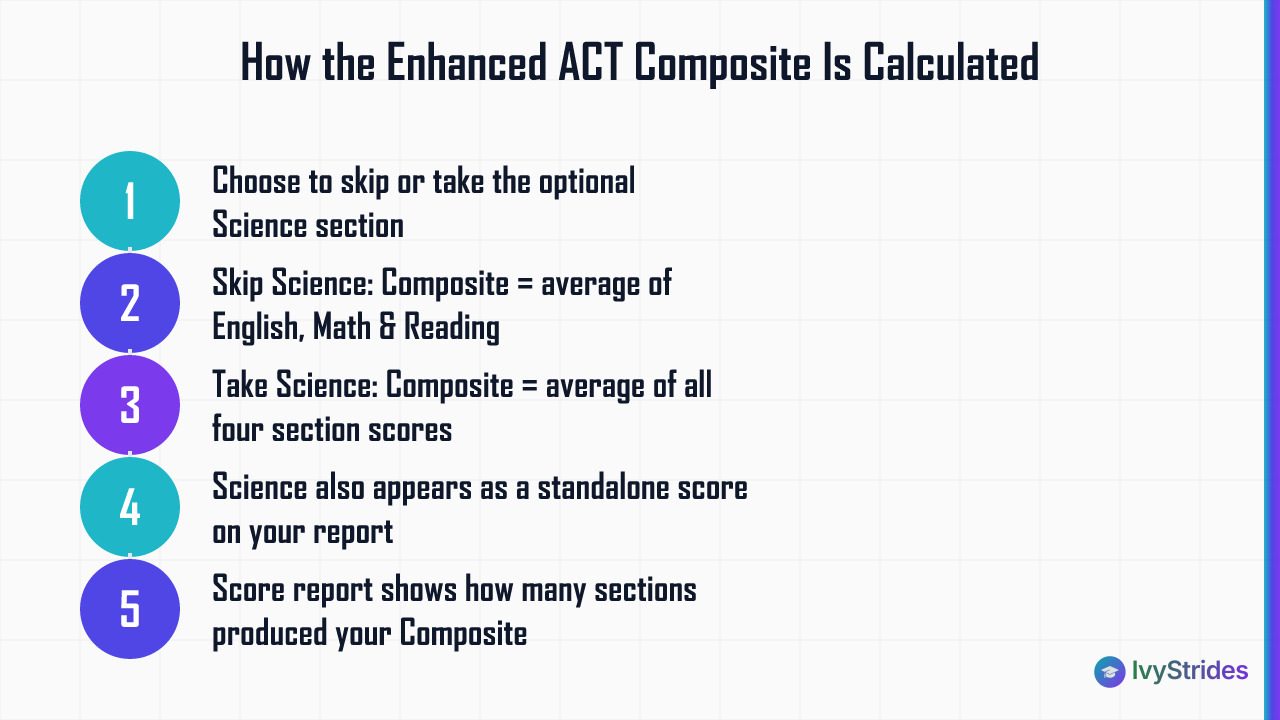
The Composite stays on the 1-36 scale, per ACT, Inc. That doesn't change. What changes is what goes into it.
Skip Science: Composite equals the average of your English, Math, and Reading scaled scores, rounded to the nearest whole number. Three sections in, one Composite out.
Take Science: Composite equals the average of all four section scores, exactly like the classic format. Science is also reported separately, so it exists both inside the Composite and as a standalone score on your report.
The obvious question: is a 32 Composite from three sections the same as a 32 from four sections? ACT, Inc. has commissioned a linking study to confirm score comparability between the enhanced and legacy formats on the same 1-36 scale. Colleges should treat a 32 as a 32 regardless of format. That said, the number of sections producing that 32 will be visible on the score report, so admissions readers can see the difference if they look.
Superscoring is where things get genuinely unsettled. Colleges that superscored the classic ACT may or may not apply the same policy when combining an enhanced-format score with a legacy score, or when combining a three-section enhanced score with a four-section enhanced score. This is not standardized yet. Verify with each target school's admissions office directly.
Once you have your enhanced ACT scores, understanding score choice and superscore policies at your target schools determines which scores you actually send. Our guide on how to send ACT scores to colleges walks through the mechanics.
Is the Enhanced ACT Easier or Harder Than the Classic Format?
Short answer: neither, and both. It depends what "easier" means to you.
Easier in these specific ways:
- Roughly 18% more time per question on core sections. Pacing pressure is meaningfully lower.
- Shorter total test length reduces late-test fatigue, which for students in the 24-30 band often cost around 1-2 Composite points on Reading and Science under the classic format.
- Optional Science means students whose weakest section was Science can now avoid it entirely.
- Fewer questions per section means fewer opportunities for a bad question to compound a bad section.
Not easier in these ways:
- Content standards are unchanged, per ACT, Inc. The math you need to know, the grammar rules tested, the passage complexity in Reading, none of that got simpler.
- Math went from five answer choices to four. That shifts elimination strategy in ways that reward students who prepped with the new format, not those relying on classic materials.
- A 27 Composite still sits at roughly the 88th percentile nationally. The scale hasn't been curved down. Reaching a target score still requires the same content mastery.
In our coaching with students who have taken early enhanced-format administrations, the shorter length reduces late-test fatigue, but students who under-prepared for content still struggled on Math and Reading. Time pressure was never the whole story. The other half is knowing the material cold, and that part didn't get easier.
If you're still weighing which test to take, our comparison of is the SAT harder than the ACT works through the trade-offs.
When Does the Enhanced ACT Roll Out and Who Is Affected?
Per ACT, Inc., the enhanced format begins rolling out in spring 2026 through state and district administrations. That's the confirmed starting point. National test dates follow a separate timeline that ACT, Inc. is publishing on a rolling basis; verify the current schedule at act.org before locking in your test date.
Here's what to check:
- Testing before spring 2026 on a national date: you may still encounter the classic 215-question format. Confirm the format with ACT, Inc. for your specific date.
- Testing on a state or district administration in spring 2026 or later: expect the enhanced format.
- PreACT: ACT, Inc. is running parallel enhancements to the PreACT, so 9th and 10th graders will see the new structure in their diagnostic administrations too.
- Paper vs. digital: both delivery modes remain available depending on administration. ACT, Inc.'s testing options page has the current breakdown.
Your ACT test date needs to fit inside a broader college application timeline, and knowing your target score early gives you enough retake windows before application deadlines. Our post on college application deadlines and timeline maps the full sequence.
Because rollout details are time-sensitive and ACT, Inc. is publishing updates on a rolling basis, we date-stamp this article and refresh it annually. Confirm any specific test-date claim directly against act.org before making a registration decision.
How to Prep for the Enhanced ACT Format
The prep methodology that produces score gains doesn't change with the format. What changes is which practice materials are valid and where the pacing pressure lives. Here's the sequence that works.
Start with a diagnostic. Not a chapter quiz, not a section drill. A full-length enhanced ACT practice test under timed conditions, using official ACT enhanced-format materials from act.org. Skipping this step is the single most common reason prep plans stall in the first month: without diagnostic data, students burn hours on their strongest section because it feels productive. The most reliable way to calibrate your pacing for the new format is a full-length enhanced practice test under timed conditions, which gives you real data on where your time is going before test day.
Identify the two highest-use sections. Students at a 24 Composite aiming for 30+ do not need to improve equally across four sections. They need to find the two sections where they lose the most points relative to their target, and work those first. Section-specialist coaching (separate coaches for ACT English/Reading, ACT Math, and ACT Science) matters here because the tactics differ. Grammar rules tested in English don't overlap with pacing tactics for Reading passages.
Recalibrate pacing for the new time-per-question ratios. On classic ACT Reading, students had roughly 52 seconds per question. On enhanced Reading (36 questions, similar total time), the per-question budget stretches. That doesn't mean read slower; it means read once carefully rather than twice quickly. In our coaching, students who kept their classic pacing on enhanced practice tests routinely finished several minutes early and left points on the table.
Adjust Math strategy for four answer choices. Elimination is now stronger. Each wrong choice ruled out cuts remaining probability by about 33% instead of 25%. Back-solving is faster. A blind guess on an unknown question moves from a 20% base rate to 25%. Practice these adjustments deliberately with enhanced-format materials.
Retest with spacing. Diagnostic in week 1, targeted work weeks 2-5, full-length retest in week 6, targeted work weeks 7-10, full-length retest in week 11. This spacing is what turns tutoring hours into Composite points.
For students completing our 1-on-1 ACT prep program, a typical Composite improvement is 4+ points, following the diagnostic-first plan that identifies the two or three highest-use sections before the first tutoring session begins. Not a guarantee. A typical outcome tied to the methodology.
Each section of the enhanced ACT rewards different skills. Our section-by-section ACT prep guide walks through the specific tactics for English, Math, Reading, and Science. To calibrate pacing on the actual format, use our online ACT practice test library, which includes enhanced-format materials. If you want a coach who specializes in the specific section pulling your Composite down, our 1-on-1 ACT prep matches students to section-specialist tutors rather than generalists.
Is Free ACT Prep Enough for the Enhanced Format?
Honest answer: it depends on your starting Composite, your target, and how self-directed you actually are.
What free resources cover well: official ACT practice tests from act.org, the official ACT prep guide, and the free enhanced-format materials ACT, Inc. is publishing. These are the correct starting point for any student. Don't skip them. Any student who hasn't worked through the official free materials before paying for coaching is spending money to fix something free resources could have addressed.
Where free resources fall short: personalized weakness identification, pacing coaching under live conditions, and section-specialist depth. A generic study plan tells you to "practice Reading." It doesn't tell you that your specific pattern is losing 3-4 points on humanities passages because you're over-reading opinion pieces looking for facts. That's diagnostic work.
Score band matters. Students at 20-24 aiming for 26 have wide gains available from content review that free materials can deliver. In our coaching, students at 26-28 aiming for 31+ typically need targeted work on two specific sections, not a general content review. Free resources rarely provide that diagnostic precision.
Our full treatment of the trade-off is in is free ACT prep enough to raise your Composite. The free ACT and SAT prep downloads page is a good complement to official ACT materials for students starting out.
FAQ
Is there a break in the enhanced ACT?
Yes. The enhanced ACT core test (without Science) takes approximately 2 hours and 15 minutes of seated time, not including check-in and breaks. A short break is typically scheduled between sections depending on the administration. Because state and district administrations may vary from national test dates on exact break timing, confirm the schedule with your testing site in advance.
What is the difference between the classic ACT and the enhanced ACT?
The classic ACT had 215 questions across four mandatory sections (English 75, Math 60, Reading 40, Science 40), with a Composite averaged across all four. The enhanced ACT has 131 core questions (English 50, Math 45, Reading 36), makes Science optional at 40 questions, reduces Math answer choices from five to four, and calculates the Composite from three sections when Science is skipped. Core testing time drops from roughly 175 minutes to about 125 minutes.
Will my old ACT score still be valid if I retake with the enhanced format?
Yes. ACT, Inc. has commissioned a linking study confirming that enhanced ACT scores are comparable to legacy scores on the same 1-36 scale. Colleges that accept the ACT will treat both formats as equivalent. Superscore policies across formats may still vary by school, so verify with each college's admissions office before deciding which scores to send.
How many questions are on the enhanced ACT?
The enhanced ACT core has 131 questions: 50 in English, 45 in Math, and 36 in Reading. If you add the optional Science section (40 questions), the total rises to 171. The classic ACT had 215 questions total.
Can I superscore a classic ACT with an enhanced ACT score?
This depends entirely on the individual college's policy. Some schools will superscore across formats; others will not. Because the enhanced Composite can be calculated from three sections rather than four, colleges are still updating their superscore policies. Contact each target school's admissions office directly to confirm before deciding which scores to send.
How long will the enhanced ACT take on test day?
The core enhanced ACT (without Science) runs approximately 125 minutes of testing time, or about 2 hours and 15 minutes of total seated time excluding check-in and breaks. Adding the optional Science section extends testing time to roughly 165 minutes. Total time at the testing center, including check-in, breaks, and administration, will be longer; plan for around 3 to 3.5 hours at the site.
The students who see the largest Composite gains in 2026 will be the ones who diagnose their weaknesses against the new format early, prep with official enhanced materials, and make a deliberate Science decision based on their target schools, not a default one.

Award-winning author (South Asian Book Award) and graduate of BITS Pilani and UCLA Luskin School of Public Affairs. Brings a published writer's eye to Common App essays and grammatical precision to SAT and ACT R&W instruction.