
How to Improve your ACT Score: The Complete 2026 Playbook for a Top Score
On this page
- The Short Answer: How to Improve Your ACT Score in Four Steps
- Step 1: Take a Diagnostic Test and Set a Realistic Target Score
- Why Your ACT Score Is Not Improving (And What to Fix First)
- Section-by-Section Tactics: Where to Find Your Fastest Points
- ACT English (75 questions, 45 minutes on the legacy format)
- ACT Math (60 questions, 60 minutes on the legacy format)
- ACT Reading (40 questions, 35 minutes)
- ACT Science (40 questions, 35 minutes)
- What the 2026 Enhanced ACT Means for Your Prep Plan
- How Much Can You Realistically Raise Your ACT Score?
- What Is a Good ACT Score for College Admissions?
- Building Your ACT Study Schedule: A Week-by-Week Framework
- Is a 1400 SAT Score Equivalent to a 31 ACT? Understanding Score Conversions
- FAQ
- Is it possible to raise your ACT score by 10 points?
- Which ACT section is the easiest to improve quickly?
- Why did my ACT score go down on a retake?
- Can I improve my ACT score in a month?
- Does the ACT Writing section affect my composite score?
To improve your ACT score, start with a full-length, timed practice test to establish your baseline composite and section scores. Review every wrong answer, categorize the error type, and build a targeted study plan around your two weakest sections. In our coaching with students, roughly 40 to 60 hours of focused practice typically produces a 2 to 4 point composite gain; a 5 to 7 point improvement usually requires about 80 to 100 hours. The 2026 Enhanced ACT format changes Math pacing (four answer choices instead of five) and makes Science optional, so any plan you build now must reflect the current test, not the legacy version.
Those format details come from ACT, Inc.'s official documentation; the hour ranges reflect what we see across score bands in our 1-on-1 coaching. The harder question, the one this article actually answers, is where your fastest points live and how to sequence the work so you don't waste 30 hours drilling a section that was never the problem.

The Short Answer: How to Improve Your ACT Score in Four Steps
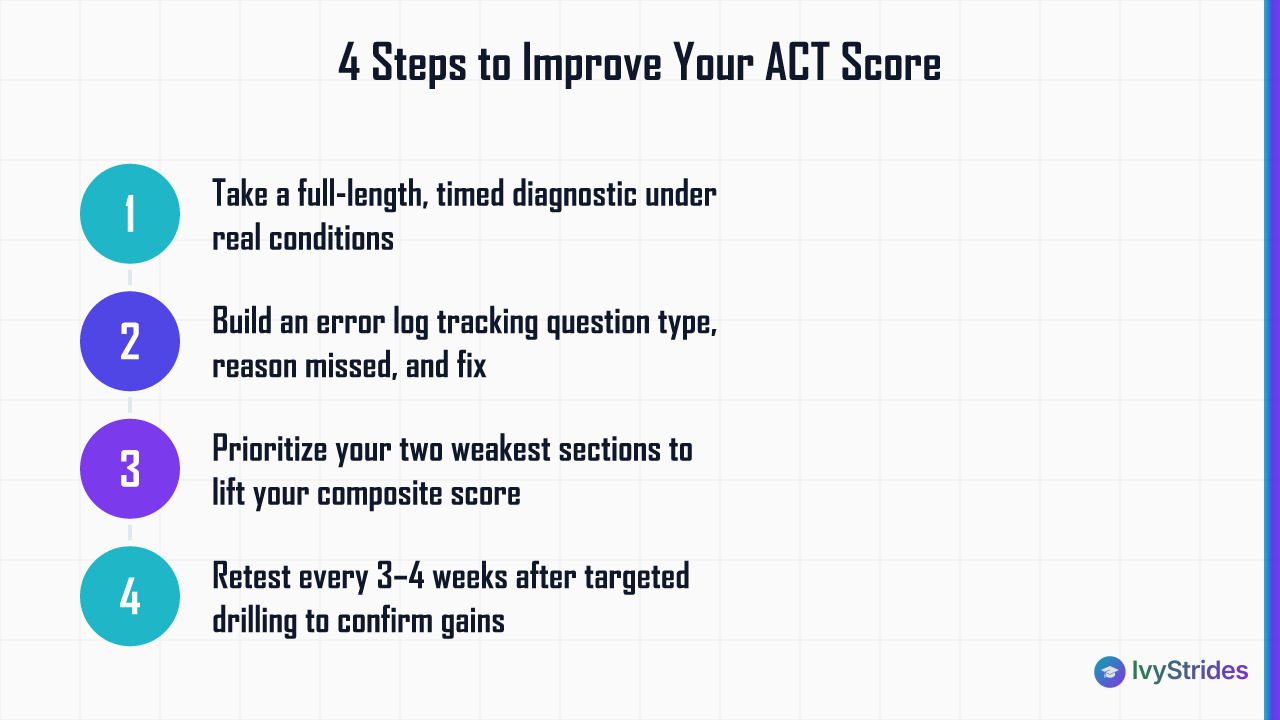
Here's the compressed version. Four steps, in order, no substitutions.
Step 1: Take a full-length, timed diagnostic. Use an official or near-official ACT test under real conditions. Score every section. This is non-negotiable per ACT, Inc. prep guidance, and you can source a test from our online act practice test library.
Step 2: Build an error log. For every wrong answer across the four ACT sections (English, Math, Reading, Science), record the question type, the reason you missed it (content gap, pacing, careless), and the correct approach. This is what separates score-movers from plateau students.
Step 3: Prioritize your two weakest sections. Because the composite score is the average of your four section scores rounded to the nearest whole number, one section sitting 3 points below the others suppresses your composite by nearly a full point. Fix the drag first.
Step 4: Retest on a spaced schedule. After roughly 3 to 4 weeks of targeted drilling, take a second full-length test to confirm gains and pivot. Repeat.
Typical hour investments: roughly 40 to 60 hours for a 2 to 4 point gain, about 80 to 100 hours for a 5 to 7 point gain, and 100+ hours for a 10-point gain, assuming lead time. Remember, the 2026 Enhanced ACT made Science optional and reduced Math to four answer choices, both of which affect pacing and elimination strategy.
Step 1: Take a Diagnostic Test and Set a Realistic Target Score
Skip the diagnostic and you're guessing. That's the honest version.
The ACT composite is scored on a 1 to 36 scale, with a national average of approximately 20.5 per ACT, Inc. Your composite is the arithmetic mean of your four section scores (English, Math, Reading, Science on the legacy format; the 2026 Enhanced ACT changes below), rounded to the nearest whole number. That rounding matters. A student who scores 28, 28, 28, 25 lands at a 27 composite, not a 28, because one section pulled the average below the .5 threshold.
Set your target by looking up the middle-50% ACT range in the Common Data Set of each college on your list. Search "Common Data Set [University Name]" and look at Section C9. Then aim for the top of that range. Rough benchmarks per ACT, Inc. percentile data:
- 27: above the national average, around the 85th percentile, competitive at many strong colleges
- 30: approximately the 93rd percentile, competitive at many top-50 schools
- 33 to 36: 99th percentile territory, the expected range for highly selective schools
Once you know your baseline and your target, calculate the gap. A student at 24 aiming for 30 has a 6-point gap, which typically places them in the 80 to 100 hour range if the work is targeted.
Before you commit to an ACT prep plan, students who haven't yet taken either test should confirm the ACT is the right fit; our detailed comparison of ACT vs SAT covers format, difficulty, and scoring differences side by side. Running a timed, full-length practice test is the non-negotiable first step; our online act practice test page links to official and near-official full-length tests you can use to establish your baseline.
Why Your ACT Score Is Not Improving (And What to Fix First)
If you've already taken the ACT once, maybe twice, and your score refuses to move, the cause is almost always one of three things. Not motivation. Not intelligence. Method.
Failure mode #1: Practicing without an error log. In our coaching with students in the 20 to 24 range, the most common issue is reviewing wrong answers without categorizing the error type. Reading the explanation, nodding, moving on. That's passive review, and it teaches you nothing about the pattern. The fix: after every practice set, list each miss with its question type ("comma splice," "linear equation word problem," "author's tone in humanities passage") and the specific reason you missed it. Within two weeks, the pattern reveals itself, and typically 3 to 5 question types account for roughly 60% of your errors.
Failure mode #2: Drilling content but not timing. Untimed practice builds accuracy on easy questions and false confidence everywhere else. The ACT is a pacing test. If you can answer a question correctly with unlimited time but not in about 36 seconds (English) or roughly 52 seconds (Reading), the score report reads the same as if you didn't know it. Every drill after week 2 should be timed.
Failure mode #3: Studying all four sections equally. Suppose you sit at 26, 29, 22, 27. Spending equal time on each section is malpractice. That 22 in Reading is what's suppressing your composite. Fix it first, retest, then move on.
ACT English errors cluster around a small set of rules: subject-verb agreement, comma splices, pronoun-antecedent agreement, modifier placement, and transitions (rhetorical skills). ACT Science score drops are almost always a pacing problem, not a content knowledge problem, since the test measures data interpretation speed, not biology or chemistry. Once you know your failure mode, spaced retesting (retaking a timed section roughly 5 to 7 days after the initial drill) confirms whether the fix stuck. If accuracy holds after a week, move on. If it slips, drill again.
For students who want a coach to build the error log with them and adjust the plan weekly, our 1-on-1 ACT prep program is built around this diagnostic-first sequence.
Section-by-Section Tactics: Where to Find Your Fastest Points
Not all sections improve at the same rate. English is the fastest lever. Reading is the slowest for most students. Here's where to spend your hours.
ACT English (75 questions, 45 minutes on the legacy format)
Target pace: approximately 36 seconds per question. The section rewards mastery of a finite grammar rule set, not deep reading. Drill these categories in order of frequency: punctuation (commas, apostrophes, semicolons), sentence structure (run-ons, fragments, comma splices), pronoun and modifier issues (pronoun-antecedent agreement, dangling modifiers), and rhetorical skills (transitions, relevance, best placement of a sentence within a paragraph).
Honestly, this is the highest-ROI move in ACT prep. In our coaching with students in the 24 to 28 range, focusing exclusively on ACT English grammar rules for two weeks before touching other sections typically produces a 1 to 2 point section gain.
ACT Math (60 questions, 60 minutes on the legacy format)
Roughly one minute per question. Calculator permitted throughout. No formula sheet is provided, so you memorize: SOHCAHTOA, the quadratic formula, area and volume formulas for common shapes, the distance and midpoint formulas, slope-intercept and point-slope forms, basic probability, and the arithmetic and geometric sequence formulas. Content spans pre-algebra through trigonometry.
The 2026 Enhanced ACT reduced Math answer choices from five to four, which slightly improves guessing odds on questions you can't solve and changes elimination strategy on questions you can partially solve. Verify current specs at ACT, Inc. before your test date.
ACT Reading (40 questions, 35 minutes)
Approximately 52 seconds per question. Four passages: literary narrative, social science, humanities, natural science. At least one set uses paired passages, where you track two authors' viewpoints and compare them.
Pacing is where students lose this section. A rule that works: spend no more than about 3 minutes on a passage before starting the questions. If a single question takes more than 60 seconds, mark it and move on; return only if time permits. The literary narrative passage is often the slowest read for STEM-leaning students; consider tackling it second or third rather than first.
ACT Science (40 questions, 35 minutes)
The Science section tests data interpretation, not science content. You don't need Krebs cycle details. You need to read charts, tables, and experimental setups quickly. Three passage types: data representation (fastest, tackle first), research summaries (moderate), and conflicting viewpoints (slowest, tackle last if pacing is an issue, it's essentially a reading passage in scientific costume).
Under the Enhanced ACT 2026 format, Science is optional. Whether to skip it depends on your target colleges; some programs, especially in STEM, still expect a Science score. Verify each school's policy before deciding.
For a full section-by-section curriculum, our ACT prep overview covers each section's methodology in depth. Our breakdown of what is the enhanced ACT explains the 2026 format shifts.
What the 2026 Enhanced ACT Means for Your Prep Plan
The 2026 Enhanced ACT introduced a shorter core format with an optional Science section and four answer choices in Math instead of five, so any prep plan must account for these structural changes; our full breakdown of Enhanced ACT changes explains exactly what shifted and what stayed the same.
Three shifts that materially affect your prep:
1. Shorter core format. English, Math, and Reading form the required test. Science is an optional add-on. Per ACT, Inc.'s enhancements documentation, the core sections have been recalibrated for per-question timing. Practice materials built on the legacy 75-question English or 60-question Math format won't reflect current pacing. Use Enhanced ACT format practice tests only.
2. Four answer choices in Math. Elimination strategy tightens. On any question where you can rule out one choice, your guessing odds move from 1-in-4 to 1-in-3, which is meaningful over 60 questions. Practice the elimination habit deliberately.
3. Optional Science. Some students will benefit from skipping Science (fewer sections, less fatigue, more focus per section). Others will hurt themselves. STEM-track applicants and any student targeting a school that expects Science should still take it. Confirm with each target college before deciding.
One important caveat: ACT, Inc. has staged the Enhanced rollout across test administrations. Before you commit to a prep plan or register, verify current format details at act.org for your specific test date. What's true for the September administration may not be true for the April administration.
How Much Can You Realistically Raise Your ACT Score?
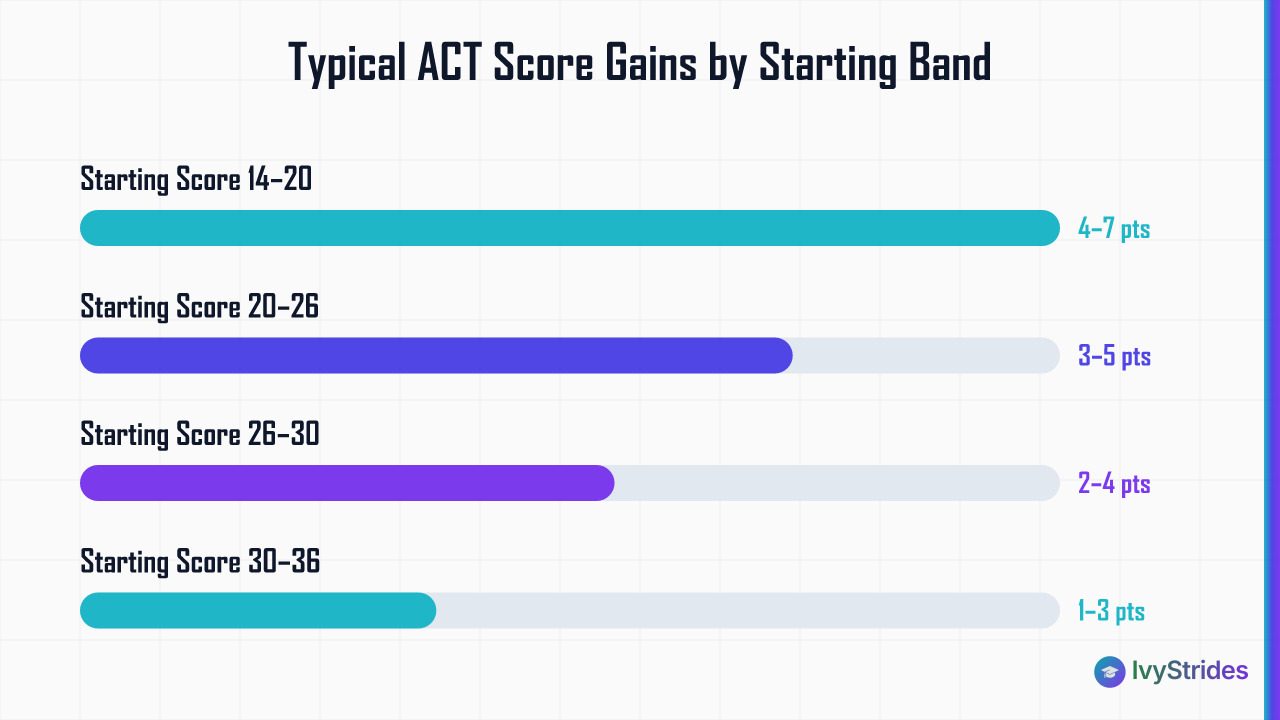
Honest answer, broken out by starting band. These ranges reflect what we see in our 1-on-1 ACT coaching, framed as typical outcomes, not guarantees.
Starting band 14 to 20: Largest absolute gains possible. Students here often have foundational content gaps, particularly in Math (weak algebra, unfamiliar geometry) and English (grammar rules never explicitly taught). Once addressed, 4 to 7 point composite gains are typical with roughly 60 to 80 hours of targeted work.
Starting band 20 to 26: 3 to 5 point gains are typical with about 60 to 80 hours. Improvements come primarily from pacing gains in Reading and Science and grammar drilling in English. Math gains come from filling specific topic gaps (trigonometry, functions, data analysis).
Starting band 26 to 30: 2 to 4 point gains typically require roughly 80 to 100 hours. At this range, every point requires eliminating a specific error pattern rather than learning new content. Careless errors become the enemy.
Starting band 30 to 36: 1 to 3 point gains typically require 100+ hours and near-perfect execution. A 36 is the 100th percentile and requires essentially zero careless errors across all four sections. Students in this band should be running full-length tests weekly and analyzing every miss.
Is a 10-point gain possible? Yes, but only with at minimum 100 hours of structured study and significant lead time, usually around 4 to 6 months. Don't expect it in a month. Students in our 1-on-1 ACT prep program follow this same diagnostic-first sequence, with a section-specialist coach reviewing every error log and adjusting the plan weekly based on retesting data; for students completing the full IvyStrides 1-on-1 ACT program, a 4+ composite point gain is typical.
One caveat: gains depend on starting score, consistency of practice, quality of error review, and time available before your test date. Two students studying the same 80 hours can see very different results if one is running structured error logs and the other is passively reviewing. Method beats hours. For students weighing which test to focus on, our take on is the SAT harder than the ACT walks through the tradeoffs.
What Is a Good ACT Score for College Admissions?
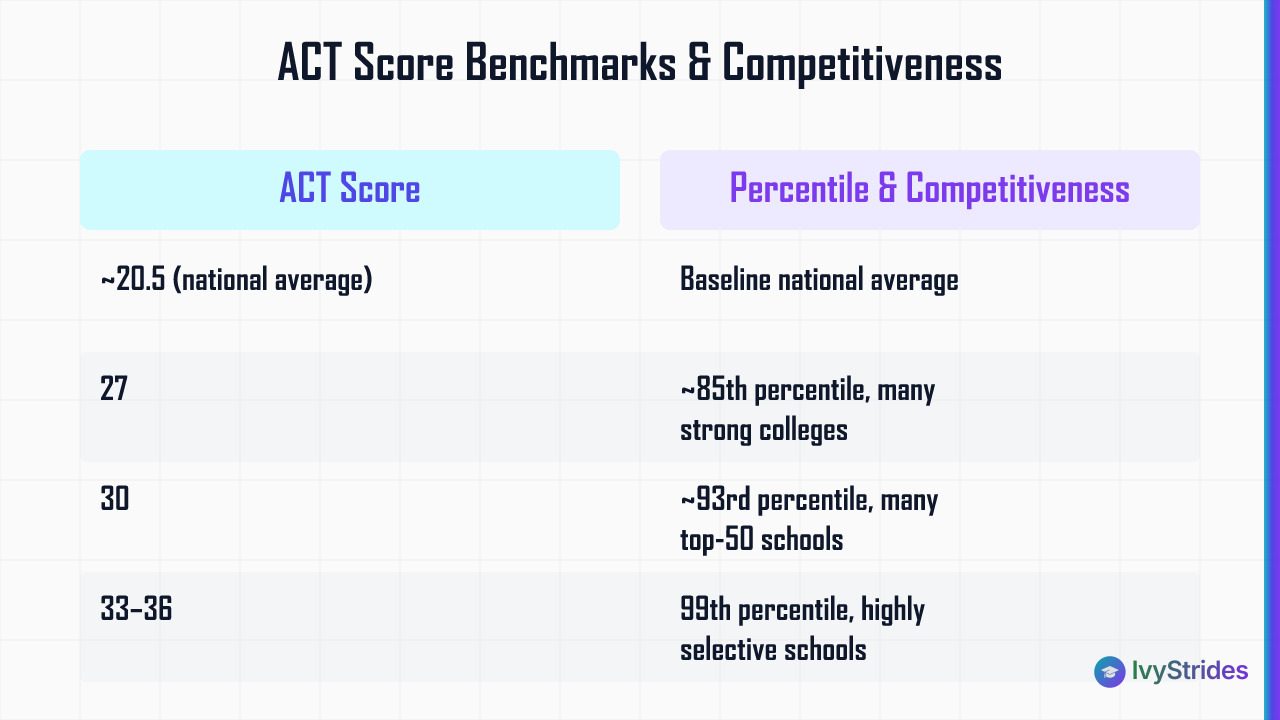
A "good" ACT score is one that sits at or above the middle-50% range of your target colleges. Absolute benchmarks per ACT, Inc. percentile data:
- 27 ACT: around the 85th percentile nationally, well above the national average of ~20.5, competitive at many strong colleges
- 30 ACT: approximately the 93rd percentile, competitive at many top-50 schools
- 33 to 36 ACT: 99th percentile range, expected at highly selective schools including the Ivy League, MIT, and Stanford
- 36 ACT: the maximum composite, 100th percentile
Yes, a 27 is a good ACT score in absolute terms, but "good enough" is a function of your target list. Look up each school's Common Data Set (Section C9) for the actual middle-50% ACT composite range of enrolled students. Aim for the top of that range.
Test-optional policies vary by school and change year to year, so confirm each college's current policy before deciding whether to submit your ACT score. FairTest maintains the most current tracker. Even at test-optional schools, a score at or above the middle-50% typically strengthens the application. A test-optional policy is not the same as a test-blind policy; submitting a strong score at a test-optional school helps. Admissions outcomes always depend on the full application (transcript, essays, activities, recommendations), not test scores alone, so plan accordingly. Our post on college application deadlines can help you sequence testing with your overall application timeline.
Building Your ACT Study Schedule: A Week-by-Week Framework
Here's an 8-week structure that works for students with a 3 to 6 point target gain and roughly 6 to 8 hours of weekly study time.
Weeks 1 to 2: Full-length diagnostic. Build the error log. Identify your two weakest sections. Total: roughly 12 hours.
Weeks 3 to 5: Targeted drilling on your weakest section only. 3 to 4 sessions per week, 45 to 60 minutes each. End each week with one timed section under real conditions. Total: about 18 hours.
Weeks 6 to 7: Second full-length timed practice test. Error log review. Pivot to second-weakest section, same drilling cadence. Total: roughly 14 hours.
Week 8: Light review. Timed section drills at reduced intensity. Confirm exam-day logistics (test center address, ID, calculator with fresh batteries, arrival about 30 minutes before start). Total: around 6 hours.
That adds up to roughly 50 hours across 8 weeks, which fits the 2 to 4 point gain profile for most students. For a 5 to 7 point target, extend to about 12 to 14 weeks or increase weekly hours.
If you have less than 4 weeks: prioritize ACT English grammar rules and ACT Science pacing as the two fastest-moving levers. Drop the ambition of hitting every section equally. You don't have the time, and equal-section drilling is the failure mode we discussed earlier anyway.
Last-minute ACT tips for the final 72 hours: don't attempt new content. Run one timed section per day at most. Review your personal error log, not generic practice sets. Sleep. Confirm logistics. Show up early.
Exam-day pacing rule for ACT Reading: if a question takes more than 60 seconds, mark it and move on; return only if time permits. Missing one hard question is fine. Running out of time and blanking on the final 5 questions is not.
In our coaching, students who follow a structured 8-week plan with two full practice tests and weekly error-log reviews consistently outperform students who study the same total hours without a structured cadence. For more on setting effective targets, our post on SMART Goals: Your Secret Weapon for College Prep Success walks through how to break a composite target into weekly milestones. If you're building the plan around our digital ACT prep library, use the full-length tests every 3 weeks for the retest cadence.
Is a 1400 SAT Score Equivalent to a 31 ACT? Understanding Score Conversions
Roughly, yes. Per the College Board and ACT, Inc. concordance tables, a 1400 SAT maps most closely to a 31 ACT, with the equivalent range spanning approximately 30 to 32.
Which is "better"? Neither. Colleges that accept both tests evaluate whichever score you submit using their own internal concordance. Submit the score that places you higher in your target school's middle-50% range. If your 1400 SAT is above the school's SAT middle-50 but your 31 ACT is below the ACT middle-50, submit the SAT. And vice versa.
A few practical points:
- Superscoring: some colleges superscore the ACT (using your highest section scores across multiple sittings to compute a new composite). Verify each school's policy via their Common Data Set or admissions page.
- Concordance is approximate: the tables are useful for setting a target when switching tests, not a substitute for actually taking practice tests in the new format.
- Don't take both tests without a strategic reason: pick one based on your diagnostic performance and commit. Splitting prep hours across two tests almost always produces weaker results on both.
For students still deciding, our comparison of ACT vs SAT difficulty walks through how to make the call based on your diagnostic profile rather than a coin flip.
FAQ
Is it possible to raise your ACT score by 10 points?
Yes, but it isn't typical for students with 4 to 6 weeks of prep. A 10-point gain requires at minimum 100 hours of structured, diagnostic-driven study and significant lead time before your test date, usually around 4 to 6 months. In our coaching, students who start below a 22 and commit to a full structured program have reached the 30+ range. The further you are from your target, the more lead time and coaching support you need. Set a realistic timeline based on your starting score and available hours per week.
Which ACT section is the easiest to improve quickly?
ACT English is typically the fastest section to improve because gains come from mastering a finite set of grammar rules rather than building broad content knowledge. In our coaching with students in the 20 to 26 range, two to three weeks of focused grammar drilling (subject-verb agreement, comma usage, modifier placement, pronoun-antecedent agreement) commonly produces a 1 to 2 point section gain. ACT Science pacing is the second-fastest lever for students whose errors are primarily time-related rather than content-related.
Why did my ACT score go down on a retake?
A lower score on a retake is more common than most students expect, and it's usually not the result of one major problem. Every ACT administration is a different test with different passage topics and question distributions, so natural variation of 1 to 2 points in either direction is normal. Meaningful score drops usually come from insufficient targeted prep between sittings, test-day anxiety affecting pacing, or attempting the retake too soon without addressing the specific error patterns identified from the first test. Build the error log before you register again.
Can I improve my ACT score in a month?
Yes, meaningful improvement in one month is realistic if you study consistently and focus on your weakest sections. Students who complete roughly 40 to 50 hours of targeted practice in a month, including at least two full-length timed practice tests with thorough error review, typically see a 2 to 4 point composite gain. Larger gains in a single month are possible but require daily study sessions and a very focused plan built around your specific diagnostic results. Don't spread the time across all four sections equally; pick the two weakest and drill.
Does the ACT Writing section affect my composite score?
No. The ACT Writing (essay) section is optional and doesn't affect your composite score of 1 to 36. It's scored separately on a scale of 2 to 12. Most colleges don't require the Writing section, but verify each target school's policy before registering. Under the 2026 Enhanced ACT format, confirm the current Writing section availability with ACT, Inc. before your test date, as availability has shifted with the Enhanced rollout.
A strong ACT score strengthens your application, but it works alongside your essays, not instead of them; students who raise their composite to their target score often turn next to their Common App personal statement.
Score improvement is a method problem before it's an hours problem. Diagnose first, prioritize the weakest section, drill with an error log, retest on a spaced schedule. That sequence works whether you're moving from 20 to 24 or 32 to 34. For more on the coaches behind this methodology, you can meet the tutors who work with students at each score band.

Award-winning author (South Asian Book Award) and graduate of BITS Pilani and UCLA Luskin School of Public Affairs. Brings a published writer's eye to Common App essays and grammatical precision to SAT and ACT R&W instruction.