
How to Register for the ACT in 2026: A Step-by-Step Guide That Actually Works

On this page
- What You Need Before You Register for the ACT (Checklist)
- Before You Register for the ACT: Confirm It Is the Right Test for You
- ACT Test Dates and Registration Deadlines for 2026
- How to Register for the ACT Online: Step-by-Step
- ACT Registration Fees in 2026: What You Will Actually Pay
- Can You Take the ACT Online? Paper vs. Computer Format Explained
- How to Register for the ACT If You Are Outside the United States
- Is a 27 a Good ACT Score? Setting Your Target Before You Register
- After You Register for the ACT: Building Your Prep Timeline
- FAQ: ACT Registration in 2026
- How do I set up my MyACT account?
- Can I do my ACT online at home?
- Is the ACT changing in 2026?
- How much does it cost to register for the ACT?
- Can you take the ACT outside the United States?
- How do I register for the ACT as an adult or out-of-school student?
- Is a 1480 SAT or 34 ACT better for college applications?
- What happens if I miss the ACT regular registration deadline?
- Can I change my ACT test date after registering?
- Your Registration Is the Starting Line
To register for the ACT, go to my.act.org and create a free MyACT account. Have a digital photo, your high school course information, and a credit or debit card ready before you start. The core registration fee is $68. Choose a 2026 test date, select paper or computer format, and submit before the regular deadline (roughly five weeks before the test) to avoid the $42 late fee. International students register at global.act.org and must choose the computer format. The whole form takes about 35 to 45 minutes.
Those figures come from ACT, Inc.'s official registration page and shift year to year, so confirm them the day you register. The harder part of this article is not the form. It's picking a date that leaves enough runway to raise your score, understanding what fee waivers do and do not cover, and knowing whether the paper or computer version fits you. The sections below work through each one.
What You Need Before You Register for the ACT (Checklist)
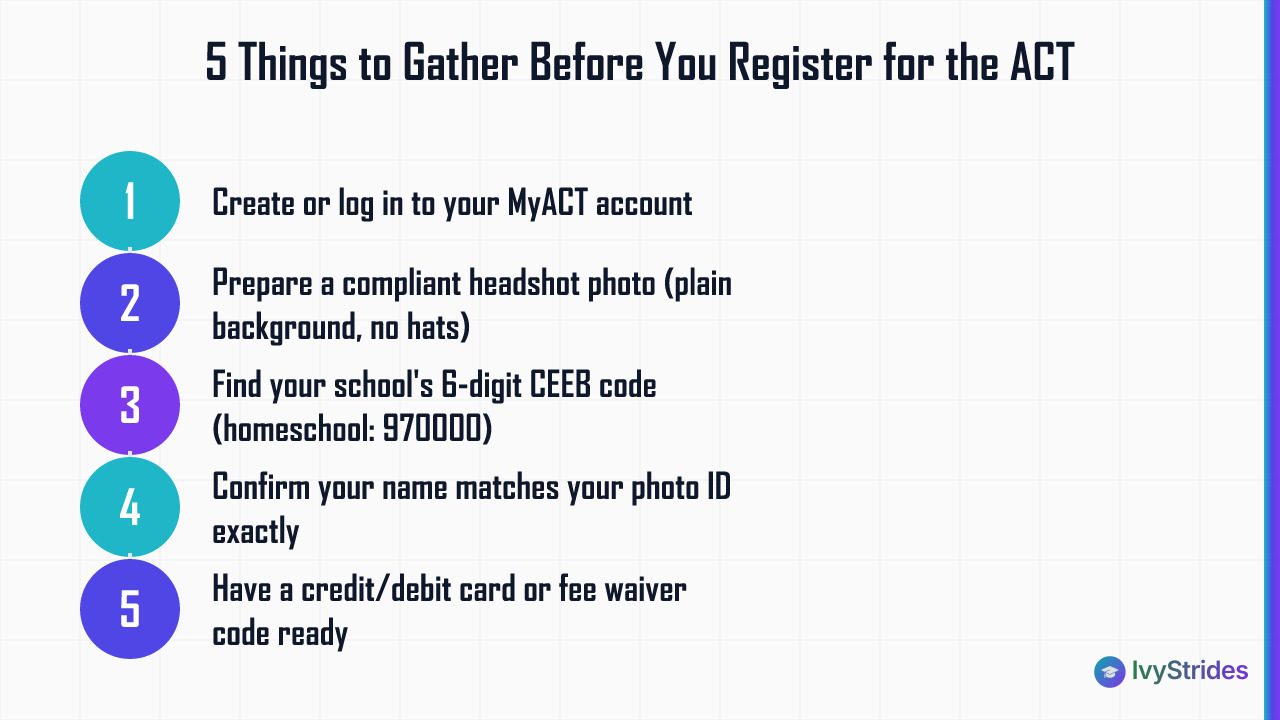
Gather five things before you open the MyACT form: a MyACT login, a compliant digital photo, your high school's CEEB code, a payment method or fee waiver code, and the exact name that appears on the photo ID you'll bring on test day. Registration takes roughly 35 to 45 minutes if you have all five in hand. It takes twice that if you're hunting for your CEEB code mid-form and your session times out.
The digital photo is the item most students underestimate. ACT requires a recent, clear headshot against a plain background, no sunglasses, no hats, and no other people in the frame. It must match the photo ID you present at the test center. A cropped yearbook photo works. A group selfie does not.
Your CEEB code is a six-digit high school identifier. Ask your counselor or search College Board's school lookup. Homeschooled students use 970000. If you enter the wrong code, your score report may not reach your counselor, which matters if you're applying for scholarships tied to school-level reporting.
The name on your MyACT account must match your photo ID exactly. Not the nickname you use in email. Not a middle name you dropped in eighth grade. If your ID says "Jonathan" and your registration says "Jon," the test center can turn you away. That costs you the whole registration fee plus the seat you can't get back.
Payment is a credit or debit card, or a fee waiver code from your school counselor. If you qualify for a waiver, request it before you start the form, not during. For a broader view of how ACT prep fits into your admissions plan, our ACT prep overview is the starting point.
Before You Register for the ACT: Confirm It Is the Right Test for You
Register for the ACT only after you've decided it beats the Digital SAT for your specific strengths. Roughly two weeks of exploration here saves months of prepping for the wrong test.
The two exams differ structurally. The ACT core is three sections: English (75 questions, 45 minutes), Mathematics (60 questions, 60 minutes) and Reading (40 questions, 35 minutes). Science (40 questions, 35 minutes) and Writing are add-ons you choose at registration, each scored separately. The Digital SAT has two sections, Reading & Writing and Math, and is adaptive by module. The ACT composite runs 1 to 36; the Digital SAT runs 400 to 1600.
The section that most often decides the ACT-versus-SAT question is ACT Science. It doesn't test whether you memorized photosynthesis or Newton's laws. It tests data interpretation, chart-reading, and conflicting-viewpoints reasoning under time pressure, roughly 52 seconds per question. Students who read graphs fluently and think in "what does this table tell me" mode tend to score higher on ACT Science than on the reading-heavy Digital SAT R&W.
Before you lock in a registration date, it is worth confirming the ACT is the right test for you; our detailed ACT vs. SAT comparison breaks down format, scoring, and which test tends to favor which skill set. If you're specifically trying to answer whether one test is harder, see ACT vs. SAT difficulty.
Neither test is objectively harder. Fit is individual. In our coaching, students who score noticeably higher on ACT Science relative to SAT Reading tend to favor the ACT. Take one full diagnostic of each before you commit.
ACT Test Dates and Registration Deadlines for 2026
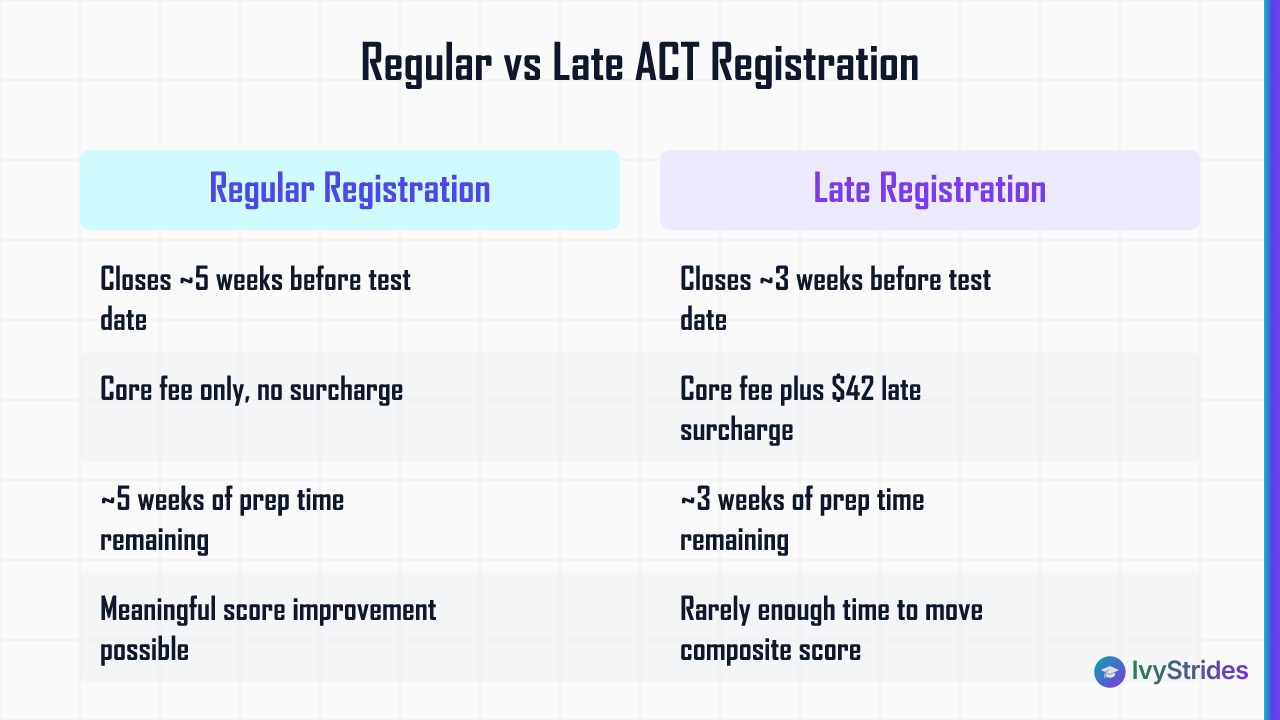
ACT test dates for the 2025 to 2026 US national calendar are September 2025, October 2025, December 2025, February 2026, April 2026, June 2026, and July 2026. Regular registration closes roughly five weeks before each test date. Late registration closes roughly three weeks before, with a $42 surcharge. Confirm exact dates at ACT, Inc.'s test dates page before you register, as calendars shift.
| Window | Timing | Cost implication |
| Regular registration | Closes ~5 weeks before test date | Core fee only, no surcharge |
| Late registration | Closes ~3 weeks before test date | Core fee plus the late surcharge |
| Date change | Before regular deadline of new date | Date-change fee applies |
| Standby testing | Test day at test center, space-available | Additional standby fee, seat not guaranteed |
Picking a test date is a strategic decision, not a scheduling one. Work backward from your college application deadline. If your earliest deadline is November 1, your last usable ACT sitting is typically September or October, because scores take roughly two to eight weeks to release depending on whether you took the paper or computer version. A June or July sitting the summer before senior year is often the smartest first attempt, since it leaves a full retake window before November deadlines close.
If you're a junior also considering the PSAT/NMSQT this fall, coordinating both registration timelines early prevents scheduling conflicts. Our PSAT strategy for juniors walks through the overlap.
A common pattern in our coaching: students who register during late registration, paying the $42 surcharge, often have only three weeks of structured prep time left. Three weeks is rarely enough to move a composite score meaningfully. Register early, prep on a real timeline, and keep the $42.
How to Register for the ACT Online: Step-by-Step
MyACT registration is a ten-step flow at my.act.org. Below is the sequence, in order, so you can finish in one sitting.
-
Create your MyACT account. Go to my.act.org, click "Create MyACT Account," enter your legal name (matching your photo ID), email, and password. Verify your email before continuing.
-
Enter personal information. Address, date of birth, gender, ethnicity (optional). This determines fee-waiver eligibility and score-report routing.
-
Enter high school information. Six-digit CEEB code, expected graduation year, and current grade level. Homeschoolers use 970000.
-
Select a test date. Choose from the 2026 calendar. Only dates still open will appear.
-
Select a test center. Search by ZIP code or city. Not every center offers both paper and computer formats. Computer-format centers are a subset of all centers.
-
Choose paper or computer format. You'll see which options your selected center supports. Format can be changed before the late deadline for a fee, but availability isn't guaranteed.
-
Decide on the Science and Writing add-ons. Science adds $4 and reports as its own score outside the composite; take it if a target program wants it or you want the STEM score. Writing adds $25 and very few colleges require it as of 2026, so check each target school's official admissions page.
-
Upload your digital photo. Meet ACT's requirements: recent, clear headshot, plain background, no sunglasses or hats.
-
Complete the optional background survey. Not required. Skip if you're short on time.
-
Pay and confirm. Enter payment (or your fee waiver code), review the summary, submit. Save the PDF confirmation and print your admission ticket closer to the test date.
Once you're registered, the next question is whether your practice conditions mirror test day. Our act practice test online library reflects the current format and timing so your diagnostic isn't guesswork.
One thing students miss: the free score sends. During registration, you can pick up to four colleges to receive your scores at no extra cost. Choose them at registration or you'll pay per report later. If you're unsure which schools to list, our breakdown of ACT score ranges for top colleges helps you decide whether early sends make sense for your situation.
ACT Registration Fees in 2026: What You Will Actually Pay
Here's what hits your card. Verify current figures at ACT, Inc. before you register, as fees are subject to change.
| Item | Cost | Notes |
| Core ACT (English, Math, Reading) | $68 | Required. All figures per ACT's fee schedule |
| Optional Science section | +$4 | Scored separately; not part of the composite |
| Optional Writing section | +$25 | Only if a target college requires it |
| Late registration surcharge | +$42 | Late window, not standby |
| Test date change | $49 | Requested in MyACT |
| Standby testing | $75 | Test day only, no guaranteed seat; refunded if you are turned away |
| Score sends beyond the first four | Per-report fee | First four are free at registration |
| Test Information Release (TIR) | Additional fee | Select dates only; you get the questions, your answers, the key |
Figures above come from ACT's published fee schedule.
Fee waivers are available to US students who meet ACT's income criteria. You request one through your high school counselor, not directly from ACT. A waiver covers the core $68 fee and includes some score-report credits. It typically does not cover the $4 Science or $25 Writing add-ons or the $42 late surcharge, so waiver students should still register on time. Confirm current fee-waiver coverage at ACT, Inc.'s registration page.
The Test Information Release is underused. For select national test dates, TIR gives you back a copy of the test questions, your answer sheet, and the answer key several weeks after the test. If you're planning a retake, that document is worth more than most practice books. It shows exactly which question types you missed on a real ACT.
A strong ACT composite can also unlock merit scholarships at hundreds of universities, so the registration date you choose is also a financial decision. Our breakdown of how ACT scores affect merit scholarships makes that math concrete.
Can You Take the ACT Online? Paper vs. Computer Format Explained
Yes, the ACT can be taken on a computer, but not at home. The computer-based ACT is administered at an approved test center. It is not a remote or at-home exam. That's the single most common misconception we hear from families.
At a computer-based test center, you'll either use a device provided by the center or bring your own (BYOD) if the center supports it. Content, timing, and scoring are identical to the paper version. What changes is the interface: on-screen highlighting, an on-screen calculator for Math, and no physical booklet to write in.
Paper is still available at most US test centers for 2026. You pick your format at registration. If you want to switch after the fact, you can request a change in MyACT before the late deadline; a fee applies and the format you want may not be available at your chosen center.
Science now sits outside the composite. ACT publishes the composite as the average of English, math and reading, rounded to the nearest whole number, and reports Science as its own section score. Science is also a paid add-on at registration rather than part of the core test, so you choose whether to sit it at all.
That changes the calculation for most students. If your target colleges look at the composite, three sections carry it, and hours spent drilling Science data interpretation buy you a separate score rather than a higher headline number. Sit Science when a target program asks for it, when you want the STEM score, which ACT computes as the average of math and science, or when Science is a genuine strength you want on the record.
Which format should you pick? In our coaching, students who read comfortably on screens and prefer typing to handwriting tend to do better on the computer version, particularly on Reading passages where the on-screen highlighter helps. Students who annotate heavily in the margins and lose focus staring at screens tend to do better on paper. Take one timed diagnostic in each format before you decide.
Whichever format you pick, the score gains come from the same place: diagnostic-driven weakness work with a section-specialist coach. Our 1-on-1 ACT prep pairs students with separate coaches for English/Reading, Math, and Science.
How to Register for the ACT If You Are Outside the United States
International students register at global.act.org, not my.act.org, and must take the computer format. There is no paper option outside the US and Canada. International test dates also differ from the US national calendar, so check global.act.org for your region's schedule.
Do not contact the test center directly to try to register. All international registration runs through the global portal. The center handles logistics on test day, not signups.
The interface at global.act.org is similar to MyACT but uses region-specific test dates and center lists. Fees differ from US registration and typically include an international surcharge on top of the core fee. Confirm at global.act.org before you pay.
For students preparing from abroad, format friction is real. In our coaching with students testing outside the US, practicing on a computer interface from day one reduces test-day surprise. If you're weighing the SAT alongside the ACT from an international base, our guide on how to prep for the SAT from abroad covers the parallel decision.
Is a 27 a Good ACT Score? Setting Your Target Before You Register
A 27 ACT composite is a good score in absolute terms and a mid-tier score for selective universities. It places you roughly in the 85th percentile of all ACT takers, well above the national average of around 19 to 20 per ACT, Inc.. Whether it's the right target for you depends on where you're applying.
For state flagship universities and many selective liberal arts colleges, a 27 is competitive. For the most selective schools (think Ivies, Stanford, MIT, Duke, Vanderbilt, Notre Dame, Cornell), the middle 50 percent ACT range is typically 33 to 35. Verify each school's range via its Common Data Set. A 27 sits below those middle-50 bands, meaning you would apply as a below-median-score applicant at those schools.
Test-optional policies vary by school and year, and a strong score still strengthens applications at many test-optional schools. The same 27 helps or hurts depending on where you send it: against a mid-50 of 24 to 29 it strengthens the file, against a mid-50 of 30 to 34 it usually drags it down.
The point of benchmarking before you register: pick a date that leaves enough weeks to reach your target. Students targeting a 30+ from a 27 baseline typically need roughly eight to twelve weeks of structured section-specialist prep. A jump from a 27 to a 33+ generally calls for about twelve weeks or a two-sitting strategy.
Our full breakdown of ACT score ranges for top colleges lists mid-50 bands by school. If you're not sure how much is realistically reachable from your current baseline, how much can you improve your ACT realistically maps out 4-, 8-, and 12-week gains.
After You Register for the ACT: Building Your Prep Timeline

Photo by cottonbro studio on Pexels
Registration is step one. Step two is a full-length diagnostic in the first week of your prep window. Not content review. Not flashcards. A timed, four-section diagnostic taken under real conditions. In our coaching, students who diagnose first and then build a plan around their two weakest sections improve more efficiently than students who start with generic content review.
Once your registration is confirmed, the next question is how much time you have to prep; our guide on how much can you improve your ACT realistically maps out what is achievable in 4, 8, and 12 weeks. Knowing your target score before you register helps you choose a test date that leaves enough prep time; see our breakdown of ACT score ranges for top colleges to set a concrete goal.
Here's what section-specialist prep tends to unlock:
- ACT English (75 questions, 45 minutes): grammar, punctuation, and rhetorical skills. Fast gains are possible with pattern recognition on comma rules, transitions, and modifier placement.
- ACT Math (60 questions, 60 minutes): pre-algebra through trigonometry. About one minute per question. The most common failure mode is pacing, not content gaps.
- ACT Reading (40 questions, 35 minutes): four passages, roughly nine minutes each. Passage-mapping and question-first strategy are the two biggest levers.
- ACT Science (40 questions, 35 minutes): about 52 seconds per question. Students lose points on conflicting-viewpoints passages and multi-figure data interpretation, not on science content knowledge.
A student with about eight weeks and a 26 composite baseline can typically target a 29 to 30 with consistent section-specialist work on the two weakest sections. Under eight weeks, the realistic goal shifts from raising the composite to protecting it: lock in pacing, stop the repeat error types, and leave the structural work for a retake.
If you have already taken the ACT once and are registering for a retake, our guide on should you retake the ACT walks through the score-band math and the cases where a second sitting is worth it. To see who you'd be working with, our ACT tutors page lists the section-specialist coaches by score band.
One last practical: your admission ticket. Print it a few days before the test and check that the name matches your photo ID exactly. Bring an approved calculator for Math (see ACT's calculator policy at act.org), several sharpened No. 2 pencils if you're taking paper, and a snack for the break. Don't rely on your phone for anything.
FAQ: ACT Registration in 2026
How do I set up my MyACT account?
Head to my.act.org and choose "Create MyACT Account." You'll enter your legal name (the one on your photo ID), an email, and a password, then verify the email before the form lets you continue. The account holds your registrations, scores, and score-send history, so save your login somewhere you'll still have next year.
Can I do my ACT online at home?
No, the computer-based ACT runs at an approved test center only. Selecting "Computer" during registration shows you which centers near you offer that format, and you can then pick between BYOD (bring your own device) or a center-provided device. There is no remote at-home ACT.
Is the ACT changing in 2026?
Yes. The core test is English, math and reading, and Science has moved out to a paid add-on. ACT calculates the composite as the average of English, math and reading, rounded to the nearest whole number, and reports Science separately when you sit it. Check ACT, Inc. for the current structure before your test date.
How much does it cost to register for the ACT?
Core registration is $68 for English, math and reading. Science adds $4 and Writing adds $25. Registering in the late window tacks on a $42 surcharge, per ACT's published fee schedule. Qualifying US students can get a fee waiver through their high school counselor covering the core fee, though generally not the add-ons or the late fee. Pricing shifts, so confirm at ACT, Inc. before you pay.
Can you take the ACT outside the United States?
You can, but the portal and format are different. Register at global.act.org, not my.act.org, and expect a computer-based test: paper isn't offered outside the US and Canada. Region-specific test dates apply, so the calendar won't match the US national one.
How do I register for the ACT as an adult or out-of-school student?
Same process as a current student: MyACT account at my.act.org, standard registration flow. Use "home school" or your most recent high school in the school field. Colleges accept ACT scores regardless of how long ago you left school, so age isn't a barrier.
Is a 1480 SAT or 34 ACT better for college applications?
By the official concordance, a 1480 SAT lines up with roughly a 33 ACT, so a 34 is marginally higher. Both sit near the 98th percentile and admissions offices treat concorded scores as equivalent. Send the higher one after concordance; if both are strong, sending both can reinforce the application.
What happens if I miss the ACT regular registration deadline?
You still have the late window, which closes about three weeks before the test date, for the $42 surcharge ACT publishes. After that, standby testing may open a seat on test day for $75, refunded if you are turned away, but nothing is guaranteed. If timing lets you, register on time and keep the surcharge.
Can I change my ACT test date after registering?
Yes. In MyACT, choose "Make Changes to Your Registration" and request a date change before the regular deadline for your new preferred date. A date-change fee applies. ACT Registration is also reachable at 319.337.1270. Availability depends on your chosen center; a full date can't be changed into.
Your Registration Is the Starting Line
A confirmed ACT registration is a plan on paper. The score is what the next roughly eight to twelve weeks build.

Award-winning author (South Asian Book Award) and graduate of BITS Pilani and UCLA Luskin School of Public Affairs. Brings a published writer's eye to Common App essays and grammatical precision to SAT and ACT R&W instruction.