
The Best ACT Practice Tests in 2026: What to Look For and How to Choose Wisely
On this page
- The Short Answer: Start With Official ACT Practice Tests From ACT.org
- Official vs. Third-Party ACT Practice Tests: Which Are Actually Accurate in 2026
- Not All Practice Tests Are Worth Your Time: What to Look For Before You Download
- Not sure which practice test to start with, or what your score actually means?
- How to Turn Any Practice Test Into a Real Diagnostic (Not Just a Score)
- How Many Practice Tests Do You Need, and When Should You Take Them
- What ACT Score Benchmarks Actually Mean for College Admissions
- Which ACT Study Guide or Book Pairs Best with Practice Tests
- Free ACT Practice Tests: A Ranked List for 2026
- FAQ
- Is a score of 27 on the ACT considered strong?
- Is a 28 out of 36 a good ACT score?
- Is a 17 a bad ACT score?
- Which ACT study guide is best for 2026?
- Are ACT practice tests harder or easier than the real exam?
- Where can I find free ACT practice tests as PDFs?
- Is two months enough time to study for the ACT?
- Where to Go From Here
- Ready to turn your next practice test into a real score improvement plan?
The best ACT practice tests in 2026 are the official ones from ACT.org. ACT, Inc. offers free full-length practice tests as PDF downloads, including the newly released Practice Test 2, which reflects the 2025-2026 enhanced format. For additional volume, some third-party providers offer one free full-length or half-length test online, but official ACT materials should be your first diagnostic and your primary benchmark throughout prep.
The harder question, which the rest of this article answers, is how to actually use those tests: which one to take first, how to review it so the score moves, and how to read your composite against the schools on your list. This guide is reviewed annually to stay current as the official format evolves.

The Short Answer: Start With Official ACT Practice Tests From ACT.org
If you take one action after reading this section, make it this: go to ACT.org's free test prep page and download Practice Test 2. It's the first official test built to the 2025-2026 enhanced format, it's free, and it comes as a PDF with an answer key and a scoring guide. That combination (full-length practice test, current format, official scoring guide) is what makes it the accuracy benchmark.
A full official test contains 215 multiple-choice questions across four sections: an English section (75 questions, 45 minutes), a Math section (60 questions, 60 minutes), a Reading section (40 questions, 35 minutes), and a Science section (40 questions, 35 minutes), plus an optional Writing section (40 minutes), per ACT, Inc.. The composite score runs 1-36, calculated as the average of the four section scores rounded to the nearest whole number.
Why does official calibration matter? ACT, Inc. writes the real exam. Every other publisher is guessing at difficulty, passage length, and question distribution. Official materials are the guess-free option. When you need extra full-length practice under real conditions, our act practice test online library gives you additional volume calibrated to the enhanced format.
Official vs. Third-Party ACT Practice Tests: Which Are Actually Accurate in 2026
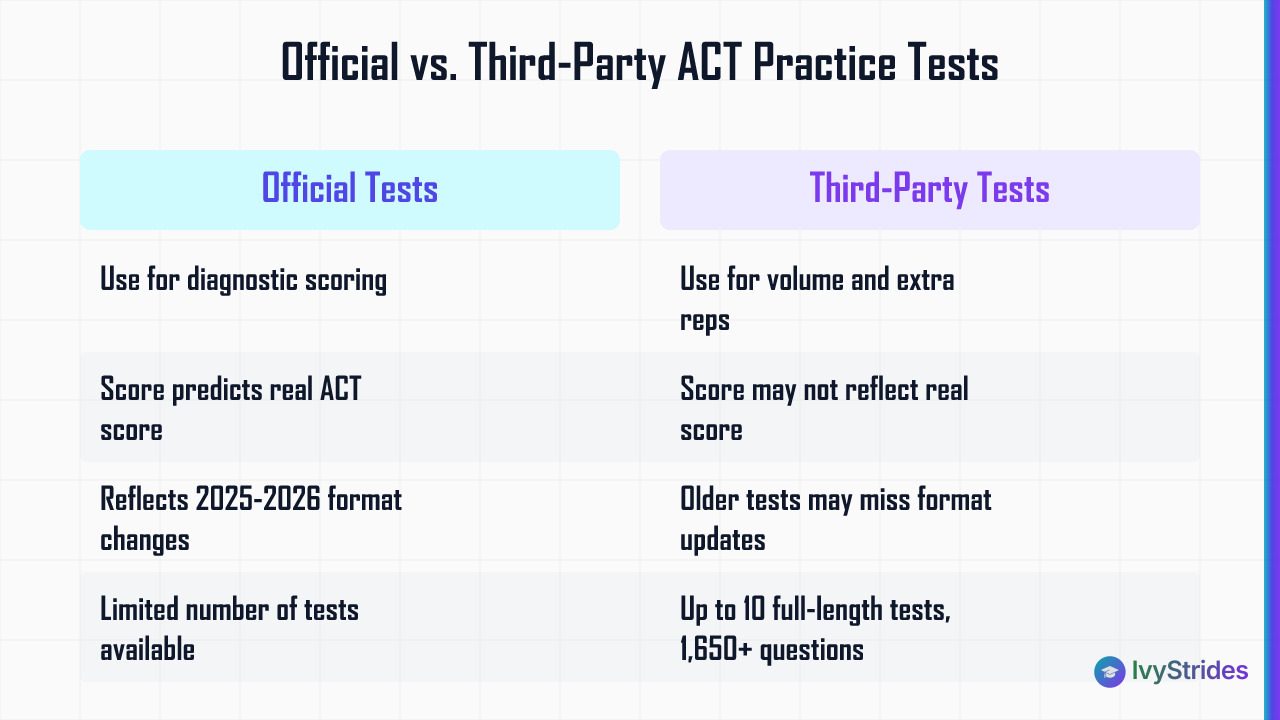
Here's the part most students miss. Third-party tests are not all equal, and they are not equal to official materials. They serve a different purpose: volume.
Because ACT, Inc. updated the test format for 2025-2026, practice tests written before that cycle may not reflect the current passage structures or question distributions, which is why starting with ACT Practice Test 2 (2026) matters. Older third-party tests are still useful for section-level drilling on skills that didn't change (grammar rules, algebra fundamentals, reading comprehension). But if you want a practice score that predicts your real score, use the official test first.
A quick read on the third-party landscape in 2026:
- Some free half-length and full-length ACT tests from third-party test-prep companies come with interactive score reports. Useful for a first taste and for extra reps, but student-reported experience is that a few of these run slightly harder on timing and passage density than the real exam. That can be motivating or discouraging depending on your baseline, but it does mean the score they give you isn't your real score.
- Paid subscription libraries offer larger banks (in some cases 10 full-length tests and 1,650+ targeted questions), which helps for high-volume prep once you've already established a real baseline with an official test.
- Free section-by-section practice from various providers can be useful for drilling one weak area between full-length tests.
The rule holds across all of them: official for diagnostic, third-party for volume. And confirm any test claims the 2025-2026 enhanced format before you trust its score prediction. For a deeper walkthrough of what changed in the current test structure, see the Enhanced ACT format sections and timing breakdown.
Once you have a diagnostic, the real work begins. Our how to raise your ACT score 4 points guide walks through the pattern we see in students who complete our 1-on-1 ACT program, where a 4+ composite gain is typical.
Not All Practice Tests Are Worth Your Time: What to Look For Before You Download
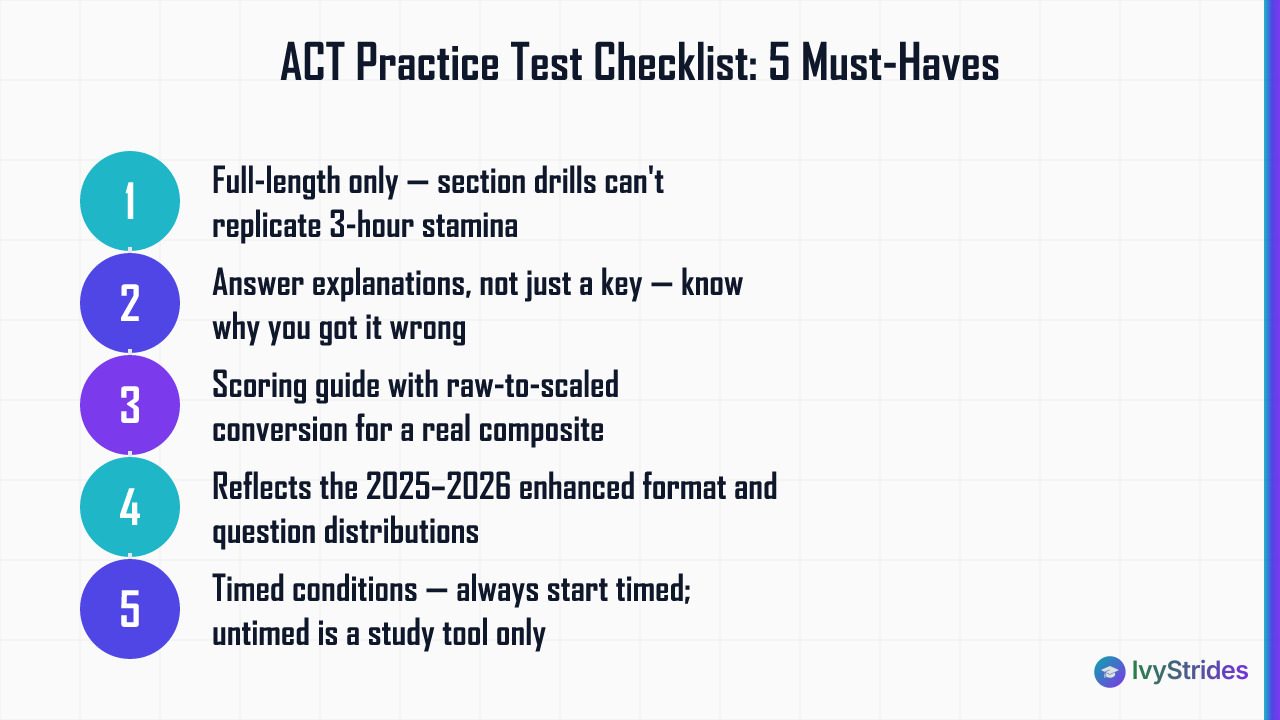
A practice test without a scoring guide can't give you an accurate composite. Full stop. If the PDF or online test lacks a raw-to-scaled conversion table, you've taken a timed quiz, not a benchmark.
Here's the checklist before you commit three hours to any practice test:
-
Full-length, not section-only. Section drills matter, but they can't replicate the stamina and pacing demands of a full three-hour exam. Reading question 195 while tired is a different skill than reading question 15 while fresh. You need to practice the whole arc.
-
Includes answer explanations, not just an answer key. Knowing you got question 34 wrong is nearly useless. Knowing why it was wrong (misread a passage detail, confused two grammar rules, ran out of time) is the whole point.
-
Includes a scoring guide with raw-to-scaled conversion. Without this, you can't estimate a real composite.
-
Reflects the 2025-2026 enhanced format. A test written to the pre-2025 format may have different passage lengths or question distributions than what you'll see on test day.
-
Offers timed conditions. ACT Practice Test 2 (2026) includes both timed and untimed modes on the ACT website. Always start timed. Untimed is a study tool, not a diagnostic.
Section-only drills have a role, but only after a full-length test tells you which section deserves the drill time. For a broader view of how these pieces fit together across a full prep plan, see our ACT prep overview.
Not sure which practice test to start with, or what your score actually means?
Book a free 15-minute strategy call. An IvyStrides ACT coach will review your diagnostic snapshot, identify your highest-leverage sections, and recommend the right practice plan for your score band and timeline. Parents and students both welcome on the call.
How to Turn Any Practice Test Into a Real Diagnostic (Not Just a Score)
Choosing the right practice test is only the first step. In our coaching, the diagnostic review after the test, where you tag every wrong answer by section and question type, is what actually moves the composite score.
A composite of 24 tells you almost nothing about what to study. A composite of 24 broken down as English 28, Math 22, Reading 26, Science 20 tells you everything: Science is the priority, Math is the secondary target, and English is already close to a strong-score band. Section-level error analysis is where the diagnostic earns its name.
Once you've isolated the weak section, tag each wrong answer by question type. The official ACT structure gives you clear categories to use:
- ACT English (75 questions): usage and mechanics (punctuation, grammar, sentence structure) versus rhetorical skills (strategy, organization, style).
- ACT Math (60 questions): pre-algebra, elementary algebra, intermediate algebra, coordinate geometry, plane geometry, and trigonometry.
- ACT Reading (40 questions): literary narrative, social science, humanities, and natural science passages.
- ACT Science (40 questions): data representation, research summaries, and conflicting viewpoints passages.
In our coaching with students in the 26-29 band who plateau, we frequently see that most of the lost points come from one or two question types in a single section, not from broad weakness across the whole test. That's a very different problem to solve than "get better at Science," and it's the kind of insight only a tagged error log produces.
The most common mistake we see is retaking a practice test without first reviewing every wrong answer by question type. The score doesn't move because the study time between tests wasn't aimed at anything specific. Spaced retesting only works when the space in between is filled with targeted weakness work. For more on this rhythm, our guide on how to improve your ACT score walks through the full diagnostic-first cycle.
Students who arrive at their first coaching session with a completed official practice test and a tagged error log start with a concrete plan on day one. If you want that structure with a section-specialist coach (a separate expert for English/Reading, Math, and Science), our 1-on-1 ACT prep is built around exactly this workflow.
How Many Practice Tests Do You Need, and When Should You Take Them
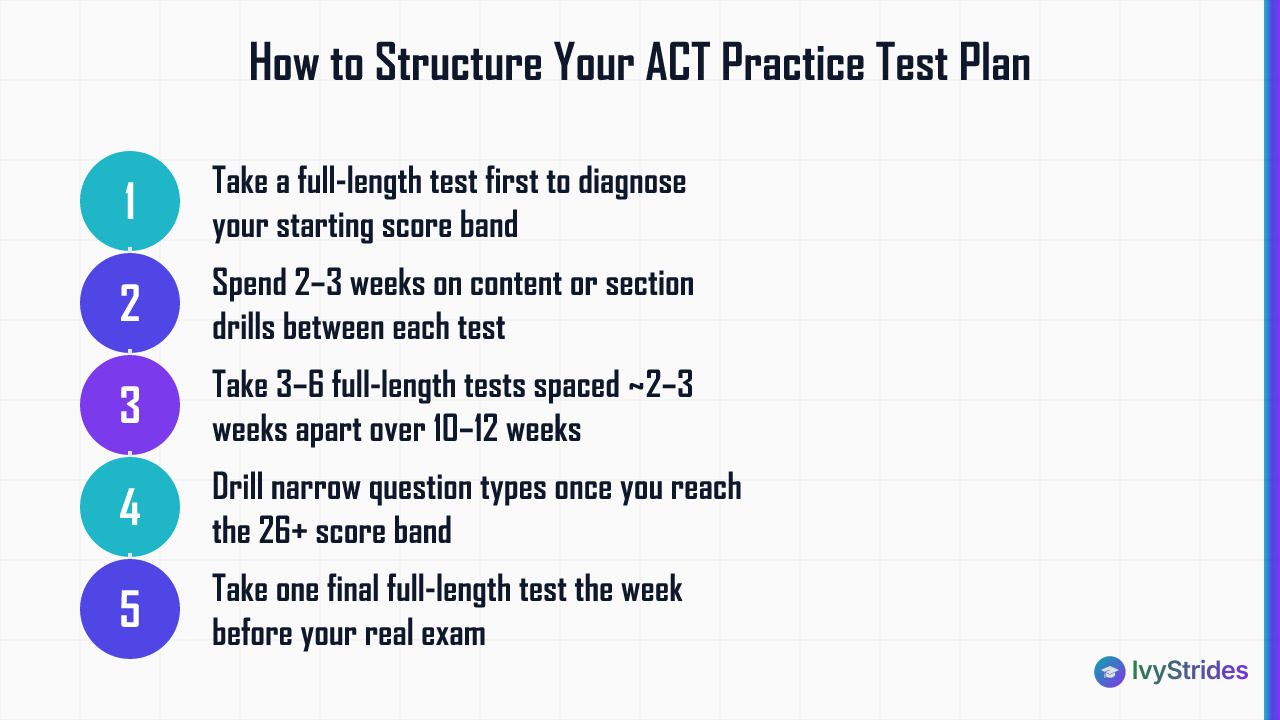
Short answer: a three-month prep plan typically includes roughly 4-6 full-length practice tests spaced about 2-3 weeks apart. A two-month plan can work with roughly 3-4 tests if the weeks between are filled with targeted section work.
A commonly cited benchmark for meaningful ACT improvement is around 80 total study hours, or roughly 6-8 hours per week over about 10-12 weeks. Some students need more, some need less. The variable that matters most is your starting score band.
- 17-20 composite: you'll benefit from more section-drill volume between full-length tests. Foundational content review (grammar rules for English, algebra fundamentals for Math) has to happen before more practice tests will produce gains. Take a full-length test to diagnose, then spend roughly 2-3 weeks on content before the next test.
- 21-25 composite: the classic sweet spot for full-length practice. Around four to six tests over 10-12 weeks, with targeted work on the two weakest sections between tests, is the typical rhythm.
- 26-29 composite: you likely don't need six full-length tests. Three or four is usually enough, and the rest of your hours should go into targeted question-type work on the specific weaknesses your error log surfaces. This is where students plateau if they keep taking whole tests instead of drilling narrow question types.
- 30+ composite: fewer full-length tests, more surgical work on the specific questions you missed. At this band, every point costs more effort, and it's almost always earned in one or two question types.
Take one final full-length practice test the week before your real exam. Use it for pacing confidence, not to introduce new material. If your score dips a bit that week, that's normal fatigue, not a signal to panic. If you've stalled across several tests in a row, our how to break an ACT score plateau piece covers the diagnostic pattern we see most often.
What ACT Score Benchmarks Actually Mean for College Admissions
Percentile context, grounded in national ACT data:
- 17: approximately the 30th-35th percentile. Below the median at most four-year colleges, but a starting point, not a ceiling.
- 20-21: roughly the national average.
- 27: approximately the 85th percentile. Competitive at many selective universities, though the 25th-75th enrolled range varies by school.
- 28: approximately the 88th percentile. Solid at most selective universities. At highly selective schools with enrolled medians of 33-35, a 28 would fall below the 25th percentile of admitted students.
- 34: roughly the top 1 percent nationally.
- 36: 100th percentile, the highest possible composite.
A composite of 34 or above puts a student in roughly the top 1 percent nationally and is competitive at every Ivy League and highly selective university, though admissions outcomes depend on the full application, not the test score alone. Course rigor, GPA, essays, activities, and recommendations all carry real weight.
Even at test-optional schools, a strong ACT score submitted voluntarily can strengthen an application, so confirming a school's current policy at FairTest.org before deciding whether to prep is a worthwhile five-minute check. The Common Data Set for any specific university lists the 25th-75th percentile ACT range for enrolled students; search "Common Data Set [University Name]" to find it.
Still weighing whether the ACT is even the right test for you? Compare ACT vs SAT difficulty before you commit to a prep plan. Some students naturally test better on one than the other, and our is the ACT harder than the SAT breakdown walks through the format differences that tend to favor each.
Which ACT Study Guide or Book Pairs Best with Practice Tests
The Official ACT Prep Guide 2025-2026, published by ACT, Inc., is the primary book recommendation. It contains four full-length practice tests built to the enhanced format, along with content review and strategy sections. That's four additional official tests beyond the free PDFs on ACT.org, which is enough volume for most prep timelines.
Practice tests and prep books serve different functions, and both matter. A prep book provides content review and question-type strategy; a practice test provides diagnostic data under timed conditions. Skip either one and prep gets lopsided. For ACT Math specifically, a student who can't identify which algebra or geometry concept a question is testing won't improve much from practice tests alone. Content review has to close that gap first. Then practice tests confirm the retention.
If you're still deciding between the ACT and the Digital SAT, taking one official practice test for each is the most reliable way to see which format plays to your strengths before committing to a full prep plan. For students switching mid-prep, our act-vs-digital-sat-transitions guide covers the mechanics.
Free ACT Practice Tests: A Ranked List for 2026
Ranked by accuracy and usefulness for a 2026 prep cycle:
-
ACT Practice Test 2 (2026), PDF via ACT.org. Free. Reflects the enhanced format. Includes answer key and scoring guide. Current gold-standard free resource. Take it first.
-
ACT Practice Test 1, PDF via ACT.org. Free. Pre-enhanced format, but still useful for English and Reading section practice, where the underlying skills didn't change.
-
The Official ACT Prep Guide 2025-2026 (paid book). Four additional full-length practice tests built to the enhanced format, plus content review. Not free, but the four extra official tests are worth the price for most students.
-
Third-party free half-length or full-length tests online. Useful for a quick baseline read or one extra full-length rep between official tests. Some run slightly harder on timing and passage density than the real exam.
-
Free section-by-section practice from various third-party providers. Useful for targeted drilling on a single weak section between full-length tests. Not a substitute for full-length practice.
-
Paid subscription libraries with large practice-test banks. Useful once you've burned through official materials and want more high-volume reps. Not the first stop.
For students who want additional practice-test volume calibrated to the enhanced format, our act practice test online library is built for that purpose. If you're looking specifically for current free official PDFs and other diagnostic tools, we keep a running list on our free downloads page.
FAQ
Is a score of 27 on the ACT considered strong?
A 27 sits at approximately the 85th percentile nationally, meaning a student scored higher than roughly 85 percent of test-takers. It's competitive at many selective colleges, though the 25th-75th percentile range varies by school. Check the Common Data Set for any specific university to see where a 27 falls relative to enrolled students.
Is a 28 out of 36 a good ACT score?
A 28 is approximately the 88th percentile nationally and is a solid score at most selective universities. For highly selective schools with median enrolled ACT scores of 33-35, a 28 would fall below the 25th percentile of admitted students, so target-score planning should account for the specific schools on a student's list. Admissions depend on the full application, not the score alone.
Is a 17 a bad ACT score?
A 17 falls around the 30th-35th percentile, below the national average of roughly 20-21. It's not competitive at most four-year colleges, but it's a starting point, not a ceiling. In our coaching with students who begin in the 17-20 range, a structured diagnostic plan targeting the highest-use question types in English and Math typically produces the fastest composite gains.
Which ACT study guide is best for 2026?
The Official ACT Prep Guide 2025-2026, published by ACT, Inc., is the most reliable study guide. It contains four full-length practice tests built to the enhanced format, along with content review and strategy sections. For students who want additional section-specific depth, pairing the official guide with a targeted Math or English strategy workbook is a common approach.
Are ACT practice tests harder or easier than the real exam?
Official ACT practice tests from ACT.org are calibrated to match real exam difficulty as closely as possible, so they're the most reliable predictor of your actual score. Third-party tests vary: some are reported by students as slightly harder on timing and passage density, while others may be easier. For the most accurate benchmark, always use an official ACT practice test as your primary diagnostic.
Where can I find free ACT practice tests as PDFs?
ACT, Inc. offers free practice test PDFs directly at ACT.org, including the 2026 Practice Test 2, which reflects the enhanced format. Each PDF includes the full test, an answer key, and a scoring guide. These are the most accurate free ACT practice tests available as PDFs and should be the first resource any student downloads.
Is two months enough time to study for the ACT?
Two months can work for students who are consistent and strategic, though three months is the more commonly recommended timeline. A two-month plan should include roughly 3-4 full-length practice tests, about 6-8 hours of study per week, and targeted weakness work between each test. Students starting below a 20 composite may need more time to build foundational content skills before practice tests become maximally useful.
Where to Go From Here
Download ACT Practice Test 2 from ACT.org. Take it under timed conditions this weekend. Log every wrong answer by section and question type. That gives you the raw material for a real prep plan, and everything else (which book to buy, which sections to prioritize, whether two months is enough) becomes answerable once you have a diagnostic. To see how our section-specialist coaches structure this work, visit our about page. You can also meet the tutors who work with students across every ACT score band.
Ready to turn your next practice test into a real score improvement plan?
IvyStrides ACT coaches work 1-on-1 with students at every score band, from a first diagnostic at 17 to a final push toward 34. Book a free 15-minute call and leave with a concrete next step. Parents welcome to join.

Award-winning author (South Asian Book Award) and graduate of BITS Pilani and UCLA Luskin School of Public Affairs. Brings a published writer's eye to Common App essays and grammatical precision to SAT and ACT R&W instruction.