
How to Break an ACT Score Plateau: The Complete 2026 Playbook for a Top Score
On this page
- What an ACT Score Plateau Actually Means (and Why More Practice Tests Make It Worse)
- Step 1: Run a Real Diagnostic Before You Change Anything
- Why Your Score Is Stuck: The Three Root Causes of an ACT Plateau
- Section-by-Section Plateau Breakers: English, Math, Reading, and Science
- ACT English (75 questions, 45 minutes)
- ACT Math (60 questions, 60 minutes)
- ACT Reading (40 questions, 35 minutes across 4 passages)
- ACT Science (40 questions, 35 minutes across 6 or 7 passages)
- How the Enhanced ACT 2026 Changes Your Plateau Strategy
- Realistic Score Targets by Band: How Much Improvement Is Achievable
- When Switching to the Digital SAT Is Worth Considering
- Building a 6-Week Plateau-Breaking Study Plan
- FAQ
- How do I raise my ACT score from a 17 to a 30?
- How rare is a 30 on the ACT, and is it a good target score?
- Can you miss questions and still get a 36 on the ACT?
- Is a 34 ACT good enough for Ivy League admissions?
- Why can't my ACT score improve even though I keep studying?
- Is a 1350 SAT or a 29 ACT better for college applications?
To break an ACT score plateau, stop adding practice tests and start diagnosing why you're missing points. Take one timed, full-length official ACT practice test, then log every error by section and question type. Most plateaus trace to one of three causes: a content gap in a specific question category, a pacing problem that forces rushed guessing in the final minutes, or a pattern of careless errors on question types you actually know. Once you identify the root cause, targeted drilling on that specific weakness, combined with spaced retesting, is what moves the composite needle.
Section structure, timing, and percentile figures throughout this article come from ACT, Inc.. The rest of this playbook shows you how to run the diagnosis and what to do with the answer.

What an ACT Score Plateau Actually Means (and Why More Practice Tests Make It Worse)
An ACT score plateau is a composite that lands within 1 to 2 points across two or more attempts, even though the student is still studying. The composite is the average of four section scores, English, Math, Reading, and Science, each on the 1 to 36 scale, per ACT, Inc. scoring documentation. When that average keeps landing in the same narrow range, something structural in the prep is broken.
Two plateau types exist, and they need different fixes.
A full-composite plateau means all four section scores are clustered close together and none is meaningfully worse than the others. Every section has a little room to improve. A single-section plateau means one section is dragging the composite by 2 to 3 points while the other three are already strong. This is the more common pattern for students at 27 to 31, and it's the easier one to fix once you name it.
Here's the part most students miss. Taking another full-length practice test without a structured error review is the fastest way to deepen a plateau. You're reinforcing the same reading habits, the same pacing decisions, and the same shortcut patterns that produced the last score. Repetition without diagnosis is just repetition. The error log, covered in the next section, is what turns a practice test into diagnostic information.
For a broader treatment of the full improvement arc, see our guide on how to improve your ACT score.
Step 1: Run a Real Diagnostic Before You Change Anything
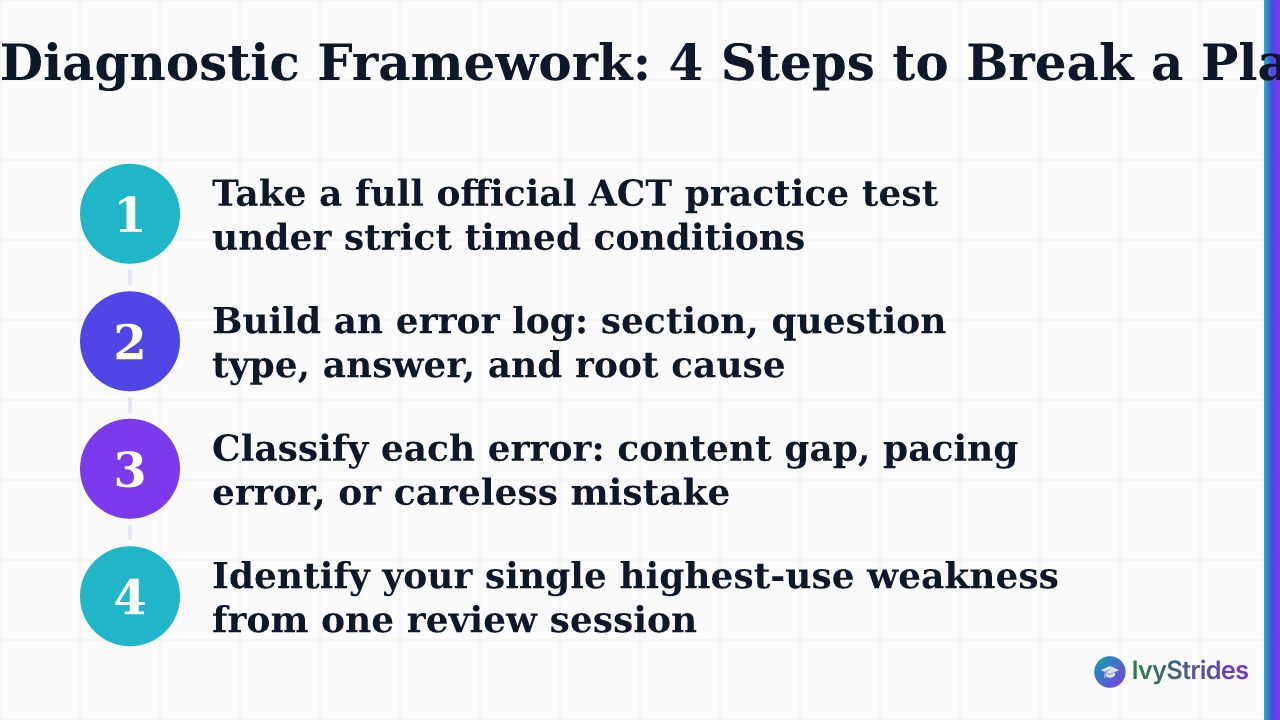
The same diagnostic-first framework that drives typical 4-point ACT composite gains in our coaching applies directly to plateau-breaking: start with a timed full-length test, log every error by category, and drill the highest-use weakness before retesting.
Do this in one sitting, under real conditions.
Use an official ACT practice test, not a third-party simulation. Third-party tests miscalibrate difficulty and question style, and a miscalibrated diagnostic sends you in the wrong direction. Sit for the full length of the exam, in one block, with strict timing per section. No phone. No pauses between sections beyond the official break.
Then build your error log. The columns matter:
- Section (English, Math, Reading, Science)
- Question number
- Question type or category (rhetorical skills, coordinate geometry, humanities passage inference, conflicting viewpoints, and so on)
- The correct answer
- Your answer
- Root cause: content gap, pacing error, or careless mistake
Root cause is the whole point of the log. A content gap means you didn't know the underlying rule or concept. A pacing error means you rushed or ran out of time and guessed. A careless error means you knew the answer on review but missed it under pressure. These three causes require completely different fixes, and mixing them together is why generic prep stalls.
In our coaching, students who build an error log after their first diagnostic typically identify their highest-use weakness within one review session. That's usually a single question category, not a whole section.
One more note on pacing. Timing errors account for a disproportionate share of missed points in ACT Reading and Science for students at roughly 25 to 30. If your last few missed questions in a section were all near the end, that's a pacing signal, not a content signal. Grab our online act practice test to start the diagnostic if you need a current, timed option.
Why Your Score Is Stuck: The Three Root Causes of an ACT Plateau
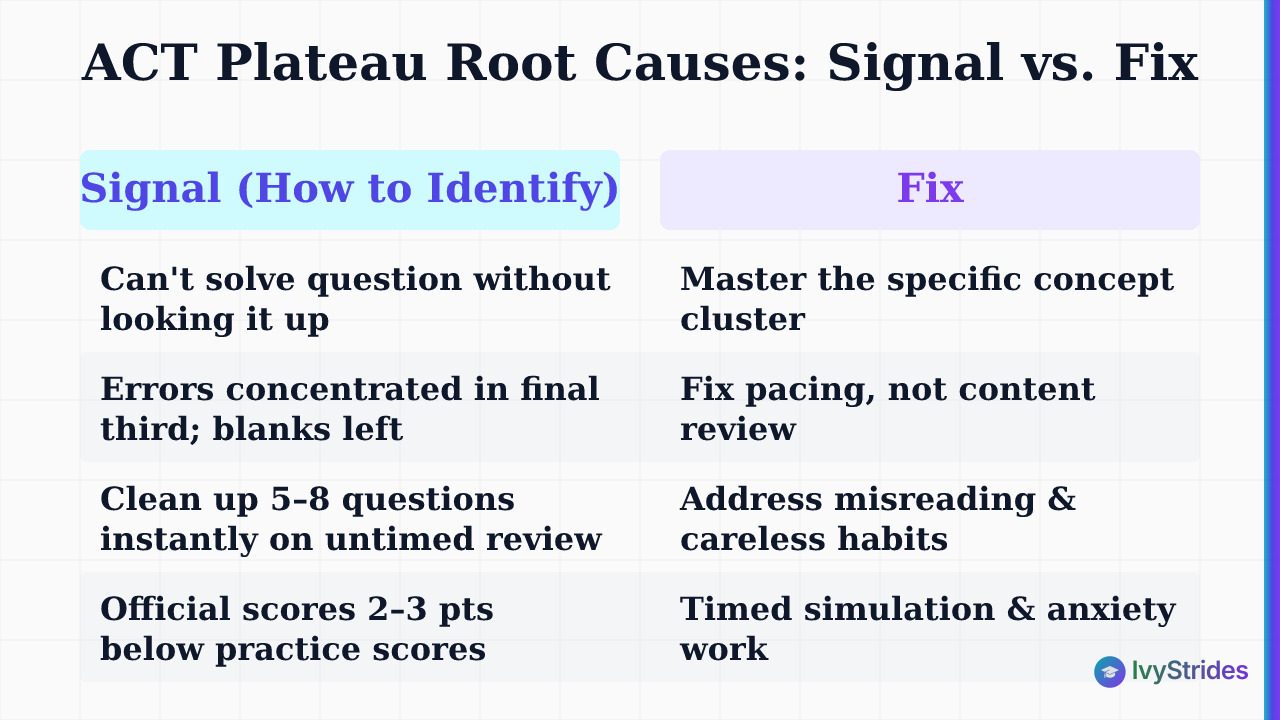
Once your error log is built, sort every missed question into one of three buckets. Almost every plateau traces to a dominant bucket, and the fix follows from that.
Content gap. You didn't know the rule, formula, or concept. Signal: on review, you still can't get the question right without looking something up. Example: a student at 28 in ACT Math missing roughly 8 to 10 questions across coordinate geometry and trigonometry has a content gap, not a pacing problem. Re-drilling algebra they already know won't move that score. Mastering the specific concept cluster will.
Pacing problem. You knew the material but ran out of time. Signal: your errors are heavily concentrated in the final third of the section, or you left questions blank. ACT Reading is 40 questions in 35 minutes across 4 passages, per ACT, Inc. That works out to roughly 8 to 9 minutes per passage. If you spend 12 minutes on passage 1, you're pacing-limited on passages 3 and 4 no matter how much content you review. ACT Science works out to about 5 minutes per data representation or research summaries passage, and roughly 8 minutes for the conflicting viewpoints passage.
Careless error pattern. You knew the answer, got it right on review, and missed it under timed conditions. Signal: on untimed review you clean up roughly 5 to 8 questions instantly. This is the dominant pattern for students plateauing at 30 to 33. They aren't missing hard content. They're misreading answer choices, skipping negatives, or trusting the first plausible answer.
There's a fourth cause worth naming: test anxiety as a behavioral driver. If your practice test scores are consistently 2 to 3 points higher than your official test scores, the intervention isn't more content drilling. It's timed simulation under pressure and, in some cases, structured anxiety work. Different problem, different fix.
In our coaching with students at the 27 to 30 band, pacing errors are the most common plateau driver in Reading and Science, not content gaps. Most students at this band assume they need to learn more, when they actually need to time themselves more honestly. For a fuller look at how we structure the full arc, see our ACT prep overview.
Section-by-Section Plateau Breakers: English, Math, Reading, and Science
Once you know the root cause, the fix is specific to the section. Here's what actually moves each one.
ACT English (75 questions, 45 minutes)
English splits into two question categories per ACT, Inc.: usage and mechanics (punctuation, grammar, sentence structure) and rhetorical skills (strategy, organization, style). Most plateau students at 28 to 31 in English are losing points on rhetorical skills, not punctuation. They've memorized comma rules and can't tell you why a paragraph belongs at position 3 instead of position 1.
The fix: sort your English errors by category. If more than roughly 60 percent of your misses are rhetorical skills, drill rhetorical skills question types in isolation, not full English sections. Strategy questions ("Would this addition strengthen the paragraph?") and organization questions ("Which order best presents the writer's argument?") reward a different kind of thinking than mechanics questions, and they respond to focused practice within a few weeks.
ACT Math (60 questions, 60 minutes)
Math covers pre-algebra through trigonometry. Students at 26 to 30 in Math typically have a cluster of roughly 6 to 10 questions in one concept area, often trigonometry, complex numbers, matrices, or logarithms, that they skip entirely or guess on. That single cluster is the plateau. Re-drilling algebra they already handle at high accuracy won't help.
The fix: look at your last three math error logs. If the same two or three concept tags keep appearing, that cluster is your target. Master it, don't tour it.
ACT Reading (40 questions, 35 minutes across 4 passages)
Passage types are fixed: literary narrative, social science, humanities, natural science. Students who read every passage fully before touching questions often run out of time on passages 3 and 4. The passage-first habit feels responsible, but it costs points at 30-plus.
Test the questions-first approach on one passage type per practice session. Read the questions, skim for the referenced lines, answer. Track time per passage. If you're consistently faster on one passage type, lead with it. Some students find literary narrative slowest and social science fastest. Some are the reverse. Your data beats generic advice.
ACT Science (40 questions, 35 minutes across 6 or 7 passages)
Science passages come in three types: data representation, research summaries, and conflicting viewpoints. Here's the use move most students miss. The conflicting viewpoints passage is roughly 7 questions and is really reading comprehension, not science knowledge. Students at 28 to 31 in Science who skip it or leave it for last typically lose 5 to 7 questions there.
The fix: do conflicting viewpoints first, when you have full attention. Then work data representation and research summaries.
Section-specialist coaching is the escalation path when self-directed drilling stalls. One coach per section, not a generalist working across all four, is how you close the last 3 to 5 points at the top of the scale. If that's where you are, our 1-on-1 ACT prep pairs students with section specialists. If you're also weighing format changes, read what is the Enhanced ACT next.
How the Enhanced ACT 2026 Changes Your Plateau Strategy
The Enhanced ACT introduced in 2025-2026 includes section retesting, which changes plateau strategy: a student stuck at 28 in Science can now target that section in isolation rather than retaking the full exam.
That's a significant shift. Before section retesting, a student with a 32 English, 33 Math, 32 Reading, and 27 Science had to sit for the entire exam to move that Science score. Now the strategy is targeted: roughly 4 to 6 weeks of Science-specific drilling, one section retake, done.
Other Enhanced ACT changes to be aware of include an optional Science section on some administrations, a shorter overall test format, and a remote proctoring option. Rollout timing and availability vary by administration and region. Verify current format details, section retesting eligibility, and Science optionality against the official ACT, Inc. site before you plan around them, as details continue to update.
One practical warning: prep books and practice tests published before the Enhanced ACT rollout may not reflect current section counts, timing, or the retesting option. If your prep material predates 2025, cross-check it against current ACT, Inc. documentation. For a fuller breakdown, see our post on Enhanced ACT changes for 2026.
Realistic Score Targets by Band: How Much Improvement Is Achievable
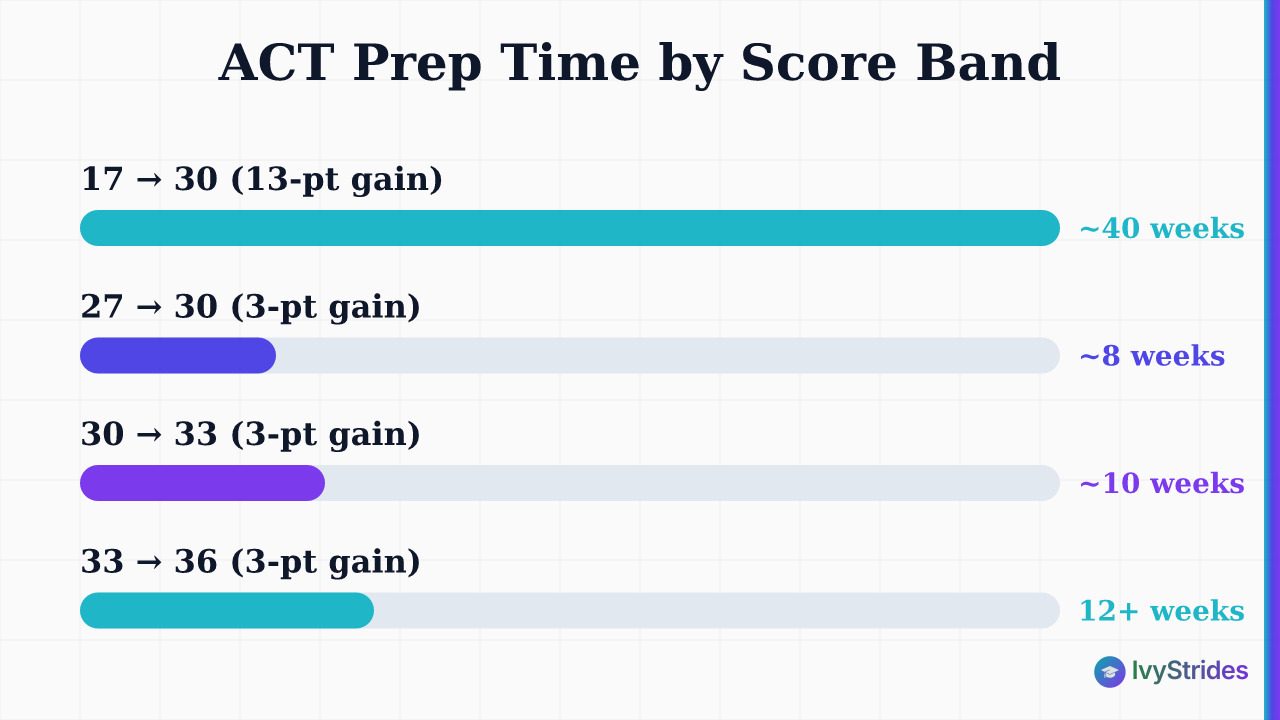
Honesty about timelines matters here. The effort required to move from 27 to 30 isn't the same as the effort to move from 33 to 36. Here's what the score bands actually demand.
17 to 30 (a 13-point gain). A large, multi-section undertaking. You're addressing fundamental content gaps in more than one section, not fine-tuning. In our coaching, students starting near 17 typically need roughly 4 to 6 months of structured prep at about 8 to 12 hours per week, beginning with a full diagnostic to identify which sections are furthest below target. Achievable, but not fast.
27 to 30 (a 3-point gain). The most common plateau-breaking scenario. Almost always driven by one or two sections dragging the composite. In our coaching, this typically takes roughly 6 to 10 weeks of targeted drilling on those sections, with pacing work usually doing more of the lifting than content review.
30 to 33 (moving from roughly the 93rd to about the 98th percentile, per ACT, Inc. national ranks). Marginal gains come from eliminating careless errors and mastering the hardest question types in each section. You're no longer learning new content. You're cleaning up execution. Typical timeline in our coaching is around 8 to 12 weeks.
33 to 36. A 36 composite is the 100th percentile and is earned by fewer than 0.1 percent of test-takers annually, per ACT, Inc. Every additional point at this level requires near-perfect execution across all four sections, or across the sections you retake if you're using section retesting. This is where a section specialist matters most.
For anchor context: a 29 ACT is approximately equivalent to a 1350 SAT, and a 34 ACT to a 1480 SAT, per the ACT, Inc. concordance table. Colleges may draw their own comparisons, so treat these as approximate.
A strong ACT score removes one barrier in the admissions file, but it works alongside your college essays, not instead of them. Even at test-optional schools, a composite at or above a school's middle-50 range typically strengthens the application, so breaking your plateau has real admissions value. Test-optional policies vary by school and by year, per FairTest, and admissions outcomes always depend on the full application, not test scores alone. For school-specific context on what a competitive score looks like, our post on Should You Apply to Duke University walks through one selective example. Our ACT vs SAT difficulty breakdown is useful if you're weighing formats.
When Switching to the Digital SAT Is Worth Considering
If you've been stuck at the same ACT composite for three or more attempts, it's worth asking whether the Digital SAT's format might suit your strengths better before investing another prep cycle in the ACT.
The two tests reward different skills. The ACT is linear, faster-paced, and includes a dedicated Science section that rewards data interpretation under tight time pressure. The Digital SAT is adaptive, with two modules per section where the second module's difficulty adjusts based on your first-module performance, per College Board. Reading passages on the SAT are shorter and question-per-passage counts are lower.
Some students who are strong in extended, careful reading but weak in timed science data interpretation score materially higher on the Digital SAT than the ACT, even at equivalent effort. Others go the other way. You can't know which without testing it.
The low-cost experiment: take one timed Digital SAT practice test under real conditions. Compare your percentile on that test to your percentile on your most recent ACT. If the SAT percentile is meaningfully higher, and you have runway before application deadlines, a format switch may be the fastest path to a stronger submitted score. If it's close, stay with the ACT and finish the plateau-breaking cycle.
For a fuller comparison, see our post on ACT vs SAT. If you're already leaning toward switching, our post on act vs digital sat transitions walks through how students actually make the shift.
Building a 6-Week Plateau-Breaking Study Plan
Here's the concrete cycle. Six weeks, roughly 5 to 8 hours per week. In our coaching at the 27 to 30 band, students completing this cycle typically see about 2 to 4 composite points of improvement. Assume you've already taken the ACT once and have a real baseline.
Week 1: Diagnostic and error log. Take one timed full-length official ACT practice test. Build your error log using the columns above. Identify the top two weakness categories per section. Don't touch full-length tests again until Week 6.
Weeks 2 through 4: Targeted weakness drilling. Drill the single highest-use weakness category for about 45 to 60 minutes per session, roughly 4 to 5 sessions per week. If your top weakness is ACT Math trigonometry, that's what you drill. Not full math sections. The specific cluster. Rotate to your second-highest weakness only after the first is at roughly 85 percent accuracy on untimed practice.
Week 5: Timed section practice with pacing checkpoints. No full tests, only timed single sections. For Reading, mark your watch time after each passage and compare to the 8-to-9-minute target. For Science, do the conflicting viewpoints passage first. This is where pacing habits become automatic.
Week 6: Full-length timed retest. Take a second timed full-length official ACT practice test. Build a new error log. Compare Week 6 to Week 1: did your targeted weakness category shrink? Are pacing errors down? That comparison, not the composite score alone, tells you whether the cycle worked.
If your targeted category improved but the composite didn't move, your next-highest weakness is now the primary driver. Repeat the cycle. If the composite jumped 2 to 4 points, schedule your official test date. To load current practice material into the cycle, use our digital ACT prep library. For a lightweight error-tracking template, our SAT mistake tracker adapts easily to ACT categories.
FAQ
How do I raise my ACT score from a 17 to a 30?
A 13-point composite gain is a major undertaking that requires addressing content gaps across all four sections, not just one. In our coaching, students starting at 17 typically need roughly 4 to 6 months of structured prep at about 8 to 12 hours per week, beginning with a full diagnostic to identify which sections are furthest below target. The 17-to-30 path is achievable but requires consistent, category-specific drilling rather than general review, and a realistic target date at least two testing windows away.
How rare is a 30 on the ACT, and is it a good target score?
A 30 ACT composite places a student at approximately the 93rd to 94th percentile nationally, per ACT, Inc. national ranks data. That means roughly 6 to 7 out of every 100 test-takers reach 30 or above, making it a strong but attainable target for a well-prepared student. For most selective colleges, a 30 falls within or near the middle-50 range, though specific score expectations vary by school and admissions outcomes always depend on the full application.
Can you miss questions and still get a 36 on the ACT?
Yes, on many ACT administrations a student can miss one or two questions and still receive a 36 composite, because the ACT uses a scale-score conversion that allows for small variation. However, the exact number of allowable misses depends on the specific test form and its difficulty calibration, and it isn't a fixed rule across administrations. A 36 composite requires near-perfect performance across all four sections and is earned by fewer than 0.1 percent of test-takers annually, per ACT, Inc.
Is a 34 ACT good enough for Ivy League admissions?
A 34 ACT is a strong score at roughly the 99th percentile, and it falls within or above the middle-50 range at several Ivy League schools. That said, Ivy League admissions depend on the full application, including essays, course rigor, extracurriculars, and recommendations, not test scores alone. A 34 is competitive at most Ivies but isn't a guarantee of admission at the most selective institutions, and test-optional policies vary by school and year, per FairTest.
Why can't my ACT score improve even though I keep studying?
The most common reason is studying without a structured error analysis. If you're reviewing content you already know, or taking practice tests without logging why you missed each question, you're reinforcing existing habits rather than fixing the specific weakness holding your score down. The fix is to stop adding practice tests and start diagnosing: build an error log after your next timed test and identify whether your missed questions trace to a content gap, a pacing problem, or careless errors.
Is a 1350 SAT or a 29 ACT better for college applications?
A 1350 SAT and a 29 ACT are approximately equivalent scores per the ACT, Inc. concordance table, both landing near the 90th to 93rd percentile. For college applications, submit whichever score is higher relative to the specific school's middle-50 range, or submit both if both are at or above the school's 50th percentile. At test-optional schools, some students choose to submit only their stronger score, though policies vary.
Plateaus break when diagnosis replaces repetition. Run the diagnostic, build the error log, name the root cause, drill the specific weakness, and retest. That's the whole method, and it's the same method our section-specialist coaches use with students at every band.

Award-winning author (South Asian Book Award) and graduate of BITS Pilani and UCLA Luskin School of Public Affairs. Brings a published writer's eye to Common App essays and grammatical precision to SAT and ACT R&W instruction.