
How Can Parents Support ACT Prep: The Complete 2026 Guide
On this page
- What Parents Can Actually Do to Help with ACT Prep (The Short Answer)
- Step 1: Start with a Diagnostic Test, Not a Guess
- When Should Your Student Start ACT Prep?
- Setting a Realistic Score Goal Together
- The Hardest Part: Staying Involved Without Taking Over
- How to Choose the Right ACT Prep Resources for Your Student
- Does ACT Prep Actually Move Scores? What the Evidence Shows
- Managing the Logistics: Registration, Dates, and Test-Day Prep
- Keeping ACT Prep in the Bigger Admissions Picture
- FAQ
- When is the right time for a student to start ACT prep?
- Is a score of 27 out of 36 a good ACT score?
- Is ACT prep worth it, or does the test just measure fixed ability?
- Is two months enough time to prepare for the ACT?
- How much does quality ACT prep typically cost, and is it worth the investment?
- Should a student take the ACT or the SAT?
Parents support ACT prep most effectively by handling logistics (registration, test dates, a quiet study space), helping set a realistic target score based on the student's college list, and providing calm accountability without taking over the studying. The student has to do the actual learning. Start by running a full-length diagnostic practice test to get a baseline composite score, then build a prep schedule backward from the target test date. Most students benefit from starting prep at the end of sophomore year or the summer before junior year, which leaves enough time for at least two full practice cycles before the first official sitting.
Every format and scoring detail below traces back to ACT, Inc.'s official site, which you should treat as the final word on dates and rules. The rest of this guide walks the division of labor step by step: how to run the first diagnostic, when to start, how to set a target score that's ambitious but honest, how to stay involved without micromanaging, and how to pick prep resources that match your student's score gap.

What Parents Can Actually Do to Help with ACT Prep (The Short Answer)
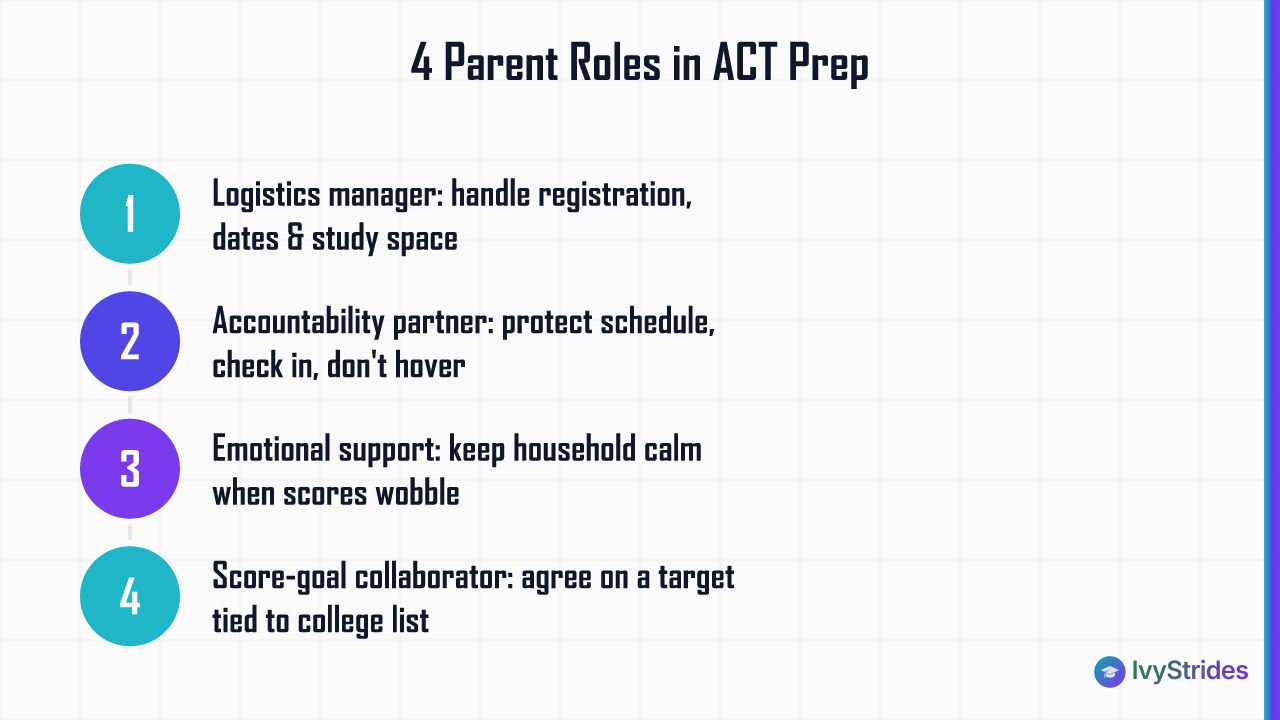
Think of your job in four roles. Logistics manager: you handle registration, pick the test date, and set up a quiet, distraction-free study space. Accountability partner: you protect the study schedule and check in, but you don't hover. Emotional support provider: you keep the household calm when practice scores wobble. And score-goal collaborator: you sit down with your student and agree on a target composite tied to their college list.
What you don't do is teach the content. The ACT has four scored sections, English, Mathematics, Reading, and Science, plus an optional Writing section, all rolling up into a composite score of 1 to 36. Your student learns the grammar rules and the data-interpretation moves. You make it possible for them to do that work consistently.
Here's a concrete example of the difference. During a full-length practice test, the single most useful thing you can do is set the timer and enforce the exact section limits, then leave the room. After the test, you score it. You do not review the answers and try to explain why question 34 was wrong. That's the coach's job, or the student's, working from real materials.
The first move is always the same: a full-length diagnostic. ACT, Inc. publishes free official practice materials on act.org, and you can also work through our act practice test online library to build a baseline under real timing. Everything downstream, the timeline, the target, the resource choice, depends on that first honest score.
Step 1: Start with a Diagnostic Test, Not a Guess
You cannot build a prep plan on a hunch. A full-length diagnostic practice test gives you two things a guess never will: a real baseline composite score, and a section-by-section breakdown that shows exactly where the score gap lives.
Here's what a real ACT diagnostic looks like, per ACT, Inc. English is 75 questions in 45 minutes, testing grammar, usage, and rhetorical skills across five passages. Mathematics is 60 questions in 60 minutes. Reading is 40 questions in 35 minutes. Science is 40 questions in 35 minutes. Note the 2026 format update below; the section proportions matter more than the exact counts once you're planning weakness work.
Your role during the diagnostic is simple and specific. Set the timer for each section. Remove phones and distractions. Score the test afterward using the official answer key. That's it. Resist the urge to sit beside your student narrating.
Once you have section scores, read them against the composite. A 26 composite hiding a 21 in one section tells you where most of the study hours should go. This is where two sections get confused. ACT English is a grammar and rhetorical-skills section: comma placement, verb agreement, sentence structure, and whether a sentence belongs in a paragraph. ACT Reading is comprehension and inference: reading a passage and answering what it actually says or implies. They're distinct skill sets, and a student can be strong in one and weak in the other. Prep them separately.
The other one people misread is ACT Science. It's a data-interpretation and experimental-reasoning section, not a science-knowledge test. Your student doesn't need to memorize the periodic table. They need to read graphs, compare experimental setups, and locate trends in a table under time pressure. In our coaching, students who treat Science as a reading-of-charts problem rather than a biology problem tend to gain fastest.
Before committing to ACT prep at all, some families should pause and compare both tests. Our guide on ACT vs SAT difficulty breaks down which format tends to suit which student profile. And because the quality of your practice materials sets the ceiling on your prep, our breakdown of the best ACT practice tests in 2026 explains which sources use real retired questions and which use lower-quality imitations.
When Should Your Student Start ACT Prep?
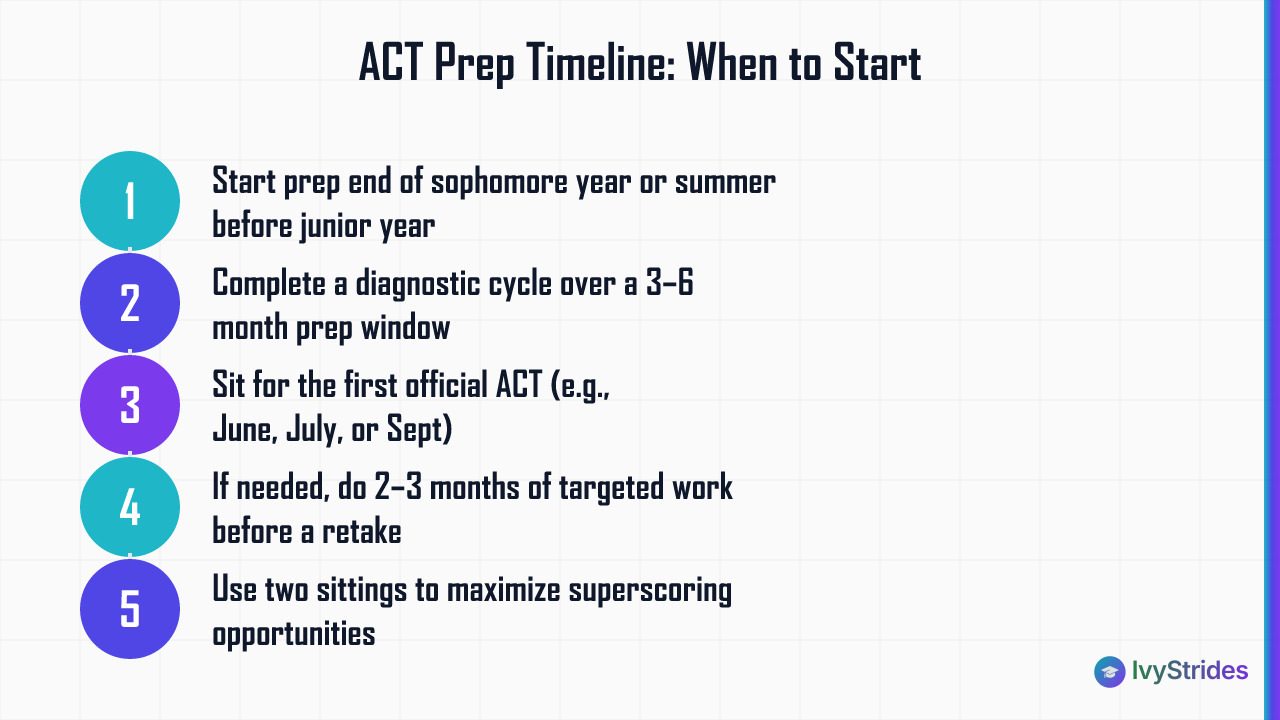
The end of sophomore year or the summer before junior year is the sweet spot. That timing gives your student room for a full diagnostic cycle, a real prep window, and at least two official sittings before applications are due.
Concretely, plan for a prep window of roughly 3 to 6 months before the first sitting. If a retake is needed, budget another 2 to 3 months of targeted work between attempts. Most students benefit from two official sittings, because many colleges superscore, taking the highest section scores across multiple test dates to build the best possible composite. Two sittings give superscoring something to work with.
Across our student cohorts, the most common timing mistake we see is families waiting until junior fall to start. That compresses everything into a single sitting, kills the retake option, and stacks ACT prep right on top of the hardest semester of high school. Students who start in 10th grade have far more flexibility for multiple retakes and a calmer schedule.
For 2026 planning, ACT, Inc. lists national test dates including June 13, July 11, and September 19, with an October date to follow; always verify the current calendar at act.org before you register, since dates shift. The new Official ACT Prep Guide 2026-2027 is also available and uses real retired questions, which makes it a solid backbone for at-home practice.
For families outside the United States, registration logistics and costs differ. Our guide to ACT fees for international students covers what to expect and how to plan around earlier deadlines and limited test centers.
Setting a Realistic Score Goal Together
A target score should come from the college list, not from a number that sounds impressive. Sit down with your student, pull up 6 to 10 schools they're genuinely interested in, and look up each school's middle 50% ACT range. You'll find it in each university's Common Data Set, which you can locate by searching "Common Data Set" plus the school name.
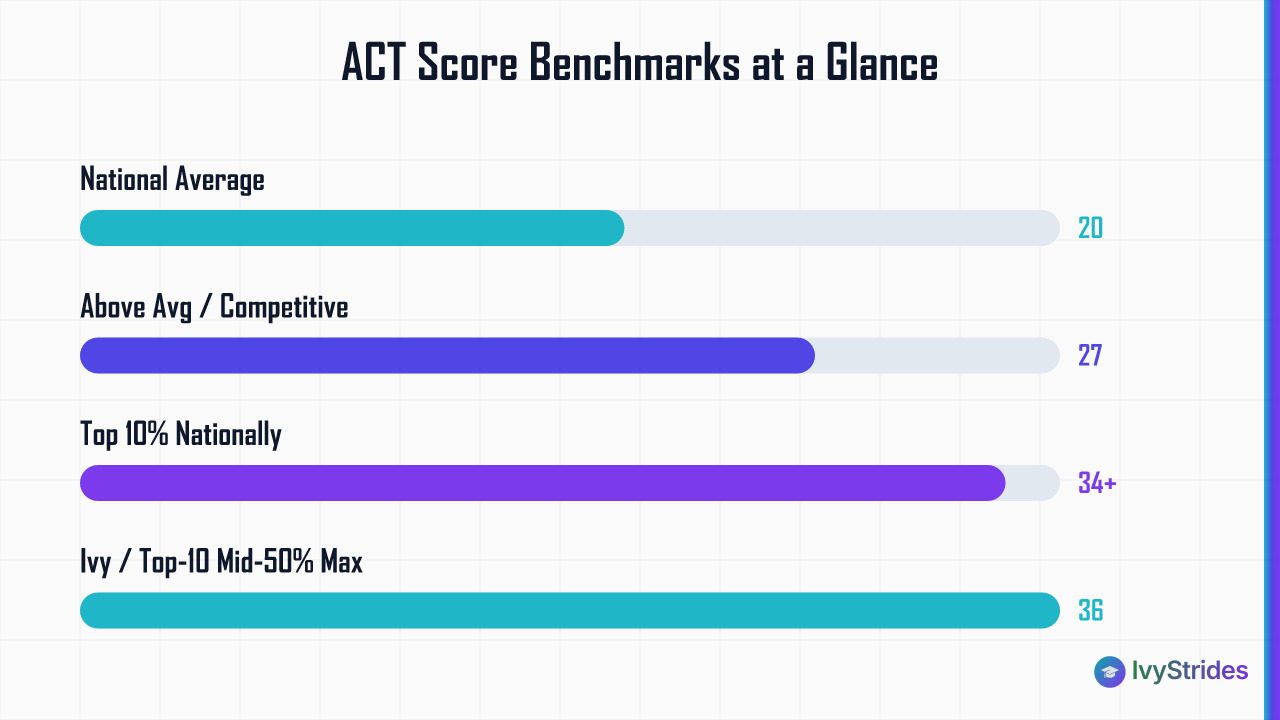
Here's the benchmark context, per ACT, Inc. The national average composite sits around 20. A 27 is above average and competitive at a wide range of four-year universities. A 34 or above reaches roughly the top 10 percent nationally, and the middle 50% at Ivy League and top-10 universities typically runs 34 to 36. Your student's target is the number that lands them at or above the middle 50% of the schools they care about.
Now the honest part on improvement. For students completing the IvyStrides 1-on-1 ACT program, a gain of 4 or more composite points is a typical outcome. But the size of a realistic jump depends heavily on the starting band. A student moving from 18 to 22 and a student moving from 30 to 34 are running different races, and the second one is harder per point. We never promise a specific number.
One caveat worth stating plainly: test-optional policies vary by school and year, so a strong score isn't universally required. Even so, at most schools a composite above the middle 50% still strengthens an application, which is why setting a real target matters even in a test-optional world.
Structured goal-setting helps students turn that target into weekly action. The WOOP framework is one approach we use with students to translate a target composite into a concrete weekly plan; our WOOP Your Way to College Success: A Goal-Setting Tool for High-Achievers post walks through how it works.
The Hardest Part: Staying Involved Without Taking Over
This is where most parents get stuck. You either back off completely, hoping your teenager self-manages, or you swing the other way and start monitoring every practice session. Both hurt the result.
In our coaching with students, the families who see the fastest composite gains are the ones where the parent manages the schedule and the student owns the content work. Not the reverse. When a parent starts grading practice tests and explaining grammar rules they last used decades ago, two things happen: the explanations are often slightly wrong, and the student learns to outsource their thinking.
So what does healthy involvement look like? A weekly 10-minute check-in. You ask three questions. Which section did you practice this week? What kinds of errors showed up? What's scheduled for next week? You're tracking the process, not auditing the answers. Use a shared calendar to block study sessions, not to surveil every minute your student spends at their desk.
Two mistakes to avoid. First, don't tie prep progress to rewards or punishments in ways that ratchet up test anxiety; the pressure usually backfires on test day. Second, don't try to be the content tutor. If your student needs someone to explain why a Science passage's conclusion is unsupported, that person should be a coach or a strong resource, not a stressed parent at 10 p.m.
One small logistics lever helps: match study sessions to your student's natural energy. Some teenagers focus far better in the morning; others hit their stride at night. Our post on Early Birds vs. Night Owls: What's the Best Time to Study? can help you schedule sessions when your student actually retains material.
How to Choose the Right ACT Prep Resources for Your Student
The score gap is the decision variable. Not your budget, not what a neighbor's kid used. Match the resource to the size of the gap between the baseline diagnostic and the target.
Start with what's genuinely free. ACT, Inc. publishes free official practice tests and prep materials at act.org, and these use real retired questions, which is the gold standard. Some other free online platforms offer ACT review too, though many lean harder toward SAT coverage, so check what's actually there before you rely on them. The Official ACT Prep Guide 2026-2027 is a paid book, but it's built on real retired questions and is worth the shelf space for a self-directed student.
Paid self-paced online courses generally run in the low-to-mid hundreds of dollars and give structure to a student who won't build their own schedule. They work best for smaller gaps and disciplined learners.
Here's a rough framework for the decision. A score gap under 2 composite points, and self-directed prep with official materials often suffices. A gap of roughly 3 to 5 points usually calls for a structured course or 1-on-1 coaching to stay on pace and catch blind spots. A gap of 6 or more points is where self-study tends to plateau, and 1-on-1 section-specialist coaching becomes the faster path.
When a student's score gap is larger than 4 composite points, or a specific section is consistently dragging the composite down, 1-on-1 ACT prep with a section-specialist coach typically produces faster, more targeted gains than self-directed study alone. The IvyStrides model uses separate specialists for English/Reading, Math, and Science, not one generalist tutor trying to cover all four, because the skill sets genuinely differ.
Here's a qualitative pattern we see often: a student comes in around a 24 composite with a Science section in the high teens, a classic data-interpretation weakness rather than a content gap. Once section-specialist work targets the passage types they keep missing, the Science score tends to climb and pull the composite up with it. For students completing the 1-on-1 program, a 4-plus composite point improvement is a typical result, though outcomes always depend on starting band, hours, and effort. For a fuller look at how the pieces fit, see our ACT prep overview.
Does ACT Prep Actually Move Scores? What the Evidence Shows
Yes, for students who practice with real materials and target their specific weak sections. This is the question that keeps parents from spending time or money, so let's be direct.
The ACT isn't an IQ or aptitude test. Per ACT, Inc., it measures skills learned in high school courses, and the organization states that students who use official prep materials often see bigger gains. Skills that are taught can be strengthened with deliberate practice. That's the whole premise.
What does meaningful improvement cost in hours? A commonly cited range is roughly 40 to 80 hours of focused practice for a solid composite bump, with larger gaps needing more. That's arithmetic on a schedule, not a promise: around 6 hours a week across 10 to 12 weeks lands you in that band.
The methodology matters more than raw hours. In our coaching, the cycle that works is diagnostic first, then targeted weakness work, then a second full-length test to measure real change, a pattern of spaced retesting rather than endless re-reading. One specific habit accelerates everything: students who review their practice-test errors within about 48 hours retain the correction far better than students who move on without error analysis. Re-reading notes is passive. Working back through a missed data-interpretation question while it's fresh is active.
The honest caveat: improvement size depends on the starting score band, hours invested, quality of the practice materials, and whether the weakness work is genuinely targeted or just generic review. Prep that isn't aimed at the diagnosed weak section is mostly wasted motion. If you want a cleaner way to structure your student's goals against those hours, our SMART Goals: Your Secret Weapon for College Prep Success post lays out a usable framework.
Managing the Logistics: Registration, Dates, and Test-Day Prep
This is the part parents fully own, and getting it right removes a surprising amount of family stress.
Registration typically opens around 5 to 6 weeks before each test date, and late registration carries extra fees, so put the deadlines on a calendar the moment you pick a date. At registration, students can send scores to up to 4 colleges for free; additional score sends cost extra, so decide the college list before you finalize the registration if you can.
On format, ACT, Inc. has announced a 2026 update reducing the exam from 215 to roughly 171 questions, which works out to about 22 percent more time per question. Treat that figure as must-verify: confirm the current question counts and timing at act.org before your student's specific test cycle, since ACT, Inc. continues to finalize details. The practical takeaway for prep is that pacing strategy shifts slightly toward accuracy, because there's marginally more room to breathe per item; that doesn't change the value of full-length timed practice.
Superscoring is worth confirming school by school. Some colleges superscore the ACT, combining your student's highest section scores across sittings; others take a single best composite. Check each school's policy directly, because it changes how many times a retake is worth attempting.
Build an exam-day checklist and hand it to your student the night before: valid photo ID, printed admission ticket, an approved calculator, sharpened pencils, and snacks for the break. Get there early. For families outside the U.S., note that international registration involves different test centers and earlier deadlines; our guide to ACT fees for international students covers the specifics.
Keeping ACT Prep in the Bigger Admissions Picture
The ACT composite is one signal among several. GPA, course rigor, AP scores, and essays all sit in the same application, and no single number carries it.
On test-optional: policies vary by school and year, and the FairTest tracker maintains current school-by-school status. Even at test-optional schools, a strong ACT score above the school's middle 50% can strengthen an application, so a good score is rarely wasted. It just isn't universally mandatory anymore.
AP scores play a complementary role by signaling college-level rigor. If your student is taking AP courses, align the AP exam timeline with ACT prep so the two don't collide into one burnout-inducing spring. May AP exams and spring ACT dates can stack up fast.
Once a student hits their target ACT composite, the college admissions essay becomes the highest-use remaining variable. A strong score is one part of the application; shifting attention to the essay is the natural next step in a connected prep strategy. If your student is stuck on where to begin, our post on what should you write your college essay about is a good starting point. And for juniors who also took the PSAT, our breakdown of National Merit cutoffs by state shows how that score can add another line to the application. The caveat holds throughout: admissions outcomes depend on the full application, never on test scores alone.
You can read more about how our section-specialist model works on the IvyStrides About page. You can also meet the coaches on our tutors page.
FAQ
When is the right time for a student to start ACT prep?
For most students, the end of sophomore year or the summer before junior year is the ideal starting point. That timing allows a full diagnostic cycle, roughly 3 to 6 months of targeted prep, and at least two official sittings before college application deadlines. Starting earlier also keeps ACT prep from colliding with junior-year coursework and AP exams.
Is a score of 27 out of 36 a good ACT score?
A 27 composite is above the national average, which sits around 20, and it makes a student competitive at a wide range of four-year universities. Whether it's strong enough depends entirely on the college list. For schools with a middle 50% range of 33 to 35, a 27 would fall below the typical admitted range, and a retake would be worth considering.
Is ACT prep worth it, or does the test just measure fixed ability?
ACT prep does move scores for students who practice with real materials and target their weak sections. Per ACT, Inc., the test measures skills learned in high school courses, not fixed aptitude, and the organization notes that students using official prep often see bigger gains. Skills that are taught can be improved with deliberate, targeted practice.
Is two months enough time to prepare for the ACT?
Two months can work for a student with a small score gap of 1 to 2 composite points who is disciplined and self-directed. For a gap of 4 or more points, roughly 3 to 6 months is more realistic. Either way, run a diagnostic immediately so the two months go toward targeted weakness work rather than general review.
How much does quality ACT prep typically cost, and is it worth the investment?
Costs range from free official ACT practice tests, to roughly $200 to $600 for self-paced online courses, to about $1,500 to $5,000 and up for 1-on-1 coaching packages. The right choice depends on the score gap and timeline, and outcomes always depend on student effort, not the price tag alone. For students targeting highly selective schools where a 2-to-3-point composite gain could meaningfully shift admissions odds, structured coaching typically delivers a stronger return than self-directed prep alone.
Should a student take the ACT or the SAT?
Most colleges accept both equally. The cleanest way to decide is to take a full-length diagnostic of each and compare section-level performance. Students who score relatively higher on ACT Science and prefer straightforward passage-based questions often favor the ACT; students who prefer the Digital SAT's adaptive format and shorter total test time sometimes lean SAT. Our ACT vs SAT difficulty guide walks through the differences in format, timing, and scoring.
Your student does the learning. You build the runway: the diagnostic, the schedule, the calm, the right resource for the gap. Get those four right and the score work has room to actually happen.

Award-winning author (South Asian Book Award) and graduate of BITS Pilani and UCLA Luskin School of Public Affairs. Brings a published writer's eye to Common App essays and grammatical precision to SAT and ACT R&W instruction.