
How Much Can You Improve your ACT Realistically? The Honest, Data-Backed Answer for 2026

On this page
- The Direct Answer: How Much Can You Improve Your ACT Score?
- Why Your Starting Score Is the Most Important Variable
- What Is a Realistic ACT Score Improvement by Baseline Score Band?
- The Study Hours Required to Hit Each Improvement Tier
- The Section Where Most Students Leave Points on the Table
- Not Sure Which Section Is Holding Your Score Back?
- How the Enhanced ACT Format in 2025–2026 Changes What Is Achievable
- How Many Points Can You Realistically Raise Your ACT Score? The Benchmark Scores Explained
- The Methodology Behind Consistent ACT Score Gains
- FAQ
- Is it possible to increase your ACT score by 10 points?
- How rare is a perfect 36 on the ACT, and is it a realistic target?
- Is a month of prep enough for a 3 to 5 point ACT improvement?
- Which ACT section is easiest to improve quickly?
- Does the enhanced ACT format in 2025–2026 make it easier to improve your score?
- How does ACT superscoring affect my retake strategy?
- Your Next Step
- Ready to Find Out Your Realistic ACT Target?
Most students gain 2 to 4 composite points on the ACT with consistent, structured preparation across roughly 8 to 12 weeks. A 5 to 8 point gain is achievable with intensive multi-month prep that targets specific section weaknesses. Without a plan, ACT, Inc. data shows the average retester gains only about 1 composite point. Your baseline matters most: students starting below 24 have the most room to grow, while students already above 30 face steeper diminishing returns.
The single biggest driver isn't hours logged. It's whether those hours address your actual weak sections, or whether they quietly review material you already know. The rest of this article breaks that answer down by score band, hours committed, and section, with the caveats families need before spending real money on prep.
The Direct Answer: How Much Can You Improve Your ACT Score?
Here's the honest version, tier by tier.
With steady prep of roughly 20 to 40 hours across about 6 to 8 weeks, a composite gain of 2 to 3 points is typical. With approximately 60 to 100 hours across a full semester, 4 to 7 points is realistic. Beyond that, gains of 8 to 10 points do happen, but they're reserved for students with a low starting baseline (typically below 22) and 100+ hours of focused work.
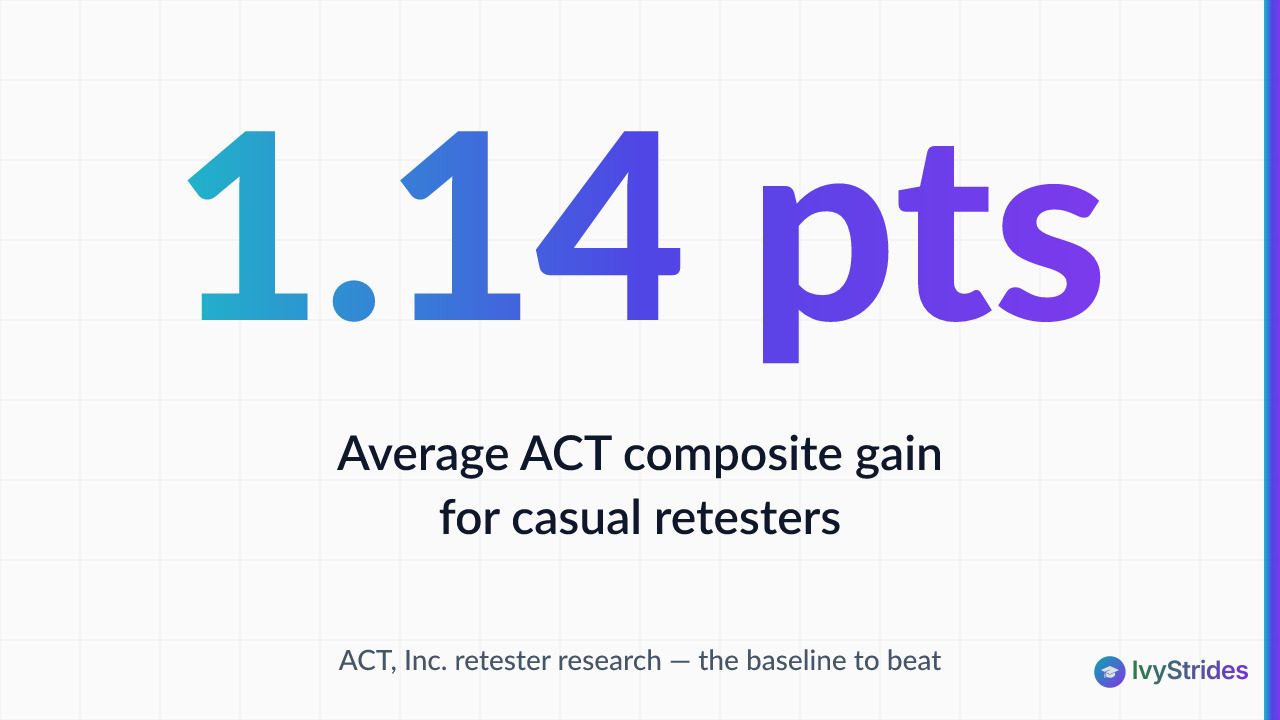
The ACT, Inc. retester research reports an average composite gain of about 1.14 points for students who retake the test without a structured plan. That figure is the ceiling for casual retesters, not the ceiling for students in a real prep program. It's the number to beat.
Section-level gains from that same data set are more revealing. ACT English shows the highest average retester gain, around 1.66 points. ACT Math shows the lowest, around 0.86 points. That gap is not random. English tests a finite grammar rulebook that a motivated student can learn in weeks. Math gaps tend to be deeper: a student weak on functions in December is often weak on functions because a foundation from Algebra II never fully set.
Two caveats before the score-band tables. First, these are typical ranges from ACT, Inc. data and our coaching, not guarantees. Second, once you know your realistic ceiling, cross-check it against ACT score ranges for top colleges so your target is anchored to schools on your actual list, not a generic "high score."
One more piece of context worth surfacing early: test-optional policies vary by school and by application year, and a competitive ACT score still adds real value even at schools that don't require one. Our breakdown on should you submit ACT scores if test-optional walks through exactly when submission helps.
Why Your Starting Score Is the Most Important Variable
Your baseline sets your ceiling. This isn't discouraging. It's clarifying.
A student sitting at 18 has roughly 18 points of room on the 1 to 36 scale. A student at 32 has 4. That structural fact means the two students are running very different races, even if they invest the same hours. In our coaching with students in the 24 to 28 band, a 4-point gain to 28 to 32 is a typical outcome across a full prep cycle. For a student already at 33, a push to 35 requires roughly the same hours but near-perfect execution across all four sections.
The percentile map explains why the top of the scale compresses so hard. A 27 sits at approximately the 88th percentile per ACT, Inc.'s national norms. A 30 is around the 93rd. Anything from 34 to 36 lands in roughly the top 1 to 2 percent of test-takers, and a perfect 36 is earned by about 0.22 percent per ACT, Inc.'s annual score distributions. At the top, each additional point represents a shrinking slice of the population, which is another way of saying each additional point requires disproportionately more hours. Above 32, you're not learning new content. You're eliminating small errors from a section you already mostly own.
For students in the 28 to 30 band, a 2-point gain is not cosmetic. It can move you across a merit scholarship threshold at dozens of universities, which materially changes what college costs your family. Our article on how ACT scores affect merit scholarships covers the financial stakes at the score bands where the money actually shifts.
Here's the part most students miss: this is why generic "study harder" advice fails. A 22 and a 32 need completely different prep plans. Same test, different mechanics.
What Is a Realistic ACT Score Improvement by Baseline Score Band?
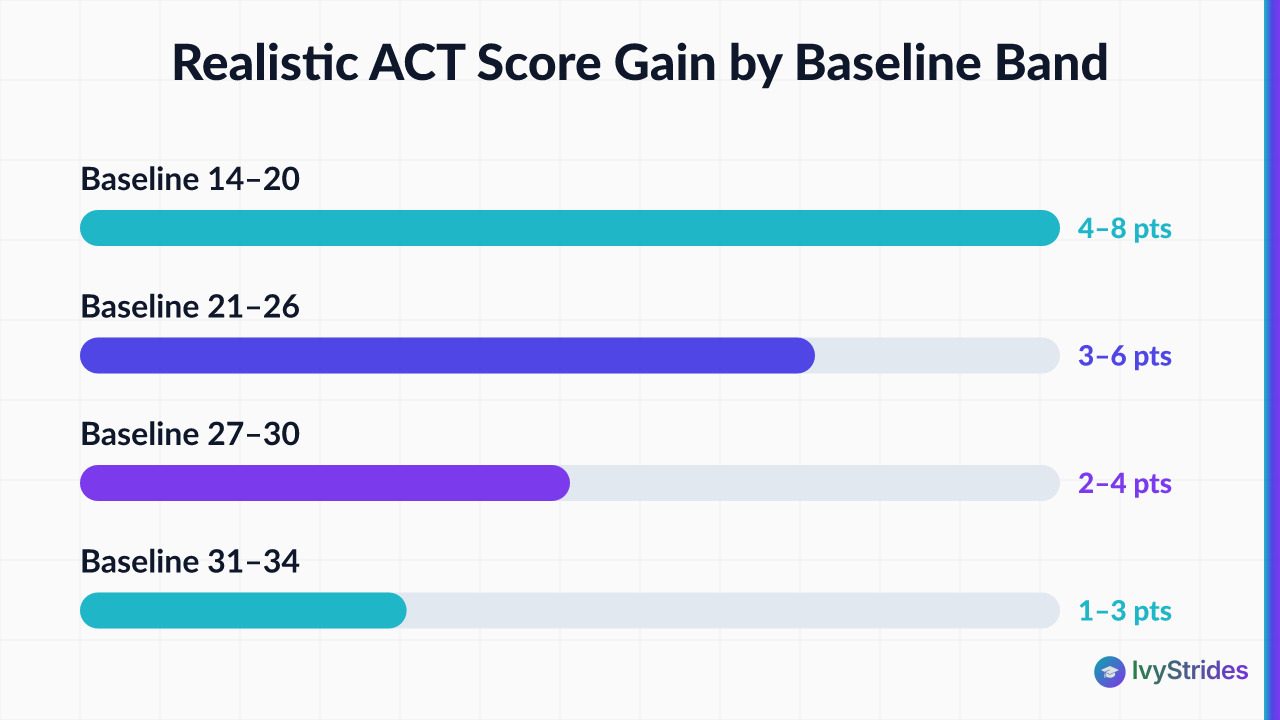
Use this as a planning table, not a promise. These ranges reflect ACT, Inc. retester data and typical outcomes in our coaching with students at each band.
Baseline 14 to 20: Realistic composite gain of roughly 4 to 8 points with about 60 to 120 hours of structured prep. Students at this band usually have foundational content gaps in English grammar and Math that respond well to targeted work. The gains look large because the room is large.
Baseline 21 to 26: Realistic gain of about 3 to 6 points with roughly 40 to 80 hours. English and Reading tend to move first; Math and Science move with dedicated section work.
Baseline 27 to 30: Realistic gain of around 2 to 4 points with roughly 40 to 60 hours of tightly targeted section work. The improvement is smaller in raw points but often crosses meaningful admissions and scholarship thresholds. At this band, generalist review is a waste of hours.
Baseline 31 to 34: Realistic gain of about 1 to 3 points with roughly 60 to 100+ hours. Every point at the top requires eliminating specific error types, not learning new content. Students in this band who plateau are usually missing 2 to 4 questions per section on the same handful of question types, and the fix is diagnostic, not volume-based.
Before any of these numbers apply to you, take a full-length timed act practice test online to establish which band you're actually in. Estimating from a homework quiz or a short section drill produces a soft baseline, and soft baselines lead to soft targets.
If you haven't committed to the ACT yet, check whether is the ACT harder than the SAT for your specific strengths before you invest 60+ hours in the wrong test. Some students genuinely have a higher ceiling on one exam than the other.
The Study Hours Required to Hit Each Improvement Tier
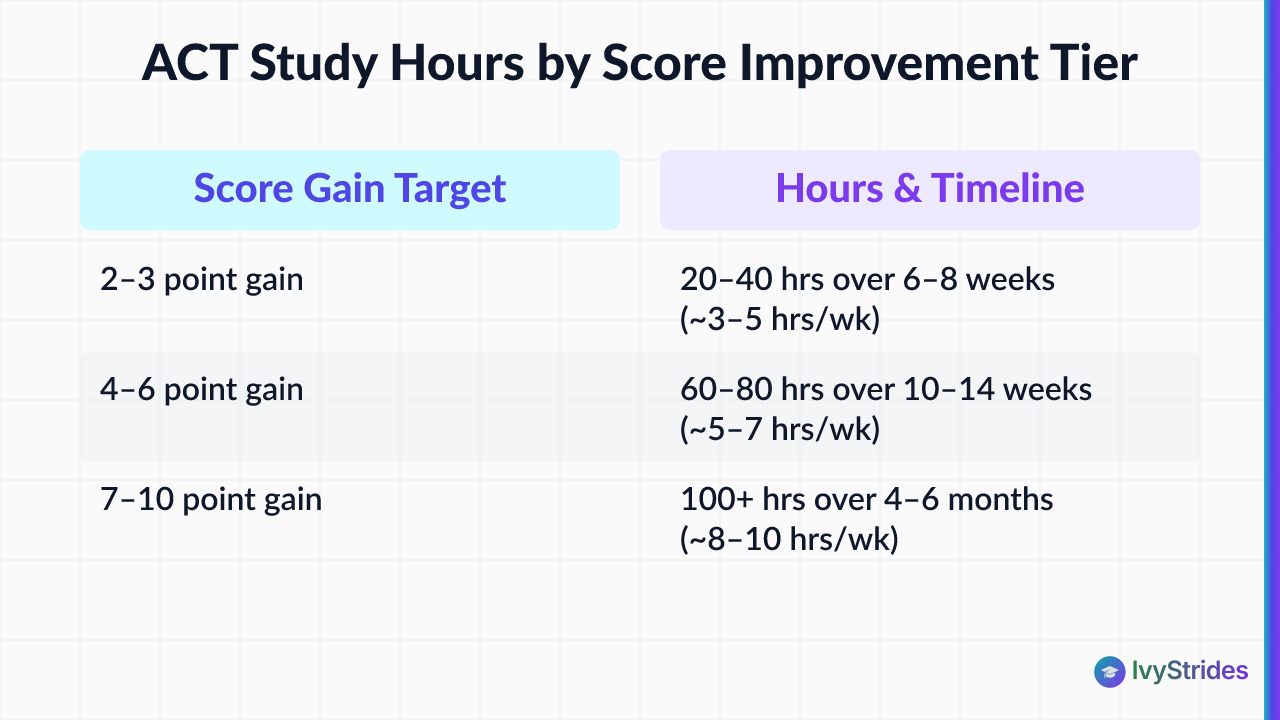
Score-band targets are only useful once you translate them into a weekly schedule you can actually keep.
The hours-to-points framework we use in planning:
- 2 to 3 point gain: roughly 20 to 40 hours across about 6 to 8 weeks. That's approximately 3 to 5 hours per week. Achievable for most students during a normal school semester without displacing coursework.
- 4 to 6 point gain: about 60 to 80 hours across roughly 10 to 14 weeks. Closer to 5 to 7 hours per week. This is where prep starts to require real calendar defense.
- 7 to 10 point gain: 100+ hours, typically across about 4 to 6 months, and typically only from a starting baseline below 24. This tier assumes roughly 8 to 10 hours per week and treats prep as a second course.
Is a 10-point improvement possible? Yes, but the conditions are narrow. It typically requires a starting composite below 22, roughly 8 to 10 hours per week for 3 to 4 months, and section-specialist coaching on the two weakest sections. It's not typical. It's earned.
Is one month enough for 3 to 5 points? One month can produce a 2 to 3 point gain if the student focuses exclusively on their weakest section and puts in about 5 to 8 hours per week. A 4 to 5 point gain in four weeks typically requires roughly 8 to 10 hours per week and a very clear plan from day one. Sprint prep works, but only for students who already have their diagnostic data in hand.
Backwards-plan from your test date. Check the ACT test dates for 2026 on ACT, Inc.'s registration page, count backwards by your target hours, and check whether the calendar math works. If your target is 6 points and your test is in 5 weeks, the math says push the test date or lower the target. Better to know now than in week 4.
One efficiency note for students juggling both exams: skills built during ACT Reading and Math prep transfer directly to PSAT/NMSQT Reading and Math, so if you're also on the National Merit pathway, concurrent prep is more efficient than parallel prep.
For the full program structure we use with 1-on-1 students, see our ACT prep overview.
The Section Where Most Students Leave Points on the Table
Look, if you only remember one thing from this article, remember this: ACT English is the fastest section to improve, and most students don't prioritize it correctly.
Per ACT, Inc. retester data, English shows an average gain of about 1.66 points per retest, the highest of the four sections. Math shows the lowest, around 0.86 points. That gap isn't about student effort. It's about section structure. English tests a defined set of grammar and punctuation rules (comma usage, subject-verb agreement, modifier placement, sentence structure, rhetorical concision) that a motivated student can genuinely master in roughly 15 to 25 hours of focused work. Math weaknesses, by contrast, usually trace back to a foundational skill from earlier coursework, and rebuilding foundations takes longer.
ACT Science is the other section where students routinely leave points behind. It's not a science knowledge test. It's a data-reading and graph-interpretation test with a chemistry-lab veneer. In our coaching, students who stop treating it as biology trivia and start treating it as an evidence-reading section typically gain 2 to 3 points on Science alone within a few weeks. That's the fastest bang-for-buck section shift we see.
ACT Reading sits in the middle. Gains here are usually pacing gains, not comprehension gains. If you're missing questions because you ran out of time in the last passage, that's a strategy problem, not a reading problem, and it's fixable in a handful of coached sessions.
ACT Math is the slowest mover for a specific reason: it's the section where a generalist tutor covering all four sections tends to underdeliver. A student weak on trig identities and coordinate geometry needs a coach who can diagnose which specific topics are producing the misses, then rebuild those topics from scratch. This is why IvyStrides staffs 1-on-1 ACT prep with section-specialist coaches: separate English/Reading experts and separate Math/Science experts, rather than one tutor spread thin across all four sections.
Take one action from this section. Pull up your most recent full-length practice test and look at your English section score in isolation. If it's below your Reading score by 2+ points, English is your fastest path to a composite gain, full stop.
Not Sure Which Section Is Holding Your Score Back?
Students and parents: book a free 15-minute ACT strategy call. We'll review your section scores, identify your fastest path to improvement, and recommend whether 1-on-1 coaching, a test pack, or a targeted study plan fits your timeline best.
How the Enhanced ACT Format in 2025–2026 Changes What Is Achievable
The enhanced ACT is shorter, and each question gets more time. That's the headline. The score scale (1 to 36) is unchanged, and ACT, Inc. equates scores across formats so a 30 today means the same thing as a 30 last year.
Confirm current section lengths against the ACT, Inc. official test details before you plan your pacing strategy, but the direction is clear: English drops from 75 questions in 45 minutes to 50 questions in 35 minutes, producing roughly 9 extra seconds per question. Across the enhanced test, students get approximately 18 percent more time per question compared to the legacy format.
Who benefits? Students whose old-format losses came from pacing pressure rather than content gaps. If you were finishing English with 5 seconds to spare and guessing on the last six questions, the new format hands those questions back to you. If you were finishing with 5 minutes to spare and still missing 12 questions, more time won't help. That's a content problem.
ACT Science is the section where the pacing benefit is highest in our coaching. Students who previously froze on the last passage because they'd burned time on an earlier data table often find their Science score climbs about 2 to 3 points on the enhanced format without any additional content work. That's the format doing the lift, not the student.
One thing the enhanced format does not do: make a 36 trivially achievable. Equating adjusts for any format-level shift in difficulty, and the population of 36-scorers remains at roughly 0.22 percent. If your goal is a top-1-percent score, the format change gives you a little more pacing headroom, not a shortcut.
For students weighing tests, our ACT vs SAT 2026 breakdown covers how the enhanced ACT stacks up against the Digital SAT for different student profiles.
How Many Points Can You Realistically Raise Your ACT Score? The Benchmark Scores Explained
Percentile context matters because "realistic improvement" only means something once you know what your target score buys you. Percentile figures below come from ACT, Inc.'s national norms.
- 27 composite: approximately the 88th percentile. Competitive at strong state flagships and many private universities, and often at the threshold for merit aid.
- 30 composite: around the 93rd percentile. Solidly competitive at selective private universities and top-tier state flagships.
- 33 to 34 composite: roughly the top 3 to 4 percent. Competitive at nearly all highly selective universities, though not a guarantee anywhere.
- 34 to 36: top 1 to 2 percent. Middle-50% range at Ivy-tier schools. According to publicly reported Common Data Set figures for a recent cycle, Harvard's middle-50% ACT composite is approximately 34 to 36.
- 36 perfect: approximately 0.22 percent of test-takers per ACT, Inc.'s annual distributions. Genuinely rare.
The national average ACT composite has hovered around 19 to 20 in recent administrations per ACT, Inc.'s annual score reports. If you're above 24, you're already above the national mean. The question is how much further your target schools require you to go.
For students holding both an SAT and ACT score and unsure which to submit, the College Board / ACT concordance places a 1480 SAT roughly at a 33 to 34 ACT. Submit whichever percentile is higher on the school's Common Data Set.
Two caveats worth restating: a 34 does not guarantee admission at Ivy-level institutions. Admissions decisions rest on the full application, and your college admissions essays carry significant weight at selective schools regardless of your composite. A strong ACT score reduces pressure on every other part of the file. It doesn't replace the file.
For school-specific score context on two commonly researched targets, see our breakdowns on Should You Apply to Dartmouth College and Should You Apply to Northwestern University in 2026. Cross-reference the score ranges with your realistic ceiling from the score-band table above.
One tactical note on retakes: some colleges superscore the ACT, combining your highest section scores across sittings. If your target school superscores, a retake is worth it even when your overall composite stays flat, as long as one section climbs. Confirm the superscoring policy on each school's admissions page or Common Data Set before you register for another sitting.
The Methodology Behind Consistent ACT Score Gains
The four-step process behind our typical 4+ composite point outcomes for students completing the 1-on-1 ACT program:
Step 1: Full-length diagnostic practice test. A timed, four-section ACT under real conditions. Not a homework packet, not a section quiz. The diagnostic produces a real baseline composite and four honest section scores. This is the single most-skipped step in self-directed prep, and skipping it is the single most common reason students plateau.
Step 2: Section-level gap analysis. We look at the diagnostic and identify whether the gap is in English grammar rules, Math foundations (algebra, geometry, functions, trigonometry), Reading passage strategy, or Science data interpretation. A 24 composite with 28-English/22-Math needs a completely different plan than a 24 composite with 22-English/28-Math. Gap analysis is what makes the plan personal.
Step 3: Targeted weakness work with a section specialist. English and Reading are coached by one specialist; Math and Science by another. This is deliberate. A tutor who is genuinely strong at ACT Math is a different person from a tutor who is genuinely strong at ACT Reading rhetoric. Trying to combine both in one generalist tutor is why generic prep underperforms at the 27+ band.
Step 4: Spaced retesting. A second full-length practice test roughly 4 to 6 weeks in. We measure actual gain against the original diagnostic, recalibrate the plan, and repeat. Spaced retesting also builds test-day stamina, which is a real variable at the top of the score scale where fatigue in the final section costs students 1 to 2 raw points.
In our coaching with students in the 24 to 28 band completing this four-step process, typical composite gains are 4+ points across a full prep cycle. Not guaranteed. Typical. The variables that shift outcomes are hours committed, consistency of weekly practice, and how honestly the student engages with the mistake-analysis part of the loop.
Between sessions, students use our free downloads library, including the mistake tracker, to log wrong answers by question type. Mistake tracking is boring. It's also the single highest-use between-session habit in ACT prep.
FAQ
Is it possible to increase your ACT score by 10 points?
Yes, but the conditions are specific. A 10-point gain typically requires a starting composite below 22 and at least 100 hours of structured prep across roughly 3 to 4 months. Students starting at 14 to 18 have the most room for this size of jump because their baseline gives them the raw scoring headroom. For students already above 24, a 10-point gain is extremely rare because the score scale compresses at the top and each additional point requires near-perfect section execution.
How rare is a perfect 36 on the ACT, and is it a realistic target?
Approximately 0.22 percent of test-takers earn a 36 per ACT, Inc.'s annual score distributions. A 35 is earned by fewer than 1 percent in most administrations. For students already scoring 33 to 34, a stretch goal of 35 to 36 is realistic with intensive prep, but it shouldn't be the primary target for most students. A 34 is competitive at nearly every selective university, including most Ivy League schools, and the effort delta between a 34 and a 36 is often better spent on essays and supplemental applications.
Is a month of prep enough for a 3 to 5 point ACT improvement?
One month usually produces a 2 to 3 point gain if the student commits roughly 5 to 8 hours per week and focuses exclusively on their weakest section rather than reviewing content they already know. A 4 to 5 point gain in a single month is possible but typically requires about 8 to 10 hours per week and a very clear section-level plan from day one. Students with less than four weeks before their test date should prioritize English and Reading, which show the fastest average gains per ACT, Inc. retester data.
Which ACT section is easiest to improve quickly?
ACT English. It shows the highest average retester gain (around 1.66 points) in ACT, Inc. data because it tests a finite set of grammar and punctuation rules that can be learned systematically. ACT Science is the second-fastest mover once students recognize it as a data-reading section rather than a science knowledge test. ACT Math shows the lowest average gain (around 0.86 points) because math weaknesses often trace back to foundational gaps that require more time to rebuild.
Does the enhanced ACT format in 2025–2026 make it easier to improve your score?
The enhanced ACT gives students roughly 18 percent more time per question, which helps students who previously lost points to pacing pressure rather than content gaps. The score scale is unchanged, and equating ensures scores remain comparable across formats. Students who struggled with Science section timing tend to see the largest benefit. The enhanced format does not lower the content bar. It reduces the time-pressure penalty for students who already know the material.
How does ACT superscoring affect my retake strategy?
Some colleges superscore the ACT, taking your highest section score from each sitting and combining them into a new composite. If your target school superscores, a retake is worth registering for even when your overall composite is likely to stay flat, as long as one section is likely to climb. Confirm each school's superscoring policy on their admissions page or Common Data Set before planning retakes, because policies vary by school and by application year.
Your Next Step
Your realistic ACT improvement is a function of three things: your starting score, the hours you're willing to invest, and whether those hours target your actual weak sections. Everything else is noise. Take the diagnostic, look at the section splits honestly, and set a target that respects both the calendar and the score-band table above.
Ready to Find Out Your Realistic ACT Target?
Students and parents: book a free 15-minute strategy call with an IvyStrides ACT specialist. We'll look at your current score, your target schools, and your timeline, and give you a concrete improvement plan before the call ends.

Award-winning author (South Asian Book Award) and graduate of BITS Pilani and UCLA Luskin School of Public Affairs. Brings a published writer's eye to Common App essays and grammatical precision to SAT and ACT R&W instruction.