
How to Score 34+ on the ACT: Top-Scorer Strategies (with a 36 Reading Path)

On this page
- What a 34 ACT Score Actually Means
- ACT Scoring at the 34+ Level: Your Error Budget Per Section
- Why the Jump from 30-33 to 34+ Is Harder Than Going from 24 to 30
- Stuck at 31 or 32? Find Out Exactly Which Questions Are Costing You the 34.
- Section-by-Section Strategy for a 34+ ACT Composite
- ACT English (75 questions, 45 minutes)
- ACT Math (60 questions, 60 minutes)
- ACT Reading (40 questions, 35 minutes)
- ACT Science (40 questions, 35 minutes)
- The 36 Reading Path: How to Make ACT Reading Your Highest-Scoring Section
- The Prep Method That Actually Moves Scores from 30-33 to 34+
- How Long Does It Take to Go from 30-33 to a 34+ ACT?
- What a 34 ACT Score Actually Gets You in College Admissions
- Is a 34 ACT Worth Pursuing, or Should You Switch to the SAT?
- FAQ
- How hard is it to get a 34 on the ACT?
- Can I get into an Ivy League school with a 34 ACT?
- Should I retake the ACT if I already have a 34?
- How many questions can I miss on the ACT and still get a 34?
- What is a 34 ACT equivalent to on the SAT?
- How many students get a 34 on the ACT each year?
- Your Next Step
- Ready to Turn Your 30-33 into a 34+ ACT Composite?
To score a 34 on the ACT, you need a composite average of at least 33.5 across English, Math, Reading, and Science, which works out to missing roughly 3-5 questions per section depending on that test date's scoring curve. A 34 sits at approximately the 99th percentile per ACT, Inc. score data, meaning fewer than 1 in 100 test-takers reach it. For students already scoring 30-33, the path to 34+ isn't more content review. It's systematic error-pattern analysis by section, timed passage practice, and targeted drilling on the specific question types where points are still leaking.
The scoring methodology and percentile figures throughout this guide come from act.org, the official ACT, Inc. site, and from each university's Common Data Set. The harder question, where most 30-33 scorers actually get stuck, is which 2-3 question subtypes are eating their final points. The next sections walk through that, section by section.
What a 34 ACT Score Actually Means
A 34 ACT composite places you at approximately the 99th percentile of all test-takers, per ACT, Inc. score data published at act.org. With roughly 1.4 million students sitting for the ACT each year, that's fewer than 14,000 students nationally reaching 34 or higher. It is a genuinely rare score.
In admissions terms, a 34 is at or above the 75th percentile of admitted students at most highly selective universities. Harvard's middle-50% ACT range sits at 34-36 per its most recent Common Data Set. Duke and Northwestern report the same 34-36 middle-50%. If you're weighing whether the target school is realistic at your score, our breakdown on whether you should apply to Duke University walks through how admissions committees actually weight a 34 inside the full application. The companion piece on whether you should apply to Northwestern University in 2026 maps the same framework to Northwestern's admissions readers.
A 34 ACT is also roughly concordant with a 1520-1540 Digital SAT per the official College Board and ACT, Inc. concordance tables. So when people ask whether a 34 is a good ACT score, the honest answer: it's a top-1% score that meets or exceeds the median at every Ivy League school. It does not guarantee admission anywhere. Selective decisions rest on the full application, including GPA, course rigor, essays, recommendations, and extracurriculars.
ACT Scoring at the 34+ Level: Your Error Budget Per Section
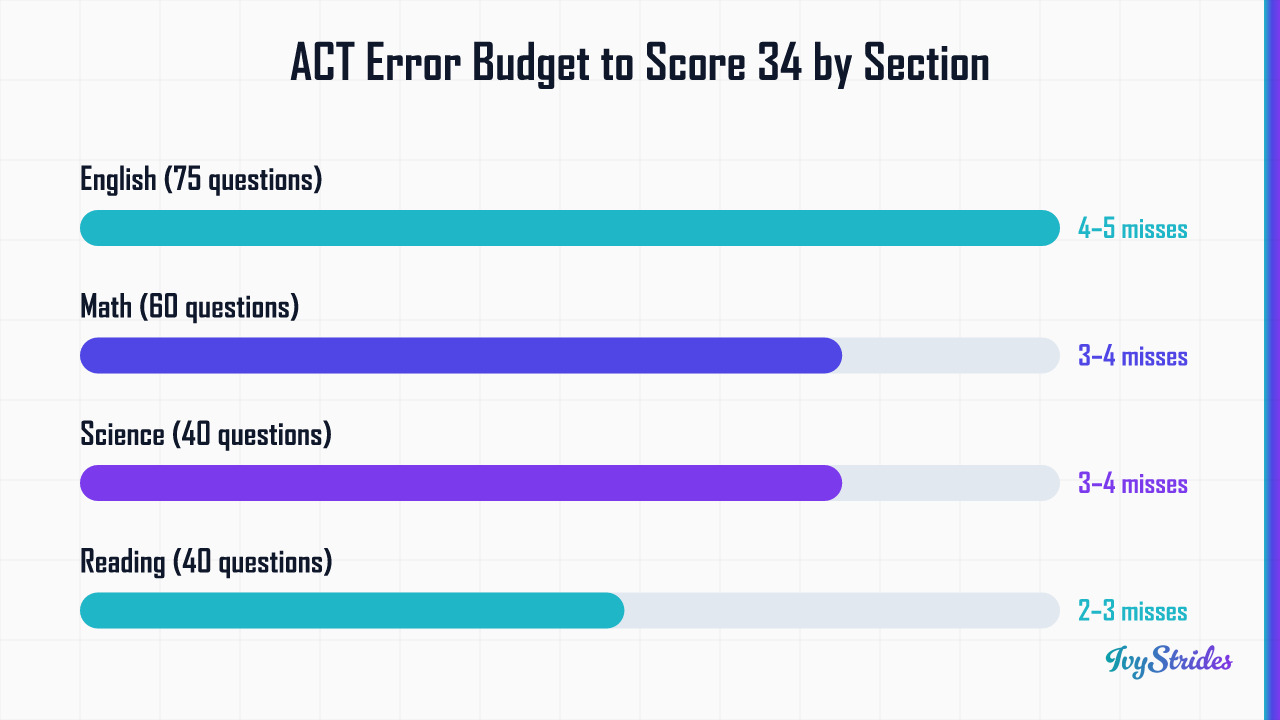
Here's the math. The ACT composite is the average of your four section scale scores (English, Math, Reading, Science), each on a 1-36 scale, rounded to the nearest whole number per act.org. To average 34.0, your four section scores need to sum to at least 134. Common combinations: 35+34+34+34, or 36+34+34+34 with a weaker section pulled up by a stronger one, or four flat 34s.
Translating that into a raw-score error budget, here is the rough miss allowance at the 34 scale-score level:
- English: 4-5 missed of 75 questions
- Math: 3-4 missed of 60 questions
- Reading: 2-3 missed of 40 questions
- Science: 3-4 missed of 40 questions
These are estimates, not promises. The scoring curve shifts every test date, and a Reading 34 might allow 3 misses on one administration and only 2 on another. Don't anchor your prep to a fixed miss count. Anchor it to your highest-error section first.
For full section structure, timing, and question counts in one place, see our ACT prep overview. The error-budget framing matters most when you triage prep: if you're at a 33 composite with a 30 in Reading, every Reading miss above 6-7 is the score you're trying to recapture. That's where the hours go.
Why the Jump from 30-33 to 34+ Is Harder Than Going from 24 to 30
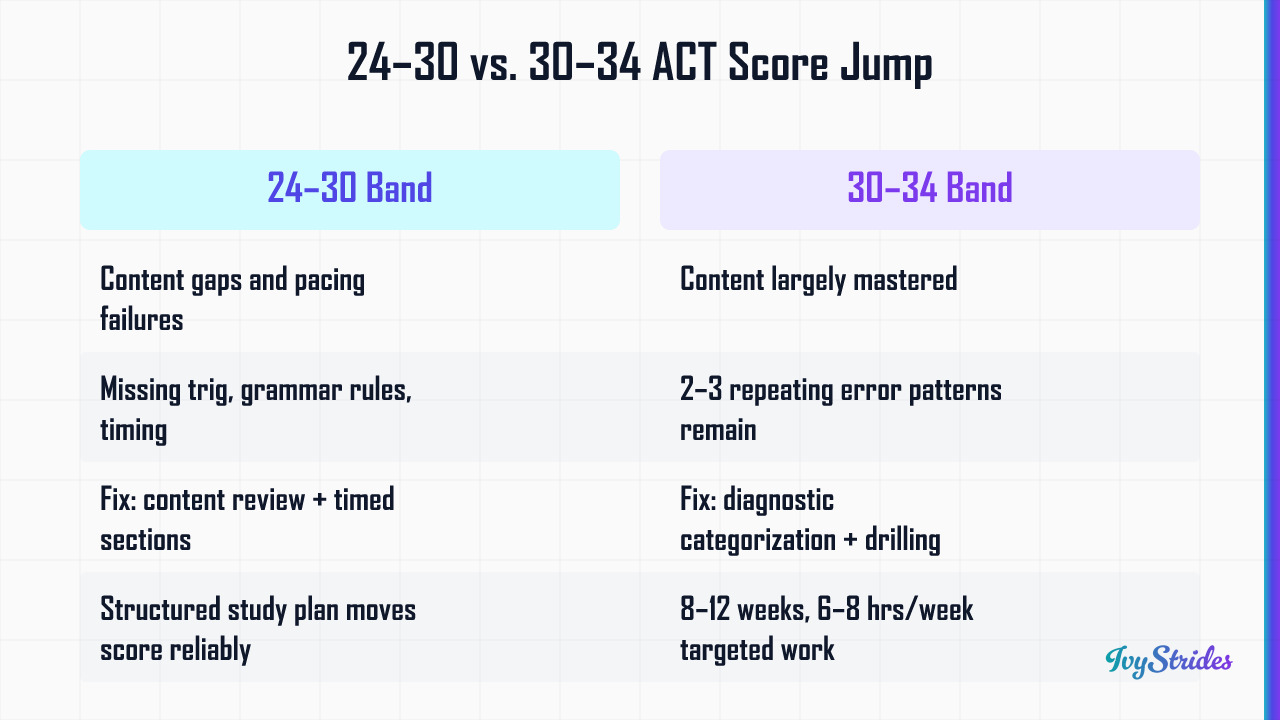
The 24-to-30 jump and the 30-to-34 jump are different problems wearing the same label.
At the 24-30 band, most missed questions trace to content gaps and pacing failures. The student hasn't fully mastered ACT Math trigonometry, or runs out of time on the fourth Reading passage, or doesn't know the ACT's specific comma rules in English. More content review, more timed sections, and a structured study plan move the score reliably.
At the 30-33 band, content is largely mastered. The student knows the trig identities, the grammar rules, the data-interpretation patterns. What remains is patterned error. In our coaching with students in the 30-33 band, 60-70% of missed questions fall into 2-3 repeating error patterns, not random misses. The same Reading inference structure trips them every test. The same Math question type, often coordinate geometry of conic sections or function transformations, eats two points per practice test. The same Conflicting Viewpoints Science passage costs them three questions.
You can't fix that with more content. You fix it with diagnostic categorization and targeted drilling. Take a timed full-length official ACT, code every miss by question type and error cause (careless versus conceptual versus pacing), then drill the 2-3 highest-frequency patterns for 3-4 weeks before retesting. Our breakdown on how to study for the ACT walks through how to set up that diagnostic loop step by step.
A typical timeline in our coaching from 30 to 34: 8-12 weeks of targeted work at 6-8 hours per week. The students who hit that timeline are the ones who actually do the categorization step and don't skip ahead to "more practice tests."
Stuck at 31 or 32? Find Out Exactly Which Questions Are Costing You the 34.
In a free 15-minute strategy call, an IvyStrides ACT specialist will review your score report, identify your highest-impact error patterns by section, and recommend a concrete next step. No generic advice, no pressure.
Section-by-Section Strategy for a 34+ ACT Composite
Each section behaves differently at the 34+ level. The tactics below assume you've already mastered the content and are now hunting the last 3-5 misses.
ACT English (75 questions, 45 minutes)
At 34+, your usage and mechanics errors should be near zero. Comma rules, subject-verb agreement, modifier placement, semicolon usage: these are drillable to mastery in a few weeks. Remaining errors at the top of the curve cluster in rhetorical skills (organization, style, strategy, and "which sentence best accomplishes the writer's goal" questions). These resist rote drilling because they require reading the passage's tone and purpose.
Pacing: 45 minutes for 75 questions is 36 seconds per question. At the 34+ level, you should finish with 3-5 minutes left for review. If you're finishing exactly at the buzzer, you're not reading enough passage context around rhetorical skills questions, and that's likely where your misses concentrate.
ACT Math (60 questions, 60 minutes)
The first 40 Math questions are not your problem. The final 15 (roughly questions 46-60) account for the majority of missed points at the 30-33 band. These test trigonometry beyond SOH-CAH-TOA, advanced algebra (logarithms, complex numbers, matrices), coordinate geometry of circles and conic sections, and the occasional probability or sequence question.
The calculator is permitted throughout. At 34+, the error is almost never computational. It's conceptual. The student doesn't recognize that a question about the distance from a point to a line is asking for a perpendicular projection, or doesn't remember that the period of sin(bx) is 2π/b. Drill the final 15 by topic, not by random practice set.
ACT Reading (40 questions, 35 minutes)
This is where most 30-33 scorers leave the most points on the table. 35 minutes across 4 passages is 8 minutes 45 seconds per passage including questions. At 34+, you must hold to that budget consistently.
The four passages are Literary Narrative, Social Science, Humanities, and Natural Science, always in that order. The Literary Narrative passage is the most time-consuming for most students because the questions reward inference about character motivation and tone. A practical move: if Literary Narrative is your slowest passage, do it second or third, not first. Build momentum with the passage type you read fastest.
In our coaching, ACT Reading is the section where students in the 30-33 band have the most room to gain points quickly, often 1-2 scale score points within 4-6 weeks of targeted pacing practice. For a week-by-week build, the ACT prep in 2 months plan maps the pacing drills to a calendar.
ACT Science (40 questions, 35 minutes)
Science tests data interpretation, not science knowledge. You're reading graphs, tables, and experiment descriptions. The six to seven passages split into three types: Data Representation, Research Summaries, and Conflicting Viewpoints.
Data Representation passages are graph-and-table heavy. At 34+, you should finish these in under 5 minutes each by going question-first: skim the figures, jump to the questions, return to the relevant chart. Research Summaries passages take longer because they describe multiple experiments and ask about experimental design.
The Conflicting Viewpoints passage is the highest-difficulty passage type for most students. Two or three scientists present competing hypotheses, and the questions test which scientist would agree with which claim. The strategy here flips. Do not go question-first. Read both viewpoints fully, mentally note the point of disagreement, then answer. Question-first on Conflicting Viewpoints is the most common reason a 33 stays a 33.
Students working through this same diagnostic-to-targeted-drilling path with a dedicated coach for each section follow our 1-on-1 ACT prep program structure, with a specialist for Math, a specialist for Reading and English, and a specialist for Science rather than one generalist tutor.
The 36 Reading Path: How to Make ACT Reading Your Highest-Scoring Section
A 36 in Reading requires missing 0-1 questions out of 40 on most curves. A 35 typically allows 1-2 misses. A 34 allows approximately 2-3 misses. The path to a 36 Reading is narrow but learnable.
Pacing rule: 8 minutes per passage, 5 minutes for question review at the end. That means you read and answer one full passage's questions inside 8 minutes flat. The five-minute review window is non-negotiable. It's where you catch careless errors and inference questions you answered from memory rather than from the text.
Annotation rule: minimal. One short note per paragraph capturing the main idea, nothing more. Heavy underlining slows you down and gives you false confidence that you "got" the passage. You didn't. You skimmed it.
Return-to-passage rule: for every inference question (the ones that ask "the author would most likely agree…" or "which best describes the narrator's attitude…"), return to the specific lines. Don't answer from memory. In our coaching, students who reach 36 Reading consistently do exactly these two things: minimal annotation, and they always return to the passage for inference questions.
Passage ordering: the Natural Science passage is typically the fastest for most students because the language is precise and the questions reward literal reading. Use it as a confidence-builder if you do it first. Literary Narrative goes second or third depending on your strength.
Paired-passage questions: one of the four passages will be a paired set comparing two short texts. At the 34+ level, paired-passage comparison questions are the most common source of Reading errors. The trap is answering based on one text when the question asks about both. Read both passages before touching the paired questions, even if it costs you an extra minute on that passage.
Anonymized example from our coaching: a junior we worked with last fall started at a 31 composite with a 28 in Reading. After 10 weeks of pacing-focused Reading practice and Conflicting Viewpoints drilling in Science, she reached a 34 composite with a 35 Reading. The Reading improvement was the largest contributor.
If you're still weighing whether the ACT is your better test, is the SAT harder than the ACT is the right starting point.
The Prep Method That Actually Moves Scores from 30-33 to 34+
The methodology has four steps. They aren't novel. What makes them work is that students at the 30-33 band almost never execute step 2 properly.
Step 1: Full-length diagnostic. Take a timed, full-length official ACT practice test. ACT, Inc. publishes free official practice tests at act.org. No skipping the Science section because you're tired. No untimed runs. The diagnostic is worthless if it isn't run under test conditions.
Step 2: Categorize every miss. For each missed question, log three things: section, question type (e.g., "Math, trig identities" or "Reading, paired-passage inference"), and error cause (careless, conceptual, pacing). This is the step most students skip. They look at the score, feel bad or relieved, and move on. The categorization is where the real prep plan comes from.
Step 3: Drill the 2-3 highest-frequency patterns. Based on our coaching with students at the 30-33 band, spend roughly 3-4 weeks on the top two or three error types. Not all of them. Two or three. Drilling everything at once means drilling nothing deeply.
Step 4: Retest. Take a second full-length official test under timed conditions. Compare error patterns. If Conflicting Viewpoints went from 4 misses to 1 miss, the drilling worked. If it didn't move, the drilling approach is wrong and needs changing.
In our coaching with students at the 30-33 band, this four-step cycle typically produces a 1-2 composite point gain per cycle when the error patterns are correctly identified. Section-specialist coaches matter here because the ACT Math coach who has seen the conic-sections error pattern across hundreds of students recognizes it instantly. A generalist tutor sees "Math, missed question 52" and treats it as random.
Students who want to compare the ACT against the Digital SAT before locking in their test choice can start with our act vs sat difficulty breakdown.
How Long Does It Take to Go from 30-33 to a 34+ ACT?
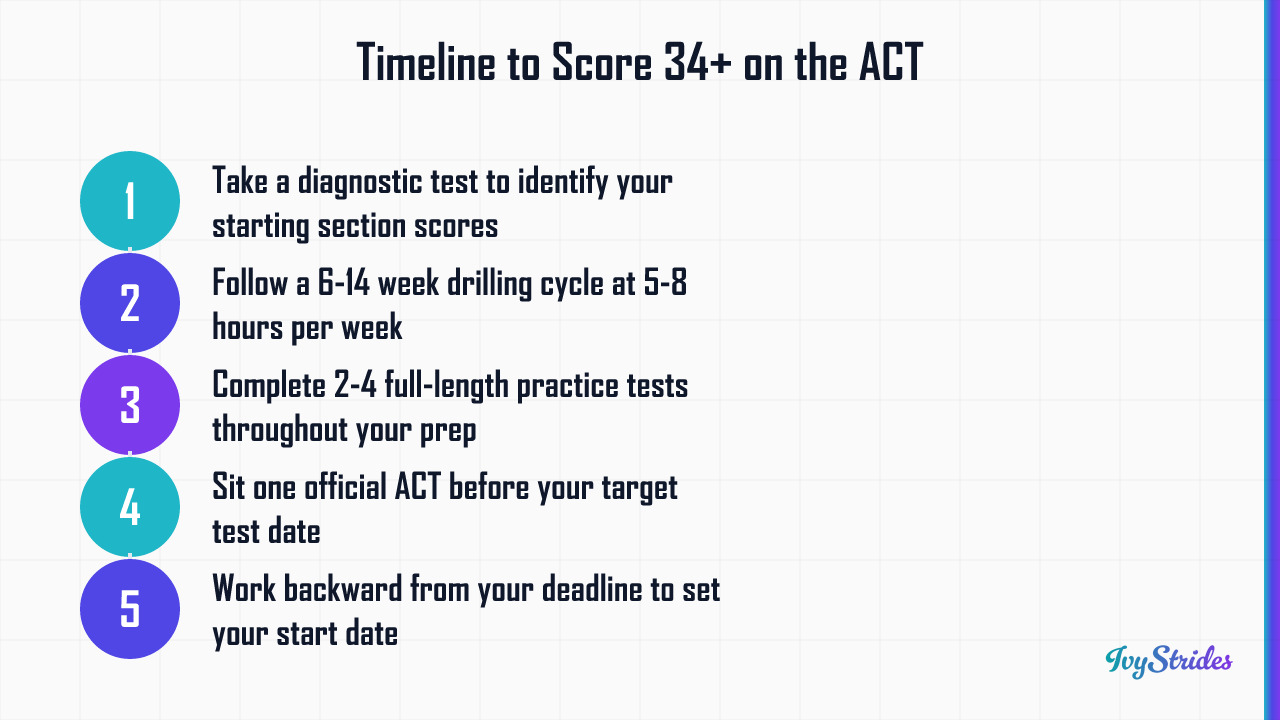
The honest answer depends on your starting section scores and your hours per week.
Starting at 30-31: a typical timeline in our coaching is 10-14 weeks at 6-8 hours per week, with 3-4 full-length practice tests across the cycle. At that cadence, total prep adds up to roughly 60-110 hours.
Starting at 32-33: a typical timeline is 6-10 weeks at 5-7 hours per week, with 2-3 full-length practice tests. Roughly 30-70 hours total.
Two notes on the timeline math. First, the students who reach 34+ are the ones who follow the diagnostic-to-drilling cycle consistently. Effort and consistency are the primary variables, not raw IQ. Second, plan for at least one official ACT test date as a real-conditions data point before your target test date. At-home practice tests are useful but never quite replicate test-day cognitive load.
ACT test dates are published at act.org, and registration typically closes about 5 weeks before each administration. If you're targeting a fall test date for early-action deadlines, work backward: a 12-week cycle to a September test means starting in mid-June. Timelines vary by student. A student whose 30-33 score is held back entirely by pacing on Reading typically moves faster than one whose misses are scattered across three sections.
For a calendar-based view, our ACT prep in 2 months plan maps the diagnostic cycle to a weekly schedule.
What a 34 ACT Score Actually Gets You in College Admissions
A 34 ACT places you inside or above the middle 50% range at most highly selective schools per their published Common Data Sets, though admissions outcomes depend on the full application, including essays, GPA, and extracurriculars.
Per the most recent Common Data Sets, Harvard, Yale, and Princeton all report ACT middle-50% ranges of 34-36. At Duke, Northwestern, and Vanderbilt, a 34 sits at or above the 75th percentile of admitted students. That means more than 75% of admitted students at those schools scored 34 or lower. So a 34 is not a borderline number at any of these schools. It's a competitive one. Our deep dive on whether you should apply to Dartmouth College walks through Dartmouth's full admissions picture. The companion piece on whether you should apply to Vanderbilt University covers Vanderbilt the same way.
A few caveats matter. Test-optional policies vary by school and year, so verify each college's current policy at fairtest.org before deciding whether to submit a 34. For most selective schools, a 34 is a meaningful asset worth reporting. For merit scholarship consideration at many public flagships and mid-tier privates, a 34 qualifies for the top scholarship tiers, but every school sets its own thresholds and you should verify on each school's scholarship page.
The full-application point bears repeating. A 34 ACT does not guarantee admission anywhere. Selective schools admit students whose applications are coherent across scores, GPA, course rigor, essays, recommendations, and extracurriculars. A parent recently asked us whether a 34 ACT meant their student could ease off the essays. The honest answer was no. If your score is already at 34 and your essays haven't been touched yet, the highest-use next step is usually essay work. Our common app essay tutor page walks through how essay coaching slots into the full admissions strategy.
Is a 34 ACT Worth Pursuing, or Should You Switch to the SAT?
If you're still deciding whether to pursue a 34 on the ACT or an equivalent score on the Digital SAT, our comparison of act vs sat difficulty can help you choose the test that fits your strengths.
The concordance math: per College Board and ACT, Inc. concordance tables, a 34 ACT is roughly equivalent to a 1520-1540 SAT. A 1480 SAT concords to about a 33 ACT, so a 34 ACT is modestly stronger than a 1480 in concordance terms. Colleges that accept both tests evaluate them on equal footing. The standard strategy is to submit whichever concordant score is higher.
Here's the harder judgment call. If you're consistently scoring 32-33 on ACT practice tests but 1480-1500 on Digital SAT practice tests, the SAT may be your higher-ceiling test, and switching at that point is rational. If you're at a 33 ACT and a 1450 SAT, stay with the ACT. The decision should come from diagnostic results on both tests, not from a hunch about which "feels" easier. For most students, the ACT Science section and the faster ACT pacing are the variables that decide it. If you can't reliably finish ACT Reading in 35 minutes, the Digital SAT's longer per-question time may suit you better.
One more caveat: test-optional policies mean some students may not need to submit either score. Verify per school. If your target schools are test-optional and your application is strong elsewhere, the marginal value of pushing from 33 to 34 may be lower than the marginal value of strengthening your supplements. For a fuller side-by-side, is the SAT harder than the ACT walks through the format differences in detail.
FAQ
How hard is it to get a 34 on the ACT?
A 34 ACT places you at approximately the 99th percentile, meaning fewer than 1 in 100 test-takers reach this score. For students already scoring 30-33, the difficulty isn't content mastery but error-pattern precision. You can miss only about 3-5 questions per section, so every repeated mistake type has to be identified and eliminated through targeted drilling. Students who complete a structured diagnostic-and-drilling cycle over 8-12 weeks typically reach 34+ when they execute the categorization step properly.
Can I get into an Ivy League school with a 34 ACT?
A 34 ACT is within the middle 50% range at every Ivy League school per their most recent Common Data Sets and is a competitive score for admission. However, admission to Ivy League schools depends on the full application, including GPA, course rigor, essays, extracurriculars, and recommendations. A 34 is a strong asset, but it's not a guarantee of admission at any school. Many 34+ scorers are denied each year. Many sub-34 scorers are admitted because of strength elsewhere in the application.
Should I retake the ACT if I already have a 34?
It depends on your target schools' score ranges and how much time you have before application deadlines. If your target schools have a 75th percentile of 35-36 per their published Common Data Sets (most Ivies, Stanford, MIT, Duke), a retake is worth considering if you have 8+ weeks to prep and a clear error-pattern plan. If your target schools' 75th percentile is 34 or lower, a retake may not be the highest-use use of your time compared with strengthening your essays, AP scores, or extracurricular narrative.
How many questions can I miss on the ACT and still get a 34?
The exact number varies by test date and scoring curve, but as a general guide: approximately 4-5 missed on English (75 questions), 3-4 on Math (60 questions), 2-3 on Reading (40 questions), and 3-4 on Science (40 questions). Because the curve shifts, treat these as estimates rather than fixed targets. Focus on minimizing errors in your weakest section first, since that section is what's pulling your composite below 34.
What is a 34 ACT equivalent to on the SAT?
Per the official College Board and ACT, Inc. concordance tables, a 34 ACT is roughly equivalent to a 1520-1540 on the Digital SAT. Colleges that accept both tests evaluate them on equal footing, so the standard strategy is to submit whichever score is higher in concordance terms. These are approximate ranges, not exact equivalencies.
How many students get a 34 on the ACT each year?
A 34 ACT corresponds to approximately the 99th percentile, meaning roughly 1% of test-takers reach this score or higher in a given year. With approximately 1.4 million students taking the ACT annually, that's roughly 14,000 or fewer students scoring 34 or above. It's a genuinely rare achievement, which is why selective colleges weight it as a meaningful signal even inside a holistic review.
Your Next Step
A 34+ ACT is reachable for most students currently scoring 30-33 inside a 10-week structured cycle. The students who get there are the ones who run a real diagnostic, categorize every miss honestly, and drill the 2-3 patterns that actually matter. The students who don't get there are the ones who take five more practice tests without ever asking why the same question type keeps eating their score.
Ready to Turn Your 30-33 into a 34+ ACT Composite?
Book a free 15-minute ACT strategy call. Your IvyStrides section-specialist will map your error patterns, set a realistic target timeline, and show you exactly how our 1-on-1 ACT prep program works. Students and parents both welcome.

Award-winning author (South Asian Book Award) and graduate of BITS Pilani and UCLA Luskin School of Public Affairs. Brings a published writer's eye to Common App essays and grammatical precision to SAT and ACT R&W instruction.