
Should You Retake the ACT? The Straight Answer for 2026 (and What to Do Next)

On this page
- The Short Answer: Should You Retake the ACT?
- How to Know If Your Score Is High Enough (or Not): A Score-Band Breakdown
- The Real Reasons to Retake: Score Gaps, Scholarships, and Superscoring
- Your Score Is In. Now What? How to Diagnose Whether a Retake Will Actually Help
- When You Should NOT Retake the ACT
- How to Make a Retake Actually Work: The Prep Plan That Moves the Needle
- ACT Retake Logistics: Cost, Dates, Limits, and Senior-Year Timing for 2026
- Is a 34 or 35 ACT Worth Retaking? What the Numbers Actually Say
- FAQ
- How much does it cost to retake the ACT in 2026?
- Can you retake the ACT after high school or as an adult?
- How many times should you take the ACT?
- Does retaking the ACT hurt your application?
- Is a 27 ACT score good, and should a student with a 27 retake?
- How does ACT superscoring affect the retake decision?
- Can you retake the ACT your senior year?
- Ready to Make Your Retake Count?
Yes, retake the ACT if your composite falls below the 50th-percentile ACT range at your target schools, if you ran out of time on one or more sections, or if you have not yet done structured, diagnostic-driven prep. According to ACT, Inc., most students who retest raise their composite score. The condition that matters: a retake without a targeted prep plan rarely moves the needle. If your composite is already at or above the 75th percentile of your target schools, a retake usually isn't worth the time or cost.
The rest of this article is the decision tree behind that answer: how to read your score against real school ranges, when a retake pays for itself in scholarship money, when to stop, and the concrete prep plan that separates a productive retake from a wasted Saturday.
The Short Answer: Should You Retake the ACT?
Three quick triggers say yes.
Your composite is below the 50th-percentile ACT range at your top-choice schools. Look up each school's 25th–75th percentile ACT range in its Common Data Set, then compare. If you're below the median, a retake is likely worth it.
You ran out of time on at least one section. Pacing gaps are highly coachable. If you left more than three questions blank on any section, your score doesn't reflect your ceiling.
You haven't yet done structured prep. If your first sitting was cold, or you studied passively without a diagnostic, there's real headroom. ACT, Inc. reports that more than half of retesters raise their composite; the students who prep with a plan are heavily overrepresented in that majority.
If none of those apply, the case for retaking gets thin fast. The next section gives you the score-band table to check yourself against.
How to Know If Your Score Is High Enough (or Not): A Score-Band Breakdown
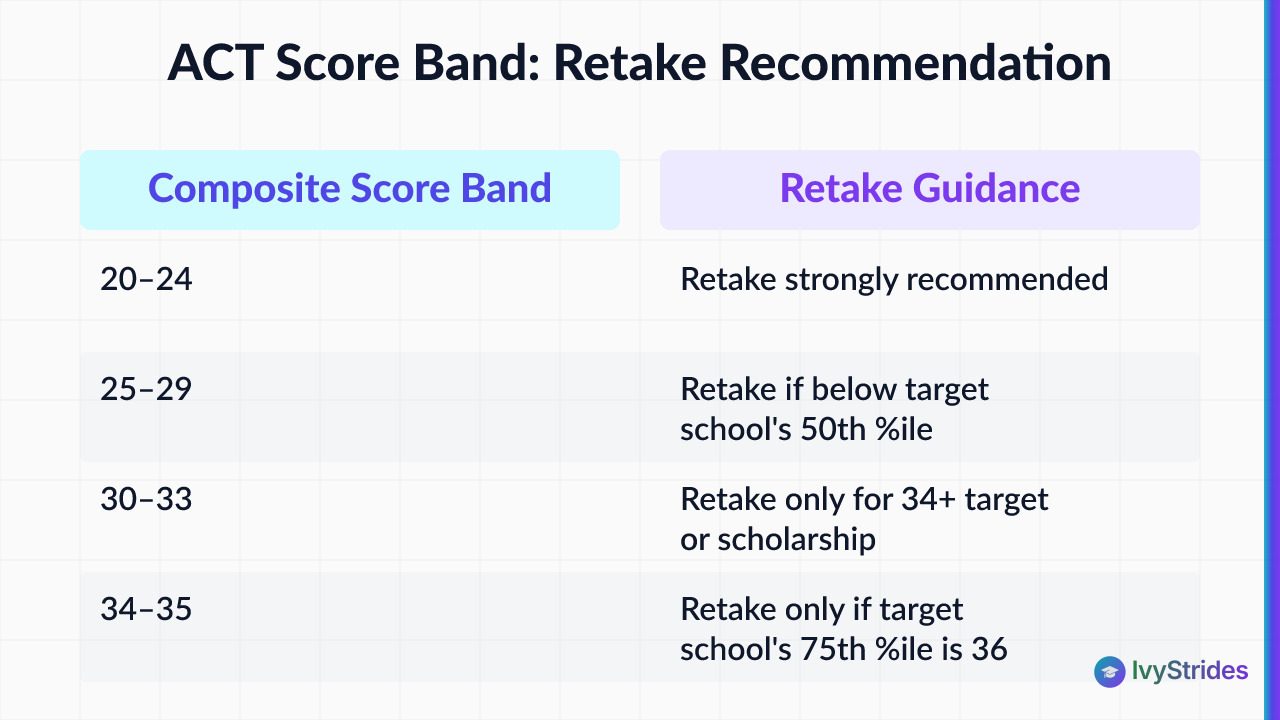
Percentiles first, then school context.
A 27 ACT sits around the 88th percentile nationally. A 30 is roughly the 93rd. A 34 is approximately the 99th percentile, which means roughly one in a hundred test-takers reaches it. A 36 is a perfect score, awarded to a small fraction of the cohort each year. These percentile bands come from ACT, Inc.'s national score distribution data and shift slightly year to year.
Percentiles alone don't answer the retake question. School ranges do. Here's the score-band framework we use in coaching:
- Composite 20–24: Retake strongly recommended if you're applying to four-year colleges. A 3–5 point gain is typical for students completing structured prep and opens up substantially more admissions options.
- Composite 25–29: Retake if your composite is below the 50th percentile of your target schools. A 2–3 point gain from targeted section work is realistic in roughly 6–8 weeks.
- Composite 30–33: Retake only if your target school's 75th-percentile ACT is 34 or higher, or if you're chasing a merit scholarship threshold you can identify by name.
- Composite 34–35: Retake only if you're applying to schools where the 75th-percentile composite is literally 36 (a very short list) and you have prep hours to spare before deadlines.
- Composite 36: No retake possible, and no reason to want one.
For the SAT concordance readers keep asking about: a 31 ACT corresponds to roughly a 1400 SAT on the official ACT/College Board concordance tables. That's useful when a target school reports SAT ranges more prominently than ACT ranges.
Named-school context matters. Highly selective schools like Northwestern, Duke, and Johns Hopkins typically report 75th-percentile ACT composites of 35 or 36 in their most recent Common Data Sets. Verify each school's current range before committing. For the full breakdown, see our post on ACT score ranges for top colleges. If Duke is specifically on your list, we cover fit and stats in Should You Apply to Duke University? Key Factors Explained.
The Real Reasons to Retake: Score Gaps, Scholarships, and Superscoring
Three reasons carry real weight. The rest is noise.
Closing a section-score gap. Say your section scores are lopsided: English 31, Math 27, Reading 30, Science 28. Your composite of 29 masks a fixable weakness. A student who focuses roughly six weeks on Math with a section-specialist coach and pulls that 27 up to a 31 lands at a 30 composite on a single retake, and a 31 superscore at schools that combine sittings.
Superscoring changes the math. A superscore combines your best English, Math, Reading, and Science across multiple test dates. If a target college superscores the ACT, a retake focused only on your weakest section can raise your effective composite even when the second sitting's overall score isn't higher. Not every school superscores. Confirm each one's policy on its admissions page before you plan your strategy. See act superscore colleges for the current list and how to use it.
Merit scholarship thresholds. A one- or two-point composite gain can cross a merit scholarship cutoff worth thousands per year. Many flagship state universities set automatic scholarship tiers at composites of 28, 30, or 32, and the dollar differences between tiers can hit five figures across four years. This is the most quantifiable financial case for retaking a "good enough" score. A one-point gain worth $10,000 a year is a strong return on a roughly $68 registration fee. Our article on how ACT scores affect merit scholarships covers the specific cutoffs at named schools.
In our coaching with students in the 27–31 composite range, the ones who gain 2–3 points on a retake almost always do the same thing: identify one weak section, work it with a section specialist, and confirm the gain on a full-length practice test before the real sitting. For self-directed drilling between sessions, our act practice test online library gives you the timed passages and error-analysis tools to do that work.
Your Score Is In. Now What? How to Diagnose Whether a Retake Will Actually Help
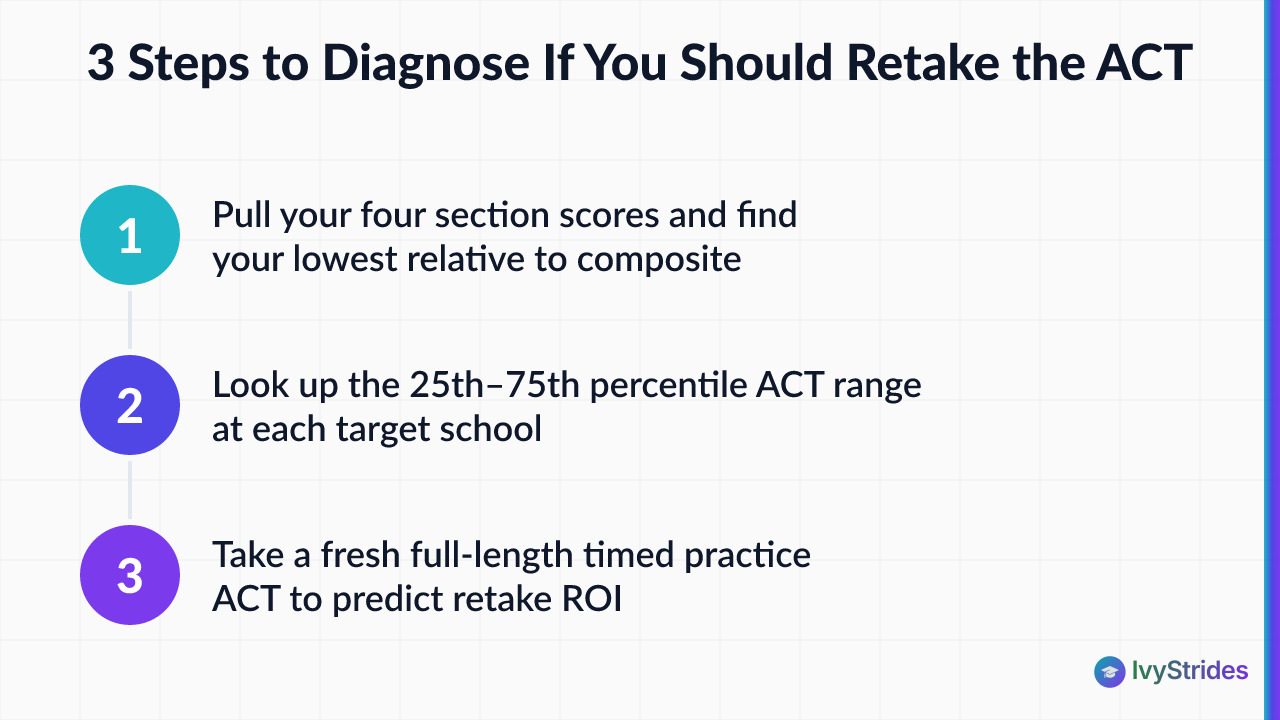
Three steps. Do them in order.
Step 1: Pull your four section scores side by side. Identify the lowest section relative to your composite. If your composite is 29 and Science is a 26, Science is your use point. If all four sections are within a point of each other, you're looking at across-the-board content and pacing work, not a targeted retake.
Step 2: Look up the 25th–75th percentile ACT range at each target school. Search "Common Data Set [University Name]" and open the most recent PDF. Section C9 has the ACT ranges. Write down the 25th, 50th, and 75th percentile composites for each school. Now you can see, in numbers, exactly how far your current score sits from each target.
Step 3: Take a fresh full-length timed practice ACT. This is the diagnostic that predicts retake ROI. A student who scores 2 or more points higher on a clean, timed practice test than on their official sitting has real retake potential; the first sitting undersold their ability. A student who lands within a point of their official score on a fresh diagnostic has hit their current ceiling, and a retake without new prep will produce the same result.
Pacing signal: if you left more than three questions blank on any single section of your official sitting, pacing is the issue, not content knowledge. Pacing is one of the most coachable variables on the ACT.
In our coaching with students in the 25–30 composite range, the ones who complete a diagnostic before committing to a retake avoid wasting a test date on a score that doesn't move. The ones who register first and diagnose later usually retest twice before figuring out what section actually needed work.
When You Should NOT Retake the ACT
Four situations argue against a retake. Read them honestly.
You're at or above the 75th-percentile ACT of every target school. The marginal admissions value of one more point is negligible when you're already in the top quartile of admitted students. Your time invests better in essays, activities, and interviews.
Your composite has plateaued after two structured attempts. If two retakes with real prep produced less than one composite point of improvement, a third retake with the same approach is unlikely to help. That's a signal to either change the prep approach fundamentally, switch to the SAT, or stop. Students who have plateaued on the ACT sometimes find the Digital SAT's adaptive format plays to their strengths; read our comparison of is sat harder than act before committing to another ACT date.
Senior-year timing has closed the window. The last ACT date whose scores typically arrive before November 1 Early Decision deadlines is the September sitting. For January 1 Regular Decision deadlines, October is usually the last viable date. Verify current score-release timelines at ACT.org before registering.
You're near a test-optional school's 50th percentile. If your composite is within a couple of points of a school's median and the school is genuinely test-optional, submitting the score may not help. Not submitting avoids a slight negative signal. Test-optional policies vary by school and year; the FairTest tracker is the authoritative source for current status. For the full framework, our guide on should you submit act scores if test-optional walks through the submit-or-not decision by score band.
If your ACT composite has plateaued after two attempts, running a diagnostic on the SAT before registering for a third ACT sitting is often the higher-value move. Our act vs sat comparison walks through which test typically favors which skill profile.
How to Make a Retake Actually Work: The Prep Plan That Moves the Needle

The methodology is simple to describe and harder to execute: diagnostic, targeted weakness work, spaced retesting, with a section specialist for your weakest area.
Prep window. A 4+ composite point gain is typical for students completing our 1-on-1 ACT program across a full prep cycle. For a targeted retake between sittings, plan on roughly 6–8 weeks of structured work for a 2–3 point composite gain in the 25–31 range.
Hours. A consistent 5–8 hours per week across 8 weeks adds up to roughly 40–60 total hours of active practice. Active means timed question sets followed by error analysis, not passive re-reading. Passive study is the single biggest reason students retake and see no movement.
Section tactics that move scores fastest:
- ACT English (45 questions, 45 minutes, per ACT, Inc.). Grammar and rhetoric questions reward knowing the tested rule categories: subject-verb agreement, comma usage, pronoun clarity, transitions, redundancy, sentence structure. Roughly 12–15 rule categories account for the overwhelming majority of English questions. In our coaching, students who drill these rules specifically gain 2–4 points on English alone.
- ACT Math (60 questions, 60 minutes). Pacing discipline matters more than new content. Students who skip hard questions on the first pass and return with remaining time typically gain 1–2 points without learning any new math.
- ACT Reading (40 questions, 35 minutes). The tightest time pressure on the test. Passage-mapping and question-triage tactics matter more than vocabulary.
- ACT Science (40 questions, 35 minutes). The most coachable section for students who've never studied it systematically. The three passage types (Data Representation, Research Summaries, Conflicting Viewpoints) each reward a different reading approach. Learn the approaches and a 3–5 point Science gain with almost no biology or chemistry content review is typical.
Spaced retesting. Take a second full-length timed practice test 3–4 weeks into prep. If the gap is closing, keep going. If it isn't, adjust the approach before you burn a test date. This is the checkpoint most self-directed retakers skip.
For the full section-by-section approach and coach matching, see our act prep overview. If you want to see who would coach you, our tutors page lists the section specialists.
ACT Retake Logistics: Cost, Dates, Limits, and Senior-Year Timing for 2026
Straight logistics, verified against ACT, Inc..
How many times can you retake the ACT? No limit. ACT, Inc. doesn't cap the number of attempts a student can make. Most students who retest do so two or three times.
How much does it cost? The standard ACT registration fee is approximately $68 without the writing section as of the current cycle. Verify at ACT.org before you register, since fees update. Late registration and score-send fees add to the total. Budget roughly $80–$120 per attempt when accounting for all fees.
2026 ACT test dates. Typical annual dates fall in February, April, June, July, September, October, and December. The exact 2026 schedule and registration deadlines are posted at ACT.org; confirm the full list before planning your prep timeline.
Senior-year retake window. Yes, you can retake the ACT as a senior, and many students do. The September ACT is typically the last date whose scores arrive before November 1 Early Decision deadlines. The October date is typically the last for January 1 Regular Decision deadlines. Score release timelines shift year to year; verify at ACT.org before you register.
Post-high-school retake. Yes, you can retake the ACT after high school or as an adult. ACT, Inc. sets no age restriction on registration; adults can register and sit at any standard test center, and scores are valid for college applications regardless of when they were earned.
Is a 34 or 35 ACT Worth Retaking? What the Numbers Actually Say
Short version: rarely.
A 34 ACT sits around the 99th percentile. It's competitive at nearly every US college, including most Ivy League schools. Ivy median composites at Harvard, Princeton, and Yale typically fall between 35 and 36 in recent Common Data Sets, which means a 34 lands inside the admitted range but below the median at those specific schools. If those are your targets and your 34 came without structured prep, a retake with real preparation can be worth the effort.
A 35 is a different calculation. The marginal admissions value of moving from 35 to 36 at most schools is negligible. The only students for whom a 35-to-36 retake makes strategic sense are those targeting a very short list of schools where the 75th-percentile composite is literally 36, and who have prep hours to spare before their deadlines. Most students at 35 get more admissions value from strengthening their essays than from a retake; in our coaching, that trade-off holds nearly every time for students applying to highly selective schools.
Named-school context: Northwestern, Johns Hopkins, and Brown typically report 75th-percentile ACT composites around 35 in their most recent Common Data Sets. Verify each school's current range before deciding. If Northwestern or Johns Hopkins are on your list, see Should You Apply to Northwestern University in 2026? and Should You Apply to Johns Hopkins University? Stats & Fit for the fit-and-stats context.
Here's the part most students miss at the top of the score distribution: at highly selective schools, moving from a 34 to a 36 doesn't compensate for a weak essay. A single memorable supplemental essay does more to differentiate you than a perfect composite. Time is finite. Spend it on the lever with the higher marginal return.
FAQ
How much does it cost to retake the ACT in 2026?
The standard ACT registration fee is approximately $68 without the writing section as of the current cycle. Verify the current fee at ACT.org before registering, since fees update annually. Late registration and score-send fees add to the total, so budget roughly $80–$120 per attempt when accounting for all fees.
Can you retake the ACT after high school or as an adult?
Yes. ACT, Inc. places no age restriction on test registration. Adults who've already graduated can register and sit for the ACT at any standard test center. Scores are valid for college applications regardless of when they were earned, which matters for transfer applicants and returning students.
How many times should you take the ACT?
ACT, Inc. reports that most students who retest do so two or three times before reaching their goal. There's no official limit on attempts. In our coaching, we recommend stopping when your composite is at or above the 75th percentile of your target schools, or when two consecutive retakes with structured prep have produced less than one composite point of improvement.
Does retaking the ACT hurt your application?
No. Most colleges use score choice (you select which scores to send) or superscore across sittings. A lower score from an earlier attempt doesn't penalize you at schools that superscore or accept score choice. Score-sending policies vary by school, so verify each target school's policy via its Common Data Set or admissions website.
Is a 27 ACT score good, and should a student with a 27 retake?
A 27 ACT places a student around the 88th percentile nationally, which is above average and competitive at many colleges. Students targeting schools with a 50th-percentile composite of 30 or higher should strongly consider a retake with targeted prep; a roughly 3-point gain is realistic in 6–8 weeks of structured section work.
How does ACT superscoring affect the retake decision?
If a college superscores the ACT, it takes your best English, Math, Reading, and Science scores across all test dates and combines them into a new composite. A targeted retake focused on your weakest section can raise your effective composite even when the second sitting's overall score isn't higher. Always confirm whether a specific school superscores before planning your retake strategy; policies vary and change.
Can you retake the ACT your senior year?
Yes. The September and October ACT dates are the most commonly used senior-year retake windows. September scores typically arrive before November 1 Early Decision deadlines; October scores typically arrive before January 1 Regular Decision deadlines. Verify exact score release timelines at ACT.org for the current cycle before you register.
Ready to Make Your Retake Count?
The retake decision is a numbers question, and it has a defensible answer once you have your section scores, your target school ranges, and one honest diagnostic in front of you. That's the work. If you want a second set of eyes on it before you register, we're glad to look. Learn more about our approach on our about page.

Award-winning author (South Asian Book Award) and graduate of BITS Pilani and UCLA Luskin School of Public Affairs. Brings a published writer's eye to Common App essays and grammatical precision to SAT and ACT R&W instruction.