
Enhanced ACT Format: Sections, Timing, and Question Counts (2026)
On this page
- The ACT Format at a Glance: Sections, Questions, and Time (2026)
- What Is the ACT? A Plain-Language Definition for Students and Parents
- The Enhanced ACT vs. the Legacy ACT: What Changed in 2025-2026
- ACT English Section: 75 Questions, 45 Minutes
- ACT Math Section: 60 Questions, 60 Minutes
- ACT Reading Section: 36 Questions, 35 Minutes
- ACT Science Section: Optional but Strategically Important
- ACT Writing Section: The Optional Essay Explained
- How the ACT Is Scored: Composite, Section Scores, and What a 36 Means
- ACT vs. SAT: A Quick Format Comparison
- How to Use This Format Knowledge to Build Your Prep Plan
- FAQ
- What is the format of the ACT?
- Is a 36 a perfect score on the ACT?
- Is the ACT harder than the SAT?
- Is a 1480 SAT equivalent to a 34 ACT?
- When did the ACT format last change?
- Should I take the ACT with or without the Science section?
- How long does it take to complete all ACT sections?
- Is two months enough time to study for the ACT?
The ACT has three required sections: English (75 questions, 45 minutes), Math (60 questions, 60 minutes), and Reading (36 questions, 35 minutes). Two optional sections follow: Science (40 questions, 35 minutes) and Writing (one essay, 40 minutes). The Enhanced ACT rolled out in 2025 cut the total question count from 215 to 171 with Science, or 131 without. Core testing time for the three required sections runs about 2 hours 15 minutes. The Composite score averages your English, Math, Reading, and Science section scores (if taken) on a 1-36 scale.
Every format figure in this article traces back to ACT, Inc.'s official documentation. The harder question, which the next sections cover, is what those numbers mean for how you actually prepare, because a lot of prep books on the shelf still describe the 215-question legacy version.

The ACT Format at a Glance: Sections, Questions, and Time (2026)
Here's the full structure:
- English: 75 questions, 45 minutes, five prose passages. Tests grammar, punctuation, sentence structure, and rhetorical skills. Scored 1-36.
- Math: 60 questions, 60 minutes. Pre-algebra through trigonometry and basic statistics. Calculator permitted throughout. Scored 1-36.
- Reading: 36 questions, 35 minutes. Four passages spanning literary narrative, social science, humanities, and natural science. Scored 1-36.
- Science (optional): 40 questions, 35 minutes. Data representation, research summaries, and conflicting viewpoints. Scored 1-36. Does not affect the Composite.
- Writing (optional): One essay prompt with three or four perspectives, 40 minutes. Scored 2-12. Does not affect the Composite.
Total question count is 171 with Science or 131 without. Core testing time (the three required sections) runs about 2 hours 15 minutes. Add 35 minutes for Science and another 40 minutes for Writing, plus administrative time and breaks at the testing center. For a fuller look at how these pieces fit into a study plan, see our ACT prep overview.
What Is the ACT? A Plain-Language Definition for Students and Parents
The ACT is a standardized college admissions test administered by ACT, Inc. and accepted at every four-year college and university in the United States. It's taken primarily by high school juniors and seniors as part of their applications, and it's one of two major admissions tests alongside the Digital SAT.
The scoring scale runs 1-36. Your Composite is the average of your four core section scores (English, Math, Reading, and Science if you take it), rounded to the nearest whole number. A 36 is the highest possible Composite and sits at the 100th percentile nationally. Fewer than one-tenth of one percent of test-takers earn one in any given year.
For students weighing whether the ACT or the SAT is a better strategic fit, read our take on ACT vs SAT difficulty before committing to a prep path.
The Enhanced ACT vs. the Legacy ACT: What Changed in 2025-2026
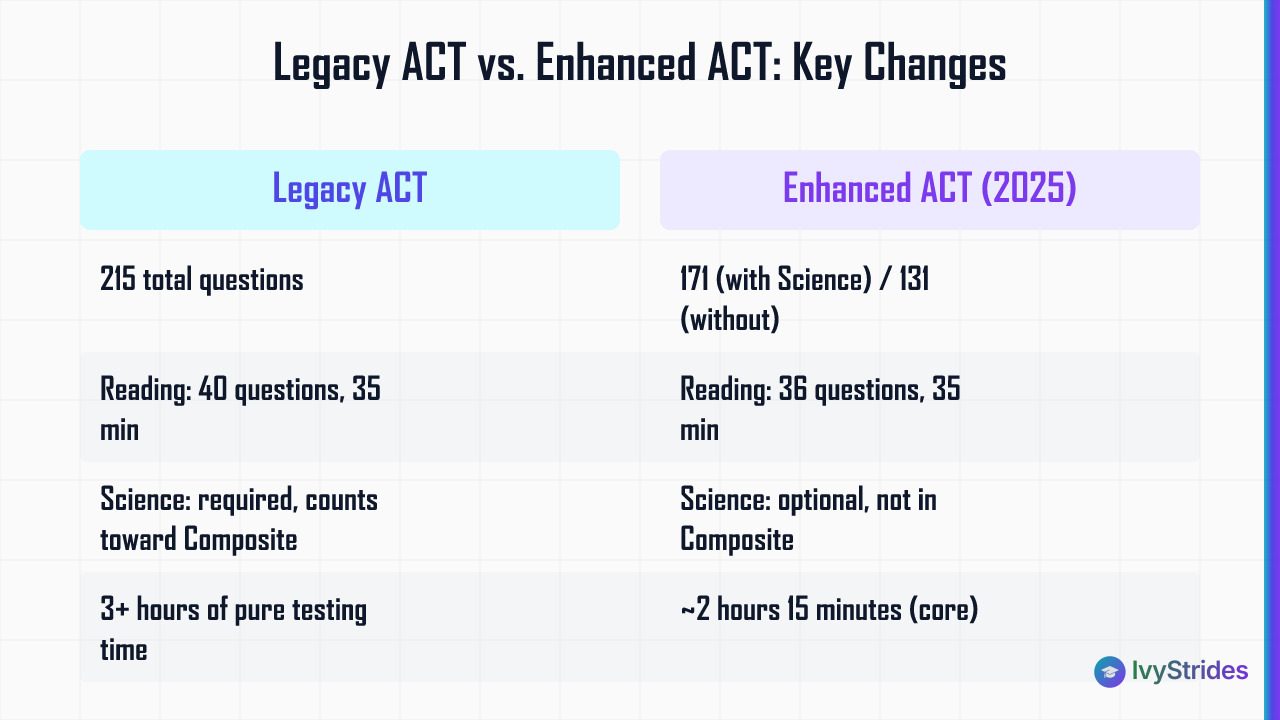
This is the section most students need and most prep books get wrong. The Enhanced ACT, rolled out in 2025, is materially shorter than the legacy format. What changed:
- Total questions: legacy ACT had 215; Enhanced ACT has 171 with Science, 131 without.
- Reading: down from 40 questions to 36 questions. Time stays at 35 minutes, so you get roughly six extra seconds per question.
- Science: moved from required to optional. It no longer factors into your Composite score.
- Writing: remains optional (unchanged from legacy).
- Total testing time: legacy sittings exceeded 3 hours of pure testing time; Enhanced core time runs about 2 hours 15 minutes.
What stayed the same: the 1-36 scoring scale, the Composite calculation, the multiple-choice format for the four core sections, and the general content domains within each section.
In our coaching, students who arrive holding prep books published in 2022 or 2023 are routinely running 40-question Reading drills against a 35-minute clock, which trains the wrong pacing and the wrong stamina curve. If your prep material doesn't say "Enhanced ACT" or "2025" on the cover, verify the question counts against ACT, Inc. before you time another drill.
For a deeper look at how to close a real point gap on the current format, see how to raise your ACT score 4 points.
ACT English Section: 75 Questions, 45 Minutes

Photo by cottonbro studio on Pexels
Five prose passages, roughly 15 questions each, at about 36 seconds per question. That pacing benchmark is the single most useful number to internalize before test day.
The questions split into two broad categories. Usage and Mechanics covers commas, apostrophes, semicolons, subject-verb agreement, pronoun agreement, and modifier placement. Rhetorical Skills covers transition words, sentence order within a paragraph, paragraph order within an essay, and questions that ask whether adding or deleting a sentence would strengthen the passage.
Here's the pattern we see most often. In our coaching, students who run out of time on English aren't struggling with grammar rules. They're spending 60 to 90 seconds each on the rhetorical skills questions early in a passage (the "would this addition be relevant?" type), then racing through the mechanical grammar at the end. The grammar questions are the faster points. Do them first within each passage, then loop back to the judgment calls.
For a broader look at raising your English section score, read how to improve your ACT score.
ACT Math Section: 60 Questions, 60 Minutes
Sixty questions in sixty minutes. Exactly one minute per question, per ACT, Inc. The content spans pre-algebra, elementary and intermediate algebra, coordinate geometry, plane geometry, trigonometry, and basic statistics and probability.
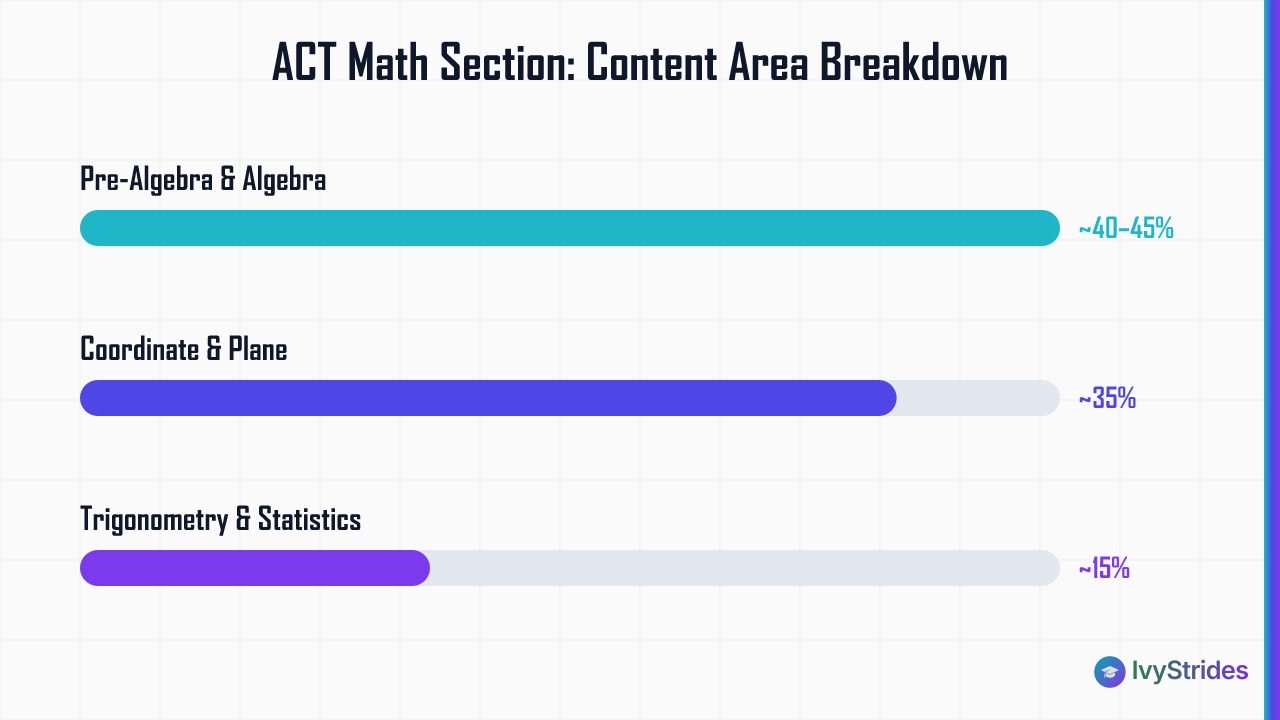
Roughly 40 to 45 percent of the questions are pre-algebra and algebra. Coordinate and plane geometry make up around 35 percent. Trigonometry and statistics are the last 15 percent or so. A calculator is permitted for the entire section, a meaningful difference from the Digital SAT and worth internalizing if you're comparing the two tests.
In our coaching with students in the 20 to 24 Composite band, the biggest math point leaks are almost never trigonometry. They're coordinate geometry (finding slope, distance, and midpoint under time pressure) and intermediate algebra (systems of equations, quadratics, function notation). Students look at their score reports, see 22 in Math, and assume they need to drill trig. They usually need to drill the middle of the section instead.
If you want a coach who specializes in one section rather than a generalist across all four, our 1-on-1 ACT prep pairs students with a section-specialist tutor for exactly this reason.
ACT Reading Section: 36 Questions, 35 Minutes
Thirty-six questions, 35 minutes, four passage sets. That works out to about 58 seconds per question, or roughly 8 to 9 minutes total per passage set including reading time.
The four passage types appear in this order: Literary Narrative (a fiction excerpt), Social Science (history, economics, sociology), Humanities (art, literature, philosophy), and Natural Science (biology, chemistry, physics writing for a general audience). One of the four sets may be a paired-passage format where two shorter passages appear together with comparative questions.
The Enhanced ACT cut Reading from 40 to 36 questions while keeping the 35-minute clock, which gives you slightly more breathing room per question than the legacy version. Use it.
In our coaching, students who read the full passage before touching the questions consistently outperform students who jump to the questions first, especially on Natural Science and Social Science. The temptation to skim and hunt is strong on a timed test. Resist it, at least on the dense information passages. If you're stuck at the same Reading score after multiple sittings, read how to break an ACT score plateau.
ACT Science Section: Optional but Strategically Important
Forty questions, 35 minutes, now optional. The Science section is built around three passage types: data representation (graphs, tables, and figures with interpretation questions), research summaries (descriptions of experiments with questions about design and results), and conflicting viewpoints (two or more scientists presenting competing hypotheses).
Because Science no longer counts toward the Composite, some students skip it. That's a legitimate choice, but it comes with a caveat: some colleges and scholarship programs still review the Science score even when the Composite is what appears on the admissions form. Check the admissions page of every target college before deciding to skip.
Students taking AP courses alongside ACT prep often find that the ACT Science section's data-interpretation passages overlap with skills tested in AP Biology, AP Chemistry, and AP Environmental Science. In our coaching, students with a semester or two of AP science coursework typically find data representation and research summaries more familiar than students without lab-heavy backgrounds. If you're building an AP schedule alongside your test prep, our AP courses online run per-subject specialists rather than one teacher trying to cover everything.
ACT Writing Section: The Optional Essay Explained
One prompt, 40 minutes, one essay. The prompt presents a complex issue and gives you three or four perspectives on it. Your task is to analyze the perspectives and develop your own position in relation to them.
Writing is scored 2 to 12 (not on the 1-36 scale) across four domains: Ideas and Analysis, Development and Support, Organization, and Language Use and Conventions. Two readers each score the essay 1 to 6 per domain; the domain scores are added. The Writing score is reported separately and does not affect your Composite.
A small number of colleges still require or recommend ACT Writing. Verify with each target school. And because test-optional policies shift year to year, check FairTest's tracker alongside each college's current admissions page before deciding whether the essay is worth 40 additional minutes of your test day.
How the ACT Is Scored: Composite, Section Scores, and What a 36 Means
Each of the four core sections is scored on a 1-36 scale. The raw number of correct answers converts to a scaled section score using a curve specific to that test form. Your Composite is the arithmetic mean of the four section scores, rounded to the nearest whole number. If you skip Science, your Composite is the mean of English, Math, and Reading.
A 36 Composite sits at the 100th percentile nationally. A 27 sits at approximately the 88th percentile. A 21 lands near the national average. Those percentile cutoffs shift slightly year to year as the norm group updates, but the shape of the curve is stable, per ACT, Inc.
One trust point on superscoring. ACT, Inc. does report a superscore across sittings if you request it, but not every college uses it. Some superscore, some take your highest single-sitting Composite, and some average multiple sittings. Verify each target school's policy directly.
To see where your current score falls before committing to a full prep block, our ACT practice test online library gives you full-length timed sittings with score-band analysis.
ACT vs. SAT: A Quick Format Comparison
If you're still deciding between the two tests, the ACT's Science section and straight-line pacing contrast sharply with the Digital SAT's adaptive module structure, and a diagnostic practice test for each is the fastest way to find your stronger format.
Four practical differences to weigh:
- Structure: The Digital SAT is adaptive. Module 1 performance determines whether Module 2 is easier or harder. The ACT is linear; every student sees the same questions in the same order on a given test form.
- Science: The ACT has a dedicated Science section (now optional). The Digital SAT has no equivalent. Science-style data interpretation appears in some Reading and Writing passages on the SAT, but there's no separate section.
- Calculator: The ACT permits a calculator throughout Math. The Digital SAT also allows a calculator throughout its Math section as of the digital rollout, but older comparison charts may still describe the old policy.
- Scoring: ACT reports 1-36. Digital SAT reports 400-1600. Approximate concordance puts a 1480 SAT near a 34 ACT, though concordance tables give a range (roughly 33 to 35) and colleges may draw their own comparisons.
Students who are also considering the PSAT/NMSQT should note that the PSAT uses a different format and scoring scale from the ACT, and the two tests serve different strategic purposes in a college admissions plan. For the fuller breakdown, see is the SAT harder than the ACT.
How to Use This Format Knowledge to Build Your Prep Plan
Knowing the section structure is step one. The next step is a full-length diagnostic that shows exactly which section and question type is costing you the most points. The most efficient way to internalize these timing benchmarks is to sit a timed, full-length ACT practice test before you begin any targeted prep.
Three months is a commonly recommended timeline for meaningful ACT preparation. Plan for roughly 80 total study hours spread across 6 to 8 hours per week. Students starting below a 20 Composite typically need more runway to build foundational content; students in the 24 to 28 band targeting 30+ can often make real gains in about 8 to 10 weeks with focused, section-specific work.
For students completing our 1-on-1 ACT program, a 4+ Composite point gain is typical when starting from a diagnostic baseline and working with section-specialist coaches. That's not a guarantee. Results depend on hours invested, starting score band, and consistency of practice, and no honest coach will tell you otherwise.
For a self-directed starting point, our digital ACT prep library gives you full-length sittings with a score-band breakdown. If you're closer to the plateau end, how to improve your ACT score walks through the diagnostic-to-plan process step by step.
FAQ
What is the format of the ACT?
The ACT has three required sections (English, Math, Reading) and two optional sections (Science and Writing). In the Enhanced ACT format for 2025-2026, the total question count is 171 with Science or 131 without. Core testing time for the three required sections is about 2 hours 15 minutes. The Composite score is the average of your four core section scores on a 1-36 scale.
Is a 36 a perfect score on the ACT?
Yes. A 36 is the highest possible ACT Composite and sits at the 100th percentile nationally, meaning a student who earns a 36 outperformed essentially every other test-taker in the national norm group. Fewer than one-tenth of one percent of test-takers earn a 36 in any given year, per ACT, Inc. reporting.
Is the ACT harder than the SAT?
Neither test is objectively harder; difficulty is student-specific. The ACT rewards steady pacing across a linear test and includes a dedicated Science section, while the Digital SAT uses an adaptive module structure with no separate Science section. Students strong in data interpretation and quick pacing often prefer the ACT. Students who prefer adaptive difficulty and more time per Reading question often prefer the Digital SAT. A diagnostic practice test for each is the reliable way to decide.
Is a 1480 SAT equivalent to a 34 ACT?
According to official ACT-SAT concordance tables, a 1480 SAT is approximately equivalent to a 34 ACT, though the actual range is roughly 33 to 35 depending on section balance. Both scores sit near the 99th percentile. Colleges that accept both tests treat concordant scores similarly, but check each school's Common Data Set for the middle-50% score ranges of admitted students.
When did the ACT format last change?
The most significant recent change was the rollout of the Enhanced ACT in 2025. It cut the total question count from 215 to 171 (with Science) or 131 (without), moved Science to optional status, and reduced Reading from 40 to 36 questions. The 1-36 scoring scale and Composite calculation stayed the same. Prep materials published before 2025 reflect the legacy format and should be verified against current ACT, Inc. documentation before use.
Should I take the ACT with or without the Science section?
For most students, taking Science is worth the extra 35 minutes because some colleges and scholarship programs still review the Science score, and a strong score can demonstrate STEM readiness. But if you're applying only to schools that don't use the Science score and time management is a real concern, skipping it is a valid choice. Check the admissions requirements of every target college before deciding.
How long does it take to complete all ACT sections?
The three required sections take about 2 hours 15 minutes of pure testing time. Adding Science adds 35 minutes. Adding Writing adds 40 minutes. With all five sections, total testing time runs approximately 3 hours 30 minutes, not counting scheduled breaks or check-in time at the testing center. Plan for a roughly 4 to 4.5 hour morning if you're taking the full battery.
Is two months enough time to study for the ACT?
Two months can work for students who are consistent and start from a real diagnostic, but three months is the more commonly recommended timeline. Budget roughly 80 total study hours spread across 6 to 8 hours per week. Students starting below a 20 Composite typically need more time to build foundational content, while students in the 24 to 28 range targeting 30+ can often make meaningful gains in about 8 to 10 weeks with section-specific work.
Match your prep materials to the current Enhanced ACT format, sit a real diagnostic before you build a plan, and target the sections where the diagnostic says the points actually live. The English and Math sections are where students in the 20-26 band typically find the fastest gains, not the sections that feel most intimidating.

Award-winning author (South Asian Book Award) and graduate of BITS Pilani and UCLA Luskin School of Public Affairs. Brings a published writer's eye to Common App essays and grammatical precision to SAT and ACT R&W instruction.