
How to Study for ACT Math in 2026: A Step-by-Step Guide That Actually Works

On this page
- What Math Topics Appear on the ACT and How Many Questions Each Gets
- How to Build Your ACT Math Study Plan Step by Step
- How to Pace ACT Math and Guess Strategically When You Are Stuck
- Is ACT Math Difficult, and What Does It Take to Score a 30 or 36?
- FAQ: Studying for ACT Math
- Is ACT math difficult?
- What math is needed for the ACT?
- What is the best strategy for guessing on the ACT math test?
- How to get a 36 in ACT math?
- Your Next Step on ACT Math
ACT Math is a 45-question, 50-minute section covering pre-algebra through trigonometry, scored 1 to 36. To study for it, take a timed practice section to find your weakest topic clusters, memorize the formulas the ACT does not provide, drill those specific topics, and review every miss in an error log.
That format runs about 67 seconds per question, and it comes straight from ACT, Inc.'s official section structure page. The trap most students fall into is re-reading textbook chapters instead of chasing the two or three topics actually costing them points. This guide fixes that.
What Math Topics Appear on the ACT and How Many Questions Each Gets
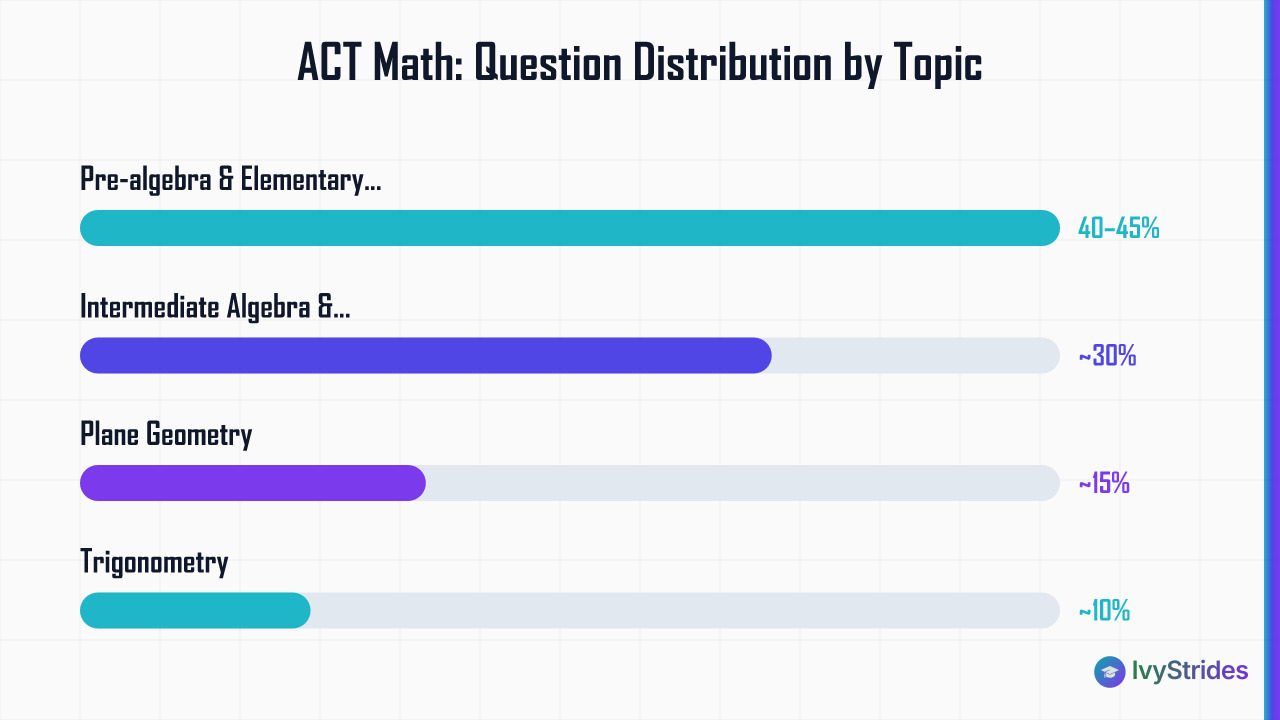
ACT Math covers six topic areas: pre-algebra, elementary algebra, intermediate algebra, coordinate geometry, plane geometry, and trigonometry. Per ACT, Inc., the section tests skills a student typically acquires through the beginning of 12th grade, so nothing on it is exotic. What matters is where the questions concentrate.
Algebra is the center of gravity. Pre-algebra and elementary algebra together make up roughly 40 to 45 percent of questions, which is why they are the first place to invest study hours. Intermediate algebra and coordinate geometry add about another 30 percent. Plane geometry sits around 15 percent, and trigonometry, the topic students fear most, is only about 10 percent of the section.
Math is one of three sections that determine your ACT composite, so gains here translate directly to your overall score; for a section-by-section plan covering English and Reading as well, see the enhanced ACT format and sections guide.
Unlike the Digital SAT, the ACT provides no formula reference sheet, so memorizing the must-know formulas is a non-negotiable first step. Formula memorization is a prerequisite, not a strategy. If you want the fuller picture of which test suits you, our ACT or SAT harder comparison walks through both.
| Topic Category | Approx. % of Questions | Approx. Questions (of 45) | Key Formulas to Memorize |
| Pre-algebra & elementary algebra | 40-45% | 18-20 | Quadratic formula, slope-intercept form |
| Intermediate algebra & coordinate geometry | ~30% | 13-14 | Circle equation, distance formula |
| Plane geometry | ~15% | 6-7 | Area of trapezoid, special right triangles |
| Trigonometry | ~10% | 4-5 | SOHCAHTOA, unit circle basics |
Percentages are approximate and reflect ACT, Inc. official test-prep documentation, not a published cut sheet. One structural detail matters for pacing: questions increase in difficulty from Q1 to Q45, which the next section builds on directly.
How to Build Your ACT Math Study Plan Step by Step
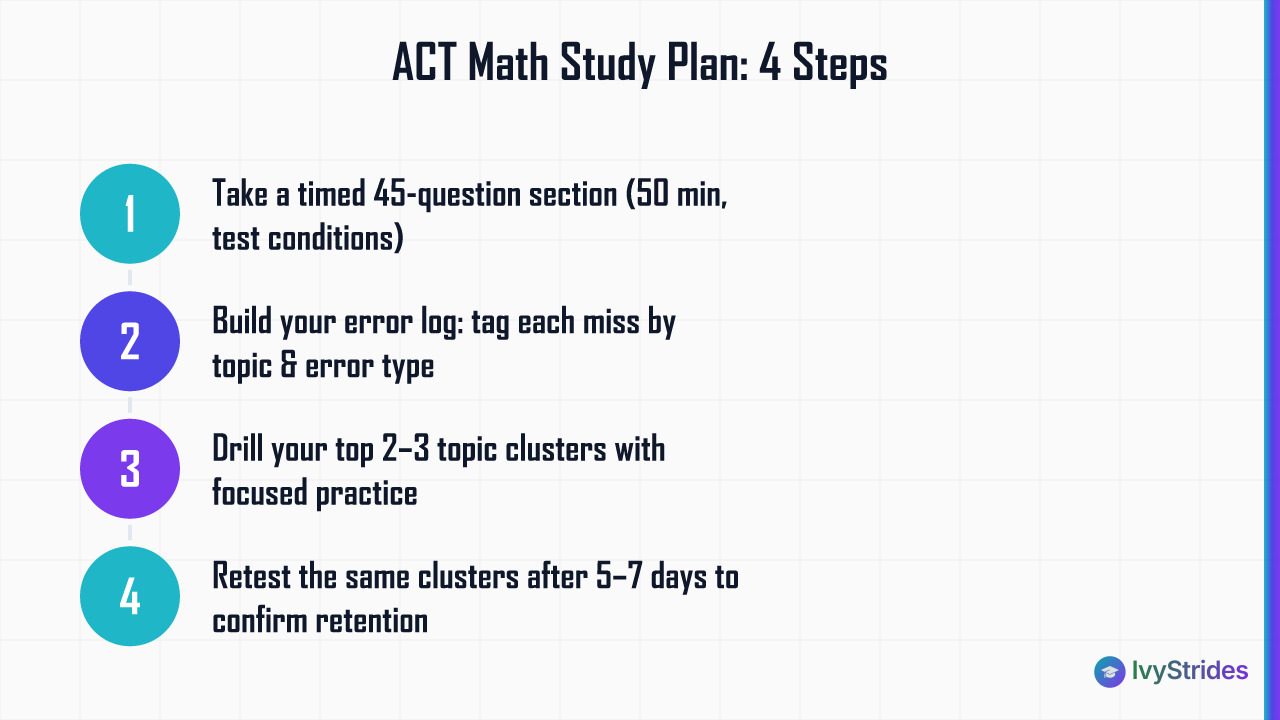
Building an ACT Math study plan means four moves in sequence: diagnose, log, drill, retest. Skip the diagnostic and you are guessing at your own weaknesses. So start with a timed section, not a chapter.
The engine here is the error log. After a timed practice section, record every missed question by number, topic category, and error type, splitting mistakes into conceptual (you didn't know the method) versus careless (you knew it and slipped). Students who keep this log consistently find that one or two topic clusters account for the majority of their lost points. That's the whole game: fix the highest-frequency gaps first, low-frequency ones last.
Where to get practice material. ACT, Inc. publishes free official practice tests and sample questions at act.org, and those are the right starting point because they mirror the real difficulty curve. For choosing among full-length options, our roundup of the best ACT practice tests sorts what's worth your time.
-
Take a timed 45-question section. Simulate test conditions: 50 minutes, calculator ready, no formula sheet.
-
Build your error log. Tag each miss by topic and by conceptual-versus-careless. Total the points lost per topic.
-
Drill your top two or three topic clusters. Spend the bulk of your hours here, not on topics you already handle.
-
Retest the same clusters after 5 to 7 days. Spaced retesting shows whether the fix held or just felt learned.
In our coaching with students in the 24-28 band, a focused 6-8 week Math plan targeting the two or three highest-frequency topic gaps typically produces a 3-4 point section gain. For a full calendar to hang that on, see our ACT prep in 2 months schedule. For the composite-level view, how to raise your ACT score 4 points covers the other sections too.
The hard part is reading your own error log honestly. A section-specialist coach who runs the diagnostic and structures the weeks removes that guesswork, which is exactly what our 1-on-1 ACT prep is built to deliver. If you'd rather match with a coach by section first, you can browse our ACT tutors by specialty.
How to Pace ACT Math and Guess Strategically When You Are Stuck
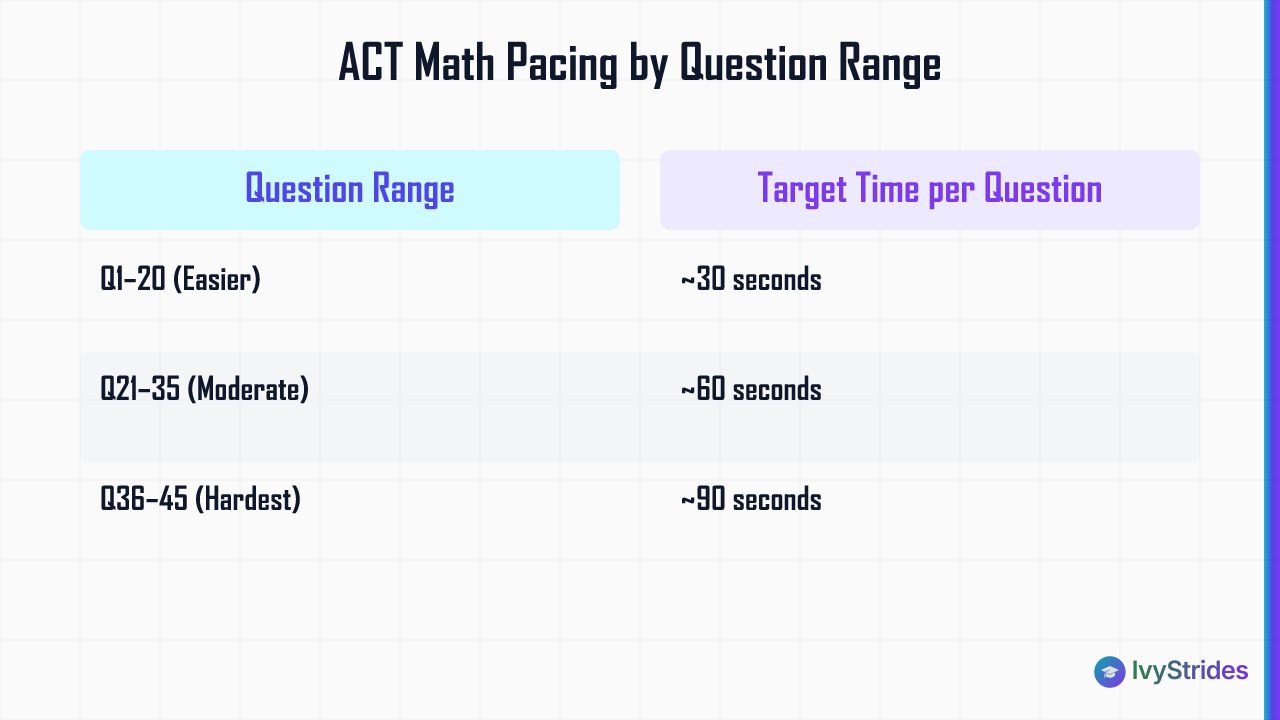
ACT Math pacing works out to about 67 seconds per question. ACT, Inc. publishes 50 minutes and 45 questions; IvyStrides calculates the per-question average at roughly 67 seconds. That average hides the real strategy, though, because the difficulty curve means the early questions should take far less time than the late ones.
Because the section climbs from Q1 to Q45, bank time early. Aim to clear questions 1 through 20 in about 30 seconds each, which leaves you a cushion for the harder intermediate algebra and trigonometry problems that cluster near the end. The triage rule is simple: if a single question stalls you past a minute, flag it, guess a placeholder, and move on. You return only if time allows.
Always fill in an answer. The ACT has no wrong-answer penalty, so a blank is strictly worse than a guess. Before you guess blind, eliminate obviously wrong choices, then pick from what remains. On algebra problems, backsolving, plugging the answer choices back into the equation, often beats setting up the algebra from scratch. Plugging in your own numbers works well on questions with variables in the answers.
Calculator use is permitted throughout, but ACT, Inc. advises using it wisely. Reaching for it on every arithmetic step burns seconds you needed for the hard questions.
| Question Range | Typical Difficulty | Target Time per Question | Triage Rule |
| Q1-20 | Easier | ~30 seconds | Answer directly; don't linger |
| Q21-35 | Moderate | ~60 seconds | Flag and skip if stuck past a minute |
| Q36-45 | Hardest | ~90 seconds | Guess a placeholder first, solve if time allows |
Once your Math section score is stable, your composite will reflect it directly, which matters when you compare your score against the middle-50 ranges at your target schools. For students pushing the top band, how to score 34 or higher on the ACT extends these tactics into the 34-36 range.
Is ACT Math Difficult, and What Does It Take to Score a 30 or 36?
ACT Math is topic-bounded and calculator-permitted, which makes it learnable, and that is the honest headline. The difficulty is not the math itself; it's the clock. Forty-five questions in 50 minutes rewards students who paced deliberately and drilled their gaps, and it punishes those who answer linearly and stall on hard problems.
Because the section is learnable, score bands map cleanly to what you need to fix. A 24 sits at roughly the 50th percentile; a 30 lands around the 93rd; a 36 is a perfect section score on the ACT's 1-to-36 scale. What moves you between bands is specific, not general.
28 to 32. In our coaching, students who reach 30-plus have typically resolved their intermediate algebra and coordinate geometry gaps before touching trigonometry, and they've cut careless arithmetic errors close to zero. 32 to 36. The final points come from near-perfect execution on trigonometry and multi-step word problems, plus consistent pacing so no question is ever left blank.
| Score | Approx. Percentile | What It Signals | Primary Focus to Move Up |
| 24 | ~50th | Solid algebra, shaky pacing | Coordinate geometry, timing |
| 28 | ~85th | Most topics stable | Careless-error control |
| 30 | ~93rd | Strong across categories | Intermediate algebra fluency |
| 32 | ~96th | Few conceptual gaps left | Trigonometry, word problems |
| 36 | 99th | Perfect execution | Full-section timed reps |
Percentile figures are approximate and reflect ACT, Inc. score-meaning data. One caveat worth stating plainly: a strong Math score helps, but admissions outcomes depend on the full application, not test scores alone, and test-optional policies vary by school and year. Set your target against the schools on your list, then work backward.
FAQ: Studying for ACT Math
Is ACT math difficult?
ACT Math is topic-bounded and calculator-permitted, which makes it learnable, but the 50-minute limit for 45 questions creates real time pressure at roughly 67 seconds each. Most students handle the early algebra and geometry questions comfortably. The difficulty spikes in the final 10 to 15 questions, which lean on intermediate algebra, coordinate geometry, and trigonometry.
What math is needed for the ACT?
The ACT Math section covers pre-algebra, elementary algebra, intermediate algebra, coordinate geometry, plane geometry, and trigonometry. Pre-algebra and algebra together account for roughly 40 to 45 percent of questions, making them the highest-priority study area. Trigonometry is only about 10 percent of the section, so it's the last thing to master, not the first.
What is the best strategy for guessing on the ACT math test?
Always guess, because the ACT has no wrong-answer penalty, so a blank is strictly worse than a filled bubble. When stuck, eliminate obviously wrong choices first, then choose from what's left. Backsolving, plugging the answer choices into the equation, is a reliable tactic on algebra questions when direct solving feels slow.
How to get a 36 in ACT math?
A 36 requires near-perfect execution: mastery of every topic category including trigonometry, zero careless arithmetic errors, and pacing tight enough that no question is left blank. In our coaching, students who reach 36 have typically drilled every topic cluster to fluency and completed at least five full timed practice sections under test conditions.
Your Next Step on ACT Math
The fastest route to a higher Math score isn't more hours, it's better-aimed hours. A timed section tells you where the points are leaking, and an error log tells you which two or three topics to drill first. Everything else is execution.
- Take one full timed 45-question section this week, under real conditions.
- Build an error log tagging each miss by topic and by conceptual versus careless.
- Drill your top two or three topic clusters, then retest them after 5 to 7 days.
- Set your target score against the middle-50 ranges at the schools on your list.

Two decades teaching quantitative and verbal aptitude on standardized tests. Rare dual expertise across Math and Verbal — particularly effective for students with gaps on both sides. Senior AP Mentor for our Calculus and English tracks.