
Is Free ACT Prep Enough to Raise Your Composite? An Honest Answer
On this page
- The Short Answer: It Depends on Your Score Gap and Your Timeline
- What Free ACT Prep Actually Gives You (and Where It Stops)
- The One Thing Every Prep Path Requires: A Diagnostic Baseline
- Score-Band Reality Check: When Free Prep Is Enough and When It Is Not
- Not Sure If Free Prep Is Enough for Your Score Goal?
- How Many Hours and Weeks Does ACT Prep Actually Take?
- What the Best Free ACT Prep Looks Like in Practice
- When Free Prep Is Not Moving Your Score: Signs You Need More
- A Note on the 2026 Enhanced ACT: What Changed and Why It Matters for Your Prep
- Frequently Asked Questions
- Is a 27 a good ACT score?
- Is a 1400 SAT or a 31 ACT better?
- Is 2 weeks enough to study for the ACT?
- What is the best free ACT prep available right now?
- How accurate are free ACT practice tests compared to the real exam?
- Is one month enough time to prepare for the ACT?
- The Honest Bottom Line
- Ready to Stop Guessing and Start Gaining Points?
Free ACT prep is enough for some students, not all. If your current composite sits within 3 to 4 points of your target and you can commit roughly 40 to 80 hours of structured self-study across 3 to 6 months, official free resources from ACT.org can produce real gains. If your gap is 5 or more composite points, or you've already been grinding free materials for weeks without movement, a diagnostic-driven, section-specialist plan almost always delivers faster, more reliable improvement. The honest answer turns on three variables: your score band, your target, and the calendar.
Format and scoring details in this article trace back to ACT, Inc. at act.org and should be verified against current documentation before your test date, since Enhanced ACT specifics have been rolling through 2025 and 2026.

The Short Answer: It Depends on Your Score Gap and Your Timeline
The national average ACT composite sits around 20 to 21, per ACT, Inc. reporting. Most students who search "is free ACT prep enough" are chasing something well above the average: roughly a 27 for state flagships, around a 31 for selective privates, a 34+ for the most selective schools.
Here's the working rule. If the distance between your baseline and your target is 3 composite points or fewer, and you have 3 to 6 months, free official practice materials plus disciplined error-log work can realistically close the gap. If the distance is 5 or more points, or you've already logged roughly 30-plus hours on free prep with no composite movement, self-study alone is unlikely to move you. That's not motivational filler. It's what we see across coaching cohorts.
A note on hours. Meaningful composite gains typically require about 40 to 80 focused study hours for a 3-to-4 point jump, and roughly 80 to 120+ for larger jumps. Spread across 6 to 8 hours per week, that's roughly 3 to 4 months of consistent work. Two weekends of cramming won't do it.
For students unsure where to start on section tactics, our ACT section prep guide breaks down English, Math, Reading, and Science by question type.
What Free ACT Prep Actually Gives You (and Where It Stops)
Let's inventory what's actually available for free in 2026, and where each resource hits its ceiling.
ACT.org official materials. ACT, Inc. publishes free full-length practice tests, daily practice questions, and format guides at act.org. These are the most format-accurate free resources for the Enhanced ACT, and they should anchor any prep plan, free or paid.
Third-party free question banks and platforms. Several test-prep providers release a free practice test or a limited free-tier question bank. Quality varies; some overestimate difficulty, some underestimate it. Use them only as supplementary practice after you've exhausted official ACT.org materials.
Free ACT practice test PDFs with answers. Older official released tests circulate as PDFs. They're useful for content practice, but pre-2025 tests don't fully reflect the Enhanced ACT format. Check the edition before you spend two hours simulating an outdated test.
The Official ACT Red Book. Not free, but worth naming because it's the most widely cited paid resource. Verify the edition against the Enhanced ACT format before buying.
Here's where free stops. Free resources give you content exposure and question volume. They don't give you personalized gap analysis, adaptive feedback after each set, or a coach who can tell you that your Reading composite drag is a passage-mapping problem rather than a vocabulary problem. That diagnostic layer is what most stalled students are actually missing, and free tools structurally can't provide it.
Once you know which section is dragging your composite down, section-specific prep becomes far more efficient than reviewing everything equally; see our ACT section-by-section prep guide for English, Math, Reading, and Science tactics. If you're still choosing between tests, our comparison of ACT vs. SAT difficulty walks through the format-level differences.
The One Thing Every Prep Path Requires: A Diagnostic Baseline
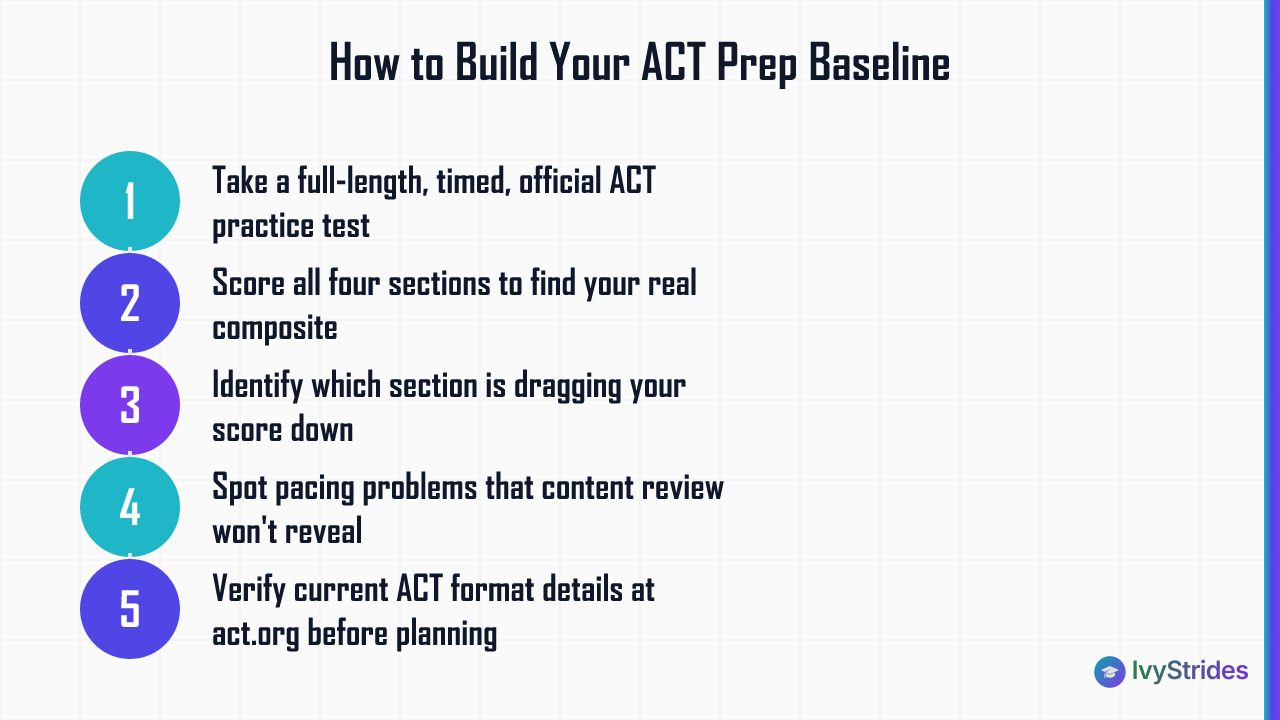
Whether you pay nothing or invest in 1-on-1 coaching, the first step is identical: a full-length, timed, official ACT practice test under real conditions.
Why this matters. A diagnostic gives you a real composite, not an estimated one, and, more importantly, four section scores that reveal which section is actually pulling you down. In our coaching, students who skip the diagnostic and jump straight into "content review" almost always plateau earlier than students who start with a scored baseline. They end up drilling Math when their real drag is Reading pacing, or reviewing grammar rules when their English section is fine and Science data interpretation is the leak.
A diagnostic also surfaces pacing problems that content review alone won't fix. Confirm current section counts and time limits against act.org before you build a plan, since ACT, Inc. has been rolling Enhanced ACT format updates through 2025 and 2026. Broadly: ACT English tests grammar, punctuation, and rhetorical skills; ACT Math covers pre-algebra through trigonometry; ACT Reading tests four passage types; ACT Science, now optional, tests data interpretation and experimental reasoning. Verify exact question counts and minutes at the source before you time yourself.
Taking a timed, full-length online act practice test is the single most important first step, regardless of which prep path you choose.
Score-Band Reality Check: When Free Prep Is Enough and When It Is Not
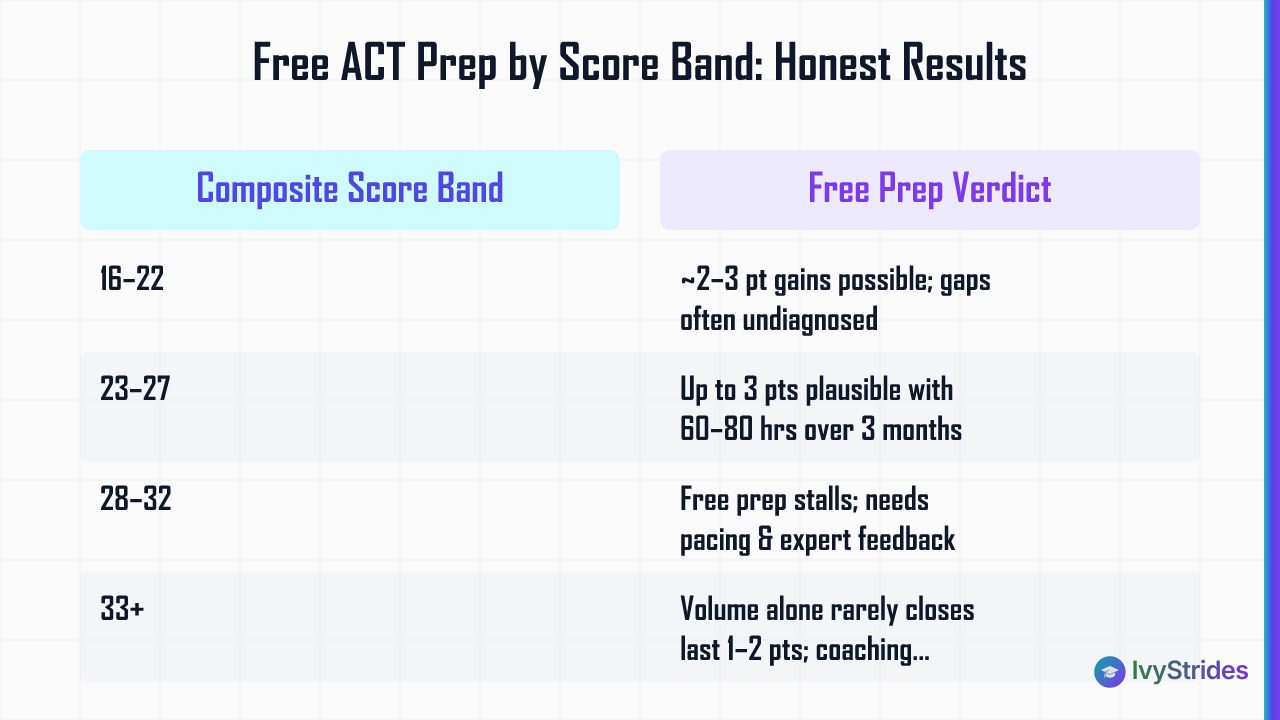
This is the part most articles skip. Here's the score-band math, honest.
Composite 16 to 22. Free resources can produce roughly 2 to 3 point gains with consistent effort. But students in this band often have foundational content gaps (algebra fundamentals, comma rules, passage-mapping habits) that free materials don't systematically diagnose or repair. Free prep here works if the student is genuinely disciplined and willing to build an error log; it fails when the student mistakes exposure for mastery.
Composite 23 to 27. A 27 is a strong score at a wide range of colleges and can qualify for merit aid at some. Free prep can plausibly close a 3-point gap in this band, if you commit roughly 60 to 80 hours across about 3 months. Above a 3-point gap, results get inconsistent.
Composite 28 to 32. Students here are targeting selective schools. A 1400 SAT converts to approximately a 31 ACT on the official concordance published jointly by ACT, Inc. and College Board. Gains of 3+ points at this band typically require question-level pattern recognition, precise pacing calibration, and section-specialist feedback that generic free resources rarely deliver. Free prep alone stalls here more often than not.
Composite 33+. At this band, marginal gains come from question-type fluency and elite pacing under pressure. Harvard's middle 50% ACT is 34 to 36, per its published Common Data Set. Free materials give you volume, but at 33+, volume without expert feedback rarely closes the last 1 to 2 points. Coaching, or at minimum a paid question bank with detailed explanations, is usually the right call.
In our coaching with students at the 24 to 28 band, the typical composite gain for students completing the full diagnostic-driven, 1-on-1 program is 4+ points. That framing matters: it's a typical outcome, not a guaranteed one, and it applies to students who finish the program.
One caveat that belongs in every conversation about ACT strategy: test-optional policies vary by school and by year. FairTest tracks the current landscape. A strong ACT still matters at many test-optional schools, especially for merit aid, and admissions outcomes always depend on the full application, not the score alone. Before committing to any prep plan, it helps to know how much your ACT composite actually moves the needle at your target schools; our breakdown of does the ACT matter for college admission gives the honest context.
Not Sure If Free Prep Is Enough for Your Score Goal?
In 15 minutes, an IvyStrides ACT specialist will review your current composite, identify your biggest section drag, and tell you exactly which prep path makes sense for your timeline and target schools. No pressure, no pitch. Students and parents both welcome.
How Many Hours and Weeks Does ACT Prep Actually Take?
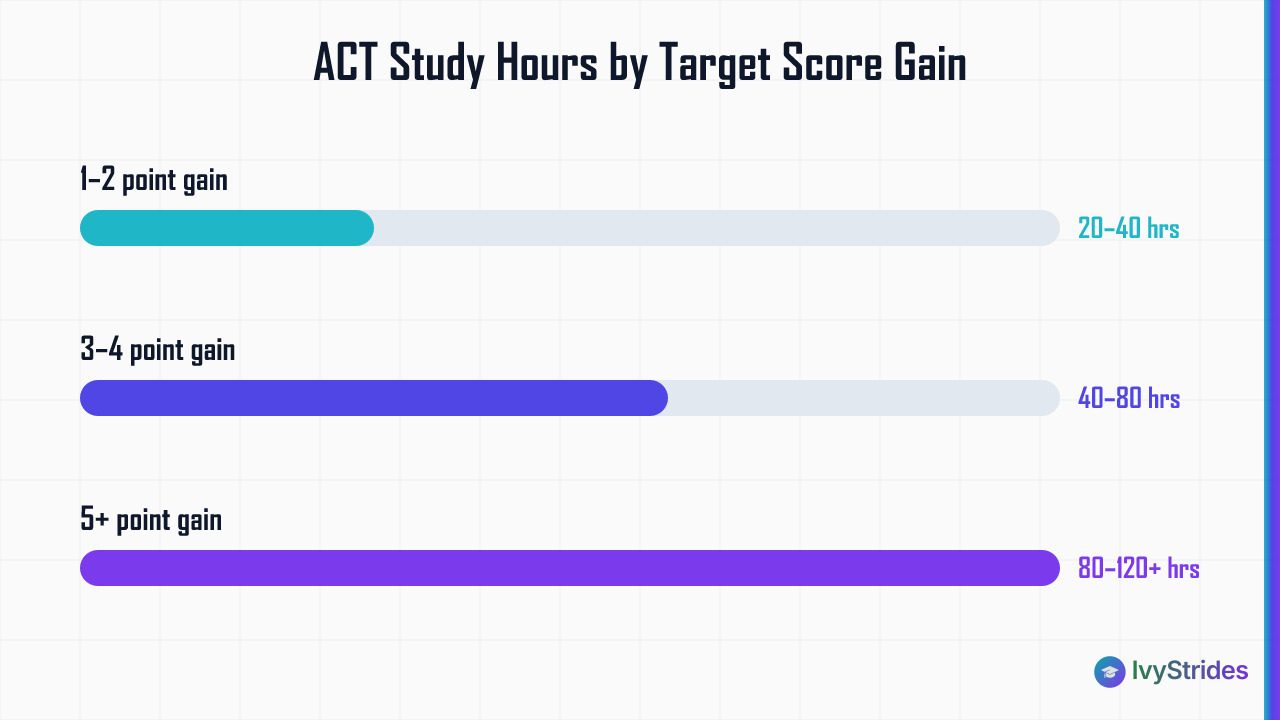
Short version: 3 to 6 months before your first sitting, 6 to 8 hours per week, roughly 80 total study hours for meaningful composite movement. That benchmark shows up consistently across coaching cohorts.
Break it down by gap:
- 1 to 2 point gain: roughly 20 to 40 hours across about 4 to 8 weeks.
- 3 to 4 point gain: roughly 40 to 80 hours across about 8 to 16 weeks.
- 5+ point gain: roughly 80 to 120+ hours across 4 to 6 months, and almost always with structured coaching rather than pure self-study.
Is 2 months enough to prepare for ACT? If your gap is 3 points or less and you can commit roughly 8 to 10 hours per week, yes. If your gap is larger, 2 months means you're triaging, not building. Prioritize the weakest section, log every mistake by type, and take at least two full-length timed tests.
Is 2 weeks enough? Honestly, no. Two weeks is useful for format familiarization and pacing rehearsal if you already have a solid foundation. It won't close a 4-point gap.
Superscoring changes the calculus. Many colleges superscore the ACT, meaning they take your best section scores across multiple sittings. If your target schools superscore, planning two sittings roughly 2 to 3 months apart is often smarter than putting everything on one test date. Once you have a composite you're proud of, knowing how to send ACT scores and use superscoring strategically is the next practical step. Our ACT prep overview lays out how we sequence sittings for students on that path.
One warning. Passive re-reading of prep books doesn't produce the same gains as active practice under timed conditions with error analysis afterward. In our coaching, students who complete 80+ hours of diagnostic-driven prep across 3 to 4 months show the most consistent composite gains. Students who log 80 hours of passive review often show less than a point of movement.
What the Best Free ACT Prep Looks Like in Practice
Here's a concrete, actionable free-prep framework you can start this week.
Anchor everything on official materials. ACT, Inc. releases free full-length practice tests at act.org; these are the most format-accurate for the 2026 Enhanced ACT. Use these before any third-party materials. If you burn through the official tests, then supplement.
Section-specific expectations (verify current specs against act.org before your test date):
- ACT English: tests grammar, punctuation, and rhetorical skills.
- ACT Math: covers pre-algebra through trigonometry.
- ACT Reading: four passage types, including literary narrative, social science, humanities, and natural science.
- ACT Science: now optional in the Enhanced ACT and excluded from the composite; tests data interpretation and experimental reasoning, not science facts.
A weekly rhythm that actually works. Better than marathon Sunday sessions: one timed section practice, one error-log review of that section, and one targeted content drill on your weakest question type. Three touches per week per weak area beats one four-hour block.
The error log is the highest-use free habit. Every missed question gets categorized: content gap, pacing error, or careless mistake. After about 100 questions, patterns emerge. Students who maintain an error log improve. Students who take practice tests without one repeat the same mistakes for months. This single habit separates the students who move their composite from the ones who plateau.
If you're still choosing between the ACT and the Digital SAT, our act vs sat comparison is the right starting point before you commit prep hours.
When Free Prep Is Not Moving Your Score: Signs You Need More
Three signals tell you free prep has hit its ceiling.
Signal 1: Three or more full-length practice tests, no composite movement. If you've taken three timed tests over roughly 6 to 8 weeks and your composite is flat, the problem isn't volume. It's diagnosis. You're drilling the wrong things.
Signal 2: You can't articulate why you missed the last 10 questions you got wrong. If your error log is blank, or every wrong answer is filed under "careless mistake," you don't have a clear picture of your actual weaknesses. Free resources won't build that picture for you.
Signal 3: Your pacing collapses in the second half of a section. This is almost always a strategy problem, not a knowledge problem. It requires targeted timing drills that free materials rarely structure.
Here's what structured coaching adds that free tools structurally can't. Section-specialist coaches address the specific question types within a section you're missing, rather than reviewing the whole section equally. Adaptive feedback after each practice set catches misdiagnoses early. In our coaching, students who come to us after 2 to 3 months of stalled free prep typically have a misdiagnosed weakness: they think they have a Math problem when the real drag is ACT Reading pacing. Fixing the actual leak often produces roughly 2 to 3 points of movement within weeks.
Paid options range from third-party question banks with detailed explanations, to structured group courses, to IvyStrides 1-on-1 ACT prep with section-specialist coaches and a diagnostic-driven plan. You can meet the tutors who specialize in ACT English, Math, Reading, and Science. International students often ask about registration windows and test-center logistics on top of the score math; our guide to the ACT for international students covers that layer.
A Note on the 2026 Enhanced ACT: What Changed and Why It Matters for Your Prep
The Enhanced ACT rollout has three format changes that directly affect which free materials are still accurate. Verify each against current ACT, Inc. documentation at act.org before your test date, since specifics have been updated through 2025 and 2026.
Science is now optional and excluded from the composite. If you skip Science, your composite is calculated from English, Math, and Reading. This changes strategy substantially for students who are strong in three sections but weak in Science; opting out can actually raise the composite.
The test is shorter with more time per question. The extreme pacing pressure of the legacy ACT is somewhat reduced, though pacing is still the primary reason students underperform their content knowledge.
Legacy prep books may be outdated. Any prep book printed before 2025, including older editions of the Official ACT Red Book, may not reflect the Enhanced ACT format. Check the edition. When in doubt, default to free materials on act.org, which are updated to the current format.
For students also weighing the Digital SAT transition, our overview of ACT vs. Digital SAT transitions covers the parallel format shifts.
Frequently Asked Questions
Is a 27 a good ACT score?
A 27 is generally considered a strong ACT score. It falls within the admitted-student range at many colleges and can qualify for merit scholarships at some. Whether it's competitive at your specific target schools depends on their middle 50% range, which you can find in each school's published Common Data Set. A 27 puts you comfortably above the national average of roughly 20 to 21.
Is a 1400 SAT or a 31 ACT better?
A 1400 SAT converts to approximately a 31 ACT on the official concordance published jointly by College Board and ACT, Inc. Colleges treat both scores equally and don't prefer one test. The better choice is whichever test plays to your strengths, best determined by taking a full-length diagnostic of each. Our SAT vs. ACT comparison walks through how to decide.
Is 2 weeks enough to study for the ACT?
Two weeks isn't enough time to build real ACT skills from scratch. It can be useful for format familiarization, pacing review, and light error analysis if you already have a strong academic foundation. For meaningful composite gains, plan for at least 3 to 6 months before your first test.
What is the best free ACT prep available right now?
The most format-accurate free resource is the official ACT practice material at act.org, which reflects the 2026 Enhanced ACT format. Anchor your prep there before touching any third-party materials. Some free third-party platforms exist, but quality varies; use them only as supplements after you've exhausted the official ACT.org content.
How accurate are free ACT practice tests compared to the real exam?
Official ACT practice tests from act.org are the most accurate predictor of real exam performance, because they're written by the same organization that writes the actual test. Third-party free practice tests vary in accuracy. For the most reliable baseline, always use at least one official ACT practice test before drawing conclusions about your composite.
Is one month enough time to prepare for the ACT?
One month can produce a roughly 1 to 3 point composite gain for a student who already has a solid academic foundation and can commit about 15 to 20 hours per week. It's not enough time for students with larger gaps or foundational content weaknesses. If you have only one month, prioritize your weakest section, take at least two full-length timed practice tests, and maintain a strict error log. International students should also review the ACT for international students guide for registration timing. Every student should know how to send ACT scores to colleges before test day.
The Honest Bottom Line
Free ACT prep is a legitimate path for the right student with the right gap and the right timeline. It isn't a universal solution. If you have a 3-point gap, six months, and the discipline to maintain an error log, ACT.org and a good weekly rhythm can get you there. If you have a 5-point gap, two months, and three flat practice tests behind you, the honest answer is that free prep has already told you what it can tell you. The next move is a real diagnosis, not more volume.
Ready to Stop Guessing and Start Gaining Points?
Book a free 15-minute ACT strategy call. We'll look at your diagnostic score, map your section weaknesses, and recommend the right prep path, whether that's a structured self-study plan, a test pack, or 1-on-1 coaching with a section specialist. Students and parents both welcome.

Award-winning author (South Asian Book Award) and graduate of BITS Pilani and UCLA Luskin School of Public Affairs. Brings a published writer's eye to Common App essays and grammatical precision to SAT and ACT R&W instruction.