
ACT Section-by-Section Prep: English, Math, Reading, and Science (2026)
On this page
- What the 2026 ACT Looks Like: Format and Scoring at a Glance
- ACT English Section Prep: Concision, Grammar, and Transition Logic
- ACT Math Section Prep: Formulas, Pacing, and the Trigonometry Question
- ACT Reading Section Prep: How to Find the Answer Before You Think You Know It
- ACT Science Section Prep: It Is a Reading Test, Not a Science Test
- Which ACT Section Should You Prioritize First? (The Diagnostic Answer)
- How Long Does It Take to Prepare for the ACT? Realistic Timelines by Score Band
- What a 27 ACT Score Means and How to Reach the 30+ Range
- Building Your ACT Section Prep Plan: A Week-by-Week Framework
- FAQ
- Is a 27 ACT score good enough for college admissions?
- Is two weeks enough time to study for the ACT?
- What ACT composite score corresponds to roughly the 75th percentile?
- Does ACT prep actually help, and what kind of prep works best?
- What is the easiest ACT section to improve quickly?
- How is ACT prep different from SAT prep?
ACT section prep means building four separate strategies, one for each scored section. English rewards concise, grammatically correct phrasing. Math requires formula recall and efficient problem setup. Reading tests your ability to locate direct textual evidence quickly. Science is a data-interpretation test, not a content-knowledge test. Start with a full-length diagnostic practice test, identify your weakest section, then allocate prep hours there first.
The enhanced ACT 2026 format is the reason all of this matters more than it used to. Fewer questions, tighter time limits, a bigger premium on pacing than raw content recall. Verify current section counts and timing at ACT, Inc. before you finalize your pacing plan.

What the 2026 ACT Looks Like: Format and Scoring at a Glance
The ACT scores you on four sections, English, Math, Reading, and Science, each on a 1-36 scale. Your ACT composite score is the average of those four section subscores, rounded to the nearest whole number. National average composite sits around 20-21. The Writing section is optional and is not part of the composite.
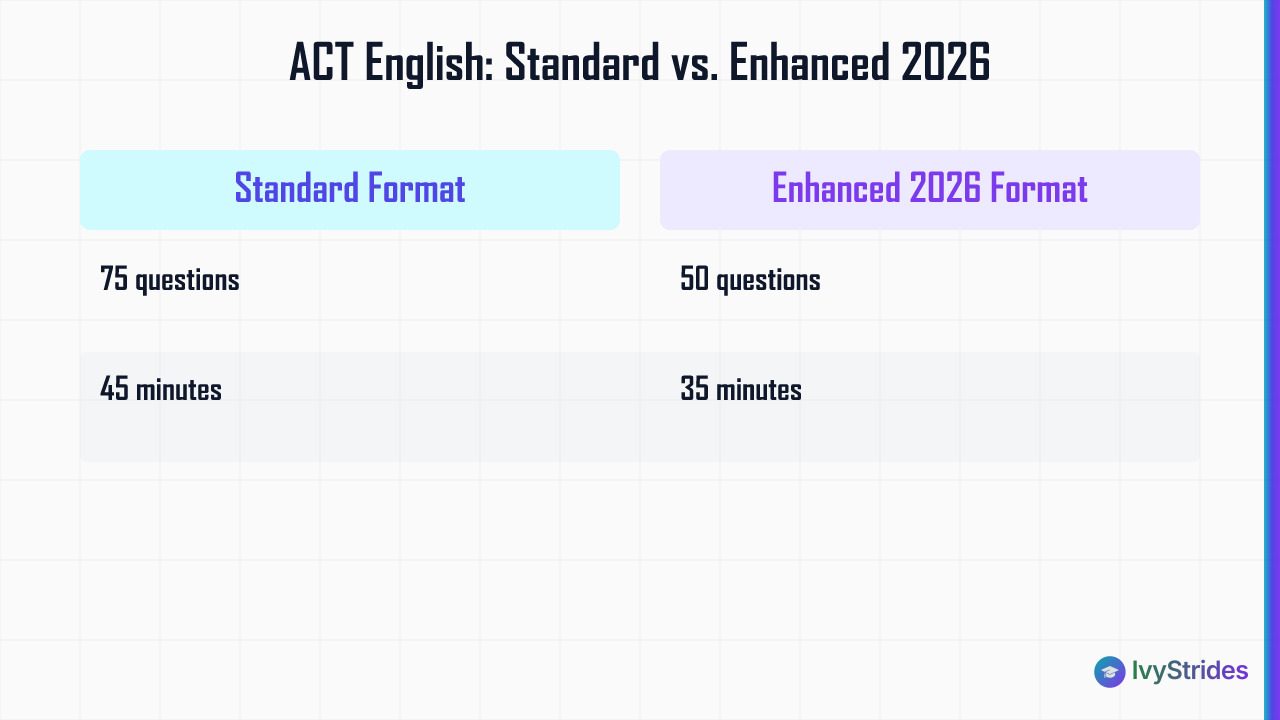
The enhanced ACT 2026 format reduces question counts and section time limits across the test. ACT English shifts to 50 questions in 35 minutes, down from 75 questions in 45 minutes. Math, Reading, and Science also see reduced question counts and shorter time limits under the enhanced format. Because ACT, Inc. is phasing changes in (international testing early 2026, state and district testing from Spring 2026), verify the current question count and time limit for your specific test date on the ACT, Inc. official site before you plan your pacing.
International students should note that the enhanced format applies to international test dates as of early 2026. Our guide for ACT for international students covers registration logistics and date selection.
One caveat worth surfacing early: test-optional admissions policies vary by school and year. A strong ACT score still strengthens most applications, but "test-optional" is not the same as "test-blind," and each college's current policy is what matters. We'll come back to that in the score-benchmark section.
ACT English Section Prep: Concision, Grammar, and Transition Logic
ACT English tests three domains: conventions of standard English (grammar, usage, punctuation), production of writing (organization, topic development), and knowledge of language (style, tone, precision). In the enhanced 2026 format, you have 50 questions in 35 minutes. That works out to roughly 42 seconds per question.
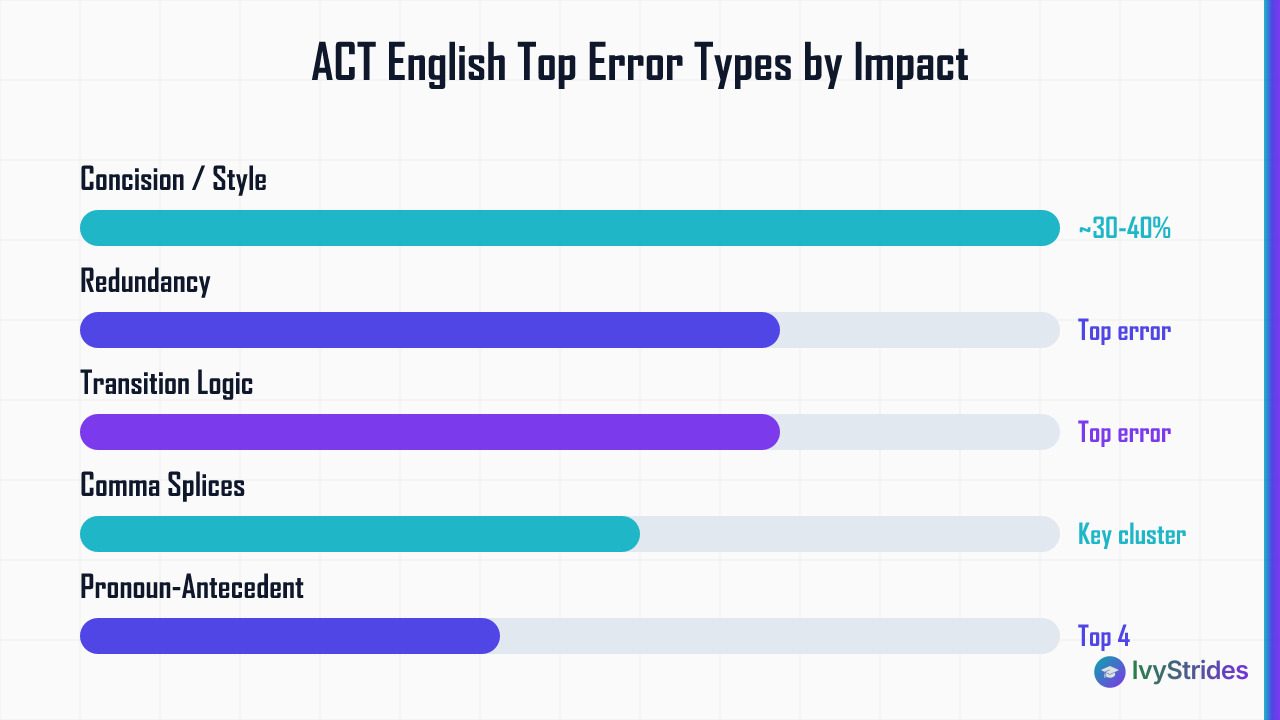
The dominant skill is concision. When two answer choices are both grammatically correct, the shorter one is almost always right on the ACT. That heuristic alone eliminates roughly 30-40% of wrong answers on usage and style questions, in our coaching with students at the 22-26 English band.
The highest-frequency error types at that same band are redundancy and transition logic. Redundancy questions test whether you can spot a phrase that repeats information already in the sentence ("the annual event, which happens every year"). Transition-logic questions ask you to pick the right connector, "however" vs. "therefore" vs. "beyond that", based on the logical relationship between two clauses. Miss the logic and you'll pick a word that sounds fine but flips the meaning.
Comma splices are the other cluster. A sentence like "The lab ran for six hours, the results were inconclusive" joins two independent clauses with just a comma. The fix is a period, a semicolon, or a subordinating conjunction. Spot the two-independent-clause structure in under five seconds and you bank time for harder rhetorical-skills questions later.
Pronoun-antecedent agreement rounds out the top-four error types: singular pronoun for singular antecedent, plural for plural. Simple in theory, often missed in practice because the antecedent is buried three lines back.
For students weighing which test to take, our breakdown of act vs sat difficulty walks through how the English section compares to Digital SAT Reading and Writing.
ACT Math Section Prep: Formulas, Pacing, and the Trigonometry Question
ACT Math covers six content domains: pre-algebra, elementary algebra, intermediate algebra, coordinate geometry, plane geometry, and trigonometry. Calculators are permitted throughout the section, so calculator strategy is less about "when am I allowed" and more about "when is it faster to solve by hand."
Verify the exact 2026 question count and time limit for Math against ACT, Inc.'s current documentation before your test date. Historically the section has averaged about one minute per question, with difficulty rising through the section. Early questions should take roughly 30-45 seconds so you bank time for the harder problems at the end.
Trigonometry is the smallest content domain and the highest-difficulty. Here's the triage rule: if you're targeting below a 28 composite, deprioritize trig. The three or four trig questions on the section typically land at the hardest end. Skip or guess on trig, invest that time in algebra and coordinate geometry where the volume of questions is much higher.
Formulas to memorize cold: slope formula, distance formula, midpoint formula, quadratic formula, SOHCAHTOA (for the trig questions you don't skip), and the standard area and volume formulas for triangles, circles, rectangles, and rectangular solids. The ACT won't give you these on the test.
Students currently enrolled in AP Calculus AB or AP Chemistry often find their content foundation reduces the ramp-up time for ACT Math and Science prep by roughly two to three weeks. If you're taking AP courses alongside ACT prep, our ap courses online page shows how the two prep tracks reinforce each other.
For timed practice aligned to the current format, use our act practice test online library.
ACT Reading Section Prep: How to Find the Answer Before You Think You Know It
ACT Reading uses four passage types in a consistent order: literary narrative (usually fiction), social science, humanities, and natural science. Each has a slightly different rhythm. Literary narrative rewards attention to character and tone. The other three reward attention to argument structure and main ideas.
The single most common Reading error, in our coaching: students pick an answer that "sounds right" instead of returning to the passage to confirm the exact line. Trap answers on ACT Reading are almost always true statements that the passage does not actually support. Not false statements. True statements you'd agree with in ordinary life but that the specific passage never claims.
That's the game. Evidence-first, always. Before you commit to an answer, put your finger on the line in the passage that proves it.
Active reading with annotation is the pacing lever. As you read, mark the main idea of each paragraph in 3-5 words in the margin. When a question asks about paragraph three, you already know where to look and you don't re-read the passage. Students who annotate consistently typically cut their re-read time roughly in half.
Verify the 2026 Reading question count and time limit against ACT, Inc. before your test date; the enhanced format changes both.
Wondering how ACT Reading compares to Digital SAT R&W? Our take on is the act harder than the sat breaks down the section-level differences.
ACT Science Section Prep: It Is a Reading Test, Not a Science Test
This is the section students most often get wrong before they start. ACT Science does not require deep biology, chemistry, or physics knowledge. Roughly 90% of questions can be answered using only the data provided in the passage: the tables, graphs, and experimental descriptions right there in front of you.
The section has three passage types. Data representation passages show you graphs and tables and ask you to read them. Research summaries passages describe an experiment and ask you about the setup, variables, or results. Conflicting viewpoints passages present two or three scientists arguing about a phenomenon and ask you to compare their positions.
Conflicting viewpoints is the one passage type where scientific reasoning matters more than graph-reading. You need to hold two competing arguments in your head, identify what each scientist claims and what evidence they cite, and then answer questions that often ask "which scientist would agree with X?" It trips up high scorers because they read it like data and skim past the argument.
The common error pattern at the 22-26 Science band: students spend roughly five or six minutes reading a research summaries passage like a textbook, trying to understand the experiment, and then rush the questions. Wrong approach. Skim the passage in about 60 seconds, get the shape of the experiment, then scan back to the specific figure the question references.
In our coaching with students scoring 22-26 on Science, the fastest gains come from graph-reading drills, not content review. The pattern we see: students who focus exclusively on data representation and research summaries drills for about six weeks tend to gain 3-5 points on Science, without touching biology or chemistry content review at all.
Verify the 2026 Science question count and time limit against ACT, Inc. before your test date.
For students juggling AP exams and ACT prep in the same semester, a coordinated AP, SAT, and ACT testing plan prevents schedule conflicts and maximizes score outcomes across both.
Which ACT Section Should You Prioritize First? (The Diagnostic Answer)
You can't answer this question in the abstract. You answer it with a full-length diagnostic practice test, taken under real conditions: timed, no phone, no pausing, one sitting. That's step one. Non-negotiable.
Once you have the diagnostic, you have four section subscores. Compare each subscore to your target composite. If your target is a 28 composite and your diagnostic shows English 27, Math 24, Reading 29, Science 22, the answer is obvious: Science first, Math second. Reading is already close to target. English needs a small polish.
Here's the part most students miss. Composite math is not always intuitive. A student at 24 English / 22 Math / 26 Reading / 20 Science has a composite of 23. Raising Science from 20 to 24 adds one composite point. Raising Math from 22 to 26 also adds one point. Both moves are equal on paper. The right pick is whichever gap is more closeable given your background. A student currently in AP Chemistry will typically close the Science gap faster than the Math gap. A student in Algebra 2 will likely go the other way.
If you're still deciding between the two tests, our ACT vs. SAT comparison breaks down format, scoring, and which test tends to favor which skill profile.
Full-length timed practice tests are the single most important prep tool. Our act practice test online page lists the current options.
The IvyStrides methodology runs on four steps: diagnostic, section-by-section weakness identification, targeted weakness work with section-specialist coaches, and spaced retesting to confirm the gain. We assign separate coaches for English/Reading and for Math/Science because no single tutor is a genuine specialist across all four. In our coaching, students who start with a diagnostic and follow the specialist model allocate prep hours roughly 40% more efficiently than students who start with generic content review. Typical outcome for students completing the 1-on-1 ACT prep program: a 4+ composite point improvement. Typical, not guaranteed. Your gain depends on baseline, hours invested, and how consistently you retest.
If your diagnostic is done and you want the retake-specific tactical plan, how to improve ACT score is the follow-up.
How Long Does It Take to Prepare for the ACT? Realistic Timelines by Score Band
Straight numbers, based on what we see in coaching.
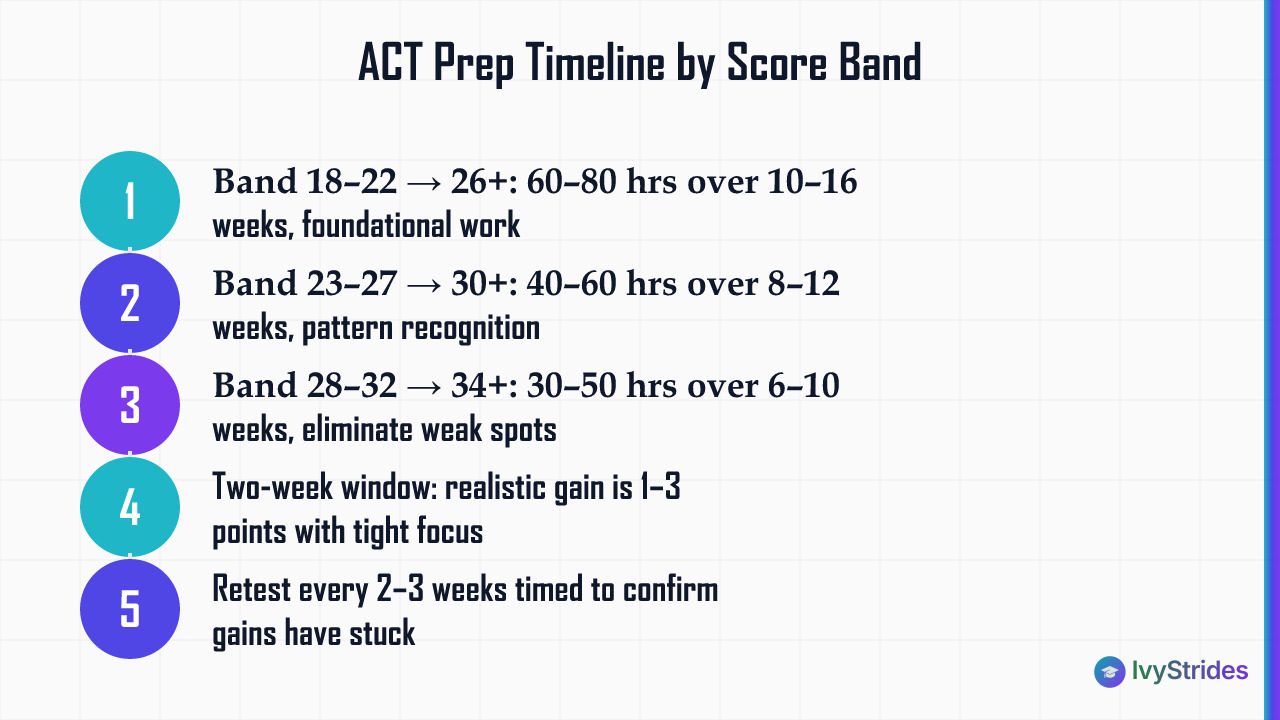
Score band 18-22 moving to 26+: typically 60-80 hours of focused prep over about 10-16 weeks. This band usually needs foundational content work in one or two sections plus pacing drills across all four. You cannot compress this into four weeks and get the full gain.
Score band 23-27 moving to 30+: typically 40-60 hours over roughly 8-12 weeks with section-specialist coaching. At this band, content foundations are mostly in place. Gains come from pattern recognition on high-frequency question types, pacing refinement, and killing careless errors.
Score band 28-32 moving to 34+: typically 30-50 hours over roughly 6-10 weeks. Every point at this band is harder than the last. The prep is almost entirely about eliminating the two or three question types where you consistently miss, plus pacing under fatigue.
Two-week prep window. Honest answer: a one to three composite-point gain is realistic if you already have a diagnostic baseline and focus on one or two sections. A five-plus point gain in two weeks is not realistic. If someone tells you otherwise, ask to see their methodology.
Spaced retesting is the piece most self-directed students skip. Every two to three weeks, take a fresh timed section under real conditions. Not to drill questions. To confirm the gain has stuck. Drills without retests give false confidence.
For students juggling AP exams and ACT prep in the same semester, a coordinated AP, SAT, and ACT testing plan prevents schedule conflicts and maximizes score outcomes across both.
Once you have your baseline diagnostic score, the section-by-section retake playbook in ACT prep overview walks you through how to allocate your remaining prep weeks. For the parallel view on the other test, sat vs act is the companion piece.
Caveat: these timelines are typical ranges in our coaching, not guarantees. Individual results depend on baseline, consistency, and how honest you are with your error log.
What a 27 ACT Score Means and How to Reach the 30+ Range
A 27 sits at roughly the 85th percentile nationally, meaning you scored higher than about 85% of test-takers. Verify the current percentile against the ACT, Inc. score percentile tables before you cite this figure on an application; percentiles shift slightly year to year.
A 27 is above average and competitive at many colleges. At highly selective schools (single-digit or low-teens acceptance rates), the middle 50% ACT range often starts at 33 or higher, which means a 27 sits well below the 25th percentile at those institutions. Check the current Common Data Set for each school on your list. Our writeups on Should You Apply to Duke University and Should You Apply to Northwestern University in 2026 walk through score ranges and admissions context for those two specifically.
Test-optional caveat, because it matters: many selective colleges remain test-optional for the current cycle. Test-optional does not mean scores don't count. It means you choose whether to submit. A 27 may strengthen or weaken your application depending on the school's median and your other application strengths. Check each school's current policy via FairTest or the school's admissions page directly.
To move from 27 to 30, you need about three points on average across sections. The efficient path is not "improve everything equally." It's identifying the one or two sections furthest below 30 and targeting those. If your 27 breaks down as 30 English / 24 Math / 29 Reading / 25 Science, your Math and Science subscores are doing all the damage. Fix those and the composite moves fast.
A composite of 30 sits at roughly the 93rd-94th percentile nationally.
Building Your ACT Section Prep Plan: A Week-by-Week Framework
Here's the twelve-week structure we use, condensable if your timeline is shorter.
Week 1: Diagnostic and analysis. Take one full-length, timed, official ACT practice test under real conditions. No phone, no pausing, no music. Score it. Break down subscores by question type, not just section. English: how many redundancy questions did you miss? Math: how many coordinate geometry? Reading: which passage type ate your time? Science: data representation or conflicting viewpoints?
Weeks 2-4: Lowest-scoring section, targeted drills. Not full sections. Question-type drills. If your Math weakness is coordinate geometry, do roughly 30 coordinate-geometry problems this week, review every wrong answer, log the error type. Same principle for the other sections.
Weeks 5-8: Second section, plus mixed practice. Bring your second-weakest section into the rotation. Start adding mixed timed sets, roughly one full section per week under real timing, to build pacing endurance.
Weeks 9-12: Full-length timed retests and error review. Two full-length timed tests, spaced about two weeks apart. After each, spend more time on error review than you did taking the test. That ratio matters. Two hours of test, three hours of review.
The error log is the tool that ties this together. After every practice set, categorize each wrong answer by question type: comma splice, coordinate geometry, data representation, conflicting viewpoints, and so on. Patterns across three or more sessions reveal your true weakness. One-off mistakes are noise. Three misses on the same question type in three sessions is the signal.
Free official prep resources exist. ACT, Inc. publishes free practice tests and sample questions on the official site. Use those first before paying for anything.
For students who want structured section-specialist coaching rather than self-directed prep, IvyStrides' 1-on-1 ACT prep program starts with a diagnostic and assigns a specialist coach per section. You can meet the tutors who work with students at each section. To learn more about our approach, read about IvyStrides.
If you're prepping for both tests, how to study for the SAT is the parallel framework for the Digital SAT.
FAQ
Is a 27 ACT score good enough for college admissions?
A 27 sits at roughly the 85th percentile nationally, which is above average and competitive at many colleges. At highly selective schools (acceptance rates below 20%), the middle 50% ACT range often starts at 33 or higher, so a 27 typically sits below the 25th percentile at those institutions. Whether to submit a 27 depends on the specific school's current test-optional policy and the rest of your application. Check each school's Common Data Set and current admissions page for the accurate benchmark.
Is two weeks enough time to study for the ACT?
Two weeks is enough time for a targeted 1-3 composite point gain if you already have a diagnostic baseline and focus on one or two sections. It is not enough time for a 5+ point gain, which typically requires roughly 8-16 weeks of structured prep. In two weeks, prioritize your lowest-scoring section, take two full-length timed practice tests, and review every error by question type. Skip the temptation to "review everything." Depth beats breadth in a compressed window.
What ACT composite score corresponds to roughly the 75th percentile?
A composite of roughly 25-27 sits near the 75th percentile nationally, meaning you scored higher than about 75% of test-takers. The exact percentile for a given score shifts slightly year to year, so verify the current ACT score percentile tables at act.org before using this figure in any application context.
Does ACT prep actually help, and what kind of prep works best?
Yes, structured ACT prep produces measurable score gains for most students. The most effective approach combines a diagnostic practice test, targeted work on identified weaknesses by section, and spaced retesting to confirm improvement. In our coaching, students completing the IvyStrides 1-on-1 ACT program typically gain 4+ composite points. Generic content review without a diagnostic baseline is the least efficient approach; you end up spending hours on material you already know.
What is the easiest ACT section to improve quickly?
ACT Science is often the fastest section to improve because it tests data interpretation, not deep science content knowledge. Students who learn to read graphs and tables efficiently, rather than studying biology or chemistry textbooks, can typically gain 3-5 points on Science in roughly four to six weeks of focused practice. ACT English is the second-fastest section for students who master the concision and transition-logic question types.
How is ACT prep different from SAT prep?
Both tests cover similar math and verbal content, but the ACT includes a dedicated Science section, requires faster pacing across all sections, and does not use an adaptive format (unlike the Digital SAT). ACT English is more grammar-and-style focused; SAT Reading and Writing is more evidence-based. Students stronger at data interpretation and faster readers often prefer the ACT. Students who prefer more time per question often prefer the Digital SAT.
The four ACT sections aren't one test. They're four tests that happen to share a Saturday morning. Prep them that way, starting with the diagnostic, and the composite gain follows.

Two decades teaching quantitative and verbal aptitude on standardized tests. Rare dual expertise across Math and Verbal — particularly effective for students with gaps on both sides. Senior AP Mentor for our Calculus and English tracks.