
ACT Test Dates 2026-2027: Complete Schedule, Registration Deadlines & Score Release Dates

On this page
- 2026 ACT Test Dates at a Glance: The Full Schedule
- ACT Registration Fees and Deadlines: What You Will Pay and When
- How Long Does the ACT Take in 2026 and What Does Each Section Cover
- How to Pick the Right ACT Test Date for Your Grade and Timeline
- Is Two Months Enough Time to Prepare for the ACT
- Is a 31 ACT or 1400 SAT Better for College Admissions
- ACT International Test Dates and Locations for 2026
- Can Colleges See Every ACT Attempt, and How Many Times Should You Test
- FAQ
- What is the February ACT date in 2026 and who should take it?
- Is the ACT changing in 2026, and is it easier or harder than before?
- How do I change my ACT test date after registering?
- What happens if I do not show up to my ACT test date?
- Should a senior take the September or October 2026 ACT if applying Early Decision?
- Pick Your Date, Then Build the Plan
The ACT is offered seven times in the 2026-2027 school year. National test dates are September 19, 2026; October 17, 2026; December 12, 2026; February 27, 2027; April 10, 2027; June 12, 2027; and July 10, 2027. For the remaining 2025-2026 cycle, the dates are April 11, 2026; June 13, 2026; and July 11, 2026. Each date carries a standard registration deadline roughly five weeks prior and a late-registration window with an added fee.
All dates, deadlines, and current fee amounts are confirmed at act.org. The harder question for most families isn't which dates exist, it's which date matches your prep window, your grade, and your application deadlines. The rest of this article works through that decision and the surrounding logistics.
2026 ACT Test Dates at a Glance: The Full Schedule
Below is the full schedule across both testing cycles, with the standard registration deadline (approximately five weeks before each test) and the late-registration window that follows.
Remaining 2025-2026 national test dates:
- April 11, 2026, standard registration closes early March; late registration through late March.
- June 13, 2026, standard registration closes mid-May; late registration through late May.
- July 11, 2026, standard registration closes early June; late registration through mid-June. (Not offered in New York or California.)
2026-2027 national test dates:
- September 19, 2026, standard registration closes mid-August.
- October 17, 2026, standard registration closes mid-September. This is the last realistic date for most Early Decision and Early Action applicants.
- December 12, 2026, standard registration closes early November.
- February 27, 2027, standard registration closes late January. (Not offered in New York.)
- April 10, 2027, standard registration closes early March.
- June 12, 2027, standard registration closes mid-May.
- July 10, 2027, standard registration closes early June. (Not offered in New York or California.)
Score release windows. Multiple-choice scores are typically released 2 to 8 weeks after the test date, with most students seeing scores within 10 to 14 days for online testing administrations. ACT Writing scores are released separately, usually up to 2 weeks after multiple-choice scores. Score reports become available in your student account at act.org.
For practice timing before any of these dates, our online act practice test library gives you full-length, scored sittings you can use to set a realistic target. Always verify final deadlines and fees at act.org, since ACT, Inc. adjusts windows year to year.
ACT Registration Fees and Deadlines: What You Will Pay and When
Registration opens roughly three to four months before each test date. The fee structure has four tiers you should know about before you click "register."
Standard registration covers the four-section ACT (English, Math, Reading, Science). Optional ACT Writing adds a separate fee on top of that. Late registration, the window that opens after the standard deadline closes and runs to about two weeks before the test, adds a surcharge. Standby testing is the last-resort option after late registration closes, charged at the highest fee tier and not guaranteed; you only test if a seat is open on test day.
Fees change annually and vary for international students. Confirm the current dollar amounts at act.org. What I can tell you doesn't change: late and standby tiers can roughly double the cost of a single sitting, so registering during the standard window is the cheapest path.
Fee waivers are available for eligible juniors and seniors in the US who meet income criteria. Waivers cover registration plus reporting to a set number of colleges and include access to certain prep materials. Your school counselor processes the application.
A quick note for parents managing the calendar: late fees aren't the only cost of waiting. Missing the standard deadline often means the closest test center fills up, and you end up driving 90 minutes on a Saturday morning. For broader prep planning around the date you choose, our ACT prep overview walks through how coaching, diagnostics, and timing fit together.
How Long Does the ACT Take in 2026 and What Does Each Section Cover
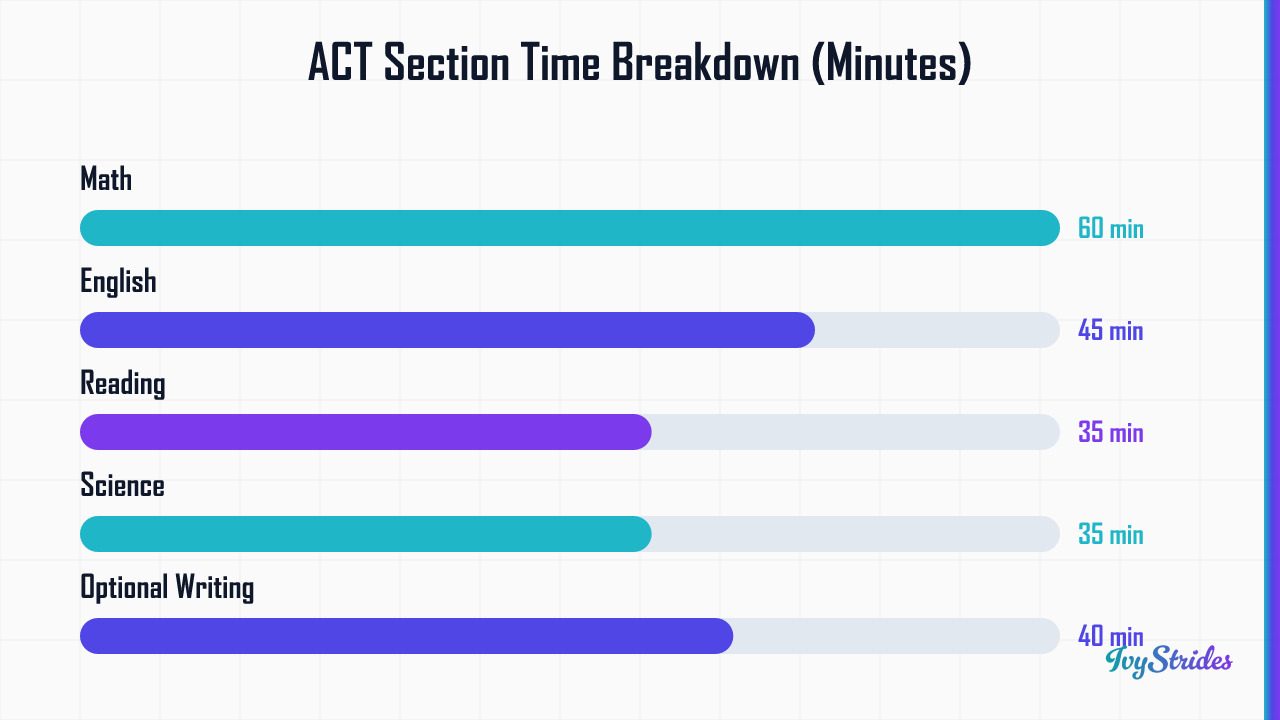
The ACT runs 175 minutes of testing time without Writing, and approximately 215 minutes with the optional Writing section. Add roughly 30 to 40 minutes for check-in, instructions, and the mid-test break, and plan on a four-hour Saturday morning.
The four required sections, in order:
- English, 45 minutes, 75 questions. Grammar, usage, punctuation, and rhetorical skills across five passages.
- Math, 60 minutes, 60 questions. Pre-algebra through trigonometry. Calculator allowed throughout.
- Reading, 35 minutes, 40 questions. Four passages: prose fiction, social science, humanities, natural science.
- Science, 35 minutes, 40 questions. Seven passages testing scientific reasoning, not memorized science content.
Optional Writing, 40 minutes, one essay responding to a perspectives prompt. Required by very few colleges now, but worth confirming against your target schools' policies.
The ACT composite is the average of the four section scores, rounded to the nearest whole number, on a 1-36 scale. A student scoring 32 English, 28 Math, 30 Reading, and 30 Science earns an average of 30.0 and a composite of 30. One weak section drags the whole composite down, which is exactly why section-specialist coaching tends to outperform generalist tutoring for students with uneven profiles.
The ACT Science section tests three passage types (data representation, research summaries, and conflicting viewpoints), and knowing this structure before your test date lets you allocate the right portion of your prep weeks to each passage type rather than treating Science as a single undifferentiated block. Conflicting viewpoints is the most time-intensive of the three; most students need explicit pacing rules to avoid burning eight minutes on a single passage.
For section-specific tactical reading, our breakdown of the ACT Writing test and how to score 11+ covers the essay path. For the top-scorer mindset, see our walkthrough on how to score 34+ on the ACT. Format details cited above are confirmed at act.org.
How to Pick the Right ACT Test Date for Your Grade and Timeline
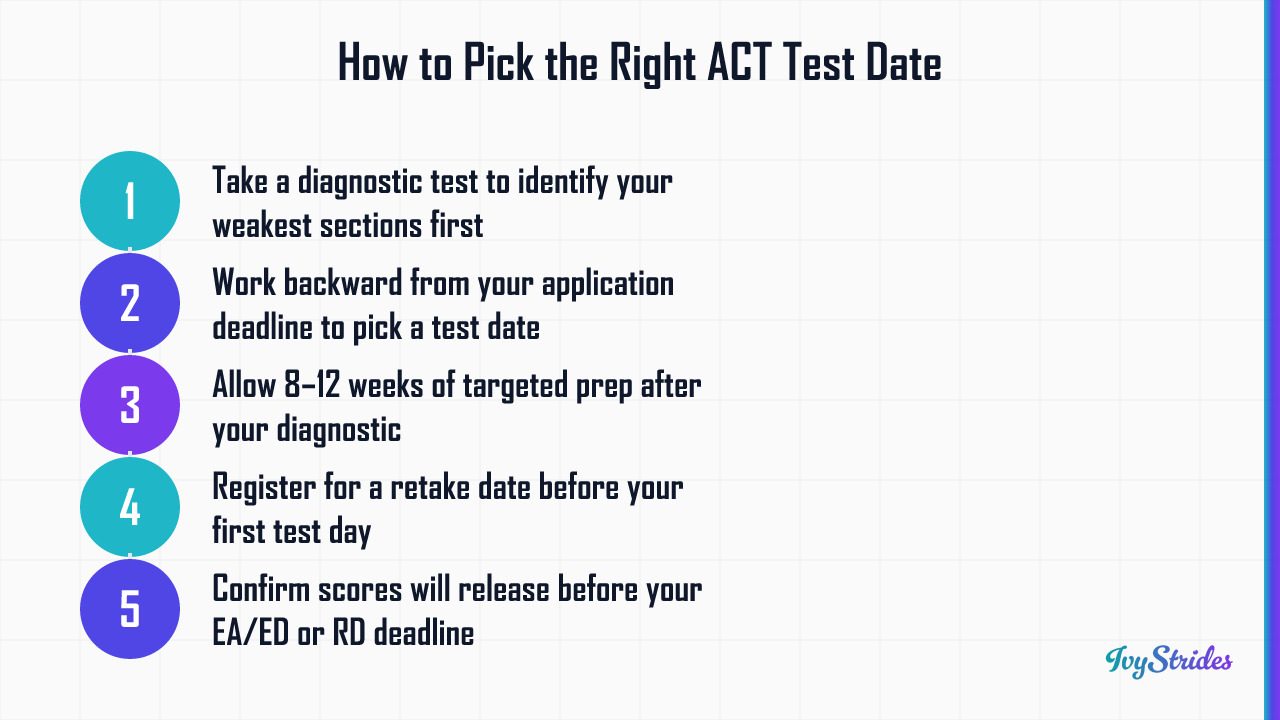
The right date is the one that gives you at least eight weeks of structured prep after a diagnostic, lands before your application deadlines, and leaves room for a retake. Work backward from the application, not forward from today.
Juniors have the most flexibility. A first attempt in the spring of junior year (April or June 2026) gives you a baseline score with senior fall (September or October 2026) available as a retake. This is the pattern that works best for students aiming for a 4+ composite point gain.
Seniors applying Early Decision or Early Action (typical November 1 to November 15 deadlines) need scores in hand by October. The October 17, 2026 date is the last viable option for most EA/ED cycles, since scores release within roughly two weeks of test day. The September 19, 2026 date provides a real buffer and a chance to retake in October if needed. December 2026 only works for Regular Decision and a small number of January EA deadlines.
Sophomores generally take the PSAT or a diagnostic ACT, then plan their first official sitting for spring of junior year. No rush.
Once you have your target test date circled, the next question is whether your prep window is long enough: in our coaching, students who complete a full diagnostic-to-retest cycle of 8-12 weeks of targeted section work are the ones who typically achieve the 4+ composite point gains we document. Two months is workable; three months gives you room for a second full-length practice test and pacing refinement. For the week-by-week version of this, see ACT prep in 2 months: week-by-week study plan.
If you haven't yet decided between the SAT and ACT, the test-date calendar is actually a useful forcing function: compare the ACT and SAT schedules side by side, take a diagnostic for each, and commit to the test that fits your strengths before you register. Our breakdown of ACT vs SAT difficulty and which test to choose walks through the section-by-section differences.
Honestly, the fastest way to lose prep weeks is to skip the diagnostic. A junior we worked with last fall did six weeks of "general ACT review," then took a practice test, then realized Science pacing was the actual bottleneck the whole time. In our coaching, self-study without a diagnostic often wastes 30-40% of prep time on already-strong sections, a pattern we see across student cohorts.
Is Two Months Enough Time to Prepare for the ACT

Photo by cottonbro studio on Pexels
It depends on where you're starting and what you're targeting. Two months is enough for a meaningful gain if you start with a diagnostic in week one and follow a section-prioritized plan. It isn't enough if you're starting at a 19 and need a 30.
Here's how the math tends to work. In our coaching, students starting at a 24-27 composite who complete 40-60 hours of targeted prep over 8-10 weeks typically see 3-5 composite point gains. Students starting at 28+ with specific section weaknesses (almost always Science pacing or a single Math topic cluster) can see meaningful gains in 6-8 weeks of focused section work, because the gap is narrow and identifiable.
Three things make two months actually work:
-
A diagnostic in week one. Not week three. Not "after I review the basics." Week one. You can't prioritize sections you haven't measured.
-
Section-prioritized hours. If your diagnostic shows 32 English, 22 Math, 28 Reading, 26 Science, your Math hours should outnumber English hours roughly 4:1. Generic "balanced review" wastes the window.
-
A second full-length test at week five or six. This catches pacing and stamina issues with two weeks left to fix them.
What two months won't do: take a 20 to a 32. Composite gains of 8+ points reliably require longer windows and, for most students, structured 1-on-1 work with a section specialist. For the full study-plan breakdown, see how to study for the ACT. For students who want a coach driving the plan, our 1-on-1 ACT prep program is built around exactly this diagnostic-to-retest cycle.
Is a 31 ACT or 1400 SAT Better for College Admissions
They're effectively equivalent. Per College Board concordance tables, a 31 ACT corresponds to roughly a 1400 to 1410 SAT composite. Admissions offices at the vast majority of schools treat concordant scores as interchangeable; they don't prefer one test over the other.
The more useful question is how either score compares to the middle-50 range at your target schools. A 31 ACT puts you below the middle-50 at most of the Ivies (where the middle-50 is typically 34-36), squarely competitive at schools like USC or NYU (middle-50 around 32-35), and well above the middle-50 at most strong public flagships. Look up the Common Data Set for each school on your list ("Common Data Set [University Name]" in Google) and compare your composite against Section C9.
A few caveats worth surfacing:
- Test-optional policy varies by school and year. Some highly selective schools have reinstated test requirements for the Class of 2026 and 2027, others remain test-optional, and a small number are test-blind. Check each school's current policy at FairTest or the school's admissions site directly. Submitting a strong score typically strengthens an application even at test-optional schools, but "typically" is the operative word.
- ACT, Inc. now provides an official superscore across multiple test dates. Individual colleges decide whether to use it. Some superscore the ACT, some take your highest single sitting, some require all scores.
- Test scores are one factor in a holistic application. Essays, rigor of coursework, AP scores, and extracurriculars all matter. A 1400 or 31 opens doors; it doesn't walk through them.
For more on the SAT-ACT comparison, see is the SAT harder than the ACT. For a worked example of how score cutoffs interact with admissions at a hyper-selective school, Stanford ACT requirements and score cutoffs walks through the math.
ACT International Test Dates and Locations for 2026
International ACT testing is a subset of the US national calendar, not a parallel schedule. Not all seven 2026-2027 national dates are available at international test centers, and availability varies by country.
For 2026-2027, international test centers generally offer September, October, December, April, and June administrations, with February and July often unavailable outside the US. Confirm country-specific availability at act.org's international page before you build your prep timeline around a specific date.
A few things international students should know:
- Fees are higher. International registration includes a non-US testing fee on top of standard registration.
- Deadlines may differ. Some international centers close registration earlier than the US standard deadline.
- Test center seats are limited in countries with fewer ACT venues. Register the day registration opens if you're testing in a smaller market.
- The ACT is moving toward computer-based testing internationally, and most international students now test on computer rather than paper. Format and content are identical to the paper test.
IvyStrides serves students worldwide online, so the location of your test center doesn't affect access to the same section-specialist coaching pool. A student in Singapore prepping for the December 2026 date works with the same Reading or Science specialist as a student in Boston. For students transitioning between test formats or comparing the ACT to the Digital SAT, ACT vs Digital SAT transitions: what changes and what stays the same covers the format differences in detail.
Can Colleges See Every ACT Attempt, and How Many Times Should You Test
ACT score choice means you decide which test dates' scores get sent to colleges. ACT, Inc. does not automatically forward all of your attempts. You select per-test-date when you order score reports.
There's a real caveat. Some colleges require you to submit all ACT scores from every sitting. Check each school's testing policy on its admissions page or Common Data Set before assuming you can hide a low attempt. Schools that require all scores typically still superscore or focus on your highest composite for admissions decisions, but the policy exists and matters.
How many times should you take the ACT? In our coaching, most students benefit from 2-3 attempts: one diagnostic-level attempt to set a baseline, one after a full prep cycle to hit target, and an optional third if the gap to your goal remains significant. Taking the ACT more than 3-4 times with no structured prep change between attempts rarely produces meaningful composite gains. The test learns you faster than you learn it.
A practical pattern for juniors: April or June 2026 as the diagnostic-aware first attempt, September or October 2026 as the target attempt after a summer of prep. If the second attempt lands well below target, December 2026 becomes the third attempt window. Seniors with no prior testing should plan September 2026 as the baseline and October 2026 as the retake if results warrant it.
For school-specific code and policy detail (helpful when you actually go to send scores), see Yale ACT code and score requirements as a worked example.
FAQ
What is the February ACT date in 2026 and who should take it?
There is no February national ACT date in the 2025-2026 cycle; the next test after the April 11, 2026 date is June 13, 2026. Some states administer a state-funded ACT in February (Ohio, for example, runs a paper-based state ACT in February), but these state tests are only available to enrolled students in those states and don't function as a national administration. Juniors who want a spring attempt before the end of the school year should target April 11 or June 13, 2026.
Is the ACT changing in 2026, and is it easier or harder than before?
For the 2025-2026 testing year, the format remains four sections (English, Math, Reading, Science) plus optional Writing, with a 1-36 composite scale. ACT, Inc. has announced plans to roll out a shorter, partially adaptive online version, with changes being phased in. Check act.org for the current format at your test date, since rollout details continue to evolve. Difficulty is consistent across administrations because ACT, Inc. equates scores across test forms; no single test date is officially easier than another.
How do I change my ACT test date after registering?
Log into your account at act.org and select "Change Test Date" before the standard registration deadline for your new preferred date. A date-change fee applies. If you miss the standard deadline for the new date, you may still be able to use the late-registration window for an additional fee. Standby testing exists as a last resort but isn't guaranteed.
What happens if I do not show up to my ACT test date?
Your registration fee is forfeited. ACT, Inc. does not offer refunds for no-shows. You can register for a future test date at full cost. In rare documented emergencies, contacting ACT, Inc. directly may result in a credit, but this isn't a standard policy and shouldn't be planned around.
Should a senior take the September or October 2026 ACT if applying Early Decision?
For most Early Decision and Early Action deadlines of November 1 to 15, the October 17, 2026 test date is typically the last viable option, since multiple-choice scores release within 2 to 8 weeks of testing. The September 19, 2026 date provides more buffer and allows a retake in October if the September composite falls short of target. Confirm your specific schools' score submission deadlines before locking in a date, since a handful of EA programs have earlier hard cutoffs.
Pick Your Date, Then Build the Plan
Circling a test date on the calendar is the easy part. The harder work happens in the eight to twelve weeks between the diagnostic and that date: knowing which section to prioritize, which pacing rules to drill, when to take the second full-length practice test, and how to convert a 28 into a 32.

Kunal writes about Digital SAT and ACT strategy for the IvyStrides blog.