
How Many AP Classes Do You Need for the Ivy League and Top Colleges?
On this page
- How Many AP Classes Do Ivy League Admits Actually Take? The Real Data
- Is 7 or 8 AP Classes Enough for Harvard, Yale, and Princeton?
- Why the Number of APs Your School Offers Changes Everything
- The AP Load Question Most Students Get Wrong: More APs vs. Better Grades
- Not sure how many APs to take this year?
- A Grade-by-Grade AP Plan for Students Targeting the Ivy League
- Which AP Classes Are Most Impressive to Colleges, and Why Subject Choice Matters
- Do Ivy League Schools Actually Look at AP Scores, or Just the Courses?
- How AP Classes Fit Into Your Broader Admissions Strategy (SAT, ACT, and Essays)
- Frequently Asked Questions About AP Classes for Ivy League and Top Colleges
- How many AP classes are good for the Ivy League?
- Is 7 AP classes enough for Harvard?
- What AP classes are most impressive to colleges?
- What is the hardest AP class?
- Is 10 AP classes enough for Ivy League?
- How many AP classes should I take sophomore year for Ivy League?
- Do Ivy League schools look at AP scores?
- How many AP classes should I take to get into MIT?
- Is a 3.7 GPA good enough for Ivy League with strong APs?
- Ready to build your AP and admissions plan?
Most students admitted to Ivy League and top colleges complete 8 to 12 AP courses across four years. No Ivy League school publishes a minimum AP requirement. Admissions officers weigh your course load against what your school actually offers, so a student who takes 7 of 8 available APs reads as more rigorous than one who takes 10 of 30. Strong AP exam scores, meaning 4s and 5s, reinforce the course itself.
The pattern matters far more than the count. This article covers the real admitted-student range, how the school profile reshapes it, the GPA-rigor tradeoff most families get backward, a grade-by-grade plan you can use this week, and how your AP load connects to your SAT/ACT scores and essays. AP format and scoring details here trace to the College Board AP Program.

How Many AP Classes Do Ivy League Admits Actually Take? The Real Data
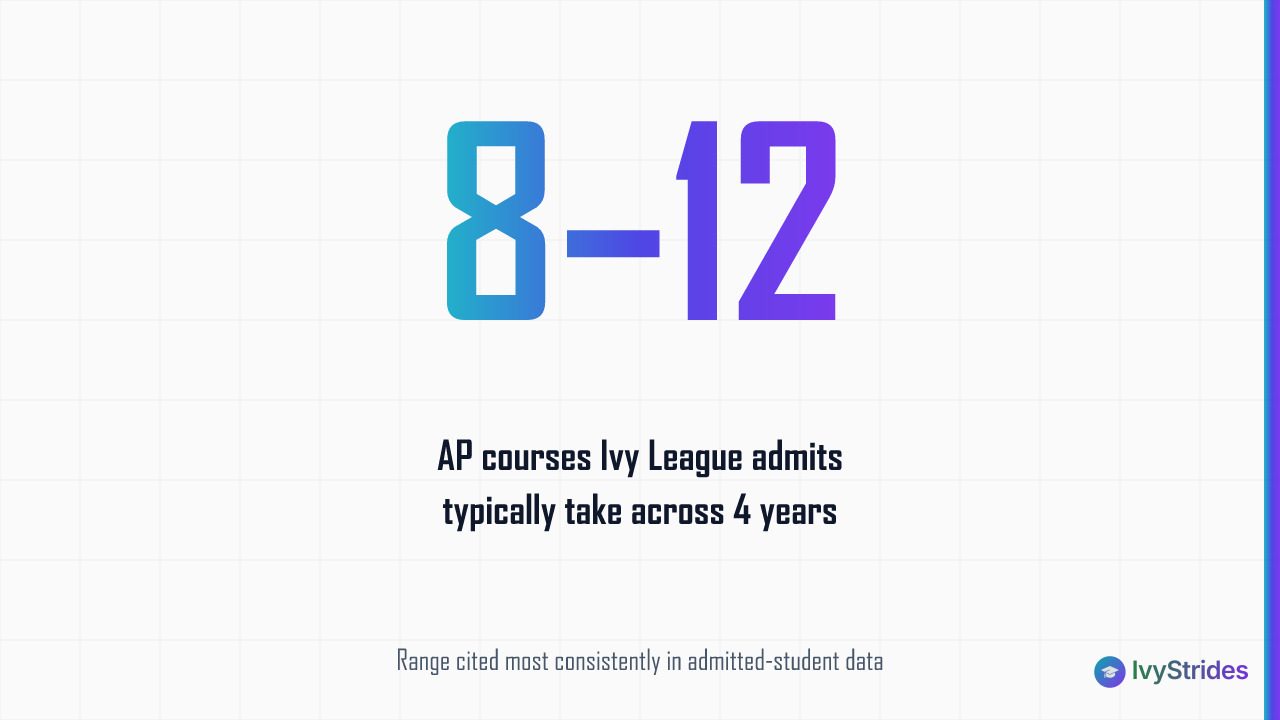
AP course load among Ivy League admits typically lands between 8 and 12 courses across four years of high school. That is the range cited most consistently across admitted-student data. Raw count is close to meaningless, though, without one piece of context: your school profile.
An AP course, run by the College Board, is a college-level class paired with a standardized May exam scored on a 1 to 5 scale. When Ivy League admissions offices read your file, they see your APs alongside every other course you could have taken.
Some admits fall below the range. A student with 6 or 7 APs paired with dual enrollment or an IB Diploma, or coming from a school with limited offerings, is regularly competitive. Others land at 12 to 14. High raw count alone does not predict admission, and no Ivy League school treats it as a threshold.
Here is the mechanism most families miss. Every high school sends admissions offices a school profile: a document listing every AP, IB, honors, and dual enrollment course the school offers, plus its grading scale and typical outcomes. Your course rigor gets read against that document, not against a national average. For a deeper look at how AP courses and scores factor into the admissions decision beyond raw course count, see our guide on does AP help with college admission.
Is 7 or 8 AP Classes Enough for Harvard, Yale, and Princeton?
Yes, 7 or 8 AP classes can be genuinely competitive at Harvard, Yale, and Princeton, on one condition: those courses represent the most rigorous curriculum your school offers, and your grades and exam scores hold up. Course count gets judged relative to the school profile, not a fixed benchmark.
Consider two students. One attends a school offering 8 total APs and takes all 8. To an admissions reader, that student has maxed out available rigor. The other attends a school offering 25 APs and takes 8; the same number now reads as selective avoidance of challenge. Same count. Opposite signal.
Common Data Set filings for Harvard, Yale, and Princeton show admitted students overwhelmingly cluster at the top of their class, having pursued the most demanding available curriculum. That pattern holds across the most selective schools. For how a similar rigor signal plays out at another Ivy, see our breakdown of UPenn SAT requirements and admissions context.
One caveat you cannot ignore. Admissions decisions at these schools depend on the full application, not AP count alone. Essays, recommendations, extracurriculars, and test scores all sit in the same file. A strong AP record is a necessary ingredient at the top, not a sufficient one. If you are planning your load with these schools in mind, our AP courses online service pairs each subject with a specialist teacher.
Why the Number of APs Your School Offers Changes Everything
The school profile is the single most misread factor in AP planning. Admissions officers receive this document from every applicant's high school, and it lists exactly what was available: every AP, every IB course, every honors and dual enrollment option. The question they ask is not "how many APs?" It is "did this student challenge themselves relative to what they could take?"
That reframe changes the whole calculation. A student at a rural school offering only 4 APs who takes all 4 demonstrates full rigor, and reads exactly as strong as a student at a magnet school who took 12 of 14. Course rigor is always relative.
IB and dual enrollment count too. An IB Diploma candidate, or a student loading up on dual enrollment at a local college, gets evaluated on comparable rigor terms, because the school profile frames those options as the school's version of most challenging. You are not penalized for attending a school without a deep AP catalog.
A second document does quiet work here. Your counselor recommendation often states plainly whether you took the most rigorous available curriculum. One line, "one of the most demanding schedules in her class," carries real weight because it comes from someone who knows the full menu. If you are still deciding on your overall load regardless of target school, our broader guide on how many AP classes should you take walks through the decision by grade and goal. Parents weighing cost and scheduling alongside their student will find a practical overview in a parent's guide to AP classes.
The AP Load Question Most Students Get Wrong: More APs vs. Better Grades
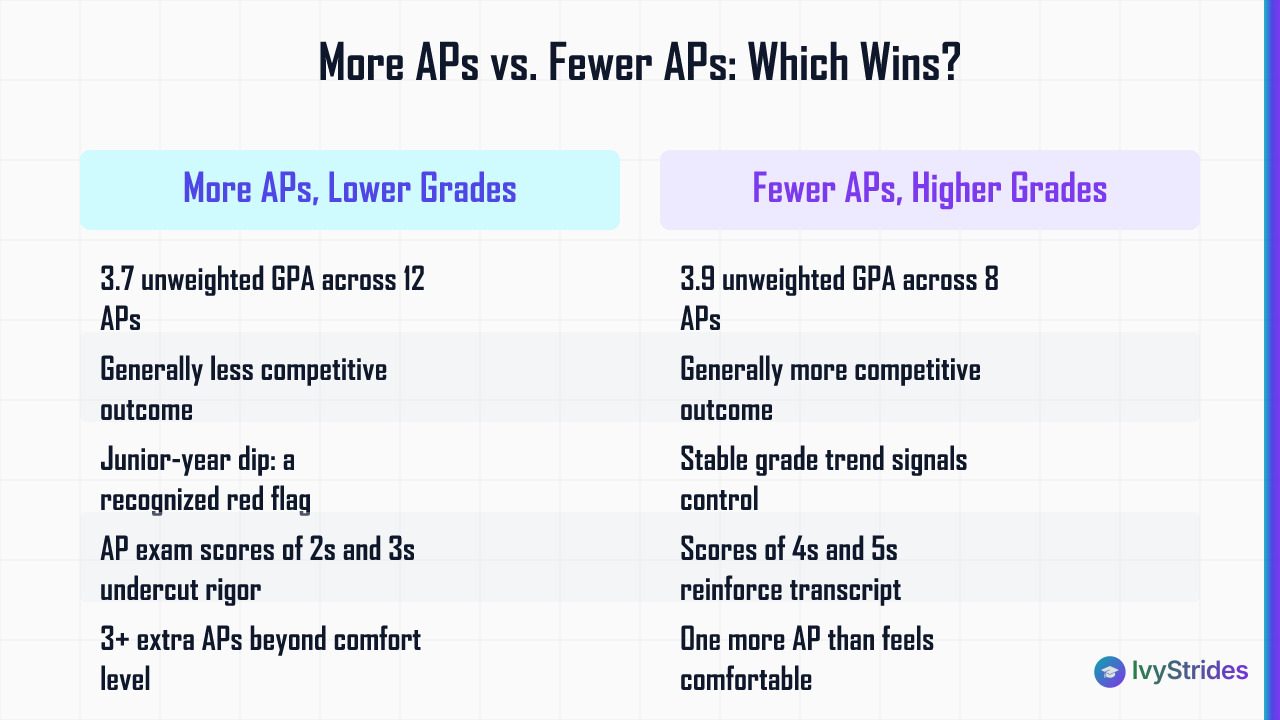
Fewer APs with higher grades beats more APs with a sagging GPA. That is the answer to the tradeoff paralyzing most families. A 3.7 unweighted GPA across 12 APs is generally less competitive at selective schools than a 3.9 across 8, because admissions readers weigh the GPA-rigor tradeoff and read grade trends closely.
Grade trends matter more than a single average. A junior-year dip caused by AP overload is a recognizable red flag, precisely because junior year is when admissions officers look hardest at rigor. A schedule that quietly torpedoes your grades sends the opposite of the intended message.
Then there is the exam. AP exam scores are a separate signal from the course itself. A 4 or 5 reinforces the grade on your transcript; a 2 or 3 can undercut the whole rigor story, hinting the course sat above your current level. Loading up on APs you cannot score well on is not a rigor play. It is a self-inflicted wound.
In our coaching with students targeting Ivy-level schools, the ones who struggle most took 5 or 6 APs in junior year with no realistic exam prep plan, then landed grade dips and 2s and 3s that undercut the very rigor they were chasing. The pattern repeats often enough to name a rule.
Here is the working rule we give students: take one more AP than feels comfortable, not three more. That one-step stretch signals ambition while protecting the grades and scores that make the ambition credible. For the mechanics of turning a hard course into a strong score, see how to study for AP exams. And if you are questioning whether the load is worth it at all, is AP worth the stress and cost takes that on directly.
Not sure how many APs to take this year?
Book a free 15-minute strategy call. An IvyStrides coach will review your current course list, your target schools, and your timeline, then give you a concrete recommendation on AP load, test prep sequencing, and next steps.
A Grade-by-Grade AP Plan for Students Targeting the Ivy League
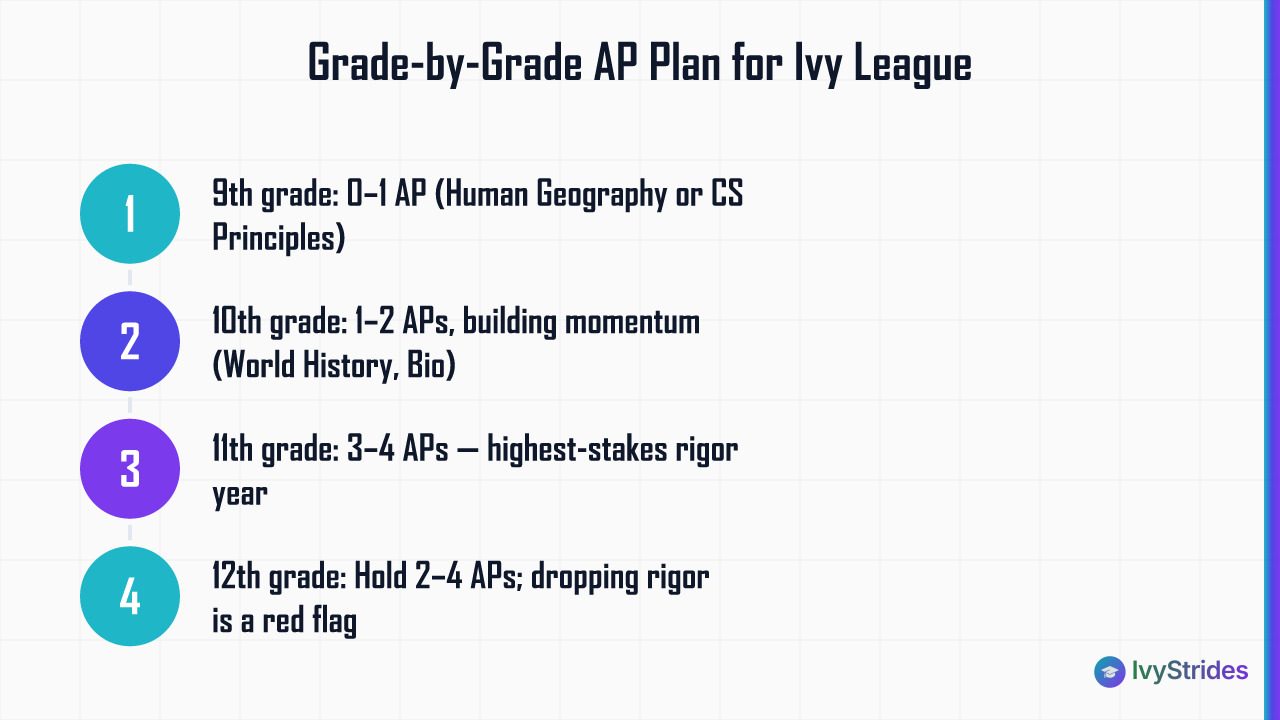
A grade-by-grade AP plan for Ivy-track students builds rigor gradually, peaks in junior year, and holds the line in senior year. The goal across four years is that 8 to 12 range, distributed so no single year buries your GPA. Here is the pacing framework we use.
| Grade | Typical AP count | Common starting courses | What admissions reads |
| 9th | 0 to 1 | AP Human Geography, AP Computer Science Principles | Foundation; zero APs is fine |
| 10th | 1 to 2 | AP World History, AP Biology, AP Language and Composition | Building momentum |
| 11th | 3 to 4 | AP US History, AP Calculus AB, AP Chemistry, AP English Language | Highest-stakes rigor year |
| 12th | 2 to 4 | Subject-aligned APs, AP Calculus BC, AP Physics C | Senior rigor held, not dropped |
Ninth grade carries no pressure. Zero to one AP is normal and appropriate; AP Human Geography or AP Computer Science Principles make common, manageable entry points. Sophomore year steps up gently to one or two, with AP World History or AP Biology as typical picks.
Junior year sets the rigor signal. Three to four APs is the target, and this is the year admissions officers scrutinize most. Senior year is no coast, though. Dropping rigor in 12th grade is a known red flag, because colleges do see your senior schedule. Hold two to four APs through the finish.
Subject alignment sharpens the whole plan. STEM-track students should prioritize AP Calculus BC, AP Physics C, AP Chemistry, AP Biology, and AP Computer Science A. Humanities-track students lean into AP English Literature, AP US History, AP World History, AP Language and Composition, and AP Government. A coherent academic narrative reads stronger than a scattered high count.
AP courses do not exist in isolation; they are one part of a connected testing strategy that includes your SAT or ACT timeline, and our full AP, SAT, and ACT high school testing plan guide shows how to sequence all three. If cost is part of the conversation, how much do AP classes cost lays out the numbers.
Which AP Classes Are Most Impressive to Colleges, and Why Subject Choice Matters
The most impressive AP class is the hardest one in your intended field that you can earn a 4 or 5 on. Colleges publish no ranked list of AP subjects. The signal comes from two things: subject alignment with your intended major, and a strong exam score that proves you handled the material.
For STEM applicants, AP Calculus BC, AP Chemistry, AP Physics C (both Mechanics and Electricity and Magnetism), and AP Computer Science A carry the strongest rigor signals. For humanities and social science applicants, AP English Literature, AP US History, AP World History, AP Language and Composition, and AP Government do the same work.
Alignment beats prestige. A 5 on AP Calculus BC signals more for a prospective engineer than a 5 on AP Art History, because it maps directly onto the intended path. The reverse holds for a prospective art historian. There is no universal best AP. There is the best AP for your narrative.
In our coaching, students who match their AP subject choices to their intended major and essay narrative present a more coherent application than students who collect APs at random for the count. The transcript reads like a story rather than a scoreboard.
Strong scores across multiple exams can also earn recognition. Students who post strong results across several AP exams may qualify for AP Scholar awards, which appear on the score report colleges receive; AP Scholar with Distinction, for instance, requires an average score of at least 3.5 on all exams taken with no individual score below 3, per the College Board AP Program. Details sit in our guide to AP Scholar Awards and what they are worth. Once you have locked in your list, build a prep plan for each exam; our subject-by-subject AP exam prep by subject guide covers every major AP.
Do Ivy League Schools Actually Look at AP Scores, or Just the Courses?
Ivy League schools look at both. AP scores are self-reported on the Common App and reviewed as part of your academic record, even though most Ivy League schools do not require official score reports for the admission decision itself. Official reports through the College Board are typically sent after you enroll.
Here is how the signal works. A 4 or 5 on a rigorous AP exam reinforces the grade on your transcript; the score confirms you genuinely mastered college-level material. A 2 or 3 can raise a quiet question about whether the course grade told the full story. Weak scores do not sink an application, but they do not help the rigor argument either.
Score reporting for admission is separate from AP credit after admission. Colleges vary widely in how much credit they award, which is worth knowing before you decide which exams to prioritize; some award course credit, some grant only advanced standing or placement, and some award neither. See do colleges accept AP credit for how that variation plays out.
AP credit policies differ sharply across Ivy League schools and change year to year. Harvard, for example, grants no course credit for AP scores but may allow advanced standing under specific conditions; other Ivies set their own thresholds. Verify current policy directly with each college's registrar before betting on credit. For the fundamentals of what each score means, AP scores explained covers the 1 to 5 scale in full.
How AP Classes Fit Into Your Broader Admissions Strategy (SAT, ACT, and Essays)
AP course load is one pillar of a connected admissions strategy, not a standalone variable. At Ivy League schools, admissions officers read your AP record, your standardized test scores, and your essays together, in a single holistic review. A strong AP transcript does not offset a weak personal statement.
The test-score context is specific. Ivy League SAT middle-50% ranges typically fall between roughly 1500 and 1580, and ACT middle-50% composites cluster around 34 to 36; check each school's Common Data Set for its exact figures, since they shift year to year. The current Digital SAT runs 98 questions across a section-adaptive format scored 400 to 1600.
Test-optional policy adds a wrinkle. These policies vary by school and by year, and a strong SAT or ACT score still strengthens your application at most Ivy League schools even when scores are optional. If your score sits in the competitive band, submitting it usually helps. Our take on whether a 1500 SAT score is good enough for Ivy League admission works through the judgment call. For the other test, ACT score ranges for top colleges does the same.
In our coaching with students targeting Ivy-level schools, the strongest applications pair 8 to 12 APs with test scores in the top percentiles and essays that reveal a specific, authentic academic or personal narrative. Those three elements reinforce one another. The essay is where the AP record stops being a list and becomes a person, which is why college essay coaching sits at the center of a connected plan. Timing matters too; early decision vs early action vs regular decision affects how your full file gets read.
One firm caveat. No combination of AP courses, test scores, or essays guarantees admission to any Ivy League or top college. Admissions is holistic and competitive at every level, and the full application, not any single factor, drives the outcome. Read more about how we connect these pieces on the IvyStrides about page.
Frequently Asked Questions About AP Classes for Ivy League and Top Colleges
How many AP classes are good for the Ivy League?
Eight to 12 AP courses across four years is the range most Ivy League admits fall into, but the count only means something relative to your school. Taking 8 of 9 available APs signals full rigor; taking 8 of 25 does not. Exam scores of 4 and 5 weigh as heavily as the count.
Is 7 AP classes enough for Harvard?
Seven APs can be enough for Harvard when they represent the most rigorous courses your school offers and you have earned strong grades and exam scores. Harvard reads course load against your school profile, not a national benchmark. A 3.9 GPA in 7 APs generally reads stronger than a 3.6 in 12.
What AP classes are most impressive to colleges?
Colleges do not rank AP subjects, but AP Calculus BC, AP Chemistry, AP Physics C, AP Computer Science A, AP English Literature, and AP US History carry strong rigor signals. They are demanding and align with common majors. The most impressive AP is the hardest one in your intended field you can score a 4 or 5 on.
What is the hardest AP class?
AP Physics C (Mechanics and Electricity and Magnetism), AP Chemistry, AP Calculus BC, and AP Biology rank consistently among the most demanding AP courses, based on the exam score distributions published by the College Board. AP Physics C: E&M carries one of the lower 5-score rates across all AP subjects.
Is 10 AP classes enough for Ivy League?
Ten APs sits well within the competitive range for Ivy League applicants, provided grades and exam scores are strong. The real test is whether 10 represents most of what your school offers. If your school offers 10, you took all 10, and you earned mostly 4s and 5s, that is a very strong academic record.
How many AP classes should I take sophomore year for Ivy League?
One to two APs in sophomore year is the typical Ivy-track target. AP World History, AP Biology, and AP Language and Composition make common 10th-grade choices. Taking more than two risks overloading before the higher-stakes junior year, when admissions officers pay the most attention to your rigor.
Do Ivy League schools look at AP scores?
Yes. AP scores are self-reported on the Common App and reviewed as part of your academic record. A 4 or 5 reinforces the rigor signal from the course; a 2 or 3 can raise questions. Official score reports are typically required only after admission, and AP credit policies vary by school.
How many AP classes should I take to get into MIT?
MIT admitted students typically complete 8 to 12 AP courses with a heavy STEM concentration: AP Calculus BC, AP Physics C, AP Chemistry, AP Biology, and AP Computer Science A are the most relevant. MIT evaluates rigor relative to school offerings, so the underlying principle matches the Ivy League schools. For registration logistics, see how to register for AP exams.
Is a 3.7 GPA good enough for Ivy League with strong APs?
A 3.7 unweighted GPA sits below the median for most Ivy League admits, where unweighted GPAs typically cluster above 3.9. Strong AP scores and a rigorous load can partially offset it, but GPA, test scores, essays, and activities get read holistically. A 3.7 is not disqualifying, though it is a real challenge at the most selective schools. International and homeschool applicants navigating AP access will find specifics in our AP for international and homeschool students guide.
The honest version of this whole question: the right AP number is the one your school's offerings, your intended major, and your capacity to earn strong scores all point to, sequenced so your grades and test timeline never collapse under it. Meet the section specialists who build these plans on the tutors page.
Ready to build your AP and admissions plan?
In a free 15-minute call, an IvyStrides coach will map out your AP course load, SAT or ACT timeline, and essay strategy as one connected plan, not three separate to-do lists.

Two decades teaching quantitative and verbal aptitude on standardized tests. Rare dual expertise across Math and Verbal — particularly effective for students with gaps on both sides. Senior AP Mentor for our Calculus and English tracks.