
AP Exam Prep by Subject: The 2026 Study Game Plan for Every Major AP
On this page
- Why AP Prep Must Be Subject-Specific (and What Happens When It Is Not)
- AP Calculus BC: Units, Calculator Rules, and FRQ Priorities
- AP US History: Mastering the DBQ, LEQ, and Stimulus-Based MCQ
- AP Biology: Data Interpretation, Investigative Labs, and the 8-Unit Framework
- Studying for Multiple AP Exams at Once: Where Most Students Lose Weeks
- AP Chemistry and AP Physics 1: Where Most Students Lose Points
- AP English Language: Synthesis, Rhetorical Analysis, and the 55% FRQ Weight
- How to Build Your AP Study Schedule When You Are Taking Multiple Exams
- AP Scores and College Admissions: What a 4 or 5 Actually Does for You
- FAQ
- Where can I find official practice problems for each AP subject?
- How many practice tests should I take to target a 5 on an AP exam?
- Is it realistic to self-study for an AP exam without taking the class?
- How do I prep for multiple AP exams in the same May window without burning out?
- Are free AP study websites good enough, or do I need a tutor?
- Do AP scores help with college admissions even at test-optional schools?
AP exam prep by subject means building a study plan around each exam's specific format, not a single generic method. AP Calculus BC splits its score 50/50 between MCQ and FRQ, with a hard calculator vs non-calculator discipline. AP US History weights FRQs at 60%, with the DBQ alone worth roughly 25%. AP Biology emphasizes data interpretation across both sections. Matching your prep to those mechanics, rather than re-reading your textbook from page one, is the highest-use move available.
These format and weighting figures come from the College Board AP Program curriculum frameworks, which are updated periodically. The sections below name the highest-yield units per subject, the FRQ types worth drilling first, and a realistic hour-count to target a 4 or 5 across multiple exams in the same May window.
Why AP Prep Must Be Subject-Specific (and What Happens When It Is Not)
Picture two students with the same 50 prep hours. Student A is taking APUSH. Student B is taking AP Calculus BC. Both split their time evenly between multiple choice and free response. Student A is typically under-investing badly: per the AP US History Course and Exam Description, the APUSH FRQ section (SAQ plus DBQ plus LEQ) is roughly 60% of the score, and the DBQ alone is weighted around 25%. Student B's even split is typically closer to correct because Calc BC really is 50/50 per College Board's AP Calculus BC framework.
That's the core point. The College Board curriculum framework tells you exactly how each exam allocates its points, which units carry the heaviest weight, and which question types reward which skills. Ignoring that map and studying every subject the same way is how students lose weeks.
AP Physics 1 makes the case sharper. Its 5-rate has historically sat among the lowest of any major AP, well below subjects like AP Calculus BC or AP Chemistry per published College Board AP score distributions. That isn't because Physics 1 students study less. It's because the exam tests applied reasoning in a paragraph-length response format that rewards a specific writing skill most students never practice. Generic prep can't fix that. Subject-specific prep can.
New to the AP system entirely? Start with our overview on what is AP, then come back here for the per-subject game plan.
AP Calculus BC: Units, Calculator Rules, and FRQ Priorities
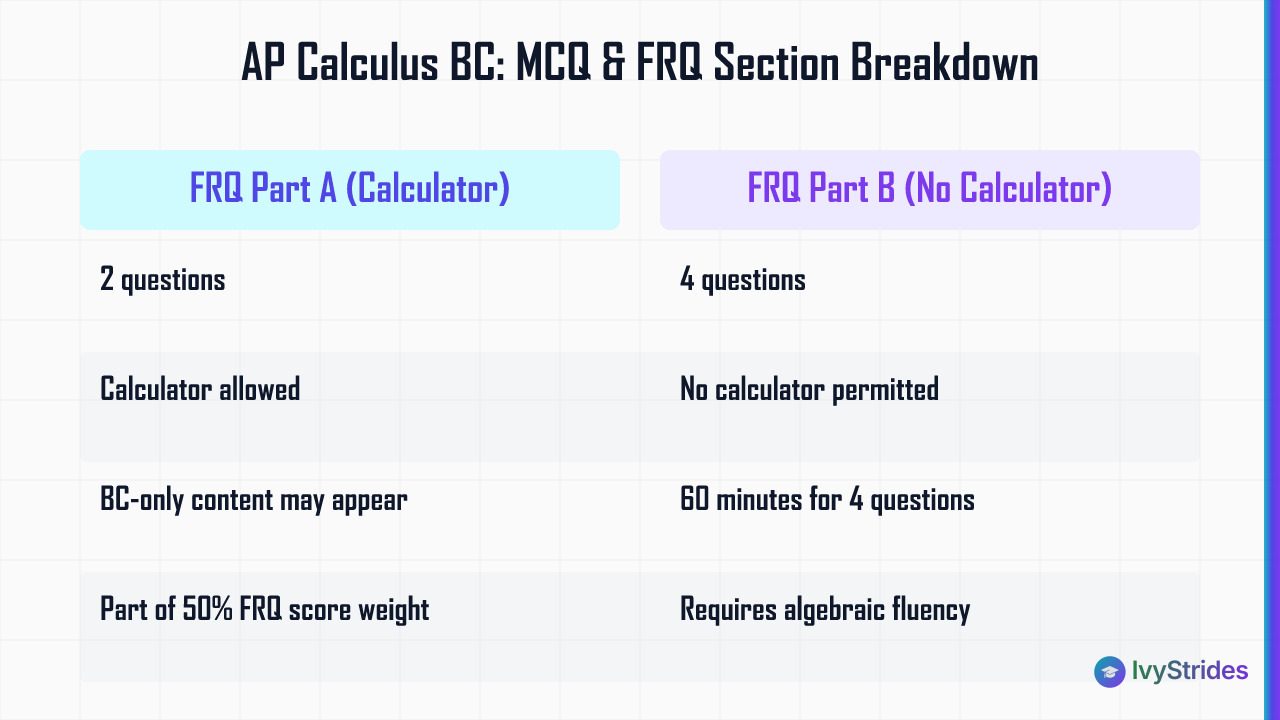
AP Calculus BC covers 10 units, from limits and continuity through infinite series and parametric/polar/vector functions. The MCQ section is 45 questions: 30 non-calculator (Part A) and 15 calculator-active (Part B). The FRQ section is 6 questions: 2 calculator (Part A) and 4 non-calculator (Part B). FRQs count for 50% of the score per the College Board AP Program.
Units 9 and 10 are the BC-only content: parametric, polar, and vector functions, plus infinite series and convergence tests. In recent released exams, roughly 2 of the 6 FRQs draw directly from this BC-only material. If you transferred in from an AB course or you're self-studying the BC content, that's where your hours go.
The calculator vs non-calculator discipline is its own skill. FRQ Part B gives you 4 questions in 60 minutes with no calculator. That means algebraic fluency on integration by parts, partial fractions, and series convergence tests, including the ratio test, the alternating series test, and the integral test. In our coaching with students at the 3-to-5 score band, those who drill series convergence tests in the final four weeks see the largest FRQ gains in this subject.
For a deeper walkthrough on tactics, see how to get a 5 on AP Calculus. Students working toward a 5 with a specialist typically focus the final four weeks on series convergence tests and FRQ Part B non-calculator fluency through our AP Calculus BC coaching.
AP US History: Mastering the DBQ, LEQ, and Stimulus-Based MCQ
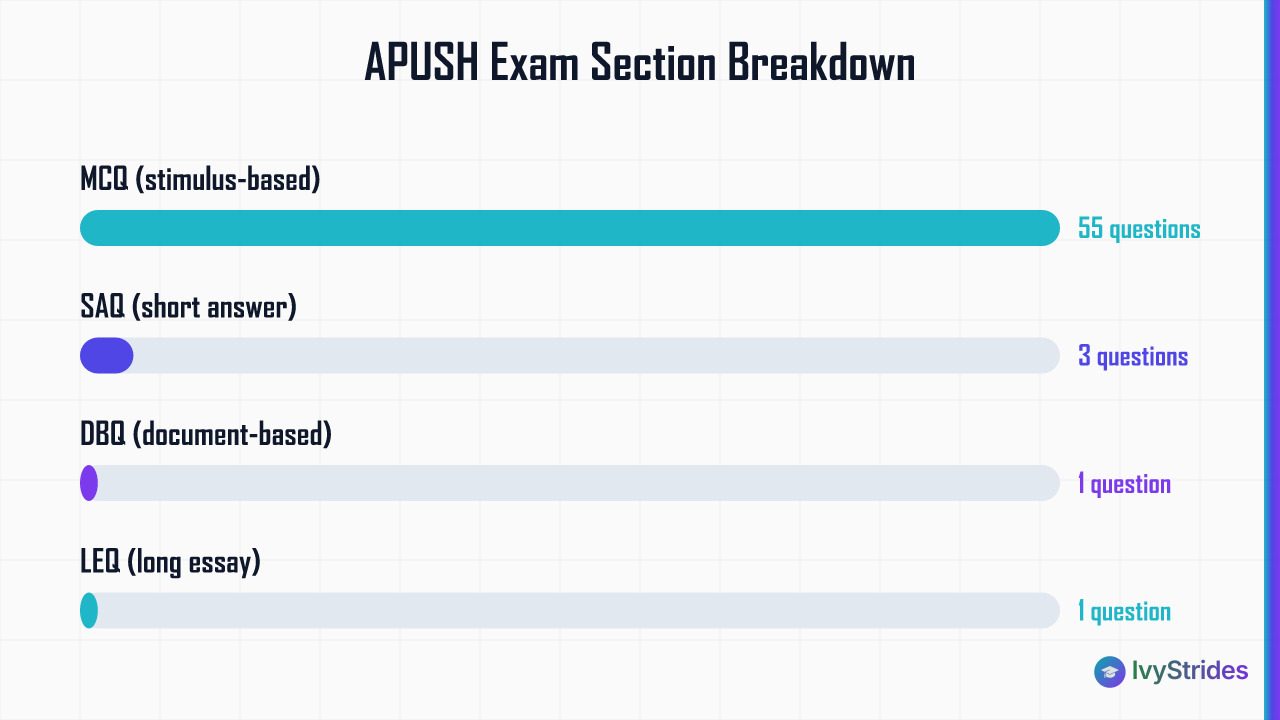
Per the AP US History Course and Exam Description, APUSH typically covers 9 historical periods, from 1491 to the present. The MCQ section is 55 stimulus-based questions; every question is anchored to a primary source, image, map, or data set, not a recall prompt. The SAQ section gives 3 short-answer questions (with a choice between options 3 and 4). The DBQ is one question built around 7 documents. The LEQ is one question chosen from 3 options. The full FRQ section (SAQ plus DBQ plus LEQ) typically accounts for roughly 60% of the exam score.
Periods 3 through 8 (roughly 1754 to 1980) carry the heaviest weighting in the College Board curriculum framework, accounting for approximately 80% of exam content. If you only have time to deeply review six periods, those are the six.
The DBQ rubric awards up to 7 points across thesis, contextualization, document use (sourcing and evidence), outside evidence, analysis, and complexity. In our coaching, the contextualization point is the most commonly missed point on the DBQ. Students write a thesis, cite documents, and forget to spend 2 to 3 sentences placing the prompt in a broader historical setting before or after the period in question. A free point lost on most rough drafts.
For the full study schedule view, see our guide on how to study for AP exams.
AP Biology: Data Interpretation, Investigative Labs, and the 8-Unit Framework
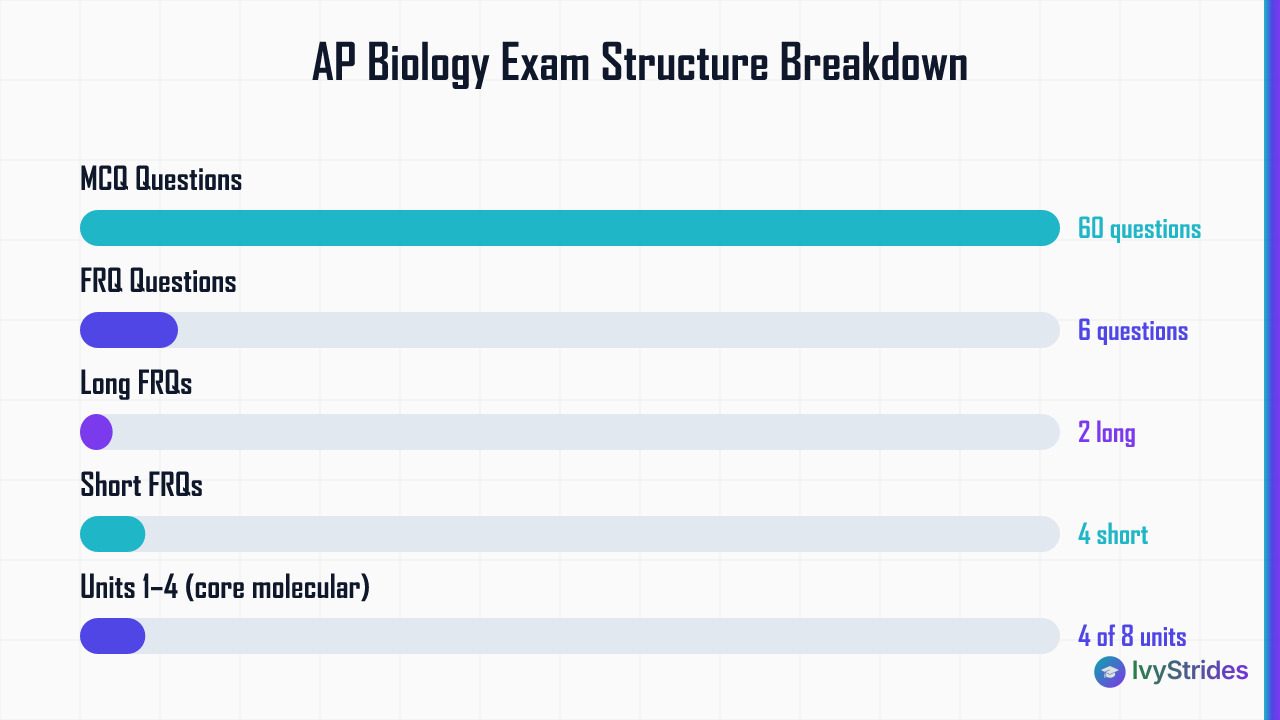
Per the AP Biology Course and Exam Description, AP Biology typically runs across 8 units, from chemistry of life through ecology. The MCQ section is 60 questions, split between discrete recall items and data-set questions that present experimental results and ask you to interpret. The FRQ section is 6 questions: 2 long, 4 short. FRQs are typically 50% of the score.
Units 1 through 4 (chemistry of life, cell structure and function, cellular energetics, cell communication and cell cycle) account for roughly half of MCQ content per the College Board curriculum framework. If your weakest area is genetics or ecology, you still can't afford to under-prep the molecular and cellular units. They show up too often.
Honestly, the math sub-skills matter more than students expect. Hardy-Weinberg, chi-square goodness-of-fit, and water potential calculations all appear in FRQ contexts, often as 1-point or 2-point sub-parts inside a longer question. In our coaching, students who drill those three calculations weekly in the month before the exam stop losing those sub-points entirely. The math is straightforward; the loss happens when students freeze because they haven't seen the format recently.
Data-set MCQs are the other quiet difficulty. The exam isn't testing whether you remember the function of the Golgi apparatus. It's testing whether you can read a graph of enzyme activity versus temperature and explain what's happening. Practice the interpretation, not the flashcards.
Before locking in your subject-specific study plan, confirm your exact AP exam dates 2026 so you can count backward to set weekly milestones.
Studying for Multiple AP Exams at Once: Where Most Students Lose Weeks
Here's the part most students miss. Taking three or four APs in the same May window isn't three or four separate prep problems. It's a scheduling problem first and a content problem second. Students who treat it as four content problems study chronologically through each textbook, run out of time in mid-April, and end up under-prepared on the subject they thought they had the most cushion in.
The fix is diagnostic-first planning. A junior we worked with last spring was taking AP Bio, AP Calc BC, and APUSH. Her instinct was to put the most hours into Bio, her hardest class. Her January diagnostics told a different story: she scored a 4 on Bio, a 2 on APUSH, and a 3 on Calc BC. The class that felt hardest wasn't the exam with the biggest gap. We reallocated her weekly hours toward APUSH FRQs first, and her March re-diagnostic moved APUSH from a 2 to a 3.
In our coaching with students taking 3 or more APs, those who run a full-length official practice test per subject in January and rank subjects by score gap close more ground by May than those who study chronologically. A student who scores a 2 on AP Biology and a 4 on AP Calculus BC doesn't need equal hours; Bio gets roughly 60% of weekly AP study time until the gap closes.
Realistic hour ranges from our coaching: approximately 40 to 60 focused hours per subject to move from a 3 to a 4 or 5, depending on the subject and starting point. Less for subjects where the student already has strong fundamentals. More for high-difficulty subjects like AP Physics 1 and AP Chemistry when starting below a 3.
Spaced practice across subjects beats single-subject cramming in the final 6 weeks. Rotate two or three subjects every few days rather than spending a full week on one. The AP exam window runs roughly two weeks in May, and the calendar order rarely matches your priority order, so spaced rotation also protects your weakest subject from being the one you most recently neglected.
For broader course-load context, see how many AP classes should you take. For structured subject-by-subject instruction with per-subject specialists, see our AP prep courses.
AP Chemistry and AP Physics 1: Where Most Students Lose Points
Per the AP Chemistry Course and Exam Description, AP Chemistry typically runs across 9 units, from atomic structure through electrochemistry. The MCQ section is 60 questions, split between Part A (no calculator) and Part B (calculator allowed). The FRQ section is 7 questions in 105 minutes: 3 long, 4 short. FRQs are typically 50% of the score. Units 4 (chemical reactions) and 5 (kinetics) are consistently among the heaviest-weighted on released exams.
Particulate-level diagrams appear in both MCQ and FRQ, and most students under-practice them. The question asks you to draw or interpret what's happening at the molecular level: which species are present, how they're arranged, what changes during a reaction. In our coaching, AP Chemistry students who practice drawing and interpreting particulate diagrams weekly gain 1 to 2 additional FRQ sub-points on average. If AP Chemistry is on your list, our subject-specialist AP Chemistry coaching covers particulate diagrams and kinetics FRQs in depth.
AP Physics 1 is a different beast. The exam covers 7 units, from kinematics through simple harmonic motion. The MCQ section is 40 questions, including a multi-select format where two answers are correct and partial credit isn't awarded. Get one of the two right? Zero on that question. The FRQ section is 5 questions, and one of them is the paragraph-length response: a written scientific argument in prose, not a calculation.
The paragraph-length response is the hardest item on the exam for most students. You're not just solving. You're explaining the physics in coherent paragraphs, citing principles like Newton's third law or conservation of momentum to justify your reasoning. Students who never practice writing science prose lose this question almost entirely. Combine that with the multi-select MCQ penalty and you have the structural reason Physics 1 sits among the lowest 5-rates published in College Board AP score distributions. Targeted prep matters more in this subject than in almost any other; see our AP Physics 1 coaching.
AP English Language: Synthesis, Rhetorical Analysis, and the 55% FRQ Weight
AP English Language and Composition is typically the most FRQ-weighted of the subjects covered here per the AP English Language Course and Exam Description. The MCQ section is 45 questions on reading and writing in context. The FRQ section is 3 essays: synthesis, rhetorical analysis, and argument. FRQs typically count for 55% of the score.
The synthesis essay provides 6 to 7 sources and requires citing at least 3 of them. Citing more than 3 doesn't automatically raise your score; citing fewer than 3 caps it. The argument essay provides no sources at all. You supply your own evidence from reading, history, or observation.
The rhetorical analysis essay is the technically hardest of the three for students new to AP Lang. You're not summarizing what the author said. You're identifying specific rhetorical choices (anaphora, juxtaposition, specific appeals to ethos or pathos, syntactic shifts) and explaining their effect on the intended audience. In our coaching, students who practice naming specific devices and articulating their function score meaningfully higher than students who write content summaries with a thesis tacked on.
That rhetorical analysis skill carries over into college essay work too. See how to write a college essay for the bridge between AP Lang writing and admissions writing.
How to Build Your AP Study Schedule When You Are Taking Multiple Exams
Backward planning is step one. Look up your exact AP exam dates 2026 schedule, then count backward to set weekly milestones. Most students should begin focused AP-specific prep in January or early February, separate from in-class learning.
Run a full-length official diagnostic per subject by early February. College Board AP Classroom hosts official topic questions, full released exams, and AP Daily videos for every subject; these are the gold-standard practice materials. Past free-response questions going back several years are publicly available on the College Board AP Program site. Third-party AP study websites vary in accuracy, so cross-check anything unofficial against released questions.
Allocate weekly hours by score gap, not equally. If your January diagnostics return a 2 on AP Biology and a 4 on AP Calculus BC, Bio gets roughly 60% of weekly AP study time until the gap narrows. Re-diagnose every 4 to 5 weeks with another full-length practice exam to confirm the gap is actually closing and reallocate hours if not.
How many practice tests? In our coaching, students targeting a 5 typically complete two to three full-length practice exams per subject across the prep window, spaced three to four weeks apart, with targeted weakness work between each. The number matters less than what you do with the results. Reviewing every missed question and drilling the underlying skill before the next practice test is the work. A fourth practice test without that review adds nothing.
Free AP study websites work best as content reinforcement for students already scoring a 3. Students sitting at a 1 or 2, or those targeting a 5 in a high-difficulty subject like AP Physics 1 or AP Chemistry, typically need structured FRQ feedback that free sites can't provide. For a full week-by-week breakdown of how to structure your AP prep from January through May, see our full walkthrough on how to study for AP exams in 2026.
AP Scores and College Admissions: What a 4 or 5 Actually Does for You
AP scores serve two functions in admissions. First, college credit: most colleges that grant AP credit require a 4 or 5, though some accept a 3 for introductory courses. Credit policies vary by institution and change year to year. Always verify at the specific college's AP credit policy page or through the College Board AP credit policy lookup.
Second, signal. AP course rigor (the fact that you took the course at all) is visible on your transcript independent of the exam score. Admissions officers see both the course grade and, if you self-report, the exam score. A strong AP score in a rigorous subject can reinforce the academic strength section of an application; a low one is generally optional to report.
Do AP scores matter at test-optional colleges? Test-optional policies apply to the SAT and ACT, not to AP scores. AP scores are self-reported on most applications and optional to include. They function as supplemental academic evidence, not a required submission. Worth understanding when planning your overall testing strategy; see do colleges require SAT in 2026 for the broader test-policy landscape.
A strong AP profile works hardest as part of a connected application: rigorous course load, solid AP scores, a tested SAT or ACT where it strengthens the file, and well-crafted essays. The essays carry weight that scores can't replicate; for support on that side, see our common app essay tutor service.
FAQ
Where can I find official practice problems for each AP subject?
College Board AP Classroom is the primary source. It includes official topic questions, past FRQs with scoring guidelines, and AP Daily videos for every subject. Past free-response questions going back several years are also posted publicly on the College Board AP Students site. Third-party sites vary in accuracy, so cross-check anything unofficial against the released College Board materials.
How many practice tests should I take to target a 5 on an AP exam?
In our coaching, students targeting a 5 typically complete two to three full-length practice exams per subject across their prep window, spaced at least three to four weeks apart, with targeted weakness work between each. The number matters less than what you do with the results. Review every missed question, drill the underlying skill, and only then sit the next practice exam.
Is it realistic to self-study for an AP exam without taking the class?
It depends on the subject. AP subjects with heavy conceptual load and lab components (AP Chemistry, AP Physics 1, AP Biology) are harder to self-study because the FRQs test applied reasoning that's difficult to develop without structured instruction. AP subjects with more text-based content (AP English Language, AP Human Geography) are more accessible for solo prep. Run a diagnostic practice test early to honestly assess whether self-study will get you to your target score or whether structured support is needed.
How do I prep for multiple AP exams in the same May window without burning out?
Start with a diagnostic practice test for each subject in January or February to identify your score gap per subject. Allocate weekly study hours proportionally to the gap, not equally across subjects. Rotate subjects every two to three days rather than spending full weeks on one. Reserve the final two weeks before each exam for that subject's targeted review and one last timed practice.
Are free AP study websites good enough, or do I need a tutor?
Free official resources, especially College Board AP Classroom and AP Daily videos, are a strong foundation for any prep plan. They work best for students already scoring a 3 who need content reinforcement. Students scoring a 1 or 2, or those targeting a 5 in a high-difficulty subject like AP Physics 1 or AP Chemistry, typically benefit from structured coaching that diagnoses specific gaps and gives FRQ-level feedback, which free websites can't replicate.
Do AP scores help with college admissions even at test-optional schools?
Test-optional policies apply to SAT and ACT scores, not AP scores. AP scores are self-reported on most applications and optional to include. A strong score (4 or 5) in a rigorous subject can reinforce the academic strength section of an application; a low score generally doesn't need to be reported. Admissions officers see AP course grades on the transcript regardless of whether you submit the exam score, and AP credit policies vary by college, so verify at each institution.
Subject-specific prep isn't a nice-to-have. It's the single biggest efficiency gain available between January and May. Pick your subjects, run your diagnostics, rank by score gap, and start with the highest-yield units in each.

Two decades teaching quantitative and verbal aptitude on standardized tests. Rare dual expertise across Math and Verbal — particularly effective for students with gaps on both sides. Senior AP Mentor for our Calculus and English tracks.