
AP for International and Homeschool Students: How to Take, Study, and Use AP in 2026-27
On this page
- What AP Is and Why It Matters for Students Outside Traditional Schools
- Step-by-Step: How to Register for AP Exams as a Homeschool or International Student
- Can You Take AP Classes as a Homeschooler? Online Courses and the AP Course Ledger
- How to Study for AP Exams Without a School Course
- Choosing the Right AP Subjects as a Homeschool or International Student
- How AP Scores Help Homeschool and International Students in College Admissions
- Is It a Disadvantage to Be an International or Homeschooled AP Student?
- AP Alongside SAT and ACT: Building a Complete Admissions Profile
- FAQ
- Can homeschooled students take AP classes?
- Can you get AP credit if you are homeschooled?
- How do I find a school that will let me take AP exams as an outside or international student?
- Do US colleges accept applications from internationally homeschooled students?
- Is it okay to take the AP exam without taking the AP course?
- What is the AP Course Ledger and does it matter for homeschoolers?
Homeschool and international students can sit AP exams in 2026-27, earn college credit, and use scores as course-rigor signals on US college applications. You do not need to be enrolled in an official AP course to register, but you cannot order exams directly from College Board. Instead, contact a local high school or authorized testing center in the fall, typically before November 1, and ask the AP coordinator to add you as an outside student. International students can find authorized centers through the College Board AP Students portal.
The rest of this article walks through what most families get stuck on: which schools accept outside students, how to build a study plan without a classroom, how AP scores factor into admissions when your transcript is homeschool or foreign, and which subjects to prioritize.
What AP Is and Why It Matters for Students Outside Traditional Schools
Advanced Placement is a College Board program offering 34 subjects in 2026-27, each ending in a May exam scored on a 1-5 scale. Most four-year US colleges award credit or advanced placement for a score of 3, 4, or 5, though selective schools typically want a 4 or 5. If you're new to the program, our overview of what AP is covers the structure in more detail.
Here's why AP carries extra weight when you're outside a traditional US high school. Admissions officers reading a homeschool transcript, or a transcript from a school they haven't heard of in another country, look for external, standardized validation of academic rigor. An AP score is exactly that. It's graded by College Board, not by you or your parent, and it means the same thing whether you sat the exam in Ohio or Jakarta.
One caveat before we go further. Test-optional admissions policies, tracked at FairTest, apply to the SAT and ACT, not to AP scores. A strong AP score still strengthens your application even at test-optional schools, but test-optional status varies by school and by year, so verify at each target college.
Step-by-Step: How to Register for AP Exams as a Homeschool or International Student
This is where most families get stuck. College Board is explicit: students and parents cannot order AP exams directly. A school's AP coordinator must place the order on your behalf. The official College Board guidance for homeschool students confirms this, and the same rule applies internationally.
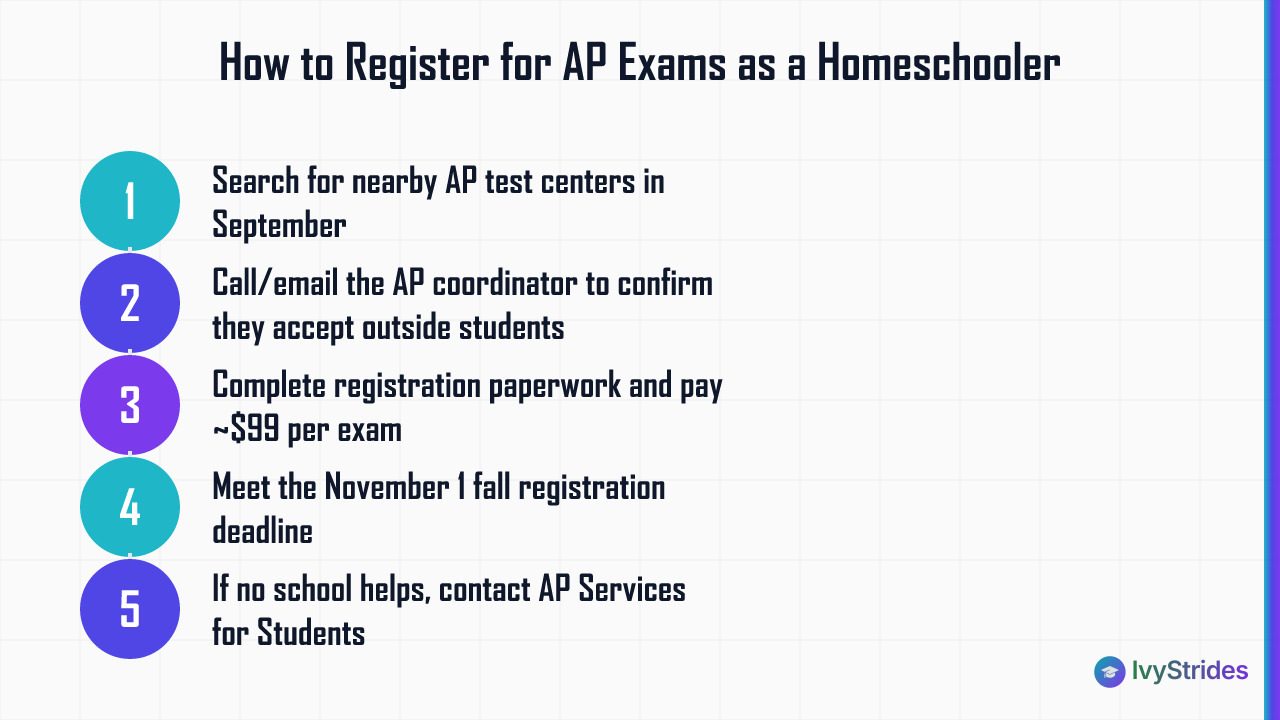
Here is the process, in the order to execute it:
-
In September, search for nearby AP test centers. Use the College Board AP Students portal to find schools within a reasonable travel distance. In the US, look at both public and private high schools. International students should use the international test-center search on the same portal.
-
Call or email the AP coordinator directly. Ask two questions: does the school accept outside or homeschool students for AP exams, and what is the school's specific registration deadline? Some schools close registration in October to give the coordinator processing time.
-
Confirm registration paperwork and payment. Once a school accepts you, the AP coordinator will guide you through registration. The exam fee is approximately $99 per exam in the US for 2024-25; confirm the current fee at collegeboard.org. International fees are higher.
-
Meet the November 1 fall registration deadline. This is the standard College Board deadline for the May exam window. Miss it and you'll face a late fee, or the exam may not be available at all at your chosen center. For a full walkthrough of the standard AP registration process, including fees and deadlines that apply to all students, see our guide on how to register for AP exams.
-
If no local school will accommodate you, contact AP Services for Students. College Board's help center can point homeschoolers toward a willing coordinator. This is a genuine last resort, not the first step.
A few state-level notes for US homeschoolers. Some states have laws requiring public schools to allow homeschooled residents to take AP exams; others don't. Check with your state homeschool organization if a nearby public school initially refuses. And if you're wondering when exams actually happen, all AP exams run in May; our AP exam dates 2026 page has the full subject-by-subject schedule and make-up windows.
One more thing worth flagging: the November 1 date is typical, not universal. Individual test centers can set earlier internal deadlines. Confirm the exact date with your specific coordinator, in writing.
Can You Take AP Classes as a Homeschooler? Online Courses and the AP Course Ledger
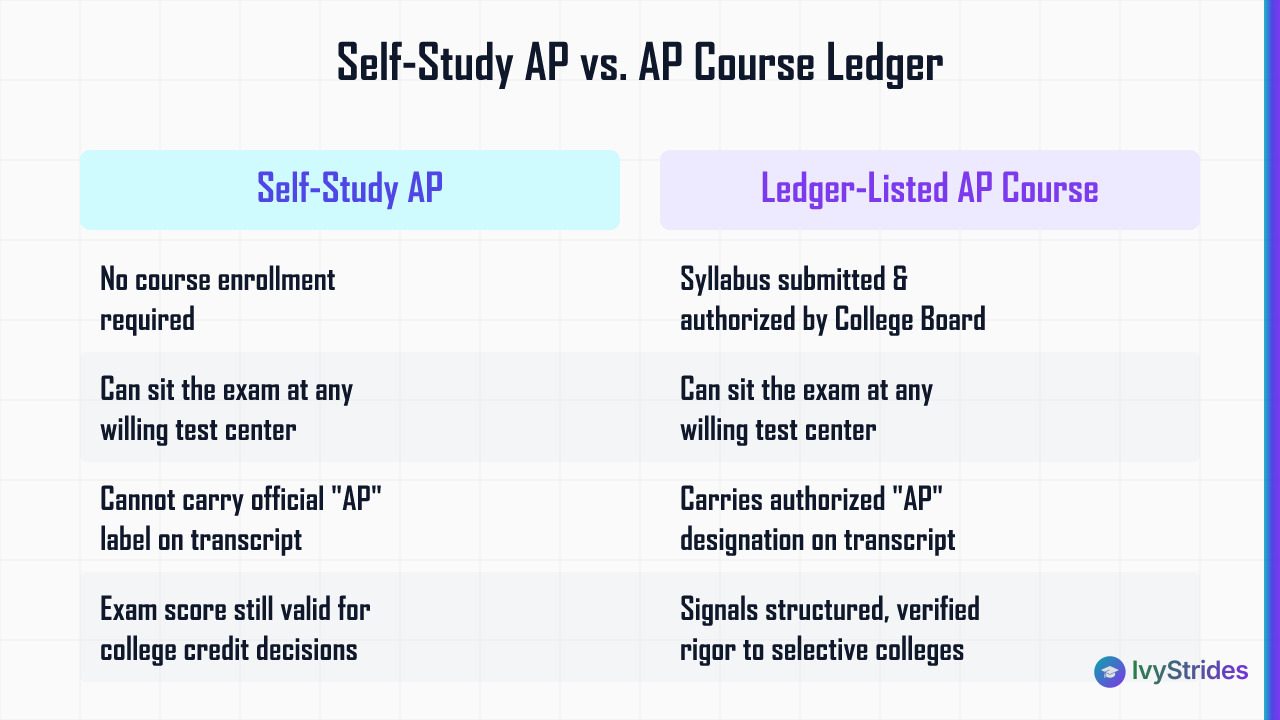
Yes, and this is where a decision matters: self-study AP versus a course-listed AP.
You don't need to take an AP course to sit the exam. College Board allows self-study students to register through any willing test center. Many homeschool and international students prepare independently and score 4s or 5s. The exam score is what colleges use for credit decisions, not the course label.
But there's a second layer. The AP Course Ledger is College Board's official registry of authorized AP courses. Schools and online providers submit syllabi for review, and only ledger-listed courses can carry the "AP" designation on a transcript with College Board's authorization. For homeschool students, that distinction matters when a selective college reviews your transcript. A course listed as "AP Chemistry" from an authorized online provider signals structured, verified rigor. Self-study preparation is valid for the exam, but it can't carry the "AP" label on your transcript.
This is why we built our best online AP courses with per-subject specialist instructors: one teacher per subject, accessible globally, with the transcript-worthy course label. In our coaching, students who complete a structured 12-16 week prep plan with a subject specialist typically move from a projected 3 to a 4 or 5 on content-heavy subjects where self-study alone tends to plateau.
For parents deciding how many AP subjects to sponsor in a single year, a parent's guide to AP classes offers a goal-based framework.
How to Study for AP Exams Without a School Course
Start with a diagnostic. Before you build a study plan, take a full-length practice exam under timed conditions and see where you actually stand. Every AP exam is structured with a multiple-choice section and a free-response section, and the weighting varies by subject. AP Calculus AB is 50% MC and 50% FR. AP English Language is 45% MC and 55% FR. AP Chemistry is 50/50. Your diagnostic tells you which section, and which units within that section, are eating your score.
Then build a 12-16 week plan around your weak units. That's the realistic timeline for a student aiming at a 4 or 5 from a cold start. Shorter than 12 weeks and you're gambling on subjects with dense content loads like AP Chemistry, AP Biology, or AP US History. Longer than 16 weeks and retention starts eroding on the earliest units unless you're actively spaced-retesting.
A concrete example. AP Calculus AB Unit 5, Analytical Applications of Differentiation, is a high-weight unit that shows up heavily in both MC and FR. A junior we worked with last fall came in with a projected 3 driven almost entirely by weakness on Units 4 and 5; two focused weeks on those units with a specialist moved his practice-exam score to a solid 4. In our coaching with students preparing independently, those who complete weekly spaced-retesting sessions and targeted weak-unit work typically improve by at least one score band within 10-12 weeks.
Once you have secured your test center, the next question is how to prepare; our AP exam prep by subject guide maps out a study plan for every major AP course. For subject-specific work, we publish deeper guides like our AP Calculus AB prep with unit-by-unit breakdowns. Our how to study for AP exams walkthrough covers the diagnostic-driven methodology in more detail.
One warning. Self-study without structure rarely produces a 4 or 5 on content-heavy exams. AP Chemistry, AP Physics C, AP Biology, and AP US History reward students who have someone checking their work and pushing them past comfortable material. If you go the pure self-study route on these subjects, be honest about your discipline and consider a subject specialist for at least the weakest two units.
Choosing the Right AP Subjects as a Homeschool or International Student
Quality over quantity. That's the single most important principle for homeschool and international applicants deciding which APs to take. Taking eight APs and scoring 2s and 3s is worse than taking four APs and scoring 4s and 5s. Admissions officers read AP scores as validation of rigor; low scores on many exams read as overreach.
Selective US colleges, roughly those with median SAT scores above 1450, typically expect 4-8 AP courses on a competitive applicant's transcript. This varies by school and by intended major. For a goal-based framework on volume, see how many AP classes you should take.
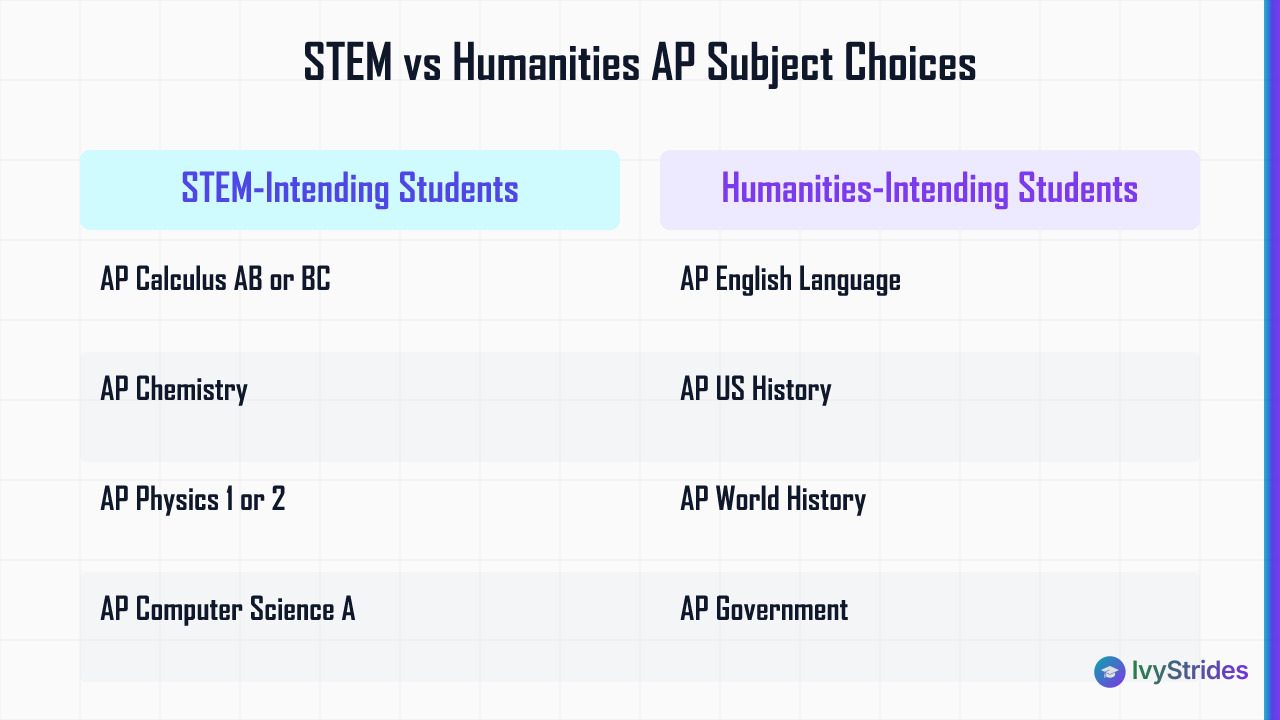
Subject choice should follow your intended major. For STEM-intending students: AP Calculus AB or BC, AP Chemistry, AP Physics 1 or 2, and AP Computer Science A are commonly expected. For humanities-intending students: AP English Language, AP US History, AP World History, and AP Government are strong choices. For business or economics: AP Microeconomics and Macroeconomics, AP Statistics, AP Calculus AB.
International students have one additional consideration. If you're already enrolled in an IB program at your school, layering APs on top can dilute your focus. Many US universities accept both IB and AP credit; the policies vary. If your school offers IB and you're doing well, prioritize IB and add one or two strategic APs in subjects your school doesn't cover, rather than replicating your IB courses with parallel AP exams.
For a plain-English breakdown of what each score on the 1-5 scale actually means to colleges, see our AP scores explained guide.
How AP Scores Help Homeschool and International Students in College Admissions
For homeschool applicants, AP scores serve as external, standardized validation of academic rigor. That's the core value. An admissions officer at a selective US university reading your homeschool transcript has no easy way to calibrate "A in Chemistry" from a home-taught course. An AP Chemistry score of 5 removes that ambiguity.
Most four-year US colleges award credit for AP scores of 3, 4, or 5. Selective schools often require a 4 or 5. Some ultra-selective schools, a handful of Ivies and peers, have narrowed AP credit significantly in recent years, awarding placement without credit hours. Before choosing which APs to sit, confirm how your target schools handle credit; our guide on do colleges accept AP credit breaks down the policies school by school.
On the Common App, homeschoolers can list AP courses under the coursework section and note the provider. A score on the official AP exam corroborates the self-reported course. This is why the ledger-listed course versus self-study distinction matters: your Common App entry reads more credibly when the course itself is authorized. For US admissions essay strategy on top of scores, our common app essay tutor team works with homeschool and international applicants to contextualize non-traditional learning environments in the personal statement.
Three caveats worth surfacing. First, AP credit policies vary by college and by subject; verify at each target school before assuming a 4 will earn you credit. Second, test-optional policies don't eliminate the value of strong AP scores, but they also don't guarantee an AP-heavy application will substitute for missing SAT or ACT scores at every school. Third, college admissions outcomes depend on the full application, not AP scores alone.
Is It a Disadvantage to Be an International or Homeschooled AP Student?
Honestly? It's mixed, and worth naming both sides.
The real disadvantage is logistical. No school AP coordinator means you and your family manage registration independently, and some regions genuinely have limited testing centers. A homeschool student in rural Wyoming or a small town in Southeast Asia may face a real barrier finding a willing school within driving distance. That's solvable, but it takes calling in September, not November.
The real advantage is strategic flexibility. Homeschool and internationally schooled students can choose AP subjects without being constrained by what a local school offers. If your intended major is computer science, you can prioritize AP Computer Science A and AP Calculus BC even if a nearby high school doesn't offer them. Your transcript is yours to design.
US admissions officers at selective colleges are experienced with homeschool applications. The Common App has a dedicated homeschool section, and admissions offices routinely review non-traditional transcripts. In our coaching with internationally homeschooled students, those who pair strong AP scores (4s and 5s) with a personal statement that contextualizes their learning environment are competitive at selective US universities. One anonymized example from last year: a homeschool student in Southeast Asia registered through an international testing center, completed online AP Calculus BC and AP Chemistry prep with IvyStrides subject specialists, scored a 5 and a 4 respectively, and was admitted to a US university that awarded credit for both.
Geographic isolation isn't a barrier to expert AP preparation when courses are delivered online. You can meet our AP subject specialists and see how per-subject expertise, rather than one generalist across all APs, changes what preparation looks like.
Caveat, as always: admissions outcomes depend on the full application. AP scores are one factor among many.
AP Alongside SAT and ACT: Building a Complete Admissions Profile
For homeschool applicants especially, a strong SAT or ACT score alongside AP scores provides two independent, standardized data points admissions officers can use to evaluate academic readiness. Two data points from different testing bodies, College Board and ACT, Inc., is stronger than one. If you're deciding which standardized test fits you better, our ACT vs SAT comparison walks through the diagnostic-driven decision.
PSAT/NMSQT is also available to homeschoolers through a similar outside-student process. Contact a local school's PSAT coordinator in August or September. A high PSAT score can open the National Merit pathway for US citizens and permanent residents, which carries scholarship value on top of admissions signaling. For context on what score range matters, see what is a good PSAT score.
Even at test-optional schools, submitting a strong SAT score (1450 or higher at selective schools) alongside AP 4s and 5s tends to strengthen an application. Test-optional policies vary by school and year, as tracked at FairTest, so verify current policy at each target school before deciding whether to submit.
We built IvyStrides as a connected admissions academy for this exact reason. Students working on APs with a subject specialist can also work on 1-on-1 SAT prep with a section specialist on R&W or Math, and essay coaching with an admissions-context coach, all with one coordinated team. In our coaching, students starting in the 1180-1300 SAT band who complete the 1-on-1 program typically see a gain of 200 points or more; combined with AP 4s and 5s, that's a materially different application.
FAQ
Can homeschooled students take AP classes?
Yes. Homeschooled students can take AP classes through authorized online providers listed on the AP Course Ledger, and they can sit the official AP exam through a local school or testing center. Taking a structured online AP course isn't required to register for the exam, but it provides the subject preparation needed to score a 4 or 5 and gives the student a course to list on their homeschool transcript with the "AP" designation.
Can you get AP credit if you are homeschooled?
Yes. If you score a 3, 4, or 5 on an AP exam, most US colleges will award credit or advanced placement regardless of whether you attended a traditional school. Credit policies are based on the exam score, not on how you prepared. Credit thresholds and the number of credits awarded vary by college and by subject, so verify each target school's AP credit policy directly.
How do I find a school that will let me take AP exams as an outside or international student?
Start by searching the College Board AP Students portal at apstudents.collegeboard.org for authorized testing centers near you. For US homeschoolers, call or email the AP coordinator at a nearby public or private high school in September and ask if they accept outside students. If no local school accommodates you, contact AP Services for Students through the College Board help center. International students should use the international test-center search on the same portal.
Do US colleges accept applications from internationally homeschooled students?
Yes. US colleges, including selective universities, routinely accept applications from internationally homeschooled students. The Common App includes a dedicated section for homeschool applicants. Admissions officers are familiar with non-traditional transcripts and typically look for external validation such as AP exam scores, SAT or ACT scores, and letters from instructors or mentors. Strong AP scores (4s and 5s) are especially valuable because they provide a standardized, independently verified measure of academic ability.
Is it okay to take the AP exam without taking the AP course?
Yes. College Board explicitly permits self-study students to sit AP exams, and many homeschool and international students earn 4s and 5s this way. The exam score is what colleges use for credit decisions. That said, a rigorous preparation plan covering all exam units is essential. Self-study without structure rarely produces a 4 or 5 on content-heavy subjects like AP Chemistry or AP Calculus BC, so plan accordingly.
What is the AP Course Ledger and does it matter for homeschoolers?
The AP Course Ledger is College Board's official registry of schools and online providers whose AP course syllabi have been reviewed and authorized. For homeschoolers, taking a course from a ledger-listed provider means the course can be labeled "AP" on a transcript with College Board's authorization. Self-study preparation is valid for the exam but can't carry the "AP" course label unless the course itself is ledger-listed. Some selective colleges look favorably on ledger-listed courses as evidence of structured rigor.
If you're a homeschool or international student mapping out AP for 2026-27, two dates matter most right now: the September test-center search and the November 1 registration deadline. Subject selection, study plan, and transcript documentation all follow from getting those two right.

Two decades teaching quantitative and verbal aptitude on standardized tests. Rare dual expertise across Math and Verbal — particularly effective for students with gaps on both sides. Senior AP Mentor for our Calculus and English tracks.