
A Parent's Guide to AP Classes in 2026-27: How Many, How Much, and How to Help

On this page
- What AP Classes Are and Why They Matter for College Admissions
- How Many AP Classes Should Your Student Take? A Grade-by-Grade Framework
- Which AP Classes to Choose: A Subject-by-Subject Overview for Parents
- The Hardest AP Classes and What Makes Them Difficult
- Understanding AP Scores: What the 1-5 Scale Actually Means for College Admissions
- Is 7 AP Classes Enough for Harvard? What Selective Colleges Actually Expect
- How to Explain AP Classes to Your Student: Starting the Conversation
- How to Support Your Student Through AP Season Without Taking Over
- What to Do When Your Student's School Has Limited AP Offerings
- FAQ
- How do AP exams and AP classes actually work?
- How do students manage four or more APs in a single year?
- What is the biggest problem with AP classes for most students?
- Is a 70% raw score a 5 on an AP exam?
- Should my student take AP classes if their target schools are test-optional?
- What AP classes are typically available for freshman year?
AP classes are college-level courses managed by the College Board, with more than 38 subjects available and a standardized exam each May scored on a 1-5 scale. A score of 3 or higher may qualify for college credit, though policies vary by institution. Most students take 0-1 APs freshman year, 1-2 sophomore year, 2-4 junior year, and 2-3 senior year. Selective college applicants typically complete 7-12 APs total across four years, and admissions officers evaluate that load relative to what the school actually offers, not against a national absolute.
These figures come from the College Board's own AP Program materials and from published Common Data Set reports at selective universities. The harder question is how to turn that framework into a specific plan for your student, and that's where the rest of this guide goes.
What AP Classes Are and Why They Matter for College Admissions
Advanced Placement is a College Board program that lets high schoolers take college-level coursework and sit for a standardized AP exam in May. The College Board reports more than 38 AP subjects across STEM, humanities, English, world languages, and arts, and each course syllabus is reviewed and approved by college faculty for college-level rigor. If your student is entirely new to the program, our foundational guide on what AP is covers the full structure of the Advanced Placement program.
Two things make AP course selection a high-stakes admissions decision, not just an academic one.
First, admissions officers at selective colleges read the transcript for course rigor before they read anything else. Taking the most rigorous curriculum available is a stated criterion at most highly selective schools. AP course load is the clearest rigor signal your student sends.
Second, AP exam scores can convert to college credit, but the policy varies. Many selective universities require a 4 or 5 for credit; some state universities accept a 3. AP credit policies vary by college and by subject, so families should verify directly with each target institution.
One caveat worth surfacing early: test-optional policies, which apply to the SAT and ACT, don't eliminate the value of AP scores. AP performance remains a separate and meaningful data point in a holistic review.
How Many AP Classes Should Your Student Take? A Grade-by-Grade Framework
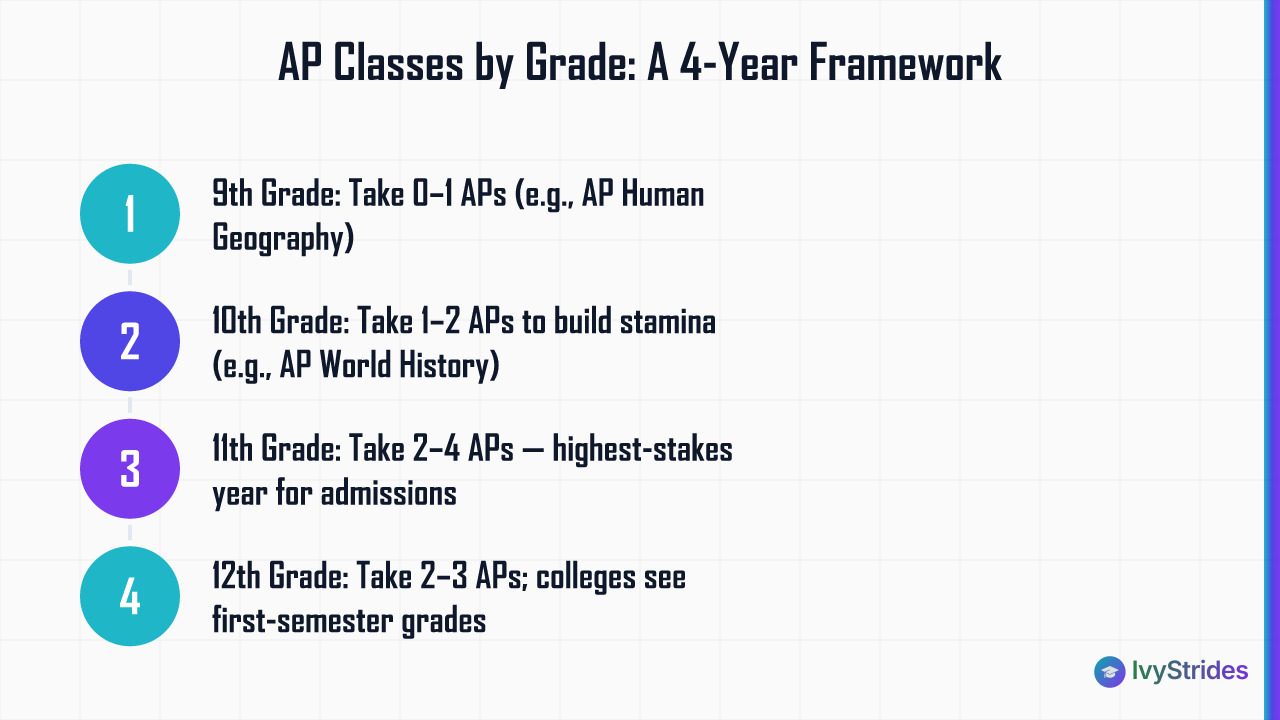
Here's the framework we use with families:
Freshman year (9th grade): 0-1 APs. AP Human Geography is the most common entry-level AP for 9th graders because it has no prior high school prerequisites. Some schools also offer AP Computer Science Principles or AP Seminar to freshmen. Zero APs is completely fine in 9th grade if your student's school doesn't offer freshman-appropriate options. Two or more freshman APs is uncommon and rarely necessary.
Sophomore year (10th grade): 1-2 APs. Common choices include AP World History, AP Computer Science Principles, and AP Psychology. This is the year to build stamina without overloading, especially if your student is also preparing for the PSAT.
Junior year (11th grade): 2-4 APs. This is the highest-stakes year for admissions rigor signaling because junior grades and course choices are the last full year colleges see before applications go in. Typical junior-year APs include AP US History, AP English Language and Composition, AP Calculus AB or BC, AP Chemistry, AP Physics 1, and AP Biology.
Senior year (12th grade): 2-3 APs. Colleges see first-semester grades and course rigor, so senior year matters. Common choices include AP English Literature and Composition, AP Calculus BC, AP Statistics, AP Government, and AP Economics.
Selective college applicants (Harvard, MIT, Stanford, and peers) commonly show 7-12 APs total across four years, with some at feeder schools showing 10-15. That range reflects what those schools offered, not a universal target. A student at a school offering only 6 APs who takes all 6 is viewed more favorably than one at a school offering 25 who takes 8.
For a deeper breakdown of how to set the right AP number based on your student's target colleges and current GPA, see our dedicated guide on how many AP classes a student should take.
Junior year is where we see families get in trouble. In our coaching, students who spread APs too thin in 11th grade without a real preparation plan often see their GPA and their May exam scores suffer at the same time. Four APs with a plan beats five APs without one. Every year.
Also worth marking on the calendar: the full May 2026 AP exam schedule, including make-up dates and registration deadlines, is in our AP exam dates guide.
Which AP Classes to Choose: A Subject-by-Subject Overview for Parents
Below is a working AP class list by category, with the practical notes parents most often ask about.
STEM. AP Calculus AB and AP Calculus BC are the two calculus tracks; BC covers all of AB plus series, parametric equations, and additional integration techniques. Students planning STEM majors typically take BC. AP Statistics is a strong choice for social science and business tracks. AP Physics 1 (algebra-based) is the standard 11th-grade physics course; AP Physics 2 and AP Physics C: Mechanics are more advanced. AP Chemistry and AP Biology round out the core lab sciences. AP Computer Science Principles is more accessible than AP Computer Science A; both are valued for STEM applicants, and A is the deeper Java-based programming course. AP Environmental Science is often cited as a manageable STEM entry.
Humanities and social sciences. AP US History (typically 11th grade), AP World History (typically 10th), and AP European History cover the three main history tracks. AP Government, AP Psychology, AP Human Geography, and AP Macroeconomics / Microeconomics fill out the social science options.
English. AP English Language and Composition is usually taken in 11th grade and focuses on rhetoric and argument. AP English Literature and Composition is typically 12th grade and centers on close reading of poetry, prose, and drama. They're distinct courses with different exam formats.
Languages and arts. AP Spanish, AP French, AP Chinese, AP Latin, and others are available depending on the school. AP Art History, AP Music Theory, and AP Studio Art round out the arts.
Looking for what the internet calls "fun AP classes"? Honest translation: parents and students mean engaging and accessible. AP Psychology, AP Human Geography, and AP Art History come up most often in that bucket. They're still real APs with real exams; they just tend to have lower barriers to entry than, say, AP Physics C.
Course availability varies by school. When a school doesn't offer a subject a student needs, ap courses online fill the gap with subject-specialist teachers. The most-requested at IvyStrides is AP Calculus AB. AP Computer Science A is the STEM-track second-most-requested.
The Hardest AP Classes and What Makes Them Difficult
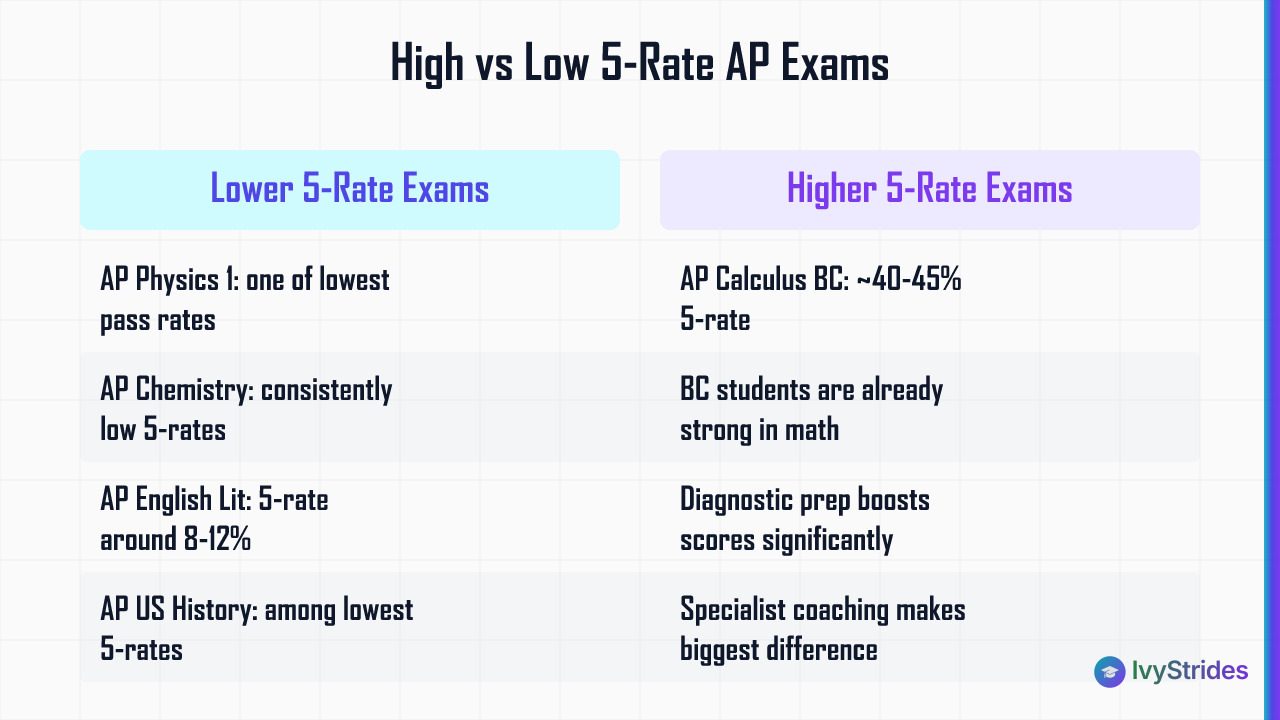
Based on College Board score distributions, AP Physics C: Mechanics, AP Chemistry, and AP US History consistently show among the lowest 5-rates once you account for the size of the test-taking population. AP Physics 1 has historically had one of the lowest overall pass rates (percentage scoring 3 or higher). AP English Literature typically shows a 5-rate around 8-12%.
AP Calculus BC, by contrast, has a relatively high 5-rate, historically around 40-45%. That's partly because the students who elect BC are already strong in math, not because BC is easy.
Difficulty is a function of two things: subject complexity and preparation quality. A student can pick AP Chemistry, one of the toughest exams on paper, and still earn a 5 with a diagnostic-driven prep plan. Another can pick AP Psychology and score a 2 by treating it as easy and never opening a practice exam.
The workload reality: a rigorous AP course typically requires 5-8 hours per week including class time. A student carrying four APs should expect 15-20+ hours of AP-specific work each week during peak periods.
Here's the part most parents miss. In our coaching, students who complete a diagnostic-driven prep plan before the May exam consistently outperform students who rely on class instruction alone. Class teaches the curriculum. The exam tests the curriculum under timed conditions with a specific question format. Those are different skills.
Subjects where specialist coaching tends to make the biggest difference include AP Chemistry and both calculus tracks. Physics-track students should also see AP Physics 1 for the specific paragraph-response format. For the calculus deep-dive, see how to get a 5 on AP Calculus.
Understanding AP Scores: What the 1-5 Scale Actually Means for College Admissions
AP exams are scored on a 1-5 scale by the College Board: 5 = extremely well qualified, 4 = well qualified, 3 = qualified, 2 = possibly qualified, 1 = no recommendation. Scores are released in July following the May exam, accessible through the College Board student portal.
Here's the thing most parents are never told: the raw-to-scaled score conversion isn't a fixed percentage. On many AP exams, roughly 60-70% of available raw points is enough for a 5, because the scoring curve accounts for that year's exam difficulty. The College Board doesn't publish a fixed percentage-to-score mapping, and cutoffs shift year to year.
What each score means practically:
- 5: strong signal to admissions officers; typically eligible for credit at most colleges that award AP credit.
- 4: still a strong score; accepted for credit at many selective universities, though some (MIT, Caltech, several Ivies) require a 5 in specific subjects.
- 3: passing per College Board; accepted for credit at many state universities and some selective schools, but often not at the most competitive institutions.
- 2 or 1: doesn't signal college-level competency; most students choose not to submit these scores.
Our full breakdown of the AP 1-5 scale, score release dates, and what counts as a competitive score at different college tiers is covered in AP Scores Explained. Whether a score of 3, 4, or 5 translates into actual college credit depends entirely on the institution, and our guide on whether colleges accept AP credit walks through the policies at major universities.
Here's the part most parents don't see coming. A father recently emailed us in May, blindsided: his daughter had earned a solid A in AP Biology all year, then scored a 2 on the exam. In our coaching, this is the most common May surprise. Class grades and exam scores measure different things. The class grade reflects homework, quizzes, tests, participation, and the teacher's rubric across a school year. The exam is one timed sitting testing the entire year's content in a specific format. Both matter, and neither predicts the other cleanly.
Is 7 AP Classes Enough for Harvard? What Selective Colleges Actually Expect
Short answer: there's no published minimum AP count at Harvard or any other highly selective college. What Harvard's Common Data Set and similar reports at Yale, Princeton, and MIT show is that admitted students typically completed the most rigorous curriculum their school offered. That phrasing matters.
Common ranges we see on admitted-student transcripts at highly selective schools: 10-15 APs at competitive feeder schools that offer 20+, and 5-8 APs at high schools with more limited offerings. Both profiles get in. What they share isn't the number but the ratio: the student took nearly everything meaningful their school offered in their intended area of study, and performed well.
A few honest caveats:
- Admissions is holistic. Test scores, essays, extracurriculars, letters of recommendation, and demonstrated interest in a specific field all factor in. AP count alone doesn't move the decision.
- Test-optional policies don't eliminate the value of strong AP scores. Test-optional applies to the SAT and ACT, not to AP scores. AP performance remains a rigor signal in a holistic review. Test-optional policies also vary by school and year.
- Quality over quantity. In our coaching, students who take 3-4 well-prepared APs and score 4-5 on each are meaningfully more competitive than students who take 6-7 APs and score 2-3 on most.
If your student's target list includes highly selective schools, the right question isn't "how many APs" but "which APs, in what order, with what preparation, resulting in what scores?" That's the plan that wins. For subject-specific tactics, see our AP exam prep by subject guide.
How to Explain AP Classes to Your Student: Starting the Conversation
Preparing to sit down and talk this through with your student? Here's the framing that lands.
Start with what AP really is. AP courses are reviewed and approved by college faculty to ensure college-level rigor. That's not marketing language; it's the actual approval process at College Board. When your student takes AP Calculus BC, they're doing the equivalent of a first-year college calculus course. That framing matters because it sets the expectation for both the work and the payoff.
Then separate the two things students always conflate: the class grade and the exam score. The class grade shows up on the transcript and factors into GPA. The May exam is a separate, standardized assessment that colleges use to award credit. A student can earn an A in the class and a 3 on the exam, or a B in the class and a 5 on the exam. They measure different things.
Set the workload expectation honestly. Most rigorous AP courses require 5-8 hours per week including class time. Students taking 3+ APs simultaneously should expect 15-20+ hours of AP-related work per week. If your student says yes to four APs, they're saying yes to that math.
Frame the outcome realistically. A 3 has demonstrated college-level competency; that's not a bad outcome. A 4 or 5 is a strong signal to admissions and may yield college credit at some institutions. A 1 or 2 doesn't disqualify anyone from a strong college application; students often don't submit those scores, and the class itself still counts as rigor on the transcript. Nobody is one exam score away from ruin.
While you're at it, confirm the school's AP exam registration deadlines. Most fall in early November for the following May.
How to Support Your Student Through AP Season Without Taking Over
AP exam season runs approximately two weeks each May. Students with multiple exams may sit two on the same day or on consecutive days, per the College Board's published schedule. The support work starts in January, not April.
Here's what actually helps.
Build a backward-planning calendar. Start from the exam dates and work backward in 2-week blocks. Which units need review by mid-March? Which full-length practice exams are scheduled and when? Registration should already be complete by November for the following May.
Protect the schedule. During peak AP season (April through mid-May), most students can't also carry a heavy extracurricular calendar, a part-time job, and a full social schedule. Something gives. Better to reduce load intentionally than to have exam scores absorb the impact.
Know when to bring in outside help. If a student's diagnostic practice exam score is below a 3 with 8 or more weeks until the exam, targeted specialist coaching can close the gap. In our coaching with students in this position, a focused 6-8 week plan targeting weak units typically moves scores from a 2-3 range to a 3-4 range. That gap is where a subject specialist matters most.
Once your student has chosen their AP subjects, subject-specific preparation strategies are covered in our AP exam prep by subject guide. For a step-by-step method to reach a 4 or 5, how to study for AP exams covers the complete preparation sequence.
For students whose schools don't offer a needed AP, our best online ap courses provide the full college-level curriculum with a subject-specialist teacher. Every subject on our roster is taught by a specialist for that subject, which you can verify by browsing our AP subject specialists. One teacher, one AP. Not one teacher covering seven.
What to Do When Your Student's School Has Limited AP Offerings
This is one of the most common problems we see, especially from international families and students at smaller US high schools. A parent from a small charter school recently asked us about this exact bind: her son wants to apply to STEM programs at top universities, but the school offers only three APs, and none of them are the ones the applicant pool is taking.
Two things to know.
First, College Board allows exam-only registration. Students can sit for an AP exam even if their school doesn't offer the course. The registration process runs through a local school or an approved test center, and requirements are documented on the College Board's AP site.
Second, self-studying an AP without structured instruction is harder than families expect. It works for a small number of highly motivated students in subjects like AP Psychology or AP Environmental Science. For most students, and for most STEM subjects, online AP courses with a subject specialist produce meaningfully better results than self-study.
IvyStrides delivers AP Classes Online to students worldwide, with a per-AP-subject specialist for each course, not a generalist tutor rotating across subjects. A most-requested option for students at schools with limited offerings is AP CS Principles. The math-track equivalent is AP Precalculus online.
In our coaching, students who take an online AP course with a subject specialist, then complete a diagnostic-driven exam prep plan in the final 8 weeks before May, consistently outperform students who self-study without structure. The compounding effect of structured instruction plus targeted exam prep is where the score gains live.
FAQ
How do AP exams and AP classes actually work?
AP classes are year-long, college-level courses taught in high school. Each course ends with a standardized AP exam in May, scored 1-5 by the College Board. The class grade and the exam score are separate: a student can earn an A in the class and still score a 2 or 3 on the exam if they haven't prepared specifically for the exam format. Colleges see the course on the transcript, and, if submitted, the exam score.
How do students manage four or more APs in a single year?
Students who successfully carry four or more APs typically do so with a structured weekly schedule, strong time-management habits, and targeted support for their hardest subjects. In our coaching, the students who manage heavy AP loads without GPA damage are the ones who start exam preparation in January rather than April, use diagnostic practice exams to identify weak units early, and get subject-specialist help for the one or two APs where they're most at risk of a low exam score.
What is the biggest problem with AP classes for most students?
The gap between the AP class grade and the AP exam score. A student can earn an A in AP Chemistry while the teacher covers the curriculum, but the May exam tests the entire year's content in one timed sitting with a specific question format. Students who don't complete full-length practice exams before May are often unprepared for the pacing, regardless of their class grade. This is the single most common May surprise we see in parent conversations.
Is a 70% raw score a 5 on an AP exam?
Not necessarily, and the threshold varies by subject and by year. On many AP exams, earning roughly 60-70% of available raw points is enough for a 5, because the scoring curve accounts for exam difficulty. The College Board doesn't publish a fixed percentage-to-score conversion; cutoffs are set after each administration based on that year's difficulty. The safest preparation strategy is to aim for consistent accuracy across all question types, not to chase a specific raw percentage.
Should my student take AP classes if their target schools are test-optional?
Yes. Test-optional policies apply to SAT and ACT scores, not to AP courses or AP exam scores. AP course rigor remains a core part of the academic transcript that admissions officers evaluate at virtually every selective college, and test-optional policies vary by school and year. Even at test-optional schools, a strong AP course load with solid exam scores is a meaningful differentiator, and can partially offset a weaker standardized test score in a holistic review.
What AP classes are typically available for freshman year?
Most high schools offer a limited AP selection for 9th graders. AP Human Geography is the most common freshman AP because it doesn't require prior high school coursework as a prerequisite. Some schools also offer AP Computer Science Principles or AP Seminar to freshmen. Taking one AP in 9th grade is a reasonable starting point; two or more as a freshman is uncommon and should only be considered if the student has a strong academic record and genuine interest in the subjects.
The families who get the best outcomes start with a clear picture of what their student's school offers, what selective target colleges expect, and where the real preparation gaps live. Then they build a plan around that, not around an AP-count goal borrowed from a college forum.

Two decades teaching quantitative and verbal aptitude on standardized tests. Rare dual expertise across Math and Verbal — particularly effective for students with gaps on both sides. Senior AP Mentor for our Calculus and English tracks.