
AP Scores Explained: Release Dates, the 1-5 Scale, and What Counts as a Good Score

On this page
- The AP 1-5 Scale: What Each Score Level Actually Means
- How AP Exams Are Actually Scored: From Raw Points to Your Final Number
- AP Score Distributions by Subject: Why a 3 in One Exam Is Not the Same as a 3 in Another
- What Is a Good AP Score? The Honest Answer by Score Band
- AP Scores for College Credit: How Policies Vary by School
- When Do 2026 AP Scores Come Out and How Do You Access Them
- Should You Report a Low AP Score on Your College Application
- Do AP Scores Affect College Admissions? What Admissions Readers Actually See
- What to Do If Your AP Score Was Lower Than Expected
- FAQ
- Is a 3 a good AP score?
- Do colleges see AP scores if I do not send them?
- When do 2026 AP scores come out?
- How much does it cost to send AP scores to colleges?
- Can AP scores expire?
- Should I submit a 4 on an AP exam to Ivy League schools?
AP exams are scored on a 1-5 integer scale. A 5 means "extremely well qualified," a 4 means "well qualified," a 3 means "qualified," a 2 means "possibly qualified," and a 1 carries no recommendation. Most U.S. colleges grant credit or advanced placement for scores of 3 and above; selective institutions typically require a 4 or 5. For 2026, AP scores are released starting July 6, 2026, through your College Board student account.
Those descriptors and dates come from the College Board AP Program, which we cite throughout. The harder question is what your specific number means in context, and that's where the next section starts: a 3 in AP Physics C is not the same achievement as a 3 in AP Environmental Science, and a "good" score depends on both the subject's difficulty distribution and your target college's credit policy.
The AP 1-5 Scale: What Each Score Level Actually Means
The AP score scale is uniform across every AP subject, from AP Art History to AP Physics C: Mechanics. Scores are whole integers only. No partial scores, no half-points, no plus/minus grades. Here are the College Board's official descriptors:
- 5, Extremely well qualified. Equivalent to an A in the comparable introductory college course.
- 4, Well qualified. Equivalent to grades of A-, B+, and B in college.
- 3, Qualified. Equivalent to grades of B-, C+, and C in college. This is the level most colleges recognize as the minimum for credit consideration.
- 2, Possibly qualified. Some colleges grant credit for a 2 in select subjects, but that's uncommon.
- 1, No recommendation. The student has not demonstrated the qualifications to earn college credit or placement.
A few structural points that surprise first-time AP test-takers. Cut scores, the raw-point thresholds that separate a 3 from a 4, or a 4 from a 5, are set annually by College Board standard-setting panels. They aren't fixed percentages. The scale is uniform across subjects, but the difficulty and score distributions absolutely aren't, which is why we spend a full section below on distributions. And the descriptors are calibrated against college outcomes, which is why the College Board avoids the words "passing" and "failing." A 2 isn't a fail; it's "possibly qualified." A 5 isn't "perfect"; it's "extremely well qualified."
If you're new to the AP program itself, our primer on what is AP covers the course structure, exam format, and how APs sit inside a high school transcript.
How AP Exams Are Actually Scored: From Raw Points to Your Final Number
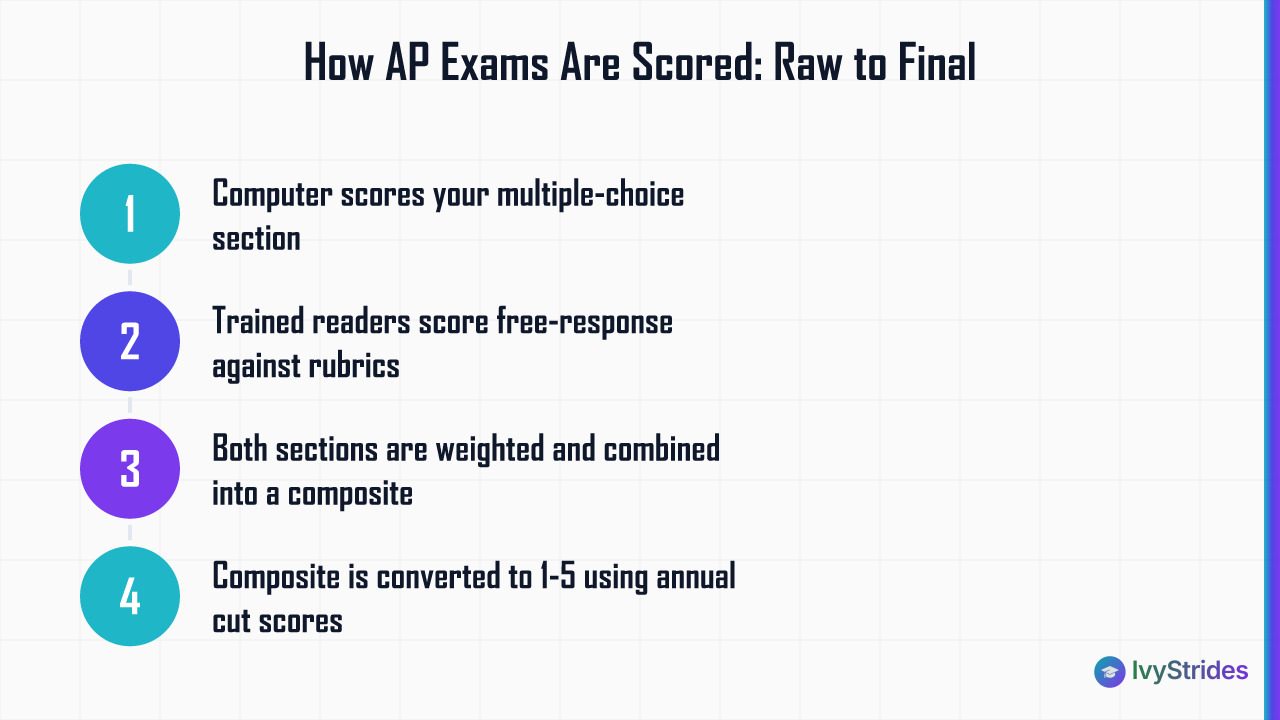
Here's the part most students miss. Your 1-5 score isn't a percentage. It's a composite.
Every AP exam has two sections: multiple-choice and free-response. The multiple-choice section is scored by computer. The free-response section, which includes essays, short-answer questions, problem sets, and portfolio submissions depending on the subject, is scored by trained AP readers who gather each June to grade responses against standardized rubrics. Raw points from both sections are combined, weighted according to the specific exam's published composition (often 50/50, sometimes 60/40), and rolled into a single composite score.
That composite is then converted to the 1-5 scale using cut scores set annually. So the raw composite that earned a 5 in AP Biology last year may not be the same composite that earns a 5 this year. Cut scores aren't published in advance, and they vary by subject and year to keep the scale calibrated against college-level performance. For the official methodology, see the College Board AP Program page.
Why does this matter practically? Because knowing that free-response is worth roughly half your composite changes how you should prepare. In our coaching with AP students, we consistently see strong multiple-choice performance masked by weak free-response scores. That's a strategic gap, not a content gap, and it responds fast to targeted work. For a structured approach, see our guide on how to study for AP exams.
AP Score Distributions by Subject: Why a 3 in One Exam Is Not the Same as a 3 in Another
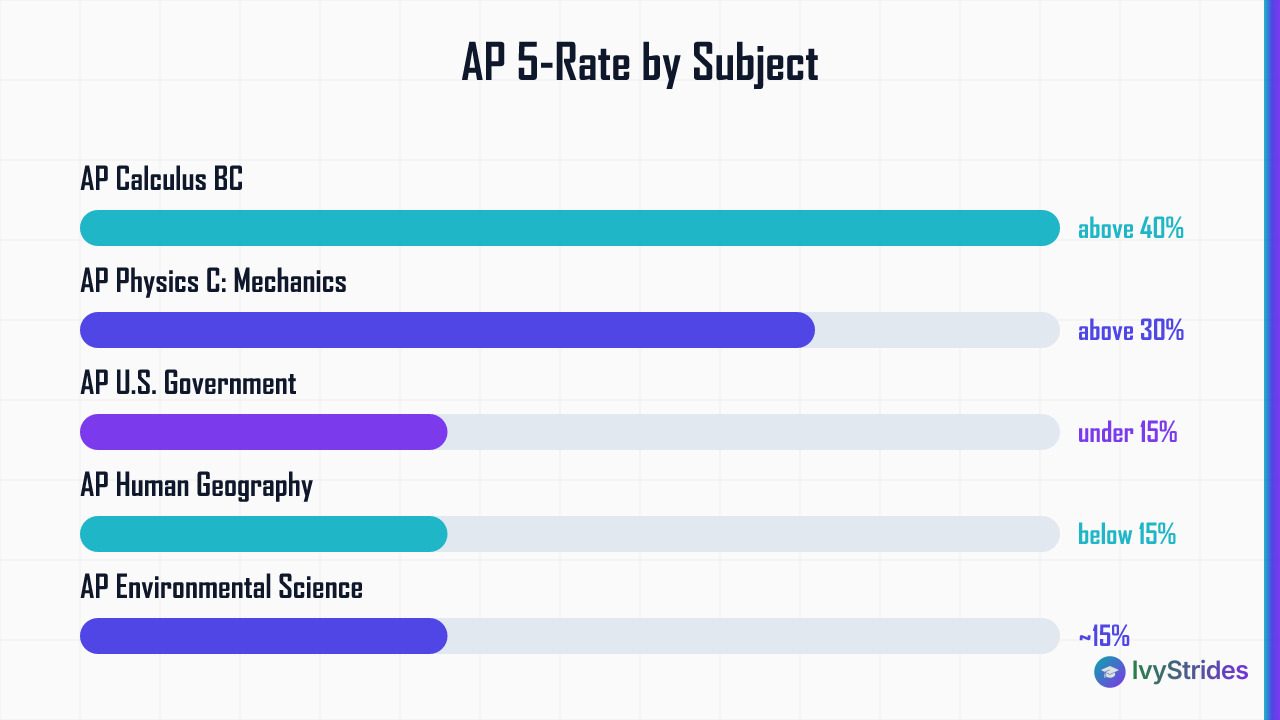
The College Board publishes score distributions for every AP subject each summer. The variation is dramatic.
Historically, AP Calculus BC has posted a 5-rate above 40%, driven largely by self-selection: students who take Calculus BC are already strong math students who often took Calculus AB first. AP Physics C: Mechanics has posted a 5-rate above 30% for similar reasons. On the other end, AP U.S. Government has posted a 5-rate under 15% in recent years, and AP Environmental Science has sat in a similar range. AP Human Geography, often taken by freshmen, has posted a 5-rate below 15% for most recent administrations.
That's why raw score interpretation without context is misleading. A 3 in AP Physics C, where the exam is genuinely difficult and the test population is math-strong, signals meaningful achievement. A 3 in AP Human Geography, where a large freshman population sits the exam, reads differently to a selective admissions office. Same number. Different signal. A common observation from our coaching: students are often surprised that a 3 in AP Physics C is viewed more favorably by admissions readers than a 3 in AP Human Geography, precisely because the distribution context matters.
Before you register for an AP course, it's worth knowing the score distribution for that subject: some exams have 5-rates above 40%, while others sit below 10%, and that context should factor into which APs are worth your time and energy. For a broader framework on course load decisions, see how many AP classes should you take. For subject-specific preparation strategy, see our AP exam prep by subject guide.
The 2026 distributions will be published on the College Board score distributions page starting July 6, 2026. Distributions are updated annually, so always check the current-year data before making comparisons.
What Is a Good AP Score? The Honest Answer by Score Band
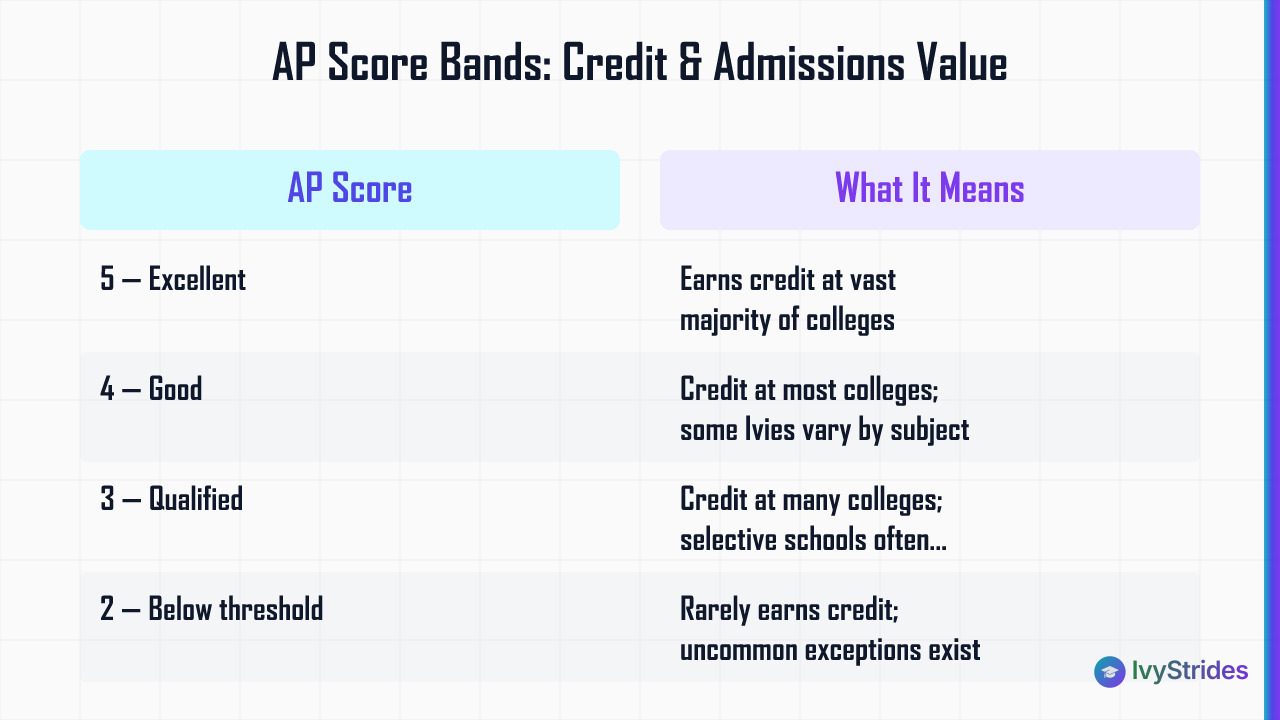
Let's answer the question directly, then complicate it.
A 5 is a good AP score at every college in the United States. It earns credit at the vast majority of institutions that accept AP credit, sends a strong admissions signal, and requires no defense.
A 4 is a good AP score at nearly every college. Most large state universities and mid-selective private colleges grant credit for a 4. Some Ivy League schools grant credit for a 4 in specific subjects but require a 5 in others. A 4 is worth reporting almost everywhere.
A 3 is where honest interpretation matters. A 3 is the College Board's "qualified" threshold and earns credit at most U.S. colleges per the College Board. But selective schools such as MIT, Harvard, Yale, and Stanford often require a 4 or 5 for credit, and some grant placement (starting at a higher-level course without the credit hours) but not the credit itself. A 3 in a genuinely difficult exam like AP Physics C or AP Chemistry signals real effort. A 3 in a lower-difficulty exam at a highly selective school may read as neutral or slightly negative.
A 2 rarely helps an application. It occasionally earns credit at less selective institutions in specific subjects, but that's uncommon and worth verifying directly with the registrar.
A 1 does not earn credit and is not worth reporting.
Two distinctions parents often ask about. First, credit versus placement: credit means the college awards you actual course units, which can reduce tuition costs and time-to-degree. Placement means the college lets you skip an introductory course and start at a higher level, without granting the credit hours. Some schools grant one, both, or neither depending on the score and subject. Second, department variation: within a single college, the math department may require a 5 for credit while the history department accepts a 3. Always verify with the specific college's registrar. Policies also change year to year, so a policy chart from last cycle isn't a reliable stand-in for this cycle.
For students working toward a 5, our how to get a 5 on AP Calculus guide walks through the specific unit-level work. Our AP prep courses page details the per-subject specialist model we use.
AP Scores for College Credit: How Policies Vary by School
AP credit policies are set by individual colleges, not by the College Board. That's the single most important thing to understand about AP scores and credit.
Every college with an AP credit policy publishes it, usually on the registrar's or admissions office's website. Search "[College Name] AP credit policy" and you should find a table listing the score required per subject and the credit awarded. For verification, the Common Data Set (per university) also lists AP credit information in Section C; search "Common Data Set [University Name]" to pull the most recent report.
A few examples to illustrate the range. The University of California system grants credit for scores of 3 and above in most subjects, with specific unit awards varying by campus and major. MIT grants credit for a 5 in select subjects only, and many MIT courses require the 5 for placement into higher sections rather than for credit hours. Highly selective liberal arts colleges vary widely: some grant credit generously; others grant placement only; a few grant neither and require students to take the introductory course regardless.
A caveat worth repeating: policies change annually. A school that granted credit for a 3 in AP Statistics last year may require a 4 this year. Departments within a college can also revise their thresholds independently. Before you count on any AP credit, verify with the registrar of your target school within the current admissions cycle.
If AP credit is factored into your college cost strategy, it can meaningfully reduce time-to-degree and tuition, but only if the credit is actually accepted. For students preparing for the AP Precalculus exam, see our AP Precalculus online program.
When Do 2026 AP Scores Come Out and How Do You Access Them
2026 AP scores are available starting July 6, 2026. Scores are released on a rolling basis, so not every student sees results on July 6 itself. Some see scores within the first few hours; others see them over the following days.
Scores are accessed through your College Board student account at apstudents.collegeboard.org/view-scores. If you haven't logged in since taking your exams, make sure your account credentials still work well before July 6. Password recovery on release day isn't a fun way to spend the morning.
Score sending logistics. When you register for AP exams, you can designate one free score recipient. That recipient receives all your AP scores from the current year at no cost. If you didn't designate a recipient at registration, or if you want to send scores to additional colleges later, each additional score report costs $15. Details are on the College Board score-sending page.
Your score report includes every AP score you have ever earned, from any year, unless you have specifically withheld or canceled a score. A rising junior who took AP World History as a sophomore will see that score included in any send automatically. If it was a 5, great. If it was a 2, withholding it is a separate process handled through the College Board.
For preparation logistics, see AP exam dates 2026 and what to bring to AP exam day.
Should You Report a Low AP Score on Your College Application
This is the most emotionally charged question in the AP scoring space, so let's be direct.
AP scores aren't automatically sent to colleges. You choose which scores to send via your College Board account. Separately, the Common App allows self-reporting of AP scores in the testing section, and here too you choose which scores to include. Self-reported scores are usually verified by an official score report only after you enroll.
Practical framework:
A 5 or 4: Report it. Almost always a net positive.
A 3 in a high-difficulty exam (AP Physics C, AP Chemistry, AP Calculus BC, AP U.S. History): Usually worth reporting, especially at less selective schools. At highly selective schools, use judgment based on the rest of your application.
A 3 in a lower-difficulty exam at a highly selective school: Judgment call. If your application is otherwise strong and this 3 is your only AP score in that subject area, it may be neutral or mildly negative. If you have 4s and 5s in other subjects, a single 3 is usually fine.
A 2: Most counselors advise against reporting. It rarely helps.
A 1: Don't report.
A caveat on test-optional policies. Test-optional almost always refers to the SAT and ACT, not AP scores. AP courses (though not always AP scores) typically appear on your high school transcript regardless of what you send. See the FairTest test-optional tracker for current SAT/ACT policy at specific schools.
Some colleges require official AP score reports after enrollment to award credit, even if you didn't report the scores during admissions. So the reporting decision at the application stage is separate from the credit decision at the enrollment stage. If you're preparing to register for future exams, see how to register for AP exams.
Do AP Scores Affect College Admissions? What Admissions Readers Actually See
Even at test-optional schools, AP scores appear on your transcript and send a signal to admissions readers about your willingness to take on rigorous coursework, separate from whether the score earns you credit.
Admissions readers look at two things when evaluating AP performance. First, the courses. Did you take AP? Which ones? How does your AP load compare to what your high school offers? A student who took 6 APs at a school offering 20 reads differently from a student who took 6 APs at a school offering 8. Second, the scores. Did you actually perform when tested by a standardized external assessment?
In our coaching, students who earn 4s and 5s across multiple AP subjects consistently present stronger academic profiles to admissions readers. A pattern of high scores across 4 to 6 AP subjects sends a stronger signal than a single 5 in one subject with unreported or middling scores elsewhere. Reviewers look for consistency: does the student's grade in the AP class match the AP exam score? A pattern of A grades and 5s is more coherent than A grades and 3s, which can raise questions about grade inflation at the school.
A structural caveat. College admissions outcomes depend on the full application: essays, extracurriculars, recommendations, course rigor, GPA, and where applicable, SAT or ACT scores. AP scores are one input among many. They aren't the deciding factor for most applicants.
If your essays are the piece you're still working on, our guide on how to write a college essay walks through the structure. For supplemental essays, our common app essay tutor service pairs you with a specialist.
What to Do If Your AP Score Was Lower Than Expected
You opened the portal, saw a number you didn't want, and now you're deciding what to do. Here's the honest breakdown.
Option 1: Cancel the score. The College Board allows score cancellation within a specific window after the exam. A canceled score is permanently removed and never sent to any college. Cancellation is irreversible, so think it through. This option makes sense if the score is a 1 or a 2 you have no intention of reporting anywhere.
Option 2: Withhold the score. Withholding is separate from canceling. A withheld score stays on your College Board record but isn't sent to any specific college. You can lift the withholding later if your thinking changes. Lower commitment than cancellation.
Option 3: Retake the exam next year. AP exams can be retaken in a subsequent year. When you send scores, you choose which sitting to send. So a 3 this year and a 5 next year gives you the option to send only the 5.
Option 4: Do nothing. If the score is a 3 or 4 in a difficult subject, it may be worth keeping and simply choosing whether to report it later.
If you plan to retake, start with a diagnostic. Look, the pattern we see most often in our coaching is straightforward: students who underperformed on free-response with strong multiple-choice scores have a strategic gap that responds to a few weeks of targeted work. Students with weak multiple-choice have a content gap in specific units, which takes longer but is entirely solvable with a subject specialist. A parent recently asked us about her son's 3 on AP Chemistry after A's all year; the diagnostic surfaced a free-response pacing issue on the equilibrium and thermodynamics units, not a content gap. That's a different plan than "study more."
IvyStrides pairs each retake student with a per-AP-subject specialist, not a generalist. The diagnostic identifies whether your gap is conceptual (unit-level content) or strategic (free-response pacing and structure), and the plan builds from there. For subject-level guidance, see AP exam prep by subject. For our most-requested subject, see AP Physics 2 prep. Chemistry-track students can also check the AP Chemistry prep walkthrough.
FAQ
Is a 3 a good AP score?
A 3 is the College Board's "qualified" threshold and earns credit at most U.S. colleges, but selective schools often require a 4 or 5. Whether a 3 is "good" depends on the subject's difficulty distribution and your target school's credit policy. In a high-difficulty exam like AP Physics C, a 3 represents genuine achievement. In a lower-difficulty exam at a highly selective school, it may carry less weight.
Do colleges see AP scores if I do not send them?
AP scores aren't automatically sent to colleges. You choose which scores to send via your College Board account. However, AP courses appear on your high school transcript regardless, so admissions readers see that you enrolled in AP. They only see your scores if you send them officially or self-report them on the Common App.
When do 2026 AP scores come out?
Per the College Board, 2026 AP scores are available starting July 6, 2026. Scores are accessed through your College Board student account at apstudents.collegeboard.org. Scores roll out over several days, so not every student sees results on July 6 itself.
How much does it cost to send AP scores to colleges?
You can send your AP scores for free to one recipient per year in which you take AP exams. Additional score reports cost $15 per report, sent through your College Board account. There's no deadline to send scores after the exam year, so you can wait until you know which colleges you're applying to.
Can AP scores expire?
AP scores don't expire. They remain in your College Board account indefinitely and can be sent to colleges at any time. Some colleges have their own policies about how many years back they will accept AP credit for placement, but the scores themselves remain valid and accessible.
Should I submit a 4 on an AP exam to Ivy League schools?
A 4 is a strong score and is generally worth reporting, even to highly selective schools. It signals you performed well in a rigorous course. A 5 is stronger, but a 4 isn't a liability. If you took a notoriously difficult exam and earned a 4, that reads as a positive signal. If you're debating a specific score, a free strategy call can help you think through the reporting decision.
Your AP score is one data point inside a full admissions picture, and the right next step depends on the number, the subject, the schools you're targeting, and how much time you have before applications open. A specialist can help you sort those variables in about 15 minutes.

Two decades teaching quantitative and verbal aptitude on standardized tests. Rare dual expertise across Math and Verbal — particularly effective for students with gaps on both sides. Senior AP Mentor for our Calculus and English tracks.