
Do Colleges Accept AP Credit? The 2026-27 Guide to AP Credit, Placement, and Admissions

On this page
- The Short Answer: Yes, Most Colleges Accept AP Credit, With Conditions
- Credit, Placement, or Neither: What Each Outcome Actually Means
- Which Colleges Do Not Accept AP Credit? Selective Schools With Restrictive Policies
- Score Thresholds by School Type: What Score Do You Actually Need?
- Not Sure Which AP Scores Will Count at Your Target Schools?
- Credit and Admissions Signal Are Two Different Things
- Should You Actually Use AP Credit to Skip Introductory Courses?
- How Many AP Credits Will Colleges Accept Before Capping Them?
- How AP Credit Fits Into Your Broader College Admissions Strategy
- How to Look Up AP Credit Policies at Your Target Schools
- FAQ
- Why do some colleges refuse to accept a score of 3 for credit?
- Do AP credits from senior year count, or is it too late?
- Does Harvard accept AP credit?
- Is a score of 3 good enough for AP credit at most colleges?
- What is the hardest AP exam, and does difficulty affect credit acceptance?
- Do community colleges accept AP credit?
- Ready to Turn Your AP Scores Into Real College Outcomes?
Yes, most U.S. colleges accept AP credit, but the policy varies by school, subject, and score. Large public universities typically award credit for scores of 3 or higher. Many selective private colleges require a 4 or 5, and several highly selective schools, including Dartmouth, Caltech, and MIT, award placement without credit or restrict AP credit significantly. A passing score of 3 doesn't automatically transfer as credit anywhere.
The authoritative lookup lives at the College Board AP Credit Policy Search, updated annually and searchable by course and institution. The harder questions, what "credit" actually means, which schools restrict it, what score you realistically need, and whether you should even use AP credit to skip courses, are where the next sections start.
The Short Answer: Yes, Most Colleges Accept AP Credit, With Conditions
Most U.S. colleges offer either credit or advanced placement for qualifying AP exam scores, per College Board's AP credit and placement documentation.
Beneath the headline, the picture splits along predictable lines.
Large public university systems tend to be the most generous. The UNC System, for example, operates a system-wide AP credit policy that awards credit for scores of 3 or higher on most exams across its 16 constituent institutions. Several state systems operate under similar state-level mandates, which is why students at flagship publics often walk in with a semester or more of credit already banked.
Selective private colleges are stricter. A 4 is a common floor, and a 5 is often required in STEM subjects. Some of the most selective schools award placement only, meaning you can skip introductory coursework but no credit hours land on your transcript.
The score threshold, the credit hours awarded, and the equivalent course waived can all differ within a single university depending on the department. That's why the College Board's search tool is your first stop, not a general blog claim. If you want a refresher on what each score actually represents, see AP scores explained.
One more note. Policies get revised every academic year. A 4 that earned three credit hours in 2023 might award placement only in 2026-27. Always verify against the current registrar page for the cycle you're applying in.
Credit, Placement, or Neither: What Each Outcome Actually Means
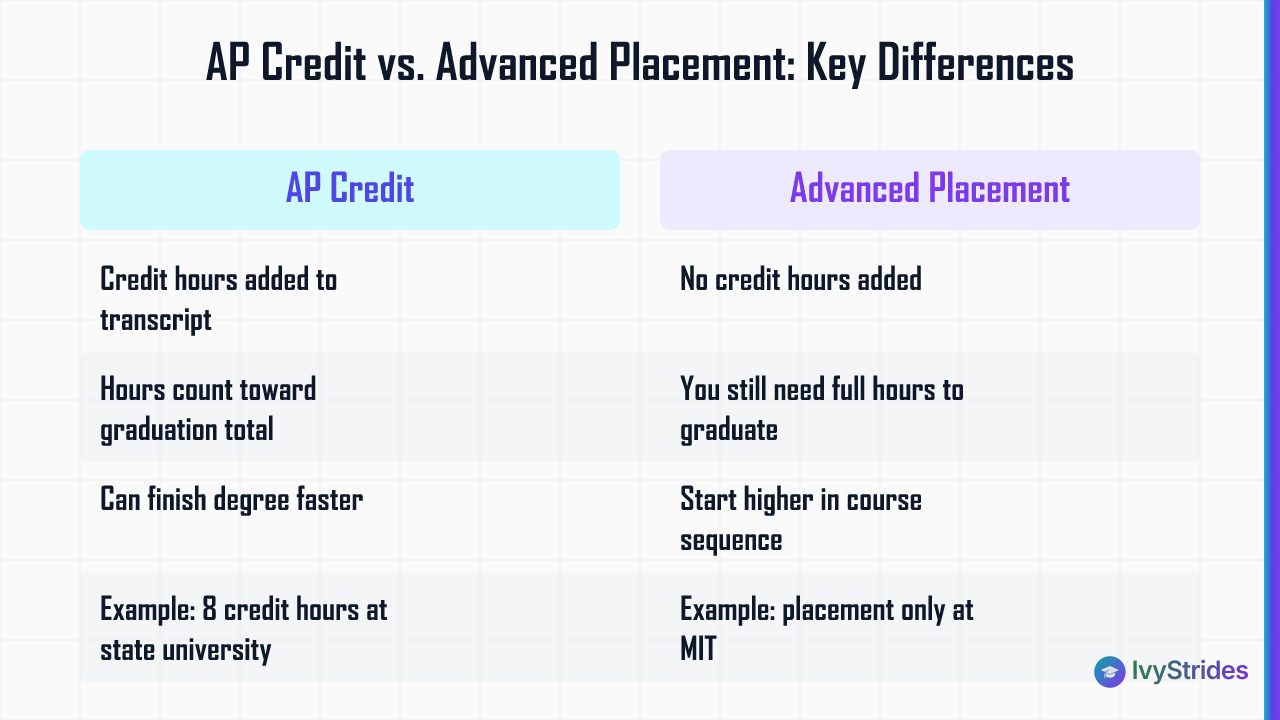
Here's where a lot of families get tripped up. An AP score can produce three different outcomes at a college, and they aren't interchangeable.
Credit means the college adds credit hours to your transcript. Those hours count toward the total you need to graduate. If your school requires 120 credit hours for a bachelor's and your AP scores earn you 24, you're already a full semester ahead in raw credit terms.
Advanced placement (also called course placement or an introductory course waiver) means you can skip a lower-level course, but no credit hours are added. You still need 120 hours to graduate. You just start higher in the sequence.
Neither means the score was too low, the subject isn't recognized by that school, or the department has excluded that particular exam from any credit or placement decision.
A concrete example. A 5 on AP Calculus BC at a large state university might award 8 credit hours and place you into Calculus III. The same 5 at MIT grants advanced placement into higher math but no credit hours toward the degree. Same score, same subject, radically different outcomes.
Departments closest to your intended major often apply stricter thresholds than the general education office. A biology department may require a 5 on AP Biology to waive the intro sequence, even if the general ed office would accept a 4 for elective credit. If you're eyeing a specific major, the department is the decision-maker you actually need to check with. This is a department-level restriction, not an institution-level one, and it's the kind of detail the College Board's tool sometimes underplays.
For subject-by-subject prep that targets the score threshold your target schools require, see how to study for AP exams. Score bands vary by subject; our AP exam prep by subject guide breaks down what a 4 vs a 5 realistically demands per exam.
Which Colleges Do Not Accept AP Credit? Selective Schools With Restrictive Policies
Short list, then the details.
Dartmouth does not award AP credit toward the degree. AP scores can be used for placement into higher-level courses, but they don't reduce the total credits required to graduate.
Caltech does not award AP credit. Scores are used for placement only, and even that is subject to departmental review.
Brown applies subject-specific restrictions. Some departments accept AP credit toward concentration requirements; others don't. Because Brown's open curriculum has no distribution requirements to waive, AP credit's utility is narrower there than at most peers.
MIT awards limited advanced standing credit in a small set of subjects. Physics and Calculus are the most commonly discussed. The policy is restrictive and subject to departmental review, and most AP scores at MIT function as placement signals rather than credit awards.
Harvard offers Advanced Standing to students who earn 5s on a sufficient number of AP exams in eligible eligible subjects. It's a formal designation, not automatic credit transfer, and it requires meeting Harvard's specific eligibility rules. Not every 5 counts, and eligible subjects change over time.
Do Ivy League colleges accept AP credit? The honest answer: it varies by school and subject, and most Ivies are meaningfully more restrictive than large public universities. Cornell tends to be more generous than Harvard or Dartmouth. Penn falls somewhere in the middle. Blanket statements about "the Ivies" will steer you wrong.
Verify current policy two ways. Use the College Board AP Credit Policy Search for the baseline. Then cross-check with each school's registrar page for the application cycle you're in. Policies shift year over year, and the College Board tool occasionally lags behind a fresh registrar update.
If you're deciding how many APs to take given that some target schools may not award credit, how many AP classes should you take breaks down the tradeoff. And plan your test dates against the calendar in AP exam dates 2026.
Score Thresholds by School Type: What Score Do You Actually Need?
This is the section most students wish they'd read before May of junior year. A quick, illustrative reference:
| School Tier | Typical Minimum Qualifying Score | Notes |
| Large public universities | 3 in most subjects | Many state systems mandate credit for 3+ across general education requirements |
| Mid-tier private colleges | 4 in STEM, 3 in humanities | Subject-by-subject variation is common |
| Highly selective private colleges | 5 in STEM, 4-5 in humanities | Some award placement only, not credit |
Treat that table as a starting point, not a rule. Individual school policies override the general pattern.
A few subject-level realities worth knowing. AP Calculus AB and BC, AP Chemistry, AP Physics C, and AP English Language are the most reliably credited exams across school tiers. AP Computer Science Principles and AP Seminar are accepted less often than AP Computer Science A or AP Calculus, even at schools that credit APs broadly. Humanities exams (AP US History, AP English Literature, AP Psychology) often earn credit at a 3 where STEM exams at the same school require a 4 or 5.
AP Precalculus is a specific case worth flagging. The exam launched in 2023-24, so many colleges are still finalizing their credit policies. Some schools haven't yet published one. If your target list includes AP Precalculus credit acceptance as a key question, verify directly with each school's registrar rather than trusting a blog or forum. In the meantime, AP Precalculus online is where our students prep for the exam itself while the credit landscape catches up.
In our coaching with students targeting selective STEM programs, we consistently see a 5 as the practical floor for major-adjacent credit. A 4 on AP Chemistry may earn general education credit at a top private school but not satisfy the chemistry prerequisite for a biology or engineering major. If you want a target-score plan tuned to your intended major, how to get a 5 on AP Calculus walks through the score-band methodology.
One anonymized example. A junior we worked with last spring earned a 4 on AP Calculus BC and assumed the credit would apply toward the engineering track at their target school. The department required a 5 for the credit to count toward the major sequence. They found out during first-semester course registration, which isn't when you want to find out.
Not Sure Which AP Scores Will Count at Your Target Schools?
Book a free 15-minute strategy call. Our coaches will map your current AP slate to your target colleges' credit policies and help you build a prep plan that supports both your scores and your admissions profile.
Credit and Admissions Signal Are Two Different Things
Your AP score serves two separate purposes: it signals academic rigor to admissions officers before you enroll, and it determines whether you receive credit or placement after you do, so a score that earns no credit can still strengthen your application.
That's the reframe that changes how students think about their AP slate. A 4 on AP Chemistry at a school that requires a 5 for credit isn't a wasted score. On the transcript, it still demonstrates college-level science readiness. It still shows an admissions officer that you took a demanding course and performed at a real level on the standardized assessment.
Selective colleges evaluate the rigor of your course load as a distinct data point. The number of APs offered at your school matters. Six APs at a school that offers six looks stronger than three at a school offering twelve. The subjects matter. The upward or flat trajectory across three years matters. Whether the school ultimately awards you credit for those scores is a separate downstream question.
Test-optional policy is worth clarifying here, because students confuse it with AP score reporting. Test-optional policies, tracked at FairTest, apply to the SAT and ACT, not to AP scores. AP scores are reported separately, usually self-reported on the Common App and later verified via official College Board score reports, and strong AP scores are generally viewed positively regardless of a school's test-optional stance on the SAT/ACT.
The framing we use in coaching: your AP slate is a public statement about the academic identity you want to project. If you want that statement to hold up under scrutiny, the exam scores should back the course rigor. For more on what AP is and how it functions in admissions, see what is AP. Students building a coherent narrative across coursework and applications often layer AP prep with our essay review service so the transcript and the story line up.
One caveat, because this is admissions territory: admissions outcomes depend on the full application, not AP scores alone. A strong AP slate helps. It doesn't guarantee anything.
Should You Actually Use AP Credit to Skip Introductory Courses?

Here's the part most students never think about until they're staring at their college's course registration portal.
Getting AP credit and using AP credit are two different decisions. Many colleges let you accept or decline the credit within a set window, often the first semester. So the real question is: even if you earned it, should you use it?
The case for skipping. You free up schedule space for upper-division electives, a second major, undergraduate research, or study abroad. You avoid paying tuition for a course you already mastered. For students confident in the subject and clear about their trajectory, skipping intro coursework is a meaningful advantage.
The case for retaking. College intro courses often cover material at greater depth than the corresponding AP course. They introduce lab methodology, problem-solving frameworks, and disciplinary conventions that the AP exam doesn't fully assess. If you're pre-med, pre-law, or engineering, the intro sequence is usually a prerequisite for upper-division courses that build directly on it. A shaky foundation compounds fast.
In our coaching with students planning STEM majors, we often recommend retaking intro college courses even when AP credit is available, particularly in Chemistry and Physics. The AP exam rewards a specific test-taking pattern; the college course rewards the depth and lab experience that upper-division work demands. Getting a strong grade in the intro course also protects the major GPA, which matters for graduate admissions later.
The practical rule. Before you decide to use AP credit to skip a course in your intended major, book time with the department advisor at your college. Ask two questions. Does this AP credit satisfy the prerequisite for the next course in the sequence? And do students who skip typically perform as well in the next course as students who took the intro version?
If AP course selection and prep is the earlier decision you're still working through, our AP courses online run with one specialist per subject.
How Many AP Credits Will Colleges Accept Before Capping Them?
There's usually a ceiling, and it matters for planning.
Many large public universities cap AP credit at 30 to 32 semester hours, roughly one full year of coursework. Once you hit the cap, additional AP scores may still count for placement, but not for further credit hours toward graduation.
Private colleges are less uniform. Some have no formal cap but restrict which credits apply to the major versus which count only as general electives. Some cap by category: no more than 6 hours of AP English credit, for example, toward the English distribution requirement.
There's also a reporting distinction worth understanding. On the Common App, you self-report AP courses and scores. Admissions offices use that for review. But for credit to be formally awarded after you enroll, you need to send official AP score reports through College Board. Self-reporting on the application isn't the same as sending the official report to the registrar. If you want a full walkthrough of the exam registration and reporting pipeline, see how to register for AP exams.
Credit caps are set by individual institutions and get revised. Verify with the registrar for the cycle you're entering.
How AP Credit Fits Into Your Broader College Admissions Strategy
The AP courses you choose, the scores you earn, and the way you frame academic challenge in your college essays all work together as a single admissions narrative, not as three separate checkboxes.
Admissions officers read the AP slate alongside the transcript, standardized test scores, and essays as one unified picture. A student who takes AP Chemistry, earns a 4, and writes a supplemental essay about a chemistry research project has built a coherent story. A student who takes eight APs across unrelated subjects with no through-line in the essays looks scattered, even with strong scores.
Context matters. A student who takes six APs at a school that offers six has maxed out available rigor. A student who takes three APs at a school offering twelve has left options on the table. Admissions offices access the school profile submitted by your counselor, so this comparison happens whether you flag it or not.
On the Common App, AP courses appear in the coursework section, and scores are self-reported. Colleges verify scores via official College Board reports if they need to. The essay layer is where the AP narrative gets connected to something more specific: a lab, a book, a moment where the coursework produced a real question. Our common app essay tutor coaches work this connection directly. If you want examples of supplemental essays that thread academic rigor into a specific story, our why this college essay examples walkthrough is a good starting point. For the personal statement structure, how to write a college essay covers it end-to-end.
In our coaching with students targeting selective colleges, we treat AP course selection, AP exam prep, and essay strategy as a connected plan, not three separate decisions. That's the framing that produces coherent applications.
How to Look Up AP Credit Policies at Your Target Schools
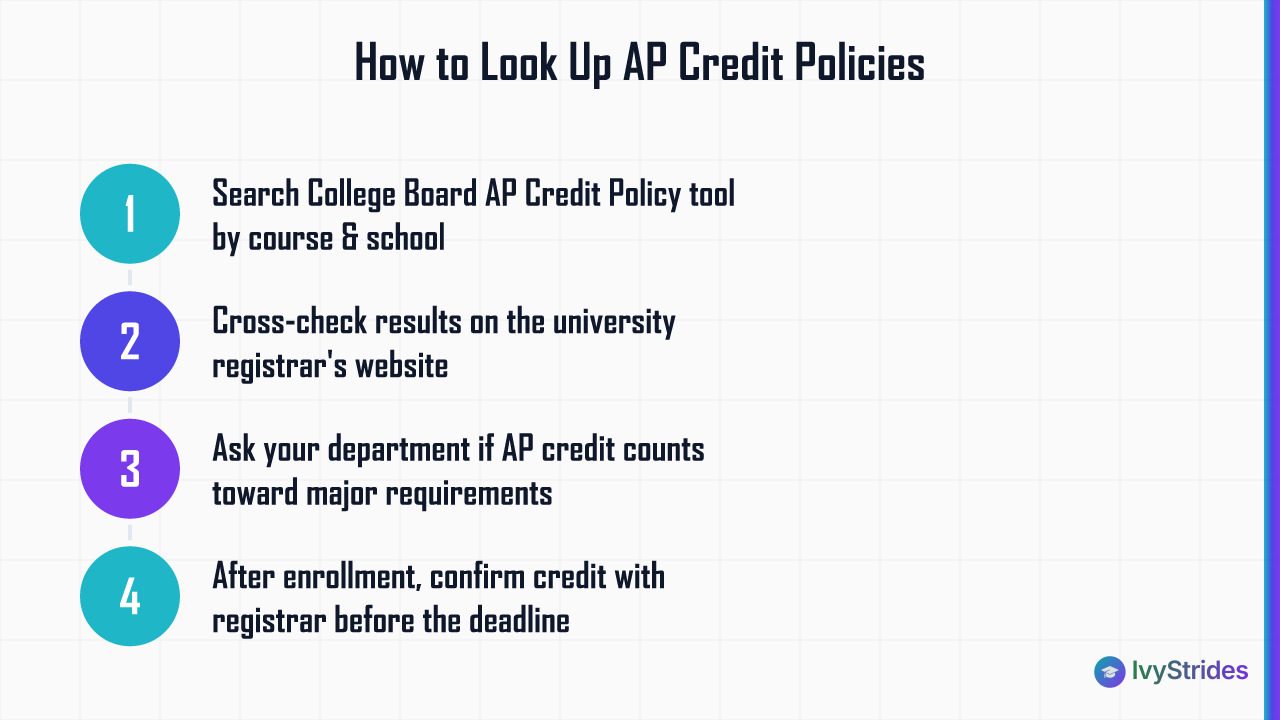
A four-step process, in order.
Step 1. Go to the College Board AP Credit Policy Search and search by AP course name. You'll see which colleges award credit, at what score threshold, and how many credit hours apply. Do this for every AP subject you've taken or plan to take, against every school on your target list.
Step 2. Cross-check against the university's registrar or admissions website. The College Board tool is thorough but occasionally lags a recent policy revision. The registrar page is the current source of truth.
Step 3. If you have a declared or intended major, contact the relevant department directly. Ask whether AP credit satisfies major prerequisites or only counts as general education. This step catches the "I got credit but it doesn't count toward my major" trap.
Step 4. After enrollment, confirm the credit award with the registrar before the deadline to accept or decline (typically within the first semester). Send official AP score reports through College Board promptly. Scores from senior year AP exams release in July, which is generally in time for freshman fall registration, but don't wait.
For continued prep after this decision layer is settled, our AP exam prep by subject breakdown targets score thresholds per exam. Our AP prep courses run with one specialist per subject.
FAQ
Why do some colleges refuse to accept a score of 3 for credit?
A 3 is College Board's minimum passing threshold, but colleges set their own credit standards independently. Selective schools often argue that a 3 doesn't demonstrate the same mastery as earning a B or higher in their own introductory course, so they require a 4 or 5 to ensure students are prepared for upper-division work. Large public universities tend to be more generous because state policy or law often mandates credit for passing scores across the system.
Do AP credits from senior year count, or is it too late?
Yes, AP scores from senior year count. Exams are taken in May, scores release in July, and you can send official score reports to your college after confirming enrollment. The important part is sending scores before the college's deadline for credit evaluation, usually early in the first semester. There's no rule that AP exams must be taken before senior year to qualify.
Does Harvard accept AP credit?
Harvard offers an Advanced Standing program for students who score 5 on a sufficient number of AP exams in eligible subjects, which can allow a student to graduate in three years or enter as a sophomore. The bar is high, the eligible subjects are specific, and the program has formal application rules. Harvard doesn't award AP credit the way a large public university does; Advanced Standing is a selective designation, not automatic credit transfer. Verify current policy directly with Harvard's registrar for the cycle you're applying in.
Is a score of 3 good enough for AP credit at most colleges?
At many large public universities, yes. A 3 is the minimum qualifying score at a significant number of state schools, particularly for general education requirements. At mid-tier private colleges, a 3 often earns credit in humanities but may fall short in STEM. At highly selective schools, a 3 rarely earns credit in any subject. The only reliable answer is to look up the specific school and subject in the College Board AP Credit Policy Search.
What is the hardest AP exam, and does difficulty affect credit acceptance?
Difficulty and credit acceptance are separate questions. AP Physics C: Mechanics, AP Calculus BC, and AP Chemistry consistently rank among the exams with the lowest 5 rates, based on College Board score distributions. But credit acceptance depends on the college's policy, not on how hard the exam is. A college may accept a 3 on AP Physics C at the same threshold it accepts a 3 on AP Human Geography, regardless of the difficulty gap.
Do community colleges accept AP credit?
Most community colleges accept AP credit, often with lower score thresholds than four-year universities. Many award credit for scores of 3 or higher across a wide range of subjects. If you plan to transfer to a four-year school, verify that the AP credit awarded by the community college also transfers to the destination institution. Transfer credit policies add another layer, and community college credit doesn't always carry across the way you'd expect.
AP credit policy rewards families who do the homework in advance. The College Board tool, the registrar page, and a five-minute email to the department can save you a semester of confusion once you enroll. And the AP scores themselves still work for you in admissions, whether or not credit gets awarded on the other side.
Ready to Turn Your AP Scores Into Real College Outcomes?
Whether you need to raise a score, choose the right AP courses, or connect your AP performance to a stronger college essay, IvyStrides coaches work with you one-on-one. Start with a free 15-minute call.

Two decades teaching quantitative and verbal aptitude on standardized tests. Rare dual expertise across Math and Verbal — particularly effective for students with gaps on both sides. Senior AP Mentor for our Calculus and English tracks.