
How Many AP Classes Should You Take? A Smart, Goal-Based Plan for 2026

On this page
- The Direct Answer: How Many AP Classes Each Year?
- How Colleges Read Your AP Course List
- The Problem Most Students Get Wrong: Too Many APs, Too Few Strong Scores
- A Grade-by-Grade AP Plan: 9th Through 12th
- 9th Grade: 0 to 1 APs
- 10th Grade: 1 to 2 APs
- 11th Grade: 2 to 4 APs
- 12th Grade: 2 to 4 APs
- How Many APs Do You Need for Harvard, the Ivy League, and T20 Schools?
- AP Scores Matter as Much as AP Enrollment: What Colleges Actually See
- Choosing APs by Intended Major: Depth Over Breadth
- Is Taking 6 APs in One Year Too Much? A Workload Reality Check
- Building Your AP Plan as Part of a Broader Admissions Strategy
- FAQ
- Is 7 AP classes enough for Harvard?
- Is taking 3 AP classes in one year too much?
- What is the hardest AP class?
- Do colleges care more about the number of APs or the scores on AP exams?
- Can I self-study for AP exams my school does not offer?
- How many AP classes should I take sophomore year?
- How many AP classes do I need to skip a year of college?
Most students should take between 1 and 4 AP classes per year, with the right number depending on grade level and target colleges. For strong state flagships, 3 to 6 total APs across high school is a reasonable range. For T20 and Ivy League targets, 8 to 14 total APs is more typical, with 2 to 4 per year from 10th through 12th grade. There is no single correct number. The right AP load is the most challenging schedule you can sustain while keeping your GPA strong and your exam scores at 3 or above.
These benchmarks come from College Board's AP Program guidance and Common Data Set reporting at named selective schools, cited throughout. The harder question is which APs, in which years, and how to read the signal admissions officers actually receive. That's where the rest of this guide goes.
The Direct Answer: How Many AP Classes Each Year?
Here's the grade-by-grade benchmark we use when building plans for students worldwide.
9th grade: 0 to 1 APs. Most freshmen take zero, and that's fine. If your school offers AP Human Geography or AP Computer Science Principles to 9th graders, those are the standard entry points because they don't require strong prerequisites. Don't force an AP this year. A solid 9th-grade GPA matters more than an AP credit.
10th grade: 1 to 2 APs. AP World History: Modern, AP Biology, and AP Statistics are the common sophomore choices. Sophomore year is also when most students sit for the PSAT/NMSQT for the first time, so leave bandwidth for test prep. If you're aiming for good PSAT scores for 10th graders, don't load up on APs that compete for the same study hours.
11th grade: 2 to 4 APs. Highest-stakes year for course rigor in context. Admissions officers weight junior year heavily because it's the most recent full year on your application when you apply. Common junior APs: AP Language and Composition, AP US History, AP Calculus AB, AP Chemistry, AP Physics 1.
12th grade: 2 to 4 APs. Don't drop to zero. At selective schools, a sudden senior-year drop in rigor reads as a red flag. Common senior choices: AP Literature, AP Calculus BC, AP Physics C, AP Macroeconomics, AP Microeconomics.
Now layer in your college selectivity tier:
- Regional and test-optional schools: 1 to 4 total APs is sufficient.
- Strong state flagships: 3 to 6 total APs.
- Top 50 national universities: 5 to 10 total APs.
- T20 and Ivy League targets: 8 to 14 total APs.
The College Board is explicit that there is no required AP count across its 38 AP courses. If you're new to the program, our overview of what is AP walks through how the courses and exams work. Once you start planning around exam season, the AP exam dates 2026 calendar matters more than the count itself.
How Colleges Read Your AP Course List
Admissions officers evaluate your AP slate in the context of what your school offers, so ten APs at a school that offers twelve reads differently than ten APs at a school that offers thirty.
They compare your slate against your school's profile, which lists how many APs your school makes available. That single fact reframes the conversation. A student who takes 8 of 10 available APs at their school is read as maximally rigorous, even if a peer at a different school took 12. Course rigor in context is the operative phrase.
Two other facts shape how the AP slate gets read:
Weighted GPA reflects AP enrollment, but the exam score validates it. Your transcript shows you took AP Chemistry. Your AP score report shows what you actually learned. A 4 or 5 confirms the rigor claim. A 2 partially undoes it.
The course grade and the AP exam score are separate signals. Most colleges see both. An A in AP Calculus BC paired with a 5 on the exam is a coherent signal. An A in AP Calculus BC paired with a 2 on the exam tells admissions officers something about grade inflation at your school.
For students whose school doesn't offer the APs they need, an accredited online option fills the gap. Our AP courses online are taught by per-subject specialist teachers, not generalist tutors covering five subjects at once.
A note on credit thresholds: a score of 3 is the minimum for most college credit, while a 4 or 5 is preferred at selective institutions, per College Board's AP Program. AP credit policies vary by college and year. Check the specific institution before planning around credit.
The Problem Most Students Get Wrong: Too Many APs, Too Few Strong Scores
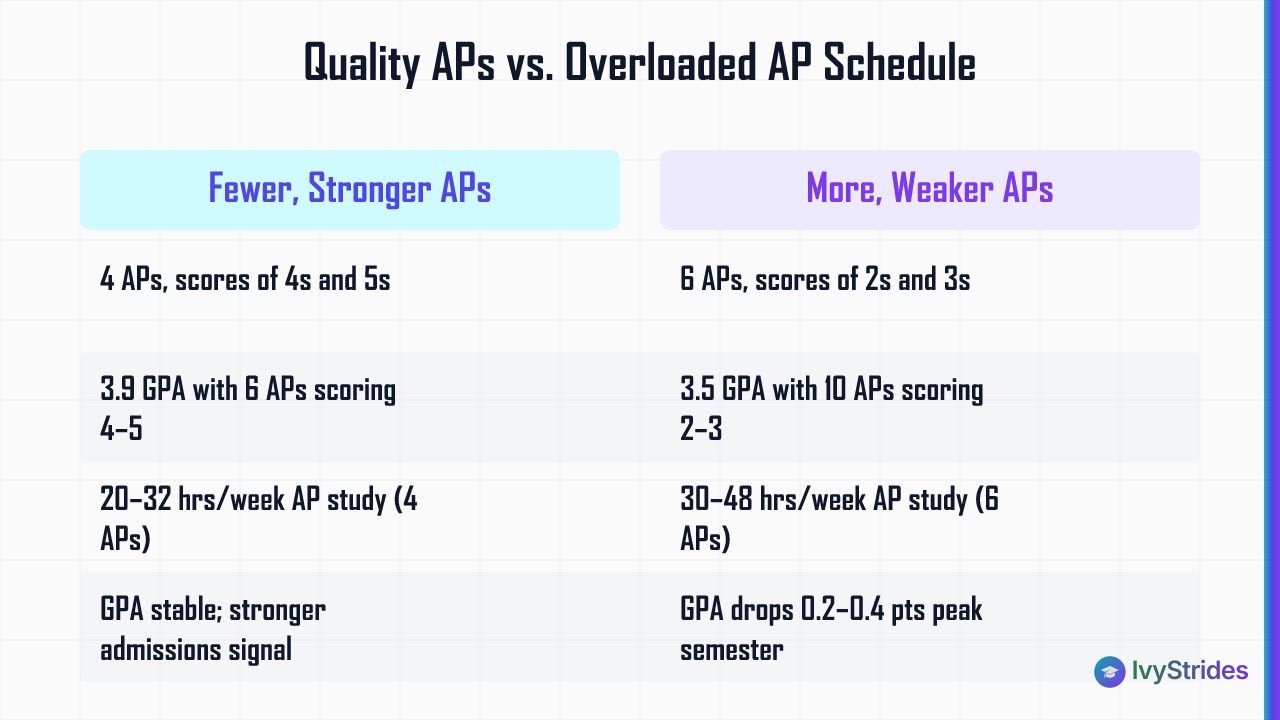
Here's the pattern we see most often. A junior loads up on six APs because a forum told them T20 schools want double-digit AP counts. Then three things happen, sometimes all at once: the GPA drops 0.2 to 0.4 points in the peak-load semester, two AP exam scores come back as 2s, and SAT prep gets pushed to the summer because there were no hours left for it.
The math is straightforward. A typical AP course requires 5 to 8 hours of weekly study outside class, per College Board's course and exam descriptions. At 4 APs, that's 20 to 32 hours of AP study per week on top of non-AP coursework, extracurriculars, and test prep. At 6 APs, it's 30 to 48 hours. Sustainable for some students. Catastrophic for many.
In our coaching, students who take 5 or more APs simultaneously without a structured study plan typically see GPA drops in the 0.2 to 0.4 range during their peak-load semester. A junior we worked with last fall had taken six APs, earned Bs in three of them, and scored 2s on two exams. The admissions signal was weaker than if she'd taken four APs and scored 4s across the board. She rebuilt the senior plan around four APs aligned to her intended major. Scores came back as three 5s and a 4.
The trade-off, stated plainly: a student with a 3.9 GPA and 6 APs scoring 4 and 5 is a stronger applicant than a student with a 3.5 GPA and 10 APs scoring 2 and 3. Quality and scores beat raw count once you're past the rigor floor for your target tier.
GPA protection isn't about being cautious. It's about recognizing that admissions officers read your transcript and your score report as one document. If you need targeted exam prep for a course you're already enrolled in, see our guide on how to get a 5 on AP Calculus. For full-course support, our AP prep courses pair each student with a subject specialist.
A Grade-by-Grade AP Plan: 9th Through 12th
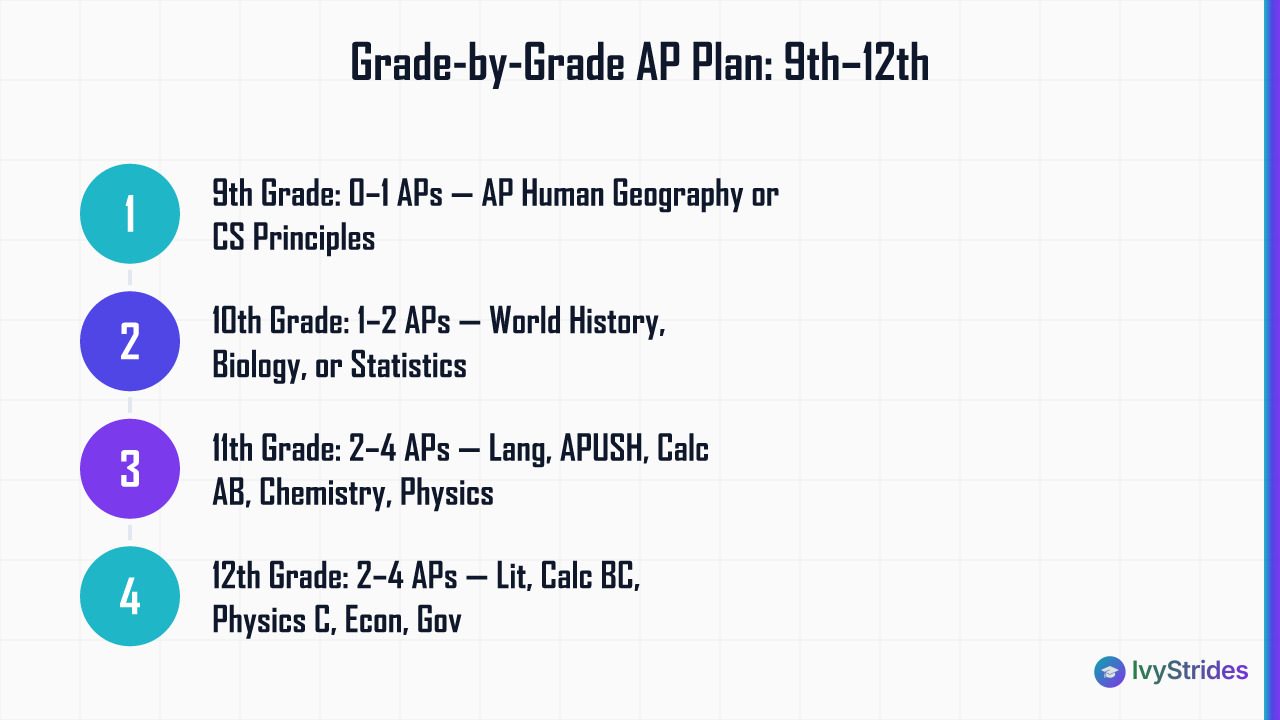
This is the ramp we build for students targeting competitive colleges. Adjust the upper bound down for state flagship targets and up for T20 targets.
9th Grade: 0 to 1 APs
Most freshmen should take zero APs. If your school opens AP Human Geography or AP Computer Science Principles to 9th graders, those are the safest entry points. Both have manageable workloads and no heavy prerequisites. Skipping APs entirely in 9th grade is also a defensible choice. Use the year to build the study systems you'll lean on later.
10th Grade: 1 to 2 APs
AP World History: Modern, AP Biology, and AP Statistics are the typical sophomore APs. Pick one if you're new to AP-level work, two if you're confident in both subjects. This is also the year of the PSAT/NMSQT, which matters for National Merit consideration. Look at PSAT percentiles to understand what cutoff you're aiming for before you decide whether to add a second AP.
11th Grade: 2 to 4 APs
Junior year is the year colleges weight most heavily. Common AP choices: AP Language and Composition, AP US History, AP Calculus AB, AP Chemistry, AP Physics 1, AP Spanish or another world language. For T20 and Ivy League targets, the upper end (4 APs) is standard. For state flagships, 2 to 3 APs is plenty.
A planning note: junior year is also when most students prepare seriously for the SAT or ACT. Building both into the same year requires deliberate scheduling.
12th Grade: 2 to 4 APs
The senior-year rigor signal matters. Dropping to zero APs after a strong junior load reads as coasting at selective schools. Common senior APs: AP Literature, AP Calculus BC, AP Physics C: Mechanics, AP Macroeconomics, AP Microeconomics, AP Government, AP Statistics (if not taken earlier).
For students targeting the UC system (UCLA, UC Berkeley, UC Davis), 8 to 12 total APs is common among admitted students at the most selective campuses, per Common Data Set reporting. The UC system evaluates AP rigor in the context of school offerings, just like the Ivy League.
How Many APs Do You Need for Harvard, the Ivy League, and T20 Schools?
The honest answer: there is no published minimum, and the right number depends on what your school offers.
Common Data Set reporting and admissions disclosures show that the middle 50% of admitted students at Harvard, Stanford, Yale, Princeton, and MIT typically have 10 to 14 AP courses. None of these schools publish a minimum. Each one evaluates rigor in the context of school offerings.
What does that mean for a specific student?
If your school offers 8 APs and you take all 8, you've maxed out rigor. You read as competitive even against peers at schools offering 25 APs. This is the single most important point in the section.
If your school offers 20+ APs and you take 6, you're underutilizing the rigor available. Admissions officers will notice.
If you're at an Ivy League target with 7 to 9 highly relevant APs and scores of 4 and 5, you're still in the conversation. Students with that profile are admitted every year. The AP slate works in concert with everything else: SAT or ACT scores, essays, extracurriculars, recommendations.
A test-required versus test-optional caveat matters here. Even at test-optional schools, strong AP scores of 4 and 5 provide an academic signal that can partially compensate for a missing SAT or ACT score. Test-optional policies vary by school and year. See FairTest for the current policy landscape, and our breakdown of do colleges require SAT 2026 for the latest on which schools have reverted to test-required.
On the test-score side: if you're targeting Ivy League schools, our analysis of whether a 1500 SAT score is good for Ivy League admission sets the realistic bar.
One firm caveat: admissions outcomes depend on the full application. Essays, extracurriculars, recommendations, demonstrated interest, and institutional fit all matter. AP count alone admits no one.
AP Scores Matter as Much as AP Enrollment: What Colleges Actually See
Choosing how many APs to take and deciding which scores to aim for are decisions that belong together. A 5 on AP Calculus BC signals more than enrollment alone, and colleges read both the course list and the score report.
AP exams are scored on a 1 to 5 scale. College Board publishes annual AP score distributions by subject. Most colleges grant credit for scores of 3, 4, or 5. Selective colleges often require a 4 or 5 for credit. AP credit policies vary by college and year, so verify before planning around credit.
Students self-report AP scores on the Common App. Official scores are sent separately via College Board when you matriculate. Some students choose not to report low scores, and that's allowed. Whether to omit a score is a strategic decision worth thinking through.
A few subject-difficulty markers worth knowing:
- A 5 on AP Calculus BC is earned by roughly 40% of test-takers in recent years. High, because the test pool self-selects.
- A 5 on AP Physics C: Mechanics is earned by roughly 30%.
- A 5 on AP English Literature is earned by roughly 15%.
These rates signal subject difficulty more than they signal which courses are "best." A 5 on AP Physics C tells a STEM admissions reader something different than a 5 on AP Human Geography.
In our coaching, students who take AP courses without dedicated exam prep typically score 1 to 2 points lower than their in-class performance would predict. The exam format, free-response structure, and timing differ from classroom tests. Showing up to the May exam having done only your school's coursework leaves points on the table.
For students who want structured exam prep alongside their school course, our best online AP courses are taught by per-subject specialists who know the exam format cold. Also check the AP exam dates 2026 calendar early; backward-planning from your exam date is how a 4 becomes a 5.
Choosing APs by Intended Major: Depth Over Breadth
Which APs you take matters more than how many. Depth in major-relevant subjects outweighs a scattered list of unrelated APs.
STEM-bound students. The core stack is AP Calculus AB or BC, AP Physics 1 and 2 or AP Physics C, AP Chemistry, AP Biology, and AP Computer Science A or Principles. A future engineering applicant who took AP Calculus BC, AP Physics C, AP Chemistry, and AP Computer Science A with 4s and 5s presents a coherent profile. Our AP Computer Science A course is the most-requested by STEM-track students worldwide. For the calculus track, AP Calculus AB pairs naturally with it.
Humanities-bound students. AP English Language and Composition, AP English Literature and Composition, AP US History, AP World History: Modern, AP European History, AP US Government and Politics. Two or three history-and-government APs paired with both AP English exams signals serious reading and writing capacity.
Business, economics, or social science bound. AP Statistics, AP Macroeconomics, AP Microeconomics, AP Computer Science Principles, AP US Government. AP Statistics is particularly valuable because business and social science programs rely on quantitative reasoning.
AP Capstone (AP Seminar and AP Research). This two-course sequence signals research and writing skills valued at research universities. AP Seminar is typically 10th or 11th grade, AP Research is 11th or 12th. Worth considering if your school offers it and your application emphasizes independent research.
Self-study APs. College Board allows any student to register for an AP exam without taking the official course. Self-study works best for motivated students in subjects close to their existing knowledge base. The score appears on your score report the same way as a school-offered AP. But the course will not appear on your transcript, and the school profile will not list it. Admissions officers see the score; they don't see a course they can compare against your school's offerings. For subjects your school doesn't offer, an accredited online AP course gives you both a course record and structured exam prep, which is the stronger option.
Is Taking 6 APs in One Year Too Much? A Workload Reality Check
For most students, yes. For a specific kind of student, no. Here's how to tell which one you are.
The workload math: at 5 to 8 hours of weekly study per AP outside class, 6 APs is 30 to 48 hours of AP study per week. Add non-AP coursework, extracurriculars, college visits, applications if you're a senior, and SAT or ACT prep if you're a junior. The math gets tight fast.
In our coaching, students who take 6 APs junior year while also preparing for the SAT or ACT typically see one of three outcomes: AP scores drop, test scores drop, or GPA drops. Rarely do all three stay strong without a structured plan and serious time discipline.
Six APs in one year is reasonable when three conditions are met:
-
You're genuinely advanced in all six subjects. Not "I got an A in honors last year." Advanced means you've already worked above the course's starting level.
-
You have strong time-management systems already in place. Not aspirations to develop them. Already in place.
-
You're not simultaneously preparing for a major standardized test that semester.
If even one of those conditions is off, drop to 4 or 5. Published education research also suggests that taking more than 5 AP exam scores does not significantly improve first-year college grades. The signal value beyond that threshold flattens.
A note on timing: if you're carrying a heavy AP load and SAT prep, the question of when to start SAT prep matters more than usual. Starting earlier (sophomore summer) reduces the junior-year squeeze. For students who need maximum personalization to balance both, our 1-on-1 SAT prep builds around the student's AP calendar.
Building Your AP Plan as Part of a Broader Admissions Strategy
Your AP course list, your SAT or ACT score, and your admissions essays are three parts of one story: a student who can handle rigorous work and communicate why it matters.
Consider a STEM-focused student with AP Calculus BC, AP Physics C, a 780 SAT Math score, and an essay about a robotics project that taught her how to debug under pressure. The AP slate, the test score, and the essay all point to the same academic identity. Admissions officers read that coherence. A scattered AP slate paired with an unrelated essay topic doesn't tell a story. It tells a checklist.
A parent recently asked us why their son's application "wasn't landing" despite seven APs and a strong SAT. The answer was on the essay: he'd written about debate, but the AP slate and SAT subscores all pointed toward biology. Realigning the essay to the science identity changed how the file read.
Two practical implications:
If your school doesn't offer an AP that fits your major. Accredited online AP courses fill the gap with subject-specialist teachers. IvyStrides offers per-AP-subject experts, meaning the teacher for AP Chemistry only teaches AP Chemistry, not five different subjects.
If your essay needs to connect to your academic profile. The Common App personal statement and supplemental essays are where the AP slate becomes a story. Our Common App essay tutor work focuses on exactly that connection. For students with drafts already in hand, our essay review service provides targeted revision support. For inspiration on the supplemental essay that most often catches students off guard, see our breakdown of why this college essay examples.
One more test-optional caveat: AP scores of 4 and 5 can partially substitute for a missing SAT or ACT score in demonstrating academic readiness. But this varies by school and year. Per FairTest, the test-optional landscape is shifting. Verify each target school's current policy before deciding what to submit.
FAQ
Is 7 AP classes enough for Harvard?
Seven APs can be enough for Harvard if they're the right APs, taken at the right time, and backed by strong scores. Harvard doesn't publish a minimum AP count. Admitted students typically report 10 to 14 APs, but students with 7 to 9 highly relevant APs, scores of 4 and 5, and a compelling overall application are admitted each year. The key is that 7 APs represent the most rigorous schedule available at your school, not a deliberate under-load.
Is taking 3 AP classes in one year too much?
Three APs in one year isn't too much for most students. It's the sweet spot for 10th and 11th graders targeting competitive colleges. At 5 to 8 hours of weekly study per AP, three APs adds 15 to 24 hours of outside study per week, which is manageable alongside extracurriculars and test prep for students with solid time-management habits. The real concern is whether you can sustain your GPA and score at 4 or 5 on each exam.
What is the hardest AP class?
Difficulty depends on a student's strengths, but AP Physics C: Mechanics, AP Chemistry, AP Calculus BC, and AP Biology consistently have the lowest percentage of 5 scores in College Board's annual score distributions. AP English Literature and AP US History are demanding for students who aren't strong writers or close readers. The best approach is to choose APs where you have genuine subject-area strength, not to avoid hard ones entirely.
Do colleges care more about the number of APs or the scores on AP exams?
Both matter, but scores validate the rigor claim. Taking 10 APs and scoring 2s and 3s is a weaker signal than taking 6 APs and scoring 4s and 5s. Admissions officers see both the course list and the score report. A strong score of 4 or 5 confirms you mastered the material, not just that you enrolled in a hard class.
Can I self-study for AP exams my school does not offer?
Yes. College Board allows any student to register for an AP exam without taking the official course. Self-study works best when you have strong background knowledge in the subject and a structured study plan. The score will appear on your score report the same way as a school-offered AP. However, the course won't appear on your school transcript, so admissions officers will see the score but not the course. For subjects your school doesn't offer, an accredited online AP course is the stronger option because it produces both a course record and exam preparation.
How many AP classes should I take sophomore year?
One to two APs is the typical range for 10th grade. AP World History: Modern, AP Biology, and AP Statistics are common sophomore choices. Sophomore year is also when most students take the PSAT/NMSQT for the first time, so balancing AP workload with PSAT preparation is worth planning. Starting with one AP and adding a second only if the first is going well is a lower-risk approach.
How many AP classes do I need to skip a year of college?
There is no fixed number, because AP credit policies vary significantly by college and by subject. Most colleges grant credit for scores of 4 or 5 in specific subjects; some accept 3s. To skip a full year (roughly 30 credit hours), a student would typically need 8 to 12 AP exams with scores of 4 or 5, covering subjects that map to the college's general education requirements. AP credit policies vary by college and year, so check the specific institution's AP credit chart before planning around this goal.
The right AP plan matches your college list, your grade level, and your actual academic bandwidth. Not a forum's guess. Not a peer's schedule. Yours.

Two decades teaching quantitative and verbal aptitude on standardized tests. Rare dual expertise across Math and Verbal — particularly effective for students with gaps on both sides. Senior AP Mentor for our Calculus and English tracks.