
How Much Do Online AP Courses Cost? A Full 2026 Price Breakdown
On this page
- The Short Answer: What Online AP Courses Cost in 2026
- What Does the College Board AP Exam Fee Add to Your Total Cost?
- AP Exam Fee Waivers
- Free Online AP Courses: What You Actually Get (and What You Don't)
- Is a $1,400 Online AP Course Worth It? How to Match Cost to Your Needs
- Online AP Courses for International Students: Extra Costs to Know
- How Many AP Classes Do You Need? What Selective Colleges Actually See
- AP Exam Fee Waivers: Who Qualifies and How to Apply
- Which AP Courses Are the Hardest Online, and Does That Change What You Should Pay?
- How IvyStrides AP Classes Online Compare to Other Providers
- FAQ
- Do AP classes cost money in high school?
- Can you take AP courses online for free?
- Is AP harder than the SAT?
- Is 7 AP classes enough for Harvard or Ivy League schools?
- What AP classes can you take online?
- How do I get an AP exam fee waiver?
Online AP courses cost between $225 and $1,900 or more per course in 2026, depending on the provider and level of instruction. On top of the course fee, every student pays a separate College Board AP exam fee of $99 per exam in the U.S. for the 2025-26 cycle. Free study resources exist, but they don't produce accredited transcript credit. The right tier depends on how much structure, live instruction, and subject-specialist support a student needs to reach a score of 4 or 5.
Pricing figures below come from each provider's own published rates and from College Board's official exam fee schedule. The harder question is which tier actually matches your student's subject list, self-direction level, and target score. That's what the rest of this breakdown solves.
The Short Answer: What Online AP Courses Cost in 2026
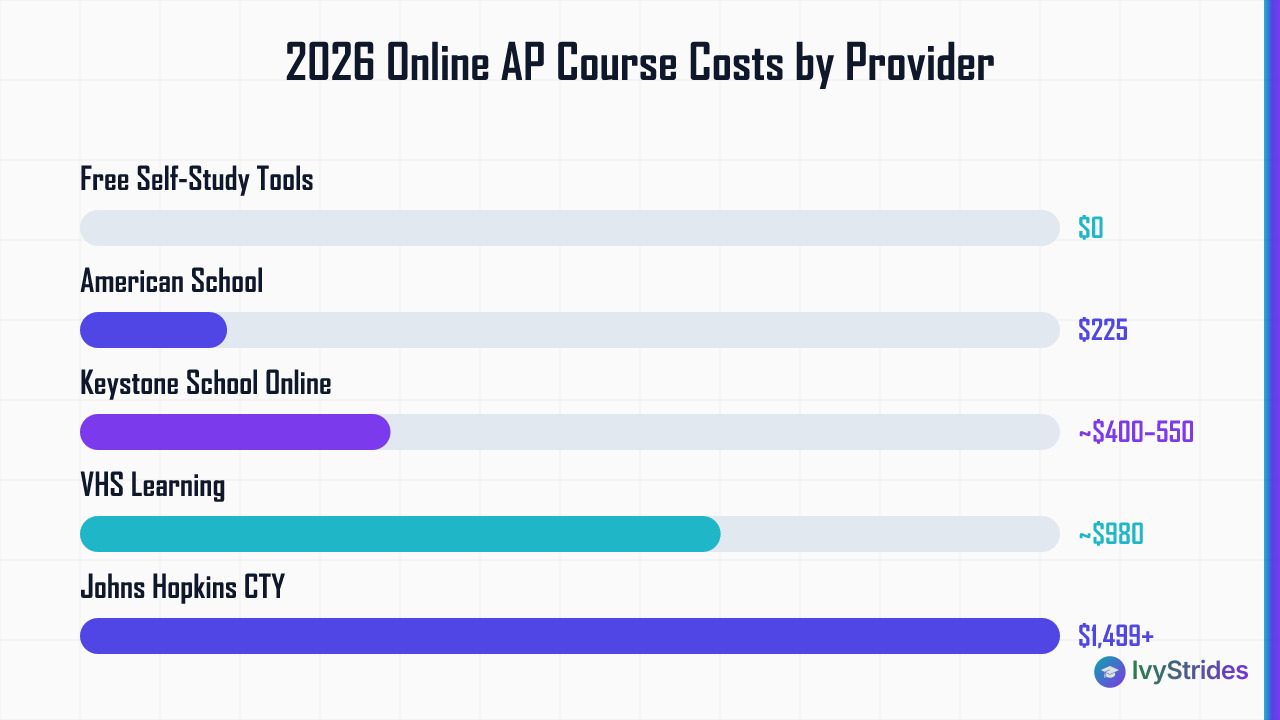
Here's the 2026 landscape at a glance, from free study tools to premium live instruction, plus the mandatory College Board exam fee that applies to every path.
| Provider tier | Price per course | Exam fee included? | Accredited (transcript credit)? | Live instruction? |
| Free self-study tools and AP Classroom | $0 | No | No | No |
| American School of Correspondence | $225 enrolled / $425 non-enrolled | No | Yes | No |
| Keystone School Online | roughly $400 to $550 | No | Yes | Partial |
| VHS Learning | around $980 | No | Yes | Cohort-based |
| Johns Hopkins CTY | roughly $1,499 (individually paced) to $2,127 (session-based) | No | Yes | Yes |
| IvyStrides best online AP courses | 1-on-1 specialist pricing | No | Coaching plus exam prep | Yes, 1-on-1 |
A few things to notice before the deeper breakdown. None of the paid tiers include the $99 AP exam fee set by College Board. Every student registers and pays for the exam separately through their school, or through an authorized exam center for international students and homeschoolers. "Accredited" only matters if the student needs the course to appear on a transcript. A student whose school already offers AP U.S. History doesn't need to pay for an accredited version elsewhere. A homeschooled student, or a student whose school doesn't offer AP Physics 2, does.
Price is a proxy for support level, not for score outcome. A $2,000 course does not buy a 5. It buys structure, live teaching, and, in the best cases, a specialist who has taught the exam many times.
What Does the College Board AP Exam Fee Add to Your Total Cost?
The 2025-26 AP exam fee is $99 per exam in the United States, set by College Board. This applies whether the student learns the material through a $0 self-study platform, a $400 correspondence course, or a $1,900 live-instruction program. Four exams in May means $396 in exam fees alone.
Outside the U.S., a late order fee of $129 applies, and international students should verify the current schedule directly with College Board since regional fees change year to year.
Paying for an online AP course is only half the equation. Students who also prepare specifically for the AP exam format tend to score higher, and a 4 or 5 can translate to real college credit savings. A score of 4 or 5 on an AP exam can earn college credit at many universities, and college tuition at four-year institutions typically runs above $500 per credit hour, sometimes several times that. That means the $99 exam fee may be the most cost-efficient credit a student ever buys, though credit policies vary by college and year. Verify the specific policy at each of your student's target colleges before assuming credit will transfer.
For a broader look at testing costs that fit alongside AP planning, see our breakdown of how much does the sat cost. For what colleges actually do with AP scores after they arrive, see AP Certification and what colleges actually see.
AP Exam Fee Waivers
Income-eligible students can apply for a fee reduction that brings the exam cost down to roughly $15 to $40 per exam, depending on how the school and state stack their subsidies. Applications go through the school's AP coordinator. More on the mechanics later in this article.
Free Online AP Courses: What You Actually Get (and What You Don't)
Free AP study resources exist. They're useful. They're also not accredited AP courses. This distinction trips up more families than any other item in this article, so let's be direct.
Free study platforms offer topic-by-topic instruction and practice questions in many AP subjects, including AP Calculus, AP Biology, AP Chemistry, and AP U.S. History. These are prep resources. They don't appear on a transcript, and they don't, by themselves, register a student for an AP course.
AP Classroom is College Board's official digital platform, and it's free, but there's a catch: access requires the student to be enrolled in an AP course through a school that has completed the AP Course Audit. If your school offers the AP course, your teacher gives you the AP Classroom join code. If your school doesn't offer it, AP Classroom access requires enrolling through an authorized third-party provider.
So what does "do AP classes cost money in high school?" actually work out to? For most students at U.S. public high schools where the AP course is offered on-site, the course itself is free. The primary out-of-pocket cost is the $99 exam fee, per College Board. Everything else, including AP Classroom, is bundled in.
For students whose school does not offer a specific AP, or for homeschoolers, an accredited paid online AP course is the route to transcript credit. Free resources supplement that. They don't replace it.
International students face a related but distinct challenge, covered here: how do international students study AP online.
Is a $1,400 Online AP Course Worth It? How to Match Cost to Your Needs
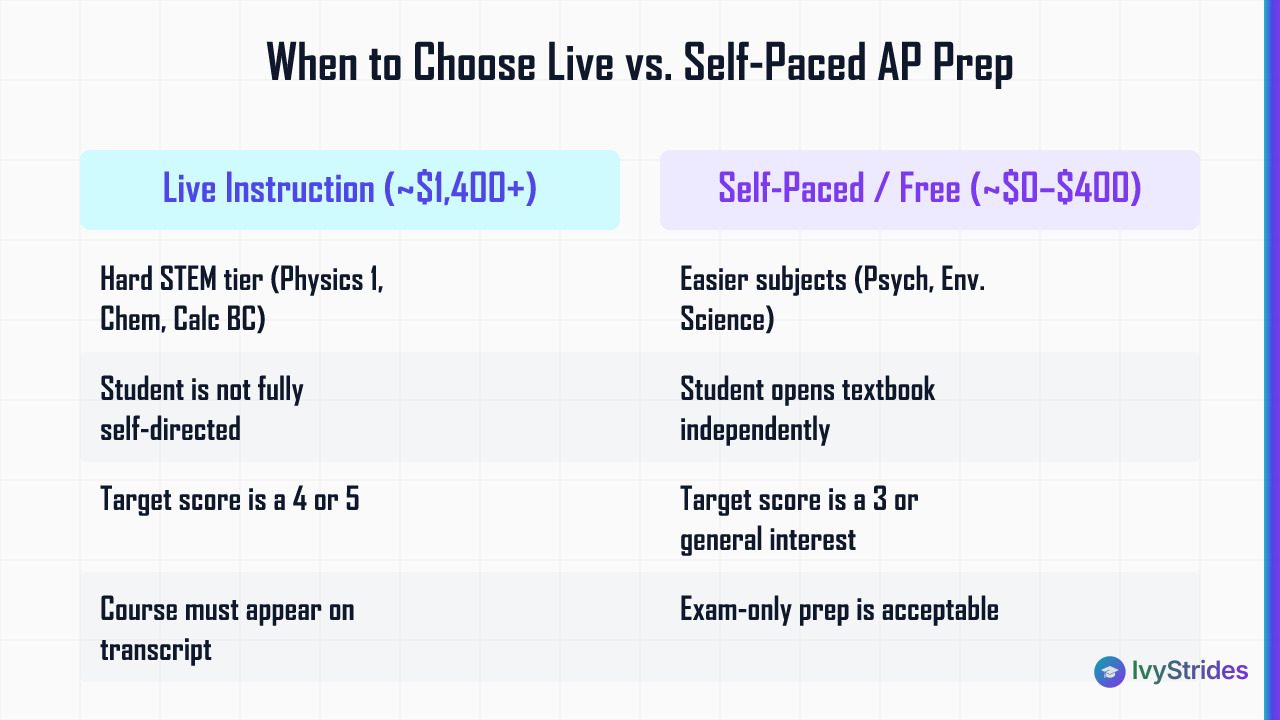
Here's the question most families are actually asking: my student can take a $0 platform, a roughly $400 correspondence course, a $980 cohort class, or a $1,400+ live-instruction program. Which one is right?
Three variables decide this. Get them wrong and you either overpay for support the student doesn't need, or underpay and watch the score come back a 2 or 3.
Variable 1: Subject difficulty. AP Physics 1 is widely cited as one of the most challenging AP exams in the program, with a smaller percentage of test-takers scoring 4 or 5 than in subjects like AP Psychology or AP Environmental Science (see College Board's published score distributions). AP Chemistry and AP Calculus BC sit in a similar tier. A student taking one of these on top of a full academic load, aiming for a 5, is a different profile from a student taking AP Psychology for general interest.
Variable 2: Self-direction. Can the student open a textbook at 4 p.m. on a Wednesday without being asked? Can they diagnose their own weak units? Some can. Most cannot, and that's not a character flaw, it's a developmental reality of a 16-year-old juggling six classes. A self-directed junior taking AP U.S. History at a school that already offers it may need only the $99 College Board exam fee plus free study tools. A less self-directed student taking AP Chemistry outside of school, aiming for a 5, needs structure. Probably live structure.
Variable 3: Target score and transcript need. Is the goal a 3 (to say the student took the AP), a 4 (to earn credit at most colleges), or a 5 (to reinforce a competitive admissions file at highly selective schools)? And does the course need to appear on the transcript, or is this exam-only prep?
Here's the framework we use with families. If the subject is in the harder STEM tier, the student is not fully self-directed, and the target is a 4 or 5, live specialist instruction is worth the cost. If any two of those three are low-stakes, a mid-tier or self-paced option often gets the job done. In our coaching with students preparing for AP Physics 1 and AP Chemistry, students who start with a diagnostic and work with a per-subject specialist consistently reach higher score bands than students using self-paced resources alone.
Which brings up the piece most families skip: the diagnostic. Every serious AP plan starts with a real practice exam to identify which units the student already understands and which ones are genuinely shaky. Without that, you're paying for instruction on material the student may already know. In our coaching with students in AP Calculus BC, the diagnostic-first approach typically identifies two to four specific unit gaps that, once addressed, move students from a 3 to a 4 or 5.
Online AP Courses for International Students: Extra Costs to Know
For students outside the U.S., online AP courses are often the only practical path to building an AP record, and the exam fee and registration logistics differ from the domestic process. Three cost and logistics items matter here.
First, the exam fee outside the U.S. has additional layers. The 2025-26 College Board fee schedule adds a $129 late order fee for exams ordered outside the U.S. under certain conditions, and some countries have regional pricing that runs higher than the domestic $99. Verify the current fee directly with College Board's international pages for your student's country.
Second, exam center availability varies by country. Not every city has an authorized AP exam center, and seats fill early. Students in some regions travel to a neighboring city or country to sit for the exam. Registration deadlines outside the U.S. are typically earlier than domestic deadlines, and missing them means missing the entire testing window until the following May.
Third, and this is the point most international families arrive at eventually: without a local school offering the AP course, an accredited online AP provider is functionally required to get transcript credit. Free study platforms and AP Classroom (which requires school-based enrollment) don't fill this gap on their own.
In our coaching with international students, the combination of an accredited online AP course plus 1-on-1 exam prep is the most reliable path to a score of 4 or 5. One anonymized example: a student outside the U.S. who had no local AP course access enrolled with an online accredited provider for course credit and used IvyStrides 1-on-1 specialist sessions for exam prep, scoring a 5 on AP Chemistry.
For international students weighing specific subjects, see ap computer science a and the deeper guide on how do international students study AP online.
How Many AP Classes Do You Need? What Selective Colleges Actually See
The number of AP courses on a transcript matters to selective colleges, but the quality of preparation behind each score matters more than the raw count. Most Ivy League admits complete roughly 10 to 14 AP courses by graduation, based on widely reported admissions data. Students with 12 or more are especially common in the admitted pool. But 7 APs with scores of 4 and 5 across the board present a stronger record than 12 APs with mixed scores of 2 and 3.
Two caveats matter here, both YMYL-critical.
Admissions outcomes depend on the full application, not AP count alone. Essays, recommendations, extracurricular depth, course rigor across non-AP subjects, and (at many schools) standardized test scores all factor in. AP count is a signal, not a determinant.
At schools where test-optional policies are in effect, a strong AP score record can carry additional weight in the admissions file, making the investment in quality AP preparation more consequential. Test-optional policies vary by school and year, and several highly selective universities have reinstated score requirements for the classes of 2026 and beyond. Verify current policy at each of your student's target schools through the school's own admissions page.
At schools that have reinstated score requirements, a strong AP record complements but does not replace a competitive SAT or ACT score. If your student is aiming at Ivy-tier admissions, the AP transcript and the standardized test score work together, not as substitutes. See is a 1500 SAT score good for Ivy League admission for how the score side stacks up. For the math-track AP most Ivy-bound STEM applicants take, see ap calculus ab.
AP Exam Fee Waivers: Who Qualifies and How to Apply
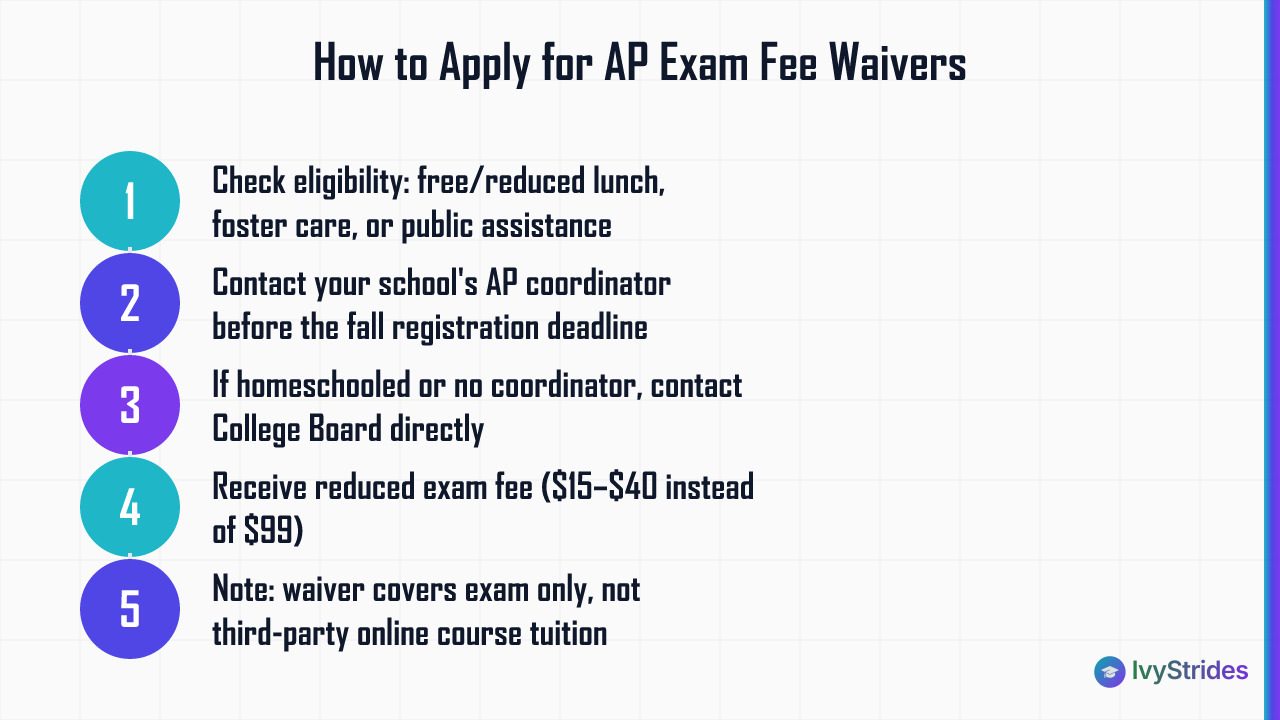
College Board's AP fee reduction program reduces the exam fee to roughly $15 to $40 per exam for income-eligible students. That's a swing from $99 down to, in some cases, less than the cost of a paperback prep book.
Eligibility is typically income-based. The most common qualifier is enrollment in the federal free or reduced-price lunch program, though other criteria apply for students who don't fit that category (foster care, homelessness, families receiving public assistance, and similar). The exact reduction amount depends on how the state and school layer their own subsidies on top of College Board's reduction.
The application process runs through the school's AP coordinator. Students should ask their coordinator by the fall registration deadline; waiting until spring often means missing the window. Homeschooled students, or students at schools without an AP coordinator, should contact College Board directly for guidance on the process.
One important limit: fee waivers apply to the exam fee only. They do not cover the cost of an accredited online AP course from a third-party provider. A student receiving a fee waiver who also needs an accredited course through, say, VHS Learning still pays the full course tuition. In these situations, free study platforms paired with the school's AP course (if available) is the lowest-cost path.
Verify the current waiver amounts and eligibility rules with College Board for the current academic year, since exact figures update annually. For comparable cost information on the SAT side, see SAT fees and waivers 2025-26. For a lower-difficulty AP that fits well into a fee-waiver-supported plan, see ap cs principles.
Which AP Courses Are the Hardest Online, and Does That Change What You Should Pay?
Yes. And this is where families most often under-invest.
Based on College Board's published score distributions, AP Physics 1 sits at or near the top of the difficulty ranking every year, with a lower share of test-takers earning a 4 or 5 than in subjects like AP Psychology or AP Environmental Science. AP Physics 2, AP Chemistry, and AP Calculus BC round out the high-difficulty STEM tier. These subjects test deep conceptual mastery across a full year of material, and the free-response sections reward students who can reason through unfamiliar problem setups, not just recall formulas.
For subjects in this tier, the case for paying more (whether a mid-tier live-cohort provider or 1-on-1 specialist instruction) is much stronger than for lower-difficulty AP subjects. In our coaching with students in AP Physics 1 and AP Chemistry, those working with a per-subject specialist rather than a generalist tutor show noticeably stronger score improvement in the 4 to 5 band. This isn't because generalist tutors are bad. It's because a specialist who has taught AP Physics 1 for years has seen the specific misconceptions that keep students at a 3 (torque direction confusion, momentum vs. impulse errors, circular motion sign conventions), and they teach directly against those patterns.
For lower-difficulty subjects, especially those the student's school already offers, a $0 to roughly $400 path is often plenty.
Is AP harder than the SAT? Look, they're not really comparable. AP exams test deep subject mastery over a full year; the SAT tests reasoning and problem-solving in a single sitting. High-difficulty AP subjects like AP Physics 1 do have lower rates of 4 and 5 scores than the SAT has students in top percentiles, but that difficulty gap reflects different tests measuring different things. For students who add AP Precalculus as a foundation-builder for AP Calculus, see ap precalculus online.
How IvyStrides AP Classes Online Compare to Other Providers
IvyStrides AP Classes Online is a 1-on-1 per-subject specialist model. One student, one teacher, one AP subject at a time. This mirrors how the AP Program itself is structured: each exam has its own curriculum framework, its own units, its own scoring rubrics. Assigning one specialist per subject rather than a generalist tutor across all APs reflects that reality.
Every IvyStrides AP plan starts from a diagnostic. Before instruction begins, the student completes a real practice exam so the specialist can identify which units are already solid and which two, three, or four units are actually shaky. That's what "diagnostic-driven" means in practice. It's the same discipline the strongest classroom AP teachers use, adapted for 1-on-1 pacing.
Subjects currently covered include AP Physics 1, AP Physics 2, AP Chemistry, AP Calculus AB, AP Calculus BC, AP Computer Science A, AP CS Principles, and AP Precalculus. The concentration on STEM subjects is deliberate. These are the AP courses where subject-specialist instruction moves scores most reliably.
Delivery is fully online and global. Students in Singapore, São Paulo, Seoul, and Seattle work with the same specialist pool, which matters especially for international students who cannot access AP courses through a local school.
Compared to self-paced correspondence providers, IvyStrides is live and interactive. Compared to group cohort providers, it's 1-on-1, which means the pacing and the practice-question selection are matched to this student's diagnostic, not to the median student in a cohort of 25. That's a meaningful difference for a student aiming to move from a 3 to a 5 in a high-difficulty subject.
For more on the coaching approach and the people behind it, see the ap computer science a specialist course page. You can also meet the IvyStrides tutors who work across each AP subject.
FAQ
Do AP classes cost money in high school?
In most U.S. public high schools, the AP course itself is free. The primary cost is the College Board AP exam fee, which is $99 per exam in the U.S. for 2025-26. Income-eligible students can apply for a fee reduction that brings the cost down to roughly $15 to $40 per exam through their school's AP coordinator. Students whose school doesn't offer a specific AP course, or homeschoolers, will also need to pay an accredited online provider ($225 and up per course) to get transcript credit.
Can you take AP courses online for free?
Free AP prep resources exist through several study platforms and through College Board's AP Classroom, but these are study tools, not accredited courses. They don't appear on a transcript. If your student needs an accredited online AP course, expect to pay $225 or more depending on the provider. Free tools are useful as supplements to a formal course; they aren't a full substitute when transcript credit matters.
Is AP harder than the SAT?
They test different things, so a direct difficulty comparison isn't clean. AP exams assess deep mastery of a specific subject after a full year of study; the SAT tests reasoning and problem-solving across math and reading in a single sitting. High-difficulty AP subjects like AP Physics 1 have lower rates of students scoring 4 or 5 than the SAT has students scoring in the top percentiles, but the two exams serve different admissions purposes. Most competitive applicants take both, not one instead of the other.
Is 7 AP classes enough for Harvard or Ivy League schools?
Most Ivy League admits complete roughly 10 to 14 AP courses by graduation. That said, 7 strong scores of 4 or 5 can still be competitive, especially when the rest of the application is exceptional. Admissions outcomes depend on the full application (essays, recommendations, extracurriculars, standardized test scores where required, and course rigor), not AP count alone. Admissions policies vary by school and year.
What AP classes can you take online?
Most of the 38 AP subjects are available through at least one online provider. Common online offerings include AP Calculus AB and BC, AP Chemistry, AP Physics 1 and 2, AP Computer Science A, AP CS Principles, AP U.S. History, AP English Language, and AP Psychology. Availability varies by provider, so check each provider's current course catalog. IvyStrides currently focuses on STEM subjects: AP Physics 1, AP Physics 2, AP Chemistry, AP Calculus AB, AP Calculus BC, AP Computer Science A, AP CS Principles, and AP Precalculus.
How do I get an AP exam fee waiver?
Contact your school's AP coordinator and ask about College Board's AP fee reduction program. Eligibility is typically income-based, often tied to free or reduced-price lunch status. The reduced fee runs roughly $15 to $40 per exam, depending on state and school layered subsidies. Homeschooled students, or students at schools without an AP coordinator, should contact College Board directly for guidance. Apply in the fall, not the spring, since registration deadlines run early.
The right online AP course is the one that matches the specific subject, the specific student, and the specific target score. That's not something a comparison table can decide for you. It takes a diagnostic and a conversation.
Two decades teaching quantitative and verbal aptitude on standardized tests. Rare dual expertise across Math and Verbal — particularly effective for students with gaps on both sides. Senior AP Mentor for our Calculus and English tracks.