
AP, SAT, and ACT: How to Build a Winning High School Testing Plan (Grades 9-12)

On this page
- The 60-Second Answer: What a Four-Year Testing Plan Looks Like
- Grade 9: Build the Foundation Before the Clock Starts
- Grade 10: PSAT 10, First AP, and the SAT vs. ACT Decision
- The Problem Most Juniors Hit: Trying to Prep for Everything at Once
- Not sure where your testing plan stands? Get a free diagnostic snapshot.
- Grade 11: The Primary SAT/ACT Window and AP Exam Season
- Do AP Scores Replace the SAT or ACT? What Colleges Actually See
- Grade 12: Lock Your Scores and Shift to Essays
- SAT vs. ACT: Which Score Is Higher for You?
- Your Grade-by-Grade Testing Calendar at a Glance
- How to Start: The Diagnostic-First Approach
- FAQ
- Is a 33 ACT score the same as a 1440 SAT score?
- Is test-optional going away in 2026 and beyond?
- Is a perfect 1600 SAT harder to achieve than a perfect 36 ACT?
- Do AP classes actually help with SAT or ACT prep?
- When is the last realistic date to take the SAT or ACT for college applications?
- What is the ACT test and how is it different from the SAT?
- Where to Go From Here
- Ready to build your personalized grade-by-grade testing plan?
A strong high school testing plan follows a four-year arc: 9th grade for foundations and a first diagnostic practice test, 10th grade for the PSAT 10 and an introductory AP, 11th grade for the primary SAT or ACT attempt plus AP exams, and 12th grade for one strategic retake and essay completion. Most students take the SAT or ACT for the first time in the spring of junior year, with a fall senior retake if needed. AP exams run the first two weeks of May each year and should be scheduled around, not on top of, standardized test prep.
These format and timing details come from the College Board, ACT, Inc., and the Common App. The rest of this article maps each grade to specific months, tests, score targets, and prep windows for the 2026–2027 testing cycle and the current Digital SAT.
The 60-Second Answer: What a Four-Year Testing Plan Looks Like
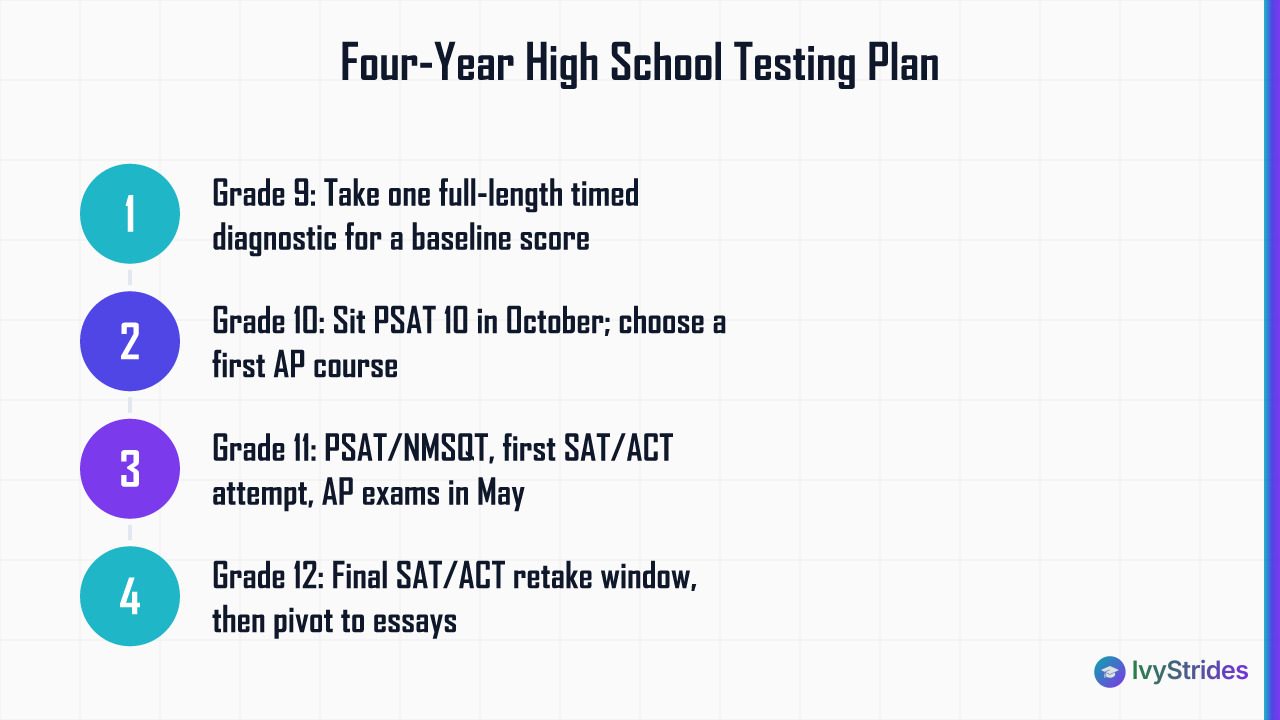
Four tests. Four years. One coordinated calendar.
The Digital SAT is a two-section adaptive exam (Reading and Writing, then Math) scored 400 to 1600, delivered through the Bluebook app in 2 hours 14 minutes, per the College Board. The ACT is a four-section linear exam (English, Math, Reading, Science) scored 1 to 36, running roughly 2 hours 55 minutes with breaks, per ACT, Inc. The PSAT/NMSQT is scored 320 to 1520 and, when taken in October of junior year, serves as the National Merit qualifier. AP exams are scored 1 to 5 and administered the first two weeks of May each year.
Here's the compressed timeline. Grade 9: take one full-length timed diagnostic to establish a baseline score band. Grade 10: sit the PSAT 10 in October and pick a first AP course. Grade 11 is the primary window, which means the PSAT/NMSQT in October, a first SAT or ACT attempt in March or April, AP exams in May, and a second SAT or ACT sitting in May or June if needed. Grade 12 is your final retake window (October or November SAT, September or October ACT) and then the pivot to essays.
Registration is public information. For SAT test dates 2026, the College Board typically opens registration 4 to 6 months ahead of each administration.
Grade 9: Build the Foundation Before the Clock Starts
Ninth grade is not the year to register for the SAT. It's the year to gather one piece of information: your baseline.
Take a timed, full-length Digital SAT practice test at home in the fall or winter. Use official SAT practice tests from the Bluebook app so the score maps directly to the real exam. This single sitting tells you your current score band (below 1000, 1000–1200, 1200–1400, 1400+), and that band determines every prep decision that follows. A student scoring 1080 on a diagnostic needs a different plan than a student scoring 1310, even if both want to reach 1500.
Some high schools offer the PSAT 8/9 to freshmen. It's scored on a 240 to 1440 scale, and it is not the National Merit qualifier. Treat it as a low-stakes second data point, not a milestone.
The other 9th-grade lever is course rigor. Freshman GPA and your course sequence determine which APs your school will let you take in 10th and 11th grade. If you're aiming at selective schools, get familiar with what is AP coursework now so you can plan a sophomore entry point (AP Human Geography and AP Computer Science Principles are common ones).
What 9th graders should not do: register for the SAT, register for the ACT, or start weekly prep sessions. You'll waste money and burn motivation you'll need in junior year.
Grade 10: PSAT 10, First AP, and the SAT vs. ACT Decision
Sophomore year is where the plan gets real.
In October, your school will administer the PSAT 10, scored on the same 320 to 1520 scale as the PSAT/NMSQT, per the College Board. Sophomores who take the PSAT 10 in October get a scored diagnostic that maps directly onto the Digital SAT scale, giving them 12 to 18 months of lead time before the junior PSAT/NMSQT that counts for National Merit.
Two clarifications students get wrong. First, the PSAT 10 does not qualify anyone for National Merit; only the junior-year PSAT/NMSQT does. Second, good PSAT scores for 10th graders sit around 1010 for the 50th percentile and roughly 1210+ for the top 10%. If you scored above 1210 as a sophomore, National Merit becomes a realistic conversation. Below 1000, it isn't.
Sophomore year is also when to start the SAT vs. ACT decision. Take one timed section of each: a Digital SAT R&W module and an ACT English section, then a Digital SAT Math module and an ACT Math section. Convert to concordant scores. If your ACT equivalent beats your SAT number, prioritize ACT prep. If they're close, choose based on format preference. The Digital SAT uses adaptive modules (Module 1 sets difficulty for Module 2 in each section), while the ACT is fixed-linear with a dedicated Science section that tests data interpretation, not memorized biology or chemistry.
A junior we worked with last fall scored 1180 on her Digital SAT diagnostic and a concordant 26 on the ACT. On paper the SAT was her test. But she also read graphs quickly, so we had her sit a timed ACT Science section as a tiebreaker. She missed 3 questions. That confirmed the SAT was still her better fit, but the tiebreaker mattered: students who read graphs quickly often outscore their SAT concordance on the ACT. Sophomores sometimes ask is the PSAT harder than the SAT? Short answer: no, the PSAT is slightly easier and shorter, which is why the score maps but doesn't equal a real SAT.
Pick one AP for sophomore year, not three. AP Human Geography, AP World History, and AP Computer Science Principles are the most accessible 10th-grade entries per College Board enrollment data. A 4 or 5 on one sophomore AP signals rigor to admissions readers without wrecking your GPA.
The Problem Most Juniors Hit: Trying to Prep for Everything at Once
Here's the pattern we see every year. A capable junior takes four AP classes, decides to sit the SAT in April, and starts prep in mid-March. By late April they're studying for AP Chemistry, AP US History, AP Calculus AB, and the SAT simultaneously. Every subject gets a fraction of the attention it needs. The SAT score comes back 80 points below the diagnostic, and two AP scores land at 3 when they should have been 4s.
The numbers behind the collapse are simple. AP exams run the first two weeks of May. SAT spring administrations typically fall in March, May, and June. ACT spring dates typically fall in February, April, and June. A junior prepping for two AP exams and the SAT in the same April–May window without a plan is splitting 20+ weekly study hours across three demands that all peak the same week.
The fix isn't more hours. It's sequencing. In our coaching, students who separate SAT/ACT prep (September through February) from AP exam prep (February through May) score higher on both. The mechanism: the SAT and ACT reward pacing drills and question-type pattern recognition, which take 3 to 6 months of consistent low-volume work. AP exams reward content review and free-response practice concentrated in the 8 weeks before the exam. Trying to do both at once starves each of what it actually needs. For AP-specific pacing, see how to study for AP exams. For SAT-specific weekly structure, see our SAT study plan.
Not sure where your testing plan stands? Get a free diagnostic snapshot.
In 15 minutes, an IvyStrides coach will review your current grade, target schools, and test history, then recommend the right next step: SAT prep, ACT prep, AP support, or essay coaching. Students and parents welcome on the call.
Grade 11: The Primary SAT/ACT Window and AP Exam Season
Junior year is the highest-use 12 months of the whole plan. Get it right and senior fall becomes a one-test cleanup. Get it wrong and you're triaging in October of 12th grade.
October: sit the PSAT/NMSQT. This is the National Merit qualifier. The Selection Index is calculated as (2 × ERW score) + Math score, and state cutoffs for Semifinalist status typically fall in the 209 to 222 range, per College Board data. Cutoffs vary by state and by year, so a Selection Index that qualifies in Wyoming won't qualify in New Jersey.
September through February: primary SAT or ACT prep window. The methodology is consistent: diagnostic practice test, targeted weakness work by question type, spaced retesting every 3 to 4 weeks, and section-specialist coaching (separate coaches for Digital SAT R&W and SAT Math, separate coaches for ACT English/Reading and ACT Math/Science). In our coaching, students who begin structured SAT prep in September and sit their first test in March typically have 6 months of targeted work behind them. Typical outcomes for students completing our 1-on-1 SAT prep program: 200+ SAT points or 4+ ACT composite points.
March or April: first SAT or ACT attempt. For most juniors, this is when the diagnostic-driven prep pays off. If you hit your target, you're done. If not, you have one more shot in May or June.
AP exam prep runs on its own calendar (January through May each year), so the smartest junior-year plans stagger SAT/ACT prep in the fall and winter, then shift primary focus to AP exams in the spring. AP registration closes in November of the prior year at most schools. Confirm the specific AP exam dates 2026 with the College Board and your school's AP coordinator.
How many APs should a junior take? Depends on the target school. For the framework, see how many AP classes should you take. The short answer: three to five is standard for competitive applicants, and rigor should track your school's offerings, not an arbitrary number.
May or June: second SAT or ACT sitting if needed. If the March attempt was 30 points below target, retake in May. If it was 100 points below target, retake in June after 8 more weeks of work, not in May while AP exams are burning your bandwidth.
Do AP Scores Replace the SAT or ACT? What Colleges Actually See
Short answer: no, not at most selective schools. AP scores and SAT/ACT scores answer different questions for admissions readers.
AP scores (1 to 5) signal subject mastery in a specific discipline. A 5 on AP Calculus BC tells Yale you can handle college calculus. SAT and ACT scores signal standardized benchmarking across all applicants, regardless of what their high school offered. A 1520 SAT typically tells Yale you outperformed roughly 99% of test-takers on a nationally normed exam per College Board's SAT percentile tables. The two are complements, not substitutes.
Test-optional doesn't mean test-blind. Most test-optional schools still consider scores when submitted, and a strong score usually helps. Test-optional policies vary by school and change year to year, so check each college's current policy on FairTest or the school's Common Data Set before deciding whether to submit a score. Several selective universities, including MIT and Yale, have reinstated standardized test requirements as of the 2024–2025 and 2025–2026 admissions cycles.
AP credit policies also vary widely. A 4 on AP Calculus BC earns 8 credits at one university and 0 credits at another. Do colleges accept AP credit walks through how to check each school's policy. For a breakdown of what each score means to colleges, see AP scores explained.
The scenario that trips students up: five AP 5s and no SAT/ACT score, applying to a school that reinstated the requirement. The application is incomplete regardless of the AP results. Caveat as always: admissions outcomes depend on the full application, not test scores alone.
Grade 12: Lock Your Scores and Shift to Essays
By September of senior year, your prep energy shifts. You're not learning new question types anymore. You're locking a score and moving to essays.
The senior fall SAT retake window is August, October, or November. The ACT window is September or October. Most Early Decision and Early Action deadlines fall on November 1 or November 15, and SAT scores take approximately 2 to 4 weeks to be sent to colleges. That makes the October SAT and the October ACT the last realistic tests for ED applicants. The November SAT works for some ED II and Regular Decision deadlines; the December ACT is the practical cutoff for January 1 RD deadlines. See how many times can you take the SAT for the full retake logic.
Many colleges superscore the SAT (best section scores across attempts), and some superscore the ACT. Policies differ. Confirm each target school's policy through its Common Data Set before deciding whether a retake will actually improve your submitted number.
By the time senior fall arrives, test scores should be locked so all remaining energy goes toward Common App essays and supplemental writing. In our coaching, students who finish their primary SAT/ACT prep by October of senior year have 6 to 8 weeks of focused essay time before ED deadlines. That's roughly the minimum to write, revise, and polish a Common App personal statement (650-word limit, per the Common App) plus 4 to 8 supplemental essays for a typical school list.
For structured essay support, see our essay review service. For prompt-specific frameworks, why this college essay examples walks through the most common supplemental essay type.
SAT vs. ACT: Which Score Is Higher for You?
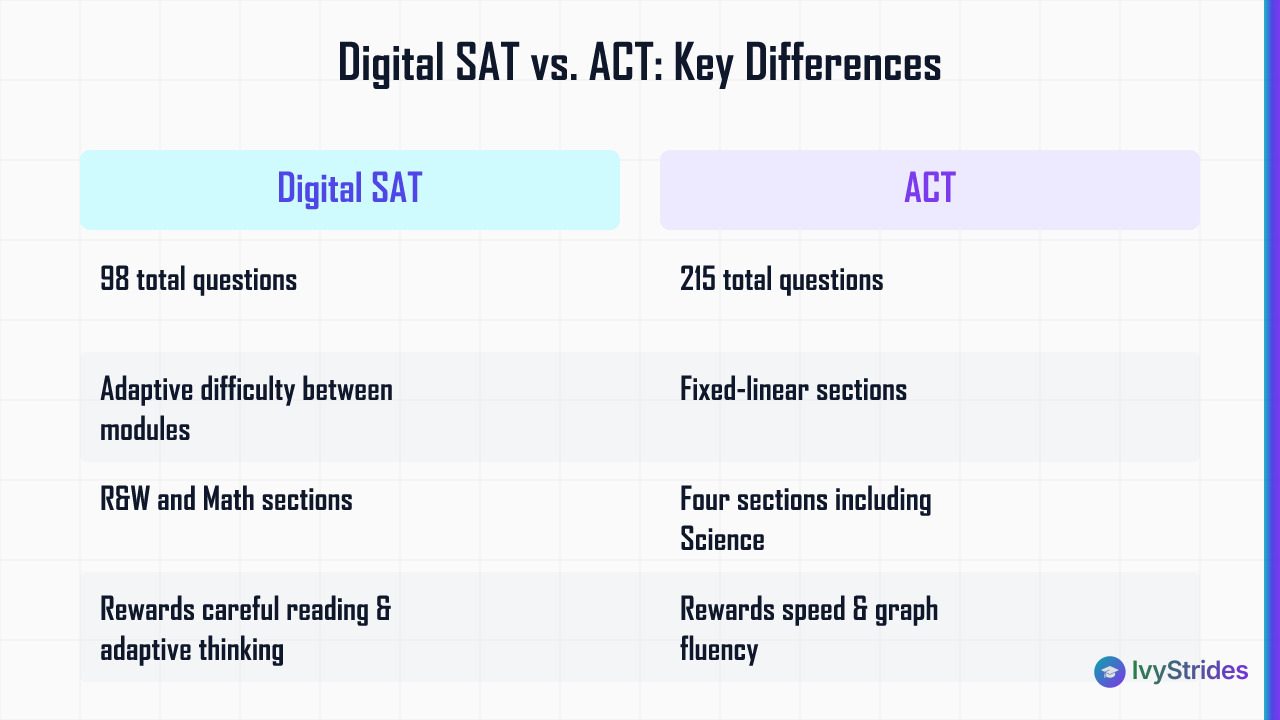
The comparison questions everyone Googles: is a 33 ACT the same as a 1440 SAT? Is a 1600 harder than a 36?
Per the College Board and ACT, Inc. concordance tables, a 33 ACT composite corresponds to approximately a 1440 to 1450 SAT. A 34 ACT maps to roughly 1490 to 1520. Both are 97th to 99th percentile scores, and colleges that accept both tests treat concordant scores as equivalent for admissions purposes.
Perfect scores are both rare. Fewer than 1% of test-takers achieve a 1600 SAT or a 36 ACT composite. Neither is objectively harder; the format determines which ceiling you can reach. The Digital SAT contains 98 total questions across R&W and Math modules with an adaptive difficulty jump between Module 1 and Module 2. The ACT contains 215 total questions across four fixed-linear sections. The Digital SAT rewards students who read carefully and think adaptively. The ACT rewards students who process quickly and read graphs fluently.
The decision framework is simple. Take one timed practice section of each. Convert to concordant scores. Whichever test produces the higher concordant number is your test. For percentile-by-percentile detail, see SAT score scale and percentiles. For an ACT practice test online library, start with our official-format materials before committing to a prep track.
One more note on ACT Science. It's the section students fear most and often the section that separates high SAT scorers from equivalent ACT scorers. It tests graph reading, experimental design interpretation, and cross-referencing tables. It doesn't test whether you remember mitosis or Newton's laws.
Your Grade-by-Grade Testing Calendar at a Glance
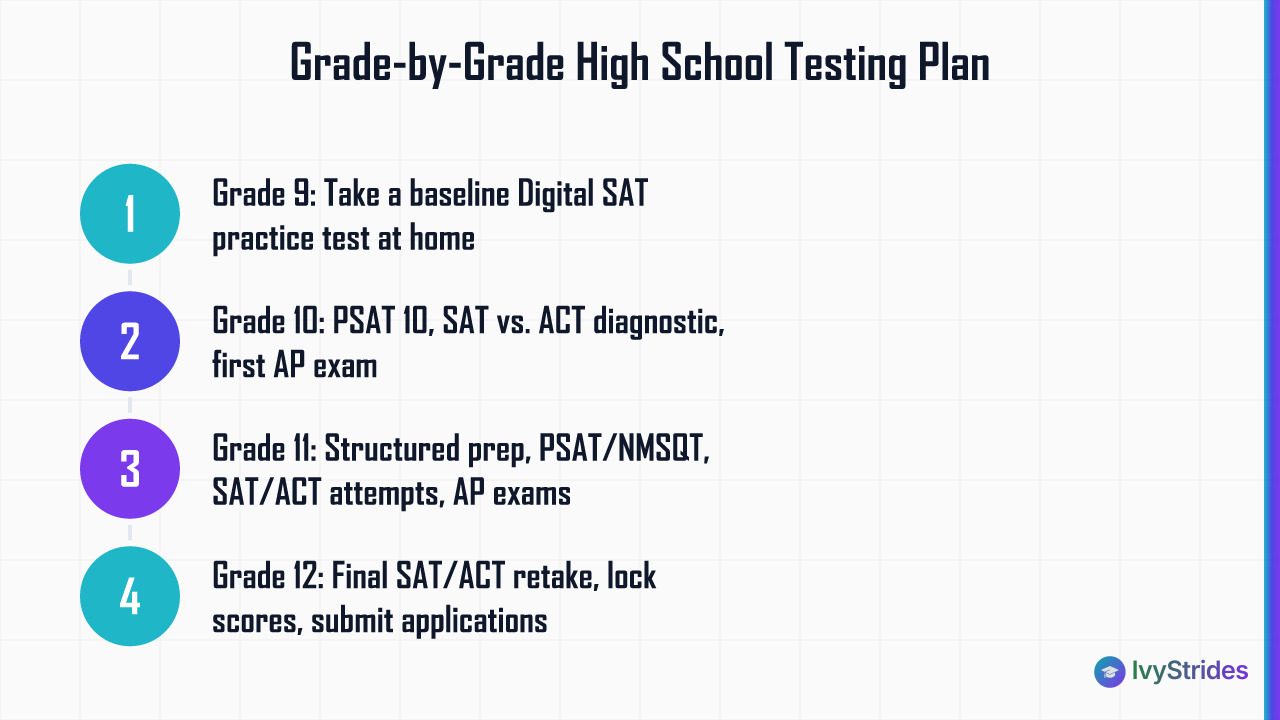
Here's the four-year plan compressed to specific months and actions.
Grade 9, Fall or Winter: Take one timed, full-length Digital SAT practice test at home. Identify your baseline score band. No official registration.
Grade 10, October: PSAT 10 at school. Begin SAT vs. ACT crosswalk diagnostic. Enroll in one sophomore-year AP.
Grade 10, May: First AP exam if enrolled in a 10th-grade AP course.
Grade 11, September: Begin structured SAT or ACT prep with a section-specialist coach.
Grade 11, October: PSAT/NMSQT (National Merit qualifier).
Grade 11, November: AP exam registration closes at most schools.
Grade 11, March or April: First SAT or ACT attempt.
Grade 11, First two weeks of May: AP exams.
Grade 11, May or June: Second SAT or ACT attempt if needed.
Grade 12, August through October: Final SAT or ACT retake if needed.
Grade 12, October or November: Scores locked for ED/EA deadlines.
Grade 12, November onward: Common App and supplemental essays. Applications submitted.
Registration logistics. SAT registration typically opens 4 to 6 months before each test date per the College Board. ACT registration typically closes 5 weeks before each test date per ACT, Inc. For structured practice between test dates, use our PSAT practice tests as one primary source. Add the official SAT study guide 2026 for the broader SAT curriculum.
How to Start: The Diagnostic-First Approach
Every good plan starts with the same first step: a full-length, timed diagnostic. Not a 20-question quiz. Not a section sample. A complete Digital SAT or ACT under real conditions.
The reason is boring and important. Score band determines strategy. In our coaching, students who start with a diagnostic and follow a targeted weakness plan see typical improvements of 200+ SAT points or 4+ ACT composite points for students completing the 1-on-1 program. But the plan for an 1100 student and the plan for a 1350 student share almost nothing in common. An 1100 student is fixing foundational algebra, sentence-boundary rules, and pacing. A 1350 student is fixing the top 15% of missable questions: inference-level reading, advanced grammar edge cases, and question-type traps.
Section-specialist coaching is the second lever. Separate coaches for SAT R&W and SAT Math. Separate coaches for ACT English/Reading and ACT Math/Science. Generalist tutors can teach both sides; specialists know the question-type patterns cold. See our 1-on-1 ACT prep for how we assign coaches by section.
Free starting points. Pull a full-length practice test from free SAT resources or the Bluebook app. Take it in one sitting. Note where your time ran out and which question types you missed most. That data becomes your first coaching conversation. For AP-specific starting points by subject, see AP exam prep by subject.
A recent example. A junior we worked with came in at 1180 on her October diagnostic. She started structured prep in November with section-specialist coaching (one coach for R&W, one for Math), sat the March SAT after 4 months of targeted weakness work, and scored 1390 on her first official attempt. She retook once in June and scored 1450. That's the typical arc when the plan starts early enough and the diagnostic is honest.
FAQ
Is a 33 ACT score the same as a 1440 SAT score?
Per the College Board and ACT, Inc. concordance table, a 33 ACT composite typically corresponds to approximately a 1440 to 1450 SAT. Both typically fall in the 97th to 98th percentile range, and colleges that accept both tests treat concordant scores as equivalent. The right choice is whichever test produces your higher concordant score after a diagnostic, not the one that sounds more familiar.
Is test-optional going away in 2026 and beyond?
Test-optional policies vary by school and change year to year. Several selective universities, including MIT and Yale, have reinstated standardized test requirements as of the 2024–2025 admissions cycle, and the trend at highly selective schools is moving toward reinstating requirements. Per FairTest, many schools remain test-optional. Check each school's current admissions page or Common Data Set before deciding, and remember that a strong score is rarely a disadvantage even where submission is optional.
Is a perfect 1600 SAT harder to achieve than a perfect 36 ACT?
Both are typically extremely rare per College Board's SAT percentile tables and ACT's National Profile Report. Fewer than 1% of test-takers achieve either. The SAT 1600 requires a perfect score on both R&W and Math across two adaptive modules. The ACT 36 requires a perfect composite average across four fixed-linear sections. Neither is objectively harder; the difficulty depends on which test format suits the student. A timed diagnostic crosswalk is the only reliable way to know which ceiling is more reachable for you.
Do AP classes actually help with SAT or ACT prep?
AP classes build content knowledge and analytical reading skills that show up on both the SAT and ACT, but they don't teach test-taking strategy, pacing, or the specific question formats those exams use. AP Calculus AB reinforces the algebra and functions content that makes up roughly 35% of Digital SAT Math. AP English Language and Composition builds rhetorical analysis skills tested in SAT Reading and Writing. AP coursework alone is not a substitute for structured, diagnostic-driven SAT or ACT prep.
When is the last realistic date to take the SAT or ACT for college applications?
For Early Decision and Early Action deadlines (typically November 1 or 15), the October SAT or the October ACT is usually the last viable test date, since scores take 2 to 4 weeks to be sent to colleges. For Regular Decision deadlines (typically January 1), the November SAT or the December ACT is the practical cutoff. Taking a test in December for a January 1 deadline is very tight and not recommended unless you're only chasing a modest improvement on an already-strong score.
What is the ACT test and how is it different from the SAT?
The ACT is a standardized college admissions test administered by ACT, Inc. It has four sections: English (75 questions, 45 minutes), Mathematics (60 questions, 60 minutes), Reading (40 questions, 35 minutes), and Science (40 questions, 35 minutes), plus an optional Writing section. Composite scores range from 1 to 36. The key difference from the Digital SAT is format: the ACT is fixed-linear, while the Digital SAT uses adaptive two-module sections. The ACT also has a dedicated Science section that tests data interpretation rather than memorized science content.
Where to Go From Here
The plan on this page is a template. Your actual four-year calendar depends on your current grade, your current score band, your target schools, and how many APs your school offers. A junior at an 1180 diagnostic needs a different next step than a sophomore who just scored 1310 on the PSAT 10.
Ready to build your personalized grade-by-grade testing plan?
Book a free 15-minute strategy call. We'll identify your current score band, map out your SAT, ACT, and AP calendar, and recommend the exact prep path for your target schools. Open to students and parents.

Award-winning author (South Asian Book Award) and graduate of BITS Pilani and UCLA Luskin School of Public Affairs. Brings a published writer's eye to Common App essays and grammatical precision to SAT and ACT R&W instruction.