
Is AP Worth the Stress and the Cost? An Honest Take for Families
On this page
- The Short Answer: When AP Classes Are Worth It and When They Are Not
- What AP Classes Actually Cost Families in 2026
- AP Stress Is Real: How Many AP Classes Are Too Many?
- How AP Classes Affect College Admissions: What Selective Schools Actually Look For
- What Percentage Do You Need for a 5 on an AP Exam?
- How to Decide Which AP Classes Are Actually Worth Taking
- AP vs. SAT: Which Should a Student Prioritize When Time Is Limited?
- Frequently Asked Questions About AP Classes, Stress, and Cost
- Is AP stressful?
- Is 70 percent of raw points a 5 on an AP exam?
- Is 7 AP classes enough for Harvard?
- What is the hardest AP class?
- Do AP classes actually prepare you for college?
- Are AP exams worth it for international students?
- What if I do not think I will get an A in the AP?
- The Bottom Line on Whether AP Is Worth It
AP classes and exams are worth the stress and cost for most students, but only when chosen strategically. Taking 1 to 4 AP courses aligned with a student's strengths and intended major typically earns college credit, strengthens the admissions profile, and adds up to 1.0 point to weighted GPA. The 2026 AP exam fee is $99 per exam, with a $37 fee reduction for eligible students. Five or more APs in a single year raises burnout risk and produces diminishing admissions returns.
Every fee and scoring figure below comes from the College Board AP Program or named school policy pages, with caveats where policy varies. The rest of the piece breaks the decision down by cost, stress load, admissions signal, and subject choice.
The Short Answer: When AP Classes Are Worth It and When They Are Not
AP courses are worth it when three conditions line up: the subject connects to the student's demonstrated strength or intended major, the target colleges award credit or admissions weight for the score, and the total AP load leaves room for sleep, SAT or ACT prep, and one or two real extracurriculars.
Miss any of those, and the math changes fast.
Here is the framework we use with families in our 1-on-1 coaching:
| AP load per year | Typical outcome | Recommended for |
| 1-2 APs | Rigor signal, manageable workload, protects GPA | Most sophomores; students balancing heavy extracurriculars |
| 3-4 APs | Strong rigor signal, some stress, credit potential | Juniors and seniors targeting selective schools |
| 5+ APs | Elevated burnout risk, GPA and sleep pressure | Only students with a proven track record at 3-4 APs |
Each AP exam costs $99 in the 2026 cycle, with a $37 College Board fee reduction for eligible students. Most schools add 1.0 point to weighted GPA for an AP course, though the unweighted grade still lands on the transcript. Colleges that award AP credit generally require a score of 3, 4, or 5, with more selective schools setting the bar at 4 or 5.
If your school offers a strong AP program, that is the use point. If it doesn't, do online AP courses count for college credit covers the alternative path.
What AP Classes Actually Cost Families in 2026
The direct cost of AP is smaller than most families expect, and the potential savings are larger.
Exam fees. Each AP exam is $99 in 2026, per the College Board AP Program. Students eligible for the College Board fee reduction pay $62 after the $37 reduction, per the same source. Late-testing and cancellation fees are set separately by College Board.
Prep cost. This is where families overspend or underspend. A student in AP US History with a strong teacher and a review book may need nothing extra. A student in a weaker AP program, or one self-studying an AP the school doesn't offer, benefits from targeted prep. Our ap prep courses pair a subject-specialist teacher with the student for the full year, which is a different animal than a review book two weeks before May.
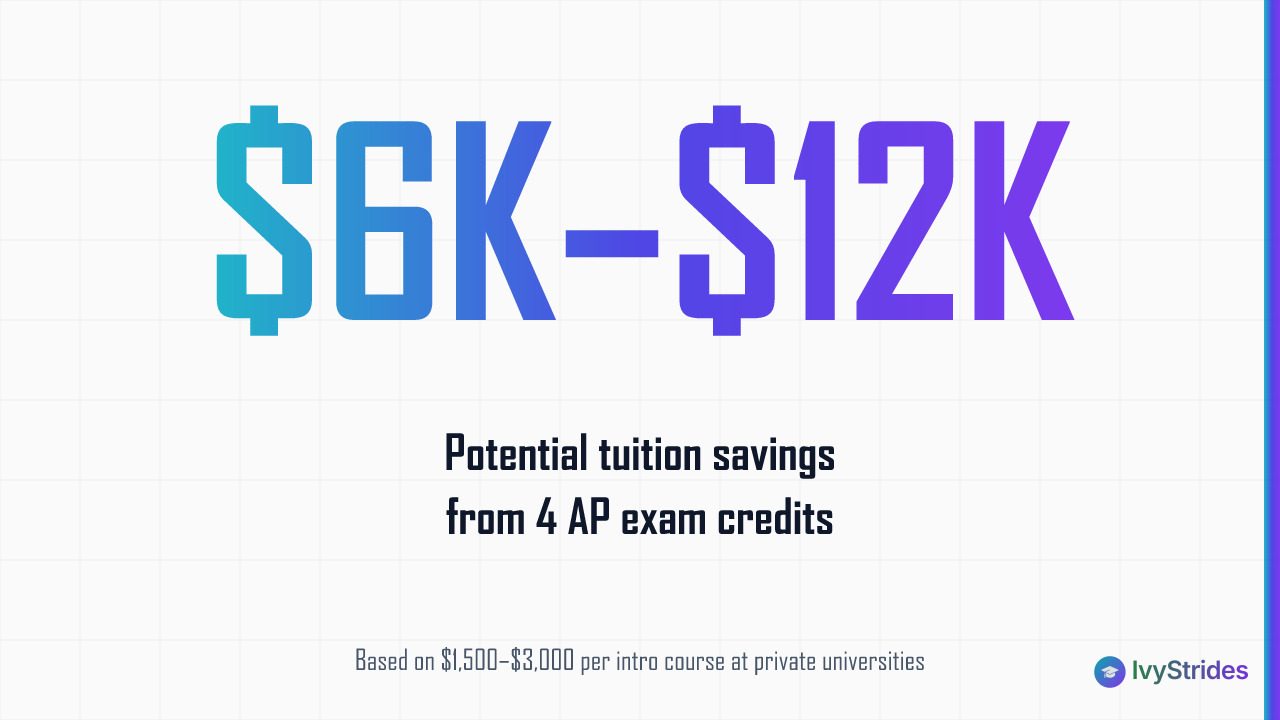
Tuition savings on the other side. A single introductory course at a private university typically runs $1,500 to $3,000. A student earning credit for four AP exams could reduce tuition cost by roughly $6,000 to $12,000, and in some cases graduate a semester early. Public universities discount those numbers, but the mechanism holds.
International students. AP exam fees run higher outside the US, and testing centers may charge additional administration fees. In our coaching with international students applying to US colleges, three to four targeted APs in STEM subjects usually delivers a stronger college-readiness signal than a scattered five or six.
For a fuller breakdown of the direct and indirect costs, see how much AP costs for families.
One caveat every family should read: AP credit policies vary by college and by subject. Confirm your target schools' policies before deciding an AP is worth the fee purely for credit reasons.
AP Stress Is Real: How Many AP Classes Are Too Many?
AP stress is real, measurable, and predictable. The National Bureau of Economic Research has documented that student stress rises sharply during high-stakes exam weeks, and the May AP exam window is exactly that kind of stretch, stacked across two weeks of testing.
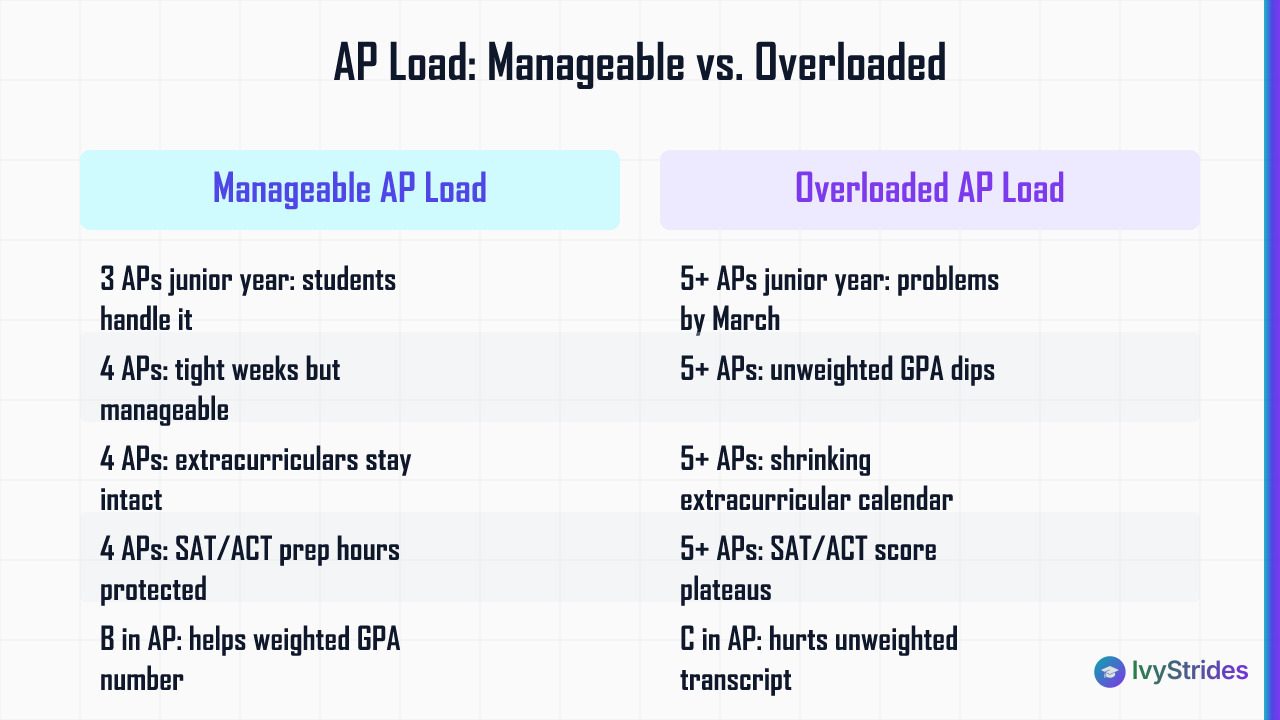
Here is the pattern we see in our coaching. Students taking three APs in junior year handle it. Four APs makes for tight weeks, but manageable. Students taking five or more in junior year almost always show one of three things by March: a dip in unweighted GPA, a shrinking extracurricular calendar, or a stalled SAT or ACT score because prep hours got squeezed out.
The weighted GPA math is seductive and misleading. AP typically adds 1.0 point to weighted GPA, which pushes the number up. But the unweighted grade still appears on the transcript, and admissions officers read both. A B in AP Chemistry helps the weighted number; a C in AP Chemistry hurts the unweighted number without a proportional rigor bonus.
The May scheduling conflict is the sleeper problem. AP exams run in early and mid-May. Digital SAT spring administrations sit right next to that window. Juniors who didn't lock their testing calendar in the fall end up prepping for both at once, which is how SAT scores plateau. Set the SAT or ACT calendar first, then the AP load.
AP prep and SAT prep compete for the same study hours in junior year, so a student's testing calendar should be set before AP course load is finalized. Students building a rigorous junior-year schedule should also account for PSAT prep in October, since National Merit recognition is a separate credential that runs on its own timeline; our PSAT strategy for juniors walks through that timing. For students already feeling the load, reduce stress while studying for the SAT has tactics that translate to AP prep too.
In our coaching, we cap most juniors at 4 APs and recommend 3 for students carrying heavy extracurricular commitments or a competitive testing schedule.
How AP Classes Affect College Admissions: What Selective Schools Actually Look For
Selective colleges read AP course load in context, not as a raw count. The question isn't "how many APs did this student take" but "how many did they take out of what the school offered, and how did they perform?"
A student who takes all seven APs their high school offers is demonstrating full available rigor. A student at a school with 25 AP offerings who takes seven is signaling something different. Seven APs can be sufficient for Harvard when grades, scores, and the rest of the application are competitive; the count alone doesn't decide it.
Harvard's AP credit policy is one of the strictest, per the Harvard College admissions site. A score of 5 is required for course credit, and four scores of 5 can qualify a student for Advanced Standing. Most other Ivy League and highly selective schools accept scores of 4 or 5 for credit in most subjects, with department-by-department variation.
Score reporting strategy. On the Common App, students self-report AP scores. Reporting 4s and 5s is standard. A 3 can generally be withheld without penalty at selective schools, though College Board still classifies a 3 as "qualified," per College Board. Confirm each target school's self-report policy before making the call.
Test-optional does not cover AP. Test-optional policies at many colleges apply to the SAT and ACT. AP scores are reported separately on the Common App and are not waived by test-optional status. Selective test-optional schools often still weigh AP performance heavily as evidence of academic readiness.
Strong AP performance gives admissions officers a data point, but the essay is where a student explains the choices behind the course load, including why they took a demanding AP in a subject they love. Our common app essay tutor coaches help students turn AP choices into an application narrative rather than a list of grades.
One more caveat: admissions decisions depend on the full application. A strong AP transcript alongside a weak essay or middling SAT score doesn't clear the bar at highly selective schools. For context on where test scores sit in that picture, is a 1540 a good SAT score unpacks the score-band question at the same tier.
What Percentage Do You Need for a 5 on an AP Exam?
There is no fixed percentage. College Board sets the raw-to-scaled cutoffs after each administration, based on that year's difficulty and student performance. On many exams the cutoff for a 5 lands roughly in the 65 to 75 percent range of raw points, but this is not a rule and it varies by subject and year.
AP scores use a 1 to 5 scale:
| Score | College Board Label | Typical College Credit |
| 5 | Extremely well qualified | Credit at most colleges, including selective schools |
| 4 | Well qualified | Credit at most colleges; some selective schools require 5 |
| 3 | Qualified | Credit at some colleges; rarely at highly selective schools |
| 2 | Possibly qualified | No credit at most colleges |
| 1 | No recommendation | No credit |
A 3 is not a failure. College Board classifies it as "qualified," meaning the student showed the ability to do college-level work in that subject. Whether a 3 earns credit depends entirely on the college.
5-rates vary widely by subject. AP Physics C: Mechanics and AP Calculus BC consistently show among the highest 5-rates in College Board's published score distributions, partly because the students who take them tend to be strong in math. AP US History and AP English Language typically show lower 5-rates, in part because they draw a broader student population.
Don't assume 70 percent of raw points equals a 5. On a harder exam, 70 percent might be a 5; on an easier one, it might be a 4. Master the content and the exam format, not a specific percentage target. For students self-studying accessible APs, how to self-study AP Statistics, Human Geography, or Environmental Science for a 5 walks through the mechanics.
How to Decide Which AP Classes Are Actually Worth Taking
Four filters, in order:
1. Alignment to intended major or demonstrated strength. A student planning to study engineering should prioritize AP Calculus BC, AP Physics C, and AP Chemistry over AP Art History, even if AP Art History looks easier on the schedule. Alignment signals intent; scattered APs don't.
2. Realistic grade expectation. If a student can earn a B or higher in the AP, take it. A B in AP Calculus BC signals more rigor than an A in a standard math course, and admissions officers read it that way. A C or below in an AP hurts the unweighted GPA without delivering a proportional rigor bonus.
3. Teacher and program quality. AP teacher quality varies dramatically across schools and even within the same building. If your school's AP Chemistry teacher has a track record of 4s and 5s, take it there. If not, consider whether an online AP course with a subject-specialist teacher would produce a better outcome. If you decide AP is the right move, the next question is whether your school's AP teacher is the right fit, and that is where online AP courses with a subject-specialist can fill the gap. Can you take AP classes online covers when the online path makes sense.
4. Target college credit policy. Before registering, check the AP credit policy at your target schools. If your top-choice school doesn't award credit for the AP you are considering, the exam still has admissions value but the credit-and-tuition math changes.
For students without a strong school AP program, online AP for homeschoolers shows how a full AP course load can be built independently.
A note on the hardest APs. AP Physics C: Mechanics, AP Physics C: Electricity and Magnetism, AP Calculus BC, and AP Chemistry consistently rank among the most demanding by workload. AP Environmental Science, AP Psychology, and AP Human Geography are commonly used as accessible entry points, though "easier" here means the content curve is gentler, not that a 5 is automatic.
AP vs. SAT: Which Should a Student Prioritize When Time Is Limited?
AP and SAT measure different things and serve different admissions purposes. AP tests college-level mastery in a specific subject. The Digital SAT tests reasoning, reading, writing, and math skills across a shorter, adaptive format.
Most students find AP material harder than SAT material, because AP is college-level content in one subject while the SAT stays within high school reasoning skills. The Digital SAT runs 2 hours and 14 minutes total, per College Board. AP exams typically run 2 to 3 hours per subject and include free-response sections that demand written arguments or multi-step problem solving.
Prioritize SAT prep when:
- The student hasn't yet hit their target admissions score
- Junior spring is approaching and AP exams are still weeks out
- The target college is test-required
Prioritize AP prep when:
- The SAT score is already at or near target
- The AP subject aligns with intended major and the score will be reported
- The target college awards meaningful credit for the AP
A student with a 1200 SAT and four AP 5s presents differently to admissions than a student with a 1500 SAT and no APs. Both signals matter. The application that works is the one where both show effort in the direction of the intended major.
Here's the scheduling insight most families miss: set the testing calendar first. Decide which SAT or ACT dates the student will sit, back-plan the prep hours, then finalize the AP course load. Reversing that order is what produces the March plateau. For students still deciding between the two admissions tests, act vs sat difficulty walks through the framework. For focused score work, 1-on-1 SAT prep pairs the student with a section-specialist coach.
Frequently Asked Questions About AP Classes, Stress, and Cost
Is AP stressful?
Yes. AP courses and exams are genuinely stressful, and the National Bureau of Economic Research has documented that student stress rises sharply during high-stakes exam weeks. In our coaching, students carrying three or more APs at once in junior year consistently report disrupted sleep and squeezed extracurricular time across the May window. That stress is manageable with a realistic schedule and section-specialist prep, but it should be planned for, not absorbed by surprise.
Is 70 percent of raw points a 5 on an AP exam?
Not necessarily. College Board sets score cutoffs after each administration, and they shift by subject and year. On many exams a 5 falls roughly in the 65 to 75 percent raw-score range; harder exams may set lower cutoffs and easier ones higher. Check the published score distribution for the specific subject rather than assuming a universal percentage.
Is 7 AP classes enough for Harvard?
Seven APs can be sufficient for Harvard when the student's grades, scores, essays, and extracurriculars are also competitive. Harvard reads course rigor against what your school offers: seven APs at a school with eight offerings shows full available rigor, while seven at a school with 25 offerings reads differently. For credit specifically, Harvard requires a 5, and four 5s can qualify a student for Advanced Standing.
What is the hardest AP class?
AP Physics C: Mechanics, AP Physics C: Electricity and Magnetism, AP Calculus BC, and AP Chemistry are the most consistently demanding by workload and content depth. Difficulty is also personal. A student who loves math may find AP Calculus BC more manageable than AP English Literature. Choose on demonstrated strength, not reputation alone.
Do AP classes actually prepare you for college?
Yes, with a caveat. College Board research has documented that students who take even one AP course tend to have higher first-year college GPAs and better four-year graduation rates than peers who didn't. The preparation comes from the college-level reading load, written analysis, and timed exams. The caveat: readiness quality depends heavily on the teacher. A weakly taught AP doesn't deliver the same benefit as a strong one.
Are AP exams worth it for international students?
For international students applying to US colleges, targeted AP scores can strongly signal college readiness, especially when the local curriculum doesn't map cleanly to US standards. The $99 exam fee (2026), plus international administration costs, is a real expense. In our coaching with international students, we recommend three to four APs aligned to the intended major and confirming each target US college's credit policy before registering.
What if I do not think I will get an A in the AP?
Take it if a B is realistically in reach. Below that the trade stops paying: the unweighted GPA takes the damage while the rigor credit stays flat. Decide on the honest grade forecast rather than the ambition, then pair the class with targeted prep so the transcript grade and the May score hold up together. If essays are on your radar, our essay review service helps students turn a strong AP transcript into a coherent application narrative.
The Bottom Line on Whether AP Is Worth It
AP is worth the stress and cost when the courses are chosen strategically: 1 to 4 APs aligned to strengths and intended major, taken with teachers or programs strong enough to produce 4s and 5s, at colleges whose credit policies you have checked. Beyond that threshold, the marginal admissions benefit shrinks and the burnout risk climbs.
The families who get this right start with the target colleges and the testing calendar, then choose the AP load that fits. The families who get it wrong pile on APs because the neighbor's kid took eight. You can read our approach on the IvyStrides About page. You can also meet the tutors who coach students through AP, SAT, ACT, and essays.

Two decades teaching quantitative and verbal aptitude on standardized tests. Rare dual expertise across Math and Verbal — particularly effective for students with gaps on both sides. Senior AP Mentor for our Calculus and English tracks.