
Does AP Help with College Admission? The Straight Answer for 2026 (and What to Do Next)
On this page
- The Short Answer: How AP Helps with College Admission in 2026
- AP Exam Scores vs. AP Course Grades: Which One Admissions Officers Actually Weight
- How Many AP Courses Do Selective Colleges Actually Expect to See?
- Will a Low AP Score Hurt Your College Application? What to Know About 3s, 4s, and Withholding Scores
- Not Sure Which APs to Take or How Hard to Prep for the Exam?
- Are AP Exams Harder Than the SAT? Understanding the Difficulty Spectrum
- How to Use AP Strategically as Part of Your College Application
- FAQ: AP and College Admission
- Is AP necessary for college admission?
- Do bad AP scores affect college admission?
- Is a 4 on an AP exam good for Ivy League applicants?
- Is 7 AP classes enough for Harvard?
- What is the hardest AP class?
- Does Harvard consider AP scores for admission?
- Do colleges care if I self-studied for AP instead of taking the class?
- Are AP scores out yet for 2026?
- Ready to Build an AP Plan That Actually Helps Your Application?
Yes, AP helps with college admission, but the AP course grade on your transcript carries more weight than the exam score. Admissions officers at selective colleges treat AP enrollment as evidence of course rigor, one of the top factors in holistic review. A strong grade in an AP class signals you can handle college-level work. The exam score, reported on the 1-5 scale, is a secondary signal: a 4 or 5 adds positive context, and a 3 rarely hurts.
The scoring framework used throughout this piece comes from the College Board AP Program; the test-optional context is drawn from FairTest. The next sections cover how much each piece weighs, how many APs are enough, what a low score actually costs you, and how to build a plan around all of it.

The Short Answer: How AP Helps with College Admission in 2026
AP helps with admission in two distinct ways, and it's worth separating them. The course on your transcript signals rigor. The exam score validates the grade. Selective admissions officers see the course first; the score is a second data point they can (or cannot) use, depending on whether you send it.
Course rigor sits at the top of nearly every published list of admissions factors at highly selective colleges. The mechanism is simple: an AP class on your AP course transcript tells an admissions officer you chose harder work when your school offered it, and your grade in that harder work reflects genuine college-level performance.
The exam score works differently. AP exam scores are reported on a 1-5 scale by the College Board AP Program, and you self-report them on the Common App. Official score reports are only required after admission if the college grants credit. That asymmetry matters: you get to decide whether a 3 lives on your application or not.
One caveat that trips families up. Test-optional policies apply to the SAT and ACT, not to AP scores. Self-reported scores from AP have always been optional. Test-optional status at a target college doesn't change how AP is evaluated; the transcript still shows the course. For a deeper look at the 1-5 scale itself, see our AP scores explained guide.
AP Exam Scores vs. AP Course Grades: Which One Admissions Officers Actually Weight
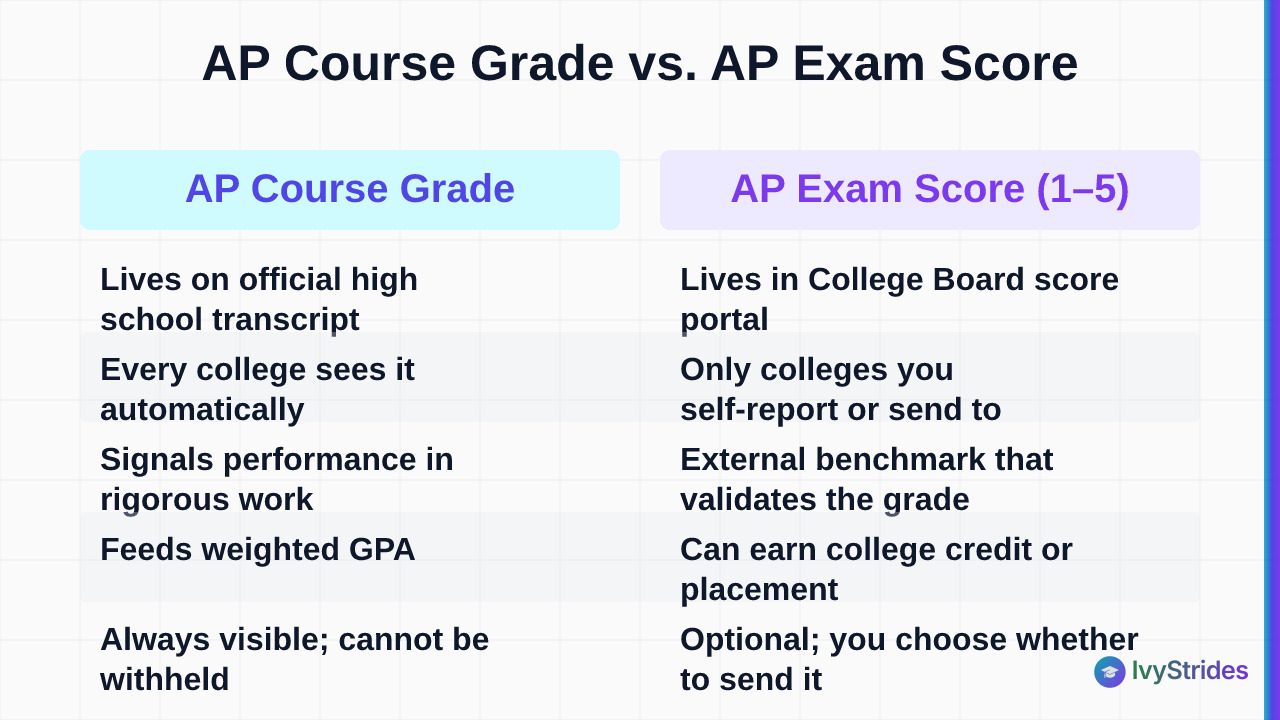
The AP course grade wins this comparison, and it isn't close. The grade lives on your official high school transcript. The exam score does not, unless you choose to send it. That single structural difference explains most of the confusion families run into.
Here's how each piece functions in an application:
| Element | Where it lives | Who sees it | Primary role |
| AP course on transcript | Official high school transcript | Every college automatically | Course rigor signal |
| AP course grade | Official high school transcript | Every college automatically | Performance in rigorous work; feeds weighted GPA |
| AP exam score (1-5) | College Board score portal | Only colleges you self-report to or send scores to | External benchmark; validates the grade |
That last row is the one to internalize. Because the score is self-reported, admissions officers use it as score validation, an external benchmark against the transcript. This matters more than it used to. A 4.3 weighted GPA is common at high-performing high schools, and grade inflation is a real phenomenon admissions offices track. A 5 on AP Chemistry alongside an A in AP Chemistry class tells an admissions officer the grade is real.
The reverse also matters. A B in AP Chemistry paired with a 5 on the exam still reads as strong: the exam validates the mastery. A B paired with a 2 is a rougher story. You'd choose not to send the 2, which is your right.
A related but separate benefit is college credit and placement. Depending on the score threshold (typically 3, 4, or 5), a strong AP score can exempt you from an intro course after admission. Whether your AP scores translate into actual credit depends on the school's policy and your score; our guide on do colleges accept AP credit walks through the details by institution type.
How Many AP Courses Do Selective Colleges Actually Expect to See?
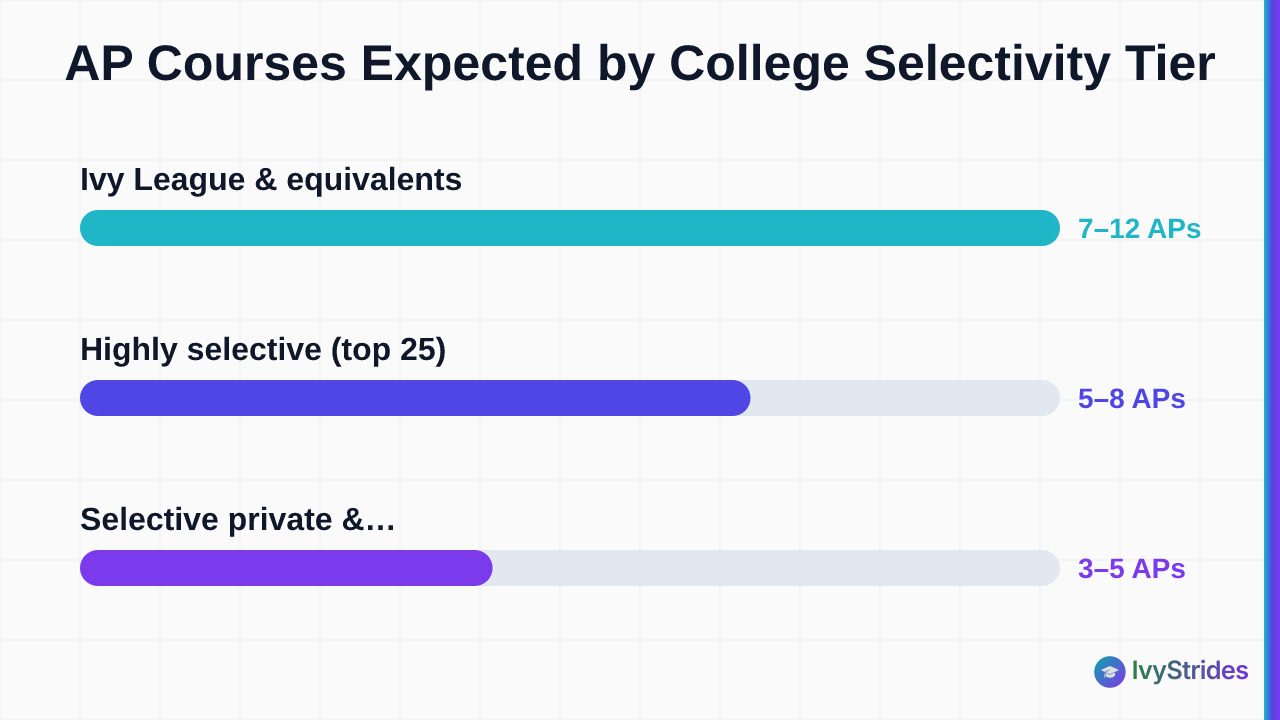
Selective colleges evaluate AP course count relative to what your high school offers, not against a universal target. That single sentence dissolves most of the anxiety families bring to this question.
Competitive ranges do exist by selectivity tier. Rough benchmarks from what we see in successful applications:
| Selectivity tier | Typical AP count across four years |
| Ivy League and equivalents | Roughly 7 to 12 |
| Highly selective (about top 25) | Around 5 to 8 |
| Selective private and flagship publics | Roughly 3 to 5 |
Is 7 AP classes enough for Harvard? Yes, seven sits inside the competitive band. But the count alone isn't what gets a student in. Course selection matters: seven APs that include the hardest offerings in your intended field beat seven easier APs. Grades in those courses matter more. And the rest of the application, essays, activities, recommendations, matters most of all.
Grade-level pacing matters too. A typical trajectory looks like zero to one AP in 9th grade (many schools don't offer APs to freshmen), one to two in 10th, two to four in 11th, and three to five in 12th. Junior year is where rigor shows up most visibly, because 12th-grade grades arrive after most decisions. For a grade-by-grade breakdown, see our guide on how many AP classes you should take.
What if your school offers few APs? Admissions officers know. Every application includes a school profile listing exactly what your high school offers. If your school has six APs and you took five, that reads as strongly as a student at a well-resourced school taking ten out of thirty. Students whose schools offer limited AP sections can take ap classes online and still earn the same admissions signal. IvyStrides runs ap courses online with per-subject AP subject specialist teachers for exactly this situation.
Will a Low AP Score Hurt Your College Application? What to Know About 3s, 4s, and Withholding Scores
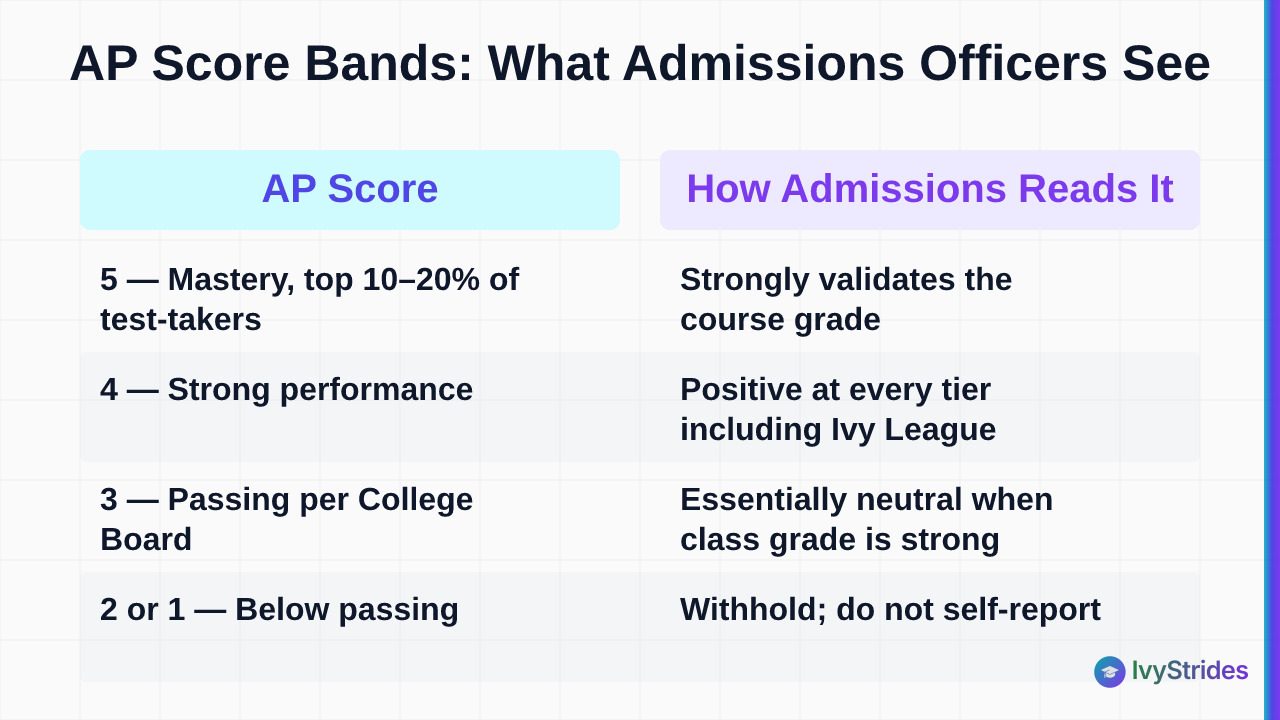
A single low AP exam score rarely hurts a college application, because you choose whether to report it. AP scores are always self-reported on the Common App, and you can decide, per exam, whether the number goes on your application at all.
Here's how the score bands actually read:
| Score | What it signals | How admissions officers read it |
| 5 | Mastery; top ~10-20% of test-takers by subject, per College Board | Strongly validates the course grade |
| 4 | Strong performance | Positive; adequate at every tier including Ivy League |
| 3 | Passing per College Board | Essentially neutral at most colleges when the class grade is strong |
| 2 or 1 | Below passing | Withhold; do not self-report |
A 3 is a passing score per the College Board. At most colleges outside the most selective tier, a 3 is fine to report. At the very top of the selectivity ladder, a 3 alongside an A in the class is essentially neutral: it neither helps nor hurts. Some highly selective applicants withhold 3s. That's a defensible choice, not a required one.
A 4 is a strong score. Is a 4 on an AP exam good for Ivy League applicants? Yes. A 5 is ideal, but a 4 does not disqualify anyone. In our coaching with students applying to highly selective schools, a 4 on AP Calculus BC or AP Chemistry carries positive weight, while a 3 on AP Art History in the same application is essentially neutral. Admissions officers read scores in the context of the subject and the student's intended direction.
What about withholding? Nothing on the Common App requires you to list every AP score. Withholding a 2 or 1 is reasonable and common. A few colleges (rare) ask students to self-report all standardized scores; check each school's application instructions. The pattern to watch is not any single low score but a spread: a high-GPA transcript sitting next to a string of 2s across multiple AP exams can raise questions about grade inflation. One 2 doesn't tell any story at all.
The single biggest mistake we see students make? Prioritizing exam prep at the cost of the course grade. In our coaching, students who focus on the AP course grade first and exam second consistently land better admissions outcomes than students who sacrifice grades to over-prep for a May test. The transcript is permanent. For subject-specific prep considerations, see is AP tutoring worth it.
Caveat, and it matters: admissions outcomes depend on the full application. No single AP score, high or low, decides the result.
Not Sure Which APs to Take or How Hard to Prep for the Exam?
In a free 15-minute call, an IvyStrides AP specialist will review your current course load, target colleges, and score goals, then give you a concrete recommendation on which APs to prioritize and how to prep for them. Students and parents are both welcome on the call.
Are AP Exams Harder Than the SAT? Understanding the Difficulty Spectrum
The comparison isn't apples to apples. The Digital SAT is a reasoning test: 98 questions across Reading & Writing and Math in about 2 hours 14 minutes of testing, scored 400 to 1600, per the College Board. An AP exam tests deep mastery of one college-level subject over roughly three hours, scored 1 to 5.
Different targets, different preparation, different kinds of hard.
AP exams also sit on a wide difficulty spectrum. The hardest tier, based on published College Board score distributions, includes:
- AP Physics C: Mechanics and AP Physics C: Electricity and Magnetism
- AP Calculus BC
- AP Chemistry
- AP English Literature and Composition
Some of these show single-digit 5-rate percentages in certain administrations, per the College Board, meaning fewer than one in ten test-takers earns the top score.
The more accessible AP entry points include AP Psychology, AP Human Geography, and AP Environmental Science, which show higher 5-rates and shorter content lists. That doesn't make them easy. It means the ceiling is more reachable for a student who studies well.
"Harder" also depends on you. A student who thinks in equations may find AP Calculus BC more manageable than AP English Literature, and vice versa. Pick APs where your track record supports success. For subject-by-subject guidance, see our AP exam prep by subject resource and our overview of how to study for AP exams.
How to Use AP Strategically as Part of Your College Application
Four rules, in order.
One: choose APs where you have demonstrated strength. If you earned a B+ or higher in the prerequisite course, the AP version is a reasonable next step. If you struggled at the pre-AP level, taking the AP for the rigor signal alone is a bad trade, because a C in AP hurts more than a B in Honors helps.
Two: prioritize the course grade above the exam score. For students targeting highly selective colleges, two to three APs in junior year with strong grades is more valuable than five APs with mediocre grades. The transcript is what admissions officers see automatically; the exam score is optional.
Three: give exam prep real lead time. Moving from a 3 to a 4 or 5 typically requires around 8 to 12 weeks of structured review before the May exam, in our coaching with students in that score band. The methodology is diagnostic-driven prep: a diagnostic to identify current unit-level weaknesses, targeted work with an AP subject specialist, and spaced retesting so you walk into the exam room knowing your actual performance level.
Four: treat AP, SAT/ACT, and the essay as one connected strategy. A strong AP record can partially offset a borderline SAT score at some schools. A stellar SAT can compensate for one weak AP. AP prep does not exist in isolation; for a connected plan that coordinates your AP schedule with SAT and ACT timing, see our AP, SAT, and ACT testing plan.
One more caveat. Test-optional policies vary by school and by year (see the FairTest tracker for the current list), and AP credit policies vary by college and by intended major. Always verify with the specific institution. Knowing when AP scores are released relative to college application deadlines also matters for your reporting strategy; our college application deadlines for fall 2027 piece covers the key dates.
If you're weighing whether the workload and exam fees are justified, our honest take on is AP worth the stress and cost covers the ROI question directly. For subject-specialist coaching, see our ap prep courses.
FAQ: AP and College Admission
Is AP necessary for college admission?
AP isn't a formal requirement at most colleges, but selective schools expect rigorous coursework, and AP is the most widely available way to demonstrate it. Students at schools with few AP offerings are evaluated on what was available. Skipping AP entirely when your school offers ten or more courses reads as a visible gap at highly selective institutions.
Do bad AP scores affect college admission?
A single 2 or 1 rarely hurts if you don't report it, since AP scores are always optional to submit. A pattern of low scores across several exams paired with a very high GPA can raise grade-inflation questions. Withholding a score you're not proud of is a common and defensible strategy.
Is a 4 on an AP exam good for Ivy League applicants?
Yes. Ivy League admissions officers view a 4 positively. A 5 signals full mastery, but a 4 does not disqualify an applicant. A consistent pattern of 4s and 5s across rigorous subjects carries meaningful weight, especially when the subject lines up with your intended major.
Is 7 AP classes enough for Harvard?
Seven APs across four years sits inside the competitive range for Harvard applicants. The admitted class typically shows roughly 7 to 12 APs, but the count alone isn't the deciding factor. Course selection, grades in those courses, and the strength of the full application matter more than hitting a specific number.
What is the hardest AP class?
AP Physics C (Mechanics and Electricity and Magnetism) and AP Calculus BC consistently rank among the most demanding, with 5-rates in the single to low double digits in some administrations per College Board data. AP Chemistry and AP English Literature also sit in the high-difficulty tier. Difficulty is relative to your subject strengths.
Does Harvard consider AP scores for admission?
Yes. Harvard reviews self-reported AP scores as part of holistic review, using them to validate rigor alongside the transcript. Harvard doesn't grant course credit for AP scores but does offer advanced standing for students who score 5 on qualifying exams. The admissions signal from strong AP scores is real even without the credit benefit.
Do colleges care if I self-studied for AP instead of taking the class?
Colleges generally view self-studied AP exams positively as evidence of intellectual initiative. Because there's no course grade on the transcript, the exam score carries proportionally more weight in that context. A 4 or 5 on a self-studied AP in a subject aligned with your intended major can strengthen your application.
Are AP scores out yet for 2026?
AP scores for the May 2026 exam administration are typically released in mid-July via the College Board student score portal. Log in with your College Board account to check. Release dates vary slightly by subject, so check the official AP score release schedule for your exam.
For related questions about cost and coaching, see should I pay for AP tutoring, how much do AP classes cost, and ap certification.
The takeaway is direct. AP helps. The course grade matters more than the exam score. The number of APs should match what your school offers. Low scores don't have to appear on your application. What most families need next isn't more research; it's a plan that fits their specific transcript, target colleges, and calendar.
Ready to Build an AP Plan That Actually Helps Your Application?
Book a free 15-minute strategy call. An IvyStrides AP coach will map your current AP schedule to your target colleges, identify the exams worth prepping hard for, and show you exactly where to focus your time between now and May.

Two decades teaching quantitative and verbal aptitude on standardized tests. Rare dual expertise across Math and Verbal — particularly effective for students with gaps on both sides. Senior AP Mentor for our Calculus and English tracks.