
How to Register for AP Exams in 2026-27: Deadlines, Fees, and Step-by-Step Sign-Up
On this page
- The Short Answer: How AP Exam Registration Actually Works
- Step-by-Step: How to Register for AP Exams Online Through Your School
- How to Register for AP Exams Without Taking the Class (Independent and Self-Study Students)
- AP Exam Registration Deadlines for 2026 and 2027
- How Much Does It Cost to Register for an AP Exam?
- What Happens If You Miss the AP Exam Registration Deadline?
- After You Register: Confirming Your Spot and Planning Your Prep
- FAQ
- What is the deadline to register for AP exams in 2026?
- Can I register for an AP exam if my school does not offer the class?
- How do I know if I am actually registered for an AP exam, not just enrolled in the class section?
- How many AP exams is too many to take in one year?
- What are the fees for AP exams for international students?
- Can a homeschooled student register for AP exams?
To register for AP exams, complete two steps: first, join your AP class section online at myap.collegeboard.org using the join code from your teacher or AP coordinator; second, notify your school's AP coordinator so they can officially order your exam and collect the fee. You cannot register directly with the College Board. The standard fee is $98 per exam in the US and Canada, and $128 per exam outside the US and Canada. Most schools set internal deadlines in October or early November, ahead of the College Board's November 15 framework date. Students not enrolled in an AP class can still register through a local AP coordinator.
These figures come from the College Board's official AP exam registration documentation and reflect the 2026-27 cycle; verify them annually, since the College Board can adjust fees and policy windows. The harder questions, what to do when your school doesn't offer the class, when the deadline has slipped, or when you're testing from outside the US, are where the next sections start.
The Short Answer: How AP Exam Registration Actually Works
AP exam registration is a school-mediated process. The College Board runs the exam and the My AP platform, but every student's registration goes through a person at a school: the AP coordinator. That person, not you, submits the exam order to the College Board and collects payment.
Here's the two-step framework every student follows, whether you're enrolled in an AP class or self-studying:
-
Join your class section on My AP. Log into your College Board account at myap.collegeboard.org, enter the join code from your AP teacher or coordinator, and confirm enrollment in the class section.
-
Confirm with your AP coordinator that you intend to take the exam. The coordinator adds you to the school's exam order, collects your fee, and submits the order to the College Board.
Joining a class section is not the same as being registered for the exam. That distinction is the single most common point of confusion we see in our coaching. A student can be enrolled in a class section on My AP and still not have an exam seat if no one ordered one. The College Board's AP registration page says this, but most students skim past it.
Per College Board's published AP exam fee schedule, the fee is typically $98 per exam in the US and Canada, $128 per exam outside the US and Canada, with a $40 late fee per exam for orders placed after the school's internal deadline. Confirm exact figures at the College Board's site for your testing year.
Before you go further, check the AP exam dates 2026 for your subjects so you know which May testing days you're committing to.
Step-by-Step: How to Register for AP Exams Online Through Your School

Photo by RDNE Stock project on Pexels
If you're enrolled in an AP class at your school, the sequence is straightforward, but you have to actually finish it. Here's the seven-step path inside My AP:
1. Create or log into your College Board account. Go to collegeboard.org and sign in. If you're a freshman or first-time test-taker, create an account with your legal name as it appears on school records. This is the same account you use for the Digital SAT, PSAT/NMSQT, and AP score reporting, so use a personal email you'll keep through high school.
2. Get your join code from your AP teacher. Each class section has a unique six-character join code. Your teacher hands it out in the first weeks of school. Missed it? Ask your teacher or your AP coordinator directly.
3. Go to myap.collegeboard.org and enter the join code. This adds you to your class section on the My AP platform.
4. Confirm class section enrollment. My AP will ask you to verify the teacher and section. Confirm it. You'll now see the class on your dashboard.
5. Notify your AP coordinator that you intend to test. This is the step most students miss. Joining a class section signals to your teacher that you're in the course; it does not tell the coordinator to order an exam for you. Most schools handle this with an internal form or a confirmation deadline. Ask your coordinator directly: "Is my exam ordered?"
6. Pay the exam fee by your school's internal deadline. Payment goes to your school, not to the College Board. Some schools collect via cash, check, or an online portal; some districts subsidize the fee entirely. Confirm the method and deadline.
7. Get written confirmation. Email your coordinator and ask them to confirm in writing that your exam has been ordered. Save the email.
That seventh step matters more than it sounds. In our coaching, students who lose exam seats almost always lost them because they assumed verbal confirmation was enough, or because they joined the class section and walked away thinking they were done. Get it in writing.
If you're looking at AP coursework outside your school's catalog, our ap courses online is one option for students whose schools don't offer a given subject.
How to Register for AP Exams Without Taking the Class (Independent and Self-Study Students)
This is the case the College Board's standard documentation handles least clearly, and where most of the panic registrations happen.
Independent registration is for any student whose school does not offer the AP class they want to take. Self-study students, homeschooled students, and students at schools without a particular AP subject all follow the same path. The fee is the same. The deadlines are the same. The only difference is who orders your exam.
Here's the sequence:
1. Start with your own school's AP coordinator. Even if your school doesn't offer the class, your coordinator can often add you to the school's exam order for an AP subject you're self-studying. Ask first. Many schools say yes.
2. If your school says no, find a host school. A host school is a nearby school whose AP coordinator agrees to add you to their exam order as an outside student. Use the College Board's AP coordinator locator to find schools in your area.
3. Contact host school coordinators early. Here's what to say in your email or phone call:
"Hi, my name is [Name]. I'm a [grade] student at [School Name]. My school does not offer AP [Subject], and I am self-studying for the May [Year] exam. Would your school be willing to host me as an outside student for the AP [Subject] exam? I understand I would pay the standard $98 fee directly to your school. Please let me know what materials or registration steps you need from me."
That's it. Short, professional, specific. Naming the subject, the year, and the fee signals you've done your homework.
4. Expect to contact more than one school. In our coaching with international and self-study students, the most common friction point is finding a willing host school. A self-study junior we worked with last fall registered for AP Computer Science Principles independently by contacting three schools before a coordinator agreed to host. The timeline from first email to confirmed registration was six weeks. Start in September, not October.
5. Homeschooled students follow the same path. There is no separate homeschool registration system. Contact local schools, ask to be added as an outside student, and pay the standard fee.
6. International students typically pay $128 per exam per College Board's published fee schedule and must test at a College Board-authorized test center in their country, or arrange to test at a US-based school. Many international schools host AP exams; the AP coordinator locator covers them as well.
Reddit and Quora threads on this topic share the same refrain: "My school doesn't offer this class, can I still take the exam?" Yes. But you need to act early, and you need to be the one driving the process.
For students self-studying, our guide on how to study for ap exams walks through the prep side once registration is locked in. If you're newer to the AP system entirely, start with what is ap.
AP Exam Registration Deadlines for 2026 and 2027
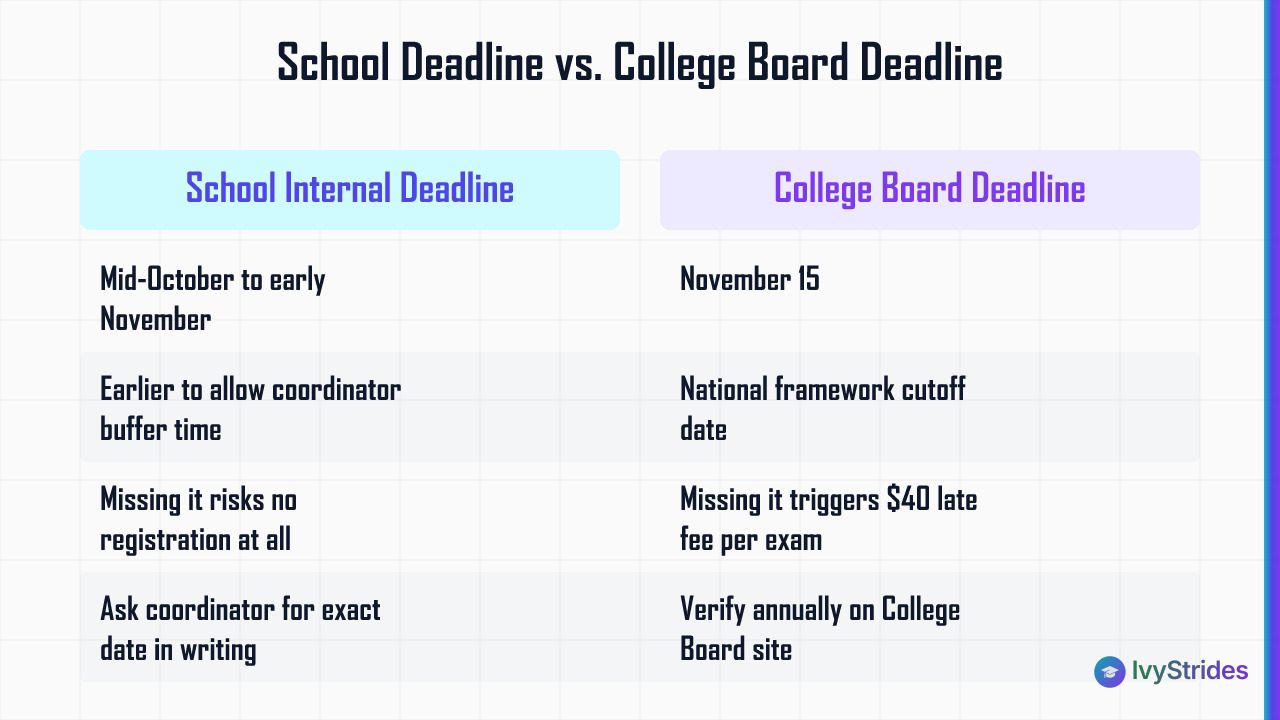
The College Board's national framework deadline is November 15 for most AP exams. That date applies to the 2025-26 and 2026-27 cycles, per the College Board's official AP registration page. Verify annually.
Here's the part most students miss. Your school's internal deadline is almost always earlier than November 15. Schools build in buffer time so the coordinator can compile and submit the full exam order before the College Board cutoff. In practice, most US high schools set internal deadlines in mid-October to early November. Some are earlier.
What this means: if you wait until November 14 to ask your coordinator about registering, you've probably already missed your school's deadline, and you're now typically looking at the $40 late fee per exam per College Board's published fee schedule, assuming your coordinator agrees to process a late add at all.
Before you register, confirm the exact exam date for each subject you plan to sit, since AP exams run across two weeks in May and scheduling conflicts can affect which exams you take. The full schedule is in our AP exam dates 2026 article.
If you are still deciding which AP exams to register for, a goal-based framework for choosing the right number of APs can help you avoid over-committing before the deadline. See how many AP classes should you take for the framework we use with students.
Action step: email your AP coordinator this week and ask for two dates in writing: your school's internal registration deadline, and your school's late registration cutoff. Put them in your calendar.
How Much Does It Cost to Register for an AP Exam?
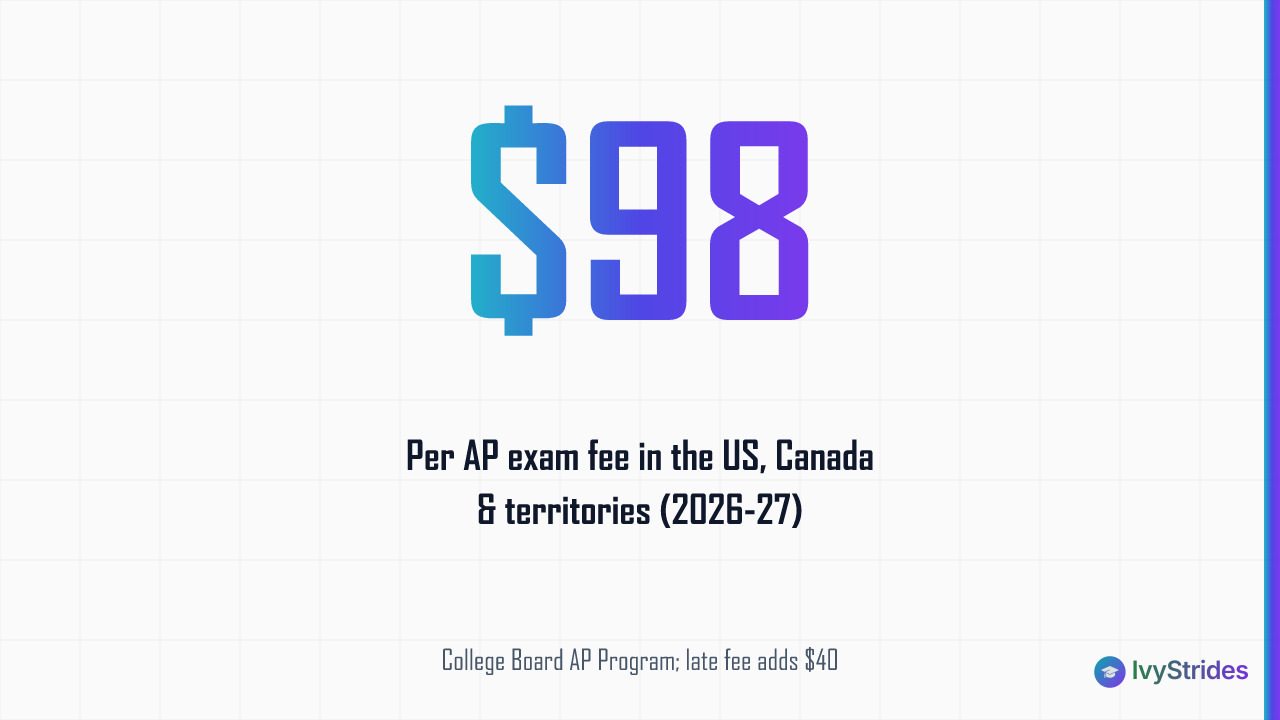
Per the College Board's AP Program, the 2026-27 fees are:
- $98 per exam in the United States, Canada, US territories, and DoDEA schools.
- $128 per exam for testing locations outside the US and Canada.
- $40 late registration fee per exam, added on top of the base fee for orders placed after your school's internal deadline.
- Fee-reduction grants are available for students with demonstrated financial need. The College Board grant reduces the fee substantially; eligibility is determined through your school. Ask your AP coordinator or counselor.
Several states and districts subsidize AP exam costs entirely or partially. Florida and Tennessee, for example, have historically covered AP exam fees for public school students. Policies change year to year, so confirm with your school's coordinator rather than assuming.
Payment goes to your school, not to the College Board. Your school collects the fee, then remits the total exam order. This is why your coordinator handles payment timing, refund policy, and any fee-reduction paperwork.
A note on refunds: if you register and then can't sit the exam, an unused/canceled exam fee of around $40 typically applies, with the remainder refunded through your school. The exact policy is in the AP Coordinator's Manual for the current year. Confirm with your coordinator before assuming a refund.
For students also navigating SAT registration alongside APs, see SAT fees and waivers for the parallel structure on that test.
What Happens If You Miss the AP Exam Registration Deadline?
This is the question that drives the most panicked emails to our coaches in November and February. The honest answer has three layers.
Layer 1: You missed your school's internal deadline, but the College Board's late ordering window is still open. You can usually still register through your coordinator, with the $40 late fee per exam added. The coordinator has to approve it. If you've been a reliable student and there's a clear reason for the late request, most coordinators will say yes. Email them immediately. Don't wait until next week.
Layer 2: The College Board's late ordering window has closed. No new exams can be added for that May administration cycle. There is no appeal process. Your option at that point is to register for the same exam the following year.
Layer 3: Subject-specific cutoffs. Some exams have stricter cutoffs than others. Portfolio-based exams like AP Art and Design require students to be registered well before the standard deadline because portfolio materials and submission systems must be set up months in advance. Lab-component exams may also have earlier cutoffs depending on materials shipping. Check your subject specifically.
If you missed your school's internal deadline, here's the script for the email to your coordinator:
"Hi [Coordinator Name], I missed the internal deadline for AP [Subject] registration. I understand a $40 late fee applies. Is it still possible to be added to the exam order? I'm prepared to pay the base fee and late fee today. Please let me know what you need from me."
Short, direct, accountable. That's the version that gets a yes.
Once you're registered, the prep clock starts. Subject-specific prep paths are covered in our ap exam prep by subject article.
After You Register: Confirming Your Spot and Planning Your Prep
Registration is the gate, not the goal. Once you've paid the fee and your coordinator has confirmed the exam order, two things matter: verifying the registration is real, and starting structured prep.
Verifying registration. My AP will show your class section enrollment, but it does not always clearly show that your specific exam has been ordered. The authoritative source is your AP coordinator. Email them: "Can you confirm in writing that my AP [Subject] exam has been ordered for the May [Year] administration?" Save the response. If you don't hear back within a week, follow up.
AP scores: what you're working toward. Scores are on a 1-to-5 scale and are released in July following the May exam administration, per the College Board's AP Program. A score of 3 is generally considered passing, with 4 and 5 representing higher levels of mastery. College credit and placement policies vary widely by institution and major. Some colleges grant credit for a 3; others require a 4 or 5; some give credit only in specific subjects. Always check the AP credit policy at each target college; never assume.
Once your registration is confirmed, the next priority is building a structured study plan so you arrive at the exam with enough practice under your belt to score a 4 or 5. Each AP subject has a different exam structure and scoring distribution, so your prep plan should be tailored to the specific units and question formats for your exam.
For students registered for AP Calculus AB or BC, a subject-specific 12-week prep plan can make the difference between a 3 and a 5. See our breakdown of how to get a 5 on AP Calculus for the structure we use. For 1-on-1 coaching options, our AP Calculus AB page covers the program details.
Strong AP scores strengthen the academic rigor section of a college application, but they work best alongside a compelling personal statement and well-crafted supplemental essays. AP scores demonstrate course-level mastery; essays demonstrate voice, judgment, and fit. Both matter. Neither alone is enough.
For subject-specific coaching across the full AP catalog, see our best online ap courses page.
FAQ
What is the deadline to register for AP exams in 2026?
The College Board's national framework deadline is November 15 for most AP exams in the 2025-26 cycle, per apstudents.collegeboard.org. Most schools set their own internal deadlines in October or early November. Confirm the exact date with your AP coordinator rather than relying on November 15 alone. Late registrations after the school deadline incur a $40 per-exam fee and require coordinator approval.
Can I register for an AP exam if my school does not offer the class?
Yes. Students whose school does not offer a particular AP course can register independently by contacting an AP coordinator at their own school or a nearby school willing to host them as an outside student. Use the College Board's AP coordinator locator at apstudents.collegeboard.org to find a host school. The same $98 US fee and the same November deadlines apply.
How do I know if I am actually registered for an AP exam, not just enrolled in the class section?
Joining a class section on My AP is not the same as being registered for the exam. Official registration happens when your AP coordinator submits the exam order to the College Board and collects your fee. Confirm with your coordinator in writing, email is fine, that your exam has been ordered. If you don't hear back within a week of paying, follow up. Save the confirmation email.
How many AP exams is too many to take in one year?
There is no College Board limit on how many AP exams a student can take in a single year. In our coaching, we typically advise students to weigh their course load, extracurricular commitments, and realistic preparation time before registering for more than four or five exams in one cycle. Quality of preparation matters more than quantity for both score outcomes and admissions impact. The framework in our how many AP classes should you take article can help you decide before the deadline.
What are the fees for AP exams for international students?
Students testing outside the United States and Canada typically pay $128 per exam per College Board's published fee schedule, compared to $98 per exam within the US and Canada (verify annually at apstudents.collegeboard.org). International students must find a College Board-authorized test center in their country or arrange to test at a US-based school. The $40 late fee applies the same way if registration occurs after the host school's internal deadline.
Can a homeschooled student register for AP exams?
Yes. Homeschooled students follow the same independent registration path as self-study students per College Board's AP homeschool registration guidance. Contact an AP coordinator at a local school willing to host outside students and ask to be added to that school's exam order. The College Board's AP coordinator locator tool at apstudents.collegeboard.org helps identify nearby schools. The standard $98 fee and the standard deadlines typically apply.

Two decades teaching quantitative and verbal aptitude on standardized tests. Rare dual expertise across Math and Verbal — particularly effective for students with gaps on both sides. Senior AP Mentor for our Calculus and English tracks.