
AP Scholar Awards Explained: How to Qualify and What They Are Worth
On this page
- What Are AP Scholar Awards?
- AP Scholar Award Criteria for 2026
- The AP Scholar Awards College Board No Longer Offers
- Are AP Scholar Awards Worth Anything for College Admissions?
- Planning an AP schedule around a target score?
- How to Plan an AP Schedule That Earns Distinction
- When AP Scholar Award Notifications Arrive
- Frequently Asked Questions About AP Scholar Awards
- Do AP Scholar Awards come with money?
- Is AP Scholar with Distinction hard to get?
- Can I put AP Scholar on my resume or college application?
- What happened to National AP Scholar?
- Do retakes count toward AP Scholar Awards?
- When will I know if I earned an award?
- Can I earn more than one AP Scholar Award?
- Your Next Step on AP Planning
- Choose AP exams on evidence, not guesswork
AP Scholar Awards are academic recognitions from College Board for students who score well across multiple AP Exams, and there are three levels currently offered. AP Scholar goes to students who score 3 or higher on three or more AP Exams. AP Scholar with Honor raises that to an average of at least 3.25 across every exam you have sat, with four or more of them at 3 or better. Distinction sits one step further again: a 3.5 average and five qualifying scores. No money comes with any of them.
That last point matters, and so does one other. These awards are recognitions, not scholarships, and several AP Scholar awards that other sites still describe in detail no longer exist. If you're planning an exam schedule around State AP Scholar or National AP Scholar, stop: College Board has discontinued both.
This guide gives the current criteria, names the discontinued awards so you don't chase them, explains the averaging rule that catches most students out, and takes an honest position on what the recognition is worth in admissions. You can confirm any award you've already earned when you check your AP scores.

What Are AP Scholar Awards?
An AP Scholar Award is a designation College Board adds to your AP score report when your exam results across multiple subjects meet a published threshold. You don't apply for it. There's no nomination, no essay, and no committee. College Board calculates it automatically from the scores you already have.
Three things follow from that, and they're worth being clear about before you plan anything around them.
There's no money attached. The word "scholar" leads people to expect a scholarship, and these awards carry no funding whatsoever. If you're looking for AP-related financial benefit, it comes from credit rather than recognition, which do colleges accept AP credit covers.
You can't earn it in one year and lose it later. College Board grants awards on your cumulative record at the time of calculation, and once granted they stay there.
The award appears on the score report colleges receive, which means admissions officers see it alongside the scores that produced it.
AP Scholar Award Criteria for 2026
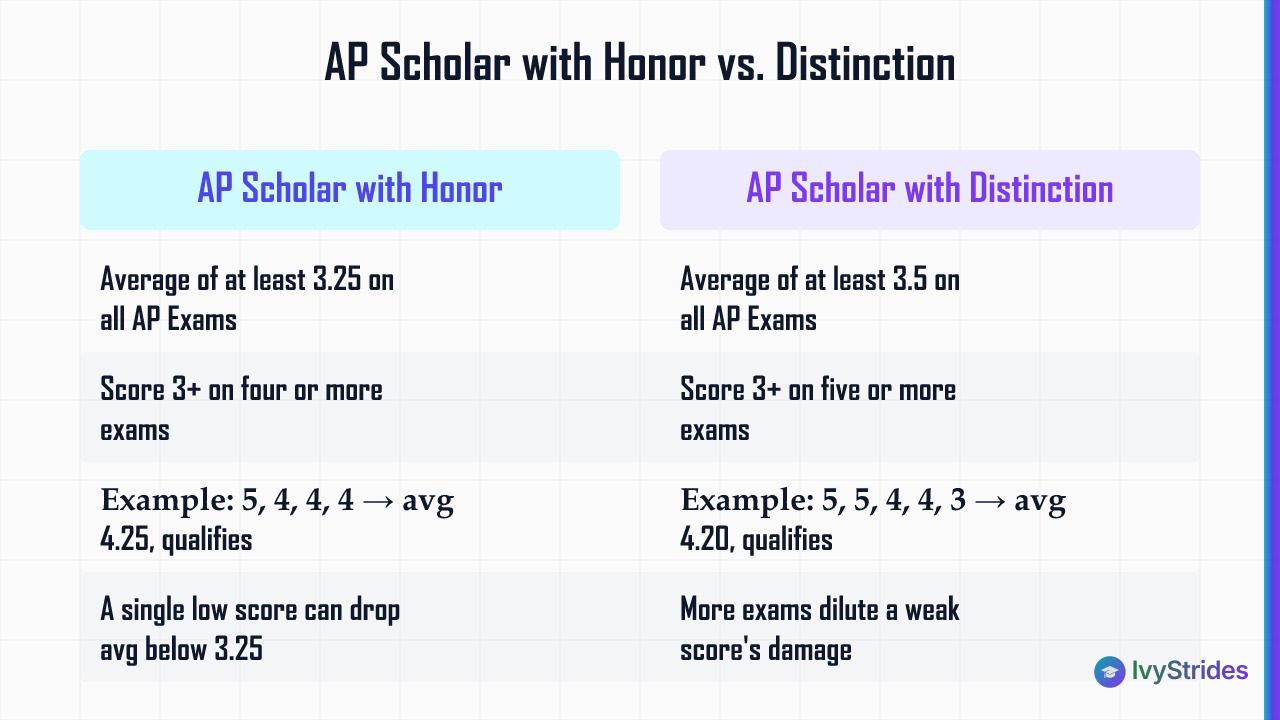
Here are the three levels College Board currently offers, with the exact qualification rules:
| Award level | Score requirement | Exam count requirement |
| AP Scholar | 3 or higher | Three or more AP Exams |
| AP Scholar with Honor | Average of at least 3.25 on all AP Exams taken | 3 or higher on four or more exams |
| AP Scholar with Distinction | Average of at least 3.5 on all AP Exams taken | 3 or higher on five or more exams |
The AP International Diploma is a separate recognition with its own requirements, published on its own College Board page.
Read the middle column of the top two rows again, because it contains the rule that surprises people. For AP Scholar with Honor and with Distinction, the average is calculated across all AP Exams you have taken, not just the ones you scored 3 or higher on.
A student with five exams scored 5, 4, 4, 4 and 1 has four scores of 3 or higher, which satisfies the Honor exam-count rule. Their average is 3.6, which clears the 3.5 average bar, but Distinction also needs five qualifying scores and they have four, so they land on Honor. But a student with 5, 4, 3, 3 and 1 has an average of 3.2, and that single 1 keeps them below the 3.25 line despite four qualifying scores. The weak score doesn't just fail to help. It actively pulls the average down.
That's why exam selection matters more than exam volume for these awards, and it's the opposite of what most students assume.
Five worked cases make the rule concrete. Each row is a full set of scores, and the award is whatever the results qualify for:
| Scores | Average | Scores at 3+ | Award earned |
| 4, 3, 3 | 3.33 | 3 | AP Scholar |
| 5, 4, 4, 4 | 4.25 | 4 | AP Scholar with Honor |
| 5, 4, 3, 3, 1 | 3.20 | 4 | AP Scholar only, average missed 3.25 |
| 5, 5, 4, 4, 3 | 4.20 | 5 | AP Scholar with Distinction |
| 5, 5, 4, 4, 3, 1 | 3.67 | 5 | Distinction, average survived the 1 |
Compare rows three and five. Both students sat an exam they scored 1 on. The third student had only five exams, so the 1 carried a fifth of the weight and dropped them below Honor. The fifth student had six, so the same score carried a sixth of the weight and they kept Distinction. The damage a weak score does depends on how many strong scores sit beside it.
The lesson isn't "take more exams to dilute a bad one". It's that a marginal exam you're unsure about costs you more when your total is small.
The AP Scholar Awards College Board No Longer Offers
A large number of pages about AP Scholar Awards still list criteria for awards that have been discontinued. College Board no longer offers any of the following:
- State AP Scholar
- National AP Scholar
- National AP Scholar (Canada)
- National AP Scholar (Bermuda)
- International AP Scholar
- DoDEA AP Scholar
If you earned one of these before College Board retired them, it still appears on your official AP score report and on any report you send to colleges. College Board takes nothing away retroactively.
But if you're a current student reading an older guide that tells you to sit a particular number of exams to reach National AP Scholar, that path no longer exists. Planning around it means spending exam fees chasing a target you cannot reach. Given that AP exams carry a per-exam fee, this is a real cost rather than a theoretical one, and it's a good reason to check the source date on anything you read about these awards.
The three levels in the table above are what remains.
Are AP Scholar Awards Worth Anything for College Admissions?

Photo by Andy Barbour on Pexels
Here's the honest answer: an AP Scholar Award is a summary of information colleges already have. It signals nothing they can't see by reading your score report directly.
That doesn't make it worthless. It makes it a byproduct rather than a goal. The distinction matters for how you spend your time.
Where it can genuinely help is in the places a short label does work that a list of numbers doesn't. A resume line, a scholarship application with limited space, a summer program form asking for academic honours. In those contexts "AP Scholar with Distinction" communicates a pattern of results in three words, and that's a real if modest advantage.
Where it doesn't help is the admissions read itself. An officer looking at your file sees the individual scores. The award adds no information on top of them. If you're weighing whether AP results move your application at all, does AP help with college admission takes that question on directly.
The practical implication: pursue strong AP scores, and let the award follow. Students who invert that, adding a fifth exam purely to reach Distinction, sometimes end up with a lower average and no award at all.
Planning an AP schedule around a target score?
We map which exams you are most likely to score 4 or 5 on.
How to Plan an AP Schedule That Earns Distinction
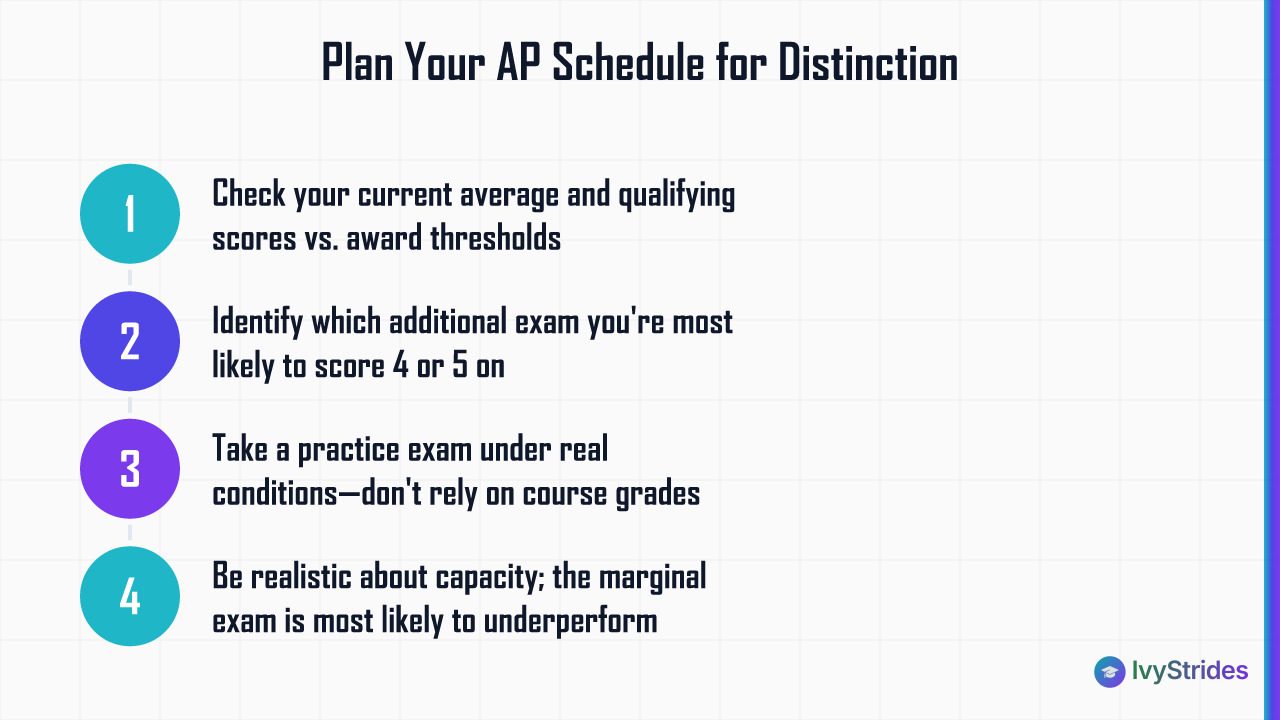
If Distinction is a goal, the averaging rule should drive your exam choices, and it points somewhere counterintuitive: taking one more exam can cost you the award.
Work through it. You have four exams scored 5, 4, 4 and 4. Your average is 4.25 and you have four scores at 3 or higher, so you hold AP Scholar with Honor. Distinction needs five qualifying scores, so you add a fifth exam. If you score 4, your average becomes 4.2 and you earn Distinction. If you score 2, you now have five exams averaging 3.8 but only four scores of 3 or higher, so you stay at Honor. If you score 1, your average drops to 3.6 and you still hold Honor, with one more exam fee spent and a 1 on your permanent record.
So the question isn't "how many more exams can I take." It's "which exam am I most likely to score 4 or 5 on."
That's a question about evidence rather than ambition. In our coaching, the exam a student is unsure about is the one that most often comes back a 2 or a 3. A practice exam under real conditions in a subject you're considering tells you far more than your course grade does, because AP grades and AP scores measure different things. Students who choose based on their current grade alone are guessing.
It's also worth being realistic about capacity. Five AP exams in one year is a heavy load, and the marginal exam taken purely for an award is exactly the one most likely to underperform. Is AP worth the stress and cost covers that trade-off in more depth.
When AP Scholar Award Notifications Arrive
Expect an email during the summer, and expect the award itself to appear on your score report from July. College Board notifies recipients directly, so there is nothing to claim or apply for.
There's no physical certificate mailed to your home. The recognition lives on your score report, which is where colleges see it. If you want it on a resume or application, you take it from there yourself.
If you don't see an award you think you qualified for, check the averaging rule first before contacting anyone. The most common explanation is a low score pulling the average below the threshold, and the second most common is having earned the award for a level you didn't expect, since the three levels sit on a single ladder rather than being separate applications.
Counsellors managing this across a cohort will find the administrative side covered in AP for teachers and counselors.
Frequently Asked Questions About AP Scholar Awards
Do AP Scholar Awards come with money?
No. They're academic recognitions with no scholarship funding attached. The financial benefit of AP comes from college credit that can reduce the number of courses you pay for, not from these awards.
Is AP Scholar with Distinction hard to get?
It requires an average of at least 3.5 across all AP Exams you have taken, plus scores of 3 or higher on five or more of them. The difficulty depends less on the number of exams than on keeping every score respectable, since a single low score pulls the average down.
Can I put AP Scholar on my resume or college application?
Yes. It's a legitimate academic honour and belongs in an honours or awards section. Just be aware that colleges see your actual scores too, so the award reinforces rather than replaces them.
What happened to National AP Scholar?
College Board discontinued it, along with State AP Scholar, International AP Scholar, DoDEA AP Scholar, and the Canada and Bermuda variants. Students who earned them before they were retired keep them on their score reports.
Do retakes count toward AP Scholar Awards?
Every AP Exam you take goes into the calculation, which is why the averaging rule matters. If you're considering a retake, remember it affects the average as well as the count.
When will I know if I earned an award?
College Board notifies recipients by email during the summer, and awards appear on score reports beginning in July.
Can I earn more than one AP Scholar Award?
The levels form a ladder rather than a set you collect. You're recognised at the highest level your results qualify for, and earlier awards remain on your record.
Your Next Step on AP Planning
In our coaching, almost every question about these awards arrives in July, after scores are released and the exam choices that determined the outcome are already fixed. The planning in this guide is only useful in the other direction, before you register. Treat AP Scholar Awards as confirmation that a plan worked, not as the plan. Pick exams you have evidence you can score well on, keep the average up rather than the count, and let the recognition arrive on its own.
If you want help deciding which exams those are, that decision should come from a diagnostic rather than from your course grades. You can read how we approach it on the IvyStrides about page. You can also meet the tutors who coach individual AP subjects.
Choose AP exams on evidence, not guesswork
Diagnostic-led planning with subject-specialist coaches.

Two decades teaching quantitative and verbal aptitude on standardized tests. Rare dual expertise across Math and Verbal — particularly effective for students with gaps on both sides. Senior AP Mentor for our Calculus and English tracks.