
How to Study for AP Exams in 2026-27: The Complete Method to Score a 4 or 5

On this page
- What Scoring a 4 or 5 Actually Requires: Hours, Weeks, and Honest Expectations
- Your Month-by-Month AP Study Plan: January Through May
- The Core Study Method: Spaced Practice and Active Recall
- How to Study for Multiple AP Exams Without Burning Out
- Using Official AP Resources: AP Classroom, Past FRQs, and Free Study Guides
- How to Know If Your Practice Score Is on Track for a 4 or 5
- The Final Two Weeks Before the AP Exam: What to Do and What to Stop Doing
- When Self-Study Is Not Enough: How Specialist Coaching Changes the Outcome
- FAQ
- Is a typical 70% raw score a 5 on an AP exam?
- What are the hardest AP exams to score a 5 on?
- Does a B+ in an AP class mean I will score well on the AP exam?
- How do you study for multiple AP exams at the same time?
- Can you self-study for an AP exam without taking the class?
- How long before the AP exam should I start studying?
To score a 4 or 5 on an AP exam, in our coaching students typically start at least 8-12 weeks before the May exam window per College Board's AP exam study guidance, spend 20-30 minutes per subject each day on active practice (not re-reading), and work through the AP Course and Exam Description unit by unit. Use AP Classroom progress checks to find your weak units, take at least two full-length timed practice exams before test day, and self-score every free-response question against the official College Board rubric. Cramming in the final two weeks is the single most common reason capable students score a 3 instead of a 4 or 5.
These framework points come from the College Board AP Program. The harder question is how to sequence the work across the weeks you have left, which is where the next section starts. If you're juggling three or more APs, skip ahead to the multi-exam section; if you're starting from scratch in February, read straight through.
What Scoring a 4 or 5 Actually Requires: Hours, Weeks, and Honest Expectations
AP exams are scored 1-5 by College Board. A 3 is considered passing, but most selective colleges grant credit only for a 4 or 5, and credit policies vary by institution and by subject. Always check the target college's AP credit chart before assuming a score will count.
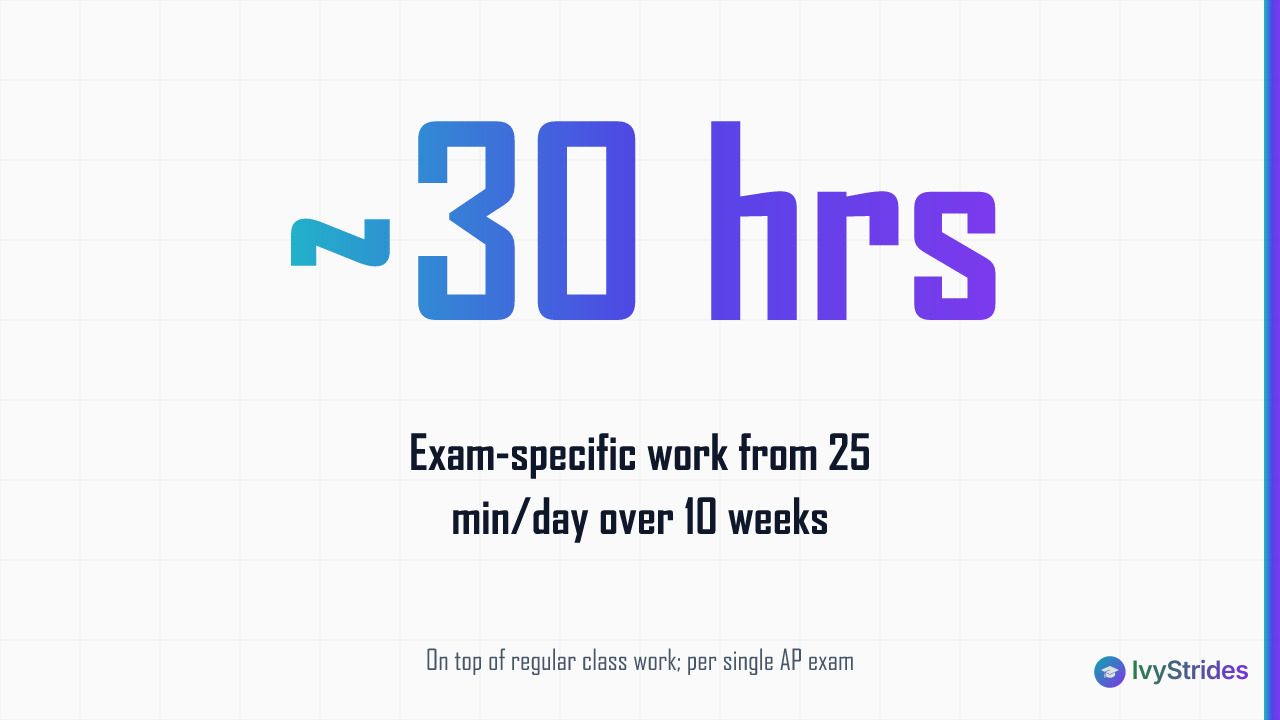
Here's the honest math. For a single AP exam, plan on 8-12 weeks of structured review, 20-30 minutes per day of active practice per subject, and at least two full-length timed practice exams. A consistent 25 minutes per day across 10 weeks adds up to roughly 30 hours of exam-specific work, on top of whatever you're doing for the class itself. Keeping up with class isn't the same thing as preparing for the exam. Class grades reward homework completion and unit tests; the AP exam rewards timed multiple-choice accuracy and free-response questions scored against a specific rubric.
Score distributions vary widely by subject. In many AP subjects, roughly 20-30% of test-takers earn a 5, but the rate is much lower in subjects like AP Physics 1 and AP United States History, and higher in subjects like AP Computer Science Principles. Check the current year's distributions at the College Board AP Program site for your specific subject.
In our coaching, students who begin structured exam review before March consistently outperform students at the same course-grade level who start in late April. The difference isn't IQ. It's the number of weeks available for spaced practice and the number of FRQs that get self-scored before test day.
Before you build the plan, confirm your test date and the courseload context. See AP exam dates 2026 for the full May calendar. If you're still deciding next year's schedule, our breakdown of how many AP classes should you take walks through the decision.
Your Month-by-Month AP Study Plan: January Through May
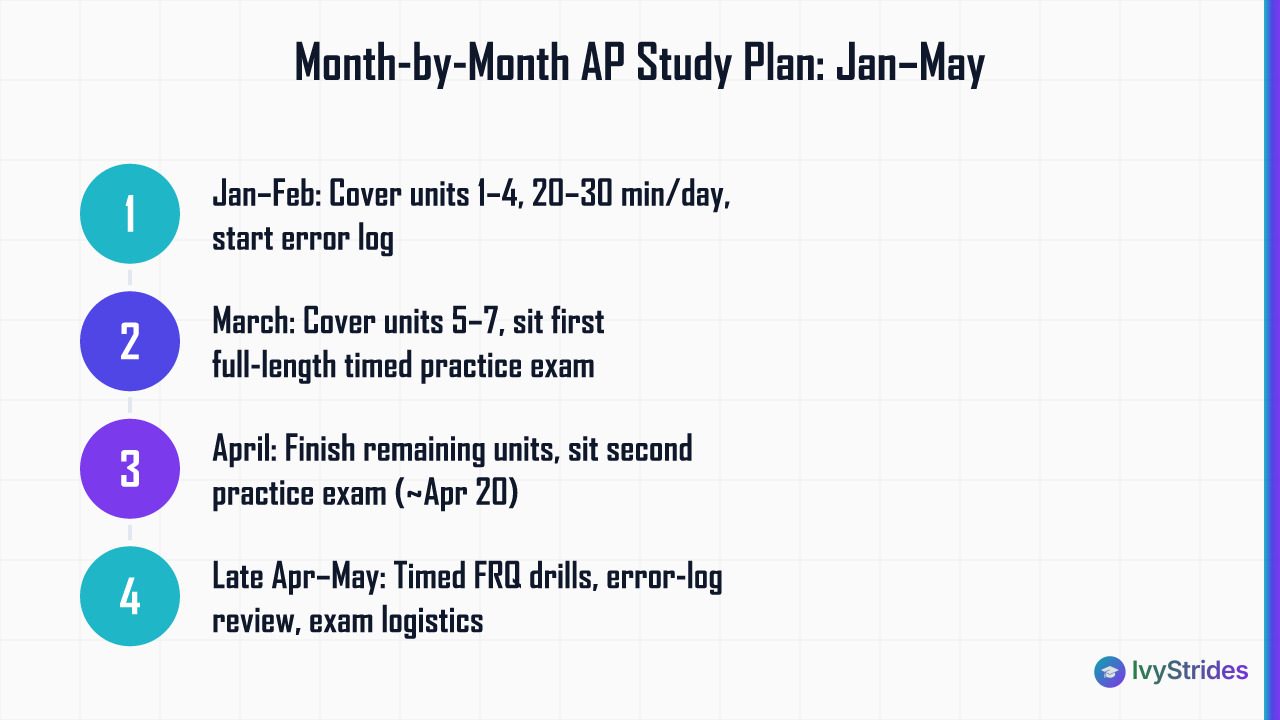
Adjust the unit numbers below to match your subject's AP Course and Exam Description (CED), which is the authoritative unit map for every AP exam and is available at the College Board AP Program site.
January and February: units 1-4, build the habit. Twenty to thirty minutes per day. Read or re-derive the major concepts in each unit, then immediately answer 5-10 topic questions in AP Classroom and review every wrong answer. Don't skip the review step. The point of practice is the diagnosis, not the question count. By the end of February, you should have completed at least one progress check per finished unit and started an error log: a running document of every wrong answer, sorted by unit and by the reason you missed it (content gap, careless arithmetic, misread the prompt, ran out of time).
March: units 5-7, plus the first full-length timed practice exam. In the second week of March, sit a full-length practice exam under real timing conditions. Most AP exams run 2.5-3.5 hours. Sit it in one block, on a Saturday morning if possible. Score the multiple-choice section against the official answer key and self-score every FRQ against the College Board scoring rubric. In our coaching, students who self-score at least 4 FRQs per subject before the exam show measurably stronger written-response performance on test day. The act of scoring your own response against a rubric forces you to internalize what the graders actually reward.
April: remaining units, second full-length practice exam, targeted weakness work. Finish the final units of the CED by mid-April. Sit your second full-length practice exam around April 20. Compare against your March results unit by unit. Whatever two or three units are still scoring lowest, those are the only units you study in the final two weeks.
Late April to early May: stop introducing new content. Timed FRQ drills, error-log review, exam-day logistics. That's it.
The month-by-month framework here is the general scaffold; for the unit-by-unit breakdown specific to your subject, see the per-subject guides linked throughout, including the detailed plan for how to get a 5 on AP Calculus.
If you're taking the class on your own or want structured instruction alongside the exam-prep schedule, our ap courses online cover the curriculum and the exam together.
The Core Study Method: Spaced Practice and Active Recall
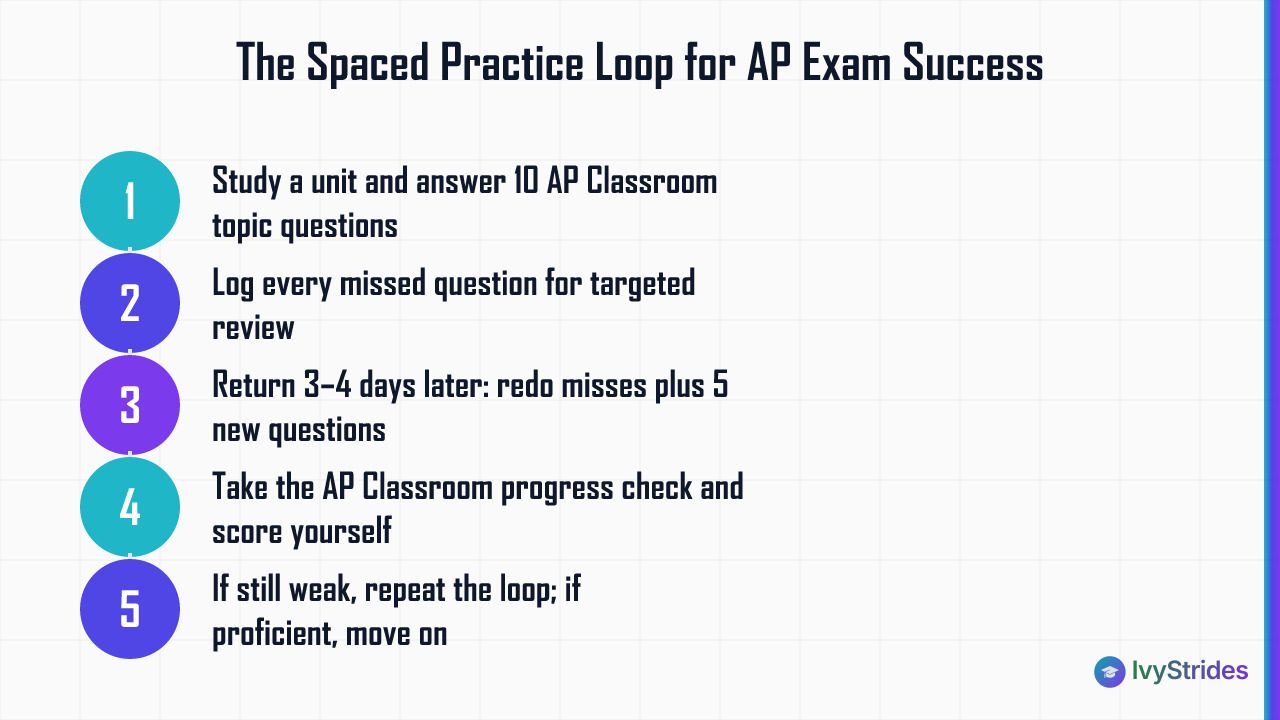
Here's the part most students miss. Re-reading your notes feels like studying. It isn't. In our coaching, students who re-read notes without testing themselves rarely improve their practice scores between sessions. Students who answer AP Classroom topic questions, immediately review their wrong answers, and return to those same weak topics three to four days later consistently do.
That gap of three to four days is the active ingredient. Spaced repetition means returning to a weak unit after enough time has passed that you have to actually retrieve the information from memory, not just recognize it on the page. Same-day re-reading produces the illusion of mastery. Spaced retrieval produces the real thing.
The practical loop looks like this. Monday: study Unit 4, answer 10 AP Classroom topic questions, log every miss. Thursday: redo only the missed questions plus 5 new ones from the same unit. The following Monday: take the AP Classroom progress check for Unit 4 and compare. If you're still in the "approaching" or "not yet" band, that unit goes back into the rotation. If you're at "proficient" or "advanced," move on.
For AP History, AP English, AP Calculus, and AP Science subjects, layer one timed FRQ per week starting in February. Self-score against the rubric the same day you write it. Past free-response questions going back multiple years are publicly available on the College Board AP Program site, organized by subject and year, with scoring guidelines.
The spaced-retesting logic here mirrors the same diagnostic-plus-targeted-practice cadence we use in SAT and ACT coaching, where students who complete at least three spaced full-length practice tests see the most consistent score gains. The methodology is the same: diagnose with a real assessment, work the specific weaknesses, retest to confirm.
For supplementary worksheets and templates, our free downloads library includes error-log templates you can copy.
How to Study for Multiple AP Exams Without Burning Out
Three APs is hard. Five is harder. The students who handle it well don't work more hours; they schedule the hours differently.
Rotate subjects in 25-30 minute blocks rather than dedicating full evenings to one subject. In our coaching, students managing 3 or more AP exams who rotate subjects in 25-minute blocks outperform students who dedicate full days to one subject at a time. The reason is interleaving. Switching subjects forces your brain to re-engage retrieval each time, which strengthens recall more than long blocks of the same material.
Prioritize by three criteria, in this order:
-
Exam date. AP exams cluster in the first two weeks of May. If two of your exams are on consecutive days, the earlier one gets the heavier review in the last week.
-
Current gap from target. If you're already hitting "proficient" on AP Classroom checks in one subject, that subject gets a maintenance dose, not a heavy dose. The subject that's still in "approaching" gets the time.
-
College credit value. A 4 in AP Calculus BC at your target university might earn credit for a full semester of calculus. A 4 in AP Psychology might earn only general elective credit at the same school. Check each target college's AP credit chart and weight accordingly.
A triage rule for the final two weeks: accepting a 3 on one exam to protect a 5 on a higher-priority exam is a reasonable tradeoff. Five 3s don't stack into the same admissions or credit value as one 5 and three 4s.
A junior we worked with last spring took AP Chemistry, AP US History, and AP Calculus AB. She used a rotating block schedule (Chem-APUSH-Calc, 25 minutes each, with a 10-minute break) five days a week from late January through April. She scored 4, 5, and 5 respectively. The schedule wasn't more hours than her classmates were putting in. It was better structured hours.
If you're not yet sure whether AP is the right courseload for you, see what is AP. For students who want structured instruction across multiple subjects, our ap prep courses cover each AP with per-subject specialist teachers.
Using Official AP Resources: AP Classroom, Past FRQs, and Free Study Guides
AP Classroom is the official College Board platform and the single most important resource you have. Access requires enrollment through your AP teacher or, for self-studying students, self-enrollment through the College Board AP Program account. Once you're in, you get four things: topic questions organized by unit, progress checks with immediate feedback, AP Daily videos covering every unit in the CED, and a personal progress dashboard that shows your performance by skill.
Use it weekly, not just at the end of a unit. In our coaching, students who use AP Classroom progress checks as a weekly diagnostic, rather than only at the end of a unit, identify weak sub-topics two to three weeks earlier than students who wait. Two to three weeks is the difference between fixing a weakness and walking into the exam with it intact.
Past free-response questions are the second pillar. The College Board AP Program site hosts past FRQs going back multiple years for every subject, with the official scoring guidelines that the AP readers actually use. Pick one a week, write it under timed conditions, and score yourself against the rubric. Be honest. Graders are.
Supplementary free resources from other online platforms can be useful for concept review, but treat them as supplementary. The official AP Classroom questions and past FRQs are calibrated to the actual exam. Third-party questions usually aren't.
If you're also doing SAT prep this spring, our free SAT resources hub covers that side of the timeline.
What official resources can't replace: timed full-length practice (you have to commit a Saturday morning to it), FRQ feedback from someone who actually knows the rubric (self-scoring catches most issues, but not structural ones), and pacing drills under exam conditions.
How to Know If Your Practice Score Is on Track for a 4 or 5
Here's a question we get every week in our coaching: "I'm getting 70% on my AP Classroom progress checks per College Board's official AP Classroom platform. Is that a 5?"
Not reliably. AP score conversions are set by the College Board AP Program after each exam administration and aren't publicly pre-released. The raw-score-to-scaled-score threshold varies by subject and by year. In many AP subjects, a raw score in roughly the 65-75% range is associated with a scaled score of 4 or 5, but that's a rough band, not a guarantee. AP Chemistry's curve isn't AP Psychology's curve.
A more useful gauge: AP Classroom progress checks label your performance by skill band (not yet, approaching, proficient, advanced). If you're consistently hitting "proficient" or "advanced" across all units by mid-April, you're likely on track for a 4 or 5. If you're stuck in "approaching" on multiple units after six weeks of structured study, that's the signal to escalate.
A separate question: does a B+ in an AP class mean I'll score well on the exam? Not automatically. Course grades reward consistent homework completion, classroom participation, and unit tests written by your teacher. The AP exam rewards timed multiple-choice accuracy and FRQs scored against a specific national rubric. In our coaching, students with a B+ course grade who haven't practiced timed FRQs or full-length exams often score a 3 rather than a 4 or 5. The skills overlap, but they aren't the same.
If your practice has plateaued and you can't tell why, it's almost always one of three things: a specific unit gap you haven't identified, an FRQ structural issue (you know the content but you're losing rubric points), or pacing on the multiple-choice. All three are easier to diagnose with someone watching your work. Meet our AP specialist tutors if you want a second set of eyes on your practice exams.
The Final Two Weeks Before the AP Exam: What to Do and What to Stop Doing
Stop introducing new content. This is typically the biggest mistake in the final stretch per College Board's AP exam preparation guidance. In our coaching, students who try to learn new units in the final week before the exam consistently underperform students who spend that time on timed FRQ practice and error-log review. There's a temptation to "finally get to Unit 9," but the marginal value of a half-understood new unit is typically lower than the marginal value of solidifying units you already know 70% of.
Here's what the final two weeks look like.
Days 14 to 8: One timed FRQ per day for written-response subjects (AP History, AP English, AP Sciences, AP Calculus FRQs). Self-score the same day. Re-do the highest-priority progress checks from your two or three weakest units. Read through your error log; look for repeat patterns. Do you keep missing stoichiometry? Keep losing thesis-statement points on DBQs?
Days 7 to 3: Shorter sessions, more variety. Mix one short FRQ with 15 multiple-choice questions. Pacing matters here. Most AP exams allow roughly 60-90 seconds per multiple-choice question depending on the subject; if you're routinely running over, practice the timing, not the content.
Days 2 and 1: Light review only. Re-read your error log. Look at the formula sheet or reference table for your subject. Confirm exam-day logistics: AP exams begin at 8:00 a.m. local time for morning sessions and 12:00 p.m. for afternoon sessions, with exact times confirmed at the College Board AP Program site. Confirm what you can bring (approved calculators for math and science exams, multiple sharpened No. 2 pencils, blue or black pens for FRQs on most exams). Sleep.
Test anxiety in the final days is normal. The same pacing-and-routine tactics work across exam types; our last-minute SAT tips cover exam-eve logistics in detail. If anxiety is interfering with your sleep or your performance, strategies to overcome test anxiety lays out specific techniques.
When Self-Study Is Not Enough: How Specialist Coaching Changes the Outcome
Can you self-study for AP exams? Yes. College Board allows any student to register for an AP exam regardless of whether they took the course, and with the CED, AP Classroom, and past FRQs, a disciplined student can absolutely score a 4 or 5 on their own. Most students who self-study successfully are already strong in the subject and start at least 12 weeks out.
But self-study has predictable plateau points. Three signals that more self-study won't fix the problem:
-
Your practice scores haven't moved in four weeks despite consistent daily work. That usually means there's a specific unit gap or a structural FRQ issue that you can't see from inside your own work.
-
Your FRQ scores are consistently below the rubric threshold for a 4 or 5, but you don't know which rubric points you're missing. FRQ rubrics are nuanced; even strong writers lose points to rubric structure they didn't realize mattered.
-
You're running out of time on the multiple-choice section. Pacing problems usually have a content-confidence root cause, and unwinding it requires watching the work in real time.
What per-subject specialist coaching adds at those points: a unit-level diagnostic that pinpoints the two or three units with the highest score-improvement use, FRQ feedback aligned to the actual rubric (not a generalist tutor's impression of it), and pacing drills calibrated to your specific timing pattern. IvyStrides AP coaching uses per-subject specialist teachers, so AP Chemistry students work with an AP Chemistry specialist, AP Calculus BC students work with an AP Calculus specialist, and so on. Not a generalist who teaches "AP."
For students who need full-course instruction alongside exam prep (especially for self-study APs without a school class), the best online AP courses at IvyStrides cover the full CED with per-subject specialist teachers. For students already in the class who want exam-targeted help in a specific subject, AP Calculus BC specialist coaching is one example of the per-subject 1-on-1 model.
FAQ
Is a typical 70% raw score a 5 on an AP exam?
Not reliably. AP score conversions are set by College Board after each exam administration and vary by subject and year. In some subjects, roughly 65-75% of raw points may correspond to a 4 or 5, but it isn't a fixed rule. The most accurate gauge of readiness is your performance on AP Classroom progress checks (proficient or advanced band) plus your self-scored FRQs against official rubrics.
What are the hardest AP exams to score a 5 on?
According to College Board score distributions, AP Physics 1, AP Chemistry, AP United States History, and AP English Literature and Composition historically have lower percentages of students scoring a 5 compared to subjects like AP Computer Science Principles or AP Environmental Science. The difficulty depends on FRQ demands and curriculum breadth. Check the current year's distributions at apstudents.collegeboard.org for your specific subject.
Does a B+ in an AP class mean I will score well on the AP exam?
Not automatically. Course grades measure homework, classroom participation, and teacher-written unit tests. The AP exam measures timed performance against a national rubric. In our coaching, students with a B+ course grade who haven't practiced timed FRQs or full-length exams often score a 3 rather than a 4 or 5. Exam-specific practice is a separate skill from keeping up with class.
How do you study for multiple AP exams at the same time?
Prioritize by exam date, current gap from target, and college credit value at your target schools. Rotate subjects in 25-30 minute blocks rather than dedicating full days to one subject. Set a minimum daily touchpoint for each exam, even if it's just one AP Classroom topic question set. In the final two weeks, triage: focus on the exam where you have the most to gain while maintaining lighter review for subjects already at target.
Can you self-study for an AP exam without taking the class?
Yes. College Board lets any student register for an AP exam regardless of course enrollment. You'll need the AP Course and Exam Description as your curriculum guide, AP Classroom access (through self-enrollment), and a disciplined unit-by-unit plan. Self-study is most successful for students already strong in the subject area with 12 or more weeks to prepare.
How long before the AP exam should I start studying?
In our coaching, students typically start at least 8-12 weeks before the May exam window per College Board's AP study guidance. Students targeting a 5 in a demanding subject like AP Chemistry, AP Physics 1, or AP US History benefit from starting in January or February. Starting in late April and cramming is the most common reason capable students score a 3 when they were on track for a 4 or 5.
The plan in this article works if you start it. The schedule is the easy part; the daily 25 minutes is the hard part. If you've already started and your practice scores have stalled, that's the moment to get a second opinion before you lose more weeks to the same plateau.

Two decades teaching quantitative and verbal aptitude on standardized tests. Rare dual expertise across Math and Verbal — particularly effective for students with gaps on both sides. Senior AP Mentor for our Calculus and English tracks.