
Early Decision vs Early Action vs Regular Decision: The Real Difference and Which One Is Right for You
On this page
- Early Decision, Early Action, and Regular Decision: What Each Plan Actually Means
- Does Applying Early Action Actually Improve Your Admission Odds?
- Is Harvard Early Action or Early Decision? How REA Works at Top Schools
- When Your Test Scores and Essays Need to Be Ready for Each Application Plan
- Not sure if your scores and essays are ready for an early deadline?
- Early Decision vs Early Action: Which Plan Fits Your Situation?
- Early Decision II: The Second Binding Round Most Students Overlook
- FAQ: Early Decision, Early Action, and Regular Decision
- Is early action binding?
- Does EA give you an advantage over regular decision?
- Is there a downside to applying Early Action?
- What is the early decision acceptance rate for Babson College?
- What is the easiest Ivy League school to get into ED?
- Is it better to apply ED or EA?
- Is Regular Decision binding?
- Can I apply Early Action to multiple schools at the same time?
- Ready to build an application plan around your real scores and deadlines?
Early Decision (ED) is a binding application plan: if you're accepted, you must enroll and withdraw every other application. Early Action (EA) is non-binding, with the same November deadline but no commitment; you keep the right to compare offers until May 1. Regular Decision (RD) is also non-binding, with January deadlines and late-March decisions. At selective schools, ED historically produces the largest acceptance-rate lift, EA a moderate one, and RD the smallest.
The harder question isn't what these plans are. It's which one fits your scores, your essays, and your family's financial picture, and that's what the rest of this article decides.

Early Decision, Early Action, and Regular Decision: What Each Plan Actually Means
Early Decision, Early Action, and Regular Decision are the three primary timing plans US colleges offer, plus two important variations: Early Decision II (a second binding round) and Restrictive Early Action (a non-binding plan with limits on where else you can apply early). Every plan uses the same application; only the deadline, the decision date, and the commitment level change.
Here's the whole picture on one screen. Verify each school's exact date on its admissions page before you submit, because deadlines shift by a day or two across the admissions cycle.
| Plan | Binding? | Typical deadline | Decision released | Apply to multiple schools? |
| Early Decision I | Yes | Nov 1 or Nov 15 | Mid-December | No, one ED school only |
| Early Decision II | Yes | Jan 1 or Jan 2 | Mid-February | No, one ED school only |
| Early Action | No | Nov 1 or Nov 15 | December or January | Yes, unless REA rules apply |
| Restrictive EA / SCEA | No | Nov 1 or Nov 15 | Mid-December | No, restricts other private EA/ED |
| Regular Decision | No | Jan 1 or Jan 15 | Late March or early April | Yes |
Four schools drive most of the confusion around Restrictive Early Action: Harvard, Yale, Stanford, and Princeton. Their round is non-binding but limits where else you may apply early. We'll cover the exact rules two sections down.
Most of these plans run through the Common App, which handles the personal statement, the activities list, and each school's supplemental essays inside one interface. A few colleges use the Coalition Application or their own platform; the timing categories stay the same. For a full calendar view, see our post on college application deadlines for fall 2027.
Does Applying Early Action Actually Improve Your Admission Odds?
Yes, applying early usually improves your odds at a given school, but the size of the lift depends on the plan and, honestly, on who else applies early. ED acceptance rates at selective schools typically run roughly 15 to 25 percentage points higher than RD rates at the same school, and at Ivy-level colleges the ED rate is often about two to six times the RD rate. EA gives a smaller but real advantage.
Why the gap? Two forces stack. First, self-selection: students who apply early tend to have polished applications, competitive scores, and clarity about fit, so the early pool is stronger than the RD pool on average. Second, demonstrated interest: ED signals a firm commitment to enroll, which helps schools protect their yield. EA carries no such signal, which is why its lift is milder.
Read the acceptance-rate numbers carefully. A school reporting a 25 percent ED rate and a 5 percent RD rate isn't offering a five-times boost to every applicant. If your scores, coursework, and essays sit below the school's admitted-student profile, applying early won't manufacture competitiveness; it just delivers a "no" earlier. In our coaching, students who apply EA before their SAT or ACT reaches the school's 25th-percentile range rarely benefit from the early-round lift the way competitive applicants do.
Test-optional policies vary by school and change year to year, so check each college's current policy before deciding whether to submit scores with an early application. If you're weighing whether to submit at all, our post on do colleges require SAT in 2026 walks through the current landscape. If your essays aren't strong enough to carry an early application, our college essay coaching is where students in this position spend their summer.
One more caveat: nursing programs, BS/MD tracks, and specialized conservatory programs sometimes carry earlier or separate deadlines that don't follow the general admissions calendar. Verify on the program's own page, not the general undergraduate admissions page.
Is Harvard Early Action or Early Decision? How REA Works at Top Schools
Harvard uses Restrictive Early Action, not Early Decision. So do Yale, Stanford, and Princeton (Princeton labels it Single-Choice Early Action). All four plans are non-binding: if accepted, you're not required to enroll, and you keep until May 1 to decide. What makes them restrictive is where else you can apply early during the same admissions cycle.
Under REA and SCEA rules, you generally cannot apply Early Action or Early Decision to any other private college. You can, however, apply Early Action to public universities, which matters if you're targeting the University of Michigan, UNC Chapel Hill, UVA, Georgia Tech, or the University of Georgia alongside Harvard or Yale. Each restrictive school publishes slightly different fine print (Yale, for example, allows some non-binding early rounds at foreign universities), so read the specific policy on that school's admissions page before you submit.
Decisions from REA and SCEA schools arrive in mid-December. Three outcomes are possible: admit, deny, or defer to Regular Decision. If you're deferred, you're released from the REA restriction and free to apply anywhere in the RD round. If you're denied, same freedom, plus you should update your college list quickly since RD deadlines are just weeks away.
The strategic implication is real. Choosing REA at one of these four schools means you spend your entire early round on a single highly selective private college. If Harvard, Yale, Stanford, or Princeton is a genuine reach for you but not your clearest first choice, you may get more strategic value from EA at multiple less selective schools, or ED at a school you'd truly commit to. For the score side of this decision, see how to send SAT scores to Harvard. If Stanford is on your list, our breakdown of whether Stanford accepts superscore covers how to time your sittings.
When Your Test Scores and Essays Need to Be Ready for Each Application Plan
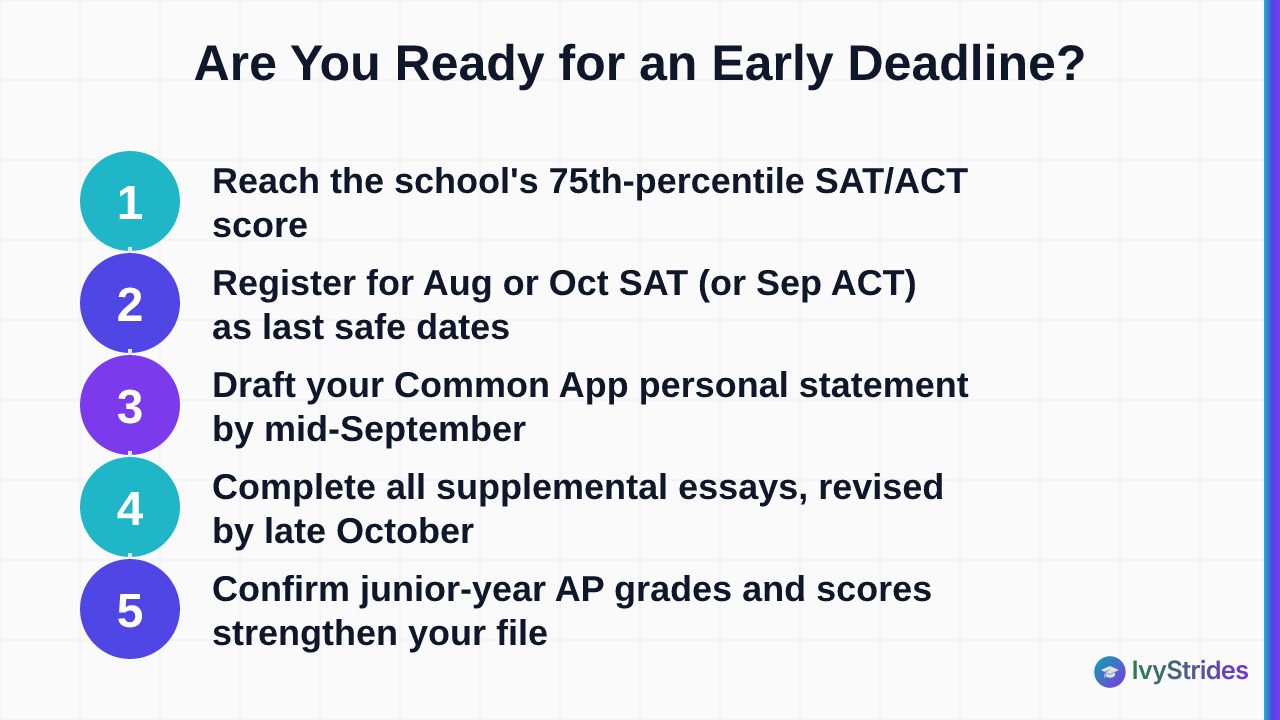
Here's the part most students miss. A November 1 deadline sounds far away in June and impossibly close in October. The readiness checklist below determines whether ED or EA actually makes strategic sense for you.
Your SAT or ACT score. Before you submit an ED or EA application, your score should sit at or above the school's 75th-percentile range, published in its Common Data Set. That's the benchmark that lets you benefit from the early-round acceptance-rate lift, rather than getting deferred to the RD pool. If your score isn't there yet, holding for RD (or ED II) gives you the December test date as one more retake opportunity.
The last test dates that reach a November 1 deadline. The August and October SAT test dates return scores in time for November 1 EA and ED deadlines; October is the last safe SAT sitting. For the ACT, the September test date is the last safe one; the October date is a tighter call and depends on how quickly the school processes scores. Register through the official ACT test dates page or College Board well in advance.
Your Common App personal statement. The essay runs 250 to 650 words. To submit November 1, the personal statement should be fully drafted by mid-September and fully revised by late October. In our coaching with students targeting ED schools, those who begin essay drafting in June or July consistently have more revision cycles before the October submission window, producing sharper final drafts.
Supplemental essays. These vary widely by school. A student applying EA to five schools may face roughly 15 to 25 supplemental essays across all of them. Our post on how to write supplemental essays that get you in covers the drafting cadence. Because ED and EA deadlines fall in early November, your Common App personal statement and supplemental essays need to be fully revised by late October, which is why many students begin essay coaching in the summer before senior year.
Your AP record. Junior-year AP grades and any AP scores you've already earned are visible to admissions officers when they read your file in November. If you're targeting an ED school, your SAT or ACT score needs to be at or above that school's 75th-percentile range before you submit, because you won't have time to retake after a November 1 deadline. A strong AP course load visible on your transcript by senior fall strengthens an ED application, since admissions officers can see junior-year AP grades and any AP scores you've already earned.
A pattern we observe across students: those who apply EA before their SAT or ACT score reaches the school's 25th-percentile range do not benefit from the early-round acceptance-rate lift in the same way competitive applicants do. If your score isn't ready, RD or ED II is often the smarter path.
Not sure if your scores and essays are ready for an early deadline?
Book a free 15-minute strategy call. We'll review your current scores, your target schools, and tell you exactly which application plan fits your timeline. No pressure, no sales pitch.
Early Decision vs Early Action: Which Plan Fits Your Situation?

Photo by Norma Mortenson on Pexels
Match yourself to the row that fits, then apply accordingly.
| Situation | Best plan | Why |
| Clear first choice, competitive application, family comfortable with aid range | ED I | Largest acceptance-rate lift, binding commitment is acceptable |
| Multiple strong-fit schools, want early answers, no first choice yet | EA (or REA at one) | Non-binding, keeps aid comparison intact |
| Score or essays not ready in October | RD or ED II | December scores available, more revision time |
| First choice clarified in December, or deferred from ED I | ED II | Second binding round with January deadline |
| Need to compare full aid packages before committing | RD | Only round where all offers arrive together |
Your choice of ED school should be your clearest first-choice reach or target school, not a safety, because the binding commitment means you forfeit the ability to compare offers. Applying ED to a safety school wastes the strategic advantage; you'd likely be admitted RD anyway, and you give up the aid comparison for nothing. For help sorting your list, see our post on reach, target, or safety: how to classify any college.
The financial-aid caveat matters. Under the National Association for College Admission Counseling guidelines, an ED applicant who receives an inadequate financial aid package may withdraw from the binding agreement, but this conversation should happen with your school counselor before you apply ED. What "inadequate" means in practice depends on the school and the family's demonstrated need. Run each ED school's net price calculator before you commit to the round, not after the decision arrives.
EA is the right call for students applying to multiple schools who want early answers without a commitment. You can apply EA to as many schools as you like, except during a REA cycle. That said, EA still front-loads your workload: our post on how many supplemental essays will you write puts the volume in perspective.
RD is genuinely the smarter choice more often than students think. If your score improved between September and December, if your essays needed the fall to develop, if your financial aid picture demands direct package comparison, RD wins. Applying early with a weak application doesn't "show interest." It shows an application that wasn't ready.
Nursing programs and specialized programs (BS/MD, conservatories, some engineering programs) may have unique deadlines, sometimes as early as October 15. Check the specific program page rather than assuming general admissions dates apply.
Early Decision II: The Second Binding Round Most Students Overlook
Early Decision II is a second binding round with a January 1 or January 2 deadline and a mid-February decision. Same rules as ED I: if you're accepted, you must enroll and withdraw all other applications. The only difference is timing. Many selective liberal arts colleges and universities offer ED II, including schools like Emory, NYU, Vanderbilt, Bowdoin, Middlebury, and Tufts; verify current offerings on each admissions page.
ED II is strategically useful for three kinds of students. First, students who were deferred or denied ED I at another school and now want to commit to a second-choice school that's still a genuine fit. Second, students who didn't clarify their first choice until December, after visiting campuses in the fall. Third, students whose SAT or ACT score improved after the October or November test date, making a new school competitive that wasn't before.
The December SAT falls before ED II deadlines at most schools. That's one more retake opportunity than ED I applicants get, which is the main reason improving your SAT score on a retake between October and December can meaningfully change your school list.
ED II still carries an acceptance-rate advantage over RD at schools that offer it, though the lift is typically smaller than ED I. Same binding commitment applies, so the "clear first choice" test still governs the decision. In our coaching with students who were deferred ED I, applying ED II to a second-choice school that's still a strong fit has produced acceptances in the February round.
FAQ: Early Decision, Early Action, and Regular Decision
Is early action binding?
No. Early Action is non-binding. You receive a decision in December or January but aren't required to enroll, and you can compare aid offers from every school before the universal May 1 reply deadline. Restrictive Early Action at Harvard, Yale, Stanford, and Princeton is also non-binding, though it limits where else you may apply early in the same cycle.
Does EA give you an advantage over regular decision?
Usually yes. At selective schools, EA acceptance rates typically run higher than RD rates at the same institution, partly because early applicants tend to bring stronger applications and partly because some schools use the early round to shape their class. The lift is smaller than the ED lift because EA carries no binding commitment.
Is there a downside to applying Early Action?
The earlier deadline. Test scores, personal statement, and supplemental essays all need to be finalized by late October for November 1. Submitting EA before your application is competitive can hurt your odds instead of helping them. If any piece still needs work, Regular Decision is the smarter move.
What is the early decision acceptance rate for Babson College?
Babson offers both ED and EA, and its ED rate historically runs higher than its RD rate, consistent with the national pattern at selective schools. For the current figure, pull Babson's Common Data Set from its admissions website; rates shift each cycle with applicant pool size and class composition.
What is the easiest Ivy League school to get into ED?
No Ivy is easy. All eight admit a larger share of their class through the early round than through RD, and Cornell and Dartmouth have historically shown some of the largest ED-to-RD acceptance-rate gaps among the Ivies. Applying ED only makes strategic sense if the school is a genuine first choice and your application is fully competitive; a weaker application doesn't inherit the ED average.
Is it better to apply ED or EA?
ED offers a larger acceptance-rate advantage but requires a binding commitment. EA offers a smaller advantage with no commitment. Pick ED only if the school is your clear first choice and the financial aid picture works. If you're still comparing schools, EA or RD fits better.
Is Regular Decision binding?
No. Apply by the January deadline, receive a decision in late March or early April, and decide by May 1. You keep the right to compare every aid package before committing.
Can I apply Early Action to multiple schools at the same time?
Yes, with one exception. Standard EA lets you apply to as many schools simultaneously as you choose. But Restrictive Early Action or Single-Choice Early Action at Harvard, Yale, Stanford, or Princeton bars EA or ED to other private colleges in the same cycle. Public universities remain open. For the writing side, see how to write a college essay step by step and our guide to AP, SAT, and ACT: how to build a winning high school testing plan.
Application-plan strategy isn't a single decision. It's a chain of them: which schools sit in your ED and EA rounds, whether your October scores clear each school's 75th-percentile bar, whether your essays hit the level admissions readers reward, and whether the aid picture works for your family. Get the sequencing right and the early rounds work for you. Get it wrong and you either commit under-prepared or leave real acceptance-rate advantage on the table. Our coaches at IvyStrides work through this sequencing with students and parents. You can also meet the tutors who lead each subject.
Ready to build an application plan around your real scores and deadlines?
Our coaches work with students and parents to map out exactly when to take the SAT or ACT, when to start essays, and which application round gives you the best shot at your target schools. Start with a free 15-minute call.

Award-winning author (South Asian Book Award) and graduate of BITS Pilani and UCLA Luskin School of Public Affairs. Brings a published writer's eye to Common App essays and grammatical precision to SAT and ACT R&W instruction.