
How to Balance AP Classes with Activities and Wellbeing
On this page
- A Grade-by-Grade AP Load Framework That Protects Your GPA and Activities
- What AP Load Actually Signals to Colleges: GPA, Rigor, and Activities Together
- How to Build a Weekly Schedule That Fits APs, Activities, and Sleep
- When to Cut Back on APs and What That Signals to Colleges
- FAQ: Balancing AP Classes, Activities, and Wellbeing
- How can I effectively balance school and extracurricular activities?
- What matters more, GPA or extracurriculars?
- Are AP classes extracurriculars?
- Is 6 APs good?
Balancing AP classes with extracurriculars and wellbeing comes down to one rule: take the most rigorous schedule you can sustain without dropping below a B in any AP course or cutting the one or two activities where you have real depth. AP course load is the yearly scheduling decision that most directly shapes your admissions profile.
For most students, that means one to two APs in grade 10, two to four in grade 11, and three to five in grade 12. Holding that load against your activity hours and sleep is the harder part, and it's what the rest of this article walks through, grade by grade.
A Grade-by-Grade AP Load Framework That Protects Your GPA and Activities
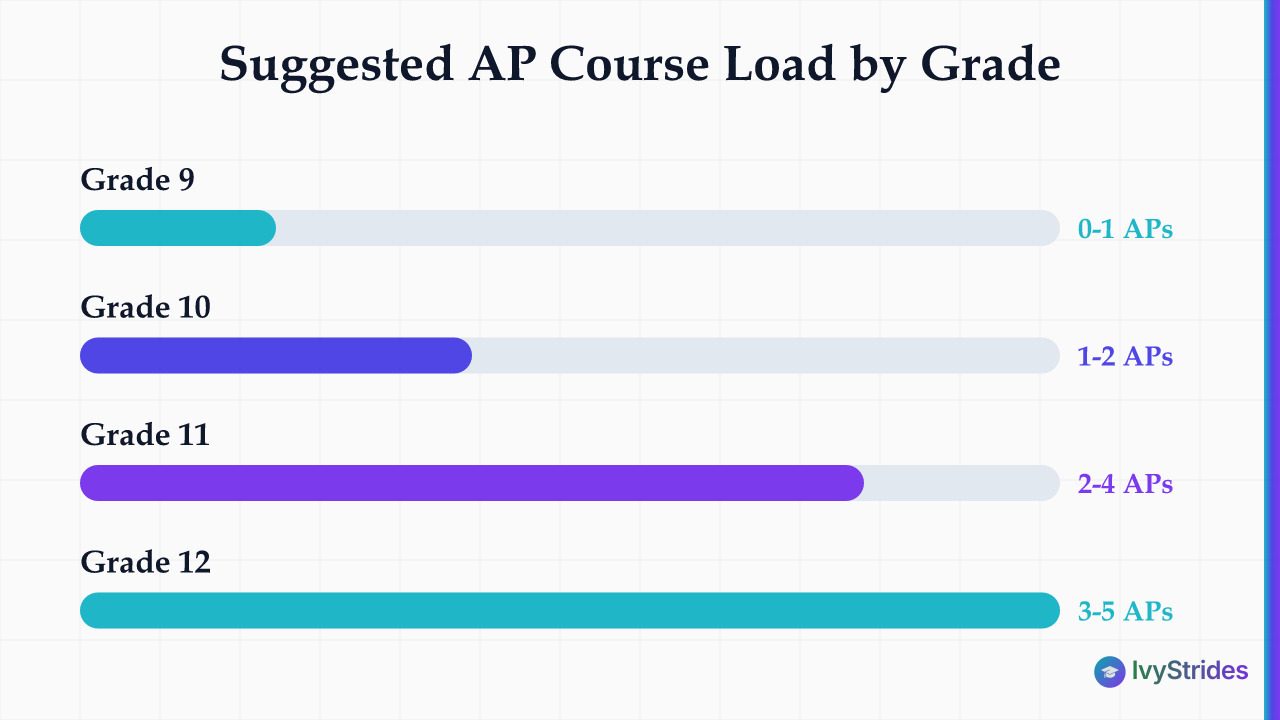
AP course load should escalate as you move through high school, not spike all at once. A workable scaffold is zero to one AP in grade 9, one to two in grade 10, two to four in grade 11, and three to five in grade 12. That range lets you build study stamina before the junior-year crunch, when admissions officers scrutinize rigor most closely.
Every AP Exam is scored on a scale of 1 to 5, and College Board's score table rates a 3 as "qualified," a 4 as "very well qualified," and a 5 as "extremely well qualified" to receive college credit and placement (College Board). The point is never just taking APs; it's earning scores that signal mastery.
The four-year pattern matters more than any single year. Selective colleges read your course record as a whole, and expectations differ by campus, so compare your plan with typical AP class counts at Ivy League and top colleges rather than chasing one number.
Start every AP plan from a weekly-hours estimate, because the count on paper means nothing if the hours don't fit. Homework, reading, and problem sets vary by subject and teacher, so ask students who took each course how much time it really took. Lab-heavy and reading-heavy courses differ, and the hardest AP classes and their weekly workload can tip an otherwise balanced schedule, so add a demanding course only when the rest of your week has room.
| Grade | Suggested APs per Year | Planning Focus |
| 9 | 0 to 1 | Build study habits and start an activity you care about |
| 10 | 1 to 2 | Add a first AP in a strong subject |
| 11 | 2 to 4 | Peak rigor year; protect your primary activity |
| 12 | 3 to 5 | Keep rigor steady while applications take time |
AP classes are not extracurriculars. They sit on your transcript under course rigor, not in your activities list. If your school offers only a handful of AP sections, AP classes taken online can carry the AP label on your transcript, but each one still adds homework to an already packed week. For exam preparation alongside a school AP class, IvyStrides runs live online AP exam prep across 10 College Board subjects. Your next step: map your planned count against the table above and flag any year where the study hours crowd out the activity hours you need to protect.
What AP Load Actually Signals to Colleges: GPA, Rigor, and Activities Together
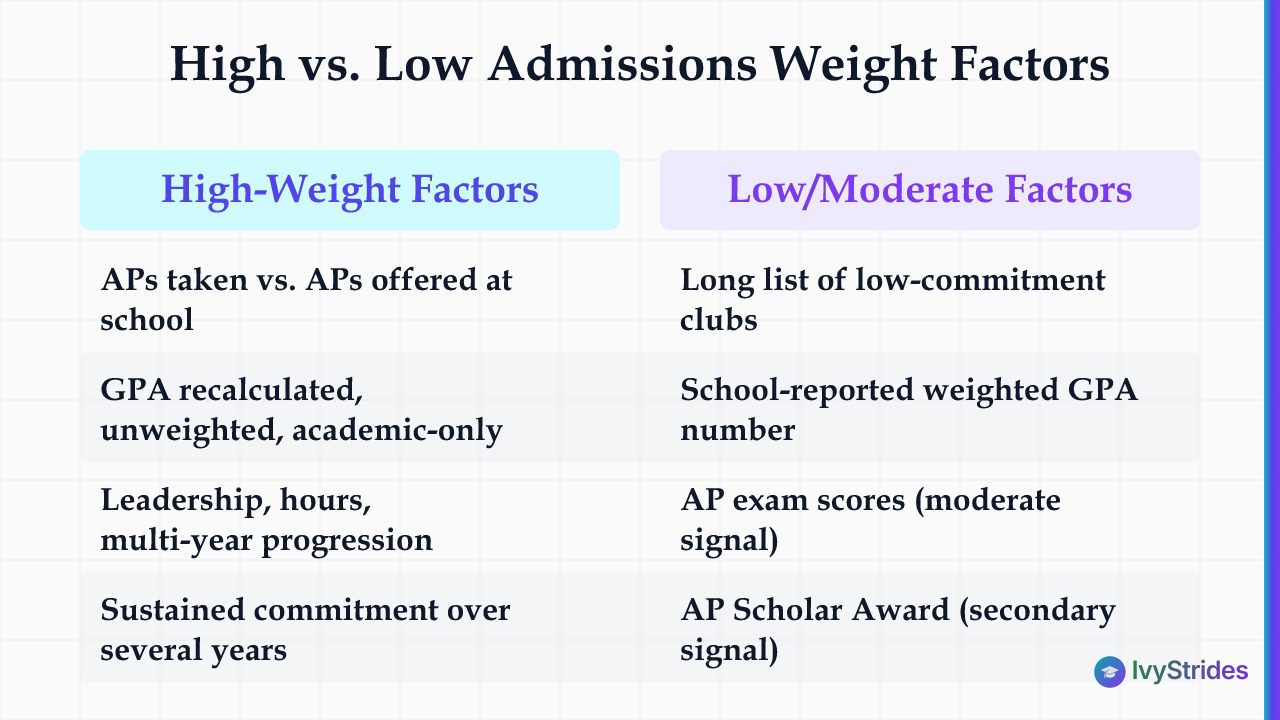
AP load signals course rigor, and selective colleges read rigor and GPA together in holistic review, never in isolation. Harvard, for example, says the strongest applicants take "the most rigorous secondary school curricula available to them" (Harvard College), so your transcript is read against what your school offers.
Because rigor is read in context, the GPA number itself gets recalculated. Many colleges strip out non-academic courses and apply their own weighting, so the figure they evaluate often differs from your school-reported one. The mechanics of college GPA recalculation decide whether your weighted number reads the way you expect.
Depth beats breadth on activities. Bucknell's admissions blog, for example, says "What matters more than quantity is depth and consistency" and lists "Sustained commitment over several years" among the qualities colleges look for (Bucknell University). One activity you've led for years reads stronger than a long list of clubs joined for a résumé line. Use that lens when you compare your list with the Ivy League extracurricular activities that stand out at the schools you're targeting.
Get your Daily IV Dose on Instagram: quick study tips and test-day advice for high school students. Follow @ivy.strides.
| Factor | What Colleges Actually See | Admissions Weight |
| Course rigor | APs taken vs. APs offered at your school | High |
| GPA | Recalculated, often unweighted and academic-only | High |
| Extracurricular depth | Leadership, hours, multi-year progression | High |
| Extracurricular breadth | Long list of low-commitment clubs | Low |
| AP exam scores | 3 or higher as a mastery signal | Moderate |
Strong AP scores also unlock formal recognition. The AP Scholar Award goes to students who earn 3 or higher on three or more AP Exams, and the AP Scholar with Distinction requires an average of at least 3.5 across all exams taken plus scores of 3 or higher on five or more (College Board).
These awards are a secondary signal, not a decision driver. The AP Capstone Diploma asks more: scores of 3 or higher in AP Seminar and AP Research and on four additional AP Exams (College Board). Your next step: look at your projected transcript the way an officer would, in the context of what your school offers.
How to Build a Weekly Schedule That Fits APs, Activities, and Sleep
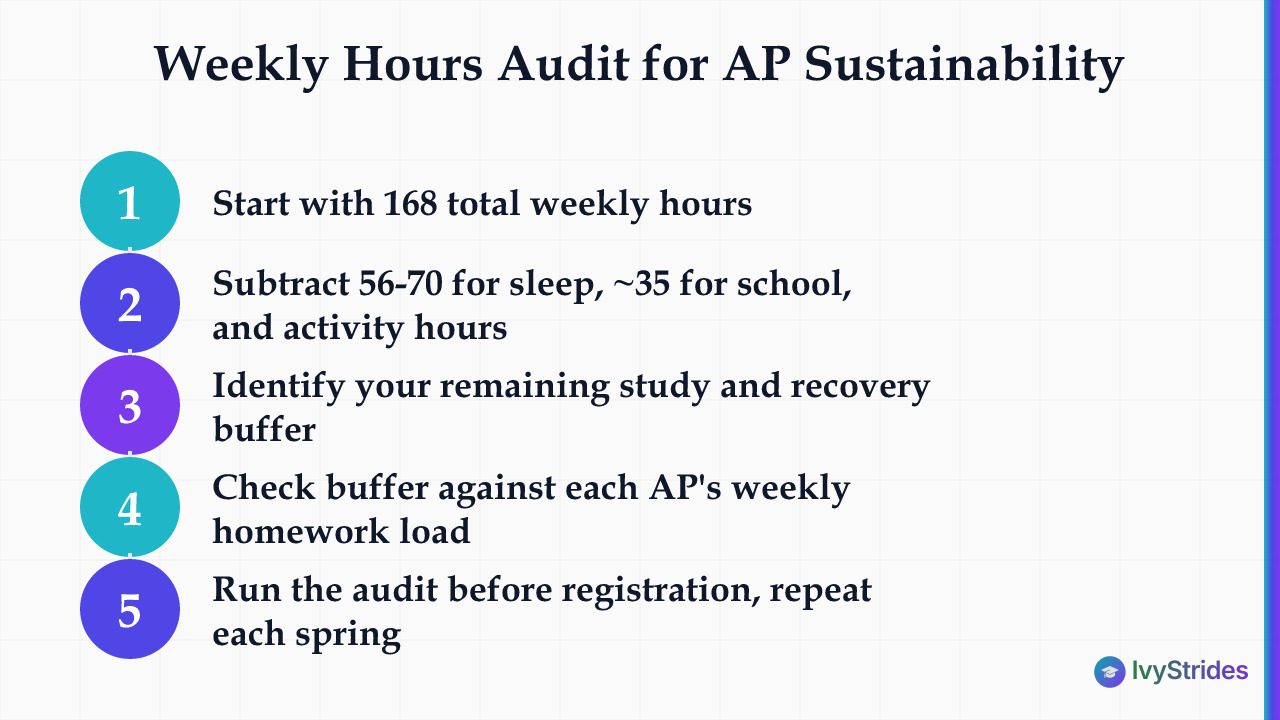
A weekly hours audit is the fastest way to test whether your AP load is sustainable before you commit. Start from the whole week and subtract the fixed blocks. A week has 168 hours. Subtract 56 to 70 for sleep at 8 to 10 hours a night, roughly 35 for school, and your activity hours. What remains is your study and recovery buffer.
That buffer is the number to watch. Each AP adds its own weekly block of homework and review, so a third or fourth AP can erase it fast. The American Academy of Sleep Medicine says teenagers 13 to 18 years of age should sleep 8 to 10 hours per 24 hours on a regular basis. Protect the sleep floor, then fit APs to what's left.
Watch for the burnout signals early. Burnout rarely announces itself. It shows up as grades falling in two or more subjects at once, quiet withdrawal from a primary activity, and persistent fatigue that a weekend doesn't fix. When those appear together, the load has already tipped, and the fix is structural.
| Check | Target |
| Sleep per night | 8 to 10 hours |
| Hours per AP class, weekly | Estimated from students who took it |
| Primary activity protected | Yes |
| Study and recovery buffer | Some hours left every week |
| Grades stable across subjects | Yes |
| Free day or half-day per week | At least one |
| Signs of chronic fatigue | None persistent |
Run that audit before registration, not in October when the damage is done, and repeat it each spring so no single semester becomes the one that breaks.
When to Cut Back on APs and What That Signals to Colleges
Cutting an AP is the right call when the alternative is a GPA drop or losing your deepest activity. A lower cumulative AP count rarely outweighs a strong GPA and a sustained commitment, provided your remaining schedule is still the most rigorous you can reasonably carry. Admissions officers read the school profile alongside the transcript, so four strong APs instead of six strained ones still reads as rigorous in context.
Because that context is what gets evaluated, how you frame a reduction matters more than the reduction itself. Dropping one AP to protect a strong GPA and a primary activity is often the sound move. If a change needs explaining, the additional information section is where a brief, factual note belongs, not an apology.
| Situation | Recommended Action | Admissions Framing |
| GPA slipping below B in an AP | Drop before the deadline | Protects transcript strength |
| Primary activity shrinking to fit APs | Keep the activity, cut the AP | Depth outranks one extra course |
| Load sustainable, scores strong | Keep all APs | Rigor in context |
| Already past drop deadline | Get targeted help, finish the term | Effort visible on transcript |
| Considering a sixth AP in one year | Defer to a later grade | Spread rigor across years |
Daily SAT and ACT prep on YouTube: short strategy videos from IvyStrides. Subscribe to IvyStrides on YouTube.
Test-optional policy adds one more layer. Testing policies vary by college and by cycle, so check each college's own admissions page for fall 2027 entry; where no score is sent, your transcript and AP rigor make up more of the academic picture. That interacts with whether to submit scores at a test-optional college at all. AP credit and placement policies also vary by college, so confirm each school's rules directly.
For balancing APs with extracurriculars and wellbeing across high school, IvyStrides' college counseling plan that maps courses, activities, and testing month by month runs from the summer before 9th grade to the deposit deadline and also covers the college list and essays. For students early in high school, the grades 9 and 10 counseling plan built around a four-year course map is the natural starting point. Once you've settled the load, the next job is turning protected depth into clear activities list descriptions on the application.
FAQ: Balancing AP Classes, Activities, and Wellbeing
How can I effectively balance school and extracurricular activities?
Run a weekly hours audit first. Subtract sleep (56 to 70 hours at 8 to 10 hours a night), school time (about 35 hours), and your activity hours from 168. Then estimate each AP's weekly hours from students who took it, and the math tells you how many fit before the buffer disappears.
What matters more, GPA or extracurriculars?
Selective colleges weigh both in holistic review, but GPA and course rigor come first as a baseline. A strong GPA in rigorous courses signals academic readiness; extracurriculars show character. Because grades are read in the context of rigor, a slightly lower GPA in demanding courses, paired with one deep activity, is not the setback many students fear.
Are AP classes extracurriculars?
No. AP classes are academic coursework that appears on your transcript under course rigor, not in the extracurricular section. Your activities list is for clubs, sports, jobs, volunteer work, and independent projects outside the classroom. Conflating the two leads students to undercount their actual commitments when planning a schedule.
Is 6 APs good?
Six APs in one year is high for most students and can strain GPA and wellbeing. Six spread across grades 10 and 11 is a reasonable pace. Context matters: what your school offers, your target colleges, and whether you're earning 4s and 5s across four years.

Rajesh is a technology leader, entrepreneur, and angel investor with 28+ years in Business & Technology Leadership and Product & Solution Engineering. He is passionate about education, mentoring, and driving digital transformation.