
What Makes a College Essay Good, Explained: Everything You Need to Know in 2026
On this page
- What Makes a College Essay Good: The Direct Answer in Under 100 Words
- The Six Qualities of a Good College Essay (What Admissions Readers Actually Look For)
- Quality 1: Specificity over generality
- Quality 2: Authentic voice
- Quality 3: Self-reflection
- Quality 4: Show, don't tell
- Quality 5: A hook that earns the next sentence
- Quality 6: A purposeful close
- What Makes a Good College Essay Topic: Small Stories Beat Big Achievements
- What Makes a Good College Essay Hook: The First Two Sentences That Decide Everything
- Show, Don't Tell: The Technique That Separates Good College Essays from Great Ones
- Not Sure If Your Essay Has These Qualities?
- What Makes a College Essay Bad: The Patterns That Hurt Otherwise Good Drafts
- How to Tell If Your College Essay Is Good: A Self-Check Before You Submit
- College Essay Format and Length: What Good Looks Like on the Page
- FAQ: What Makes a College Essay Good
- What are the qualities of a good college essay?
- Is a 400 word college essay bad?
- How do I write a college essay if I'm boring?
- How do I make my college essay stand out?
- How to tell if a college essay is good?
- Is ChatGPT good for college essays?
- What are good examples of college essays?
- What should you avoid in a college essay hook?
- Ready to Turn a Good Draft Into a Great Essay?
A good college essay shares one specific, honest story that reveals your character, values, and how you think. It opens with a hook that earns the next sentence, uses concrete detail instead of vague adjectives, and closes with a moment of genuine self-reflection. The Common App personal statement runs 250 to 650 words, and admissions readers use it to answer one question: who is this person beyond the transcript?
These qualities come from what admissions readers reward, cross-checked against the current Common App guidelines and the patterns we see across hundreds of essay drafts in our coaching. If your draft feels flat, the six sections below name exactly what's missing. For the full writing process from blank page to final line, start with our guide on how to write a college essay.
What Makes a College Essay Good: The Direct Answer in Under 100 Words
A good college essay reveals character through one specific, honest story told in the student's authentic voice. That's the whole game. Admissions readers at selective schools read hundreds of essays per cycle, and the ones they remember are specific, reflective, and unmistakably human.
Six qualities separate an essay that gets a real read from one that gets skimmed:
-
Specificity over generality
-
Authentic voice that sounds like you, not a formal report
-
Self-reflection that explains what an experience meant
-
Show, don't tell through concrete scenes
-
A hook that earns the next sentence
-
A purposeful close that lands rather than summarizes
Past a strong transcript, the admissions reader is asking one thing: who is this person beyond the numbers? The personal statement is your only direct answer.
The Six Qualities of a Good College Essay (What Admissions Readers Actually Look For)
The six qualities of a good college essay are specificity, authentic voice, self-reflection, show-don't-tell craft, a strong opening hook, and a purposeful ending. Each does a distinct job. Miss two and the essay reads as competent but forgettable. Hit all six and the reader finishes with a clear sense of who you are.
Quality 1: Specificity over generality
Vague claims disappear. When a reader has already seen forty essays that say "I learned the value of hard work," the forty-first sinks without a trace. Compare "I've always been passionate about helping others" with "Every Tuesday at 4 p.m., I sat across from Marcus at the library and watched him sound out the word 'because' for the ninth week straight." One tells the reader nothing. The other puts them in the room. Name the object, the time, the exact word. Specificity is the fastest quality to add and the one most first drafts lack.
Quality 2: Authentic voice
Your essay should sound like you talking, not like a formal academic paper or a polished machine output. If your friends wouldn't recognize the voice as yours, something's off. Harvard Summer School's guidance on writing college essays puts authenticity near the top of its strategy list for good reason: readers can feel when a student is performing versus being honest. Write the way you'd explain the story to a teacher you trust.
Quality 3: Self-reflection
Reflection means explaining what an experience meant, not just what happened. This is the single most commonly missing element in the first drafts we review. A student describes the event in vivid detail, then stops, as if the story speaks for itself. It doesn't. The reader needs to see you think. What did the moment change in how you see the world, other people, or yourself? That paragraph turns a well-written anecdote into an essay.
Quality 4: Show, don't tell
Replace adjective claims with scenes. "I am a dedicated student who loves chemistry" tells the reader what to think. Instead: "I stayed after the bell to watch the copper sulfate crystals grow, and when the blue finally deepened I actually said 'yes' out loud to an empty lab." The second version lets the reader draw the conclusion, which is far more persuasive. The next section breaks this down.
Quality 5: A hook that earns the next sentence
Your hook is the first one to two sentences, and its only job is to make the reader want to continue. Three types tend to work: dropping into a scene mid-action, opening with a specific sensory image, or opening with a short, surprising statement that demands explanation. More on what separates a strong hook from a weak one below.
Quality 6: A purposeful close
The ending should circle back to your opening image or land on a forward-looking insight, not restate what you just said. A generic lesson ("and that's how I learned to never give up") undercuts an otherwise strong essay. College Essay Guy's framework describes colleges looking for values, vulnerability, and growth, and the ending is where growth becomes visible. Close on the version of yourself the story produced.
IvyStrides essay coaches work through a structured draft-review-revise cycle: one pass for specificity, one for voice, one for reflection. If you want a coach to check a draft against these six qualities, see our college essay coaching. For sentence-level rewrites, read our dedicated guide to show, don't tell in college essays.
What Makes a Good College Essay Topic: Small Stories Beat Big Achievements

Photo by ClickerHappy on Pexels
A good college essay topic is any specific moment you can reflect on honestly. Topic size does not determine essay quality. A student writing about restringing a guitar can outperform one writing about a two-week mission trip, if the execution is more specific and more reflective. Read that again if you've been sitting on the idea that your life isn't dramatic enough. It almost certainly is.
Most students fall into the achievement recap: listing awards, GPA, or leadership titles that already appear elsewhere in the application. If a fact lives on your activities list, restating it in paragraph form adds nothing new. The essay is the one place you get to reveal what the activities list can't.
In our work with students, the essays that stand out most often center on a specific 10-minute moment rather than a months-long journey. The 10-minute moment forces detail. The months-long journey invites summary. Detail wins.
The seven 2026-27 Common App prompts remain unchanged from the prior cycle, which gives you a flexible range of angles: a background or identity central to you, a challenge you faced, a belief you questioned, a moment of growth, an idea that captivates you, and two open options. None of them ask for your biggest accomplishment. They ask who you are.
Before you can write a good essay, you need a topic worth writing about; see our guide on how to brainstorm college essay ideas for a step-by-step process. It's equally worth knowing which topics to steer clear of, covered in our list of college essay topics to avoid.
Still mapping out when to write versus when to submit? The college application timeline for 2026-27 shows exactly when essay drafts should be ready relative to Early Decision and Regular Decision deadlines.
What Makes a Good College Essay Hook: The First Two Sentences That Decide Everything
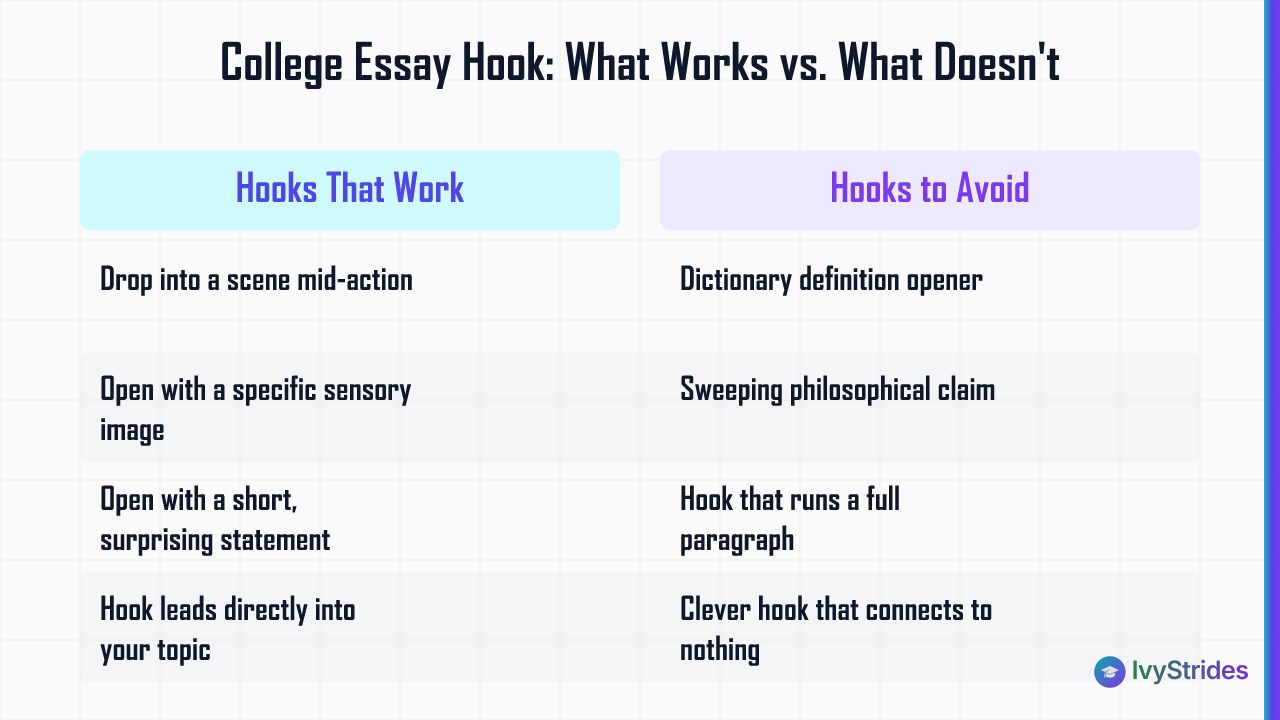
A good college essay hook is one to two sentences that make the reader want the next line. Keep it short. A hook that runs a full paragraph before anything happens has already lost the reader who's on essay number thirty of the afternoon.
Three hook types reliably work:
- Drop into a scene mid-action. "The smoke alarm went off before the pancakes did." The reader is now in the kitchen, wanting to know what went wrong.
- Open with a specific sensory image. "My grandmother's kitchen smelled like cardamom and burnt sugar every Sunday at noon." Concrete, grounded, immediately yours.
- Open with a short, surprising statement. "I've failed my driver's test four times, and I'm grateful for every one." The reader needs to know why.
Two patterns to avoid: the dictionary definition ("Webster's defines leadership as...") and the sweeping philosophical claim ("Since the dawn of time, humans have sought meaning..."). Both are throat-clearing. Both signal that the real essay hasn't started yet.
Here's the part most students miss. Your hook shouldn't be random; it needs to lead into your topic. A clever opening that connects to nothing does more damage than a plain one that flows cleanly into the story. If the hook and the essay's central story feel like two different pieces, cut the hook and start from the story.
For how the hook fits the paragraphs that follow, see our guide on how to structure a Common App essay.
Show, Don't Tell: The Technique That Separates Good College Essays from Great Ones
Show, don't tell replaces adjective claims with concrete scenes, and it's the single fastest way to upgrade a flat draft. When a sentence tells the reader what to think, it asks them to take your word for it. When a scene shows them, they reach the conclusion on their own, which is more persuasive and far more memorable.
Here's the mechanism in action.
Before: "I am a dedicated student who loves chemistry."
After: "I stayed forty minutes past the last bell to watch the titration hit its endpoint, and when the solution flashed from clear to pink in a single drop, I laughed out loud in an empty lab."
The first version is a claim the reader has no reason to believe. The second proves dedication and love of chemistry without ever using those words. Let the specific action carry the meaning.
In our essay coaching work, the single most common revision we make in a first draft is replacing a paragraph of adjective claims with one concrete scene. Students arrive with "I'm hardworking, curious, and resilient" and leave with a Tuesday afternoon that demonstrates all three at once. The scene does more work in two sentences than the adjectives did in ten.
This applies equally to the personal statement and to supplemental essays, where shorter word counts make every wasted adjective more expensive. Our guide on show, don't tell in college essays walks through before-and-after sentence rewrites. Once your scenes are in place, the polishing happens during revision, covered in how to edit and revise your college essay.
Not Sure If Your Essay Has These Qualities?
Book a free 15-minute call with an IvyStrides essay coach. We will read your draft, tell you exactly which of the six qualities need work, and give you a concrete next step, no obligation.
What Makes a College Essay Bad: The Patterns That Hurt Otherwise Good Drafts
A bad college essay is usually a technically clean essay that reveals nothing about the writer. The grammar is fine. The structure is fine. The reader finishes and still couldn't tell you a single thing about who the student is. Knowing what makes an essay good is only half the picture; our article on common college essay mistakes to avoid covers the specific patterns that sink otherwise promising drafts.
Five patterns show up again and again:
| Pattern | Why it hurts |
| Retelling the activities list in paragraph form | Adds no new information; wastes the one section that could |
| A topic so common it blurs into the pile (sports injury, mission trip, immigrant grandparent with no fresh angle) | The reader has seen it fifty times this cycle |
| Using AI to write or heavily polish the draft | Strips voice; risks sounding identical to thousands of submissions |
| Ending with a generic lesson ("I learned hard work pays off") | Undercuts the story with a cliché |
| Writing to impress rather than to reveal | Reads as performance; readers can feel it |
The AI point deserves care. Admissions readers are trained to notice voice inconsistency, and AI-generated prose tends to sound the same across submissions. That doesn't mean AI use will automatically disqualify you, and no one can promise detection is flawless. But the risk is real and the upside is thin: if the voice and the reflection aren't yours, the essay can't do its one job.
The most common reason a technically correct essay fails to land is that it tells the reader what the student did rather than who the student is. Fix that, and most of the other problems fix themselves. For ground worth standing on, see our roundup of the best college essay topics in 2026.
How to Tell If Your College Essay Is Good: A Self-Check Before You Submit
You can tell if your college essay is good by running it through a six-point check that mirrors the six qualities. Do this before anyone else reads it.
-
Does it open with a specific scene or image, not a definition or a sweeping generalization?
-
Does it sound like you, the way you'd actually talk, rather than a formal report?
-
Does it reveal something not visible elsewhere in your application?
-
Does it show rather than tell in at least two places?
-
Does it include a moment of genuine reflection, not just a summary lesson?
-
Does the ending feel earned, connected to the story, rather than tacked on?
Then run the read-aloud test, a technique Harvard Summer School recommends: read the essay out loud, slowly. Every place you stumble is a sentence that needs rewriting. Your ear catches what your eye skips.
One more test, and it's the toughest. Hand the essay to someone who knows you, with your name removed. Can they tell it's yours? If it could belong to any student in your grade, it needs more specificity. A good essay is unmistakable.
Once you have a draft that hits these six qualities, the revision process is where good essays become great; see how to edit and revise your college essay without losing your voice. For finding the right readers, our guide on how to get feedback on your college essay covers who to ask and what to ask them. Because revision can flatten voice if you're not careful, read how to keep your voice while editing.
College Essay Format and Length: What Good Looks Like on the Page
The Common App personal statement runs 250 to 650 words, per the Common App. That's the hard ceiling and the hard floor. Within that range, most strong essays land between 500 and 650 words, but longer isn't automatically better.
Is a 400-word essay bad? No. A tight, specific, reflective 400-word essay outperforms a padded 650-word one every time. Filler dilutes voice. If your essay says what it needs to say in 420 words and stops, that's a finished essay, not a short one.
In our work with students, essays that run under 450 words often have a missing reflection paragraph, not a word-count problem. The fix is depth, not filler: add the paragraph where you explain what the experience meant, and the count usually takes care of itself.
A few format notes worth knowing:
- The Common App text box strips most formatting, so don't rely on bold, italics, or headers to carry meaning. The words have to do the work.
- Break your essay into clear paragraphs; a single dense block is hard to read on screen.
- Supplemental essays run on their own limits, typically 150 to 350 words depending on the school and prompt. The same six quality standards apply at any length, just with less room to spare.
For a deeper look at the count itself, see our guide on the Common App essay word limit. For the shape of the piece from open to close, read how to structure your personal statement.
FAQ: What Makes a College Essay Good
What are the qualities of a good college essay?
A good college essay is specific, honest, reflective, and written in your authentic voice. It opens with a hook that earns the next sentence, uses concrete scenes instead of vague adjective claims, and closes with a genuine insight rather than a generic lesson. All six qualities apply to both the personal statement and supplemental essays.
Is a 400 word college essay bad?
No. The Common App accepts personal statements from 250 to 650 words, so 400 sits well within range. A tight, specific 400-word essay beats a padded 650-word one. In our coaching, essays under 450 words usually have a missing reflection paragraph, so the fix is adding depth rather than stretching for filler.
How do I write a college essay if I'm boring?
You're not boring; your topic is probably too big or too vague. Pick one specific 10-minute moment and write it in detail. The quality of your reflection matters far more than the drama of the event. A student writing about making their grandmother's recipe can outwrite a student writing about a state championship, if the reflection is honest.
How do I make my college essay stand out?
Be more specific than you think you need to be. Name the exact object, the exact conversation, the exact feeling. Generic essays blur together; specific ones stick. Avoid overused angles, resist writing what you think admissions officers want to hear, and let one honest moment reveal who you are.
How to tell if a college essay is good?
Read it aloud; if you stumble, rewrite the sentence. Then ask whether it opens with a specific scene, sounds like you, reveals something not on your activities list, shows rather than tells, and includes real reflection. Final test: could a stranger identify it as yours without your name attached? If yes to all six, it's ready.
Is ChatGPT good for college essays?
Using AI to write or heavily polish your essay is risky. Admissions readers are trained to notice voice inconsistency, and AI prose tends to sound the same across thousands of submissions. AI can help with brainstorming or a grammar check, but the voice, the story, and the reflection must be entirely yours.
What are good examples of college essays?
Strong examples share four traits: a specific opening scene, a clear central insight, moments of genuine vulnerability, and a voice that sounds like a real person. College Essay Guy publishes annotated examples from admitted students, a reliable place to see these qualities on the page. For angles that tend to work, see our college essay ideas that work.
What should you avoid in a college essay hook?
Skip dictionary definitions, sweeping claims about humanity, and hooks with no logical connection to your story. A clever but disconnected opening is worse than a plain one that leads cleanly into the narrative. The hook's only job is to make the reader want the next sentence.
The same quality standards that carry your personal statement carry your supplemental essays too, though shorter word counts demand even tighter specificity; see how to write supplemental essays that get you in for school-specific tactics. Because the essay works alongside your academic record, see whether AP helps with college admission for the full picture of how each piece fits together.
One caveat worth keeping front of mind: a strong essay is one component of a holistic application. Admissions outcomes depend on your grades, scores, activities, and the full file, not the essay alone. No essay, and no essay coach, can guarantee admission to any school. What a good essay does is give the reader a clear, memorable sense of who you are, which is exactly the job the rest of the application can't do. To learn how we approach this work, visit our about page. You can also meet the coaches on our tutors page.
This article reflects the 2026-27 Common App cycle and will be reviewed annually as prompts and policies update.
Ready to Turn a Good Draft Into a Great Essay?
IvyStrides essay coaches work 1-on-1 with students on every draft, from the opening hook to the final line. Students and parents: book a free 15-minute strategy call to get a diagnostic read on your current draft and a clear revision plan.

Award-winning author (South Asian Book Award) and graduate of BITS Pilani and UCLA Luskin School of Public Affairs. Brings a published writer's eye to Common App essays and grammatical precision to SAT and ACT R&W instruction.