
College Essay Topics to Avoid (and What to Write Instead)
On this page
- Why These Topics Hurt Your Application More Than You Think
- The Most Overused College Essay Topics (and Why Each One Fails)
- The sports injury or big-game essay
- The mission trip or community service abroad essay
- The immigration story told as a timeline summary
- The hero-figure tribute
- The achievement recap (the "resume repeat")
- The travel epiphany
- The bad grade or failure essay without a real growth arc
- Controversial political or religious topics
- Highly personal trauma narratives
- Words and Phrases That Weaken a College Essay (Even When the Topic Is Strong)
- Can a Cliche Topic Ever Work? The Angle-Shift Test
- What to Write Instead: Finding a Topic That Actually Works
- The 5 Ds of College Essays: A Craft Checklist for Any Draft
- A Note on Supplemental Essays: Different Prompts, Different Rules
- Dos and Don'ts for College Essays: A Quick-Reference Summary
- FAQ
- What are the 5 Ds of college essays?
- What words should you not use in a college essay?
- Are there college essay topics that are always off-limits?
- Can a sports essay ever work for a college application?
- Do college essay topics change each year?
- What makes a bad college essay?
The college essay topics most likely to hurt your application are the sports injury or big-game story, the mission trip or community service abroad essay, the immigration story told as a timeline summary, the hero-figure tribute to a coach or grandparent, the achievement recap that repeats your resume, and the travel epiphany. These fail not because the experiences don't matter, but because thousands of students write them every cycle, and most versions focus on the event rather than on the writer's specific thinking. The fix is almost always a shift in angle, not a full topic change.
All word-limit and prompt references in this article reflect the 2025-2026 Common App cycle, confirmed on Common App's official announcement. The harder question, once you know what to avoid, is how to diagnose whether your current topic is salvageable and what to write instead. The next section starts there.

Why These Topics Hurt Your Application More Than You Think
Admissions readers at large universities can review roughly 50 to 100 or more applications per day during peak season. Pattern recognition kicks in fast. When the first paragraph signals "this is the sports injury essay" or "this is the mission trip essay," the reader has already seen ten versions this week, and your specific version now has to work twice as hard to earn attention.
The Common App personal statement has a 250 to 650 word limit. That's your one qualitative space in the application where you fully control the narrative. Everything else, grades, activities, test scores, is filtered through someone else's format. Waste it telling the reader what your grandmother taught you, and you've handed away the one moment where the admissions reader can actually meet you.
At schools where submitting test scores is optional, the essay often carries more weight as the primary qualitative signal in the file. Test-optional policies vary by school and year, so check each school's current policy through resources like the FairTest tracker before deciding whether to submit scores. Admissions readers evaluate the full application together: course rigor, AP scores, test scores where submitted, grades, activities, and essays. A strong essay can't compensate for a weak transcript, but a weak essay can undercut an otherwise competitive file.
Here's the core distinction that runs through the rest of this article. Topic is the surface subject of your essay. Angle is the specific lens or insight you bring. Same topic, different angle, completely different essay. A sports essay about winning the championship is a cliche. A sports essay about the 90 seconds before you deliberately let a teammate take the shot you'd trained a year to take, and what you understood about yourself in that decision, is not.
For a fuller picture of the essay workload ahead, see our guide to how many supplemental essays will you write.
The Most Overused College Essay Topics (and Why Each One Fails)
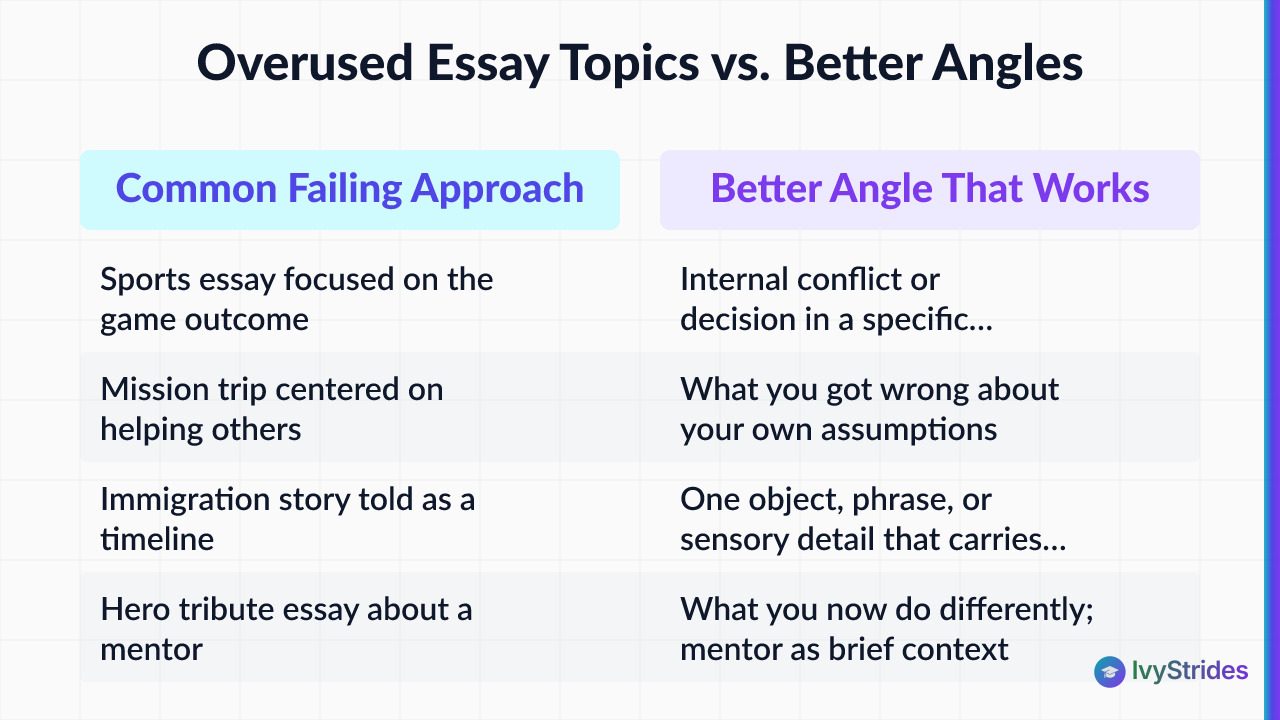
Across hundreds of personal statement drafts reviewed in our coaching, these are the topics that show up most and the ones that most often fail on the first draft. Each can be rescued with the right angle. Most students don't rescue them.
The sports injury or big-game essay
The problem: the essay ends up being about the sport, not the student. The touchdown, the torn ACL, the state final. You describe the event and attach a lesson ("I learned resilience"). The reader learns nothing specific about you.
When it works: the sport becomes a lens for a specific insight about identity, failure, or community that couldn't be shown any other way. In our coaching with students on sports essays, the versions that work almost always zoom in on a moment of internal conflict, a decision made in three seconds, a realization mid-practice, not the outcome of the game.
The mission trip or community service abroad essay
This topic centers the student as helper and the community being served as backdrop. It reads, often unintentionally, as self-congratulatory. The reader closes the essay knowing you went to Guatemala. They don't know you.
Better angle: what you learned about your own assumptions. What you got wrong. What surprised you about your own reaction, not about the community you visited.
The immigration story told as a timeline summary
Written chronologically, "we left, we arrived, we struggled, we made it," this essay tells the reader what happened rather than who you are. The experience is real and often formative. The execution flattens it.
Better angle: a single object, phrase, or sensory detail that carries the weight of the larger experience. One specific dinner. One phone call. The moment you realized your mother pronounces a word differently than you do.
The hero-figure tribute
A 650-word essay about your grandfather tells the admissions reader about your grandfather. It doesn't tell them about you. The essay is supposed to reveal the applicant, not the person the applicant admires.
Better angle: if a mentor genuinely shaped you, write about the specific thing you now do differently, and let their influence appear briefly as context, not as the subject.
The achievement recap (the "resume repeat")
You list your debate wins, your research internship, your class rank. The information is already elsewhere in the application. You've spent 650 words repeating your activities section. In our coaching, the resume-repeat pattern is the single most common structural mistake we see in personal statements.
The essay's unique function is to show thinking and character, not to inventory accomplishments.
The travel epiphany
You went somewhere, you saw something beautiful or difficult, and you came home changed. The structure is so familiar that readers can predict paragraph three from paragraph one. Unless the trip is genuinely the vehicle for a specific, surprising realization about yourself, skip it.
The bad grade or failure essay without a real growth arc
Prompt 2 in the Common App invites reflection on a challenge or setback. It's a good prompt. It fails when students describe the failure, claim they learned from it, and don't show any evidence of the learning in how they now think or act. The growth has to be visible on the page.
Controversial political or religious topics
You don't know your reader's views. There's real risk of alienating a reader whose politics or faith differ from yours, and usually no upside unless you can demonstrate genuine nuance and self-awareness that few 17-year-olds actually put on the page. Not banned. High risk.
Highly personal trauma narratives
Essays about self-harm, active substance use, eating disorders in progress, or acute family crisis can work, but only when the writer has processed the experience enough to write about it with perspective rather than raw pain. Essays that leave the reader worried about your current wellbeing can backfire. Use your own judgment. If you're not sure whether you've reached that perspective, that's usually the signal to write about something else for this application cycle.
For a positive framing of what to write instead, see our companion piece on what should you write your college essay about.
If you already have a topic in mind and want a coach to work through it sentence by sentence, one-on-one help from a common app essay tutor is often the fastest way to know whether to keep drafting or pivot.
Words and Phrases That Weaken a College Essay (Even When the Topic Is Strong)
Topic risk is only half the problem. A strong topic can still land flat if the sentences are doing the wrong work. Here's what to watch for.
Cliche openers. "Ever since I was young…" "Webster's dictionary defines…" "Have you ever wondered what it means to…?" Opening with a dictionary definition is one of the most flagged cliche openings in admissions essay coaching, and opening with a rhetorical question directed at the reader is a close second. Both signal that the writer hasn't yet found a real entry point into their own story.
Vague abstract nouns. Passion. Journey. Growth. Impact. These words appear in a high proportion of essays and signal generic thinking. They tell the reader nothing specific. "My passion for science" is filler. "The specific problem I couldn't stop thinking about after AP Chemistry Unit 6" is a sentence.
Filler phrases. "And so forth." "Etc." "So on and so forth." Anything that suggests you have more examples but won't name them tells the reader you don't actually have more examples.
Passive constructions that distance you from the action. "It was decided that I would attend…" versus "I decided to attend…" The essay is about you. Let yourself be the subject of your own sentences.
Contractions. Quick note: they're fine. Don't, won't, it's, that's. They support conversational voice. Avoiding them entirely can make the essay sound like a formal report, which isn't the register you want.
The counter to all of this is the 5 Ds: Description, Dialogue, Detail, Depth, Development. If a sentence isn't doing one of those five jobs, it probably shouldn't be in your 650 words. If you want a second set of eyes on the sentence-level work, our essay review service focuses heavily on this layer.
Can a Cliche Topic Ever Work? The Angle-Shift Test
Yes, but rarely by accident. Here's the test we run in our coaching. Apply it to your current draft.
Question 1: Does this essay reveal something about how I think, not just what I did? If a reader can summarize the essay by describing the events, and can't summarize how you process the world, the essay is doing the wrong work.
Question 2: Could any other student with a similar experience have written this exact essay? If yes, the essay is generic even if the experience wasn't. Add specificity until the answer is no.
Question 3: Does the essay end with a specific insight, or a generic lesson? "I learned that hard work pays off" is a generic lesson. "I learned that I'm the kind of person who apologizes before I've finished thinking, and that habit cost my lab partner a week of data" is a specific insight.
If your current draft fails two or three of these questions, don't scrap the topic yet. Try the small-moment technique first. Instead of writing about the whole season, write about the 90 seconds before a specific moment and what was going through your mind. Instead of writing about your immigration story, write about the specific afternoon you understood something about your parents you hadn't understood before.
Immigration essays that work in our coaching almost always anchor on a single object, phrase, or sensory detail that carries the weight of the larger experience. Sports essays that work zoom in on internal conflict, not the outcome of the game. The topic didn't change. The angle did.
If you'd like a coach to walk through the angle-shift with you on your specific draft, one-on-one help for common app essay is built for this.
What to Write Instead: Finding a Topic That Actually Works
The 2025-2026 Common App personal statement prompts are unchanged from the prior cycle. Same seven options, including the open-ended Prompt 7. The word limit remains 250 to 650 words. Topic choice is entirely your strategic decision. Nothing about the prompts forces you toward a cliche.
Once you know what to avoid, the harder question is what to actually write about. Our companion guide on what should you write your college essay about walks through the small-moment technique and prompt-matching strategy in full. The short version:
Ordinary topics with specific angles beat dramatic topics with generic angles. Every time. In our coaching, essays about mundane subjects, a specific family recipe, a recurring argument with a sibling, a habit of re-reading the same book every fall, consistently outperform essays about dramatic events when the student writes with genuine specificity and interiority.
There's a query cluster we see a lot: "college essay ideas for boring people." The premise is wrong. There are no boring people. There are essays that hide the person behind a topic they thought would sound impressive. College essay topics that stand out share one trait: the reader learns something specific and irreplaceable about this particular student.
Brainstorm with the 5 Ds as a generative tool, not just a revision tool. Ask: what's a moment in the last two years where I can Describe the scene precisely, include real Dialogue, name specific Details only I would notice, show my Depth of internal processing, and trace a Development in how I now think? If you can answer all five for a moment, you have an essay. If you can only answer two, keep looking.
One aside for students juggling essay season with AP coursework: if you're stretched across five AP exams and college essays, the timeline matters. Look into how our AP classes online can compress your subject prep so you have real hours for drafting in September and October.
The 5 Ds of College Essays: A Craft Checklist for Any Draft
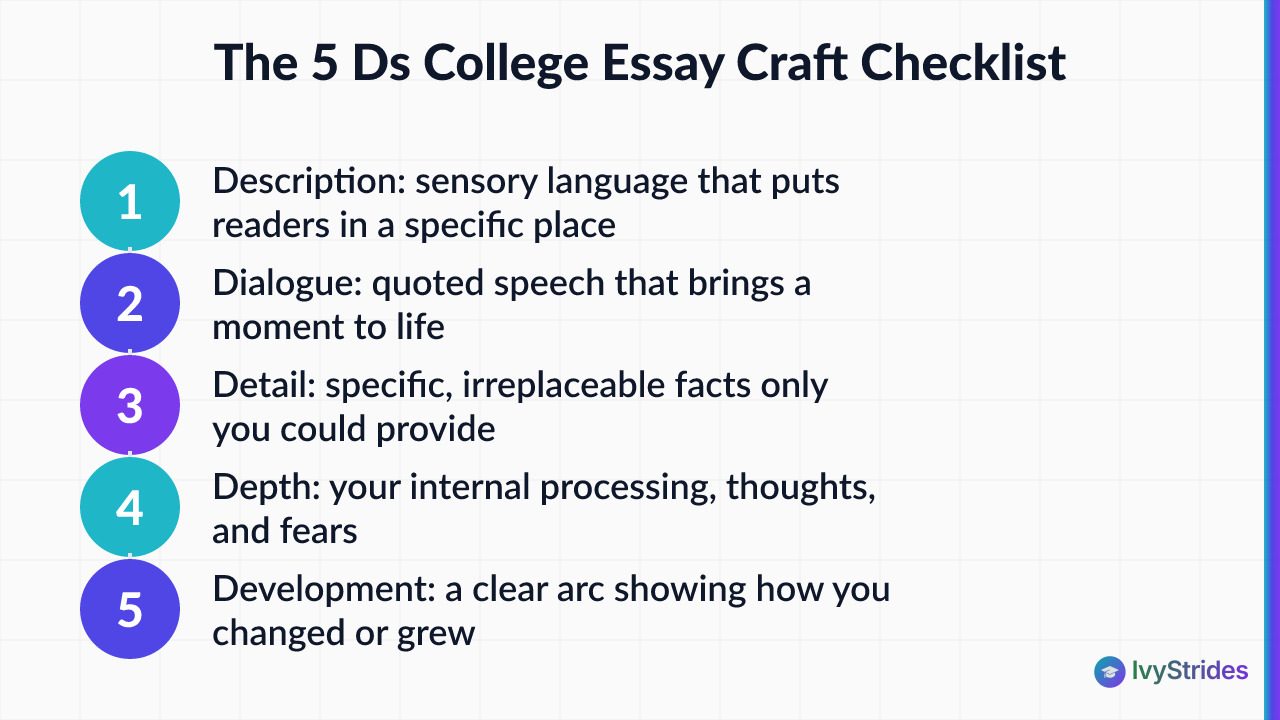
The 5 Ds are Description, Dialogue, Detail, Depth, and Development. They're widely used in admissions coaching as a craft framework. Use them as a diagnostic on any draft.
Description. Sensory and scene-setting language that puts the reader in a specific place. Not "it was a difficult summer" but "the fan in the tutoring center window rattled every time someone opened the door."
Dialogue. Quoted or paraphrased speech that brings a moment to life. Even one line of real dialogue changes the texture of an essay. What did your father actually say when he found out? What did you say back?
Detail. Specific, irreplaceable facts and observations. The brand of pen your grandmother used. The exact word your debate coach kept mispronouncing. Details that couldn't have come from anyone else's life.
Depth. Your internal processing. What you were thinking. What you almost did and didn't. What you were afraid of. In our coaching, the most commonly missing D is Depth: the essay describes what happened but doesn't show the student's internal processing. This is the single highest-use revision most drafts need.
Development. A clear arc showing how you changed or understood something new. Not a moral tacked onto the end. A visible movement from one way of seeing to another.
Practical check: print your draft. Highlight every sentence that shows what you were thinking or feeling, not just doing. If fewer than roughly 30 percent of your sentences are highlighted, the essay needs more Depth. Add interiority sentence by sentence, not in a paragraph at the end.
For handouts and templates that support this kind of revision work, our free downloads library has essay-specific tools.
A Note on Supplemental Essays: Different Prompts, Different Rules
The personal statement is only one piece. Most applicants to selective schools also write between four and ten supplemental essays, each with its own topic risks and opportunities. For the full breakdown, see how many supplemental essays will you write.
Supplemental essays are shorter, typically 150 to 350 words per school, and school-specific. The topic risks are different from personal statement risks. A few high-frequency ones:
Why This School essays. The most common supplemental mistake we see: the essay lists rankings and campus beauty instead of naming specific faculty, courses, programs, or student organizations the student has actually researched. If your Why This School essay would work for three different schools with light editing, it's not doing its job.
Extracurricular essays. The trap: listing what you did. The alternative: showing what it meant, what it taught you, what conflict or growth showed up inside it. 150 words is not enough space to describe the activity and reflect on it. Skip the description. Go straight to what you noticed about yourself while doing it.
Community or diversity essays. The trap: tokenizing your own identity to fit what you think the school wants. The alternative: writing about a specific community you actually belong to, which might not be the demographic category the prompt implies, and one specific way it has shaped how you think.
Dos and Don'ts for College Essays: A Quick-Reference Summary
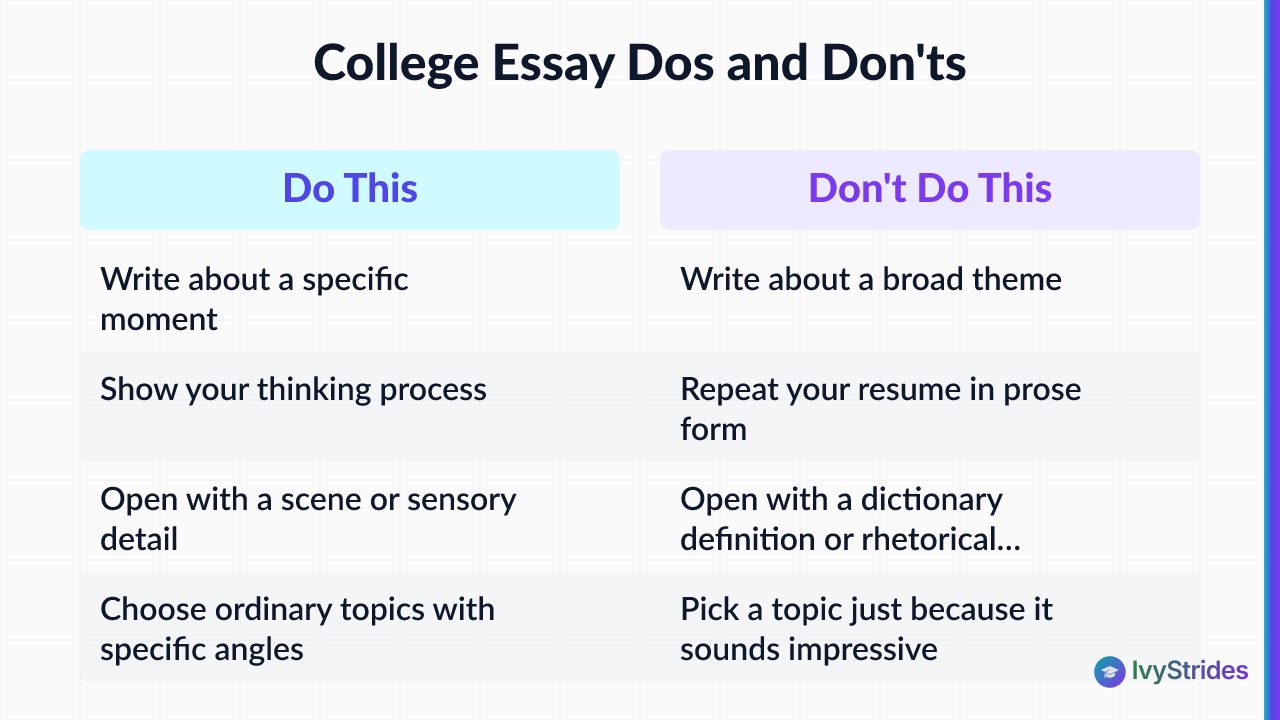
Do: write about a specific moment, not a broad theme.
Do: show your thinking process, not just your actions.
Do: use the 5 Ds as a revision checklist on every draft.
Do: read the essay aloud. If a sentence sounds like a formal report, it doesn't sound like you.
Do: respect the 250 to 650 word limit for the Common App personal statement.
Don't: open with a dictionary definition or a rhetorical question aimed at the reader.
Don't: write a tribute to someone else and call it your essay.
Don't: repeat your resume in prose form.
Don't: choose a topic because you think it sounds impressive. Impressive topics with generic angles lose to ordinary topics with specific angles every time.
Don't: write about a trauma you haven't yet processed with real perspective.
In our coaching, essays that open with a specific scene or sensory detail hold the reader's attention better than essays that open with a thesis statement or a question. If you want a coach to run this checklist on your draft, our essay review service is built around this diagnostic.
FAQ
What are the 5 Ds of college essays?
The 5 Ds are Description, Dialogue, Detail, Depth, and Development. They're craft elements that help create vivid, specific essays. In our coaching, Depth, meaning showing internal processing and not just external events, is the most commonly missing element in first drafts. A draft that scores well on all five can work even on a borderline topic, because the craft signals genuine voice and self-awareness.
What words should you not use in a college essay?
Avoid vague abstract nouns like passion, journey, and impact without specific evidence to back them up. Skip cliche phrases like "ever since I was young" or "Webster's dictionary defines." Avoid filler like "and so forth" or "etc." Contractions are generally fine and support natural voice, so don't strip them out.
Are there college essay topics that are always off-limits?
No topic is categorically off-limits, but some carry high risk. Essays about illegal activity, active self-harm, or ongoing substance use require exceptional craft and self-awareness to avoid leaving the reader worried rather than impressed. Controversial political or religious topics risk alienating a reader whose views differ from yours, usually with no offsetting upside unless you can demonstrate genuine nuance.
Can a sports essay ever work for a college application?
Yes, but rarely in its default form. The sports essay works when the sport is a lens for a specific insight about identity, failure, or community that couldn't be shown any other way. It fails when the essay is about the game, the season, or the injury rather than about your specific internal experience inside those events.
Do college essay topics change each year?
The Common App personal statement prompts have remained largely stable for several years. For 2025-2026, the prompts are unchanged from the prior cycle, confirmed by the Common App's official announcement. Supplemental essay prompts do change year to year by school, so check each school's current requirements directly on their admissions page.
What makes a bad college essay?
A weak college essay typically does one or more of these: focuses on an event rather than the writer's thinking; uses a topic so common that it blends into hundreds of similar essays; tells the reader what happened without showing interiority; or repeats information already visible elsewhere in the application. The underlying problem is almost always a lack of specificity and depth, not the topic itself.
The essay is one part of the full application. Course rigor, grades, test scores where submitted, activities, and recommendations all matter alongside it. Admissions outcomes depend on the whole file, and no single essay guarantees anything. What a strong essay does is make sure the qualitative signal in your application is genuinely yours. That's the target. You can read more about our approach on the IvyStrides about page. You can also meet the essay coaches who work with students at each stage of the drafting process.

Award-winning author (South Asian Book Award) and graduate of BITS Pilani and UCLA Luskin School of Public Affairs. Brings a published writer's eye to Common App essays and grammatical precision to SAT and ACT R&W instruction.