
How to Brainstorm College Essay Ideas: The Complete 2026 Playbook for a Top Score
On this page
- The Direct Answer: How to Brainstorm College Essay Ideas in Four Steps
- Why Your Essay Topic Choice Is a Strategic Admissions Decision
- I Feel Like Nothing Interesting Has Happened to Me: How to Find Your Story Anyway
- Not Sure Which Story to Tell? Talk to an Essay Coach.
- Three Brainstorming Exercises That Surface Your Best College Essay Topics
- Exercise 1: The Peak-Moment Inventory (Facts Level)
- Exercise 2: The Values-Mapping (Values Level)
- Exercise 3: The Object or Artifact Exercise (Symbols Level)
- How to Evaluate Your Candidate Topics: A Four-Question Rubric
- The 2025-26 and 2026-27 Common App Prompts: What Has and Has Not Changed
- College Essay Brainstorming AI: What It Can Help With and Where It Falls Short
- From Topic to Draft: What Comes After Brainstorming
- FAQ
- How do you start brainstorming for a college essay when you have no idea where to begin?
- What are the 3 D's of college essays and should you always avoid them?
- How do you brainstorm ideas for a college essay about yourself when you feel like you're not interesting enough?
- Is a college essay brainstorming worksheet actually useful or just busywork?
- What are the 2025-26 Common App essay prompts and have they changed for 2026-27?
- How many college essay topics should you brainstorm before picking one?
- Get a Second Set of Eyes on Your Topic
- You Have a Topic. Now Make It a Strong Essay.
To brainstorm college essay ideas, start with yourself, not the prompt. List five to ten specific moments, objects, or relationships that shaped how you think, then ask what each one reveals about your values. The strongest Common App personal statement topics aren't dramatic events; they're ordinary details examined with genuine insight. The 2025-26 Common App prompts are unchanged for 2026-27, which gives you seven entry points, but your topic should come from self-reflection first and the prompt should be the frame you choose after you've found the story.
That framing comes from the Common App, which confirms both the prompt list and the 250-650 word limit. The harder question, and what the rest of this article walks through, is how to actually generate topics worth writing about: three named brainstorming exercises, a four-question topic rubric, and a strategic note on each of the seven prompts.
The Direct Answer: How to Brainstorm College Essay Ideas in Four Steps
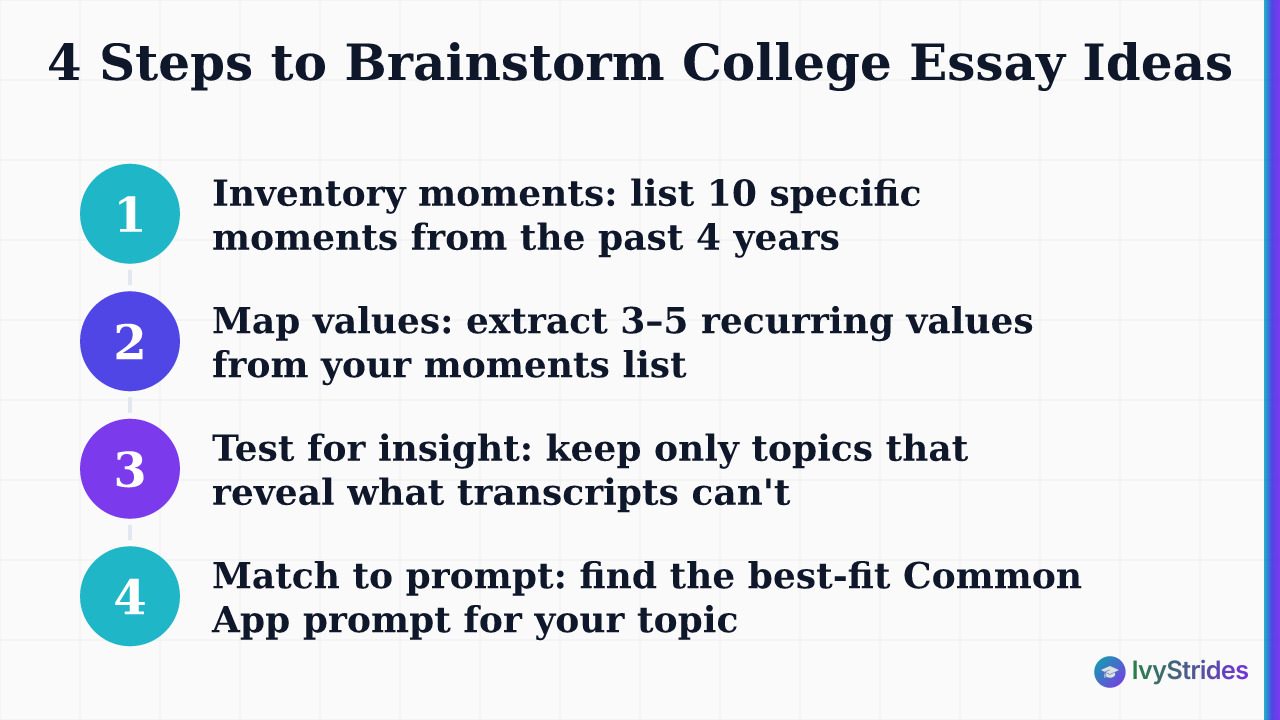
Here's the compressed framework. If you only have ten minutes, do these four steps in order.
Step 1: Inventory moments. List ten specific moments from the past four years. Not achievements. Moments. Include at least two that felt small at the time, like the walk home after a hard conversation, the first time you noticed something about how your mother makes coffee, or the afternoon you gave up on a project and started a different one.
Step 2: Map values. From that list, extract three to five values that recur. Precision. Loyalty. Curiosity about systems. Care for younger siblings. Whatever actually shows up. Where a value appears in two or more moments, you have a topic candidate.
Step 3: Test for insight. For each candidate, ask: what does this reveal about me that isn't already on my transcript or activities list? If the answer is nothing new, cut it. The essay exists to fill gaps the rest of the application cannot fill.
Step 4: Match to prompt. Only now do you open the Common App prompts and ask which of the seven fits your candidate topic most naturally. If none fit, Prompt 7 (free choice) exists for exactly that reason.
The Common App personal statement runs 250 to 650 words per commonapp.org, and in our coaching most strong essays land between roughly 550 and 650. That word count matters when you evaluate topics: a story requiring 900 words to make sense is too big for this format. Once you have a topic, see our guide on how to structure your personal statement for the opening-to-closing framework.
Why Your Essay Topic Choice Is a Strategic Admissions Decision
The essay is the one part of your application you fully control. Your transcript is fixed. Your activities list is fixed. Your test scores, if you choose to submit them, are what they are. The essay is where you get to shape the narrative.
That control matters more at some schools than others. According to the FairTest tracker, a large share of four-year institutions remain test-optional or test-blind, and at test-optional schools where you withhold scores, the essay carries disproportionate weight in the admissions file. Test-optional policies vary by school and year, so verify each target school's current policy before you finalize your submission strategy. At test-required schools, the essay still matters, but it works alongside scores rather than compensating for them. For students targeting highly selective schools, a strong essay complements a strong score. Our breakdown of whether a 1500 SAT score is enough for Ivy League admission explains how the two interact in the admissions file. At test-optional schools, a compelling essay can offset a below-median score, but the interaction is more nuanced than a straight trade. See how much the SAT matters for college admission in 2026 for the full picture.
Here's the part most students miss. Admissions readers typically spend only a few minutes on a full application file at highly selective schools. Your essay has to earn its share of that attention by showing them something they can't learn from your transcript. If your essay tells them you're hardworking, they already knew. If it tells them you're captain of the debate team, they already knew. Your topic has to reveal a dimension of you that the rest of the file doesn't surface. That's a strategic decision, not just a writing decision.
One caveat worth stating plainly: admissions outcomes depend on the full application, not the essay alone. A strong essay doesn't overcome a weak transcript, and a weaker essay doesn't sink a strong file. But at the margins, and at selective schools most decisions happen at the margins, the essay is where you tip.
I Feel Like Nothing Interesting Has Happened to Me: How to Find Your Story Anyway
This is the most common starting point we see. A student sits down, opens a blank document, and is immediately convinced that nothing in their life is worth writing about. No one in their family died dramatically. They didn't survive a natural disaster. They didn't build a school in a foreign country. They played tennis, took AP Chem, argued with their brother, and read too much on their phone. What could they possibly say?
Honestly, dramatic events aren't required, and they're often actively unhelpful. In our coaching, the majority of students who feel they have nothing to write about produce their strongest topic from an everyday object or routine, not a peak achievement. One student wrote about the specific way they organize their desk. Sounds boring. But the essay revealed a values system around precision and calm that no other part of the application showed, and the reader closed the essay knowing something specific about how that student thinks.
The distinction to internalize is this: a topic is what happened; an insight is what it reveals about you. Admissions readers evaluate insight, not drama. A student writing about the death of a grandparent with no genuine reflection produces a weaker essay than a student writing about the sound their refrigerator makes at 2 a.m. with real observation. This is why the show, don't tell in college essays technique matters so much: the ordinary detail, rendered specifically, is what carries the insight.
Try this right now. Name one object you'd grab in a fire that isn't your phone or a family member. Just one. Write three sentences about why. You'll find, almost every time, that the object points at something you actually care about. That's the beginning of a topic.
Not Sure Which Story to Tell? Talk to an Essay Coach.
In a free 15-minute call, an IvyStrides essay coach will review your brainstorming list, identify your strongest topic candidate, and tell you exactly which Common App prompt it fits. Students and parents both welcome. No prep required.
Three Brainstorming Exercises That Surface Your Best College Essay Topics
These three exercises operate at different levels of abstraction: facts, values, and symbols. Do all three in one sitting for the best result. In our coaching, students who complete all three typically produce five to eight candidate topics, compared to one or two from prompt-first approaches.
Exercise 1: The Peak-Moment Inventory (Facts Level)
List ten specific moments from the past four years. Not achievements, moments. Include at least two that felt small at the time. Then, for each one, answer a single question: what did I do, think, or feel that surprised me?
The surprise is the key. A moment where you did exactly what everyone expected isn't a topic. A moment where you noticed yourself acting slightly out of character, or feeling something you didn't expect to feel, is where the essay lives. This exercise maps most naturally onto Common App Prompt 5 (personal growth) and Prompt 2 (lessons from setback).
Exercise 2: The Values-Mapping (Values Level)
Take your moments list. Look across all ten and extract three to five values that recur. Not the values you think you should have. The values that actually show up in what you did. Someone might discover their recurring value is stubbornness in the face of pointless rules. Someone else might discover it's a compulsion to make things fair, even at cost to themselves.
Now find the intersection. Which value shows up in at least two moments? That intersection is a topic candidate, because it's the value your life is already illustrating. This exercise maps onto Prompt 1 (background and identity) and Prompt 6 (a captivating topic that reveals you).
Exercise 3: The Object or Artifact Exercise (Symbols Level)
Name one object that matters to you and isn't obviously impressive. Not a trophy. Not a Bible. Not a family photograph. Something odd. A specific mug. The receipt you've kept in your wallet. A shirt you never throw out. Describe the object in three sentences of physical detail, then answer: what does my attachment to this object say about what I care about?
This exercise consistently produces the most original topics because objects concentrate meaning without requiring dramatic events. It maps onto Prompt 6 and Prompt 7 (free choice) most naturally.
Use a college essay brainstorming worksheet to keep the outputs organized; the raw material is easy to lose if you scatter it across notes apps and napkins. Our free downloads page has one you can use. If you want a coach to pressure-test your candidate topics with you, our essay review service covers exactly that stage.
How to Evaluate Your Candidate Topics: A Four-Question Rubric
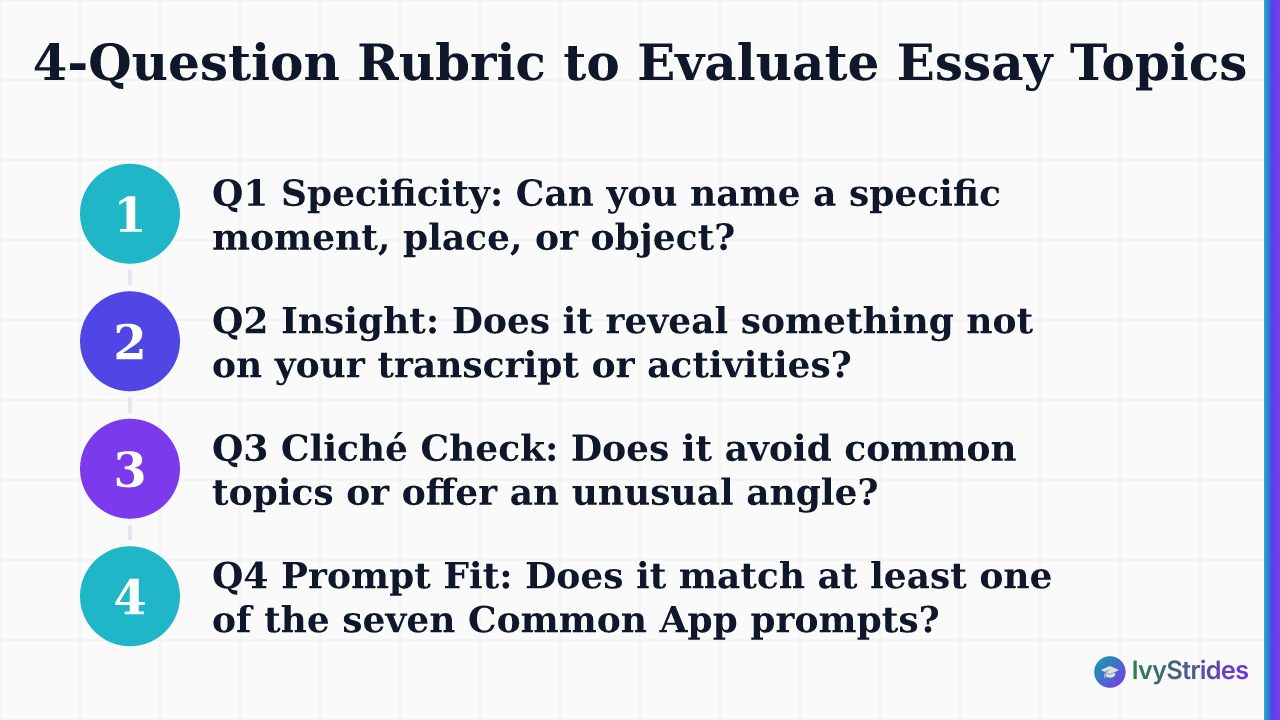
Once you have five to eight candidates, apply this rubric to each. Topics that pass all four questions in under two minutes of reflection are, in our coaching, typically the strongest candidates.
Question 1: Specificity. Can you name a specific moment, place, or object? If your answer sounds like "it's more of a general thing I do," the topic is too broad. Broad topics produce broad essays, and broad essays produce nothing memorable. A topic like "my love of reading" fails specificity. A topic like "the summer I read the same 40-page short story every night for six weeks" passes.
Question 2: Insight. What does this topic reveal about you that isn't already on your transcript or activities list? If the answer is nothing new, the topic is redundant and you should cut it. An essay about being captain of the tennis team when your activities list already says "Tennis Team Captain (11, 12)" is redundant. An essay about the way you talk yourself down before a match is not.
Question 3: Cliche check. Does this topic sit in the top ten most common college essay subjects? The recurring categories, in our reading, include the sports injury comeback, the immigrant grandparent, the mission trip, the leadership role, and the moment I realized my parents were people too. These aren't automatically disqualifying. But they require a genuinely unusual angle to work, because the reader has read many versions of the same essay this month.
Related to the cliche check: the 3 D's. Death, Divorce, and Drugs as primary essay subjects are high-risk because they tend to center the essay on the event rather than on your growth and insight. They aren't banned. But if your strongest story genuinely involves one of these, at least roughly 70 percent of the essay should sit on your reflection and what you did next, not on describing what happened.
Question 4: Prompt fit. Which of the seven Common App prompts does this topic fit most naturally? If it doesn't fit any prompt cleanly, either reconsider the topic or use Prompt 7, which exists for exactly that case.
If two candidates tie after the rubric, our common app essay coaching service exists to help you break the tie with a coach who has read hundreds of drafts and can tell you which topic has a higher ceiling.
The 2025-26 and 2026-27 Common App Prompts: What Has and Has Not Changed
The 2026-27 Common App prompts are confirmed identical to 2025-26, per the Common App. Any topic you develop now is valid for both cycles. The word limit remains 250 to 650 words, and most strong essays land between roughly 550 and 650. Prompt wording and word limits are subject to change; verify at commonapp.org before submitting.
Here are the seven prompts with a strategic note on which brainstorming exercise maps to each.
-
Background, identity, interest, or talent so meaningful your application would be incomplete without it. Maps to values-mapping. Strong fit when a recurring value in your life needs a full essay to explain.
-
A time you faced a challenge, setback, or failure. Maps to peak-moment inventory. Strong fit when a specific moment from your list involves genuine setback, not a manufactured obstacle.
-
A time you questioned or challenged a belief or idea. Maps to values-mapping. High-risk if written politically; strong when the challenged belief was one you personally held.
-
A person, event, or thing that made you grateful and how that gratitude affected or motivated you. Maps to object or artifact exercise. Strong fit for concrete subjects; avoid generic gratitude essays about parents.
-
An accomplishment, event, or realization that sparked personal growth. Maps to peak-moment inventory. The trap is choosing the accomplishment over the realization; the realization is what the essay is actually about.
-
A topic, idea, or concept you find so engaging it makes you lose track of time. Maps to object or artifact exercise. Excellent for students with a genuine intellectual obsession; requires specificity to avoid sounding like a hobby list.
-
Share an essay on any topic of your choice. The free-choice prompt. Use this when your strongest topic doesn't fit prompts 1-6 cleanly, not as a first choice by default.
If you're applying to ten or more schools, a strong personal statement topic can often be adapted for supplemental prompts. Our guide on how to reuse essays across applications covers the adaptation strategy without sacrificing authenticity.
College Essay Brainstorming AI: What It Can Help With and Where It Falls Short
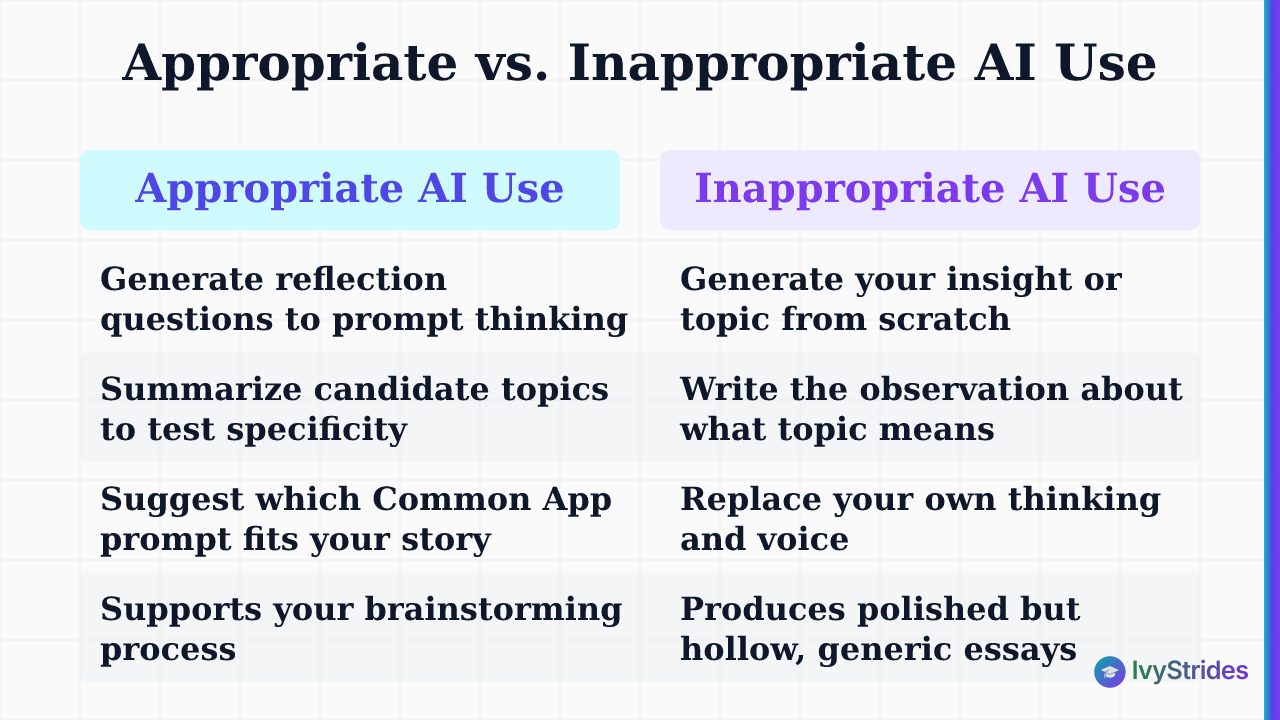
Students are using AI for essay brainstorming. Ignoring that would be dishonest. Here's our position, based on reading many drafts through recent admissions cycles.
Appropriate use. AI can generate a list of reflection questions to prompt your thinking. It can help you identify which of your candidate topics sounds most specific by summarizing them back to you. It can suggest which Common App prompt fits your story best. These are tool-level uses: the AI supports your process; it doesn't replace your thinking.
Inappropriate use. AI cannot generate your insight for you. If the AI writes the observation about what your topic means, the essay will read as generic because the AI doesn't know you. It doesn't know the specific way your father says your name when he's disappointed, or why you keep the receipt from a coffee shop you visited once in ninth grade. In our coaching, students who use AI to generate their topic from scratch typically produce essays that sound polished but reveal nothing specific about the student, which is the opposite of what admissions readers want.
Look, there's also a risk beyond writing quality. Many colleges have publicly stated they evaluate essays for authentic student voice. Using AI to write rather than to brainstorm is a risk to your authenticity signal, not just an academic integrity concern. The polished-but-hollow essay is easier to spot than most students think.
If you want to pressure-test your topic with a human coach instead, book a free 30-min consultation and mention essay strategy when you book.
From Topic to Draft: What Comes After Brainstorming
Once you have a topic that passes the four-question rubric, the next step is a one-paragraph outline. Three sentences: opening scene, middle reflection, closing implication. That's enough structure to protect you from the most common early-draft error, which is summarizing the topic rather than showing a specific moment.
Once you have a topic you believe in, the next challenge is structure: see our guide on how to structure your personal statement for a proven opening-to-closing framework. The single most common revision note our coaches give after brainstorming is to show the moment rather than summarize it. Our article on show, don't tell in college essays explains the technique with annotated examples. If you're applying to ten or more schools, a strong personal statement topic can often be adapted for supplemental prompts, and our guide on how to reuse essays across applications covers the adaptation strategy.
One last note on supplementals. They're a separate layer. Each school's supplemental prompts are different, and they require their own brainstorming pass. Don't try to reuse your personal statement topic verbatim across supplementals; adapt the raw material, but write to each prompt on its own terms. In our coaching, students who arrive at their first session with a topic already selected and a one-paragraph outline produce a stronger first draft than students who arrive with only a vague idea. Start the brainstorming this week.
FAQ
How do you start brainstorming for a college essay when you have no idea where to begin?
Start with the object or artifact exercise: name one object you'd grab in a fire that isn't a phone or a family member, then write three sentences about why. This bypasses the blank-page paralysis because it gives you a concrete starting point rather than asking you to generate a topic from nothing. From that object, ask what it reveals about your values. You typically have a topic candidate within ten minutes.
What are the 3 D's of college essays and should you always avoid them?
The 3 D's are Death, Divorce, and Drugs, three subject categories that essay coaches commonly flag as high-risk for personal statements. They aren't automatically disqualifying, but they tend to center the essay on the event rather than on your growth and insight. If your strongest story genuinely involves one of these subjects, the key is to spend at least roughly 70 percent of the essay on your reflection and what you did next, not on describing what happened. Execution has to be exceptional for these topics to work.
How do you brainstorm ideas for a college essay about yourself when you feel like you're not interesting enough?
The feeling that nothing interesting has happened to you is the most common starting point our coaches see, and it almost always resolves once a student completes the peak-moment inventory exercise. The exercise asks for specific moments, not achievements, and it includes a prompt to list at least two moments that felt small at the time. In our coaching, the small moments consistently produce the most specific and insightful essays because they reveal how a student actually thinks, not just what they've accomplished.
Is a college essay brainstorming worksheet actually useful or just busywork?
A structured worksheet is useful specifically because it forces you to generate raw material before you evaluate it. The mistake most students make is evaluating topics as they generate them, which shuts down the process before it produces enough candidates. A good college essay brainstorming worksheet separates the generation phase from the evaluation phase. Fill the page first, then apply the four-question rubric to filter.
What are the 2025-26 Common App essay prompts and have they changed for 2026-27?
The 2025-26 Common App prompts are unchanged from the previous cycle, and the 2026-27 prompts have been confirmed as identical to 2025-26. The seven prompts cover background and identity, lessons from challenges, questioning a belief, gratitude for someone's influence, personal growth, a captivating topic, and a free-choice option. Always verify the current prompts directly at commonapp.org before submitting, as the Common App reserves the right to update them.
How many college essay topics should you brainstorm before picking one?
In our coaching, we recommend generating at least five to eight candidate topics before evaluating any of them. Students who stop at one or two tend to over-invest in their first idea and miss stronger options. Completing all three exercises in this article in a single sitting typically produces five to eight candidates, which is enough to apply the four-question rubric and identify a clear frontrunner.
Get a Second Set of Eyes on Your Topic
The hardest part of essay brainstorming is knowing when you've found the right story. You're too close to your own life to see which topic will land with a reader who has never met you. That's what a coach solves.
You Have a Topic. Now Make It a Strong Essay.
IvyStrides essay coaches work 1-on-1 with students from brainstorming through final draft. Book a free 15-minute call to get a topic evaluation and a clear next step for your Common App personal statement.

Award-winning author (South Asian Book Award) and graduate of BITS Pilani and UCLA Luskin School of Public Affairs. Brings a published writer's eye to Common App essays and grammatical precision to SAT and ACT R&W instruction.