
How to Structure your Personal Statement in 2026: A Step-by-Step Guide That Actually Works
On this page
- Why Structure Is the First Thing an Admissions Officer Notices
- The Three-Part Narrative Structure That Works for Most Personal Statements
- Step 1: Choose a Topic That Has a Real Story Inside It
- Step 2: Write an Opening That Drops the Reader Into a Moment
- Step 3: Build a Middle Section With Real Reflection, Not Just Events
- Step 4: Close With Growth, Not a Summary
- How Long Should Each Section of Your Personal Statement Be?
- The Most Common Structural Mistakes Students Make (and How to Fix Them)
- What the 5 D's of College Essays Mean for Your Structure
- A Personal Statement Structure Example You Can Use as a Template
- FAQ
- What is a good structure for a personal statement?
- How do I structure a personal statement with an example?
- What is the 80/20 rule for a personal statement?
- How should I start my personal statement?
- Does the personal statement structure change for test-optional applicants?
- How is the Common App personal statement different from supplemental essays?
A strong Common App personal statement follows a three-part narrative structure: a specific opening scene that drops the reader into a real moment, a middle section with 2-3 reflective insights that reveal your values or growth, and a closing paragraph that shows forward momentum without simply restating the opening. You have 650 words to work with. A practical allocation is roughly 100-150 words for the opening, 350-400 words for the middle, and 100-150 words for the close.
These word limits come directly from the Common App, which is used by more than 1,000 US member colleges. This guide covers the Common App personal statement for US college admissions. If you're applying through UCAS in the UK, the format changed for 2026 entry to three separate questions, and this framework won't fit that structure.
Why Structure Is the First Thing an Admissions Officer Notices
Admissions officers at selective US colleges read thousands of personal statements each cycle, often at a pace of a few minutes per essay. When an essay lacks structure, it loses them in the first paragraph. When it has structure, they finish it, and they remember what the student was trying to say.
Structural clarity signals something specific about you as an applicant: that you can take a messy, personal experience and shape it into a coherent argument about who you are. That's the same skill college expects you to have in a seminar, a lab report, or a thesis. The essay is a writing sample as much as it's a personal introduction.
The Common App personal statement is a single essay you submit to every school on your Common App list. One essay, read by every admissions committee you apply to. That volume matters when you're deciding how much time to spend on structure.
Context matters too. At schools that remain test-optional for the 2026-27 cycle, the personal statement often carries additional weight in holistic review because it may be the primary differentiator when scores are absent from the file. Test-optional policies vary by school and year, so check each school's current policy directly through their admissions site or the FairTest tracker. If you're still weighing how much weight to give your essay relative to your test scores and transcript, our explainer on what the college application essay is and why it matters covers the full picture.
In our coaching, the essays that lose admissions officers in paragraph one almost always share the same flaw: they open with a summary sentence instead of a scene.
The Three-Part Narrative Structure That Works for Most Personal Statements
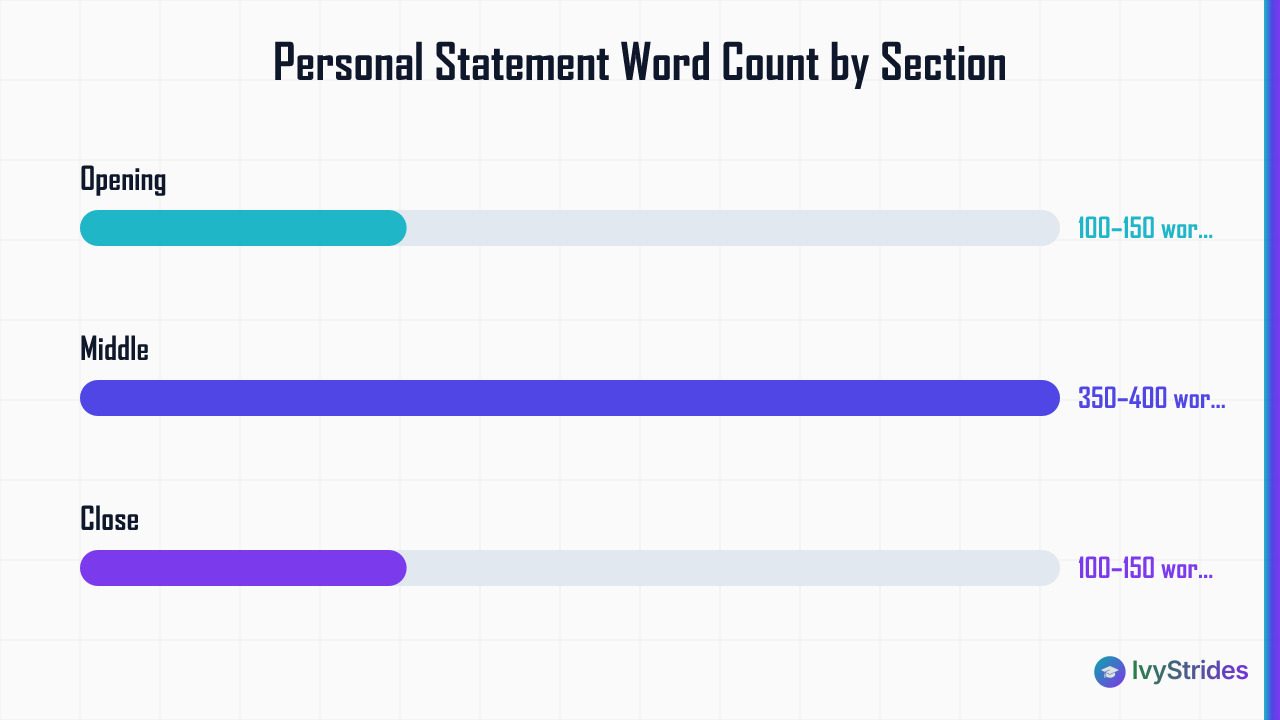
Here's the framework. Three parts. A specific opening scene, a reflective middle, and a forward-looking close, connected by a single thematic thread.
The opening (100-150 words) drops the reader into a moment. Not a summary of your life. Not a statement of your values. A moment, told in-media-res, meaning mid-action. Instead of "I have always been fascinated by chemistry," try "The beaker cracked in my hand at 6:42 a.m., three hours before the science fair opened." One puts the reader inside a scene. The other tells them what to think.
The middle (350-400 words) does the heavy lifting. This is where you develop the story, layer in concrete detail, and hit 2-3 so what moments where you pause and reflect on what an experience revealed about you. The middle is where the narrative arc bends, where a complication forces growth, where the reader learns why this story matters. Most of the essay lives here.
The close (100-150 words) shows forward momentum. Not a restatement of the opening. Not a summary of everything above. A short passage that shows how the experience changed the way you approach something, and hints at who you're becoming. That's it.
The Common App gives you 7 prompt options for the 2025-26 cycle, and the same three-part structure works for all of them. The prompt is a lens, not a mold. If you want prompt-specific strategy, our guide on how to answer each 2026-27 Common App prompt walks through all seven options.
In our coaching, essays that open with a scene rather than a thesis hold the reader's attention through the second paragraph much more often than essays that open with a general statement.
Step 1: Choose a Topic That Has a Real Story Inside It
Structure can't rescue a hollow topic. Before you outline, before you draft, you need a topic that contains a real story, meaning a specific moment with tension, change, or realization inside it.
Broad topics fail because they don't give you structural anchors. "My love of music" is not a topic. It's a category. "The moment I realized I had been playing the wrong key for three years, and what I did the next morning" is a topic. It has a specific inciting moment, a complication, and space for reflection. You can build a narrative arc on it.
The Common App's seven prompts are designed to be flexible enough that almost any meaningful experience fits somewhere. Don't pick the prompt first. Pick the story first, then find the prompt that gives it room to breathe. Structure decisions are easier when you know how much time you actually have. See our college application timeline for 2026-27 to map your essay drafting windows against Early Decision and Regular Decision deadlines.
A quick diagnostic: can you name the specific moment your story turns on? If yes, you have a topic. If you can only describe a general theme or interest, you have a category, and you need to keep brainstorming.
In our coaching, topics without a specific inciting moment are the hardest to structure, because there's no narrative tension to build the middle around. The student ends up narrating a theme instead of telling a story.
Step 2: Write an Opening That Drops the Reader Into a Moment
The first two sentences decide whether the reader keeps going. That's the whole game.
The technique is called in-media-res: start in the middle of the action, not at the beginning of the explanation. Sensory detail, dialogue, a specific object, a precise time. These all work. Abstract reflection doesn't.
Look at these two openers side by side:
Weak: "I have always been passionate about helping others, which is why I decided to volunteer at my local hospital."
Strong: "The patient in bed seven had not spoken in four days when I walked in with my volunteer cart."
The strong version doesn't tell you the theme. It shows you a scene, and the theme emerges as the essay unfolds. That's the shift.
Cliches to avoid: dictionary definitions ("Webster's defines resilience as…"), rhetorical questions ("Have you ever wondered what it means to fail?"), and sentences that begin with "I have always." Admissions officers see thousands of these each cycle, and they signal that the student is warming up instead of starting.
Your opening doesn't need to state your essay's theme. The theme emerges from the story you tell. Trust the reader to see it. If you're stuck on getting the opening right, one-on-one help for common app essay is available when you want a coach's eye on your first paragraph.
In our coaching, the most common opening mistake is summarizing the essay's conclusion before the story has been told. The student writes something like "This experience taught me the value of perseverance," and then spends the rest of the essay proving a point the opening already gave away.
Step 3: Build a Middle Section With Real Reflection, Not Just Events
The middle is where most personal statements fall apart. It's also where the essay earns its keep.
Two ideas to hold in mind while you draft this section:
The 80/20 rule. In a 650-word essay, roughly 520 words should be concrete scene, action, and specific detail. Roughly 130 words should be stated reflection and meaning. That's an 80/20 split of showing to telling. Flip that ratio and your essay reads as preachy, abstract, or self-congratulatory. Keep it, and your essay reads as alive.
So what moments. These are the 2-3 points across the essay where you pause after describing an experience and briefly state what it revealed about you. If you narrate a failed robotics competition, the so what moment is where you reflect on what the failure revealed about your relationship with perfectionism. Not a paragraph of philosophy. A sentence, maybe two, of honest reflection.
Here's the part most students miss. The trap to avoid is the list-of-accomplishments middle, where high-achieving students, out of habit, convert their resume into paragraph form. Debate captain, then research internship, then hospital volunteer, then club president. That's a resume. It's not a personal statement.
The fix is to pick one thread and stay on it. One experience, developed deeply, with reflection layered in. The thematic thread, the through-line of who you are, needs to connect every paragraph in the middle back to the same core idea. If a paragraph doesn't advance that thread, cut it or rewrite it.
Students who work with a coach through our essay review service typically submit a structurally tighter draft in fewer revision rounds, because the framework is set correctly from the first session.
In our coaching, students who write more than roughly 30% reflection tend to produce essays that feel preachy rather than personal. The scene has to carry most of the weight.
Step 4: Close With Growth, Not a Summary
The closing paragraph is where most students make the same mistake: they restate the opening. They circle back to the beaker, or the patient in bed seven, or the wrong musical key, and they wrap it up with a neat little bow.
Don't do that. The reader remembers the opening. They don't need it repeated. What they need is a sense of what changed.
A strong closing shows how the experience shifted the way you approach a recurring challenge, a relationship, an intellectual question, or your own self-understanding. It might gesture toward the future, toward college, toward what you plan to do with what you learned, but only if that gesture feels earned. It should not read like a "why this school" answer. That belongs in supplemental essays.
Here's the contrast:
Weak close: "As I look back at that morning with the cracked beaker, I realize how much I have grown as a scientist and as a person."
Strong close: "I still break beakers. I've stopped pretending I won't. What I've started doing instead is checking the tension in my grip before I lift, a small habit that has quietly changed how I approach every problem I care about."
The strong version doesn't restate the opening. It moves past it. It shows a specific, small change, and it hints at a broader pattern of thinking. The reader closes the essay with a clear sense of who this student is becoming.
Keep the close tight. Around 100-150 words is plenty. If you want a scaffold you can print and mark up as you draft, we have free downloads with essay-structure worksheets.
In our coaching, the strongest closings leave the reader with a clear sense of who the student is becoming, not just who they've been.
How Long Should Each Section of Your Personal Statement Be?
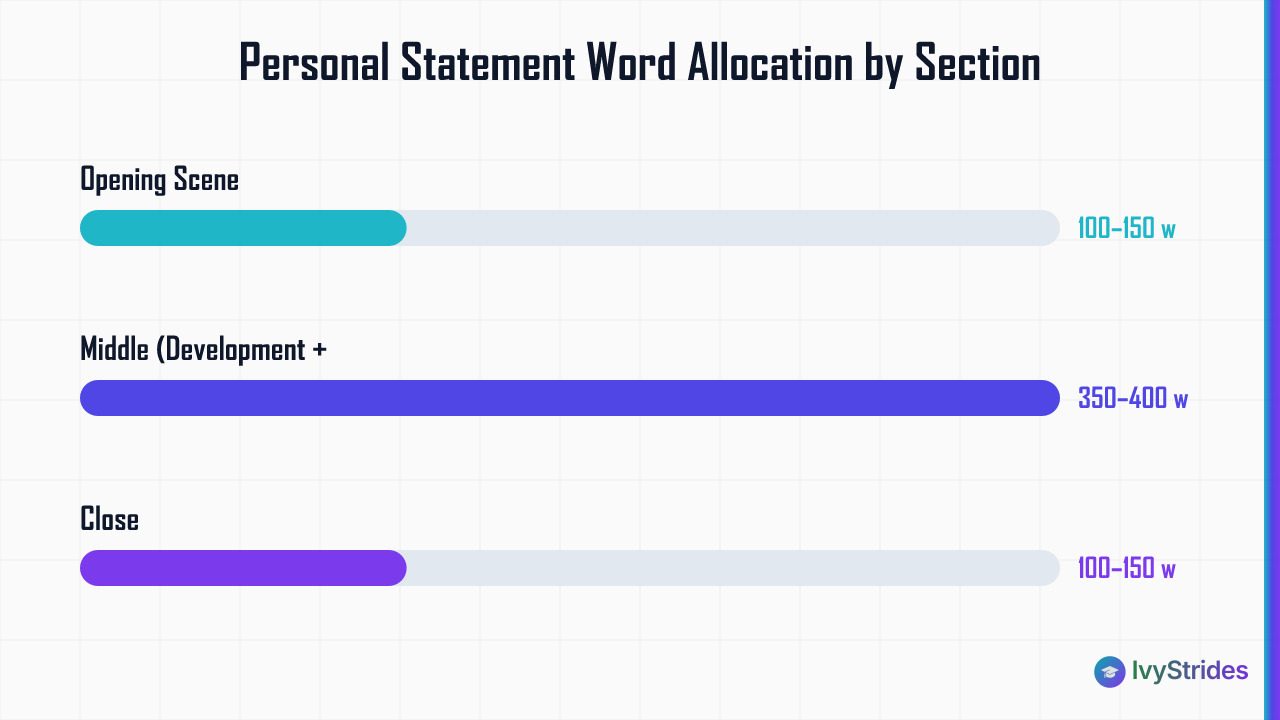
Here's the word allocation in one place, so you can check your draft against it.
| Section | Word range | Paragraph count |
| Opening scene | 100-150 words | 1-2 paragraphs |
| Middle (development + reflection) | 350-400 words | 3-4 paragraphs |
| Close | 100-150 words | 1-2 paragraphs |
| Total | up to 650 words | 5-8 paragraphs |
The Common App enforces a 250-word minimum and a 650-word maximum. Anything below 250 won't submit. Anything above 650 gets cut off. Most competitive essays land between about 600 and 650, but essays at 550 or 580 can be just as strong if the story is complete. Length is not a proxy for quality.
Paragraph length should vary. A single 400-word block signals structural weakness and is visually daunting. Mix short paragraphs (a two-line reflection, for instance) with longer scene-driven paragraphs. That variation is what makes an essay feel readable rather than dense.
Timing matters too. See our college application timeline for 2026-27 to map your essay drafting windows against Early Decision and Regular Decision deadlines.
In our coaching, essays that run exactly 650 words are not automatically stronger. The right length is whatever the story needs, up to the limit.
The Most Common Structural Mistakes Students Make (and How to Fix Them)
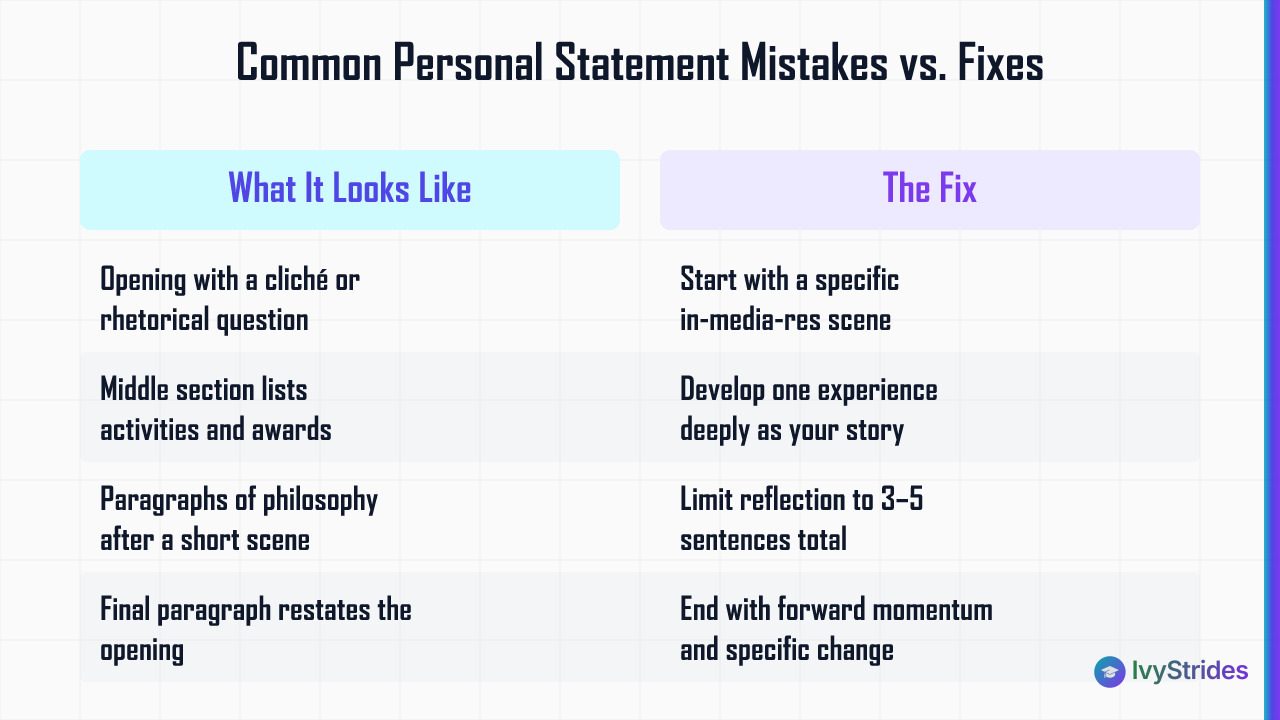
Five patterns show up in almost every first draft. Here's what they look like and how to fix them.
1. Opening with a cliche or summary statement. What it looks like: "I have always been passionate about…" or "Webster's defines…" or a rhetorical question. The fix: replace the opening with a specific scene, told in-media-res, with sensory detail from the first sentence.
2. Writing a resume in paragraph form. What it looks like: a middle section that lists activities, awards, and leadership roles without a unifying story. The fix: pick one experience, develop it deeply, and let it stand in for the pattern of who you are. In our coaching, this is the most common pattern we see in first drafts from high-achieving students who are used to listing accomplishments.
3. Over-explaining the reflection. What it looks like: paragraphs of philosophy after a two-sentence scene. The fix: apply the 80/20 rule. Cut reflection down to 3-5 focused sentences across the whole essay, and let the scene do the work.
4. Closing that restates the opening. What it looks like: a final paragraph that returns to the opening image and wraps it up with a summary of what the essay was about. The fix: end on forward momentum. Show a small, specific change in how you now approach something.
5. Losing the thematic thread mid-essay. What it looks like: paragraph three is about robotics, paragraph four is about your grandmother, paragraph five is about a summer job, and none of them connect. The fix: pick one thread. If you're trying to cover more than one major experience in 650 words, you'll lose the thread almost every time. Cut down to one.
If you want structural feedback on a draft you're stuck on, a common app essay tutor can run a paragraph-by-paragraph diagnostic in a single session.
What the 5 D's of College Essays Mean for Your Structure
The 5 D's are a widely cited essay-coaching framework: Describe, Develop, Discuss, Demonstrate, Distinguish. Use them as a structural diagnostic when you review your draft.
Describe belongs in the opening. It's the scene, the sensory detail, the specific moment.
Develop happens in the early middle. You expand the scene, add context, introduce the complication or tension.
Discuss lives in the reflective middle. This is where the so what moments sit, where you talk about what the experience meant.
Demonstrate runs through the whole essay. It's the show-don't-tell principle. You demonstrate your values, curiosity, and character through action and detail, not by claiming them.
Distinguish belongs in the close, though it can appear anywhere. This is where you signal what makes your version of this story different from anyone else's version of a similar story. Plenty of students have volunteered at hospitals. What did you notice, question, or change that no one else in that hallway did?
In our coaching, essays that skip Distinguish often feel generic even when the story is strong. The student had the material. They just never told the reader what made their angle theirs.
The 5 D's don't replace the three-part structure. They sit inside it as a checklist you can run against a draft to spot what's missing. If you're also balancing your essay drafting with AP courses online in the fall of senior year, a diagnostic checklist saves revision hours.
A Personal Statement Structure Example You Can Use as a Template
Here's a paragraph-by-paragraph scaffold you can use to outline before you draft. Fill in the placeholders with your own material.
Paragraph 1: Opening scene (75-100 words). A specific moment, told in-media-res. Sensory detail. A precise time, place, or object. No summary, no thesis, no theme statement.
Paragraphs 2-3: Development (150-200 words). Expand the scene. Introduce the complication, the tension, or the question that drove the experience. Add context only where it's needed to understand what's happening. Keep the reader inside the story.
Paragraphs 4-5: Reflection and insight (150-200 words). Layer in your 2-3 so what moments. What did the experience reveal? What did you learn about yourself, your values, your way of thinking? Keep it honest. Keep it brief. Every reflection should be earned by the scene that came before it.
Paragraph 6: Close with growth (75-100 words). Show a specific, small change in how you now approach something. Optionally gesture toward the future. Do not restate the opening.
Some strong essays use four paragraphs. Others use seven. The scaffold is a guide, not a rule. What matters is that every paragraph serves a structural purpose, and that the thematic thread runs through all of them.
In our coaching, students who outline using this scaffold before drafting typically produce a cleaner first draft and need fewer structural revision rounds. It doesn't replace voice, and it doesn't override your story. It just sets the frame so you can focus on what actually matters: writing something honest.
For students juggling test prep alongside essay work, a free SAT consultation can help you triage your fall timeline so the essay doesn't get squeezed out.
FAQ
What is a good structure for a personal statement?
A good personal statement structure follows a three-part narrative arc: a specific opening scene that hooks the reader, a middle section with 2-3 reflective insight moments that reveal character or values, and a forward-looking closing paragraph that shows growth. For the Common App, this fits within 650 words, with roughly 100-150 words for the opening, 350-400 for the middle, and 100-150 for the close. Every paragraph should serve a distinct structural purpose.
How do I structure a personal statement with an example?
Use a paragraph-by-paragraph scaffold. Paragraph 1 opens with a specific scene or moment, not a summary. Paragraphs 2-3 develop the story with concrete detail and introduce a complication. Paragraphs 4-5 add reflection and insight, hitting 2-3 so what moments. Paragraph 6 closes with a sense of growth or forward momentum. The thematic thread, meaning the through-line of who you are, should connect all six paragraphs.
What is the 80/20 rule for a personal statement?
The 80/20 rule means roughly 80% of your essay should be concrete scene, action, and specific detail, while only about 20% should be explicit reflection or stated meaning. In a 650-word essay, that's approximately 520 words of showing and 130 words of telling. Essays that flip this ratio tend to feel preachy or abstract rather than personal and compelling.
How should I start my personal statement?
Start with a specific moment or scene rather than a general statement about yourself. The in-media-res technique, dropping the reader into the middle of an action or situation, is the most reliable opening strategy. Avoid dictionary definitions, rhetorical questions, and sentences that begin with "I have always." The first two sentences should make the reader want to know what happens next.
Does the personal statement structure change for test-optional applicants?
The structural framework is the same regardless of whether you submit test scores. However, at schools where you choose not to submit scores, the personal statement may carry more weight in holistic review because it becomes a primary differentiator. This makes structural clarity and a strong reflective voice even more important. Note that test-optional policies vary by school and year; always check each school's current policy directly.
How is the Common App personal statement different from supplemental essays?
The Common App personal statement is one essay submitted to every school you apply to through Common App, with a 650-word limit and a choice of 7 prompts for the 2025-26 cycle. Supplemental essays are school-specific, shorter, and typically ask targeted questions like "Why this school?" or "Describe a community you belong to." Your personal statement should not try to answer supplemental questions. It should tell the broader story of who you are.
The structure is a frame. Your voice, your specific detail, and your honest reflection are what fill it. Get the frame right first, and everything else gets easier. Admissions outcomes always depend on the full application, meaning transcript, scores, activities, recommendations, and essays together, so treat the personal statement as one strong signal among many. If you want a coach's eye on whether your structure is holding up, our essay coaches work 1-on-1 with students at every stage of the drafting process. You can also learn more about IvyStrides and how we approach admissions essay coaching.

Award-winning author (South Asian Book Award) and graduate of BITS Pilani and UCLA Luskin School of Public Affairs. Brings a published writer's eye to Common App essays and grammatical precision to SAT and ACT R&W instruction.