
How to Edit and Revise your College Essay in 2026: A Step-by-Step Guide That Actually Works
On this page
- What Editing and Revising a College Essay Actually Means (They Are Not the Same Thing)
- Start With the Big Picture: Structure, Narrative, and Prompt Fit
- The Voice and Tone Pass: Keep What Makes the Essay Yours
- Getting Useful Feedback: Who to Ask and What to Ask Them
- Can You Use ChatGPT to Edit Your College Essay? An Honest Answer
- Final Checks Before You Submit: The Proofreading Pass
- How Many Times Should You Revise Your College Essay Before Submitting?
- FAQ
- What are the 5 Ds of college essay revision?
- What are the 3 Cs of editing?
- What happens if there is a typo in my submitted college essay?
- Can I revise my Common App essay after I have already submitted it to one school?
- Is it okay for someone else to edit my college essay?
- How do I edit my college essay for free?
- The Bottom Line
To edit and revise your college essay effectively, work in three ordered passes. First, fix big-picture issues like narrative structure, prompt alignment, and your opening hook. Then check voice and tone to make sure the essay still sounds like you. Finally, do a line-level pass for grammar, word count, and typos. Most students need three to five focused passes, not one panicked read-through the night before submission. Doing it in this sequence prevents you from polishing sentences that will later get cut.
The word limits and prompt counts referenced throughout this guide come from the official Common App site. The harder question is not what the rules are but how to apply the passes without over-editing your draft into someone else's voice. That's what the rest of this guide covers, starting with the difference between three words most students use interchangeably.
What Editing and Revising a College Essay Actually Means (They Are Not the Same Thing)
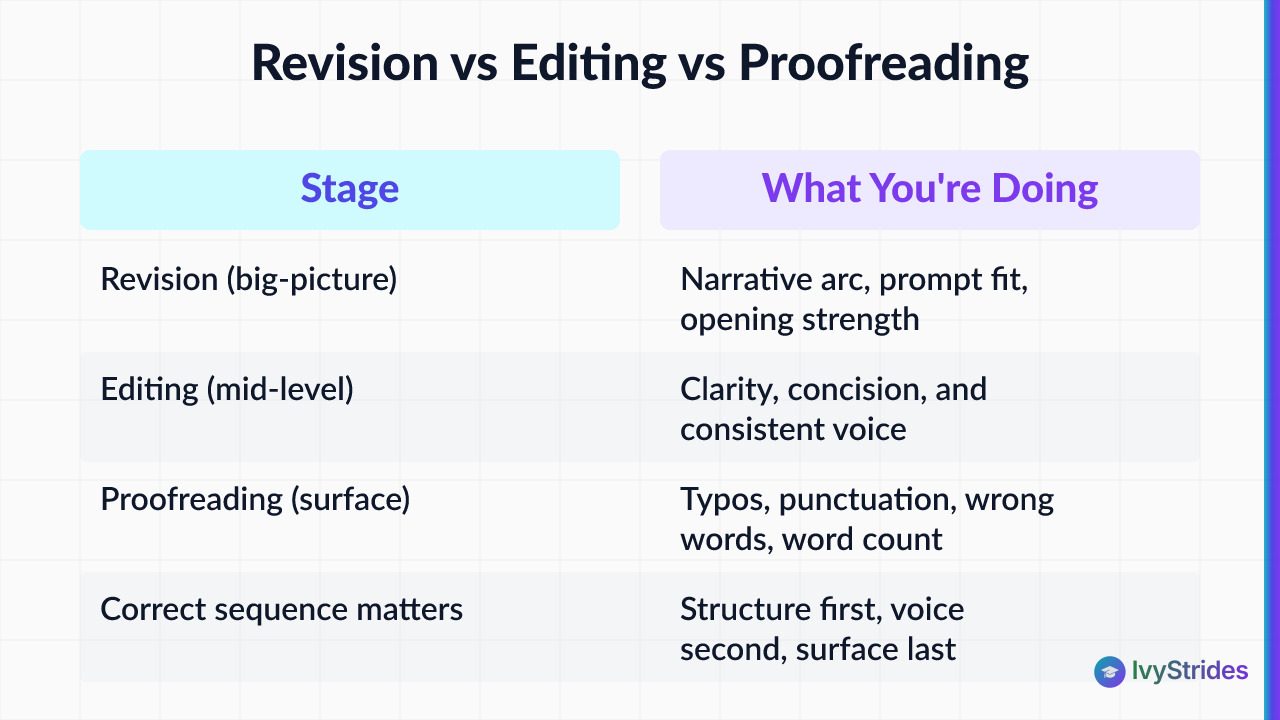
Revising, editing, and proofreading are three separate jobs. Confusing them is why so many drafts arrive at the deadline heavily edited but structurally weak.
Revision is big-picture work. You're asking whether the narrative arc holds, whether the essay answers the prompt, and whether the opening earns the reader's attention. Sentences get moved, cut, or rewritten wholesale. This is where the essay actually gets stronger.
Editing sits at the mid-level. Voice, tone, clarity, concision. You're not restructuring; you're refining what's already there. The classic frame is the 3 Cs of editing: clarity (is every sentence easy to understand on first read?), concision (is every word earning its place inside the 650-word limit?), and consistency (does the voice hold steady from opening to close?).
Proofreading is surface. Typos, punctuation, wrong-word errors, word count. Nothing more.
Why sequence matters: if you spend an hour perfecting the punctuation in paragraph three, then realize paragraph three needs to be cut, you've wasted that hour. Worse, sunk-cost bias makes you defend weak paragraphs because you already polished them. Structure first. Voice second. Surface last.
One 2025-2026 context point worth flagging. The Common App personal statement remains capped at 650 words. Admissions readers move fast, typically around 8 to 10 minutes per full application file, which means every sentence in your essay is competing for attention against transcripts, recommendations, and activities. Structural clarity isn't a stylistic preference. It's how a busy reader finds the point.
If you're still choosing what story to tell before you revise, our guide to college essay ideas that work walks through brainstorming from scratch.
Start With the Big Picture: Structure, Narrative, and Prompt Fit
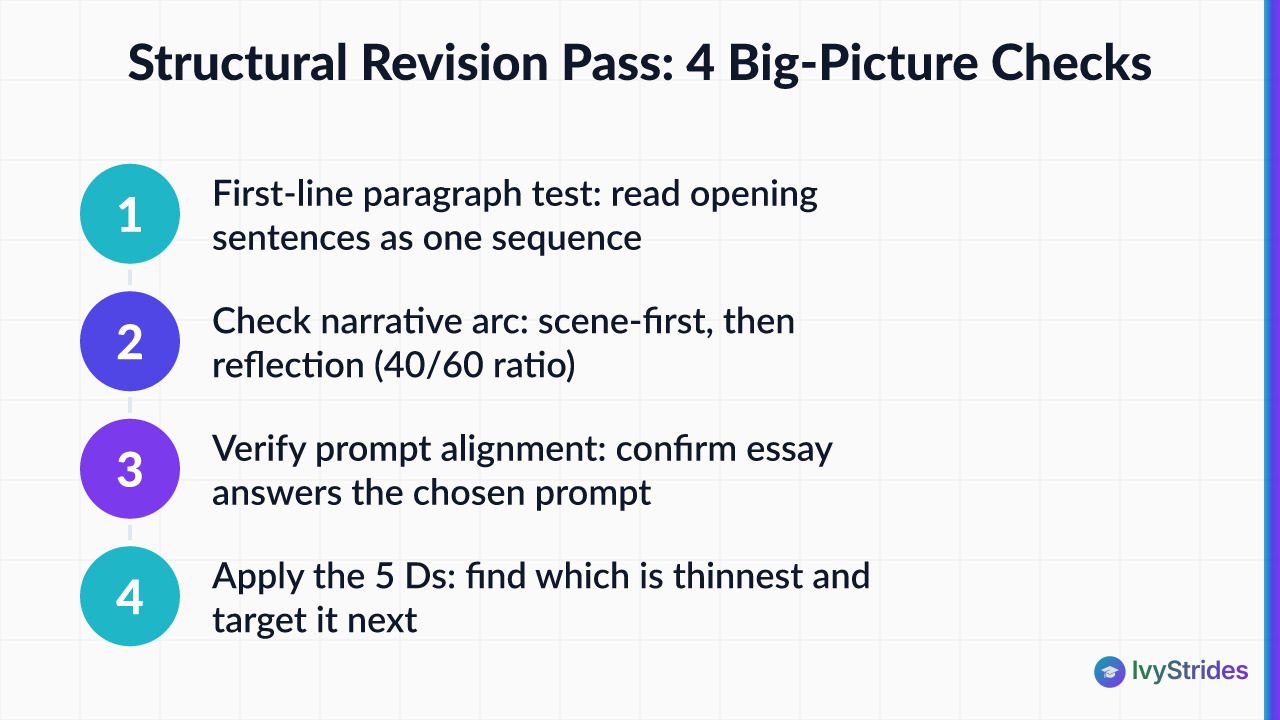
Pass one is the structural revision pass. You are not fixing commas here. You are asking whether the essay works.
Start with the first-line paragraph test. Highlight only the first sentence of each paragraph. Read those sentences in order, out loud, as if they were a single short paragraph. If that sequence tells a coherent story with a beginning, middle, and end, your structural bones are solid. If those first lines feel disconnected, or if two of them make the same point, you have a structural problem no amount of line editing will fix.
Next, check narrative arc. Does the essay open with a specific moment or image, develop meaningful stakes in the middle, and arrive somewhere the reader could not have predicted from paragraph one? A common failure pattern in first drafts is the "essay of conclusions," where the student tells the reader what they learned without ever showing the scene that taught them. If your essay is roughly 60 percent reflection and 40 percent scene, flip the ratio.
Then check prompt alignment. The Common App lists seven personal statement prompts for the 2025-2026 cycle on the official Common App site. Re-read the exact prompt you chose. Then re-read your essay. Does the essay actually answer it, or did the draft drift into a related but different question? Drifting is common and often invisible to the writer.
Here's the part most students miss. A useful frame is the 5 Ds: Describe (paint the scene), Discuss (explain its significance), Demonstrate (show what it reveals about you), Distinguish (make clear what is unique about your perspective), and Develop (make sure each paragraph moves forward instead of restating the last one). Run the draft through each D and note which one is thinnest. That's your next revision target.
One warning on opening hooks. Starting the essay with a famous quote is a well-known structural weakness. It signals that someone else's words matter more than yours, and it burns your opening real estate on a stranger's idea.
At schools where test-optional policies are in effect, the essay carries even more weight in the admissions file, which makes a polished, authentic draft more important than ever. Test-optional status varies by school and year, per FairTest, so check each school's current policy directly.
Before you finalize your revised draft, confirm your topic isn't on the list of angles that tend to backfire with admissions readers. See our breakdown of college essay topics to avoid.
The Voice and Tone Pass: Keep What Makes the Essay Yours
This is where most students panic. After a structural pass, the draft feels different, and you start to wonder if it still sounds like you.
Read the whole essay aloud. Not silently. Out loud. Your ear catches things your eye skips: sentences that run too long, phrases you'd never actually say, transitions that feel wooden. If a sentence makes you stumble when you read it aloud, a stranger reading it silently will stumble too.
While you read, watch for three specific voice killers. First, clichés. "I learned that hard work pays off." "This experience shaped me into the person I am today." "I discovered my true passion." These sentences appear in tens of thousands of drafts every year, and they tell the reader nothing about you. Cut them or replace them with the specific thing you actually thought or felt in that moment.
Second, vocabulary that doesn't match your actual speech. If you're using words in the essay that you would not use in a conversation with a teacher, replace them. A thesaurus isn't your friend during this pass. Admissions readers can tell when a 17-year-old suddenly deploys words like "quintessential" or "myriad" in an otherwise plain-spoken essay. In our coaching, students whose parents rewrite entire paragraphs often produce essays that sound like adults, not 17-year-olds, and admissions readers notice.
Third, over-editing. This is the point where extra polish starts stripping personality. If your third or fourth revision pass has removed every specific detail and replaced it with smoother but blander sentences, you have crossed the line. Revert.
One 2025-2026 wrinkle worth naming. Many colleges have adjusted how they read essays because of the volume of AI-generated content in the pipeline. Admissions readers often watch for the generic, competent-but-hollow prose that AI tools produce. Authentic voice, with its slight quirks and specific details, is a stronger signal now than it was five years ago, not a weaker one.
Consistency, the third of the 3 Cs of editing, matters most in this pass. If your opening paragraph is warm and conversational and your closing paragraph is formal and abstract, the reader feels the shift even if they can't name it. Hold the voice steady.
If you want a trained essay coach to run these revision passes with you, IvyStrides offers one-on-one help for Common App essay, with coaches who have worked through hundreds of supplemental drafts.
Getting Useful Feedback: Who to Ask and What to Ask Them
The question isn't just who reads your essay. It's what you ask them to look for.
Trusted adult readers (a parent, a teacher, a counselor) are useful if you give them a specific job. "Does this sound like me?" is a good question. "Is anything unclear?" is a good question. "Can you fix it?" is not. The moment a reader starts rewriting your sentences, the essay drifts toward their voice.
School counselors and English teachers are excellent for grammar and clarity. They tend to be less useful for voice, because their instinct is to make prose more formal and their day job trains them to correct rather than preserve. Take their line edits seriously. Take their voice suggestions with skepticism.
Peer readers work well for one purpose: comprehension. Hand your essay to a friend who doesn't know the story and ask what they took away from it. If their summary matches what you were trying to say, the essay is landing. If it doesn't, you have a clarity problem.
Professional essay coaches add something informal readers rarely can: an understanding of the admissions context. A coach who has read hundreds of drafts knows which topics are overdone at which schools, which structural moves land with readers, and where the essay is losing energy. For a structured expert review before submission, IvyStrides' essay review service provides detailed written feedback on structure, voice, and prompt alignment.
How many readers is too many? In our coaching, essays reviewed by more than four or five people tend to become committee documents that lose the student's original angle. Two to three trusted readers is the sweet spot. Ten readers is a red flag.
On the specific question of ChatGPT and AI tools, the honest answer is narrow. Grammar checks are fine. Asking an AI to suggest alternative word choices is fine, as long as you decide whether to accept each suggestion. Asking an AI to rewrite paragraphs or generate new content is not, both because it crosses the line on application integrity and because colleges are actively screening AI-generated prose in the 2025-2026 cycle. The Common App's guidance requires the essay to represent the student's own work, and a common app essay tutor can help you draw that line without crossing it.
Can You Use ChatGPT to Edit Your College Essay? An Honest Answer
Yes, narrowly. No, broadly. Here's the distinction.
What ChatGPT can legitimately help with:
- Flagging grammar errors and run-on sentences
- Suggesting alternative phrasings for a specific awkward sentence (you decide whether to accept)
- Identifying passive voice or repetitive sentence starts
- Checking word count and tightening obviously wordy phrasing
What ChatGPT cannot do:
- Replicate your lived experience
- Produce authentic voice (it produces average voice, which is the opposite)
- Understand the admissions context of a specific school
- Tell you whether the story you're telling is the right story for you
In our coaching, we've seen AI-edited drafts that read more cleanly than the original but have lost the specific detail and voice that made the first draft compelling. A metaphor a student invented gets replaced with a smoother, more common one. A quirky word choice gets sanded down. The essay reads well and lands nowhere.
Here's the authenticity test. After running your draft through any AI tool, read the revised version aloud. If it no longer sounds like you, revert. Every time.
For lower-risk free tools, a standard grammar checker will flag surface errors, and reading the essay aloud will catch voice problems no software can. Our free downloads library includes essay-planning resources you can use before you get anywhere near an AI tool.
The safest use of AI on a college essay is as a spell-checker with opinions. The riskiest use is as a co-writer. Don't confuse the two.
Final Checks Before You Submit: The Proofreading Pass
Pass three is surface work. This is the shortest pass and the one most students skip.
Word count discipline. The Common App personal statement maximum is 650 words per the official Common App site. Aim for 620 to 650. Under 600 signals you didn't have enough to say. Over 650 gets truncated in the submission portal. Supplemental essay word limits vary by school and must be checked individually against each school's requirements.
Typo hunt. Read the essay backward, one sentence at a time, starting from the last sentence and working up. This breaks the narrative flow that lets your brain autocorrect errors on a normal read-through. It's tedious. It works.
Format change. Print the essay and read it on paper. The physical shift from screen to page surfaces errors your eyes skip on screen. If you can't print, change the font to something you never use and re-read on screen. Same principle.
Portal check. Paste the final essay into the actual Common App text box before submitting. Sometimes formatting changes on paste, and sometimes the character count in the portal disagrees with your word processor. Better to find that mismatch a week before the deadline than an hour before.
Prompt re-check. Re-read your chosen prompt. Then re-read your essay. Confirm alignment one last time.
On the question of typos specifically: a single minor typo is unlikely to cause rejection, but it does signal carelessness in a file where carelessness reads as a lack of interest. Multiple errors, or a typo in a school's name or program title in a supplemental essay, are more serious because they suggest the essay wasn't written specifically for that school. In our coaching, the two most common final-pass errors are wrong school names in supplemental essays copied from another application, and word count overages that get cut off in the submission portal. Both are catchable with a slow, deliberate proofreading pass.
A strong essay works alongside your test scores and AP results as part of a complete admissions file, not as a replacement for them. Admissions outcomes depend on the full application, not any single component. Our guide to college essay ideas that work covers the connection between topic choice and the rest of your file.
How Many Times Should You Revise Your College Essay Before Submitting?
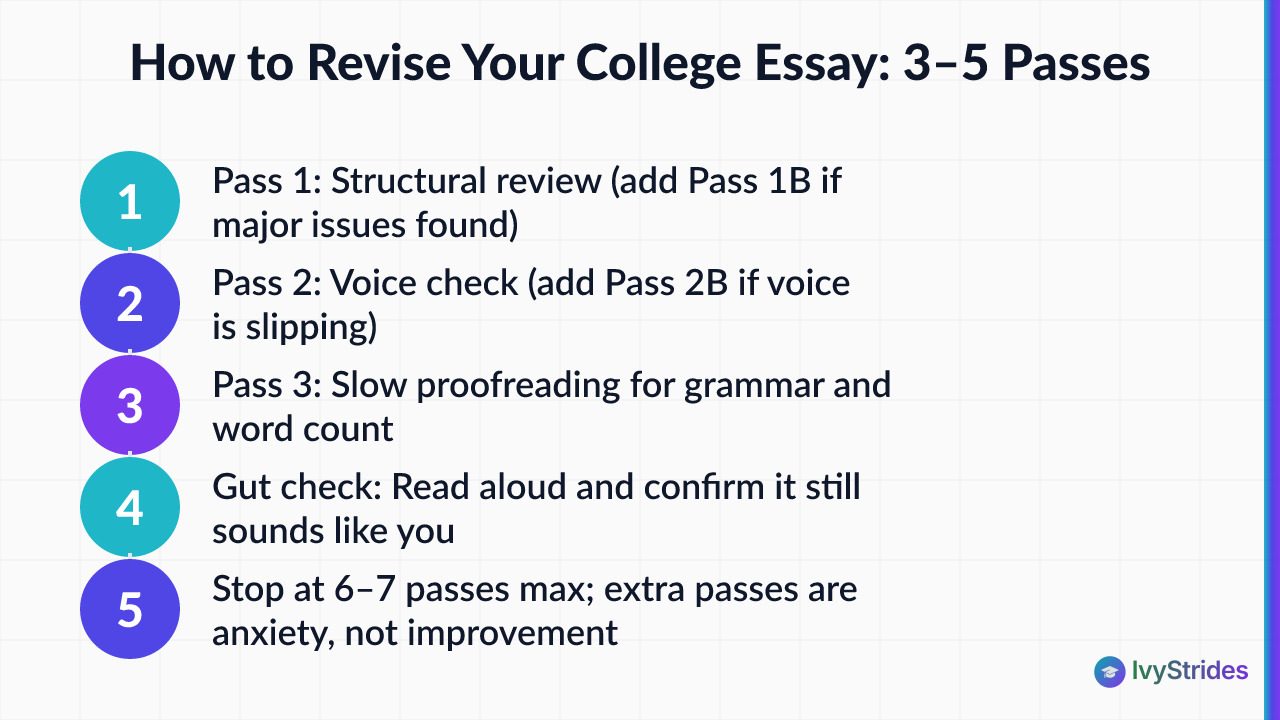
Three to five focused passes, each with a single purpose. Not one long marathon session. Not fifteen anxious re-reads.
Pass one is structural. Pass two is voice. Pass three is proofreading. If pass one uncovers major structural problems, add a pass 1B to fix them before moving on. If pass two shows the voice slipping, add a pass 2B. The passes are focused, not open-ended.
Signs the essay is ready:
- It reads naturally when you say it aloud
- It answers the exact prompt you chose
- It sounds like you, not like your parent or an AI tool
- No grammar errors on a slow proofreading pass
- Word count sits between 620 and 650 on the personal statement
Signs of over-editing:
- Every sentence sounds equally formal, with no rhythm changes
- Specific details have been replaced with tidy generalities
- The essay no longer surprises you when you read it
- You've stopped recognizing your own voice in it
In our coaching, students who revise more than six or seven times without a structured framework tend to produce flatter essays, not stronger ones. Extra passes past that point are usually anxiety, not improvement.
Timeline. For November 1 Early Decision deadlines, aim to have a complete first draft by late September and finish revisions by mid-October. That gives you roughly two weeks of buffer for the final proofreading pass, portal formatting checks, and any last supplemental essays that need to sync with the personal statement. If you're staring at a rough draft in mid-October with a November 1 deadline, prioritize a single expert read over five more self-directed passes.
For a final gut check on whether your topic itself is working, our guide to college essay topics to avoid is a fast read.
FAQ
What are the 5 Ds of college essay revision?
The 5 Ds are a revision framework: Describe (show the scene or moment), Discuss (explain its significance), Demonstrate (show what it reveals about you), Distinguish (make clear what is unique about your perspective), and Develop (ensure the essay moves forward rather than repeating the same point). Running your draft through each D helps identify which element is missing or underdeveloped. Most first drafts are heavy on Describe and thin on Distinguish.
What are the 3 Cs of editing?
The 3 Cs are clarity (is every sentence easy to understand on first read?), concision (is every word earning its place, especially within the 650-word limit?), and consistency (does the voice, tense, and tone stay the same throughout?). Checking each C separately is faster and more effective than trying to fix all three in one pass. Consistency is the C most students overlook, because voice drift between the opening and closing paragraph is hard to spot without reading the whole essay aloud in a single sitting.
What happens if there is a typo in my submitted college essay?
A single minor typo is unlikely to cause rejection on its own, but it does signal a lack of careful attention in a file where attention matters. Multiple errors, or a typo in a school's name or program title in a supplemental essay, are more damaging because they suggest the essay wasn't written specifically for that school. The safest approach is to do a final proofreading pass in the actual Common App text box, not just in a word processor, because formatting sometimes changes on paste.
Can I revise my Common App essay after I have already submitted it to one school?
Once you submit an application to a school, that version of the essay is locked for that school. You can still update your Common App essay for schools you haven't yet submitted to. This means it's worth finalizing carefully before your first submission, because any changes you make afterward will only apply to future submissions. Confirm current mechanics on the Common App site before your first deadline.
Is it okay for someone else to edit my college essay?
Getting feedback and light editing help is standard and acceptable. The Common App's application integrity guidance requires that the essay represent the student's own work and voice. Having a parent, teacher, counselor, or essay coach suggest edits is fine. Having someone else rewrite paragraphs or generate new content crosses into territory that violates application integrity and risks producing an essay that doesn't sound like you.
How do I edit my college essay for free?
The most effective free techniques cost nothing. Read the essay aloud (catches awkward phrasing and voice breaks), run the first-line paragraph test (read only the opening sentence of each paragraph to check flow), and print the essay to read on paper (a format change that helps the brain catch errors it skips on screen). A standard grammar checker flags surface errors. For structured feedback, IvyStrides offers a free strategy call where a coach can give an initial read and point you to the two or three changes that matter most.
The Bottom Line
Revision isn't one job. It's three, done in order: structure, voice, surface. Do them out of order and you'll spend hours polishing sentences you later cut, or sanding away the specific details that made your draft compelling in the first place. Three to five focused passes beats fifteen anxious rereads. And the readers you invite matter as much as the number of times you revise.

Award-winning author (South Asian Book Award) and graduate of BITS Pilani and UCLA Luskin School of Public Affairs. Brings a published writer's eye to Common App essays and grammatical precision to SAT and ACT R&W instruction.