
How to Structure a Common App Essay: The Complete 2026 Playbook for a Top Score
On this page
- Common App Essay Format Rules You Must Know Before You Write a Single Word
- Choosing Between Narrative and Montage Structure for Your Common App Essay
- How to Write a Common App Essay Hook That Earns the First Read
- The Middle Paragraphs Most Students Get Wrong in Their Common App Essay
- Not Sure If Your Essay Structure Is Working?
- Which Common App Essay Structure Fits Which Prompt
- The 10% Rule: Cutting Your Common App Essay Down to 650 Words Without Losing Your Voice
- The Most Common Structural Mistakes in Common App Essays (and How to Fix Them)
- How to Close a Common App Essay: The Two Endings That Work (and One That Does Not)
- Frequently Asked Questions About Common App Essay Structure in 2026
- How do you write an essay for Common App?
- Is it bad if my Common App essay is exactly 650 words?
- How many paragraphs should a Common App essay have?
- Should my Common App essay be in MLA format?
- What is the 10% rule in essay writing?
- How do I start my Common App essay introduction?
- Can I format my Common App essay as a letter?
- How long does it take to write a Common App essay?
- The Essay Is One Piece of a Larger Application
- Ready to Turn Your Draft Into an Essay That Gets Noticed?
To structure a Common App essay, open with a specific scene or moment (the hook), develop a middle that reflects on what that experience revealed about you, and close with a forward-looking insight. The essay runs 250 to 650 words; strong drafts typically land between 550 and 650. Use blank lines between paragraphs inside the Common App text box. Skip the title. Skip the name header. Two frameworks work: narrative (one zoomed-in scene) or montage (three to five connected vignettes tied by a theme).
Everything in this playbook reflects the 2026-27 Common App cycle, and the numbers below come from Common App's official documentation cited throughout. The harder question isn't what the rules are. It's which framework fits your topic, where the reflection paragraph needs to land, and how to cut a 720-word draft down without gutting the voice that made it worth reading. That's what the rest of this article walks through.
Common App Essay Format Rules You Must Know Before You Write a Single Word
The Common App personal statement is a 250-to-650-word essay submitted through a single text box on the Common Application, sent once to every member college on your list. Per Common App official documentation, 250 words is the enforced minimum and 650 is the enforced ceiling. The platform will not accept a shorter or longer submission.
A few mechanical rules matter more than students expect:
| Rule | Detail |
| Word range | 250 min, 650 max (Common App official) |
| Practical target | 550-650 words for a full arc |
| Title | No title field; a title inside the essay eats 5-10 words of budget |
| Name header | Not needed; your name is already on the application |
| Paragraph breaks | Blank line between paragraphs (indentation does not render) |
| Additional Information section | Reduced from 650 to 300 words as of August 1, 2025 |
The Common App text box strips indentation. If you paste in a Word document with tab-indented paragraphs, the tabs disappear and your essay renders as a single block of text. The blank-line paragraph break is the only separator the platform respects.
One more thing worth noting because families still get this wrong: the Additional Information section, where you'd explain a low grade or a family circumstance, was cut from 650 words to 300 words in August 2025. That's a real change, and it means the personal statement itself carries even more of your unfiltered voice than it used to.
For a deeper look at exactly how the 650-word ceiling works inside the Common App platform, including what happens if you paste over the limit, see our detailed walkthrough of the Common App essay word limit.
Choosing Between Narrative and Montage Structure for Your Common App Essay
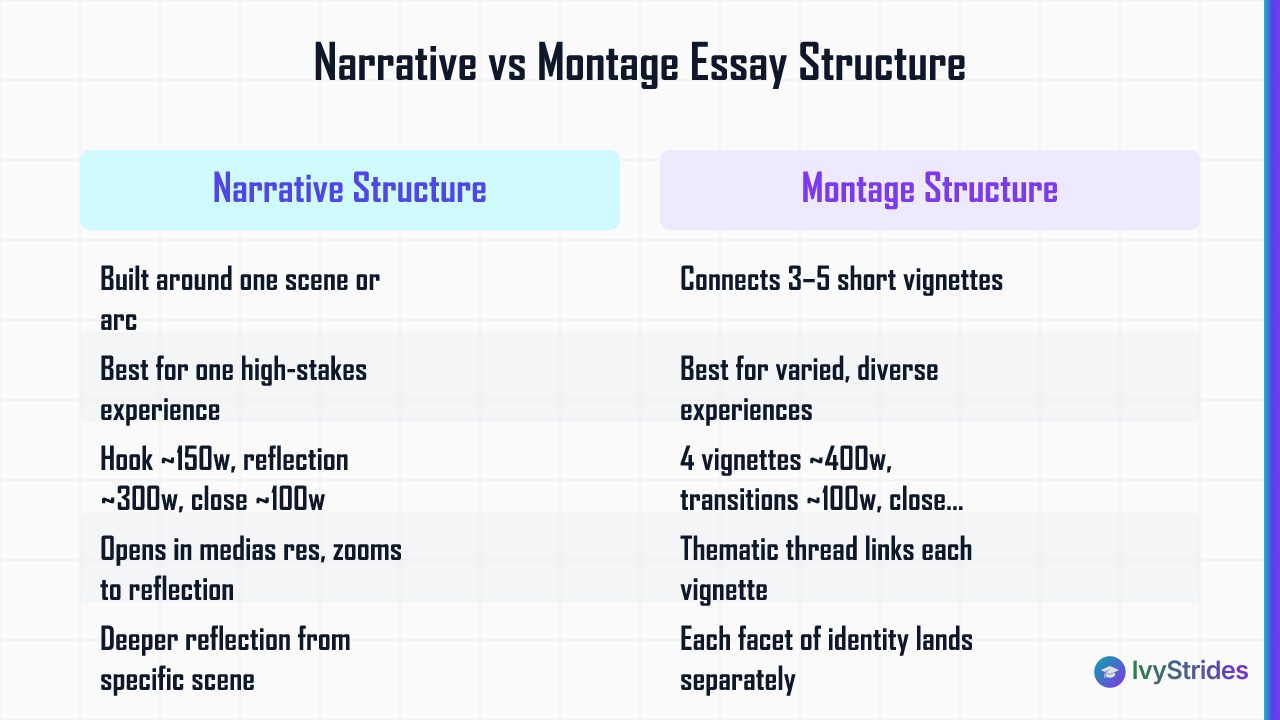
Two structural frameworks anchor strong Common App essays: narrative and montage. Narrative structure builds the entire essay around one scene or one arc. Montage structure connects three to five short vignettes through a unifying theme. Neither is inherently better. What matters is the fit between your topic and the framework.
Narrative structure works when you have one defining experience: a single chess match that changed how you think about failure, a hospital shift that shifted your view of medicine, one conversation with a grandparent that recast your family history. The essay opens in medias res, drops the reader into the scene, zooms out into reflection, and closes with a forward-looking insight. Word-count allocation typically looks like this:
- Hook and scene: roughly 150 words
- Complication and reflection: roughly 300 words
- Forward-looking close: roughly 100 words
Montage structure works when your identity is built from varied experiences and no single one carries the whole essay. Three moments across three countries that define your sense of home. Four objects on your desk that each reveal something about how you think. Each vignette runs about 80 to 120 words, and a thematic thread carries the reader from one to the next. Rough allocation:
- Four vignettes at 100 words each: 400 words
- Transitions and thematic connective tissue: roughly 100 words
- Close: 50 to 80 words
Here's the pattern we see in IvyStrides essay coaching: students with one high-stakes experience almost always produce stronger narrative essays, because reflection deepens when the scene is specific. Students with diverse cultural, extracurricular, or intellectual identities tend to write flatter narrative drafts and much stronger montages, because the montage lets each facet land.
If you're still deciding what to write about, our college essay ideas that work guide walks through the diagnostic questions that surface your strongest topic before you commit to a structure. And structural problems often start with topic problems; if you're unsure whether your subject is too common, check our list of college essay topics to avoid before you build your outline.
How to Write a Common App Essay Hook That Earns the First Read

Photo by Rufaro Makaya on Pexels
The Common App essay hook is the first one to three sentences of your essay, and it does one job: earn the second sentence. Admissions readers at selective schools work through hundreds of essays per cycle. The hook is the only moment you control the reader's first impression.
Three hook types work reliably:
In-scene opener. Drop the reader into a specific moment with sensory or situational detail. This is the strongest default. Example: "The centrifuge spun at 3,000 RPM and I had exactly four minutes to figure out what I had done wrong."
Declarative-statement opener. One surprising or counterintuitive claim that reframes something the reader thinks they understand. Example: "My grandmother taught me to lie by teaching me to cook."
Dialogue opener. A single line of real speech that sets context without a setup. Example: "'You're not going to like this,' my coach said, and handed me the lineup card."
Now the ones that consistently sink drafts. Avoid the dictionary definition ("Webster defines resilience as..."). Avoid the rhetorical question ("Have you ever wondered what it feels like to..."). Avoid "Since I was young, I have always been passionate about..." Any opener that could sit on top of five thousand other essays isn't yours.
Compare:
- Weak: "I have always loved science."
- Strong: "The centrifuge spun at 3,000 RPM and I had exactly four minutes to figure out what I had done wrong."
The first tells. The second shows, and it earns the reader's attention because there's tension in it: what did you do wrong, and what happens in those four minutes? The structural principle of opening in-scene only works if the scene itself is written with concrete sensory detail; our guide to show, don't tell in college essays explains the technique behind standout openings.
Keep the hook to one to three sentences, no more than 50 words. Longer openers delay the reader's payoff.
The Middle Paragraphs Most Students Get Wrong in Their Common App Essay
Here's the part most students miss. The middle of a Common App essay isn't a place to keep narrating. It's where you shift from describing what happened to reflecting on what it revealed. This is the reflection paragraph, and it's the essay's actual core.
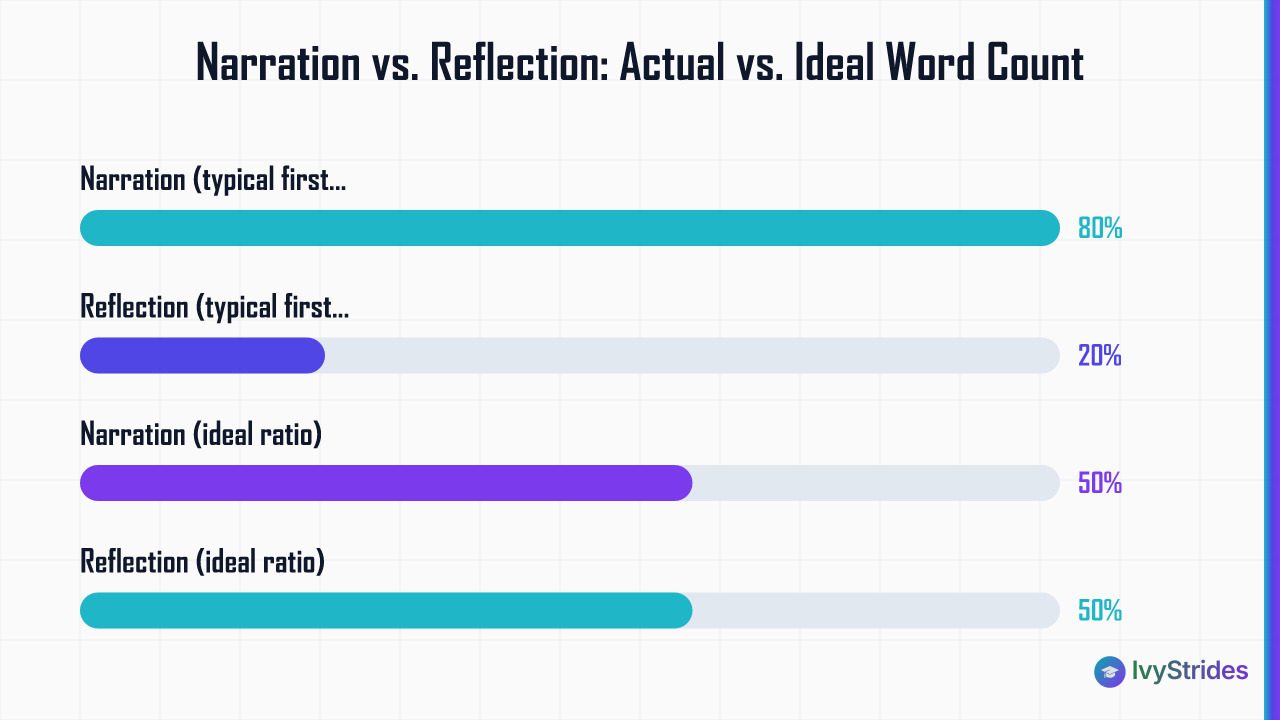
In IvyStrides essay coaching, the reflection paragraph is the single most under-developed section across first drafts. Students spend roughly 80 percent of their word count on narration and about 20 percent on insight. The ratio should be closer to 50/50. A scene without reflection is a story. A story isn't an essay.
The test to run on every paragraph is the "so what" test. After each paragraph, ask: so what does this reveal about me? If the answer is "it shows I was in a hard situation," you've narrated. If the answer is "it shows I default to solving problems by finding the person nobody else has asked yet," you've reflected. Reflection names the pattern of thinking, the value, the shift in how you see the world.
Most drafts also fumble the transition from scene to reflection. A clean bridge sentence solves it. Try: "What I didn't understand then, but do now, is..." or "Looking at that moment three years later, the thing that stays with me isn't the outcome. It's what I noticed about myself as it was happening."
For paragraph count: 4 to 6 paragraphs is typical for 550-650 words. There's no rule that requires a specific number, but fewer than 4 tends to run long and shapeless, and more than 6 can fragment a narrative essay.
Admissions readers aren't evaluating the event itself. They're evaluating what your response to it reveals about your character, your intellectual curiosity, or your resilience. The reflection paragraph is where that revelation lives, and once your structure is locked, the revision phase is where the essay earns its final form; see our step-by-step guide on how to edit and revise your college essay without losing your voice.
Not Sure If Your Essay Structure Is Working?
Book a free 15-minute strategy call with an IvyStrides essay coach. We'll review your structural outline, identify where the reflection is thin, and give you a concrete plan before you write another word. Students and parents are both welcome on the call.
Which Common App Essay Structure Fits Which Prompt
The Common App 2026-27 prompts are unchanged from the 2025-26 cycle, per the Common App official announcement. Here's how each pairs with narrative and montage:
| Prompt | Best structural fit |
| 1. Background, identity, interest, or talent | Either (narrative if one identity story stands out; montage if built from varied roots) |
| 2. Lessons from a failure or setback | Narrative (single arc almost always stronger) |
| 3. Challenging a belief or idea | Narrative or reflective hybrid |
| 4. A problem you have solved or want to solve | Narrative with a clear before/after arc |
| 5. Personal growth through a transition | Narrative if the shift was a single event; montage if gradual |
| 6. Captivating intellectual engagement | Either (montage works well for students with multiple intellectual passions) |
| 7. Topic of your choice | Any structure |
One rule matters more than the prompt-fit chart: pick your topic first, then pick the prompt that fits. Reverse-engineering a topic to match a prompt you like almost always produces a flat essay. The best draft is the one where you already know what you want to say and you're just finding the right container.
Before you commit to a structure, you need to choose the right prompt; our guide to all 7 Common App essay prompts for 2026-27 walks through each one with strategy and examples. If you're deeper into drafting and want prompt-specific tactics, see how to answer common app prompts.
The 10% Rule: Cutting Your Common App Essay Down to 650 Words Without Losing Your Voice
The 10% rule is a standard editorial technique: cut roughly 10 percent of the words from any overlong draft, and the result is a tighter, cleaner essay, not a shorter one. A 720-word Common App draft cut to 648 words almost always reads better than the 720-word version, because most of what disappears was padding.
What you're cutting:
- Redundant adverbs ("really," "very," "quite," "actually")
- Throat-clearing openers ("In this essay I will," "As I mentioned earlier")
- Repeated ideas across paragraphs (the reflection you already made in paragraph three, restated in paragraph five)
- Warm-up paragraphs that don't start in scene
In IvyStrides essay coaching, the most common single edit is removing the entire first paragraph. Students often write a warm-up paragraph before finding their real opening, and the real opening turns out to be paragraph two. Delete paragraph one, promote paragraph two to the hook, and the essay gets sharper immediately.
Is 650 words bad? No. Submitting at exactly 650 is fine if every word earns its place. The problem is padding to reach 650, not being at 650. If your essay is naturally 580 words and complete, leave it alone. If it's 720 words and bloated, apply the 10% rule.
The 250-word floor deserves a note. Essays under 250 words signal insufficient effort to admissions readers, and the platform won't accept them anyway. The practical target for a full personal statement remains 550 to 650 words, which gives you room to develop an arc without padding.
The Most Common Structural Mistakes in Common App Essays (and How to Fix Them)
Some structural failures show up so often that admissions readers spot them in the first paragraph. Here are the ones that surface most in our coaching, and the one-sentence fix for each.
Starting with birth or childhood backstory. "I was born in a small town in..." Fix: start in scene, at a specific moment, and let the backstory land later if it's needed at all.
Writing a resume in prose. Listing activities and achievements in paragraph form. This appears in roughly 40 percent of first drafts from students with strong extracurricular profiles, because that's what the rest of the application rewards. Fix: pick one moment inside one activity and let it stand for the whole.
The "I learned that..." summary close. Telling the reader what to think instead of letting the essay land. Fix: end with an image, a decision, or a forward-looking action.
Switching between two unrelated topics. Half the essay is about your grandmother, half about robotics, no thematic thread. Fix: either commit to one, or find the honest connection that links them.
Explaining a low grade or test score. That belongs in the Additional Information section (300 words as of August 2025), not in the personal statement. Fix: reclaim the 650 words for something that reveals character.
Formatting with indentation. The Common App text box strips it. Fix: blank-line paragraph breaks only.
Adding a title. Eats 5-10 words of budget for zero admissions signal. Fix: delete it.
For a broader catalog of pitfalls beyond structure, see common college essay mistakes to avoid. Students working with an IvyStrides essay coach through our Common App essay coaching receive a structural outline review in the first session, so the draft never goes in the wrong direction before the word count fills up.
How to Close a Common App Essay: The Two Endings That Work (and One That Does Not)
Two closes work reliably. One consistently doesn't.
The forward-looking close. Where you are now and where you're going, grounded in the essay's central insight. Example: "I still don't know if the centrifuge result was correct. But I know I'll spend the next four years finding out." This close works even when the opening image is only okay, because it points the reader toward the version of you that will show up on campus.
The circular callback close. Return to the opening scene with a new layer of meaning. If your hook was the centrifuge at 3,000 RPM, the close returns to the centrifuge with what you now understand about what was really being measured. This close pays off when the opening image is strong. When it's not, the callback lands with a thud.
The "lesson learned" summary close. "And that's how I learned the value of perseverance." Avoid. It tells the reader what to think instead of trusting them to arrive there. Admissions readers process what they see; they don't need a takeaway spelled out.
Closing paragraph length: 50 to 80 words. Don't introduce new information in the close, and don't tack on a moral. The last sentence should feel earned, like the essay was always heading there.
In our coaching, the forward-looking close is more reliable for students who are still developing their narrative voice. The circular callback requires a strong opening image to pay off, and if the hook is average, the callback amplifies the average-ness. When in doubt, forward-looking. For more essay concepts that consistently land, see college essay ideas that work.
Frequently Asked Questions About Common App Essay Structure in 2026
How do you write an essay for Common App?
Choose one of the seven prompts, pick a specific topic that reveals character, select a narrative or montage structure, write a hook that opens in scene, develop the reflection in the middle, and close with a forward-looking insight. Keep it between 550 and 650 words. Separate paragraphs with a blank line because the text box strips indentation.
Is it bad if my Common App essay is exactly 650 words?
No. Landing at exactly 650 is fine when every word earns its place. What hurts an essay is padding to reach 650, not being at 650. A naturally 580-word essay that completes its arc is stronger than a 650-word essay that reached the ceiling through filler.
How many paragraphs should a Common App essay have?
Most strong Common App essays run 4 to 6 paragraphs across 550-650 words. There's no required count. A narrative essay might use 5 paragraphs: hook scene, context, complication, reflection, close. A montage might use 6 or 7 shorter paragraphs, one per vignette plus transitions.
Should my Common App essay be in MLA format?
No. The Common App text box does not render MLA headers, running headers, or Works Cited. Skip the format entirely. Use blank-line paragraph breaks, no title, no name header at the top. MLA elements either disappear or waste words.
What is the 10% rule in essay writing?
The 10% rule means cutting roughly 10 percent of the words from any overlong draft to tighten the prose without losing the core ideas. For a 720-word draft, that's about 72 words. Target redundant adverbs, throat-clearing openers, and repeated ideas. The result is a cleaner essay at the same substance.
How do I start my Common App essay introduction?
Open in scene. Drop the reader into a specific moment with sensory or situational detail in the first one to three sentences. Skip dictionary definitions, rhetorical questions, and "I have always been passionate about." Concrete beats general every time.
Can I format my Common App essay as a letter?
Technically yes, but it rarely lands well. A salutation eats word budget and can feel gimmicky unless the prompt and topic genuinely call for the form. Most admissions readers respond better to an essay that opens in scene than one that opens with "Dear Admissions Committee."
How long does it take to write a Common App essay?
Most students need 4 to 8 weeks from first brainstorm to final draft when they work through topic selection, structural planning, drafting, and multiple revision rounds. Starting in June or July of the summer before senior year gives the most room for meaningful revision before Early Decision deadlines in November. If you'd like structured input during that window, our guide on how to get feedback on your college essay walks through what useful feedback actually looks like.
The Essay Is One Piece of a Larger Application
Structure alone doesn't get you admitted. Admissions decisions rest on the full application: transcript, scores, extracurriculars, recommendations, and the essay. At test-optional schools, the essay may carry proportionally more weight, but that weight varies by school and by cycle. What structure does is make sure that when a reader spends 8 to 10 minutes with your file, the essay reveals the version of you the rest of the application can only hint at. Learn more about our team on the IvyStrides About page. You can also meet the essay coaches who work with students at each stage of the drafting process.
This article reflects the 2026-27 Common App cycle. Word limits, prompts, and platform mechanics referenced above match Common App official documentation as of publication.
Ready to Turn Your Draft Into an Essay That Gets Noticed?
IvyStrides essay coaches work 1-on-1 with students worldwide to build a structural outline, sharpen the reflection, and produce a final draft that sounds like you at your best. If you're a parent reading this, the call is a good place to hear the plan alongside your student before the drafting starts.

Award-winning author (South Asian Book Award) and graduate of BITS Pilani and UCLA Luskin School of Public Affairs. Brings a published writer's eye to Common App essays and grammatical precision to SAT and ACT R&W instruction.