
Show, Don't Tell: The Technique Behind Standout College Essays
On this page
- What Show-Don't-Tell Actually Means in a College Essay
- Why Admissions Officers Notice the Difference Immediately
- The Most Painful Draft Problem: You Are Telling and Don't Know It
- Four Craft Moves That Turn Telling Into Showing
- Craft Move 1: Sensory Detail
- Craft Move 2: Concrete Action
- Craft Move 3: Dialogue
- Craft Move 4: The Telling Detail
- The 5 D's of College Essays: A Revision Checklist
- How to Audit Your Own Draft for Telling Language
- What Not to Write in a College Essay: Telling Mistakes That Hurt Your Application
- FAQ
- What are show-don't-tell essays?
- Is it ever acceptable to tell rather than show in a college essay?
- How do I show growth in a college essay without just saying "I grew"?
- Can admissions officers tell when an essay was written by AI?
- Does show-don't-tell apply to supplemental essays, or just the personal statement?
- How do I start a college essay without telling?
To show rather than tell in a college essay, replace adjective labels like "I am hardworking" with a specific scene: a concrete action, a sensory detail, or a line of dialogue that lets the reader conclude you are hardworking without being told. Instead of writing "I am passionate about robotics," write "At 11 p.m. I was still on the floor of the garage, zip-tying wires by flashlight." Same conclusion. But now the reader has experienced it, and that experience is what makes an admissions essay memorable.
This guide reflects the 2026-27 admissions cycle. The next sections give you four named craft moves, a before-and-after rewrite for each, a revision checklist called the 5 D's, and a step-by-step audit you can run on your current draft tonight.

What Show-Don't-Tell Actually Means in a College Essay
Telling summarizes. Showing immerses. When you write "I am a dedicated leader," you have handed the admissions officer a label and asked them to accept it on faith. When you write "I stayed after practice to redraw the play on the whiteboard for the two freshmen who were still confused, and we ran it three more times until they could call it themselves," you have handed them evidence. The label they attach ("dedicated leader") is now their conclusion, not your assertion. That shift is the whole technique.
The stakes are tight. The Common App personal statement is capped at 650 words, and admissions officers at selective schools routinely read roughly 50 to 100 applications a day during peak reading season. A generic adjective label is invisible in that volume. A specific, sensory scene is not. If you are still deciding what to write about before applying these techniques, our breakdown of what the college application essay is and why it matters covers the purpose and prompt landscape first.
One more clarification. Show-don't-tell is a craft move borrowed from creative writing and applied to personal narrative. It isn't a rule that every sentence must be a scene. It's a rule that the traits you want the reader to believe about you must be earned through evidence somewhere in the essay, not just announced.
Why Admissions Officers Notice the Difference Immediately
Reading application essays is pattern-recognition work. After the fiftieth "I have always been passionate about medicine because my grandfather..." an admissions officer's attention flattens. In our coaching with students, essays that open with a specific scene rather than a thesis statement about the writer's personality tend to hold the reader's attention longer.
Here's the part most students miss. The essay's job is to make a character argument, and arguments need evidence. When you tell, you skip the evidence and jump to the verdict. When you show, you present the evidence and let the reader deliver the verdict themselves. Readers trust verdicts they reach on their own. That's just how persuasion works.
There is a second reason showing matters more in 2026 than it did five years ago. AI-generated drafts tend to produce polished but generic telling language: "This experience has shaped me into a more empathetic and driven individual." Admissions offices are increasingly aware of these patterns, and readers are increasingly trained to notice them. The defense isn't to sound less like AI in the abstract. The defense is to write the kind of hyper-specific, lived detail that a language model can't invent because it never lived your life. The cumin smell on your grandmother's hands at 10 p.m. is not a phrase a model can generate about someone it has never met.
The Common App has kept the seven personal statement prompts unchanged for the 2026-27 cycle per their official announcement, so the craft demands haven't shifted. Because timing matters for how many revision cycles you can run, our college application deadlines for 2026-27 maps every key date.
The Most Painful Draft Problem: You Are Telling and Don't Know It

Photo by www.kaboompics.com on Pexels
Most students have been told to "show, don't tell" by a teacher or counselor. Very few have been given a reliable test for catching telling language in their own drafts. So they revise. And revise. And produce a slightly more elaborate version of the same telling sentence.
Here are five phrases that show up in almost every first draft. Each one is a red flag:
- "I am passionate about..."
- "This experience taught me..."
- "I have always been..."
- "I am a hard worker who..."
- "I care deeply about..."
Every one of these is a self-reported trait with no evidence attached. The reader has no reason to believe any of them, because the writer has done none of the work of proof.
The fix starts with what we call the adjective-label test. Print your draft. Highlight every adjective or abstract noun that describes you: passionate, dedicated, curious, resilient, empathetic, driven, thoughtful, hardworking. Each highlight is a candidate for replacement with a scene. Not a slightly-more-specific label. A scene.
In our coaching with students, the most common revision error is replacing one telling sentence with another slightly more specific telling sentence. "I am passionate about engineering" becomes "I am deeply passionate about mechanical engineering and love solving problems." That isn't a fix. That's a longer telling sentence. The switch has to be to a moment, an action, a sensory detail.
This problem is especially acute in supplemental essays capped at roughly 150 to 250 words, where every sentence has to carry weight. There is no room for adjective labels at all.
Four Craft Moves That Turn Telling Into Showing
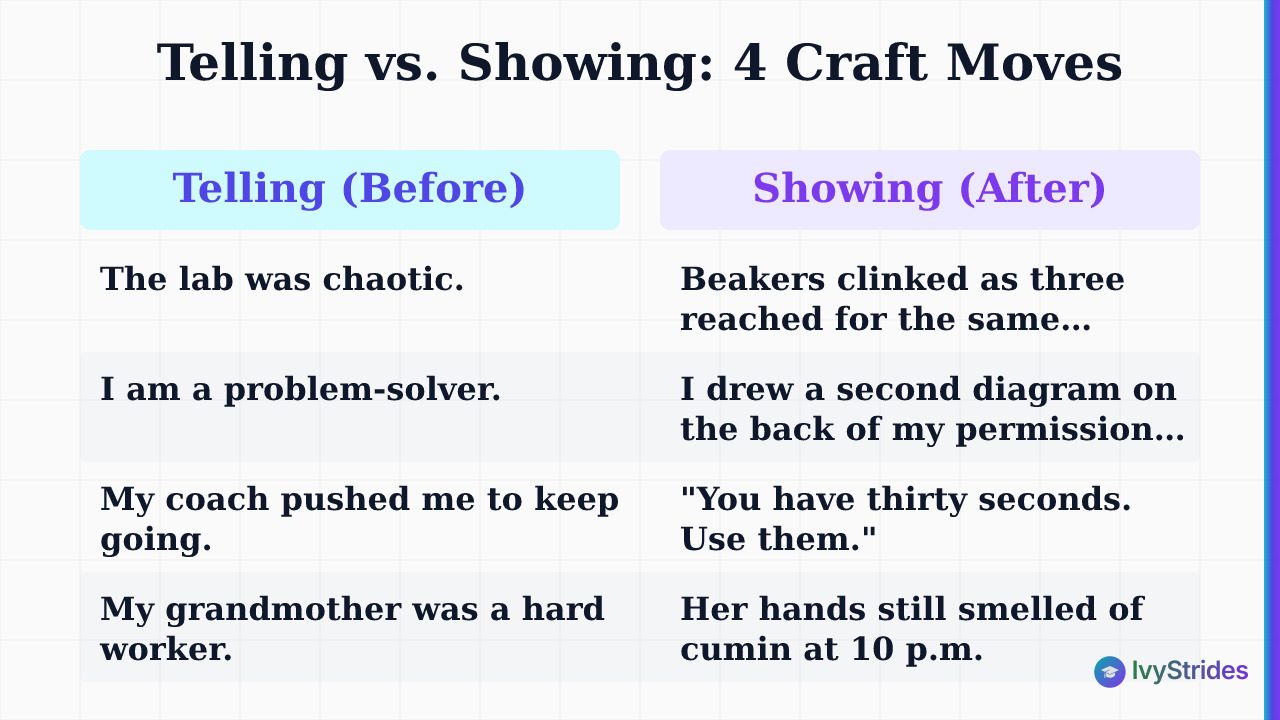
Four moves. Each one is a lever you can pull on any sentence in your draft. Learn the labels. Practice each one on a paragraph you already have.
Craft Move 1: Sensory Detail
Anchor the moment to a specific sense: sight, sound, smell, touch, or taste.
Before: The lab was chaotic.
After: Beakers clinked against each other as three people reached for the same pipette.
"Chaotic" is a label. The rewrite puts the reader in the room. They hear the beakers. They see the reach. They arrive at "chaotic" on their own, which is where you wanted them all along.
Craft Move 2: Concrete Action
Replace a trait with a verb-driven sentence that shows behavior.
Before: I am a problem-solver.
After: I drew a second diagram on the back of my permission slip because the whiteboard was full.
Notice what the rewrite does. It doesn't say "problem-solver" anywhere. It doesn't need to. The action carries the trait, and the specific detail (a permission slip, of all things) makes it real.
Craft Move 3: Dialogue
A single quoted line can carry more character than a paragraph of narration.
Before: My coach pushed me to keep going.
After: She said, quietly, "You have thirty seconds. Use them."
The word "quietly" is doing enormous work. Dialogue is compression. One line of speech, chosen well, tells the reader who this person is and what your relationship with them was.
Craft Move 4: The Telling Detail
One hyper-specific fact that carries the emotional weight of an entire paragraph.
Before: My grandmother was a hard worker.
After: Her hands still smelled of cumin at 10 p.m.
That's it. Nine words. No adjectives about her. No summary of her workday. Just cumin, hands, 10 p.m. The reader constructs the rest.
Once you understand which moments to show, structuring the essay around them becomes much cleaner. Our guide on how to structure your personal statement gives you a step-by-step framework that pairs with these craft moves. Students who work these moves in real time with a coach tend to revise more efficiently than those who self-edit in isolation. If you'd like that kind of feedback loop, our one-on-one help for common app essay service is built around that revision cycle.
The 5 D's of College Essays: A Revision Checklist
The four craft moves above are the levers. The 5 D's are the checklist you run against each paragraph to make sure at least one lever is pulled.
- Details. Specific nouns and numbers. Not "a lot of people" but "seventeen kids." Not "a car" but "a 2003 Corolla with the driver's side mirror duct-taped on."
- Dialogue. At least one quoted line somewhere in the essay. "Try it again, but slower," my grandfather said. That one line tells the reader everything about him.
- Description. Sensory language anchored to a moment. Not "beautiful weather" but "the kind of cold that makes your fingers ache inside your gloves."
- Demonstration. An action that proves a trait, per Craft Move 2 above. Show the behavior. Don't name the trait.
- Depth. One or two sentences of reflection that earn their place by following a scene, not replacing one. This is the only place where a small amount of telling is acceptable.
Read each paragraph and ask which D is present. If none of the five are in a paragraph, that paragraph is almost certainly pure telling. In our coaching with students, essays that land well tend to have at least three of the five D's present in the opening paragraph alone.
A note on Depth. Reflection is where students most often over-tell, ending with a sweeping lesson like "This experience taught me the value of perseverance." One or two reflective sentences after a well-built scene can land powerfully. Three paragraphs of reflection with no scene underneath cannot. Depth earns its place only when Demonstration has done the work first.
How to Audit Your Own Draft for Telling Language
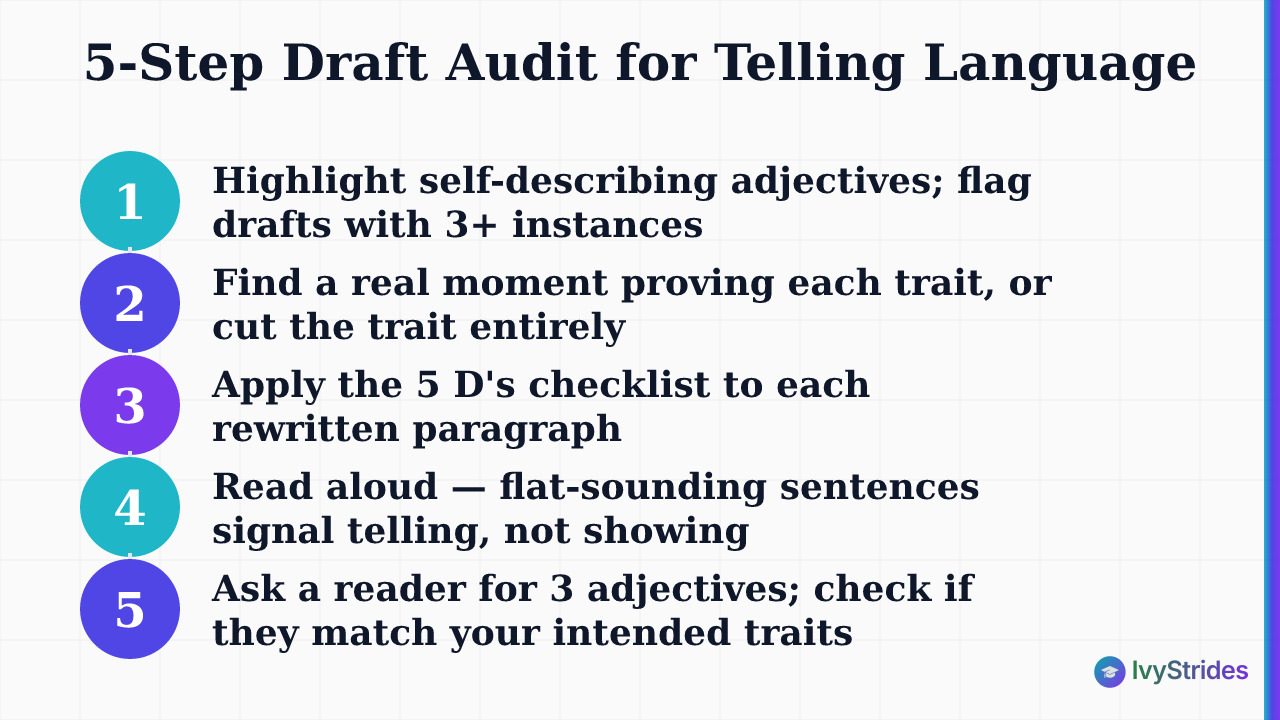
Here is the process. Run it on your current draft tonight.
Step 1. Highlight every sentence that contains a self-describing adjective or abstract noun: passionate, dedicated, curious, resilient, empathetic, driven, hardworking, thoughtful, unique. Count them. If there are more than three in a 650-word draft, you have a telling problem.
Step 2. For each highlighted sentence, ask yourself: "What moment in my life proves this?" If you can name a moment, replace the sentence with a two-to-three-sentence scene from that moment, using at least one of the four craft moves. If you can't name a moment, the trait probably shouldn't be in the essay at all.
Step 3. Apply the 5 D's checklist to each paragraph after rewriting. Which D is present? If none, revise again.
Step 4. Read the draft aloud. Sentences that feel flat when spoken are usually telling sentences. Your ear catches what your eye misses.
Step 5. Ask a reader who doesn't know you well to list three adjectives that describe you after reading the essay. If their list matches the traits you were trying to convey, the showing is working. If they list generic traits like "nice" or "smart," the essay hasn't landed a specific character argument yet.
This process applies equally to supplementals. In a 150-word "Why This College" essay, one named professor's research project or one specific campus program will do more work than three sentences of general enthusiasm. Word economy makes showing more efficient than telling, not less.
If you want a coach to flag every telling sentence in your current draft, our essay review service gives you line-level feedback within a structured revision cycle. Because your revision runway depends on when your essays are due, our college application timeline for 2026-27 maps every key deadline.
What Not to Write in a College Essay: Telling Mistakes That Hurt Your Application
Five specific patterns show up in almost every weak draft. Each one is a form of telling. Each one is fixable.
1. Opening with a dictionary definition. "Webster's defines perseverance as..." The admissions officer already knows the word. You've spent your first sentence teaching them something they don't need. Open with a scene instead.
2. Ending with "This experience taught me..." followed by a generic lesson. This is the single most common closing pattern in weak drafts. In our coaching with students, that sentence at the end of an essay is almost always a sign that the scene before it did not do enough showing work. The fix is usually to strengthen the scene, not to rewrite the lesson.
3. Using "passionate" without a scene that proves it. The word "passionate" isn't evidence. It's a claim about evidence. If you can't show the passion in an action, cut the word.
4. Describing yourself as "unique" or "different" without showing how. Every applicant is unique. Announcing it makes you sound identical to every other applicant announcing it. Show the specific fact about your life that no other essay in the pile will contain.
5. Writing in an inflated, formal register. Formal doesn't mean impersonal. "I endeavored to ameliorate the situation" isn't what a 17-year-old sounds like on their best day. Your natural voice at its most considered is the target. If your parents wouldn't recognize the sentence as something you'd say, cut it.
One caveat on voice. College essays do call for careful, edited prose. That isn't the same as corporate prose. The goal is you, thinking hard and choosing words carefully. Not a memo.
A broader caveat. A strong essay improves your application, but college admissions decisions rest on the full application: transcript, test scores where required, recommendations, activities, and fit. Test-optional policies vary by school and year, and a well-shown essay does not replace the other components. What it can do is make the reader remember you.
FAQ
What are show-don't-tell essays?
Show-don't-tell essays use specific scenes, sensory details, concrete actions, and dialogue to reveal the writer's character rather than stating traits directly. The reader experiences the evidence and draws their own conclusion, which is more persuasive and more memorable than a list of self-reported adjectives. The label the reader attaches to you is theirs, not yours, which is why they trust it.
Is it ever acceptable to tell rather than show in a college essay?
Yes, in two specific places. Brief transitional sentences that orient the reader between scenes can be told rather than shown, because their job is navigation, not persuasion. And the essay's closing reflection can carry one or two sentences of direct insight, as long as they land after a well-built scene. The rule is that telling earns its place only after showing has done the work.
How do I show growth in a college essay without just saying "I grew"?
Show two versions of yourself in action. An early scene where you handle a situation one way, and a later scene where you handle a similar situation differently. The contrast between the two scenes demonstrates growth without requiring you to announce it. The reader sees the change happen, which is far more convincing than being told it happened.
Can admissions officers tell when an essay was written by AI?
Admissions officers in 2026 are increasingly aware of AI-generated writing patterns, which tend to produce polished but generic telling language with no specific sensory detail or idiosyncratic voice. AI-detection tools aren't universally used or perfectly accurate, but reader intuition is real, and generic prose reads as generic regardless of who wrote it. The best defense is a draft full of hyper-specific details that only you could know. An essay about the cumin smell on your grandmother's hands at 10 p.m. isn't something a model can generate about a person it has never met.
Does show-don't-tell apply to supplemental essays, or just the personal statement?
It applies to both, but the technique has to be more economical in supplementals. In a 150-word "Why This College" essay, one specific detail about a named professor's research or a specific campus program does more work than three sentences of general enthusiasm. The shorter the word limit, the more work each showing sentence must do, and the less room there is for any adjective labels at all.
How do I start a college essay without telling?
Drop the reader directly into a scene. A specific moment, a sensory detail, or a single line of dialogue. Avoid opening with a question, a dictionary definition, or a broad statement about the world. The first sentence should put the reader somewhere specific, not announce what the essay will be about. If your opening could belong to any applicant, rewrite it until it could only belong to you.
The four craft moves and the 5 D's are levers you can pull tonight. The audit process is a checklist you can run in an hour. What most students need next is a second reader who can tell them whether a specific revision is working or whether they've just written a slightly more elaborate telling sentence. That's the loop coaching accelerates.
You can read more about our approach on the IvyStrides about page. To see who you'd be working with, meet our essay coaches.

Award-winning author (South Asian Book Award) and graduate of BITS Pilani and UCLA Luskin School of Public Affairs. Brings a published writer's eye to Common App essays and grammatical precision to SAT and ACT R&W instruction.