
The Best College Essay Topics in 2026 (and Which to Avoid)
On this page
- What Makes a College Essay Topic Work in 2026
- The 7 Common App Prompts for 2026-2027 (and How to Choose One)
- College Essay Topics That Stand Out: Categories That Work
- My Topic Idea Feels Too Ordinary: What to Do
- College Essay Topics to Avoid in 2026
- How to Evaluate Whether Your Topic Is Strong Enough
- A Note on Supplemental Essay Topics
- FAQ
- What are the seven Common App essay prompts for 2026-2027?
- What are the 5 Ds of college essays and do they mean I cannot write about those topics?
- Can I write a college essay about sports?
- What are some good college essay topics for students who feel their life is not interesting enough?
- Do college essay topics change every year?
The best college essay topics in 2026 are specific, personal moments or perspectives that reveal your values and thinking in a way your transcript cannot. Strong topics include a niche intellectual obsession, a formative failure and what it changed, an unconventional hobby, a cultural tension you navigate daily, or a quiet moment that shaped how you see the world. Topics to avoid aren't categories but execution patterns: the sports-injury comeback told without insight, the mission-trip summary that centers the trip rather than you, and any story where the event is more interesting than your reflection on it.
That framing draws on the Common App's official 2026-2027 prompt announcement and patterns we see across hundreds of essay drafts each cycle. The harder question is whether the topic you already have in mind passes two specific tests before you commit hours to drafting. The sections below walk through those tests, the seven prompts, the categories that work, and the ones that quietly sink applications.

What Makes a College Essay Topic Work in 2026
An admissions reader spends roughly 8 to 10 minutes on a full application file. Your personal statement, capped at 650 words per the Common App, gets a fraction of that. So the topic has one job: reveal something specific and true about you that your transcript, activities list, and recommendations don't already show.
Two tests separate topics that work from topics that don't.
The only-you test: could 500 other applicants write essentially the same essay about this subject? If the answer is yes, the topic isn't broken, but the angle is. A student writing about her grandmother's kitchen is common. A student writing about the specific moment she realized her grandmother was rounding recipe measurements because she couldn't read English is only-her.
The so-what test: after summarizing your topic in one sentence, can you say in a second sentence what it reveals about how you think? If you can't, the topic needs a sharper angle, more specificity, or a different scene.
Specificity beats scale every time. A 10-minute scene, rendered in real detail, will outperform a 10-year summary of an important experience. Your essay is the qualitative signal in a holistic review. Test scores, GPA, and AP results tell one story; the essay tells the other.
One caveat matters more than most students realize: at test-optional schools, the essay often carries additional relative weight because quantitative signals are absent. Test-optional policies vary by school and year, so verify each institution's current policy on their admissions page or through the FairTest tracker before deciding whether to submit scores. Your essay is one piece of a larger admissions picture. If you're still building your testing strategy alongside your application, our overview of how to build a winning high school testing plan covers how AP scores, SAT, and ACT fit together.
The 7 Common App Prompts for 2026-2027 (and How to Choose One)
Per the Common App's official announcement, the personal statement prompts for the 2026-2027 cycle are unchanged from 2025-2026. The word limit remains 250 to 650 words. The Additional Information section is capped at 300 words this cycle.
Here are the seven prompts, closely paraphrased:
-
A background, identity, interest, or talent so meaningful your application would be incomplete without it.
-
A time you faced a challenge, setback, or failure, and what you learned.
-
A time you questioned or challenged a belief or idea.
-
A problem you've solved or want to solve.
-
An accomplishment, event, or realization that sparked personal growth.
-
A topic, idea, or concept you find so engaging it makes you lose track of time.
-
Any topic of your choice.
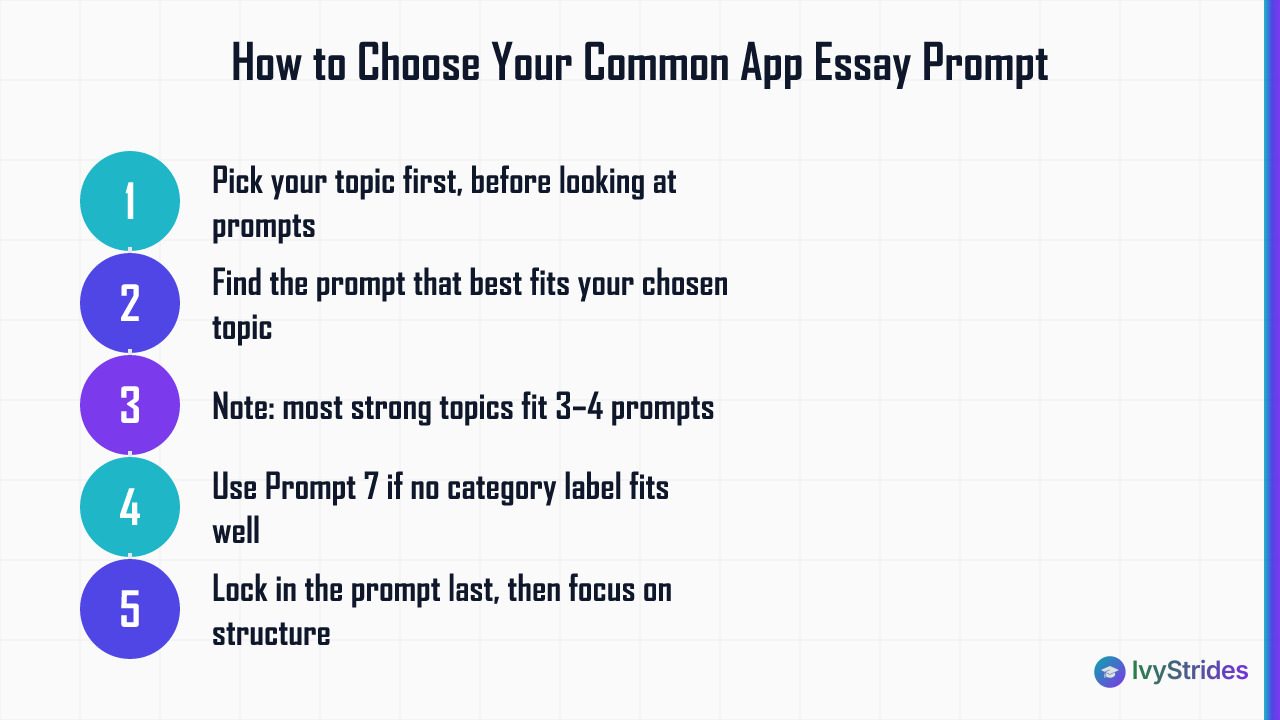
Here's the part most students miss: pick your topic first, then find the prompt that fits. The prompts are deliberately flexible, and a strong topic will usually fit three or four of them. Prompt 7 exists specifically so a great essay isn't held back by a category label. Choosing the prompt is the last decision, not the first.
Once you've locked in a topic, structure and voice come next. Our guide on how to write a personal statement walks through the drafting process step by step.
College Essay Topics That Stand Out: Categories That Work
Strong topics tend to fall into a handful of shapes. Not because there's a formula, but because these shapes make specificity and reflection easier to render.
A niche intellectual obsession. Not "I love science." A student who wrote about her obsession with the etymology of medical Latin terms, and what that taught her about how knowledge gets encoded, produced a more memorable essay than a student who wrote about wanting to be a doctor.
A formative failure with real insight. The key word is insight, not failure. The essay isn't about the loss or the low grade. It's about the sentence in the middle where you say what you now think differently.
An unconventional hobby or skill. Restoring vintage typewriters. Competitive cup stacking. Reading obituaries as a form of biography study. The subject earns attention; the reflection earns admission consideration.
A cultural identity or tension navigated daily. For international students and first-generation Americans especially, this can be powerful, but it has to render a specific scene, not summarize a background. The line between the two: does the reader see one Tuesday afternoon, or ten years?
A mundane object or routine that carries meaning. The bus ride you take at 6:14 every morning. The way you organize your notebook. A recipe you've made 200 times. Ordinary settings, specific insight.
A relationship that changed how you think. Not "my grandfather taught me hard work." That's a summary. What did he say on one specific afternoon, and what did you realize six months later?
An ethical or intellectual question you can't stop thinking about. This is the intellectual curiosity prompt in essence: what question keeps you up? Why?
In our coaching, a student who wrote about debugging code as a metaphor for how she approaches interpersonal conflict produced a more memorable essay than a student who wrote about winning a robotics championship. Same background, same activities list, very different essay outcomes. The difference was specificity of reflection, not impressiveness of achievement.
Two contextual notes. First, look at Johns Hopkins' "Essays That Worked" archive to see the actual range of successful topics at a highly selective school. The range is wider than most students assume. Second, there's no such thing as an Ivy League essay topic category. The criteria are the same. If you want a second read on your topic before drafting, a common app essay tutor can save you weeks of revision on a topic that was never going to land.
My Topic Idea Feels Too Ordinary: What to Do
This is the most common problem we see, and it almost always comes from the same misdiagnosis: the student thinks they need an interesting life. They don't. They need an interesting perspective on the life they have.
Three brainstorming exercises consistently produce stronger topic candidates than trying to think of an impressive story.
The 21 details list. Sit down and list 21 specific, concrete details about your daily life. No filtering for impressiveness. The tea your dad drinks. The specific bus route. The way your sister argues about movies. What you notice in your neighborhood at 6 PM. The point isn't to find the "essay topic" in the list. It's to force you into the register of specific noticing, which is where good essays live.
The values inventory. Write down 3 to 5 values you actually hold. Not the ones you think sound good. Then, for each, identify a specific moment when that value was tested, formed, or complicated. That moment, rendered in scene, is often the essay.
The mundane-moment scan. Think of a routine you do weekly. Ask: what does this routine reveal about how I think? Making coffee. Walking a specific route home. Sunday phone calls with a grandparent. The routine itself is the container; your reflection on it is the essay.
In our essay coaching, students who start with the mundane-moment scan consistently surface more original topics than students who start by trying to identify their most impressive achievement.
Look, your life doesn't need to be more interesting. Your attention to it does.
If you already have a rough draft and want feedback rather than topic help, our essay review service covers structural editing and voice preservation.
College Essay Topics to Avoid in 2026
Honestly, there are almost no topics you can't write about. There are patterns of execution that fail with high frequency. The distinction matters, because a blanket "don't write about X" rule will steer you away from stories that could work.
That said, a few categories require extra care because they carry a specific execution risk.
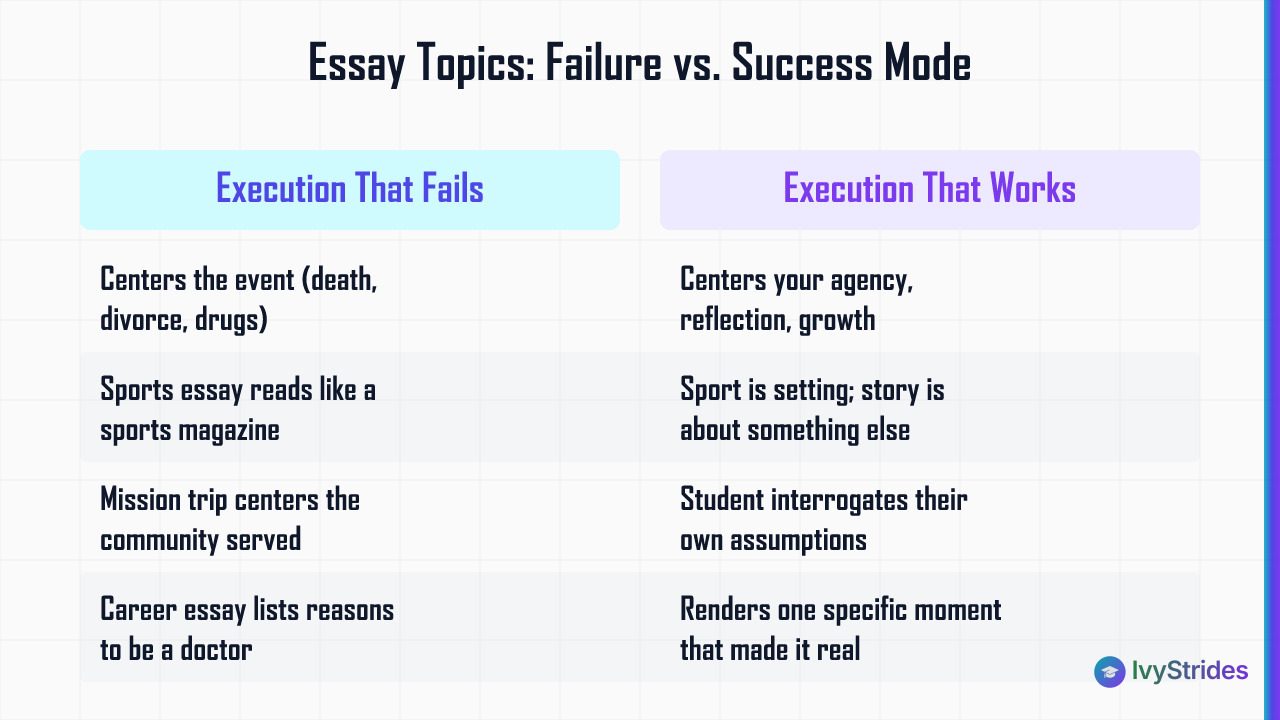
The 5 Ds framework. This admissions-coaching heuristic (not an official Common App or College Board framework) flags five topics that require heightened care: Death, Divorce, Drugs, Depression, and Diversity. The risk isn't the subject; it's that students often center the event rather than their own agency, reflection, and growth. An essay about a parent's death can be genuinely powerful if it focuses on what you learned about yourself and how you moved forward. It fails when it reads as a grief summary.
The 3 Ds (Death, Divorce, Drugs) are a subset with the same principle: your reflection is the essay, not the event.
The sports-injury comeback narrative. Possibly the single most overused format in the applicant pool. It works only when the sport is the setting and the story is about something else entirely: how you handle failure, how you think about leadership, how a specific moment changed your relationship with effort. If your essay could appear in a sports magazine, it needs a different angle.
The mission trip or volunteer-abroad summary. Fails when it centers the community served or performs gratitude. Works when the student interrogates their own assumptions honestly. A student writing "I realized how lucky I am" is telling a common story. A student writing about the moment they realized their presence in a village might have been unhelpful is telling a specific one.
The person I admire most. This becomes an essay about someone else. Admissions readers need to see you.
Why I want to be a doctor/lawyer/engineer, told as a summary. Career-motivation essays fail when they list reasons. They work when they render a single specific moment that made the motivation real.
The immigration or moving story told as summary. For international students and first-generation applicants, this material can be extraordinary. The failure mode is compressing five years into three paragraphs. The success mode is one scene, in detail, with your specific interior thinking.
The list-of-achievements essay disguised as a narrative. If your activities list would be a good summary of your essay, the essay isn't doing its job.
In our coaching, the essays that fail most often aren't about bad topics but about topics where the student describes what happened without revealing what they think. Revision is where most of this gets fixed; our guide on how to edit a college essay covers the mechanics.
How to Evaluate Whether Your Topic Is Strong Enough
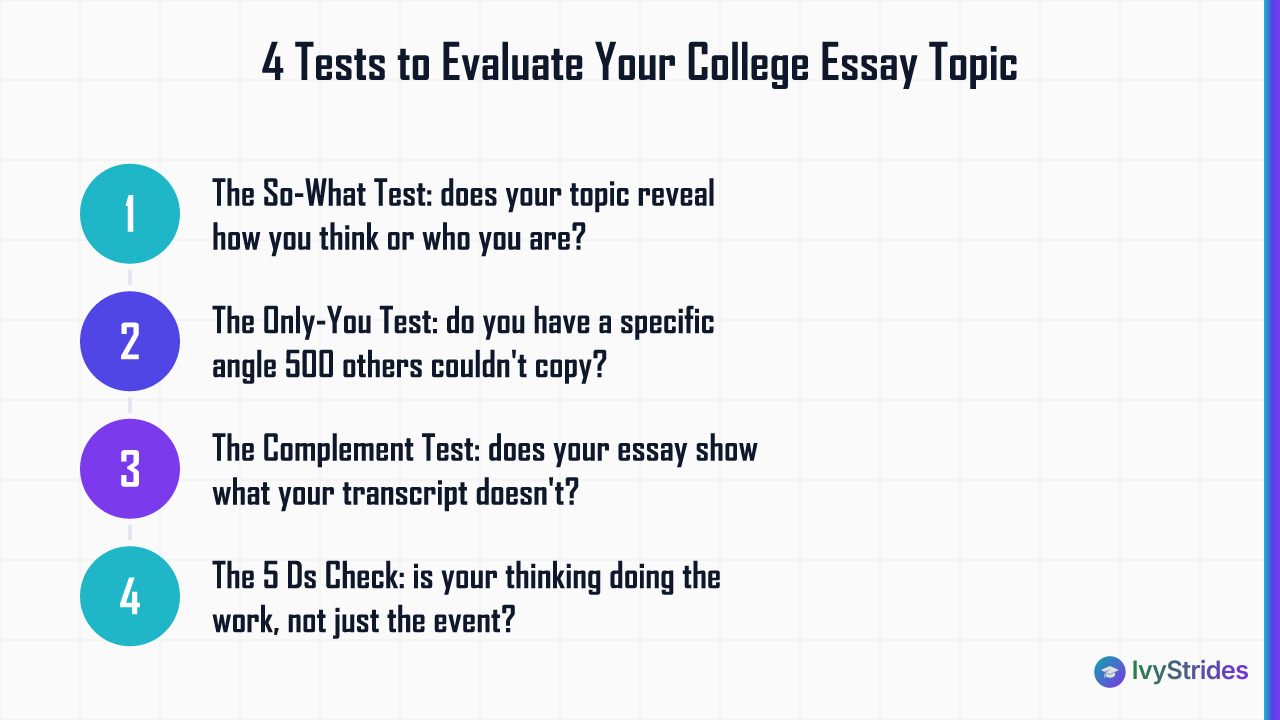
Before you spend 15 hours drafting, run your topic through four tests. If it fails two or more, pivot now.
The so-what test. Summarize your topic in one sentence, then answer: "so what does this reveal about how I think or who I am?" If you can't answer in a second sentence, the topic needs more specificity or a different angle.
The only-you test. Could 500 other students in the applicant pool write essentially the same essay about this subject? If yes, you don't necessarily need a new topic, but you need a much more specific angle.
The complement test. Does this essay reveal something your transcript, activities list, and recommendations don't already show? If your topic is "I'm dedicated to music" and your activities list already shows six years of orchestra and a state solo award, the essay is redundant. Pick something the file doesn't already prove.
The 5 Ds quality check. If your topic sits inside one of the 5 Ds, ask: am I writing about the event, or about my agency, reflection, and change? If the event is doing the emotional work, pivot the essay so your thinking does it instead.
Once your topic passes, structure and voice are next. Our guide on how to write a personal statement walks through the drafting process. And once you have a first draft, revision is where most essays improve the most; the same essay editing guide linked earlier covers cutting without losing voice.
If you want a live second opinion on a topic before committing, one-on-one help for common app essay coaches can run your idea through these tests in a working session.
A Note on Supplemental Essay Topics
Supplemental essays follow a different topic logic than the personal statement, and our guide on how to write supplemental essays covers the Why This School, intellectual curiosity, and community prompts in detail.
Two quick principles. First, supplemental prompts change annually at many schools, so verify each school's current prompts on their admissions page. Yale, for example, publishes its current-cycle essay topics each year. Second, the topic logic differs from the personal statement: supplementals are typically 150 to 350 words, and the Why This School prompt in particular requires researched specifics (named professors, programs, opportunities), not generic praise.
In our coaching, the most common supplemental essay mistake is writing a Why This School essay that could apply to any selective university. If your Why This School essay would work with the name of the school swapped out, it isn't done yet.
FAQ
What are the seven Common App essay prompts for 2026-2027?
The seven prompts cover: a background, identity, or interest that shaped you; overcoming a challenge or failure; questioning a belief or idea; a problem you've solved or want to solve; an accomplishment or event that sparked personal growth; a topic that captivates you; and a topic of your choice. Per the Common App's official announcement, the prompts are unchanged from 2025-2026. The word limit remains 250 to 650 words.
What are the 5 Ds of college essays and do they mean I cannot write about those topics?
The 5 Ds (Death, Divorce, Drugs, Depression, Diversity) are topic categories that require extra care, not automatic avoidance. The risk with each is that students center the event or circumstance rather than their own agency, growth, and reflection. An essay about a parent's death can be powerful if it focuses on what you learned about yourself and how you moved forward; it fails when it reads as a grief summary. The same logic applies to all five categories.
Can I write a college essay about sports?
Yes, but the sports essay is one of the most overused formats in the applicant pool, and most fail because they center the athletic achievement rather than the insight. A sports essay works when the sport is the setting and the story is about something else entirely: how you handle failure, how you think about leadership, how a specific moment changed your relationship with effort. If the essay could appear in a sports magazine, it probably needs a different angle.
What are some good college essay topics for students who feel their life is not interesting enough?
Interesting topics rarely come from impressive events; they come from specific perspectives on ordinary ones. Strong starting points include a weekly routine that reveals how you think, a small object that carries unexpected meaning, a question you cannot stop asking, or a skill you taught yourself and what the process revealed about you. In our coaching, students who start with the mundane-moment scan consistently surface more original topics than those who search for their most impressive achievement.
Do college essay topics change every year?
The Common App personal statement prompts have remained stable for several consecutive cycles; for 2026-2027 they're unchanged from 2025-2026 per the official Common App announcement. Supplemental essay prompts, however, do change annually at many schools. Always verify supplemental prompts directly on each school's admissions page before drafting, as prompts from the prior year may no longer apply.
Pick the topic that only you could write. Run it through the so-what test and the only-you test. If it passes both, you have something worth 15 hours of drafting. If it doesn't, pivot now, not on draft four.

Award-winning author (South Asian Book Award) and graduate of BITS Pilani and UCLA Luskin School of Public Affairs. Brings a published writer's eye to Common App essays and grammatical precision to SAT and ACT R&W instruction.