
How to Write a College Essay: A Step-by-Step Guide for the Common App (2026)
On this page
- Why the College Essay Matters More Than Most Students Realize
- Step 1: Choose Your Common App Prompt and Find Your Topic
- How to Start a College Essay: Writing a Hook That Earns the Next Sentence
- What to Do When You Feel Like You Have Nothing Interesting to Write About
- Step 2: Choose a Structure Before You Write a Single Word
- Step 3: Write a Fast First Draft Without Stopping to Edit
- Step 4: Apply the 10% Rule and Cut to 650 Words
- Step 5: Revise Until It Sounds Like You
- How the Personal Statement Fits Into Your Full Application Strategy
- FAQ
- How do you start a college essay?
- What are the 5 D's of college essays?
- What is the 10% rule in essay writing?
- What should I write my college essay about if nothing interesting has happened to me?
- How do I write a college essay without trauma-dumping?
- How is the Common App personal statement different from supplemental essays?
- Your Next Step
To write a strong Common App personal statement, pick one of the seven official prompts, find a specific moment or pattern from your life that reveals your character, draft up to 650 words in one sitting without editing, then revise for voice, structure, and a hook that earns the next sentence. The essay is not a resume in paragraph form. Admissions officers read it to hear how you think and who you are when the test scores and transcript stop talking.
The word limit and prompt list referenced throughout this article come from the Common App's official 2025-2026 cycle documentation. The next sections walk through the sequence we use in essay coaching to move a student from blank page to submission-ready draft, plus the trade-offs at each step that most general writing guides skip.
Why the College Essay Matters More Than Most Students Realize
The Common App is used by more than 1,000 member colleges, and the personal statement is the single piece of writing each of those schools reads from you. Your transcript shows what classes you took. Your test report shows what you scored on a given Saturday. The personal statement is the only place where you control voice, framing, and meaning. That's rare in an application, and it's why admissions officers weight it the way they do.
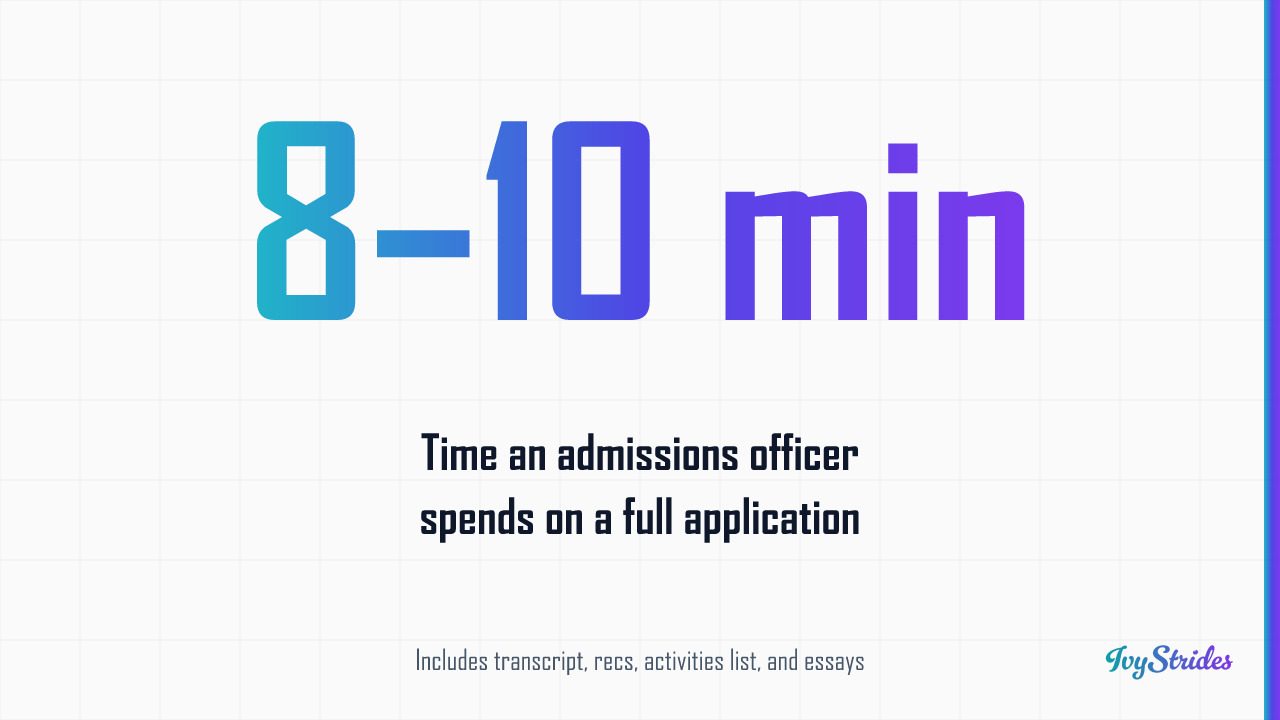
In high-volume reading cycles, an officer may spend 8 to 10 minutes on a full application. That includes transcript, recommendations, activities list, and essays. Your hook isn't decorative. It's the reason the reader keeps reading at minute four instead of skimming to minute five.
At schools with test-optional policies in 2026, the personal statement often carries more weight in the admissions review, which makes investing time in a strong essay even more consequential. Whether your target schools are test-required or test-optional in 2026, the personal statement is a constant in every application, making it one of the highest-use places to invest prep time. If you're still mapping your testing plan, our breakdown of do colleges require the SAT in 2026 walks through where each major school stands for this cycle.
One caveat we surface with every family: admissions outcomes depend on the full application, including grades, course rigor, recommendations, extracurriculars, and demonstrated interest. The essay won't fix a transcript, and a strong transcript won't survive a careless essay. Both matter. Treat them that way.
Step 1: Choose Your Common App Prompt and Find Your Topic
The 2025-2026 Common App offers seven prompts. Prompt 1 reads: "Some students have a background, identity, interest, or talent that is so meaningful they believe their application would be incomplete without it. If this sounds like you, then please share your story." The remaining six cover challenges and growth, questioning a belief, gratitude, a period of personal growth, an engaging topic, and a free-choice option. Full prompt language is on the Common App's site.
Here's the part most students miss: the prompt matters less than the story. Any of the seven can support an excellent essay. A junior we worked with last fall drafted a piece thinking it fit Prompt 2, then realized on revision that it answered Prompt 5 more honestly. She switched. That's fine. Pick the topic first, match the prompt second.
For brainstorming, skip the generic "list your accomplishments" exercise. Instead, list 10 moments when you felt most like yourself, most challenged, or most changed. Not 10 awards. Ten moments. Then for each, ask what it reveals about your values, your habits, or how you make decisions. The essays that work best almost always live inside this list. Topics that tend to underperform unless the angle is genuinely original: the sports injury comeback, the mission trip abroad, and "moving to a new school taught me resilience." Not because these can't work. Because they default to predictable reflection.
In our coaching with students, the essays that stand out most often focus on a small, specific subject rather than a large, impressive one. A 20-minute conversation with a coworker at a summer job can outperform a national competition if the reflection is sharper.
Before you commit to a prompt, read every one in context. Our full breakdown of all seven prompts with examples, Common App essay prompts for 2026, walks through how to pick the one that fits your story best.
How to Start a College Essay: Writing a Hook That Earns the Next Sentence
Three hooks consistently work, and a handful consistently don't.
The in-scene opening drops the reader into a specific moment with sensory detail. "The kitchen smelled like burnt sugar and my grandmother was laughing." That's a sentence that demands a second sentence. The reader needs to know whose kitchen, why it's burnt, what's funny.
The surprising specific detail opens with a fact that doesn't sound like a college essay. "I have read the same Wikipedia article 47 times." Now the reader is curious. Which article? Why? What does that say about you?
The direct declarative statement announces a position or identity without hedging. "I am the kind of person who reads instruction manuals cover to cover before opening the box." It's confident, it's specific, and it sets up the rest of the essay to demonstrate the claim rather than repeat it.
What doesn't work: dictionary definitions ("Webster's Dictionary defines perseverance as..."), rhetorical questions ("Have you ever wondered what makes a person truly happy?"), and broad philosophical claims ("In life, we all face challenges."). These openings ask the reader to do the work of becoming interested. The strong ones do that work for the reader.
In our coaching with students, the most common first-draft problem is an opening that summarizes rather than shows. The fix is usually to delete the first paragraph entirely and start the essay on what used to be the second paragraph. If you'd like a coach to read your draft and identify exactly where the essay starts, our essay review service does line-by-line work on hooks and structure.
What to Do When You Feel Like You Have Nothing Interesting to Write About
This is the fear that stalls more drafts than any other. The student opens the document, stares at the blank page, and thinks: nothing dramatic has happened to me. I haven't started a nonprofit. I haven't overcome a major hardship. I'm just a regular student.
Good. That's actually the right starting point.
The essay isn't about the event. It's about what the event reveals about you. An essay about making a specific dish with a grandparent every Sunday can reveal cultural identity, patience, attention, and family values more vividly than an essay about winning a state championship. A small topic developed deeply almost always outperforms a large topic developed thinly.
In our coaching with students, the essays that feel "boring" at the brainstorming stage often become the most memorable after revision because specificity creates interest, not drama. A student we worked with wrote about reorganizing the family spice rack and ended up with a piece about how she imposes order on chaos, which mapped directly to her intended major in operations research. The event was tiny. The reflection wasn't.
Two questions consistently surface usable topics:
What do I do when no one is watching? Not the curated version. The actual version. Do you reread the same book every winter? Do you redraw the floor plan of your house? Do you argue with podcast hosts in your head?
What would my closest friend say is my most defining habit? Ask them. The answer is often a topic you would never have picked yourself, which is exactly why it works.
If you'd like a longer-term engagement that takes you from brainstorm through final draft, our common app essay tutor program pairs you with a specialist who has worked through hundreds of personal statements.
Step 2: Choose a Structure Before You Write a Single Word
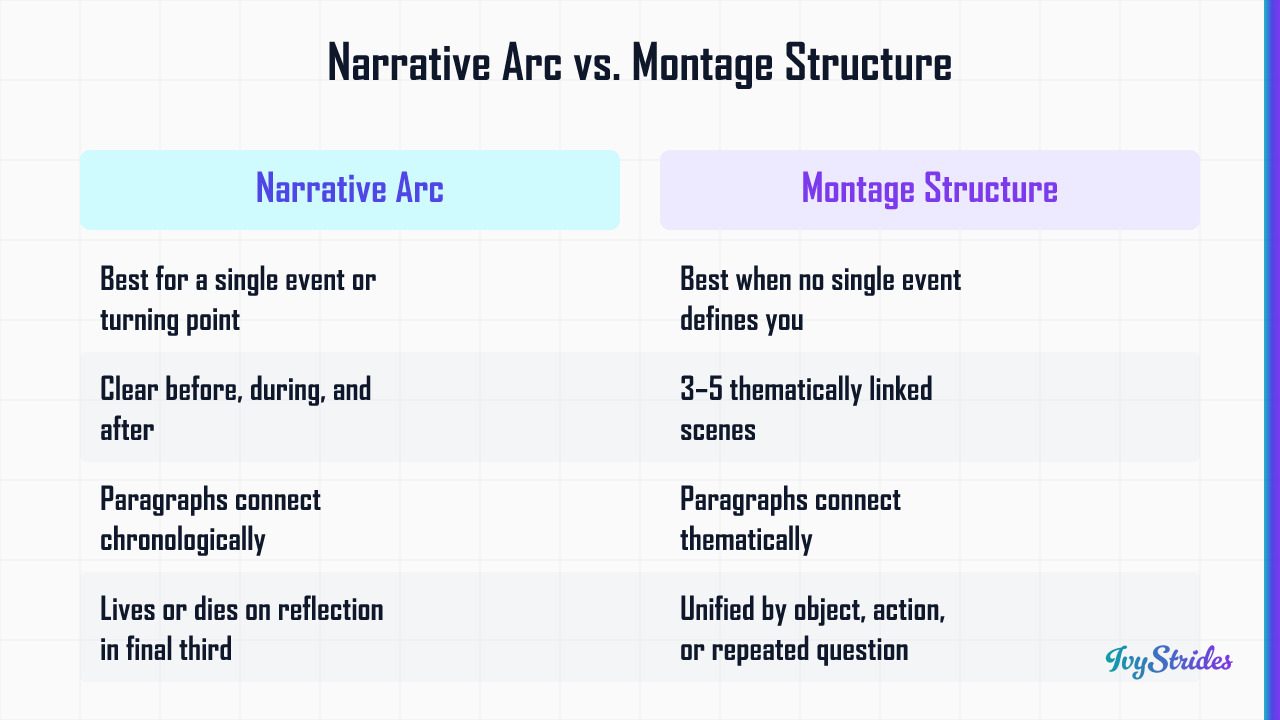
Two structures fit almost every personal statement, and choosing the right one before you draft will save you a week of stalled revision.
Narrative arc works when a single event or turning point defines the story. You start before the moment, develop the moment itself, then show the after. It has a clear before, during, and after, and it lives or dies on the reflection in the final third. Use it when you can answer: what was I before this happened, and what was I after?
Montage structure works when no single event defines you. Instead, three to five thematically linked scenes circle a central character trait or value. The unifying thread can be an object, a repeated action, or a question you keep returning to. Use it when your defining quality shows up across many small moments rather than in one big one.
In our coaching with students, choosing the wrong structure is the second most common reason a draft stalls after the first page. A montage student trying to force a narrative arc ends up inventing drama that wasn't there. A narrative-arc student trying to force a montage ends up with five disconnected anecdotes and no through-line.
A 650-word essay has room for roughly three to four developed paragraphs. Structure determines how those paragraphs connect: chronologically (arc) or thematically (montage). The 5 D's checklist, Describe, Develop, Detail, Demonstrate, Distinguish, applies inside either structure. Describe the scene. Develop the context. Add specific detail. Demonstrate what it reveals about you. Distinguish your reflection from what anyone else would say about the same experience.
The Distinguish step is what separates a competent essay from a memorable one. Most drafts stop at Demonstrate.
Step 3: Write a Fast First Draft Without Stopping to Edit

Photo by ClickerHappy on Pexels
Set a 45-minute timer. Write the full draft without stopping to fix grammar, swap word choices, or rewrite sentences. The first draft will exceed 650 words. That's expected. That's correct.
In our coaching with students, the drafts that preserve the most authentic voice are written quickly and edited slowly. The opposite, edited quickly and written slowly, produces essays that sound like college essays rather than essays by you. Voice is fragile. It gets sanded off in line edits. Get it on the page first, then refine.
Students who have practiced timed writing for the ACT Writing section often find that the discipline of organizing an argument quickly transfers to the drafting phase of the personal statement. If you've done that work, lean on it. Our breakdown of ACT Writing section strategies covers the timed-organization skill in more detail.
The introduction in the draft phase doesn't need to be the final hook. Many students write the hook last, after they know what the essay is actually about. If the opening feels blocked, write the ending first and work backward. Or start in the middle. The reader will never see the order in which you wrote it.
One more thing. If you're balancing essay drafting with test prep this fall, our take on the official SAT study guide 2026 covers how to time the two without one cannibalizing the other.
Step 4: Apply the 10% Rule and Cut to 650 Words
The Common App enforces a hard 650-word ceiling. The submission system will not let you exceed it, per the Common App's official guidance. If your first draft lands at 720 to 800 words, you're in normal territory.
The 10% rule: after completing a draft, cut approximately one in ten words by removing filler phrases, redundant modifiers, and over-explained transitions. A 720-word draft becomes a 650-word essay through targeted cuts, not by deleting whole paragraphs.
Phrases to cut on sight:
- The classic essay-wrap-up phrase that starts with "in" and ends with "conclusion"
- "I have always believed"
- "Throughout my life"
- "This experience taught me that"
- "It was at that moment that I realized"
These phrases feel like they're doing work. They aren't. They're announcing what the next sentence is about to say, and the next sentence can do its own work.
In our coaching with students, the 650-word limit is almost always an asset rather than a constraint because it forces the writer to keep only what is essential. The cut version is usually better than the longer one, not because shorter is automatically stronger, but because the cut process surfaces which sentences were carrying meaning and which were filling space.
A concrete revision exercise: highlight every sentence that could be removed without losing meaning. Remove at least half of them. The essay will be tighter and the voice louder, not quieter.
For additional drafting templates and self-edit checklists, see our free downloads library.
Step 5: Revise Until It Sounds Like You
Revision is where good essays become memorable ones. It's also where most students stop too early.
Read the essay aloud. Out loud. If you stumble over a sentence when reading it, the reader will stumble too. Rewrite it. This single test catches more problems than any other revision method we use.
Ask one trusted reader, a parent, a teacher, an older sibling, to read it. But don't ask "Is this good?" That question produces useless answers. Ask: "What do you learn about me from this essay that you didn't know before?" If they can name one specific thing, the essay is working. If they hesitate, the reflection isn't landing yet.
Re-read your chosen Common App prompt after finishing the draft. Confirm the essay actually answers it. Students draft for weeks, fall in love with their material, and forget to check that it responds to the prompt they picked. It happens often enough that we now treat the prompt-alignment check as a mandatory revision step.
On the question of sounding arrogant: the essay should show what you did and what you learned, not tell the reader how impressive you are. Replace "I am a natural leader" with a specific scene that demonstrates leadership. Confidence in a personal statement comes from specificity, not from self-description.
In our coaching with students, most essays need two to four revision passes before the voice feels natural and the structure holds. The essay is done when reading it aloud produces no stumbles and a trusted reader can name one specific thing they learned about you.
If you want a specialist coach to read your draft and give you a line-by-line revision plan, IvyStrides' essay review service pairs you with an admissions-context coach who has worked through hundreds of supplemental and personal-statement drafts. For school-specific essay strategy, our piece on should you apply to Johns Hopkins University shows how the personal statement and supplements work together at one selective school.
How the Personal Statement Fits Into Your Full Application Strategy
The personal statement is one essay, 250 to 650 words, submitted once, read by every school on your list. Supplemental essays are different. They're school-specific, typically 150 to 350 words, and answer prompts unique to each college: "Why this college?" "Describe a community you belong to." "What would you add to our campus?"
Both matter. The personal statement establishes voice and character across your entire application. The supplements demonstrate fit with each specific school. A strong personal statement that ignores supplements is an incomplete application. Strong supplements with a weak personal statement read as a student who can answer prompts but can't write about themselves.
A coherent application tells one story across components. A student who writes about scientific curiosity in the personal statement, took AP Chemistry and AP Biology, and scored well on the SAT Math section is telling a coherent story. The application as a whole reads as one person, not five disconnected components.
Two caveats we always surface. First, college admissions outcomes depend on the full application, grades, course rigor, recommendations, extracurriculars, and demonstrated interest, not the essay alone. Second, test-optional policies vary by school and by year. Verify each school's current policy directly on its admissions site, and cross-reference using the FairTest test-optional tracker.
If you're still building the testing side of the picture, our guides on do colleges require the SAT in 2026 and SAT test dates 2026 cover the planning calendar.
FAQ
How do you start a college essay?
Open with an in-scene moment, a surprising specific detail, or a direct declarative statement that drops the reader into your world without requiring context. Skip dictionary definitions, rhetorical questions, and broad philosophical claims. The first sentence should earn the second sentence on its own merits, not by promising payoff later.
What are the 5 D's of college essays?
The 5 D's is a drafting heuristic: Describe the scene, Develop the context, add specific Detail, Demonstrate what it reveals about your character, and Distinguish your perspective from what anyone else would say about the same experience. Use it as a checklist when reviewing your draft, not as a rigid paragraph formula. The Distinguish step is usually where competent essays become memorable ones.
What is the 10% rule in essay writing?
The 10% rule means cutting roughly one in ten words from your first draft to tighten the prose. For a 720-word first draft, that gets you to a 650-word final version where every sentence earns its place. The cuts come from filler transitions, redundant adjectives, and sentences that announce what the next sentence is about to say.
What should I write my college essay about if nothing interesting has happened to me?
The essay isn't about the event. It's about what the event reveals about you. Small, specific topics, a recurring habit, a particular object, a conversation with a family member, often produce more memorable essays than dramatic events because specificity creates interest, not drama. Ask yourself what you do when no one is watching, and start there.
How do I write a college essay without trauma-dumping?
If you write about a difficult experience, spend no more than one-third of the essay on what happened and at least two-thirds on how you processed it, what you did next, and what it revealed about your values. The reader needs to leave knowing you, not just your hardship. If the experience is still raw and unresolved, consider whether a different topic might let you write with more perspective and control.
How is the Common App personal statement different from supplemental essays?
The personal statement is one essay, 250 to 650 words, submitted once and read by every school on your list. Supplemental essays are school-specific, usually 150 to 350 words, answering prompts unique to each college such as "Why this college?" or "Describe a community you belong to." Both matter, but the personal statement is your broadest opportunity to establish voice and character across the entire application.
Your Next Step
A blank page is the hardest part. Once you have a topic, a structure, and a working hook, the draft tends to write itself faster than you expect. The students who stall are almost always stuck on Step 1, not Step 5.

Award-winning author (South Asian Book Award) and graduate of BITS Pilani and UCLA Luskin School of Public Affairs. Brings a published writer's eye to Common App essays and grammatical precision to SAT and ACT R&W instruction.