
What Should You Write your College Essay About, Explained: Everything You Need to Know in 2026
On this page
- The Short Answer: What Your College Essay Should Actually Be About
- What Are the Seven Common App Prompts and Which One Should You Pick
- What Makes a Good College Essay Topic: The Four Qualities Admissions Readers Notice
- How to Brainstorm a College Essay Topic When Nothing Feels Interesting Enough
- What Are You Supposed to Write on a College Essay: The Content Checklist
- What Should You NOT Write Your College Essay About: Overused Topics to Avoid
- What Should You Actually Include in Your College Essay: Structure, Length, and Format
- When Should You Start Writing Your College Essay and What Does the Timeline Look Like
- FAQ
- What is the best topic for a college essay?
- What are the 5 D's of college essays?
- Can I write my college essay about something ordinary, like a hobby or a daily routine?
- What should I write my college essay about if nothing interesting has happened to me?
- How long should a college essay be?
- Can you write a college essay about sports, music, or a movie?
- Should you write your college essay in first person?
Write your college essay about a specific moment, object, habit, or value that reveals who you are and how you think. The topic does not need to be dramatic. Admissions readers at selective colleges read thousands of essays, and they remember the ones built around a precise, honest detail, not the ones built around the biggest event. A student who writes about the ritual of fixing her grandmother's sewing machine can outperform a student who writes about winning a state championship, if the first essay shows genuine reflection and the second only recounts what happened.
The rules that govern the piece come from Common App: a personal statement runs 250 to 650 words, and you pick from seven prompts for the 2025-2026 cycle. Knowing the word limit is the easy part. The hard part is finding a topic that's genuinely yours and then earning an admissions reader's attention with it, which is what the rest of this article walks through.

The Short Answer: What Your College Essay Should Actually Be About
Your personal statement exists to do one thing your transcript and activities list cannot: let an admissions reader hear you think. Everything else in the application is a data point. The essay is a voice.
Here's the part most students miss. Admissions readers at selective schools move fast, often around 8 to 10 minutes per full application file. In that window the reader is skimming a transcript, an activities list, recommendation letters, and your essay. The essay has to earn its attention through specificity, not spectacle. A precise, small story lands. A sweeping account of a major life event usually blurs.
The word range matters more than it looks. Aiming for the low end of the 250-to-650 window almost always signals you left the reflection out. We'll come back to that.
So the real answer to "what should you write your college essay about" is not a topic. It's a test. Does this story reveal how you think, what you value, or how you see the world, in a way nothing else in your file already says? If yes, you have a topic. If it just restates your résumé, keep looking.
One caveat worth stating up front, because honesty matters more than encouragement here: no essay topic guarantees admission. Admissions outcomes depend on your full application, your fit with each school, and factors outside your control. A strong essay improves your file. It does not overrule it. Your personal statement is also only one part of the essay workload. Most selective colleges add supplementals, and it helps to know how many supplemental essays will you write before you plan your summer.
What Are the Seven Common App Prompts and Which One Should You Pick
Seven prompts. That's the full menu for the 2025-2026 cycle, and per Common App, the structure is unchanged from the prior year. Here they are, by number:
-
A background, identity, interest, or talent so meaningful your application would feel incomplete without it.
-
A time you faced a challenge, setback, or failure, and what you learned from it.
-
A time you questioned or challenged a belief or idea, and what prompted your thinking.
-
Something you did to solve a problem, or a problem you'd like to solve, and the steps you took or could take.
-
An accomplishment, event, or realization that sparked a period of personal growth.
-
A topic, idea, or concept you find so engaging it makes you lose track of time, and who or what you turn to when you want to learn more.
-
Topic of your choice. Share an essay on any subject, or one you've already written.
Now the decision rule, because students overthink this constantly: pick the prompt that fits your story, not the story that fits the prompt. Write the essay you need to write first. Then read the seven prompts and find the one it answers. Most strong essays fit two or three of them, and it does not matter which you select. Prompt 7, topic of your choice, exists precisely so no strong story gets rejected for not matching a category.
Your personal statement is only one piece of the essay puzzle; most selective colleges also require two to five supplemental essays, and understanding that workload early changes how you plan your summer.
If you have a story but no idea how to surface the ten candidates you'll choose from, the full exercise lives in our guide on how to brainstorm college essay ideas.
What Makes a Good College Essay Topic: The Four Qualities Admissions Readers Notice
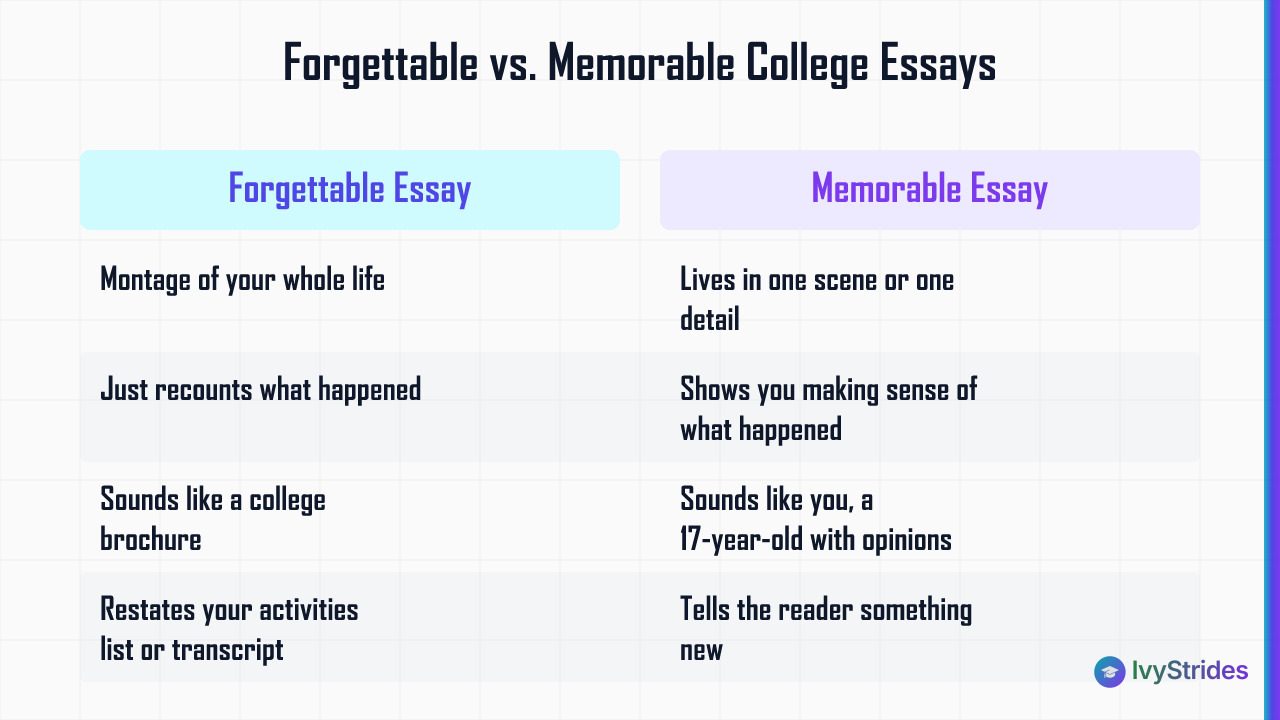
In our coaching with students, the essays we flag as memorable share four qualities. Not five, not a vibe. Four.
Specificity. The essay lives in one scene, one object, one recurring detail, not a montage of your whole life. A reader can picture it. Vague essays about "growth" and "resilience" evaporate on contact.
Genuine reflection. This is the one most first drafts miss. The essay does not just recount what happened; it shows you making sense of what happened. The reflection is the essay. The events are scaffolding.
Authentic voice. It sounds like you, a 17-year-old with actual opinions, not like a college brochure. Readers can tell when a student has been sanded down into a generic applicant. That voice is forgettable.
It reveals something not visible elsewhere. Follow the no-repeats principle: if your essay restates your activities list or transcript, it adds nothing to the file. The essay's whole value is that it tells the reader something new.
There's a useful angle here from the Harvard Summer School blog: approaching a subject from a genuinely new perspective is one of the clearest ways an essay stops blending in. That's the difference between a student who lists three leadership positions and a student who shows how they think through one specific decision they made as a leader. The first is a résumé in paragraph form. The second is a mind at work.
Want a reader who knows admissions context to pressure-test your topic against these four qualities? That's exactly what a common app essay tutor does before you sink twenty hours into the wrong draft.
How to Brainstorm a College Essay Topic When Nothing Feels Interesting Enough

Photo by ClickerHappy on Pexels
Let's talk to the student who thinks they're boring. You feel like nothing has happened to you. No tragedy, no comeback, no viral moment. Just a normal life. You're convinced you have nothing to write about.
You're wrong, and here's the fix.
Start with objects, not adjectives. Do not ask "what am I like?" That question produces useless answers like "hardworking" and "curious." Instead, list ten objects in your room that actually matter to you. A worn paperback. A specific mug. A broken thing you keep meaning to fix. Your grandmother's sewing machine. Then write one sentence about why each one matters.
That's it. That's the whole exercise. In our coaching, students who arrive certain they have nothing to write about almost always surface two or three strong topics within a 30-minute brainstorm using this technique. The objects carry stories, the stories carry values, and the values are the essay.
Once you have your list of 10 to 15 micro-moments, run each one through the stranger test: what would a stranger learn about me from this story that they could not learn from my transcript? If the answer is "nothing," cut it. If the answer is "how I think about patience," or "how I handle things I can't control," or "what home means to me," keep it.
Ordinary topics work. A kitchen routine. A repair habit. A niche hobby nobody else has. One student wrote about fixing her grandmother's sewing machine, and the essay was never really about the machine. It was about her relationship to patience and craft, and it told a reader more than a mission trip ever could.
On timing: BigFuture from College Board recommends starting during junior year, and we agree. A workable rhythm is a first topic list by the end of June, a first draft by the end of July, and a revised draft by mid-August. That leaves fall for supplementals, when the real crunch hits.
Two more resources while you're in this stage. For a second set of eyes on a draft, our essay review service gives you line-level feedback from a coach. And if you're targeting a specific school and want to see how the essay fits the wider application, Should You Apply to Johns Hopkins University? Stats and Fit shows how the pieces come together at a real school.
What Are You Supposed to Write on a College Essay: The Content Checklist
You have a topic. What actually goes on the page?
Three parts, in this order. A scene-based opening that drops the reader into a specific moment, often in medias res, in the middle of the action, with sensory detail. A reflective pivot where you step back and show what the moment revealed, how you changed, or what you now understand. A forward-looking close that connects the insight to who you are becoming or how you'll engage in college. First-person voice throughout. No exceptions.
To get the writing itself right, use the 5 D's:
- Dialogue. Real or reconstructed speech creates immediacy. A single line can do more than a paragraph of summary.
- Details. Sensory specifics ground the reader in the scene. Not "the kitchen," but "the burnt-orange kettle that only whistled if you jiggled the lid."
- Describe. Show, do not tell. Do not instruct the reader to feel moved; give them the scene and let them feel it.
- Draft. Write multiple versions. The first draft is for you. The third is for the reader.
- Develop. Revise with feedback from someone who knows admissions context, not just someone who says "looks great."
The single most common first-draft problem we see in our coaching is an essay that recounts a sequence of events without one moment of genuine reflection. It reads like a report. Fix that and you've fixed most of the essay.
And remember the no-repeats rule. If your essay only restates your activities list, it adds no new information to your file and wastes your best chance to speak directly to a reader.
Students working with an IvyStrides essay coach on their Common App personal statement typically move from a rough topic list to a polished draft in four to six sessions, with a coach who has read hundreds of supplemental essays and knows what admissions readers flag. If you want that kind of structured support, here's one-on-one help for common app essay. For a sense of how the essay fits a specific selective school's expectations, Should You Apply to Duke University? Key Factors Explained walks through the full picture.
What Should You NOT Write Your College Essay About: Overused Topics to Avoid
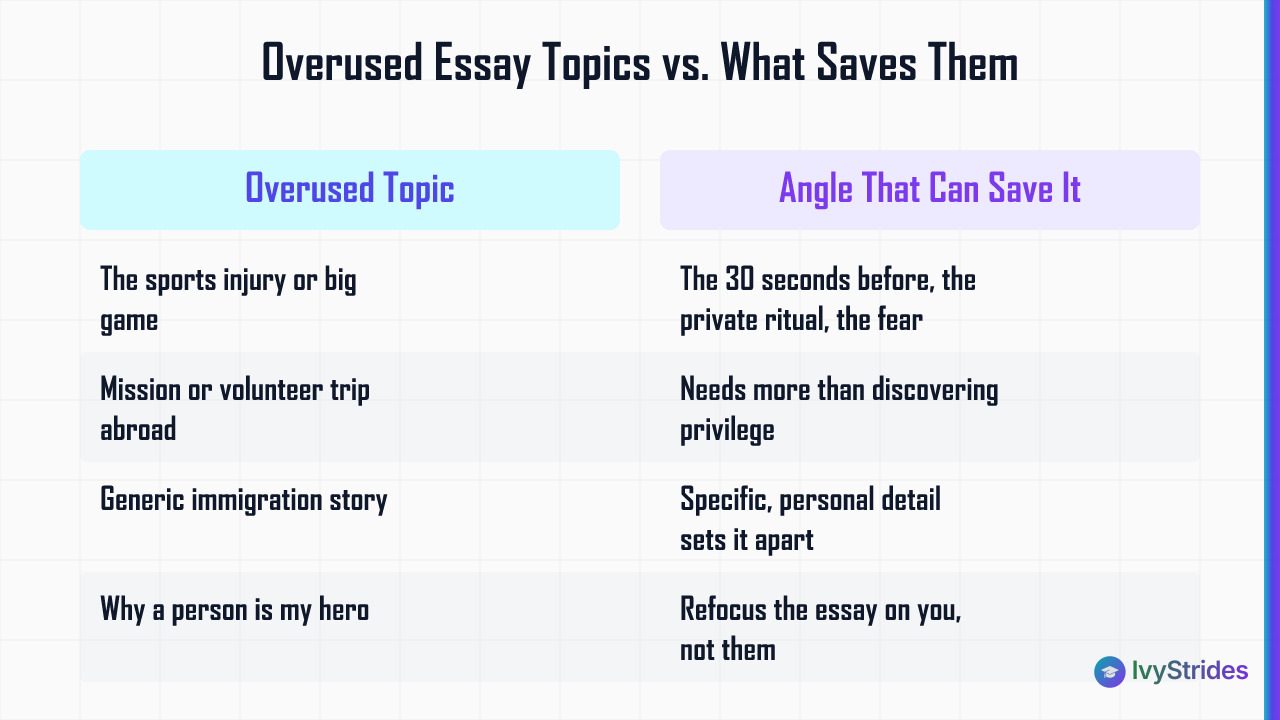
Some topics aren't bad. They're crowded. Admissions readers see hundreds of near-identical versions each cycle, which means you need exceptional execution just to sound different. Here's the list to approach with caution:
- The sports injury or the big game. Read a thousand times. The plot is always the same.
- The mission trip or volunteer trip abroad. Often reads as "I discovered privilege," which tells the reader more about what you didn't understand than what you do.
- The generic immigration story. A powerful subject, but the version without specific, personal detail blurs into every other version.
- Why a person is my hero. This becomes an essay about them, not you. The reader is admitting you.
- The academic achievement or GPA comeback. Restates the transcript. See the no-repeats rule.
- The tough grade I overcame. Same problem, smaller stakes.
None of these are banned. Any topic can work with exceptional execution; the risk is that these demand more skill to differentiate. We've seen sports essays work beautifully when the student writes about the 30 seconds before the game, the private ritual, the fear, not the score. The angle saves it.
A careful word on mental health, because students ask directly: can you write a college essay about depression, or about self-harm? Yes. These are not off-limits. But they require careful framing focused on growth and agency, on how you moved forward, not on the depth of the low point. An essay that leaves the reader worried rather than impressed works against you. This is exactly the kind of topic where a coach's guidance matters, and where honest framing protects you. When in doubt, get a second reader before you commit.
For a look at how essay fit varies by school culture, Should You Apply to Northwestern University in 2026? is a useful reference point.
What Should You Actually Include in Your College Essay: Structure, Length, and Format
Structure first. The three-part shape holds: scene-based opening, reflective pivot, forward-looking close. If your essay has all three and a consistent voice, the bones are right.
Length next. Per Common App, the personal statement runs 250 to 650 words. We recommend targeting 600 to 650. Essays that come in under 500 words almost always leave out the reflection layer that makes the story meaningful to a reader. Use the space. The word limit is a resource, not a threat.
Format is simple. First person, always. Past tense works for reflection; present tense creates immediacy in scene-based openings, and many strong essays mix both within the same piece. The Common App text box needs no special formatting, no fancy font, no headers. Plain, readable, clean.
Now, how the essay fits the rest of your file. A competitive SAT or ACT score handles the quantitative signal in your application; the essay is where the qualitative, human signal lives, and the two work together rather than substituting for each other. Strong AP scores signal academic rigor on the transcript side of your application, which frees the essay to focus on personality and values rather than restating your academic record. If APs are still on your plate, our ap classes online run one specialist per subject, though remember AP credit policies vary by college and a score strengthens your profile without guaranteeing credit.
One more caveat that matters. At schools with test-optional policies, the essay often carries more comparative weight because fewer applicants submit scores, making a strong personal statement even more important. Test-optional policies vary by school and by year, so verify each college's current policy at the source before deciding whether to submit scores. And supplemental essays are a separate exercise, usually 150 to 350 words each, with their own prompts and their own logic.
To see how a specific school weighs these pieces, Should You Apply to The Washington University in St. Louis? lays out the fit factors.
When Should You Start Writing Your College Essay and What Does the Timeline Look Like
Start at the end of junior year. April or May. BigFuture from College Board recommends beginning during junior year, and in our coaching, students who start brainstorming in May and have a first draft by July submit noticeably stronger essays than students who start in September. The difference is not talent. It's runway.
Here's a workable month-by-month:
- April to May: brainstorm. Run the objects exercise. Build your list of 10 to 15 candidates.
- May to June: narrow to two or three, test them against the four qualities, pick one.
- June to July: first full draft. Ugly is fine. Done beats perfect.
- July to August: revise. Second and third drafts, this is where the reflection layer gets built.
- August to September: final polish. The Common App opens August 1 each year, so you can transfer the essay in and start supplementals.
On deadlines: Early Decision and Early Action at most selective schools fall around November 1 or November 15, and Regular Decision typically lands around January 1 or January 15. Those are common patterns, not universal rules. Deadlines vary by school, so verify each college's specific date before you build your calendar around it.
Starting early does more than reduce stress. It gives your best ideas time to surface, because the strongest topic is rarely the first one you write down. If structured planning helps you, WOOP Your Way to College Success: A Goal-Setting Tool for High-Achievers is a framework worth trying. And Should You Apply to the University of Notre Dame? helps you back-plan around a specific target.
FAQ
What is the best topic for a college essay?
The best topic is the one that reveals something true and specific about how you think or what you value, in a way no other part of your application can. It does not need to be dramatic. A student who writes with genuine reflection about a small, precise moment almost always outperforms a student who writes a vague account of a major life event. Ask yourself: what would a stranger learn about me from this story that they could not learn from my transcript or activities list?
What are the 5 D's of college essays?
The 5 D's are a drafting framework: Dialogue (use real or reconstructed speech for immediacy), Details (sensory specifics that ground the reader in a scene), Describe (show what happened rather than telling the reader how to feel), Draft (write multiple versions before settling on one), and Develop (revise with feedback from someone who knows admissions context). Applying all five in sequence moves a flat first draft toward a polished personal statement.
Can I write my college essay about something ordinary, like a hobby or a daily routine?
Yes, and in our coaching, ordinary topics frequently produce the strongest essays. The subject is a vehicle; the reflection is the destination. A student who writes about the ritual of making coffee with her father every morning can reveal more about her values and her sense of home than a student writing a generic mission-trip account. The key is that the ordinary detail must carry genuine insight, not just description.
What should I write my college essay about if nothing interesting has happened to me?
Start by listing objects in your room, routines in your week, or small decisions you make repeatedly. In our coaching sessions, students who describe themselves as boring almost always surface two or three strong topics within 30 minutes using this exercise. The question is not "what is the most dramatic thing that happened to me?" but "what small thing, if I explained it fully, would tell a stranger exactly who I am?" That is your essay topic.
How long should a college essay be?
The Common App personal statement runs 250 to 650 words, per Common App. In our coaching, we recommend targeting 600 to 650. Essays under 500 words almost always leave out the reflection layer that makes the story meaningful to a reader. Supplemental essays have separate, shorter limits, typically 150 to 350 words depending on the school and prompt.
Can you write a college essay about sports, music, or a movie?
Yes, with caveats. Sports essays are among the most overused topics, so they need a specific, non-cliche angle: write about the 30 seconds before the game, not the game itself, or about what the sport taught you about a value that shows up elsewhere in your life. Music and film essays work when they're genuinely about how you think and engage with ideas, not a plot summary or a favorites list. The topic is always secondary to the reflection.
Should you write your college essay in first person?
Yes. The Common App personal statement is a first-person narrative by convention and by expectation. Admissions readers want to hear your voice directly, so third-person is almost never appropriate for the personal statement. Present tense can create immediacy in scene-based openings; past tense works well for reflective sections, and many strong essays use both within the same piece.
This article reflects the 2025-2026 Common App cycle. Prompts, word limits, and Additional Information rules can change between cycles, so verify the current details at commonapp.org before the 2026-2027 cycle opens. To see how our essay coaches work with students worldwide, visit our About page. You can also meet the tutors who work at each stage of the process.

Award-winning author (South Asian Book Award) and graduate of BITS Pilani and UCLA Luskin School of Public Affairs. Brings a published writer's eye to Common App essays and grammatical precision to SAT and ACT R&W instruction.