
How to Write Supplemental Essays That Get You In (2026 Guide)
On this page
- What Supplemental Essays Are and Why They Matter in 2026
- The Five Prompt Types Every Applicant Needs to Recognize
- How to Write a Why Us Essay That Actually Convinces an Admissions Officer
- How to Start a Supplemental Essay When You're Staring at a Blank Page
- Writing Strong Short Supplements: The 250-Word and 300-Word Challenge
- How to Manage Supplements Across a Full School List Without Burning Out
- The Most Common Supplemental Essay Mistakes (and How to Fix Them)
- FAQ
- Are supplemental essays required for college applications?
- What are the 5 Ds of college essays?
- How specific should I be in a Why Us essay?
- Should my supplemental essays be written in the same style as my personal statement?
- How do I write a supplemental essay if the school hasn't released its 2026-27 prompts yet?
- Where to Go From Here
Supplemental essays are school-specific prompts, separate from your Common App personal statement, that ask admissions officers to see a new dimension of who you are. To write one well: identify the prompt type (Why Us, activity, community, or short-answer), research the school until you can name specific programs or professors, and write one focused idea your personal statement does not already cover. Keep every sentence tied to the prompt. The most common failure mode is being generic; the fix is specificity backed by real research.
The rest of this guide walks through the prompt-type taxonomy, a Why Us research checklist, structural rules for 250-word and 300-word supplements, and a sequencing plan for a 10 to 15 school list. Sources cited include the Common App, Yale Undergraduate Admissions, and Rice University Admissions. One caveat before we start: admissions outcomes depend on the full application, not essays alone, and school-specific prompts for 2026-27 may not be finalized until summer. Verify each school's current portal before you submit.
What Supplemental Essays Are and Why They Matter in 2026
A supplemental essay is a short piece of writing, roughly 50 to 650 words, that an individual college attaches to your application on top of your Common App personal statement. The Common App hosts the platform, but the prompts themselves are set by each member school. Some colleges require none. Others require five or more.
Here's the framing that changes everything: treat the application as a puzzle. Your personal statement is one piece. Your activities list is another. Every supplemental essay must add a piece the readers do not already have. Before drafting any supplement, re-read your personal statement so you know exactly which themes are already on the table; every supplemental essay should add a new piece to the puzzle, not retell the same story. For more on that foundation layer, see how to write a personal statement.
Two 2026-cycle changes worth flagging. The Common App has announced the 2026-27 essay prompts, and school-specific supplements are being released across the summer. The Additional Information section was also tightened for the 2025-26 cycle, reduced to roughly 300 words, so any context you hoped to add there now needs to be woven into your supplements or left out entirely. Verify the current word limit on your Common App account before you write.
Are supplemental essays required? It depends. Many selective colleges require them. Others mark them optional but still read them. If you're applying test-optional, your supplemental essays carry even more weight because admissions officers have fewer quantitative signals to work with, which makes specificity and voice more important than ever. Test-optional policies vary by school and year, so check each college's current admissions page.
One named example to anchor scale: Yale asks applicants to write about an intellectual interest in 200 words or fewer. That's roughly one dense paragraph. No warm-up.
The Five Prompt Types Every Applicant Needs to Recognize
Before you write a sentence, categorize the prompt. In our coaching with students, misreading the prompt type is what causes most drafts to get scrapped and restarted. The five main categories:
Why Us. The most common supplemental prompt across selective schools. Asks why this college, this program, this campus. Requires named specifics. Typical length 150 to 300 words.
Activity or extracurricular. Asks you to expand on one activity from your list. Requires a specific moment or contribution, not a resume recap. Typical length 150 to 250 words.
Community or diversity. Asks about a community you belong to, a perspective you bring, or how you've engaged with difference. Requires reflection on your role, not a definition of the community.
Short-answer intellectual interest. Asks what you want to study and why, often in tight word counts. Yale's 200-word prompt is the canonical example. No preamble allowed.
Quirky or creative. "What would you bring to a desert island?" "Write page 217 of your 300-page autobiography." Feels playful but tests the same specificity muscle as Why Us. Don't mistake whimsy for permission to be vague.
Here's a memorable checklist to run any draft through, what we call the 5 Ds: Describe a specific scene or moment, Demonstrate a skill or value through action, Distinguish what makes this yours specifically, Develop growth or changed thinking, and Direct the essay toward the school or your future. If a draft is missing one of these, you know where to revise.
Rice's admissions office puts it plainly: share specific details that answer the prompt. That's the whole game. If you want structured, prompt-by-prompt help, our common app essay tutor service is built around this taxonomy.
How to Write a Why Us Essay That Actually Convinces an Admissions Officer
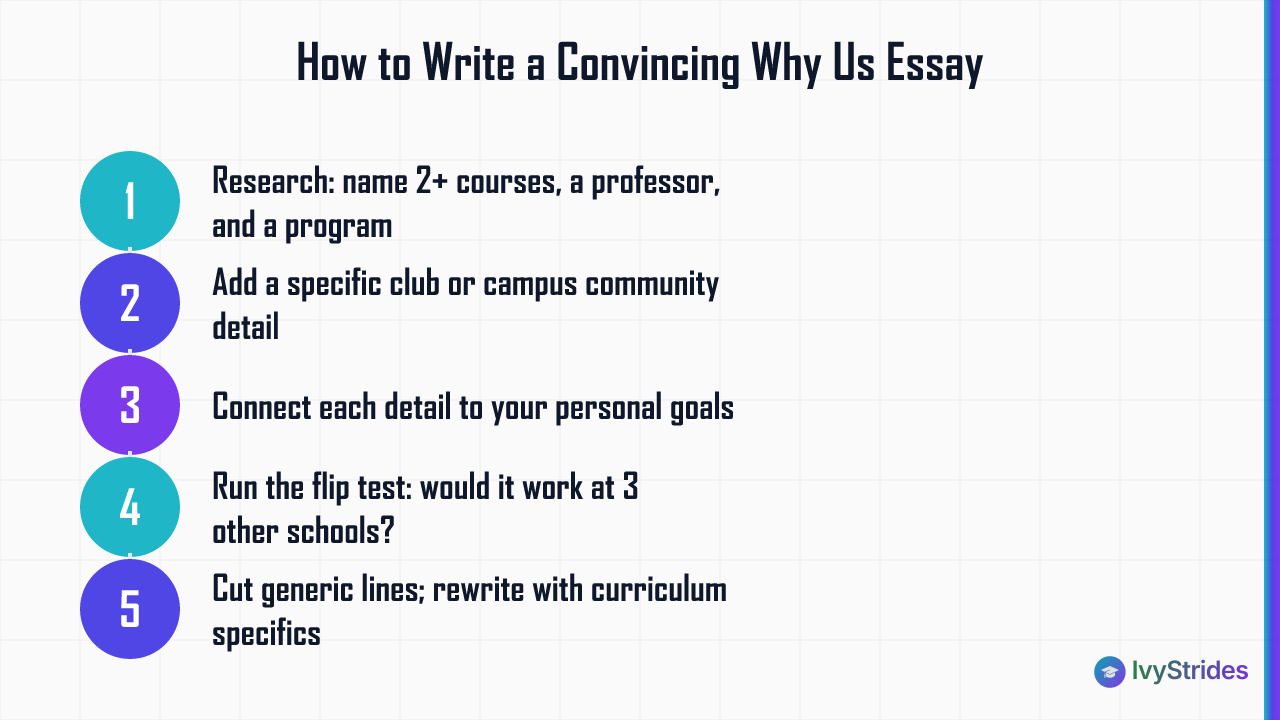
The Why Us essay is where most students lose points. Not because the writing is bad, but because the research is thin. Here's the checklist to run before you draft a single sentence:
- At least two named courses by title and course number if possible, not just "your excellent economics department"
- One named professor or lab, ideally tied to a research area you can articulate in one sentence
- One named program, initiative, or interdisciplinary track, like a specific major concentration, a first-year seminar, a research fellowship, or a study-abroad partnership
- One named tradition, club, or community feature, showing you understand campus life beyond the academic catalog
- A specific connection to your goals: why this course, this professor, this program advances what you want to do
Now the flip test. If you could swap the school name and the essay would still work at three other colleges, it's too generic. Cut and rewrite. In our coaching with students, the flip test catches generic Why Us essays in under 30 seconds, and the most common failure is naming rankings or campus beauty rather than curriculum or community specifics.
A weak line: "Your strong academics and beautiful campus make Cornell my top choice." A stronger line: "I want to take Professor Ndulo's Human Rights and International Law seminar because my Model UN work on refugee policy left me with questions his research on statelessness addresses directly."
See the difference? One is a compliment. The other is evidence.
Academic rigor matters here too. When a Why Us essay mentions a specific AP-level or college-level course you want to continue, it signals academic seriousness; pairing that claim with a strong AP score on your transcript makes it credible. If you're still building rigor into junior year, our ap courses online offering pairs AP-subject specialists with the kind of coursework you can later cite in a Why Us essay with confidence.
Length norms: most selective schools cap Why Us essays at 150 to 300 words. That's tight. One idea, developed with three or four concrete details, connected to your future.
How to Start a Supplemental Essay When You're Staring at a Blank Page

Look, the blank page isn't a writing problem. It's a decision problem. You haven't decided what the essay is about yet.
Start with the prompt's verb. Does it say describe, reflect, explain, or tell us? That verb dictates the shape of your response. Then run a three-column brainstorm:
-
List three things your personal statement already covers.
-
List three things your activities list already shows.
-
List three things nowhere else in your application: small stories, specific interests, moments of change.
Pick one item from column three. That's the seed of your supplement.
Now write a one-sentence thesis before you draft: "This essay will show admissions officers that I [specific claim]." If you can't fill that in with a concrete claim, keep brainstorming. Rice Admissions frames it well: treat your application as a story with a beginning, middle and end, where each essay carries a distinct beat.
Outline in three beats. Opening: a specific scene, moment, or claim. Middle: what it revealed or what you did with it. Closing: how it connects to the school or your future. For a 250-word activity essay, that looks like: sentence one names the activity and a specific moment, sentence two explains what it revealed, sentences three through eight develop the significance and connect it to your goals.
Then the read-aloud test. Read the draft aloud, at normal speaking pace. If a sentence sounds like a college brochure, cut it. If a sentence sounds like something you'd actually say to a smart adult who asked a real question, keep it. In our coaching with students, essays that open with a specific scene or concrete claim outperform essays that open with a dictionary definition or a broad generalization.
If you want a coach in the room while you draft rather than after, one-on-one help for common app essay is designed for exactly that phase.
Writing Strong Short Supplements: The 250-Word and 300-Word Challenge
Short supplements aren't mini personal statements. They're precision instruments. One focused idea, three beats, no preamble.
Boston University requires responses of up to 300 words per supplemental prompt. Yale's intellectual interest prompt caps at 200 words. That's the world you're writing in. Every sentence has to earn its place.
Here's the discipline: no single paragraph should carry more than roughly 10 percent of the essay in setup. In a 250-word essay, that means the first sentence must already be in the story or the claim. No "Throughout my life, I have always been fascinated by…" openings. Cut it.
For a genuinely short prompt, say 50 or 100 words, the structure collapses to two sentences. Sentence one is your answer. Sentence two is the specific detail that makes it credible. Done.
Cutting strategy for anything over the limit:
-
Delete every sentence that doesn't add new information.
-
Delete every adjective that could apply to five other students.
-
Collapse two sentences into one when the connection is logical.
-
Read aloud. If a phrase adds rhythm but no meaning, cut it.
In our coaching with students, the most common short-essay error is using 80 words to say what 20 could say. The 300-word cap is not a target. It's a ceiling. Coming in at around 265 words with every sentence pulling weight beats a padded 298.
For structural templates you can print and mark up while drafting, check our free downloads.
How to Manage Supplements Across a Full School List Without Burning Out
If you're applying to 12 schools and each has three supplements, that's 36 essays. Nobody writes 36 great essays school by school. You need a system.
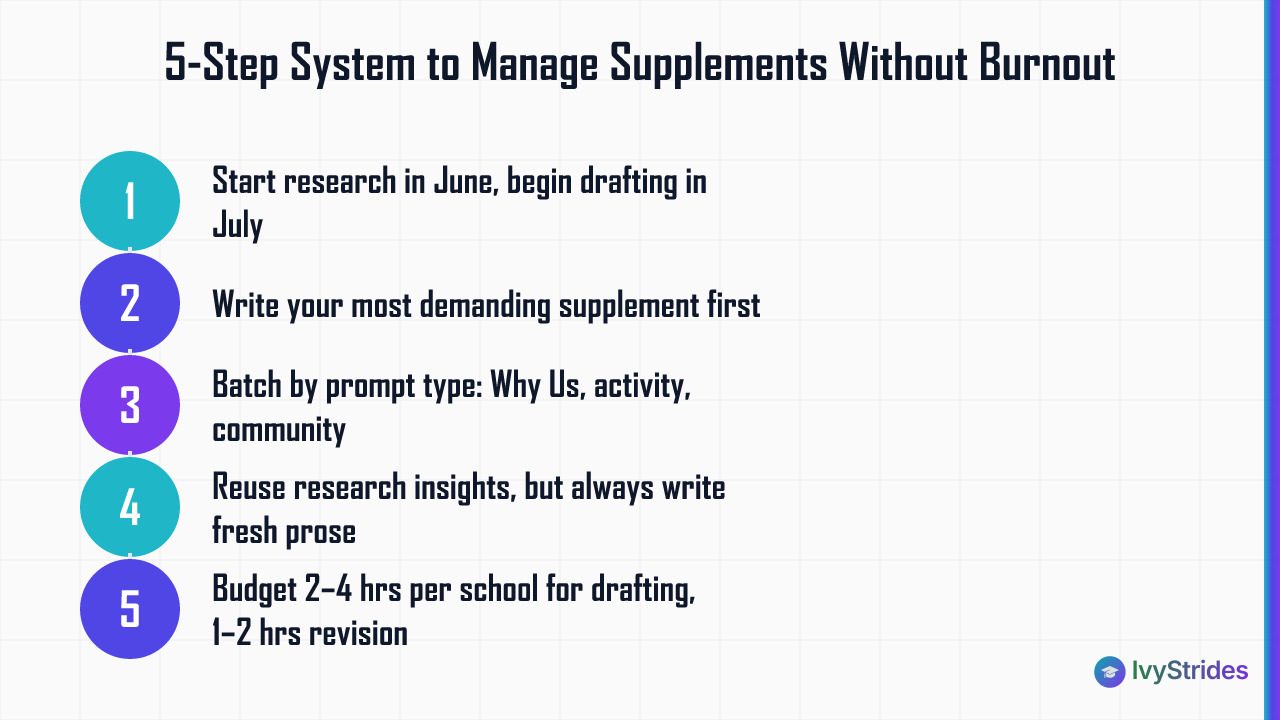
Timeline. Rising seniors should start school research in June and begin drafting in July. Waiting until October is where burnout and generic essays are born. Typical timeline in our coaching with students: roughly 8 to 12 weeks from first draft to final polish across a 12-school list.
Sequence. Write the most demanding supplement first, usually the school you want most. Your best thinking goes into essay one. Save the schools you're less certain about for later, when you've built momentum.
Batch by prompt type. Write all your Why Us essays in one research sprint. Then all your activity essays. Then all your community essays. In our coaching with students, those who batch supplements by prompt type tend to finish their list noticeably faster than those who write school by school, because the mental gear-shifting is what drains you, not the writing itself.
Reuse research, not prose. The same professor reference can appear in two essays if the connection is genuinely different. The words must be fresh. The insight can be shared.
Hour budget. Plan for roughly 2 to 4 hours per school on research plus drafting, then another 1 to 2 hours on revision. For 12 schools, that adds up to about 40 to 70 focused hours across the summer and early fall.
Freshness watch. Individual schools typically release 2026-27 supplemental prompts between May and August. Check each portal in June, again in July, and once more in early August. The Common App will notify you when a school's prompts go live on the platform.
If you're also balancing test prep and AP work through the same window, our ap sat act testing plan walks through how to layer essay drafting on top of a testing calendar without one crowding out the other.
The Most Common Supplemental Essay Mistakes (and How to Fix Them)
Five errors we see in nearly every first draft, with the fix for each.
Mistake 1: Repeating the personal statement. A student writes about resilience in the personal statement, then writes about resilience again in a supplement. Fix: before drafting, list what the personal statement covers. Choose a supplement topic from anywhere else.
Mistake 2: Generic Why Us. Rankings, weather, campus beauty, or "diverse student body" with no evidence. Fix: apply the flip test. If the essay works at three other schools, rewrite with two named courses and one named professor or program.
Mistake 3: Writing over the word limit and hoping. Most Common App portals enforce hard character limits, so going over is often literally impossible, but writing right up to the limit with filler gets penalized by tired readers. Fix: aim for roughly 90 to 95 percent of the limit, with every sentence carrying weight.
Mistake 4: Brochure voice. The essay sounds like the college's own marketing copy read back to them. Fix: read aloud. If a sentence sounds like a slogan, cut it. In our coaching with students, essays written in a student's natural speaking voice score higher on authenticity in peer review than essays written to sound "impressive."
Mistake 5: The interchangeable supplement. Same essay, five schools, name swapped. Fix: Rice Admissions frames it as considering what you want admissions to know about you that they don't already know, tied to each specific school. If you can't name what makes the essay this school's essay, keep researching.
If your personal statement itself needs a stronger foundation before you build supplements on top, revisit how to write a personal statement and re-anchor there first.
FAQ
Are supplemental essays required for college applications?
It depends on the school. Many selective colleges require one to five supplemental essays submitted through the Common App or their own portal. Some schools list supplements as optional, but in our coaching with students, submitting a strong optional essay almost always strengthens the application. Check each school's Common App requirements page or admissions portal to confirm what's required for the 2026-27 cycle. Requirements shift year to year, so verify late.
What are the 5 Ds of college essays?
The 5 Ds is a coaching checklist used to evaluate whether an essay is doing enough work: Describe (paint a specific scene or situation), Demonstrate (show a skill, value, or quality through action), Distinguish (explain what makes this experience or perspective yours specifically), Develop (show growth, reflection, or changed thinking), and Direct (connect the essay to your future goals or fit with the school). Running a draft through these five checks quickly reveals which dimension is missing.
How specific should I be in a Why Us essay?
Very specific. In our coaching with students, the most effective Why Us essays name at least two to three concrete details: a specific course title, a named professor or their research area, a named lab or program or campus tradition, and a clear connection between that detail and the applicant's own goals. If you could swap the school's name into another student's essay and it would still make sense, the essay is not specific enough. A strong test score doesn't write your essays for you, but it does give admissions officers one less reason to hesitate; students who pair a competitive score with specific, well-researched supplements tend to present the most complete applications.
Should my supplemental essays be written in the same style as my personal statement?
Your voice should be recognizably consistent across all essays, but the tone can shift slightly based on the prompt. A 650-word reflective supplement can carry the same depth as a personal statement. A 100-word short-answer prompt should be direct and conversational. What should never change is the sense that the same person wrote every piece. Admissions officers read the full application together, and inconsistency in voice raises questions about authenticity.
How do I write a supplemental essay if the school hasn't released its 2026-27 prompts yet?
Start research now and draft a Why Us essay based on last year's prompt, which rarely changes dramatically. Do your school-specific research (courses, professors, programs, traditions) so the content is ready. When the official 2026-27 prompts are released, typically between May and August, you'll only need to adjust framing rather than starting from scratch. Check the school's Common App page and admissions portal regularly starting in May. For a lighter-touch second opinion once your drafts are in shape, our essay review service gives structural feedback without full coaching.
Where to Go From Here
Supplemental essays are the school-specific writing layer that sits between a strong personal statement and an admissions decision. They won't carry a weak application on their own, and no single essay guarantees an outcome. What they do, when done well, is make an admissions officer see a specific person with specific reasons for wanting a specific school. That's the whole assignment. If you want to see how our coaches approach this at the pace of your school list, learn more on our about page. You can also meet the tutors who work with essay students each cycle.

Award-winning author (South Asian Book Award) and graduate of BITS Pilani and UCLA Luskin School of Public Affairs. Brings a published writer's eye to Common App essays and grammatical precision to SAT and ACT R&W instruction.