
Everything You Need to Know About Supplemental Essay Examples in 2026
On this page
- What Is a Supplemental Essay and Why Colleges Require It
- The Five Most Common Supplemental Essay Prompt Types in 2026
- What Makes a Supplemental Essay Example Actually Strong
- Why Us Supplemental Essay Examples: Weak Draft vs. Strong Draft
- Not Sure If Your Supplemental Essays Are Specific Enough?
- Why Major Supplemental Essay Examples: Connecting Your Past to Your Future Field
- 250-Word Supplemental Essay Examples: How the Word Limit Changes Your Strategy
- Community, Identity, and Diversity Supplemental Essay Examples
- How to Adapt Supplemental Essay Examples Across Multiple Schools
- How Many Supplemental Essays Do You Actually Need to Write in 2026
- Getting Feedback on Your Supplemental Essay Drafts: What Actually Helps
- FAQ: Supplemental Essay Examples and Prompt Types
- What is the purpose of a supplemental essay?
- What should you write in a supplemental essay for college?
- How do you start a Why Us supplemental essay?
- How long should a supplemental essay be?
- Can you use the same supplemental essay for multiple schools?
- Do all colleges require supplemental essays?
- What is an example of a supplemental essay topic?
- How do supplemental essays affect college admissions decisions?
- Ready to Turn Your Supplemental Essay Drafts Into Admits?
Supplemental essays are short, school-specific writing prompts that colleges add to the Common App or their own portals. The most common types are Why Us, Why Major, community contribution, extracurricular depth, and short-answer questions. Strong supplemental essay examples share one trait: they name something specific about the school or the student's experience rather than making claims any applicant could make. A 250-word Why Us essay that names a specific professor's research lab outperforms a 650-word essay full of generic praise every time.
That specificity gap runs through everything below. You'll find annotated weak-vs-strong drafts for each prompt type, a breakdown of how word count reshapes your approach, and a system for adapting one strong story across a full school list. The harder question, how specific "specific" needs to be, is where the examples start.

What Is a Supplemental Essay and Why Colleges Require It
A supplemental essay is a school-specific writing prompt a college adds on top of the Common App personal statement to test fit with that particular campus. Where the personal statement tells the whole reader pool who you are, the supplemental answers one narrow question: why this school, this major, or this community, and what you'll add.
The distinction matters more than most students realize. Your Common App personal statement runs 250 to 650 words, per commonapp.org, and goes to every school on your list unchanged. A supplemental essay is written for one school and one prompt. Reuse the personal statement's voice, sure. Never reuse its content wholesale.
Supplementals also carry a signal admissions offices watch closely: demonstrated interest. When a school asks "Why us?", it's checking whether you researched the place or just clicked "add to list." A student who names a specific seminar or lab reads as a genuine applicant. A student who praises "world-class faculty" reads as someone applying to forty schools with one template.
Word limits swing widely. A short-answer supplement can run as few as 25 words; a community or Why Us prompt can stretch to 650. The 2025-2026 Common App personal statement prompts stayed unchanged from the prior cycle, per commonapp.org, but that stability does not extend to supplementals, which each school sets independently and revises often.
Here's the caveat that saves hours of wasted work: verify every prompt and word limit on the school's own Common App portal before you draft. Third-party lists go stale. A prompt you found on a blog last spring may read differently by the time you open the application. For the personal statement side, see our breakdown of the Common App essay prompts for 2026-27. And before you plan your summer, it helps to know how many supplemental essays you will write across your list.
The Five Most Common Supplemental Essay Prompt Types in 2026
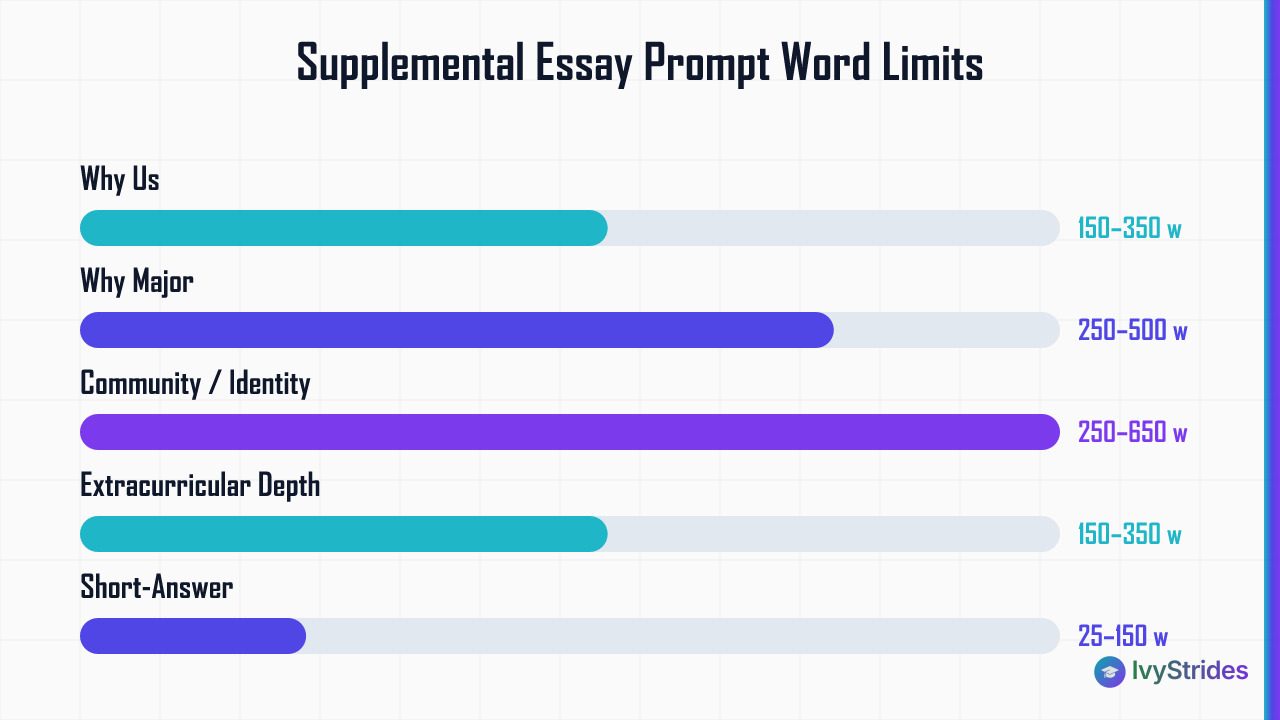
Five prompt types cover the vast majority of what you'll face. Each asks a different question, and each rewards a different structural move. Knowing which type you're facing before you write is half the work.
| Prompt type | Typical word limit | What it actually tests |
| Why Us | 150-350 words | Whether you researched this school specifically |
| Why Major | 250-500 words | The intellectual origin story of your interest |
| Community / identity | 250-650 words | What you contribute, not just who you are |
| Extracurricular depth | 150-350 words | Depth in one activity beyond your Activities list |
| Short-answer | 25-150 words | Personality and fit signals |
The Why Us prompt is the highest-frequency type and the one students botch most. It runs short, usually 150 to 350 words, which fools people into thinking it's easy. It isn't. Short word limits punish vague praise harder, because you have no room to hide.
The Why Major prompt asks for the origin story of your intellectual interest. Not your career plan. The reader wants the moment or question that pulled you toward the field, then a line connecting it to what you'd study on their campus.
The community or identity prompt asks what you bring. A common trap is listing demographic facts and stopping there. The strong version shows a scene where your background became an action or a contribution.
The extracurricular depth prompt expands one activity beyond the 150-character slot on the Common App Activities list. Show what an activity meant, not restate what it was. For the resume side of that work, see how to write strong activities list descriptions.
The short-answer supplement runs 25 to 150 words and probes personality: favorite book, three words to describe yourself, dream job. Small space, real stakes. For the full drafting process across all five, read how to write supplemental essays that get you in. One more time, because it's the caveat that costs students most: prompt wording and word limits change each cycle, so verify on the school's portal before you draft.
What Makes a Supplemental Essay Example Actually Strong
Specificity is the primary differentiator between a strong supplemental essay and a forgettable one. Everything else, voice, structure, grammar, sits downstream of one test: could another applicant to another school submit your essay with only the school name swapped? If yes, it isn't specific enough yet.
In our essay coaching, the single most common revision we make is replacing a school's name with a specific program, professor, course, lab, or tradition the student actually researched. "I love Cornell's strong engineering program" becomes "I want to work in Professor [Name]'s soft-robotics group because the compliant-actuator problem is exactly what stalled my FIRST Robotics build." One of those sentences could go anywhere. The other could go to one place.
The second marker is voice consistency. Your supplementals work alongside your Common App personal statement, not in isolation; make sure the two pieces reveal different facets of who you are. If your personal statement covered your grandmother's kitchen, your Why Major essay shouldn't return there.
Third is prompt responsiveness. Read what was actually asked, not what you wish had been asked. A prompt asking "What would you contribute to our community?" is not asking for your life story. It's asking for a contribution. Answer that.
Here's the part most students miss about attention. Admissions readers spend, on average, roughly 8 to 10 minutes on a full application file. A supplemental that opens with a concrete scene holds a reader who's moving fast. One that opens with "I have always wanted to attend [School]" loses them in the first line. For more on the underlying craft, see what makes a college essay good and the show, don't tell technique in college essays.
Specificity matters even more at test-optional schools. When a file has fewer quantitative signals to anchor the reader, the essay carries more of the weight. If you're weighing whether to submit scores, read test-optional admissions and when essays carry more weight.
One caveat worth stating plainly: a strong essay does not guarantee admission. Decisions depend on the full application, grades, test scores, recommendations, and institutional priorities. A brilliant supplemental improves your odds; it doesn't fix them.
For a step-by-step drafting process that builds on these examples, see our guide on how to write supplemental essays that get you in.
Why Us Supplemental Essay Examples: Weak Draft vs. Strong Draft
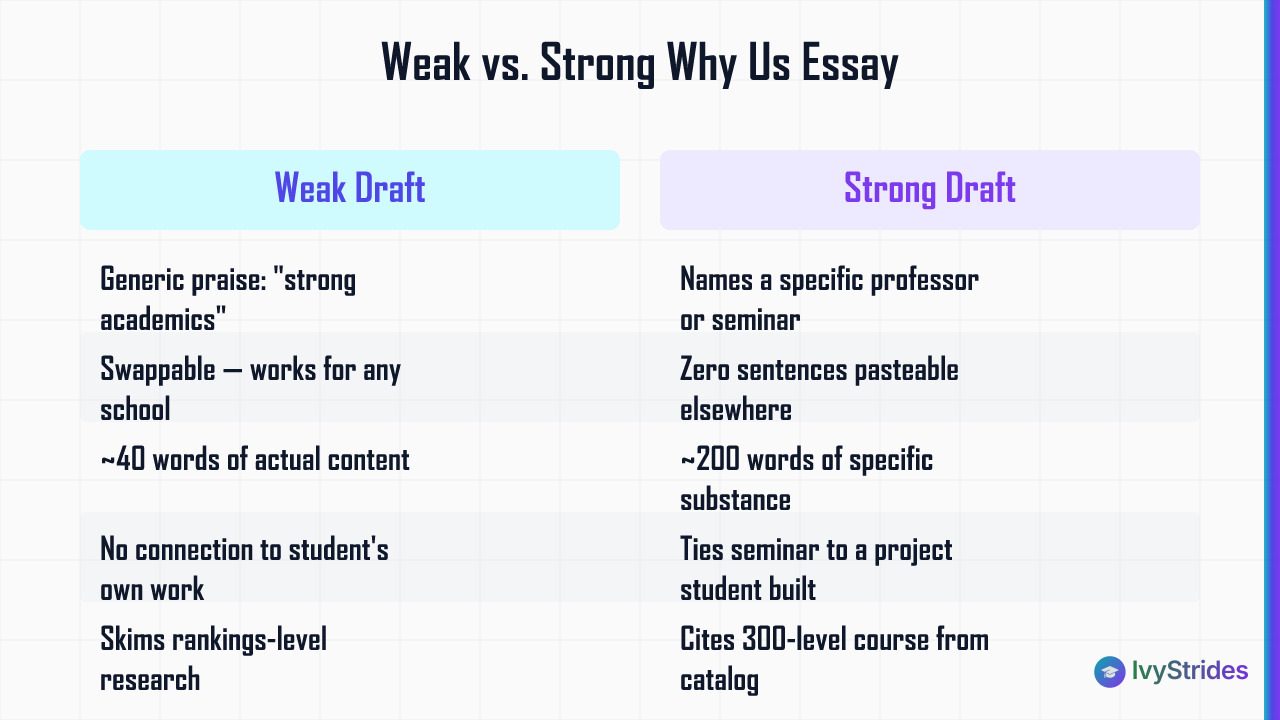
The Why Us supplemental essay asks one thing: why this school and not the twenty others like it? The prompt usually runs 150 to 350 words, and the gap between a weak and a strong answer is almost entirely research depth. Here's a weak draft, composited and anonymized from coaching, so you can see the failure clearly.
Weak draft: "I want to attend [University] because of its strong academics, diverse community, and excellent research opportunities. The professors are world-class and I know I will thrive here. [University]'s reputation is exactly what I'm looking for in a college."
Count the substance. Roughly 40 words of actual content, every one transferable to any school in the country. Swap the name and it still "works," which means it works nowhere. The reader learns nothing about you and nothing about your research into them.
Strong draft (composite): opens by naming a specific course or lab, connects it to a project the student already completed, then closes by naming one tradition or program that extends that same interest. Something closer to: "When my model of local water-table depletion kept breaking, I found Professor [Name]'s hydrology seminar, which uses the exact sensor-network approach I couldn't figure out on my own. I want to take that seminar, then bring the method back to the watershed group I started at home." Around 200 words in this register, zero sentences you could paste into another application.
Three annotation tests separate the two:
-
The named entity test. Can you swap the school name and have the essay still work? If yes, revise. Every strong Why Us essay names a professor, course, lab, or tradition that only exists at that school.
-
The research depth signal. A reader can tell within two sentences whether you visited, read the course catalog, or just skimmed the rankings page. Naming a 300-level course does the work that "excellent academics" never will.
-
The connection test. Does the essay tie the school's specific offering to something you've already done or made? The strong draft connects a named seminar to a project the student actually built. That connection is the whole essay.
The word limit changes the shape. A 150-word version is essentially one connected idea: a specific offering, your specific reason for wanting it, done. A 350-word version can add a second offering and a closing line about a tradition. Neither has room for reputation praise. If the Why Us prompt is your biggest challenge, our annotated breakdown of three Why This College essay examples that worked shows exactly how admitted students handled it. And when you map your schedule, the college application timeline for 2026-27 shows when each Why Us draft needs to be done.
Not Sure If Your Supplemental Essays Are Specific Enough?
In a free 15-minute strategy call, an IvyStrides essay coach will read your current draft, tell you exactly where it needs more specificity, and recommend a concrete next step. No prep required.
Why Major Supplemental Essay Examples: Connecting Your Past to Your Future Field
The Why Major supplemental essay asks for the intellectual origin story of one specific interest, not a career declaration. Admissions readers want evidence of genuine curiosity, the moment a subject stopped being a class and started being a question you couldn't drop. Most of these prompts run 250 to 500 words.
Weak draft (composite): "I have always been passionate about biology. Ever since I was young, I loved learning about living things. I want to study biology at [University] to pursue my passion and eventually become a doctor."
That opener wastes roughly 60 words before saying anything specific. "Always been passionate" is a claim with no evidence. "Ever since I was young" tells the reader nothing they can picture. And "eventually become a doctor" turns an intellectual essay into a career checklist, which is not what the prompt asked.
Strong draft (composite): opens with a specific experiment, paper, or question the student actually encountered, named and given context. Something like: "The first time I read about CRISPR gene drives, I couldn't sleep. Not because of the biology, but because of the ethics: a single edited mosquito population could reshape an entire ecosystem within seasons. That tension between capability and consequence is why I want [Professor Name]'s bioethics-in-genetics seminar." The reader sees exactly what pulled you in.
Look at the structural difference. The strong draft names one concrete trigger, explains what it revealed about the field, then connects it to a specific course or research group at the target school. The weak draft names nothing. At a 250-word limit, the weak opener's 60 wasted words are a quarter of the essay gone before you've said a single thing only you could say.
The Why Major essay is an intellectual autobiography of one interest, not a resume of your STEM activities. Pick the single question or moment that genuinely hooked you, then trace it forward. For help finding that moment, work through how to brainstorm college essay ideas.
250-Word Supplemental Essay Examples: How the Word Limit Changes Your Strategy
A 250-word supplemental essay gives you roughly 12 to 13 sentences to work with. At an average sentence length of about 20 words, that's the whole budget. Every sentence must advance the argument or the image, because there's no room for a warm-up. This length exposes weak writing faster than any other.
The most common structural mistake at 250 words is spending 60 to 80 words on context the reader doesn't need. Students explain what an activity is, "Debate is a competitive event where students argue both sides," instead of what the activity did to them. That's a third of the essay spent on a dictionary definition.
Here's the structure that works at 250 words, drawn from coaching observations:
- Sentence 1: the thesis or the scene. No preamble. Open in the middle of the moment.
- Sentences 2-8: develop one specific idea or moment. One. Not three.
- Sentences 9-12: connect that moment to the school or the major.
- No separate conclusion paragraph. You don't have the words for a wrap-up, and you don't need one.
Contrast that with a 650-word essay, which can afford a scene-setting opening paragraph, a complication, a turn, and a resolution. That's a four-act structure. A 250-word essay is a single scene with a connecting line at the end. Trying to fit four acts into 250 words is why so many short supplementals feel rushed and thin.
The discipline this demands is cutting, not writing. Draft long, then carve to the limit, keeping only sentences that carry weight. For the mechanics, see the Common App essay word limit guide and our process for how to edit and revise your college essay.
Community, Identity, and Diversity Supplemental Essay Examples
A community or identity supplemental essay asks what you contribute, not just which categories you belong to. The prompt usually runs 250 to 650 words. The failure mode is listing demographic facts and calling it a day. The strong version shows the reader a scene where your background became an action.
Weak draft (composite): "As a first-generation student from a Latino family, I bring diversity to campus. I have faced many challenges and overcome them. I will contribute to the community by sharing my perspective."
Every sentence there is a claim without a scene. "Bring diversity," "faced many challenges," "sharing my perspective" are phrases an admissions reader has seen thousands of times. Nothing in the draft could only have been written by this specific student.
Strong draft (composite): opens with a specific moment where the student's background shaped how they approached a problem. Something like: "At twelve, I translated my mother's questions at parent-teacher conferences, learning to carry meaning across a gap that words alone couldn't. Last year I turned that skill into a peer-translation circle at my school, pairing bilingual students with families who needed them at enrollment night." The contribution is concrete. Named. Visible.
The move that separates the two drafts: the strong version shows the identity becoming an action, then names a specific contribution, then connects it to something at the target school. Founded a tutoring circle. Translated at a school meeting. Built a bridge between two student groups. Admissions readers see endless essays that list identity categories; the ones that land show a scene where the identity did something.
One caveat: community and diversity prompts vary sharply by school, and some have shifted their wording since the 2023 Supreme Court ruling on race-conscious admissions. Read the exact prompt before drafting, and steer clear of the framings covered in our list of college essay topics to avoid.
How to Adapt Supplemental Essay Examples Across Multiple Schools
Adapting supplemental essays across schools works on a simple split: keep the core story, rewrite the school-specific layer. Most students applying to 8 to 12 schools write between 15 and 30 supplemental essays total, based on our coaching observations. Writing each one from scratch is neither necessary nor smart. Building a reusable core is.
Think of it as roughly an 80-20 split. About 80 percent of a strong essay is your core material: your voice, the specific moment, the intellectual question, the contribution you make. That travels. About 20 percent is the school-specific layer: the named professor, program, course, or tradition. That must be rebuilt for every school.
In our coaching, students who build a "core story bank" of four to six strong paragraphs about their main activities, intellectual interests, and community contributions can adapt them in roughly 30 to 45 minutes per school. Compare that to the hours it takes to start cold each time across a fifteen-school list. The bank is the use.
What must be rewritten for every single school:
- Any sentence naming the school.
- Any reference to a program, professor, lab, course, or tradition.
- The connecting line that ties your core story to that campus.
These cannot be templated. A named-entity sentence written for one school and pasted into another is exactly the transferability failure the Why Us section warned about. Once you have a strong core draft, learn how to reuse essays across applications without losing the school-specific feel each supplement requires.
One trust caveat: admissions offices at campuses within the same university system often share notes. Never send the same Why Us essay to two schools in the same system. And keep a tracking sheet, which draft went to which school, so you don't submit the Michigan paragraph to Wisconsin. Before you build the bank, it helps to confirm how many supplemental essays you will write in 2026.
How Many Supplemental Essays Do You Actually Need to Write in 2026
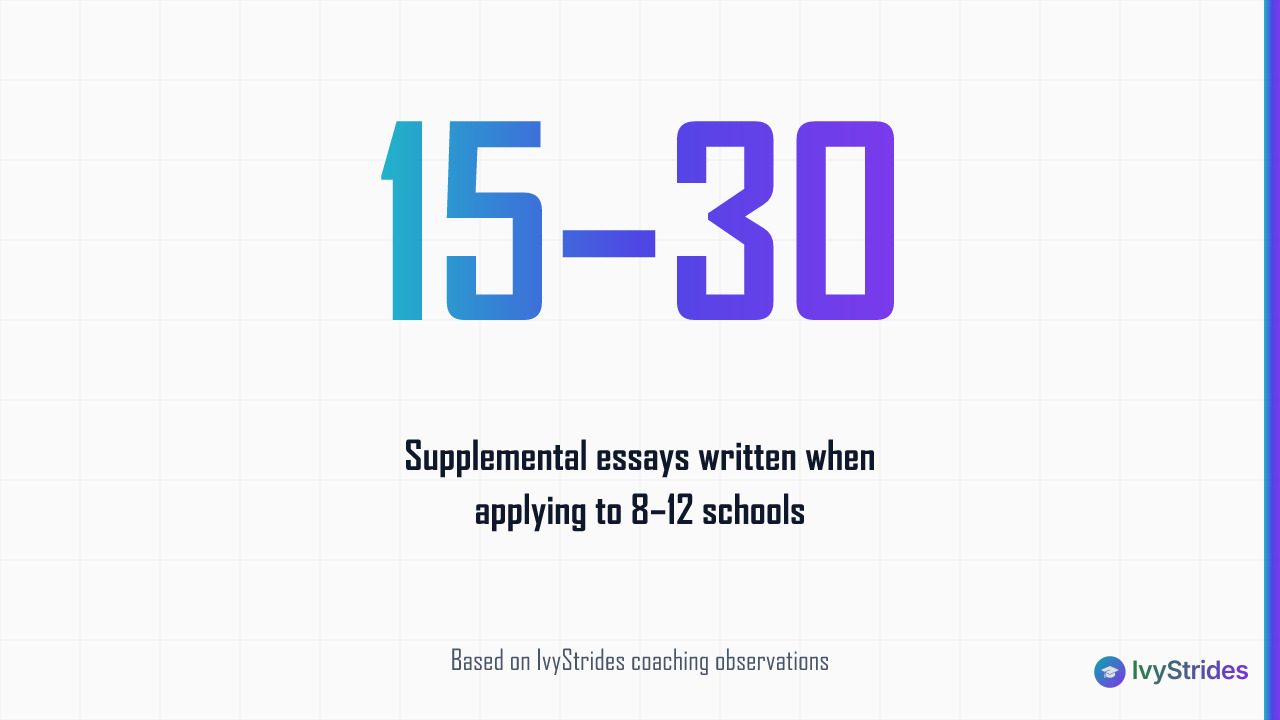
Students applying to 8 to 12 schools typically write 15 to 30 supplemental essays total, based on our coaching observations. The exact count depends entirely on your list. Some schools require no supplemental beyond the Common App personal statement. Others ask for five or more. Before you look at drafting, it helps to know how many supplemental essays you will actually write across your school list.
The range is wider than most families expect. A school with no supplemental adds zero writing. A school with a Why Us, a Why Major, a community prompt, and two short-answers adds five pieces on its own. Put two or three of those on a list, and your writing load doubles.
| Deadline type | Typical date | Draft-complete-by target |
| Early Decision / Early Action | Nov 1 or Nov 15 | Mid-October |
| Regular Decision | Jan 1 or Jan 15 | Mid-December |
If you're applying Early Decision or Early Action, your supplemental essay deadline is typically in October or November, which means drafting should begin no later than August. Regular Decision deadlines usually fall on January 1 or 15, which sounds far off in the fall and arrives faster than anyone plans for.
Our recommendation from coaching is firm: begin supplemental drafts in July or August, the summer before senior year. Don't wait until September, when APs, recommendations, and the personal statement all compete for the same hours. Knowing when to start is as important as knowing how to write well; the college application timeline for 2026-27 maps out exactly when supplementals should be drafted relative to your deadlines.
The caveat that saves the most rework: prompt wording and word limits change each cycle. Verify on the school's own Common App portal before drafting, not from a third-party list that may be a year out of date. For the strategic decision behind those deadlines, see Early Decision vs. Early Action vs. Regular Decision.
Getting Feedback on Your Supplemental Essay Drafts: What Actually Helps
Useful feedback on a supplemental essay draft targets structure, voice, specificity, and prompt-responsiveness, in that order. The least useful feedback is line-level grammar correction on a draft that hasn't yet solved its structural problem. Fix the architecture first; polish the sentences last.
In our coaching, the single most useful question to ask a reader is: "After reading this, what do you know about me that you didn't know before?" If the answer is "not much," the essay needs more specificity, no matter how clean the prose. That one question surfaces the transferability problem faster than any grammar check.
Who you ask matters. A parent can tell you whether the essay sounds like you. An English teacher can catch mechanics. But an essay coach with admissions-context experience can tell you something neither can: whether the draft answers the prompt that was asked, or the prompt you wished you'd been asked. That distinction is invisible to most readers and decisive to admissions officers.
What to ask for, and what not to. Don't ask "Is this good?", a question no reader can answer usefully. Ask "Does this answer the prompt?" and "Where does this get generic?" The revision cycle that works is draft, targeted feedback, targeted revision, not a wholesale rewrite that throws out the parts that were working.
This is the core of what our essay coaches do. IvyStrides essay coaches have worked through hundreds of supplemental drafts across every major prompt type, reading for the named-entity test and the specificity gap first. If you want a structured read, our college admissions essay coaching is built around exactly this cycle. For the DIY version, see how to get feedback on your college essay. During revision, work through how to keep your voice while editing. You can also read more about our approach on the IvyStrides About page.
FAQ: Supplemental Essay Examples and Prompt Types
What is the purpose of a supplemental essay?
A supplemental essay lets a college evaluate fit beyond the personal statement. It asks school-specific questions to test whether you've genuinely researched the program, can articulate why you belong there, and will contribute something specific to campus. Each prompt type probes a different dimension that grades and scores can't show.
What should you write in a supplemental essay for college?
Write something only you could write about that specific school. For a Why Us prompt, name a professor, course, lab, or tradition you researched and connect it to something you've already done. For a Why Major prompt, trace one intellectual moment that sparked your interest. Skip generic praise that could apply anywhere.
How do you start a Why Us supplemental essay?
Open with the specific thing at the school that connects to your own work, not a compliment about reputation. For example: "Professor [Name]'s work on tidal-energy modeling extends the exact question I couldn't answer in my junior research project." That first sentence signals real research before you've made a single claim.
How long should a supplemental essay be?
Supplemental essays range from 25 words for short-answers to 650 words for longer community or Why Us prompts, with 150, 250, and 350 words most common. Write to the word limit given, not under it. A 250-word prompt answered in 150 words signals you ran out of specific things to say.
Can you use the same supplemental essay for multiple schools?
You can reuse the core narrative and voice, but every sentence naming the school, a program, a professor, or a tradition must be rewritten for each one. Students who build a core story bank of four to six strong paragraphs, in our coaching, adapt them in roughly 30 to 45 minutes per school instead of starting cold.
Do all colleges require supplemental essays?
No. Some schools accept the Common App personal statement with no additional writing, while others require five or more supplementals. The number and type vary by school and change each cycle. Always check the school's own Common App portal directly rather than trusting a third-party list that may be outdated.
What is an example of a supplemental essay topic?
Common topics include why you want to attend that specific school (Why Us), why you chose your intended major (Why Major), a community or identity you belong to and what you contribute, an extracurricular you want to explore in depth, and short-answer questions about your personality. For structuring the longer pieces, see how to structure a Common App essay.
How do supplemental essays affect college admissions decisions?
Supplemental essays are read as part of the full application, never in isolation. At test-optional schools they carry more weight, because the file has fewer quantitative signals. Strong supplementals can distinguish two applicants with similar grades and scores, but decisions depend on the complete application, including recommendations and institutional priorities. Our essay review service reads for exactly that distinction.
Every prompt type on this page comes down to the same discipline: name the specific thing, connect it to something you actually did, and cut whatever could belong to another applicant. Pick your hardest school, draft one paragraph using the named-entity test, and get a real read on it.
Ready to Turn Your Supplemental Essay Drafts Into Admits?
IvyStrides essay coaches have worked through hundreds of supplemental essay drafts across every major prompt type. Book a free 15-minute call and get a personalized read on your strongest draft.

Award-winning author (South Asian Book Award) and graduate of BITS Pilani and UCLA Luskin School of Public Affairs. Brings a published writer's eye to Common App essays and grammatical precision to SAT and ACT R&W instruction.