
College Essay Ideas That Work: The Complete 2026 Guide for Students and Parents
On this page
- What Makes a College Essay Topic Actually Work
- The 2025-2026 Common App Prompts: What Each One Is Really Asking
- How to Brainstorm College Essay Ideas When Nothing Feels Interesting Enough
- Not Sure What to Write About? Let's Figure It Out Together.
- College Essay Topics That Stand Out: Categories and Concrete Examples
- College Essay Topics That Tend to Fall Flat (and What to Write Instead)
- What Good College Essay Examples Actually Have in Common
- How to Test Whether Your College Essay Idea Is Ready to Draft
- A Note on AI Tools and College Essay Brainstorming
- FAQ
- What are the seven Common App essay prompts for 2025-2026?
- What are the 5 D's of college essays?
- What should I write about if nothing interesting has happened in my life?
- Is it okay to use ChatGPT to help write a college essay?
- How long should a Common App personal statement be?
- What is the difference between a personal statement and a supplemental essay?
- Ready to Turn Your Topic Into a Draft That Works?
College essay ideas that work share one quality: they reveal something specific and true about how you think, not just what you have done. You do not need a dramatic story. A topic as ordinary as repairing a bicycle, learning a family recipe, or debugging a piece of code can produce a stronger personal statement than a mission trip or a championship game, provided you use it to show a genuine insight or value. The 2025-2026 Common App offers seven open-ended prompts, each flexible enough to fit almost any topic. The question is not what happened. It's what the moment shows about you.
The prompts and word limits in this guide come from the official Common App source, and the article is refreshed annually as prompts and policies change. One caveat up front, and it matters: no essay topic guarantees admission anywhere. The essay is one piece of a holistic review that also weighs your transcript, test scores, and activities.
What Makes a College Essay Topic Actually Work
A personal statement works when an admissions reader finishes it and knows something about how you think that they could not have learned from your transcript or activities list. That's the whole job. Not to impress. To reveal.
Here's the part most students miss. Admissions readers move through hundreds of essays in a single cycle, and the ones that stick are almost never the ones with the biggest events. In our coaching, the essays that land are the ones with a narrow focus and an honest character reveal. A student writing about the exact logic she uses to sort her music library can outperform a student writing about a summer building schools abroad, because the first one shows a mind at work and the second one, too often, shows a résumé line stretched into prose.
That's the distinction between specific and unique. Your life does not need to be unique. It needs to be rendered with specificity. Everyone has repaired something, waited for something, argued with a sibling about something. The essay that works zooms in on one of those and stays there long enough to show a value, a habit of mind, a way of seeing.
The Common App sets a word limit of 250 to 650 words for the personal statement, per the Common App's official guidelines. This same essay goes to every Common App member school you apply to, which is why it should carry your broadest, most human story rather than a school-specific pitch. Most strong essays we see land between 550 and 650 words. Going much under 500 usually signals a topic that ran out of depth.
Two things pull the essay's weight up. First, test-optional policies. At schools where submitting a test score is optional, a compelling essay carries even more weight in the admissions file. Whether a given school is test-optional varies by institution and by year, so check the current policy for each of your target schools and cross-reference a tracker like FairTest before you assume anything. Second, the rest of your file. Your essay, AP scores, and standardized test results are read together by admissions officers, so the story your essay tells should complement, not repeat, what the rest of your application already shows. If your activities list already screams "science research," your essay might be the place to show a completely different side of you.
Students who work with an essay coach in our 1-on-1 program typically move from a vague topic to a focused, drafted essay within two to three sessions. If you are earlier than that, still weighing angles, our guide on what to write your college essay about walks through a structured decision framework. And when you have a draft you want a second set of eyes on, our essay review service pressure-tests it against what admissions readers respond to.
The 2025-2026 Common App Prompts: What Each One Is Really Asking
The Common App uses seven prompts for the 2025-2026 cycle, and they have stayed stable across recent years, so you can stop refreshing the page to see if they changed. They didn't. Here is what each one is really designed to surface, verified against the official 2025-2026 Common App announcement.
Prompt 1 asks about a background, identity, interest, or talent so meaningful your application would be incomplete without it. This is the widest door in the building. If a part of who you are does not show up anywhere else in your file, this is where it goes.
Prompt 2 asks about a time you faced a challenge, setback, or failure, and how it affected you. The trap here is writing about the obstacle. The prompt is really asking about the how it affected you clause. Readers want the reflection, not the injury report.
Prompt 3 asks about a time you questioned or challenged a belief or idea. What prompted your thinking, and what was the outcome? This one rewards intellectual honesty over a tidy conversion story. You do not need to have won the argument.
Prompt 4 asks about a problem you have solved or would like to solve. It can be intellectual, research-based, ethical, anything. The scale does not matter. A student solving why her grandfather's radio kept cutting out can beat a student describing a hypothetical plan to end world hunger, because the small problem produces specific thinking.
Prompt 5 asks about an accomplishment, event, or realization that sparked personal growth or a new understanding of yourself or others. The keyword is realization. A quiet internal shift qualifies just as much as an external win.
Prompt 6 asks about a topic, idea, or concept you find so engaging it makes you lose track of time. Who or what do you turn to when you want to learn more? This is the micro-obsession prompt, and it is one of the most productive for students who think their lives are boring.
Prompt 7 is the topic of your choice. Fully open. You can submit an essay you wrote for another purpose or write on any subject.
Here is the practical truth about prompts. Most strong topics fit two or three of them at once, and you select your prompt after you know your story, not before. Write the essay that reveals you, then find the prompt it answers. Prompt 7 catches anything the others don't. If you want structured help matching your story to the right prompt, that's exactly the kind of work our one-on-one help for common app essay coaching handles session by session.
How to Brainstorm College Essay Ideas When Nothing Feels Interesting Enough

Photo by https://kaboompics.com/ on Pexels
"Nothing interesting has ever happened to me." This is the single most common thing we hear in essay coaching intake sessions, and it is almost always wrong. Not because dramatic things happened to you. Because dramatic things are not what a good essay needs.
The fix is to stop hunting for events and start mining for moments. Big achievements make bad essay seeds because they invite you to recap a list of accomplishments. Small, specific moments force you to describe, and description is where voice lives. In our coaching, students who start brainstorming from a specific object or routine rather than a major achievement produce more distinctive first drafts, nearly every time.
Try the mundane object deep dive. Pick something ordinary in your daily life and write about it for ten minutes without stopping. The mug you always use. The route you walk. The way you fold laundry, or refuse to. What you are looking for is the moment the writing turns from what into why. That turn is your essay.
Here are six questions to answer in writing. Do not judge the answers. Just get them down.
- What is a small habit or ritual you have that no one else in your family shares?
- What is a topic you will happily explain to someone at length, even when they did not ask?
- What is an object you own that would confuse a stranger, and why do you keep it?
- What is a question you have never fully resolved and keep circling back to?
- When was the last time you changed your mind about something that mattered to you?
- What do you notice that other people seem to walk right past?
Once you have a candidate, run the so what test. State your moment in one sentence, then ask "so what does this show about me?" If the answer is a real value, a way of thinking, a genuine trait, you have a topic. If the answer is "it shows I'm hardworking" or "it shows I care about people," you don't have a topic yet. You have a cliché waiting to happen. Keep digging until the so what is specific enough that it could only apply to you.
Knowing which topics to avoid is just as important as knowing which ones work, and our companion guide on college essay topics to avoid covers the full list with specific rewrites.
Not Sure What to Write About? Let's Figure It Out Together.
In a free 15-minute strategy call, an IvyStrides essay coach will help you identify two or three strong topic directions based on your actual experiences, not a generic list. Students and parents both welcome.
College Essay Topics That Stand Out: Categories and Concrete Examples
Certain kinds of topics tend to produce strong essays because they build in specificity from the start. These are patterns we see across coaching cohorts, not formulas, and the category matters far less than how honestly you execute it. Still, if you are stuck, these directions are a good place to look.
Micro-obsession or niche interest. A student who writes about her fixation with the design of subway maps shows spatial thinking, aesthetics, and a hunger to understand systems. The narrower the obsession, the better it reads.
Process or craft. Not that you bake, but the exact sequence of adjustments you make when a loaf comes out dense. Process essays reveal how you troubleshoot, and troubleshooting is character.
Intellectual curiosity. A question you cannot stop thinking about. Why do certain songs get stuck in your head and others don't? The essay is less about the answer than about how your mind chases it.
Relationship or community, with a specific lens. Not "my grandmother taught me resilience," but the particular way you and your grandmother argue over the right amount of salt, and what that argument taught you about listening. A student who writes about the specific logic she uses to organize her grandmother's spice rack is showing analytical thinking, cultural connection, and attention to detail at once.
Identity beyond the label. If you are going to write about an identity, go past the surface term. What is one concrete moment where that identity produced a decision or a tension that surprised you?
Failure or growth, with real reflection. These work only when the reflection is honest enough to include the part you got wrong. A growth essay where you emerge flawless is not a growth essay.
The through-line across all of these is specificity of detail plus a clear character reveal. If you want a coach to help you sharpen a candidate topic into something with a real narrative arc, our common app essay tutor coaching is built for exactly that hand-off from idea to draft.
College Essay Topics That Tend to Fall Flat (and What to Write Instead)
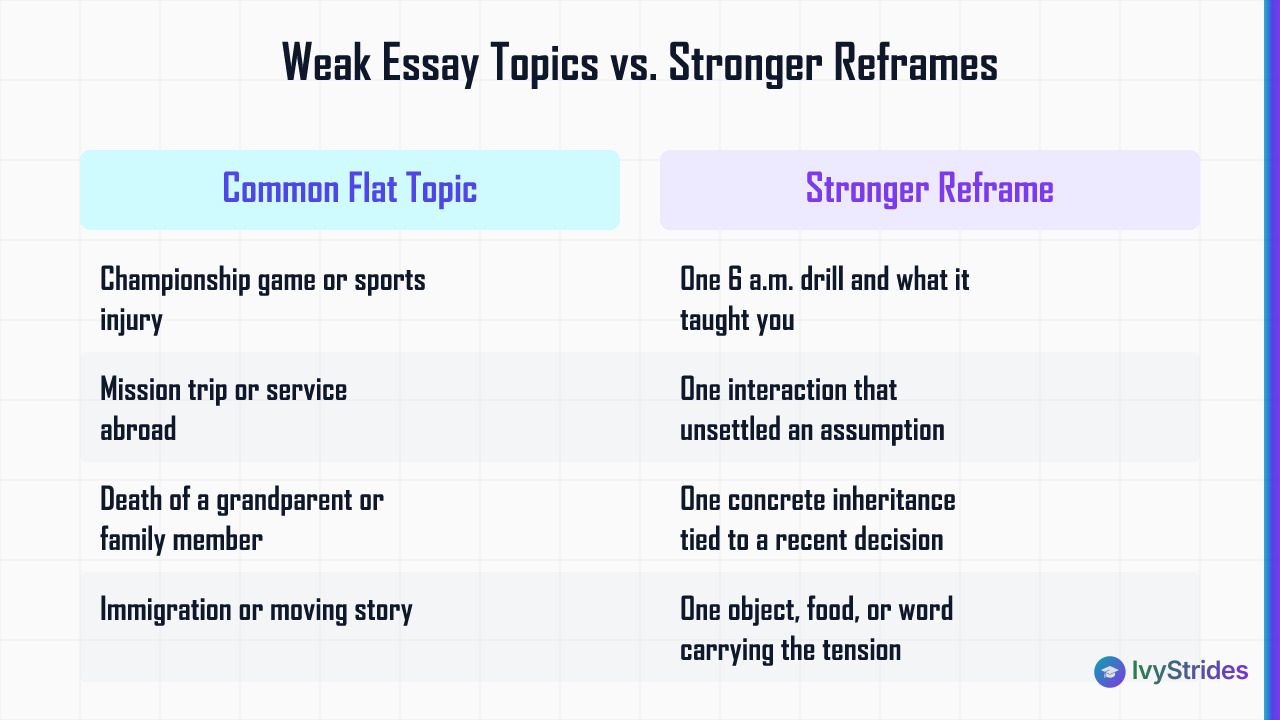
Some topics show up in so many application files that admissions readers can predict the arc from the first line. They are not banned. They are just hard, because you are starting from behind. In our coaching, the most common reason a strong student submits a weak essay is choosing a topic for its impressiveness rather than its specificity. Here are the usual culprits, each with a reframe that pulls the topic back toward what works.
The sports injury or championship game. These essays almost always end in the same lesson about perseverance. Instead of writing about winning the championship, write about the one drill you practiced alone at 6 a.m. and what it taught you about how you handle uncertainty. The narrow moment beats the big finish.
The mission trip or service abroad. The risk here is centering yourself in someone else's hardship. Reframe toward a single specific interaction that unsettled an assumption you held, and be honest about the discomfort rather than resolving it into gratitude.
The death of a grandparent or family member. Grief is real, but the essay often becomes about the person rather than about you. If you write this, anchor it in one concrete inheritance, a phrase they used, a habit you kept, and trace how it shows up in a decision you made last month.
The immigration or moving story without a lens. A move is a setting, not a topic. Reframe toward one specific object, food, or word that carries the whole tension of belonging in two places at once.
Being a club president or team captain. Leadership essays tend to list responsibilities. Instead, write about one moment your leadership failed or was questioned, and what you actually did in the next five minutes.
The reframe principle is simple. The topic is rarely the problem. The execution is. Any of these can work with a specific, honest lens, but they demand more from you than a fresh topic would. If you want the full breakdown with rewrites, our guide to the topics to avoid in a college essay goes deeper.
What Good College Essay Examples Actually Have in Common
We won't reproduce other people's essays here, but we will tell you what the strong ones share, because the pattern is remarkably consistent across the drafts we read.
They open with a specific scene or image, not a thesis. In our coaching, essays that open with a concrete sensory detail or an action hold reader attention longer than essays that open with a summary of what the essay is about. "I was seventeen and terrified" is a thesis. "The bread had risen wrong again, lopsided as a broken jaw" is a scene. Open with the scene.
They keep one voice the whole way through. If paragraph one sounds like a text to a friend and paragraph four sounds like a legal brief, the reader notices, and the essay reads as performed rather than lived. Consistency of voice is what makes an essay sound like a real person rather than a college essay.
They land a clear so what in the final third. The reflection cannot arrive as a tacked-on last sentence. It has to grow out of the scene you built. This is the small moment, big insight structure, and it is the backbone of nearly every strong personal statement. The widely-cited annotated examples from established admissions resources consistently demonstrate the same structure.
They add information not visible anywhere else in the application. If the reader could have learned the same thing from your activities list, the essay wasted 650 words.
To make this concrete: a student who wrote about the specific way she annotates books, the codes she invented for arguments she disagreed with, produced a more memorable essay than a student who wrote about founding a nonprofit. The annotation essay revealed exactly how she thinks. The nonprofit essay listed what she did. Same student caliber, very different result.
When your draft is ready for that outside read, our essay review service checks it against these exact qualities. And if you are still building your school list alongside your essay, posts like whether you should you apply to Johns Hopkins University can help you think about fit before you tailor a supplement.
How to Test Whether Your College Essay Idea Is Ready to Draft
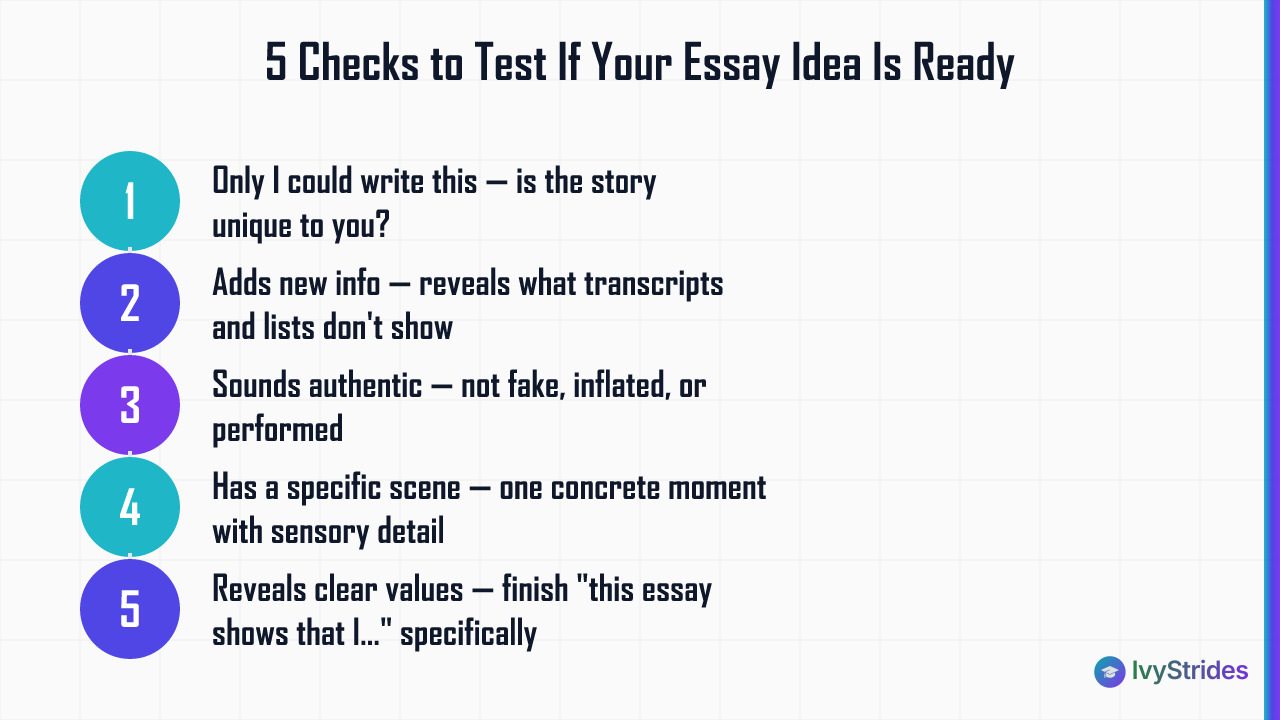
Before you spend three weekends on a full draft, run your topic through five checks. In our coaching, students who pass at least four of five before drafting produce stronger first drafts and require fewer revision rounds. Answer each one honestly, yes or no.
-
The "only I could write this" test. Could a hundred other applicants submit an essay with the same core story? If yes, your topic is too generic. Narrow it until the answer is no.
-
The "does this add new information" test. Does the essay reveal something absent from your transcript, scores, and activities list? If it just restates your résumé, it fails.
-
The "would I be embarrassed to read this aloud" test. Not embarrassed by vulnerability, that is fine. Embarrassed because it sounds fake, inflated, or like you are performing a version of yourself. If yes, you are writing for an imagined reader instead of writing true.
-
The "is there a specific scene I can open with" test. Can you name one concrete moment, with sensory detail, that you would open on? If your topic is an idea with no scene attached, you need to find the scene first.
-
The "what does this reveal about my values" test. Can you finish the sentence "this essay shows that I..." with something specific and true? If the best you can do is "hardworking" or "caring," keep digging.
Pass four or five and you are ready to draft. Fail two or more and that is a signal to return to brainstorming, not to force the draft. Forcing a weak topic wastes more time than restarting. If your topic passes but you want to confirm the fit before committing, thinking through school-specific questions, like deciding whether to apply to the University of Notre Dame, can help you see how your personal statement and supplements need to work together.
A Note on AI Tools and College Essay Brainstorming
Can you use ChatGPT or another AI tool to help with your essay? Yes, for some things. No, for others. The line matters, and it matters more than it did two cycles ago.
Using AI to generate brainstorming questions or to sketch structural options is a different activity from submitting AI-generated prose as your own writing. Asking a tool "give me twenty unexpected angles on a boring summer job" is fine, the way a brainstorming worksheet is fine. Asking it to write your paragraphs and then submitting those paragraphs is not.
Here is the integrity boundary in plain terms. Most college application certifications require that the essay represents the student's own work, and many schools' honor codes say the same. Policies vary by institution, so review the specific academic integrity policy of every school you apply to before you assume anything is allowed. This is a decision with real consequences, so treat it as one.
Beyond the rules, there is a practical reason AI cannot write this essay for you. In our coaching, AI-generated drafts consistently produce generic, polished-sounding prose that lacks the specific detail and voice that make an essay memorable to an admissions reader. The tool does not know that your grandmother salts the soup twice or that you invented a filing code for arguments you disagreed with. Those details are the whole point, and they live only in you.
So use the tool to find the topic if it helps. Write the essay yourself.
FAQ
What are the seven Common App essay prompts for 2025-2026?
The seven prompts cover a meaningful background or identity, an obstacle or challenge, questioning a belief or idea, a problem you have solved or want to solve, an accomplishment or realization that sparked growth, a topic of your choice, and a topic that engages you enough to lose track of time. All seven are open-ended enough to fit almost any personal story. They are published at commonapp.org and have stayed stable across recent cycles.
What are the 5 D's of college essays?
The 5 D's is a coaching framework you will sometimes hear: Describe (set the scene), Develop (build the narrative), Discuss (reflect on meaning), Demonstrate (show character or values), and Distinguish (show what sets you apart). Not every coach uses this exact language. But the underlying principle, that a strong essay moves from a concrete scene to genuine reflection, holds across nearly every strong personal statement we read.
What should I write about if nothing interesting has happened in my life?
This is one of the most common concerns in our essay coaching intake sessions, and the answer is to stop hunting for a dramatic event. Look instead for a specific habit, object, question, or relationship you keep returning to. Admissions readers are not looking for a remarkable biography. They are looking for a specific, honest window into how you think. A student who writes about the logic behind how she organizes her notes can produce a more memorable essay than a student who writes about a service trip abroad.
Is it okay to use ChatGPT to help write a college essay?
Using AI tools to generate brainstorming prompts or to think through structure is a different activity from submitting AI-generated prose as your own work. Most college application certifications require that the essay represents the student's own writing, and policies vary by school, so check each one. Beyond the integrity question, AI drafts tend to lack the specific voice and detail that make an essay stand out. Use AI to find the topic; write the essay yourself.
How long should a Common App personal statement be?
The Common App sets a word limit of 250 to 650 words for the personal statement, per the official Common App guidelines. Most strong essays land between 550 and 650 words, using the full space to develop a specific scene and a real reflection. Coming in significantly under 500 words usually signals an underdeveloped topic.
What is the difference between a personal statement and a supplemental essay?
The personal statement goes to all your Common App schools and tells the story of who you are as a person. Supplemental essays are school-specific, shorter, and typically answer prompts like "Why this college?" or "Describe a community you belong to." The personal statement should not repeat what your activities list already shows. A Why This College essay, by contrast, has to demonstrate genuine research and specific knowledge of that one school.
The topic you choose sets the ceiling for how good your essay can be, but the draft, the voice, and the revision are where it gets built. If you want an experienced coach to pressure-test your strongest idea and walk with you from brainstorm to final draft, you can read how we work on our about page. You can also meet the coaches on our tutors page.
Ready to Turn Your Topic Into a Draft That Works?
IvyStrides essay coaches work 1-on-1 with students through brainstorming, drafting, and revision. Book a free 15-minute call to see whether our essay coaching is the right fit for your timeline and target schools.

Award-winning author (South Asian Book Award) and graduate of BITS Pilani and UCLA Luskin School of Public Affairs. Brings a published writer's eye to Common App essays and grammatical precision to SAT and ACT R&W instruction.