
How to Get Feedback on your College Essay in 2026: A Step-by-Step Guide That Actually Works

On this page
- The Short Answer: Who to Ask and in What Order
- Why Getting the Right Feedback Matters More Than Getting a Lot of It
- Step 1: Start With a Teacher or Counselor for Structure and Prompt Alignment
- Step 2: Ask a Trusted Peer for Honest Engagement Feedback
- What to Ask Your Reviewer: How to Frame Feedback Requests That Get Useful Notes
- Not Sure If Your Essay Is Landing? Get a Professional Read.
- How to Use the Feedback You Receive Without Losing Your Voice
- Using AI Tools for College Essay Review: What They Can and Cannot Do
- When Free Feedback Is Not Enough: Knowing When to Bring In a Professional
- Free and Low-Cost College Essay Review Options Worth Knowing
- FAQ
- Can I use ChatGPT to review my college essay?
- How do I ask someone for feedback on my college essay without getting vague notes back?
- How many people should review my college essay before I submit it?
- Where can I get free college essay feedback online?
- What is the word limit for the Common App personal statement in 2026?
- How do I give useful feedback on someone else's college essay?
- Ready to Turn Good Feedback Into a Stronger Essay?
To get useful feedback on your college essay, ask three types of reviewers in sequence: a teacher or school counselor for structure and prompt alignment, a trusted peer for honest engagement, and a professional coach or trained reviewer for the admissions lens. Give each reviewer one specific question to answer instead of asking for general impressions. The Common App personal statement allows 250 to 650 words, and the 2025-2026 prompts are unchanged from the prior cycle. Plan for roughly three to five revision rounds before you submit.
These numbers come from the Common App's official prompt announcement. The harder question, which the rest of this article answers, is who to ask first, exactly what to say when you ask, and how to reconcile conflicting notes without erasing your voice.
The Short Answer: Who to Ask and in What Order
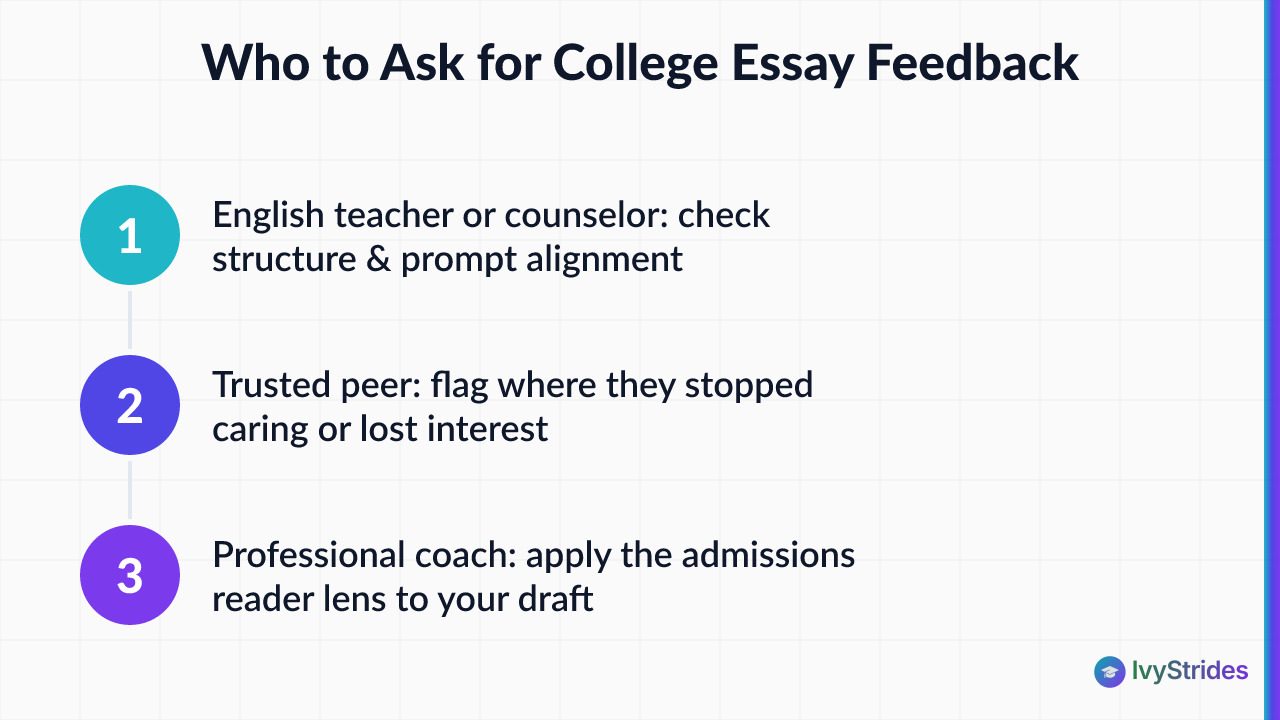
Three reviewers, in this order:
-
An English teacher or school counselor for structure and prompt alignment. Their job: tell you whether your essay actually answers one of the seven Common App prompts and whether the piece has a clear arc.
-
A trusted peer for engagement. Their job: tell you honestly where they stopped caring.
-
A professional essay coach or trained reviewer for the admissions lens. Their job: read the draft the way an admissions reader will read it and flag what a general reader can't see.
Two facts anchor everything else. The Common App personal statement has a 650-word maximum and a 250-word minimum per the official Common App, and the 2025-2026 prompts are unchanged from the prior cycle, so prompt-alignment guidance from last year still applies. In our coaching, students typically move through three to five revision rounds before a draft is submission-ready. Fewer than three usually means unfinished. More than five usually means feedback whiplash.
If a reviewer flags a structural problem you don't recognize, our guide to common college essay mistakes to avoid covers the patterns that show up most often in first drafts.
Why Getting the Right Feedback Matters More Than Getting a Lot of It
Ten pieces of vague feedback are worse than one piece of specific feedback. Volume creates noise. Specificity creates revision.
The stakes are higher than they used to be. Many colleges remain test-optional or test-flexible, though policies vary by school and by year (see the current tracker at FairTest). At schools where a student chooses not to submit test scores, the essay and supplemental writing carry even more weight in the admissions review, making high-quality feedback on those pieces especially important. Even at test-required schools, the essay is often the tiebreaker between similarly qualified applicants.
Here's the distinction most students collapse: copy-editing and substantive feedback are not the same thing. Copy-editing fixes grammar, tightens sentences, and flags typos. Substantive admissions feedback asks a harder question. Does this story land with a reader who has 40 other applications to read tonight? A pattern shows up across hundreds of supplemental essay drafts we've read: a buried lead and a summarizing conclusion are the two most common structural problems flagged in Round 1 feedback. A grammar review will not catch either one.
If feedback reveals that the topic itself isn't landing, it may be worth revisiting the brainstorming stage. Our guide on college essay ideas that work can help you find a stronger angle.
Step 1: Start With a Teacher or Counselor for Structure and Prompt Alignment

An English teacher is your best first reader for one reason. They read student writing constantly and can spot structural problems fast. They'll notice when your opening buries the lead, when a middle paragraph drifts, or when your conclusion tries to explain the essay instead of ending it.
A school counselor adds something a teacher usually can't: some admissions-context knowledge of what particular schools' readers tend to respond to. If your counselor has been in the role for a few years, they've seen which of last year's seniors landed where with which kinds of essays. That pattern recognition is worth asking about.
When you approach either reviewer, resist the urge to say "just tell me what you think." Instead, give them one specific question. Try this framing:
"I'm not sure whether my opening paragraph earns the reader's attention. Could you mark where you first felt engaged and where you lost interest?"
That single question does more work than a generic ask. It tells the reviewer you want honest engagement notes, not encouragement. It gives them a concrete task. And it produces feedback you can act on within about 48 hours instead of a paragraph of praise that leaves you stuck.
After you have their notes, a structured revision pass is the next step. Our guide on how to edit and revise your college essay walks through that process round by round.
Step 2: Ask a Trusted Peer for Honest Engagement Feedback
A good peer reviewer will tell you something a teacher won't. Where they stopped caring.
Teachers read for correctness. Parents read for pride. Peers, especially peers who don't know you well, read for engagement. They're closer to the actual audience an admissions reader represents, which is a stranger encountering your story for the first time with no built-in reason to be patient.
Give the peer a narrow prompt. Something like this:
"Read this once, then tell me the one moment you remember most clearly and the one moment where you stopped caring. Don't tell me what you liked overall."
That question forces specificity. In our coaching, peer reviewers catch pacing problems and generic transitions that teachers often overlook, because teachers scan for correctness while peers scan for whether the story holds them. A peer who says "I got a little lost in the third paragraph" is telling you exactly what to fix.
One caveat. Pick a peer who will be honest, not a peer who will tell you it's great because they don't want to hurt your feelings. If you're not sure which category yours falls into, ask them directly: "I need someone who will tell me where this doesn't work. Are you that person?"
What to Ask Your Reviewer: How to Frame Feedback Requests That Get Useful Notes
Here's the part most students miss. Most bad feedback traces back to a bad question. Fix the question and the notes get sharper immediately.
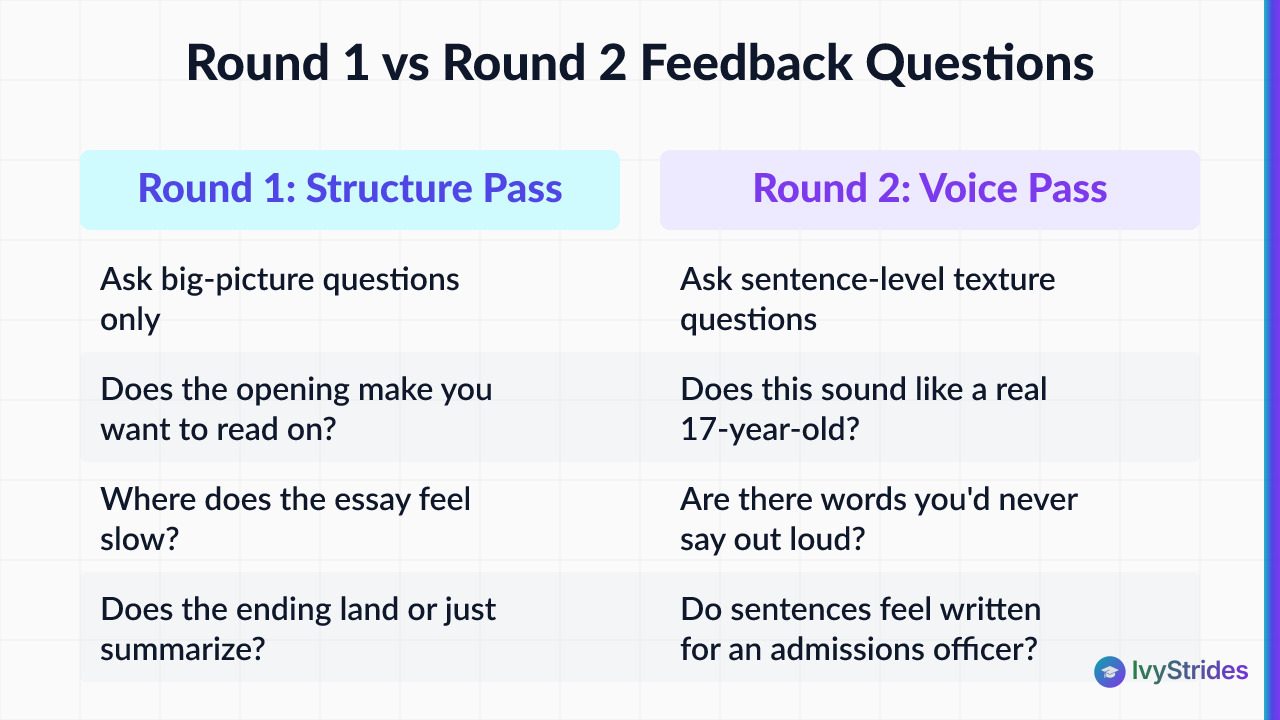
Break your feedback requests into two rounds.
Round 1 (structure pass). Ask big-picture questions only. Do not ask about word choice or grammar yet.
- "Does the opening make you want to keep reading, or does it feel like a setup?"
- "Where does the essay feel slow?"
- "If you had to describe what this essay is really about in one sentence, what would you say?"
- "Does the ending land, or does it just summarize what came before?"
Round 2 (voice pass). Only after structure is settled. Now you ask about the sentence-level texture.
- "Does this sound like a real 17-year-old, or does it sound like a college application?"
- "Are there sentences that feel like they were written for an admissions officer rather than for the story?"
- "Are there words in here you'd never actually say out loud?"
The most common mistake is asking Round 2 questions during Round 1. If your reviewer starts polishing sentences before the structure is right, you'll waste hours smoothing prose that gets cut in the next revision.
Written notes beat verbal notes almost every time. Verbal feedback disappears the moment the conversation ends, and you'll remember the compliments better than the critiques. Ask reviewers to type comments directly into a Google Doc or write in the margins of a printed copy. In our coaching, students who give reviewers a specific question and ask for written notes get feedback they can act on within about 48 hours. Students who say "just tell me what you think" often get back a paragraph of encouragement and one grammar fix.
Many of the structural problems a reviewer will flag, such as a buried lead or an ending that summarizes rather than resonates, are the same patterns covered in our guide to common college essay mistakes to avoid.
Not Sure If Your Essay Is Landing? Get a Professional Read.
Book a free 15-minute strategy call with an IvyStrides essay coach. We'll tell you exactly where your draft stands and what it needs next. No vague praise, no obligation, and useful for both students and parents trying to figure out the next step.
How to Use the Feedback You Receive Without Losing Your Voice
You are the final decision-maker on your own essay. Not your teacher, not your parent, not even a coach. The essay has to sound like you, because if you get in, the person walking onto campus is you, not your reviewer.
Here's the rule we use in coaching to sort useful notes from noise.
If two or more reviewers flag the same moment, fix it. If only one reviewer flags it, ask whether the note addresses clarity or personal preference. A sentence that confuses one reader is a preference issue. A sentence that confuses three readers is a clarity issue. Different fix, different urgency.
Watch for the red flag: a reviewer who rewrites your sentences rather than describing the problem is imposing their voice, not improving yours. If you get a draft back with tracked changes that turn your sentence into their sentence, don't accept the change. Ask what the problem with your original was. Then rewrite it in your voice. This shows up most often with parents and English teachers, both of whom mean well and both of whom have their own writing habits they'll unconsciously push onto your draft.
In our coaching, the most common voice-loss moment happens in the conclusion. A reviewer suggests a "stronger ending" that sounds polished, the student accepts it because it does sound polished, and the essay now closes in a voice that no longer sounds like them. If your ending suddenly sounds like a college brochure, that's the moment to roll it back.
Once you have your reviewer's notes in hand, the next step is a structured revision pass. Our guide on how to edit and revise your college essay walks through that process round by round.
If feedback reveals that your topic itself isn't landing, it may be worth revisiting the brainstorming stage. Our guide on college essay ideas that work can help you find a stronger angle. For students who want structured voice-preservation help before submission, our one-on-one help for common app essay service pairs each student with a coach who reads for voice first.
Using AI Tools for College Essay Review: What They Can and Cannot Do
Short version: use AI for structural flagging, not for content. And never submit AI-generated text as your own.
Where AI tools genuinely help. Ask ChatGPT or a similar tool to flag passive voice, inconsistent tense, sentences over 35 words, or paragraphs where every sentence starts the same way. This is a copy-editing task, and modern language models handle it reasonably well. Ask it to check whether your essay stays within 650 words. Ask it to identify which of the seven Common App prompts your draft most closely responds to. These are structural, mechanical tasks.
Where AI tools fail. They cannot judge whether your story will resonate with a specific school's admissions reader. They have no access to that school's current applicant pool, no read on the reader culture in that office, and no memory of what did or didn't land last cycle. They also can't tell whether your voice sounds like a real teenager or like a generic essay draft, because generic essay drafts are exactly what they were trained on. In our coaching, students who rely solely on AI feedback tend to produce essays that are structurally clean but emotionally flat.
The academic honesty boundary. Using AI to flag a passive-voice sentence in your own draft is a different category from using AI to write the sentence for you. Submitting AI-generated text as your own writing is academically dishonest and can risk application rejection at schools that have adopted AI-detection policies. See Scribbr's FAQ on ChatGPT and college essays for a fuller framing. If you wouldn't be comfortable telling an admissions officer exactly how you used the tool, don't use it that way. Draw the line before you cross it, not after.
For more structural checklists you can run against your own draft, see our free downloads library.
When Free Feedback Is Not Enough: Knowing When to Bring In a Professional
Free feedback has real value, and for many students it's enough. But it has a ceiling, and the signals that you've hit it are usually clear.
Watch for these:
- You've been through three or more revision rounds and can't tell whether the essay is getting better or just different.
- Every reviewer gives you conflicting notes, and none of them agree on what the essay is actually about.
- The essay is technically correct, no grammar errors, but a reader would call it generic.
- Your deadline is within four weeks and you don't have a submission-ready draft.
- You're writing supplemental essays for eight to twelve schools and don't have a strategy for which stories go where.
What a professional coach adds that a teacher or peer usually can't: knowledge of what specific schools' supplemental prompts are actually asking for beneath the surface language, pattern recognition across hundreds of drafts, and the ability to distinguish a voice problem from a structure problem. Those are different fixes, and confusing one for the other burns revision rounds.
In our coaching, students who bring in a coach after two rounds of peer feedback typically need two to three additional coached sessions to reach a submission-ready draft. For students who want a trained admissions eye on their draft before submission, our essay review service provides structured, round-based feedback from coaches who've read hundreds of supplemental essays.
One caveat, because this is admissions territory and it matters. Professional coaching improves the essay, but it does not guarantee admission. Admission decisions depend on your full application, including grades, course rigor, test scores if submitted, activities, recommendations, and fit. The essay is one piece of that, and a stronger essay meaningfully strengthens the application. It is not a substitute for the rest of it.
If you want to work with a coach for the entire Common App essay process rather than just review, our common app essay tutor service handles brainstorming through submission. If your topic itself needs a rethink first, start with college essay ideas that work.
Free and Low-Cost College Essay Review Options Worth Knowing
If you're not ready for paid coaching, these are the free and low-cost options that actually work, along with what each one does not do.
Your school counselor's office hours. The most underused resource. Your counselor already knows your academic record and often has context on where students from your school have landed with which kinds of essays. Book time now, not in October when their calendar fills up. Limitation: counselor caseloads at large public schools can run into the hundreds of students, so their time per essay is short.
Your school's writing center (if your school has one). Good for grammar, sentence-level clarity, and flow. Limitation: writing centers are trained in academic writing conventions (thesis statements, argument structure) that don't apply cleanly to college admissions essays, so their advice can sometimes push your voice in the wrong direction.
Public library college prep workshops. Many public library systems partner with local nonprofits to run free college essay workshops in the summer and fall. Check your library's events calendar. Limitation: these are usually group workshops, not one-on-one review, so the feedback stays general.
College Board BigFuture resources. Free tools and guidance from College Board, useful for understanding the broader application context. Limitation: they don't review your specific draft.
AI tools (with the boundaries covered above). Free for structural flagging. Limitation: no admissions judgment.
IvyStrides free 15-minute strategy call. A diagnostic read of where your essay currently stands and a service-fit recommendation. Genuinely free, and useful even if you decide not to work with us afterward.
Once you have feedback in hand from any of these sources, how to edit and revise your college essay covers the revision pass.
FAQ
Can I use ChatGPT to review my college essay?
You can use ChatGPT to flag structural issues like passive voice, run-on sentences, or inconsistent tone, which is a legitimate copy-editing use. It cannot judge whether your story is compelling to a specific school's admissions reader, and it wasn't trained on that school's current applicant pool or reader culture. Submitting AI-generated text as your own writing is academically dishonest and can risk application rejection at schools with AI-detection policies. Use AI as one structural check, not as your primary reviewer, and never as a writer.
How do I ask someone for feedback on my college essay without getting vague notes back?
Give the reviewer one specific question to answer rather than asking for general impressions. For a structure pass, ask: "Where did you first feel engaged, and where did you lose interest?" For a voice pass, ask: "Does this sound like a real high school student, or like a college application?" Specific questions produce specific, actionable notes. Also ask for the notes in writing (Google Doc comments, margins on a printed copy), because verbal feedback fades and you'll remember the compliments better than the critiques.
How many people should review my college essay before I submit it?
In our coaching, three to four reviewers across two to three rounds is the practical range for most students. More than that tends to produce conflicting notes that pull the essay in different directions. Prioritize one reviewer with an admissions lens (counselor or professional coach), one with an engagement lens (a peer who'll be honest), and one with a grammar and clarity lens (an English teacher). If two or more reviewers give you the same note, fix it. If only one reviewer flags a moment, weigh whether it's clarity or preference.
Where can I get free college essay feedback online?
Free options include your school counselor's office hours, your school's writing center, public library college prep workshops, and AI tools for structural flagging (with the limits noted above). IvyStrides also offers a free 15-minute strategy call that includes a diagnostic read of where your essay currently stands and a recommendation for next steps. Most fully free online review services will give you generic feedback. The useful free options are the ones tied to a real reader who knows you or the admissions context.
What is the word limit for the Common App personal statement in 2026?
The Common App personal statement has a 250-word minimum and a 650-word maximum. The 2025-2026 prompts are unchanged from the prior cycle per the Common App's official announcement, so prompt-alignment guidance from last year still applies. Prompt status should be verified at commonapp.org each admissions cycle, since the Common App reviews prompts annually. Reviewers should always check your draft against the specific prompt you selected and the word count before giving structural feedback.
How do I give useful feedback on someone else's college essay?
Be specific. Instead of writing "awkward" in the margin, describe what the sentence is doing that isn't working and suggest what the writer might try. Focus on one or two issues per pass rather than flagging everything at once, because a marked-up draft with 40 comments is overwhelming and usually gets ignored. Highlight what's working as concretely as you highlight what's not, so the writer knows what to protect in revision. And resist the urge to rewrite their sentences. Describe the problem, then let the writer solve it in their own voice.
The reviewer you pick this week matters more than the reviewer you plan to ask next month. Pick one person, write your two-sentence feedback request using the framing above, and send the draft today. Schedule a follow-up revision session within five days of getting notes back. That single loop, done well, moves most drafts from stuck to submission-ready faster than any other single change.
Ready to Turn Good Feedback Into a Stronger Essay?
IvyStrides essay coaches have worked through hundreds of supplemental essay drafts. In a free 15-minute call, we'll give you a diagnostic read of where your essay stands and a clear next step, whether that's one more revision round on your own or a coached session. Useful for both students figuring out the draft and parents figuring out the plan.

Award-winning author (South Asian Book Award) and graduate of BITS Pilani and UCLA Luskin School of Public Affairs. Brings a published writer's eye to Common App essays and grammatical precision to SAT and ACT R&W instruction.