
Everything You Need to Know About Common College Essay Mistakes to Avoid in 2026
On this page
- Why These Mistakes Matter More in 2026
- The Single Biggest Mistake: Writing About Someone Else Instead of Yourself
- Cliche and Overused Topics That Admissions Readers See Every Cycle
- The 5 Ds (and the 3 Ds): Which Topics Carry the Most Risk
- Structural and Mechanical Mistakes That Signal Low Effort
- Common App-Specific Mistakes That Go Beyond the Essay Itself
- A Quick Self-Audit Checklist Before You Submit
- FAQ
- What are the 5 Ds of college essays?
- What are the 3 Ds of college essays?
- What should you never put in a college essay?
- Can a college essay about sports work?
- How many mistakes are acceptable in a college essay?
- Are service trip essays always a bad idea?
The most common college essay mistakes to avoid in 2026 are: writing about someone else instead of yourself, repeating your resume, choosing an overused topic (sports triumph, mission trip, or a topic from the 5 Ds without careful handling), using AI-generated prose, opening with a cliche phrase or dictionary definition, and submitting a generic supplemental essay that could apply to any school. Each signals to an admissions reader that you haven't yet found your authentic voice. The fix for most of them is the same: get more specific, center yourself, and answer the actual prompt.
Every factual claim about the personal statement in this article, including the 650-word limit and the 2025-2026 prompt set, is drawn from the Common App. The section below walks through why these mistakes hit harder in the current cycle, then works through each one with specific rewrites you can apply this week.
Why These Mistakes Matter More in 2026
The Common App personal statement is capped at 650 words and offers 7 prompt options for the 2025-2026 cycle, per the Common App. That's the entire canvas. An admissions reader will spend, in our coaching observations, roughly 8 to 10 minutes on your full application file, including the transcript, activities list, recommendations, and both the personal statement and any supplemental essays. If your essay contains one of the mistakes below, you don't lose the whole application. You lose the reader's attention right when you needed it most.
The essay's weight has shifted. At schools that remain test-optional for 2026, where a submitted SAT or ACT score is absent from the file, the essay carries even more weight in the reader's holistic review. Test-optional policies vary by school and year. Verify each target school's current stance through the FairTest tracker or the school's admissions site. But the pattern is clear: fewer standardized signals in the file means more attention on voice, self-awareness, and fit, which is exactly what the essay exists to reveal.
Holistic review doesn't mean the essay decides admission on its own. It means the reader is building a picture of who you are from every part of the application, and the essay is the one place where you get to speak directly. Waste it on the wrong topic or the wrong voice and the picture stays flat. For a deeper look at specific subject areas that consistently underperform, see our companion piece on topics to avoid in a college essay.
One more note before we get into the mistakes. Verify the current prompts on the Common App site before you start drafting. Prompts refresh annually, and a draft aligned to last cycle's Prompt 4 won't save you time this year.
The Single Biggest Mistake: Writing About Someone Else Instead of Yourself

Photo by Rufaro Makaya on Pexels
Here's the pattern we see most in first drafts: the essay describes a person the student admires rather than the student themselves. A grandmother's immigration story. A father's illness. A coach's speech before the district final. The prose is often beautiful. The problem is that when the reader finishes reading, they know a lot about the grandmother, the father, or the coach, and very little about the applicant.
The Common App personal statement exists for self-reflection. Its purpose is to reveal your character, voice, and self-awareness beyond the resume. If the subject of most sentences in your essay isn't "I," you've drifted off the assignment. This is true even when the other person is the reason you are who you are. Especially then, actually. The reader already knows people shape us. What they need to see is what specifically shifted in you.
The reframe is straightforward. Pivot every paragraph back to what you learned, what you decided, or what you did differently. Not the abstract lesson. The specific decision.
Weak: "My grandmother taught me resilience through her stories of leaving her village at sixteen."
Stronger: "The first time I made a decision without silently asking what my grandmother would do, I was standing outside my chemistry teacher's office deciding whether to report that I'd seen a friend cheat. I chose to knock. I still don't know if she would have."
Notice what changed. The grandmother is still present. But the essay is now about the student's decision point, not the grandmother's biography.
A related failure mode: AI-generated prose. Large language models can produce clean, grammatical, generic sentences. What they can't do is know your specific memory of a Tuesday afternoon in eighth grade. Admissions readers who process hundreds of essays each cycle notice the pattern quickly. Beyond detection, the Common App honor agreement requires the work to be your own. If you can't honestly say your essay describes your interior life in your voice, you have a problem that no polish will fix.
In our coaching, students who rewrite a grandparent essay to center their own decision-making moment typically move the draft from competent but forgettable to specific and memorable in one revision pass. If you want a specialist to read your draft and flag exactly which of these mistakes appear in your essay, our one-on-one help for common app essay service pairs you with a coach who has reviewed hundreds of personal statements. For brainstorming approaches that keep you at the center from the start, see college essay ideas that work.
Cliche and Overused Topics That Admissions Readers See Every Cycle
Some topics aren't forbidden, but they arrive at admissions offices in stacks. When your essay lands in that stack, it has to work twice as hard to earn attention. Four topic patterns keep showing up.
The resume repeat. Your application already contains your activities list, awards, and coursework. An essay that walks through "how I became captain of debate, then founded the tutoring club, then earned the state honor" burns 650 words repeating what the reader already has. The essay is your only chance to show voice and character beyond the list. Don't spend it re-listing the list.
The sports triumph or injury essay. Sports essays can work. But only if the essay isn't about the game. In our coaching, sports essays that succeed focus on a specific moment of internal conflict, a leadership decision, or a private realization that happened in the context of athletics. The score of the match isn't the point.
Weak opening: "With 30 seconds left, I knew everything depended on this shot."
Stronger opening: "I had been the starting point guard for two years before I understood that I was terrified of being the person people counted on."
The first opening could belong to thousands of essays this cycle. The second could only belong to one student, and the reader wants to know what happens next.
The mission trip or service trip essay. These fail when they center the community being served rather than the student's growth. If your essay describes the poverty you witnessed, the gratitude of the children, or how much you appreciate what you have back home, you're writing a charity brochure. The essay works only if you can name a specific assumption you held before the trip and describe the concrete moment it changed, along with what you did differently as a result.
The immigration or family-heritage story told without personal specificity. Immigration narratives can be powerful. They fail when they summarize a parent's or grandparent's journey and gesture vaguely at how the student now values hard work. The story belongs to whoever lived it. Your essay belongs to the specific moment when that inherited story met a decision that was yours alone.
Non-cliche college essay topics almost always come from small, specific moments. A five-minute conversation. A repeated argument with a sibling. The reason you keep re-reading one particular book. Overused college essay topics almost always come from major life events that many applicants share. The topic isn't the problem. The scale is. Go smaller.
Once you've identified the mistakes in your draft, the next step is a structured revision pass, which we cover in how to edit and revise your college essay. A single professional read-through via our essay review service can catch the mechanical and voice errors that are hardest to spot in your own writing.
The 5 Ds (and the 3 Ds): Which Topics Carry the Most Risk
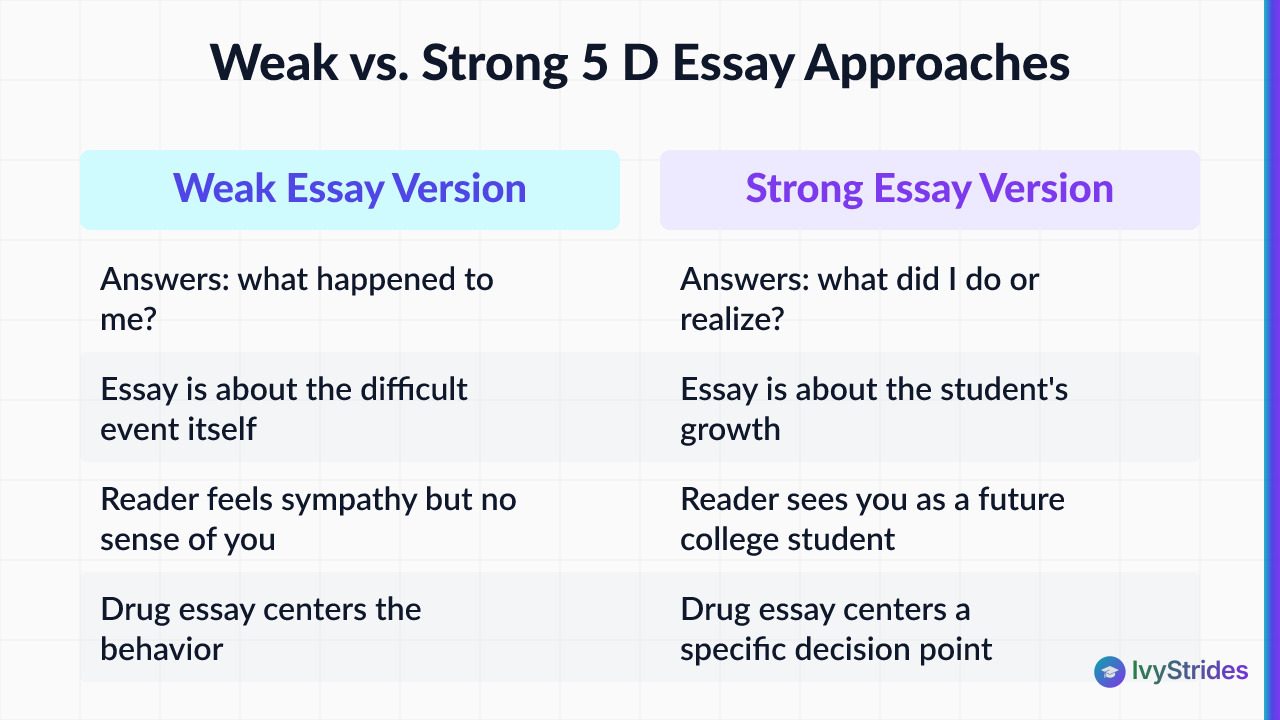
The 5 Ds of college essays are Death, Divorce, Disease (including Depression), Drugs, and Dating. The original shorter list, the 3 Ds, covers Death, Divorce, and Disease. These frameworks are shorthand used by admissions coaches to name topics that consistently underperform, not because the topics are unimportant, but because they pull essays away from the writer and toward the difficult event itself.
None of these topics are automatically disqualifying. Students write successful essays on every one of them each cycle. What makes them risky is a pattern: the harder the experience, the stronger the gravitational pull to describe the experience in detail, and the more the essay becomes about what happened to you rather than what you decided, did, or became because of it.
The test is simple. Read your draft and ask: does this essay answer "what happened to me?" or does it answer "what did I do, decide, or realize because of this?" The first version, however moving, leaves the reader with sympathy but not with a sense of who you are as a future college student. The second version does the work the personal statement exists to do.
In our coaching, essays about a parent's illness that work always answer the second question. They name the specific week the student started making their own school-day breakfast because no one else would. They describe the phone call where the student decided not to tell a friend what was happening at home, and what that silence taught them about their own instincts. The illness is context. The student's growth is the essay.
The same logic applies to a drug or recovery narrative. A weak version centers the behavior. A stronger version centers a specific decision point, often something small, and traces what changed in your thinking afterward. Dating essays face the additional risk of reading as immature to an adult admissions reader, especially when the relationship itself is the main subject. It can work, but the bar is high.
If a 5 D topic is genuinely the most important story you have to tell, tell it. Just tell it as your story of change, not as the event's story of impact. For alternative angles that avoid the risk entirely, see college essay ideas that work.
Structural and Mechanical Mistakes That Signal Low Effort
These are the easiest mistakes to fix and, oddly, the most common. Fix them first because they cost you the reader before your topic even gets a fair hearing.
Bad openings. These lines appear so often that admissions readers flag them within the first sentence:
- "Webster's Dictionary defines resilience as..."
- "Ever since I was young, I have loved..."
- "I have always been passionate about..."
- "Merriam-Webster defines success as..."
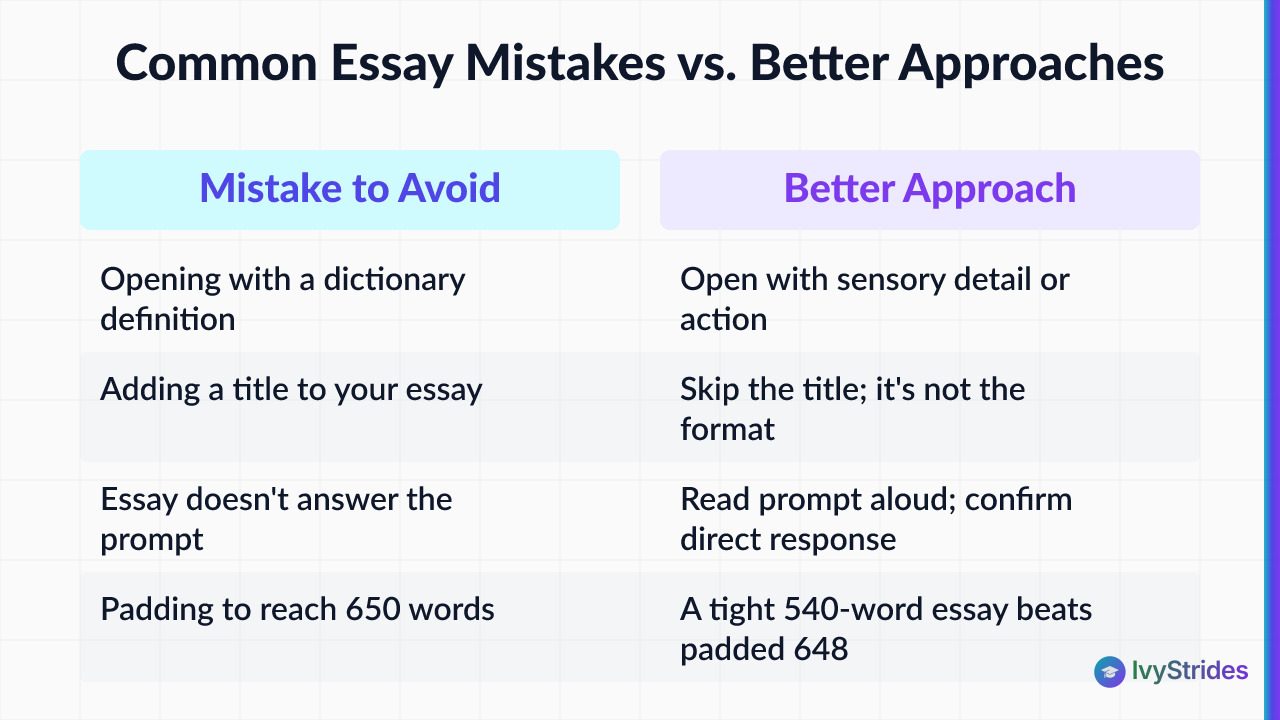
Any opening that begins with a dictionary definition, a famous quote from Gandhi, Einstein, or Steve Jobs, or a childhood-origin phrase signals that you didn't know how to start, so you reached for something generic. In our coaching, essays that open with a specific sensory detail, a moment of action, or a line of dialogue hold reader attention noticeably longer than essays that open with a thesis statement.
Adding a title. The Common App personal statement doesn't get a title. Adding one signals unfamiliarity with the format. Skip it.
Ignoring the prompt. Each of the 7 Common App prompts asks a specific question. If you wrote a beautiful essay on a topic that doesn't answer the prompt you selected, you haven't written a Common App essay. You've written a personal essay that happens to be 650 words. Prompt alignment matters. Read the prompt aloud, then read your essay aloud, and confirm your essay is a direct response.
Padding to hit 650 words. Per the Common App, 650 words is a maximum, not a target. A tight 540-word essay that says everything you needed to say beats a padded 648-word essay every time. Cut adverbs. Cut sentences that restate what the previous sentence already said. Cut any "In conclusion" wherever it appears.
Submitting without a second reader. Not a proofreader. A reader. Someone who knows you, ideally someone who isn't your parent, who can tell you honestly whether the essay sounds like you and whether it lands. In our coaching, this is the single highest-use step students skip.
Once you've identified the mistakes in your draft, the next step is a structured revision pass, which we cover in our guide on how to edit and revise your college essay. If a friend or teacher isn't available for that read, our essay review service fills the same role with an experienced admissions-context coach.
Common App-Specific Mistakes That Go Beyond the Essay Itself
The platform introduces a second category of mistakes, ones that have less to do with your writing craft and more to do with how you navigate the platform's structure.
Treating the personal statement and supplemental essays as interchangeable. They aren't. The personal statement is 650 words and travels with your application to every Common App school. Supplemental essays are school-specific, typically 150 to 350 words, and answer prompts written by that particular admissions office. Supplemental prompts and word limits vary by school and must be verified on each school's Common App portal. What works in a personal statement will often not fit a 200-word supplemental, and reusing paragraphs across the two rarely works.
The generic Why This School essay. This is the top supplemental failure mode we see. In our coaching, "Why This School" essays that name only rankings, location, weather, prestige, or "the amazing opportunities" are the most common supplemental failure across hundreds of drafts reviewed. Any of those phrases could apply to fifty other schools. The reader knows it.
The fix requires actual research. Name one professor whose research interests you and one sentence about why. Name one specific program, course, or minor you would pursue and connect it to something you've already done. Name one tradition, club, or community you've looked into and describe what drew you to it. If your Why This School essay could be sent to another school by changing only the school name, it isn't yet working.
Misreading prompt requirements. Some supplemental prompts ask two questions in one. Some cap responses at 100 words. Some require a specific format (a list, a letter, a description). Read every prompt twice. Answer the actual question asked.
If you want expert help matching essay strategy to each school's supplemental set, our common app essay tutor team works with students across their full school list, not just the personal statement.
A Quick Self-Audit Checklist Before You Submit
Read your draft against these six questions. In our coaching, the essays that improve most between draft one and final submission are the ones where the student can answer yes to every item.
-
Topic audit. Is the subject of most sentences in the essay "I"? If a reader finished it, would they know something specific about you that they couldn't learn from your resume?
-
Voice audit. Does the essay sound like how you actually think, or like a thesaurus? Are there any sentences you'd be embarrassed to read aloud because they don't sound like you?
-
Prompt audit. Does the essay directly answer the Common App prompt you selected? Could you underline the sentence where you answer the question?
-
Opening audit. Does the essay avoid a dictionary definition, a famous quote, and any "ever since I was young" phrasing? Does the first sentence make the reader want to read the second?
-
Mechanical audit. No title on the essay, no "In conclusion" transition, no padding to hit the word count. Under the 650-word limit per the Common App specification.
-
Second-reader audit. Has at least one person who knows you well read this and confirmed that it sounds like you and lands the way you intended?
If any answer is no, you have a specific revision target. If every answer is yes, you have something worth submitting.
FAQ
What are the 5 Ds of college essays?
The 5 Ds are Death, Divorce, Disease (including Depression), Drugs, and Dating. These topics aren't forbidden, but they're high-risk because they often shift the essay's focus away from the student's growth and toward the event itself. An essay on any of the 5 Ds can work if it centers your specific decision, change, or realization rather than describing the difficult experience in detail. The test is whether the essay answers "what did I do because of this?" instead of "what happened to me?"
What are the 3 Ds of college essays?
The original 3 Ds are Death, Divorce, and Disease. This shorter list predates the expanded 5 Ds framework and reflects the same core concern: essays on these topics tend to become narratives about hardship rather than narratives about the student. The same guidance applies. The topic can work, but only if the essay answers "what did you do, decide, or become because of this?" rather than "what happened to me?"
What should you never put in a college essay?
Avoid listing accomplishments already in your application (the resume repeat), opening with a dictionary definition or a famous quote, adding a title to the essay, writing primarily about another person rather than yourself, using AI-generated prose, and submitting a "Why This School" supplemental that doesn't name anything specific to that school. Also avoid controversial political or religious statements that could alienate an admissions reader without adding insight into who you are as an applicant.
Can a college essay about sports work?
Yes, but only if the essay isn't about the game. In our coaching, sports essays that succeed focus on a specific internal conflict, a moment of self-doubt, a leadership decision, or a realization that happened in the context of athletics, not on the outcome of a match or the physical challenge of an injury. If the essay could be summarized as "I worked hard, we won (or lost), and I learned teamwork," it isn't yet working. Go smaller and more specific.
How many mistakes are acceptable in a college essay?
Grammatical or spelling errors should be zero. A single typo in a 650-word essay is noticeable to an admissions reader who has read hundreds of polished submissions. Strategic or structural mistakes (wrong topic, wrong voice, not answering the prompt) are more damaging than typos because they can't be fixed by proofreading alone. The goal isn't a technically flawless essay but an honest, specific, well-structured one that answers the prompt and centers you.
Are service trip essays always a bad idea?
Service trip essays are high-risk because they frequently center the community being served rather than the student's growth, and because admissions readers see many of them each cycle. They can work if the essay focuses on a specific moment of discomfort, a changed assumption, or a concrete action you took as a result, rather than describing the trip's impact on the community. If the essay reads like a charity brochure, it isn't yet working.
Every mistake in this article is fixable in one revision pass if you catch it. The hard part isn't the fix. It's seeing your own draft clearly enough to know which mistake you're making. You can learn more about how our coaching team approaches essay work. To read about our broader methodology, see the about IvyStrides page before you book.

Award-winning author (South Asian Book Award) and graduate of BITS Pilani and UCLA Luskin School of Public Affairs. Brings a published writer's eye to Common App essays and grammatical precision to SAT and ACT R&W instruction.