
ACT Fee Waivers? Your Full 2026 Cost Breakdown (Plus Ways to Save)

On this page
- What Is an ACT Fee Waiver and What Does It Cost to Take the ACT in 2026 Without One?
- Who Qualifies for an ACT Fee Waiver in 2026: The Full Eligibility Checklist
- What the ACT Fee Waiver Actually Covers (and What It Does Not)
- How to Request an ACT Fee Waiver in 2026: The Step-by-Step Process
- Not Sure Which ACT Prep Path Fits Your Budget and Timeline?
- How Many ACT Fee Waivers Can You Get, and Do They Expire?
- Making the Most of Your Two ACT Fee Waivers: A Prep Strategy
- Ways to Save on ACT Costs If You Do Not Qualify for a Fee Waiver
- Frequently Asked Questions About ACT Fee Waivers in 2026
- How does an ACT fee waiver work?
- Where can I find my ACT fee waiver code?
- Is there a promo code for sending ACT scores?
- Is a 27 a good ACT score?
- How many ACT fee waivers can a student get?
- Does the ACT fee waiver cover late registration?
- Can homeschooled students get an ACT fee waiver?
- Do ACT fee waivers affect college admission decisions?
- The Bottom Line on ACT Fee Waivers
- Ready to Make Every ACT Sitting Count?
ACT fee waivers cover up to two free ACT registrations, including the optional writing section, for eligible US students in 11th or 12th grade. To qualify, a student must meet at least one income or program criterion set by ACT, Inc., such as enrollment in a free or reduced-price lunch program or participation in a federal means-tested program like SNAP or TANF. The waiver is requested through a school counselor, who provides a fee waiver code the student enters in their MyACT account during registration.
Those rules come from ACT, Inc.'s official fee waiver page and the ACT registration fee schedule. The harder questions come next: which programs actually count as qualifying, what the waiver does not cover (the late fee is the big one), and how to make two sittings enough when your target score is still points away.
What Is an ACT Fee Waiver and What Does It Cost to Take the ACT in 2026 Without One?
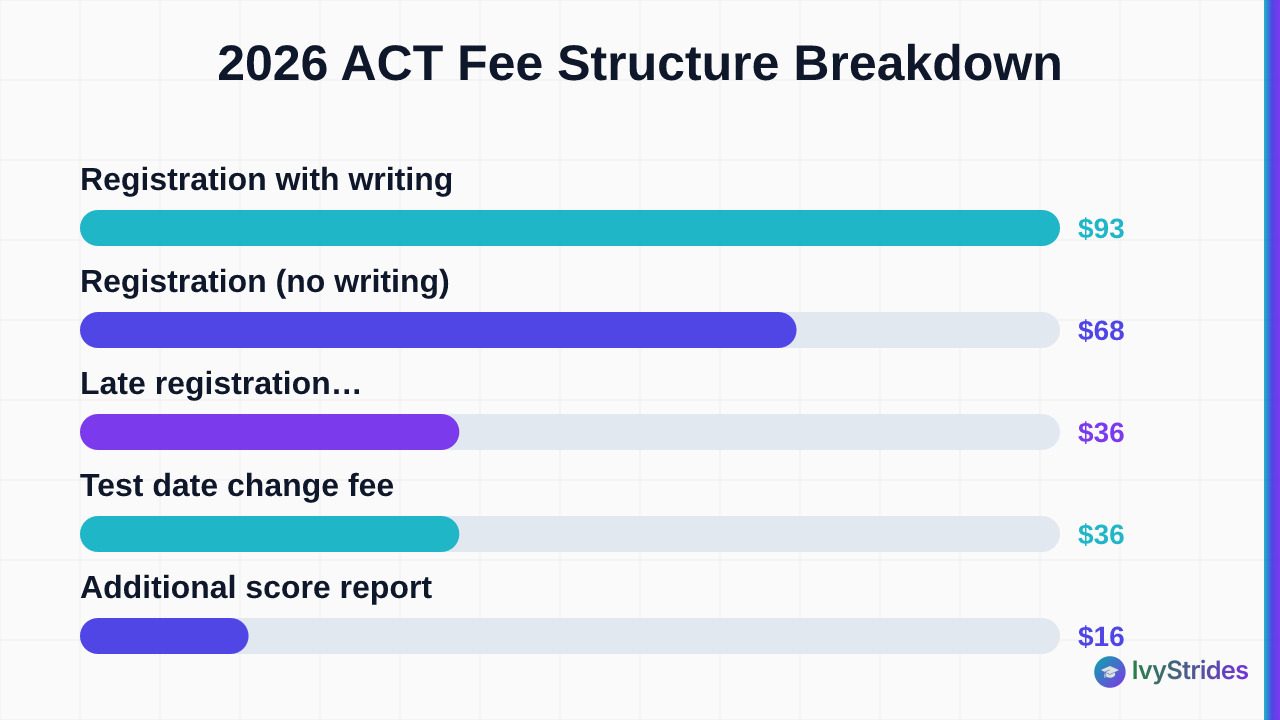
An ACT fee waiver is a code, issued by a school counselor and funded by ACT, Inc., that removes the registration fee for one ACT sitting. To see what the waiver is worth, start with the sticker price.
Here is the 2026 ACT fee structure, per ACT, Inc.'s official fee page. Verify current amounts before you register; ACT adjusts fees annually.
| Fee item | Approximate 2026 cost |
| ACT registration (no writing) | $70 |
| ACT registration with optional writing | $95 |
| Late registration surcharge | $42 |
| Test date change fee | $49 |
| Additional score report (per college) | $20 |
| Score verification (multiple-choice) | $67 |
A student taking the ACT once with writing, registering late, and sending scores to four colleges beyond the free sends pays roughly $217 out of pocket. Two sittings without a waiver, plus a few score sends, easily push past $260. That's the money a waiver removes.
The program is administered by ACT, Inc., the nonprofit that owns and delivers the test. Waivers aren't issued by colleges, by the College Board, or by third-party prep companies. To see every line item the waiver does and does not cover, including late fees and score-send costs, compare against our full ACT cost breakdown for 2026.
Who Qualifies for an ACT Fee Waiver in 2026: The Full Eligibility Checklist
ACT fee waiver eligibility rests on two things at once: grade level, plus at least one qualifying financial or program indicator. Both are required. A junior from a middle-income family doesn't qualify, and a low-income sophomore doesn't qualify either.
Grade-level requirement. The student must be enrolled in 11th or 12th grade at a US high school. Sophomores and freshmen are ineligible even if they otherwise meet the financial criteria.
Financial and program criteria (meeting any ONE is sufficient, per ACT, Inc.):
- Enrolled in the federal free or reduced-price lunch program at school.
- Family income falls within the USDA Food and Nutrition Service income eligibility guidelines.
- Enrolled in a federal means-tested program: SNAP, TANF, Medicaid, WIC, or similar.
- Family receives public assistance.
- Lives in federally subsidized public housing or receives a Section 8 housing subsidy.
- Is a ward of the state, in foster care, or was in foster care within the last three years.
- Is experiencing homelessness or is at risk of homelessness, as defined by the McKinney-Vento Act.
Homeschooled students. Homeschool students can qualify if they meet the financial criteria. Because waivers are ordered by school counselors, homeschool families should either coordinate with a local district's counselor or contact ACT, Inc. directly at act.org to arrange a waiver code.
International students. The standard ACT fee waiver program is only available to students enrolled in a US high school. International students face a different fee structure entirely, covered in our dedicated guide to ACT fees for international students.
One eligibility rule that trips families up: you self-identify the qualifying criterion when your counselor issues the code, but ACT reserves the right to verify. Keep documentation (a benefits letter, a free-lunch confirmation) in a folder, just in case.
What the ACT Fee Waiver Actually Covers (and What It Does Not)
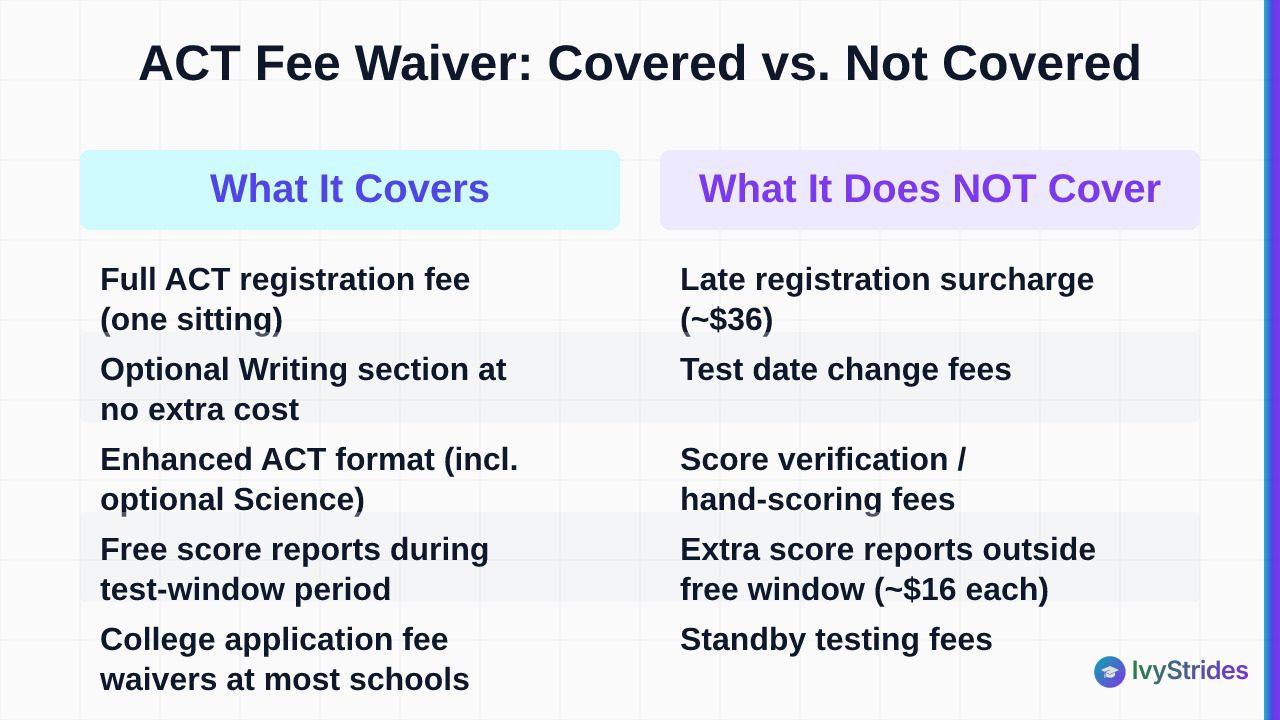
The ACT fee waiver benefits go beyond the registration fee itself, which is where most students underestimate the value of the program. Here's the precise coverage list, drawn from ACT, Inc.'s benefits page.
What the waiver covers:
- Full ACT registration fee for one sitting.
- The optional writing section at no extra cost, if the student chooses to add it.
- The enhanced ACT format, including the optional Science section, on test dates where the enhanced format is administered.
- Free score reports to colleges during the test-window score-send period (see how to send ACT scores to colleges for the mechanics).
- College application fee waivers at most participating institutions, triggered by ACT waiver status.
What the waiver does NOT cover:
- The late registration surcharge of roughly $42. Register before the standard deadline or pay the difference yourself.
- Test date change fees. If you switch test dates after registering, you pay the change fee.
- Score verification fees, if you request a hand-scoring review.
- Additional score reports requested outside the free window (about $20 per college).
- Standby testing fees.
Your ACT fee waiver status also unlocks college application fee waivers at most Common App schools, which can save an additional $50 to $90 per application. In the Common App profile, students indicate they qualify for a fee waiver; the platform then flags the application to the college, which honors the waiver at its discretion. Most participating colleges accept it, but not all. Confirm with each school on your list before assuming a fee-free application.
One caveat worth flagging: some third-party sources list waiver counts of four or higher. The current ACT, Inc. policy caps waivers at two per eligible student, and that's the figure we work from. Verify at act.org before your specific registration cycle in case the program changes.
How to Request an ACT Fee Waiver in 2026: The Step-by-Step Process
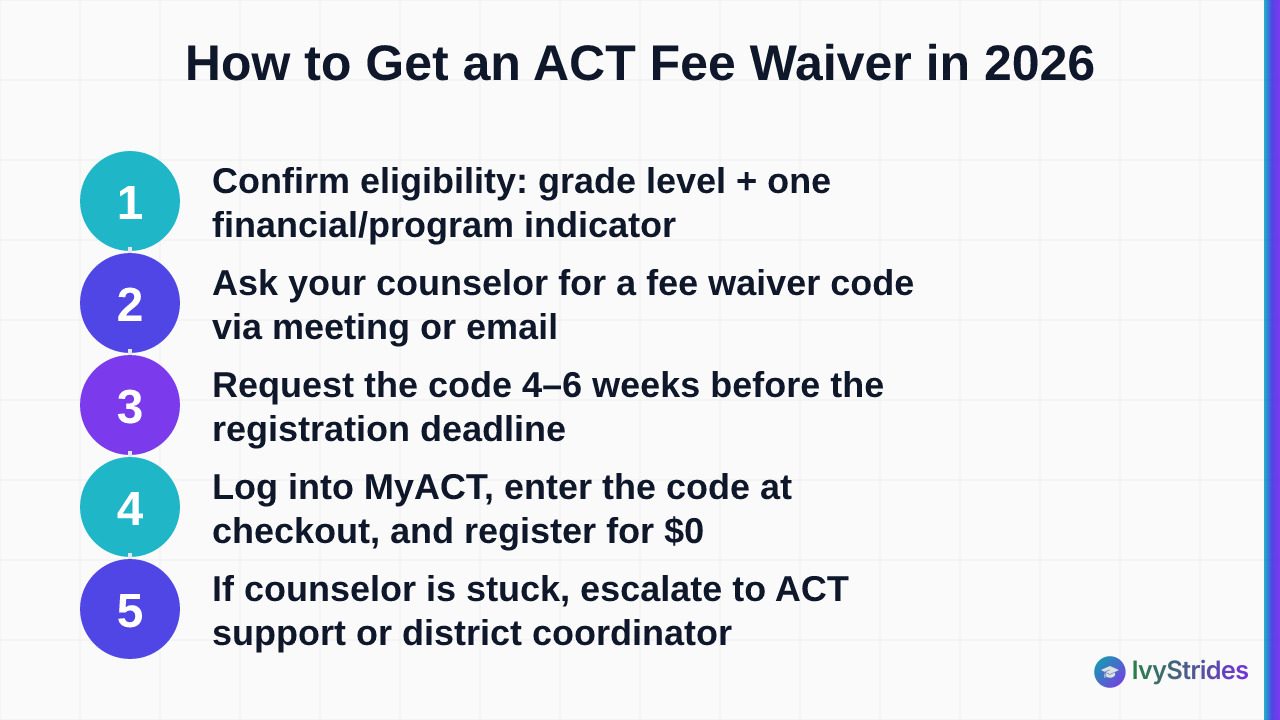
The ACT fee waiver process runs through your school counselor, not through ACT directly. Here's the exact sequence.
Step 1: Confirm eligibility with the checklist above. If you meet the grade-level requirement plus at least one financial or program indicator, you qualify. Have documentation ready if your counselor asks.
Step 2: Ask your counselor for a fee waiver code. Book a meeting, or send an email with a clear subject line: "Request for ACT fee waiver code." Counselors order waiver codes through ACT's support materials platform at no cost to the school. If your counselor is unfamiliar with the process, send them the ACT ordering guide directly.
Step 3: Request the code well before the standard registration deadline. The waiver doesn't cover the late registration surcharge. In our coaching, families who ask for the code four to six weeks before the deadline consistently avoid the $42 late fee; families who wait until the last week often don't.
Step 4: Log into your MyACT account and register for the test. During checkout, you'll see a field to enter your fee waiver code. It's typically a short alphanumeric string. Enter it exactly as your counselor provided it. The registration fee should drop to $0.
Step 5: If your counselor cannot figure out the ordering process, escalate. Ask the counselor to contact ACT customer support directly at act.org, or ask a district-level college and career coordinator to help. Bring the ACT ordering URL to the meeting so you're not asking your counselor to Google it in real time.
Once you have your fee waiver code, you enter it during the standard ACT registration flow in your MyACT account; see our step-by-step guide to how to register for the ACT for the full walkthrough. To pick a test date that gives you enough prep runway, check our current list of ACT test dates 2026.
Not Sure Which ACT Prep Path Fits Your Budget and Timeline?
In a free 15-minute call, an IvyStrides ACT coach will review your current score, your target schools, and your timeline, then recommend the prep path that makes the most of every test sitting, whether you're using a fee waiver or not. Students and parents are welcome on the call together.
How Many ACT Fee Waivers Can You Get, and Do They Expire?
Eligible students can receive up to two ACT fee waivers total, per ACT, Inc. That's a lifetime cap under the program, not two per year. Use them across junior and senior year, or use both in one year: the count runs across your high school career, not per academic session.
A few practical implications:
- Junior-year and senior-year use. A junior can use one waiver in the spring and another in the fall of senior year. That's the pattern we recommend most often in coaching, because it lines up with a diagnostic-driven prep cycle between sittings.
- Both in one year. If you decide to take the ACT twice in junior year, you can burn both waivers that year. Nothing prevents it. But you lose the option of a free senior-year sitting.
- After the second waiver. Once you've used both, any further sittings are at the standard registration fee (about $70 without writing, or $95 with writing). At that point, should you retake the ACT becomes a real cost-benefit question tied to your target score and college list.
Some 2020-era sources cite a higher waiver count. That figure appears to reflect older program rules and doesn't match current ACT, Inc. documentation. If you see a conflicting number online, defer to the official act.org page.
Making the Most of Your Two ACT Fee Waivers: A Prep Strategy
Two waivers is enough for most students to hit a competitive composite, but only with a real prep plan between sittings. Burning both sittings cold, without a diagnostic and targeted work in between, is the most common pattern we see fail. The waiver saves money. It doesn't save prep time.
Here's the framework we use with students working under the two-waiver constraint.
Sitting one: diagnostic-first. Before your first waiver sitting, take a full-length official ACT practice test under timed conditions. Score it honestly. Break the composite into its four sections: English, Math, Reading, Science. The gap between your diagnostic composite and your target composite tells you how many points you need, and where they need to come from. In our coaching, students who skip this step and use their first waiver as the diagnostic lose a sitting to information they could have gotten for free.
Between sittings: targeted weakness work. Once you know which sections are dragging your composite, spend roughly six to ten weeks on those specifically. A student whose diagnostic reads English 32, Math 24, Reading 30, Science 28 doesn't need general ACT prep; that student needs Math. Section-specialist coaching, focused only on the weak section, moves the composite faster than generalist review. See our detailed guide on ACT section-by-section prep for how we structure that work.
Sitting two: retest with the same diagnostic discipline. Take your second waiver sitting roughly six to twelve weeks after the first, long enough for the targeted work to compound but soon enough that reading fluency and pacing are still fresh. In our coaching, composite gains of 4 or more points are typical for students who complete a full diagnostic-driven prep cycle between sittings.
Set a target that matches your college list. A 27 composite is strong at many colleges and mid-range at others. A 33 puts you in the range for good ACT score for Ivy League admissions, but only in the range; it doesn't guarantee a decision. Because the waiver covers only two sittings, making each test count matters; our guide on how to raise your ACT score 4 points walks through the diagnostic-first prep plan.
If you've used both waivers and are still short of your target. This is a real decision, not a default. Weigh a paid third sitting against the incremental admissions value at your specific colleges. If your composite is already at or above the 75th percentile of every school on your list, a third sitting is rarely worth the money. If you're three or more points below the median at your reach schools, a paid retake with a focused prep block often pays for itself in scholarship dollars. Our ACT prep program is built around this section-specialist, diagnostic-driven approach.
Ways to Save on ACT Costs If You Do Not Qualify for a Fee Waiver
Plenty of families sit just above the income threshold for the fee waiver program and still find the total cost of ACT prep and testing painful. Here's how to reduce that cost legitimately.
Register early. Always. The late registration surcharge is roughly $42. Registering one week earlier saves you the entire late fee. Put the standard deadline for each test date on a calendar as soon as you decide to take that test.
Skip the optional writing section unless a target school requires it. The writing add-on is about $25. Very few colleges still require ACT Writing. Confirm each school's policy before you pay for it.
Use official free prep before paid resources. ACT, Inc. publishes free practice materials at act.org. Work through those first. For a more structured study path, our online ACT practice tests library adds diagnostic scoring and section breakdowns on top of the practice-test format. See also best ACT practice tests for how to sequence practice across a prep cycle.
Be strategic about score sends. ACT includes free score reports with your registration. Additional reports cost about $20 each. Send scores only after you see your composite and know it's a version of your score you want colleges to have. Sending scores to eight schools blindly can cost over $150 you didn't need to spend.
Check whether your target schools are test-optional. Test-optional policies vary by school and by year. See the current tracker at FairTest for a school-by-school view. If half your list is test-optional and your composite is below the school's median, a second paid sitting may not be worth the cost. If you're relying entirely on free resources, our take on is free ACT prep enough to raise your composite is honest about where free resources hit their ceiling.
Frequently Asked Questions About ACT Fee Waivers in 2026
How does an ACT fee waiver work?
An ACT fee waiver removes the standard registration fee for one ACT sitting for an eligible US student in 11th or 12th grade. A school counselor issues a fee waiver code, which the student enters during registration in their MyACT account. The waiver covers the base registration fee, the optional writing section, and free score reports during that test window. Colleges don't see whether a student used a waiver.
Where can I find my ACT fee waiver code?
Fee waiver codes come from your school counselor, not from ACT, Inc. directly and not from any third-party website. Counselors order waiver codes through ACT's official support materials platform at no cost to the school. If your counselor doesn't know how to order them, they can contact ACT customer support at act.org for instructions. There is no legitimate way to obtain a code outside the counselor pathway.
Is there a promo code for sending ACT scores?
ACT, Inc. doesn't publish public promo codes for score reports. If you register with a fee waiver, score reports to colleges are free during the test window associated with that sitting. Outside of the waiver program, additional score reports cost roughly $20 per college. The most reliable way to save on score sends is to wait until you see your composite and send only after your strongest sitting.
Is a 27 a good ACT score?
A 27 composite falls at approximately the 85th percentile nationally, per ACT's published score distributions. It's a strong score for most colleges and a competitive score for many state flagships and mid-selectivity private schools. For highly selective universities with median composites of 33 to 35, a 27 is below the typical admitted range. Whether to retake depends on your specific college list; see our ACT score ranges for top colleges guide.
How many ACT fee waivers can a student get?
Eligible students can receive up to two ACT fee waivers under the current ACT, Inc. program, running across a student's high school career rather than per year. After both waivers are used, further sittings are paid at the standard registration rate. Verify the current limit at act.org before your registration cycle in case policy changes.
Does the ACT fee waiver cover late registration?
No. The waiver covers the standard registration fee and the optional writing section, but it doesn't waive the late registration surcharge of roughly $42. To avoid paying that fee out of pocket, request your waiver code from your counselor several weeks before the standard registration deadline and complete registration on time.
Can homeschooled students get an ACT fee waiver?
Yes, homeschool students can qualify if they meet the same financial or program eligibility criteria as traditionally schooled students. Because waivers are typically distributed by school counselors, homeschool families should either work with a local district counselor or contact ACT, Inc. directly through act.org to arrange a waiver code. Documentation of qualifying financial status may be requested.
Do ACT fee waivers affect college admission decisions?
No. Colleges don't receive any information indicating whether a student used a fee waiver to register for the ACT. The waiver is a financial-access tool administered between the student, the school counselor, and ACT, Inc. It has no visibility to admissions officers and no effect on how an application is evaluated. Whether the ACT itself matters is a separate question; see how much does the ACT matter for college admission for context.
The Bottom Line on ACT Fee Waivers
An ACT fee waiver removes the sticker-price barrier to two sittings, plus writing, plus score sends, plus college application fees at many schools. That's meaningful money. What the waiver cannot do is guarantee those two sittings produce a competitive composite. That takes a diagnostic, a section-specialist prep plan, and a realistic timeline between attempts. Learn more about how we structure that work on our about page. You can also meet the section-specialist coaches on the tutors page.
Ready to Make Every ACT Sitting Count?
A fee waiver removes the cost barrier. A diagnostic-driven prep plan removes the score barrier. Book a free 15-minute strategy call and leave with a concrete plan for your next test date.

Award-winning author (South Asian Book Award) and graduate of BITS Pilani and UCLA Luskin School of Public Affairs. Brings a published writer's eye to Common App essays and grammatical precision to SAT and ACT R&W instruction.