
How to Send ACT Scores to Colleges: Superscore, Score Choice, and Deadlines
On this page
- The Short Answer: How ACT Score Sending Works
- Step-by-Step: How to Send ACT Scores Online Through MyACT
- ACT Score Report Fees: What Is Free and What Costs Money
- Score Choice Strategy: Which Test Dates Should You Send?
- Should You Send Your Scores Now or Retake First?
- How Long Does It Take for ACT Scores to Reach Colleges?
- Sending ACT Scores to Scholarships and the NCAA
- How to Download Your ACT Score Report as a PDF
- How to Send All Your ACT Scores at Once
- FAQ
- Is MyACT the same as the ACT website?
- Can I send ACT scores while my application is still under review?
- How do I send ACT scores to Common App?
- How do I find my ACT scores from high school if I graduated years ago?
- Do I have to send all my ACT scores, or can I choose just one date?
- How do I report my ACT score for a scholarship?
- Where This Leaves You
To send ACT scores to colleges, log in to your MyACT account at act.org, open the Send Scores section, search for each college by name or four-digit ACT code, select the test date(s) you want to send, and pay by credit card. Each additional score report costs $20 per test date per college. Four score reports designated at registration are already included in your test fee. Electronic delivery typically takes 3 to 8 business days. Scores older than three years carry an extra $30 archive fee, and students with an ACT fee waiver can send up to six college reports at no charge. Fees per ACT.
These figures come from the ACT, Inc. official score-sending page and reflect the 2025-26 fee schedule. Verify at act.org before you pay, since fees change. The harder question is not the mechanics but the strategy: which dates to send, whether to superscore, whether to send at all before a retake. The next sections walk through both.

The Short Answer: How ACT Score Sending Works
MyACT is the only official portal for requesting score reports. Every test-taker gets one, free, at act.org. Inside the dashboard, you'll see each test date, your composite score, the four section scores (English, Math, Reading, Science), and any subscores. Writing, when taken, sits separately and does not factor into the 1-36 composite.
Here's the fee structure at a glance. Four college recipients you designate at registration ship free. Every additional recipient after that is $20 per test date per college. Sending three test dates to five colleges is $300, not $60. Reports from a test date more than three years old add a $30 archive retrieval fee on top of the $20 per-report charge. Electronic reports typically arrive at colleges within 3 to 8 business days; paper reports take roughly 5 to 8 weeks and are rarely necessary. Fees per ACT.
One caveat before we go deeper. If you took the school-day ACT in Spring 2026 (particularly in Arizona), log in to MyACT and confirm your score is final before requesting reports. ACT, Inc. reissued a batch of scores during that window, and you don't want to send a superseded number. For a fuller picture of how ACT prep fits into all of this, our ACT prep overview is a good starting point.
Step-by-Step: How to Send ACT Scores Online Through MyACT

Photo by RDNE Stock project on Pexels
Sign in at my.act.org. If you don't have an account, create one using the email address linked to your registration. That's the same account that houses your test dates and score history, so recover the login before you register for another test if you've lost access.
Once you're in the dashboard, here's the flow:
-
Click "Send Your Scores." It sits in the score-report area of your dashboard.
-
Search for the recipient. You can search by college name or by the four-digit ACT college code. Scholarship agencies and the NCAA Eligibility Center appear in the same search.
-
Pick your test date(s). ACT does not automatically send everything you've taken. You choose which sitting or sittings to send. This is where Score Choice lives, and we'll unpack it below.
-
Add to cart and repeat for each additional college or scholarship recipient. If you're sending to five colleges, you complete five searches inside the same order.
-
Pay by credit card. You'll get an order confirmation email with a summary of the recipients, test dates, and total charge.
-
Track delivery. MyACT shows the status of each request. Colleges also confirm receipt inside their applicant portals, typically within about two weeks of your order.
That's the whole workflow. It's mechanical once you've done it once. For students who want to build their score before sending, our act practice test online library is where most of our students calibrate.
ACT Score Report Fees: What Is Free and What Costs Money
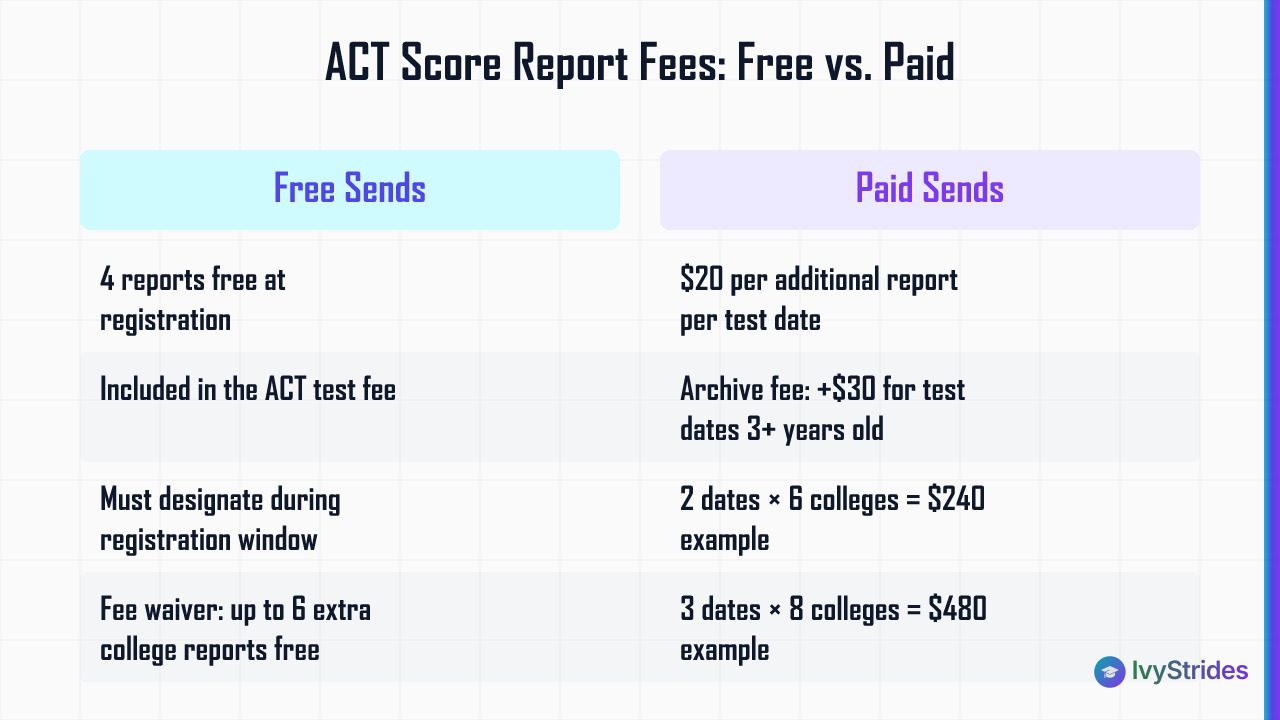
Free at registration: four score reports. You designate up to four colleges when you register for the ACT, and those reports are included in the test fee. The catch is timing. The four free sends lock in during the registration window, and the deadline to change them typically closes a few days after your test date. Miss it, and every send becomes a paid additional report.
Paid: $20 per additional score report per test date per college. If you took the ACT twice and want to send both dates to six colleges, that's $20 × 2 × 6 = $240. Sending three test dates to eight colleges is $480. This matters because the more sittings you have, the faster the math compounds, particularly at superscoring schools that want every date. Fees per ACT.
Archive fee: $30 per test date, added on top of the $20 report fee, for any test date more than three years old. If you tested in 9th or 10th grade and you're now a senior applying, those old scores trigger the archive charge. Fees per ACT.
Fee waiver: eligible students receive one high school report and up to six college reports at no cost. Eligibility is generally tied to free or reduced-price lunch qualification or the ACT's published income guidelines. The fee waiver is requested through your school counselor and applied to your MyACT account. If you qualify, use it. The six college reports on the fee waiver stack on top of the four free sends at registration, so a fee-waiver student can send ten college reports before paying anything.
If your composite isn't where you want it yet, spending report money now may be premature. Our guide to how to improve ACT score walks through the diagnostic-first approach we use with students at every band.
Score Choice Strategy: Which Test Dates Should You Send?
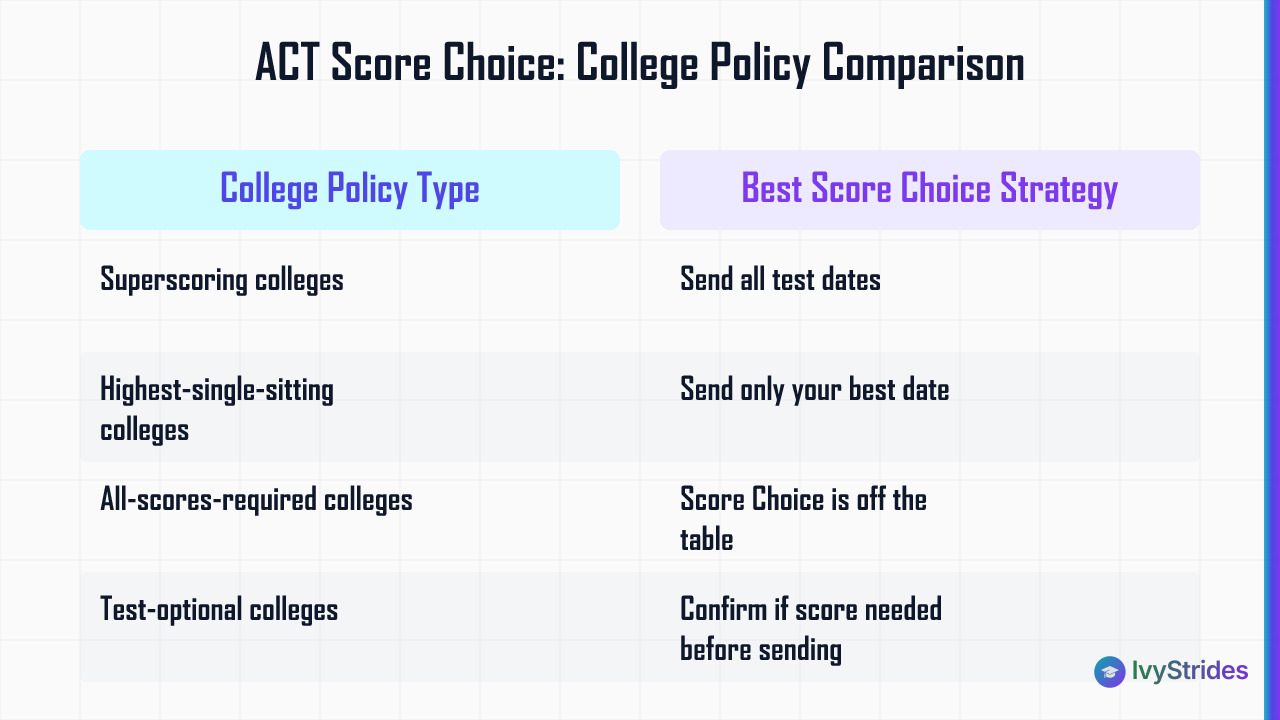
ACT Score Choice is the policy that lets you pick which test dates a college sees. ACT, Inc. does not automatically send every sitting on your record. You control the release, one test date at a time. That single fact should lower the anxiety you're carrying about a low score from an earlier test.
But Score Choice is not the whole story. Whether to send one date or all dates depends on how the college treats multiple scores. Three patterns:
- Superscoring colleges. The college takes your highest section scores across all submitted dates and rebuilds a new, higher composite. For these schools, sending all your test dates is almost always the right call. If you scored a 32 English and 28 Math in June, then a 29 English and 33 Math in September, sending both dates gets you a superscored 32/33/highest-Reading/highest-Science composite that's higher than either single sitting.
- Highest-single-sitting colleges. The college considers only your best single-day composite. Here, sending just your best date is fine and saves fees.
- All-scores-required colleges. A small number of highly selective schools state, in policy, that they expect all test dates. If you apply to one of these, Score Choice is effectively off the table. Read each admissions page carefully.
To check any college's policy, look at the admissions page or search "Common Data Set [University Name]" and check Section C7 through C9, which spells out test score usage. If you're still deciding whether to submit ACT or SAT scores to a particular school, compare both scores against that college's middle-50 range before paying to send either. Our comparison of act vs sat difficulty breaks down the decision.
Two more caveats before you place an order. First, test-optional policies vary by school and year, so confirm whether the college you are applying to requires a score before paying to send one; FairTest maintains the current tracker. Second, your ACT score is one part of the application; a strong personal statement and supplemental essays carry equal or greater weight at many selective schools. Sending a report is not sending an admissions decision. If you're weighing which test to lead with, is the SAT harder than the ACT helps clarify.
Should You Send Your Scores Now or Retake First?
This is the question that stalls most students. And it deserves a real answer, not a "trust the process" nudge.
Here's the framework we use with students in 1-on-1 ACT coaching. Look up the middle-50 composite range for each of your target schools, expressed as roughly the 25th to 75th percentile of admitted students. Then locate your current composite on that range.
- If your composite sits at or above the 75th percentile of your target schools' middle-50, send. Retaking rarely moves an admissions needle at that point, and the risk of a lower score on a retake is real.
- If your composite is inside the middle-50 range, it's a judgment call. Consider how many test dates you have left before deadlines, whether you have a clear weak section, and whether you've had targeted prep since your last sitting. If nothing about your prep has changed since the last test, expect a similar score.
- If your composite is below the 25th percentile, retaking is usually the stronger move, provided the calendar allows. A student four points below the middle-50 of their reach schools has more to gain from another test cycle than from sending what they have now.
Before requesting score reports, it is worth asking whether your current composite is where you want it to be. If you are within a retake window, improving your score first means you send a stronger number and potentially pay fewer report fees. In our coaching with students in the IvyStrides 1-on-1 ACT program, a composite gain of 4 or more points is typical, driven by a diagnostic-first methodology: a real practice test, targeted weakness work on the specific section pulling the composite down, and spaced retesting to lock in gains. If your section scores show a clear weak area, such as a Science score pulling down your composite, targeted ACT section prep before your next test date is more efficient than sending a composite you are not satisfied with.
On timing: the September ACT test date is typically the last national date whose scores arrive in time for November 1 Early Decision deadlines. Verify the exact release date on the current ACT test calendar before you commit. Register for October or later, and you're likely sending after ED deadlines pass.
For students ready to commit to a full retake cycle, our 1-on-1 ACT prep program is built around that diagnostic-driven methodology.
How Long Does It Take for ACT Scores to Reach Colleges?
Electronic delivery is the default and it's fast. Per ACT, Inc., electronic score reports typically arrive at the recipient institution within 3 to 8 business days of your order. Paper reports, which are still an option for a small number of recipients that don't accept electronic delivery, take roughly 5 to 8 weeks. Almost every college in the U.S. accepts electronic reports, so you'll rarely need paper.
A common source of anxiety: you submitted your application and forgot to send your ACT scores. Is it too late? Usually no. Most colleges accept scores received after application submission as long as they arrive before the school's stated score deadline, which often sits a week or two past the application deadline. The safest habit is to check the specific college's admissions page for its score-receipt policy and confirm delivery inside the applicant portal. Don't assume the college got the report. Verify it.
Practical rule from what we see with students, particularly international applicants where portal syncs can lag: submit score sends at least 10 business days before any deadline. That gives you buffer for the 3-8 business day electronic transit plus the college's internal processing time. If you're inside a five-day window before a deadline, submit the send immediately, then email the admissions office to flag that an official report is en route. Rush delivery is not a standard ACT service, so lead time is your only real lever.
If a target school is on your list and you're pulling deadlines together, our post Should You Apply to Cornell University in 2026: What You Must Know covers deadline structure for one of the schools students ask about most.
Sending ACT Scores to Scholarships and the NCAA
Scholarship agencies and the NCAA Eligibility Center are recipient categories inside MyACT, searchable the same way you search for colleges. The Send Scores workflow is identical: search by name, pick the test date, pay $20 per date per recipient. Fees per ACT.
The NCAA piece matters if you're a student-athlete. The NCAA Eligibility Center requires ACT scores sent directly from ACT, Inc. Self-reported scores on the NCAA account or the Common App do not satisfy the requirement for eligibility certification. Search for the NCAA Eligibility Center inside MyACT and send it as a separate recipient. The NAIA Eligibility Center follows the same official-report requirement for its member schools.
Scholarship agencies vary. Some, like state-level programs and named national scholarships, accept self-reported scores for initial screening and require official reports only if you're a finalist. Others require official reports at application. Read each scholarship's fine print before paying to send.
One clarification on the National Merit pathway. If you are also pursuing National Merit recognition, note that the PSAT/NMSQT score, not the ACT, determines National Merit eligibility. Sending ACT scores to National Merit doesn't move that needle. For the mechanics of the PSAT-based Selection Index, see our National Merit Scholarship guide.
International applicants working through their first U.S. application cycle often have questions about score timing across time zones and slower portal syncs; our ACT for international students resource covers the specific timing adjustments we recommend.
How to Download Your ACT Score Report as a PDF
Inside MyACT, there's an option to download a PDF copy of your score report from any test date. This is the student copy. It's yours. Use it for personal records, share it with your school counselor, upload it to a scholarship application that accepts self-reported scores. The PDF shows your composite, all four section scores, subscores, and percentile ranks.
Here's the distinction that trips people up. A downloaded PDF is not an official score report. Colleges and scholarship agencies that require official scores need the report sent directly from ACT, Inc. via the MyACT Send Scores workflow. Uploading a PDF printout to a college application portal does not count as an official send, even if the PDF is authentic and unaltered. The official-report requirement is about the delivery channel, not the document.
If you're wondering how to find old ACT scores from high school, log in to your existing MyACT account. All scores you've ever earned sit in that dashboard, including test dates from many years ago. If you've lost access to the email you registered with, use the account recovery option on the MyACT login page. Scores older than three years are viewable in the dashboard, but sending them officially triggers the $30 archive fee per test date, on top of the $20 report fee. That's $50 per date per college for old scores. Fees per ACT.
If you're weighing an application to a school with a strong emphasis on the full admissions picture beyond the score, our post Should You Apply to Duke University? Key Factors Explained is a useful frame.
How to Send All Your ACT Scores at Once
Sending multiple test dates in a single order is straightforward. Inside the Send Scores workflow, after you search for a recipient, MyACT lets you check every test date you want to include. You can add all your dates to a single college recipient in one action, then repeat for the next college.
The cost is what surprises students. Each test date is a separate $20 charge per college recipient. Three test dates to five colleges is 3 × 5 × $20 = $300. Four dates to seven colleges is $560. Sending all scores to a superscoring school is often the smart move because the college will build the highest possible composite from your section scores. Sending all scores to a highest-single-sitting school is money spent for no gain. Fees per ACT.
A pattern worth naming: students who check each college's superscore policy before ordering typically save roughly $40 to $60 by consolidating the send into one order (all dates to superscoring schools) rather than paying multiple times as they add dates piecemeal. Order once, send everything you need, move on.
A small number of highly selective schools state in their admissions policies that they expect all test dates to be submitted, whether or not they superscore. Verify on each school's admissions page. Our post Should You Apply to Northwestern University in 2026? covers a school with that kind of nuanced score policy.
FAQ
Is MyACT the same as the ACT website?
MyACT is the free student account portal at act.org. It's where you register for the ACT, view scores, and request score reports. The broader act.org site includes test information, prep resources, and policy pages, but all score-sending actions happen inside the MyACT dashboard. You can't send scores from anywhere else.
Can I send ACT scores while my application is still under review?
Yes. Colleges accept score reports sent after application submission as long as they arrive before the school's stated score deadline, which is often a few weeks after the application deadline itself. Check each college's admissions page for its specific score-receipt deadline, and confirm delivery in the college's applicant portal rather than assuming the report arrived.
How do I send ACT scores to Common App?
Common App allows self-reported test scores in the Testing section of the application. However, self-reported scores are not official. Most colleges require an official score report sent directly from ACT, Inc. via MyACT before or shortly after admission. Some schools verify self-reported scores only after a student enrolls; check each college's policy on the Common App or the college's admissions page.
How do I find my ACT scores from high school if I graduated years ago?
Log in to your MyACT account using the email address you used when you registered. If you no longer have access to that email, use the account recovery option on the MyACT login page. Scores are stored in the system indefinitely, so you'll see every test date on your record. Scores older than three years require a $30 archive retrieval fee per test date to send officially, but you can still view them in the dashboard for free. Fees per ACT.
Do I have to send all my ACT scores, or can I choose just one date?
ACT Score Choice lets you select which test dates to send. You are not required to send all dates unless a specific college's policy requires it. If a college superscores, sending all your test dates typically works in your favor because the school will take your highest section scores across all submitted dates to build the strongest possible composite. If a college uses only your best single sitting, send just that one date and save the fees.
How do I report my ACT score for a scholarship?
In MyACT, scholarship agencies appear alongside colleges in the Send Scores recipient search. Search for the scholarship program by name, select the test date(s) you want to send, and complete payment at $20 per date per recipient. Some scholarship programs accept self-reported scores for initial eligibility screening but require an official report before awarding funds; confirm the requirement with the specific program before paying. Fees per ACT.
Where This Leaves You
Send Scores is a mechanical process. Deciding what to send, and when, is the strategic layer. If your composite is at or above your target schools' middle-50, send now. If it's below the 25th percentile and you have a test date left on the calendar, retake first. For the students we work with 1-on-1, that calibration happens in the first diagnostic conversation, and it saves both retake stress and report fees. You can also read about IvyStrides to understand our approach. From there, meet our tutors to see who coaches at your score band.
This article reflects the 2025-26 ACT fee schedule and process, per ACT, Inc. Fees and delivery timelines are subject to change; verify current figures at act.org before placing an order.

Award-winning author (South Asian Book Award) and graduate of BITS Pilani and UCLA Luskin School of Public Affairs. Brings a published writer's eye to Common App essays and grammatical precision to SAT and ACT R&W instruction.